

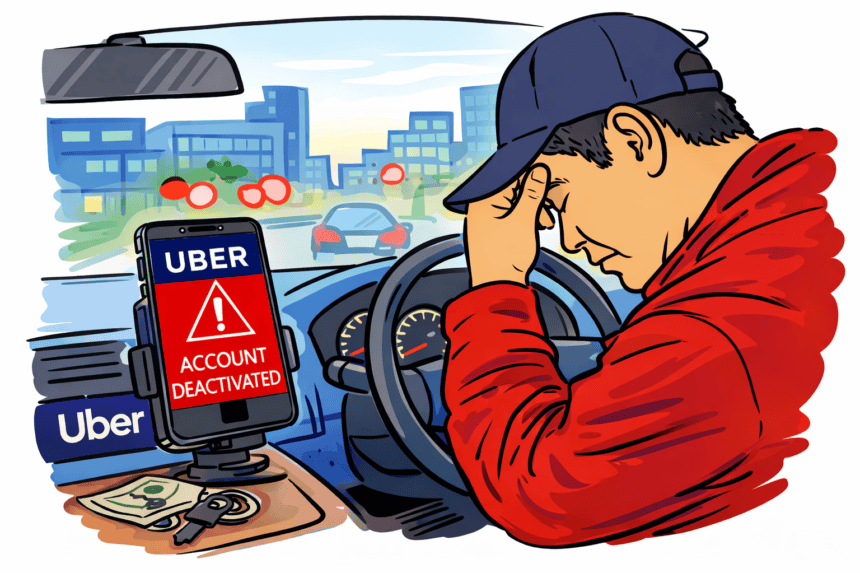

The alert often comes without warning. A driver opens the Uber app as usual. The map appears. The first ping arrives. Then suddenly the app refuses to go online. A short message appears. Account deactivated. Access to income disappears in an instant.
Uber presents itself as a flexible platform where anyone can drive and earn. In practice, deactivation functions as an automated enforcement tool with significant consequences. For many drivers, it can mean missed rent payments, car loans they still have to pay, and weeks of lost income.
I examined Uber’s policies, civil rights research, driver surveys, and thousands of forum posts on Reddit and Facebook groups to understand how this system operates. The patterns were consistent. Deactivations happen fast, the reasoning is often opaque, and appeals rarely restore access.
Who Is Behind the System?
When drivers lose access to the Uber platform, the decision feels automatic, invisible, and removed from any single person. That impression reflects how Uber has structured its leadership and governance. The power to design, oversee, and defend deactivation policies sits with executives, board members, and shareholders who set strategic priorities for the business.
At the center of Uber’s corporate leadership1 is Dara Khosrowshahi, who has served as Chief Executive Officer since 2017. He is responsible for guiding Uber’s global strategy and balancing growth with safety and regulatory compliance. Under his tenure Uber expanded profitability and diversified into delivery and autonomous initiatives.

Reporting to the CEO are senior executives who manage core functions that influence deactivation systems. These include the President and Chief Operating Officer Andrew Macdonald, the Chief Technology Officer Praveen Neppalli Naga, and senior leaders responsible for safety, product, and public policy. Together they build and oversee the automated systems that enforce driver standards.
Uber’s board of directors2 also sets corporate oversight and long‑term strategic direction. It includes independent leaders such as Ronald Sugar (board chair), business figures like Nikesh Arora, and industry veterans such as Ursula Burns and Revathi Advaithi. The board approves company strategy including policies around platform governance, compliance, and risk management.
Unlike a privately held company where a founder might directly make key decisions, Uber is a large publicly traded company with diffuse ownership. Institutional investors such as mutual funds, pension funds, and major asset managers hold most shares. Executives and insiders hold a smaller portion but retain operational control through management roles and board influence.
This corporate structure matters for accountability. When Uber refines or enforces deactivation policies, the responsibility is not just a technical team’s but a broader leadership decision. Executives and board members choose how much human oversight deactivation systems have, how transparent those systems must be, and how much priority is placed on driver protections versus rapid safety enforcement.
Critics and drivers on forums underscore the imbalance between what leadership earns and what drivers make. One Reddit post observed that Uber’s CEO earns tens of millions annually while drivers often earn far less, and yet drivers bear all operational risk.
Some drivers view this disparity as the structural backdrop to deactivations, where profit motives and algorithmic efficiency override individual driver circumstances. Others encourage dialogue with executives and regulators rather than hoping for isolated concessions from engineers or frontline staff.
In short, blame for Uber’s deactivation system does not rest with a single line engineer, a support agent, or an anonymous algorithm. It resides in the combined choices of the CEO, senior leadership, and board members who design, endorse, and defend policies that prioritize rapid enforcement and platform scalability over procedural transparency.
How Uber decides to deactivate
Uber describes deactivation3 on its driver resources page as a measure to protect rider safety. Common reasons include safety complaints, fraud, low ratings, or violations of company policies.
Public language emphasizes fairness, but internal documents and driver reports suggest the actual decision-making process is largely automated. Complaints, GPS data, trip patterns, and behavioral signals are aggregated. When thresholds are crossed, the system flags the account for deactivation.
Civil rights research and surveys show that many drivers are removed without prior warning. The Asian American Legal Defense and Education Fund found that in New York City, roughly 70 percent of Uber drivers who were deactivated received no prior notice and were not provided clear explanations for the removal AALDEF Report4.
Drivers frequently describe deactivation as sudden and mechanical. On Reddit5, one driver wrote:
“Went from my best week ever making over 1100 dollars to deactivated midway through the day. No call. No warning. Just locked out.”
Another posted:
“I never even found out what I was accused of. One complaint and that was it.”
These accounts show that even drivers with long histories and high ratings can be removed instantly.
Uber’s reliance on automated systems allows the platform to scale quickly and enforce safety rules consistently. However, the thresholds and scoring methods are proprietary. Drivers cannot see how complaints are weighed or which trip triggered the deactivation. This lack of transparency makes meaningful appeal difficult.
The Electronic Frontier Foundation notes that opaque algorithmic decisions often prevent effective recourse for individuals EFF on Algorithmic Transparency6.
While Uber has Trust and Safety teams overseeing policy design, engineers and operations staff rarely review individual cases. A driver’s fate is determined by automated rules set and maintained at the corporate level Uber Safety.
Legal and policy teams draft the agreements that classify drivers as independent contractors and include mandatory arbitration clauses. These contracts give Uber broad discretion to deactivate drivers without detailed explanation Uber Terms of Use7.
Uber frames deactivation as a necessary safety measure. Rapid action, the company argues, protects riders and maintains trust in the platform. On the surface, this makes sense. Uber carries millions of people every day, and safety is nonnegotiable. But the system reveals a tension at its core: speed and efficiency are prioritized over transparency and fairness. From the driver’s perspective, the platform’s logic can feel mechanical, even arbitrary. A single complaint, sometimes unverified or false, can trigger account suspension, and the reasoning is rarely explained in a way that drivers can challenge effectively.
This reflects a deeper structural reality: Uber has built a system optimized for scale and risk management, not for individual accountability. The technology enforces rules designed for thousands of cases at once, but the cost is human livelihoods. Drivers who depend on Uber full time are left navigating a process that feels impersonal and impenetrable. The rare reinstatement underscores another truth: in this system, fairness is secondary, and vulnerability is a built-in feature.
For those relying on this platform as their main income, deactivation is not just an inconvenience. It is an economic shock that exposes how the drive for operational efficiency can directly clash with human needs. The insight here is that Uber’s algorithmic enforcement does more than protect riders; it also quietly shifts financial risk onto the very workers the platform depends on. Speed and safety become a rationale, but behind it lies a system that is efficient for the company and precarious for the driver.
The Appeal That Rarely Restores Access
Once a driver is deactivated, Uber informs them they may request a review. On paper, this appeals process is meant to provide recourse. In practice, it often functions as a bureaucratic bottleneck with limited results.
I reviewed Uber’s official deactivation review guidelines, arbitration clauses, civil rights reports, and hundreds of driver accounts from Reddit and other forums. What emerges is a system that emphasizes the appearance of fairness without guaranteeing restoration of work.
So, how is the process supposed to work?
Uber tells drivers they can submit a review through the app, provide supporting evidence, and request additional clarification if necessary Uber Deactivation Review. Drivers are instructed to explain why the deactivation may be mistaken.
The platform states that each case will be evaluated by Uber staff. However, the company does not disclose timelines, criteria for reinstatement, or the number of successful appeals.
Driver forums tell a different story. Responses are often automated, delayed, and generic. Many drivers report submitting detailed explanations, only to receive a template denial without acknowledgment of the evidence provided.
One user wrote:
“I sent a detailed explanation. I got a reply that looked like it was copied and pasted. No mention of what I wrote.”
Another said:
“After waiting weeks, they said my account would not be reinstated. I still have no idea why.”
The common theme is a lack of transparency. Drivers rarely see the complaint, evidence, or rationale that triggered deactivation. Without this information, meaningful defense is impossible.
This brings arbitraion as the very last resort. Uber’s terms of service require drivers to agree to arbitration for disputes related to deactivation. Arbitration is technically an avenue for appeal but in practice is costly, slow, and inaccessible to most drivers Uber Terms of Use.
Many drivers report that the financial and logistical burden of arbitration outweighs potential gains. Reddit users frequently advise each other that arbitration rarely results in reinstatement:
“I looked into arbitration. It would cost more than what I lost. The process is intimidating and slow.”
Civil rights reports confirm this trend. The AALDEF survey8 in New York found that over 90 percent of drivers who appealed their deactivation were not reinstated.
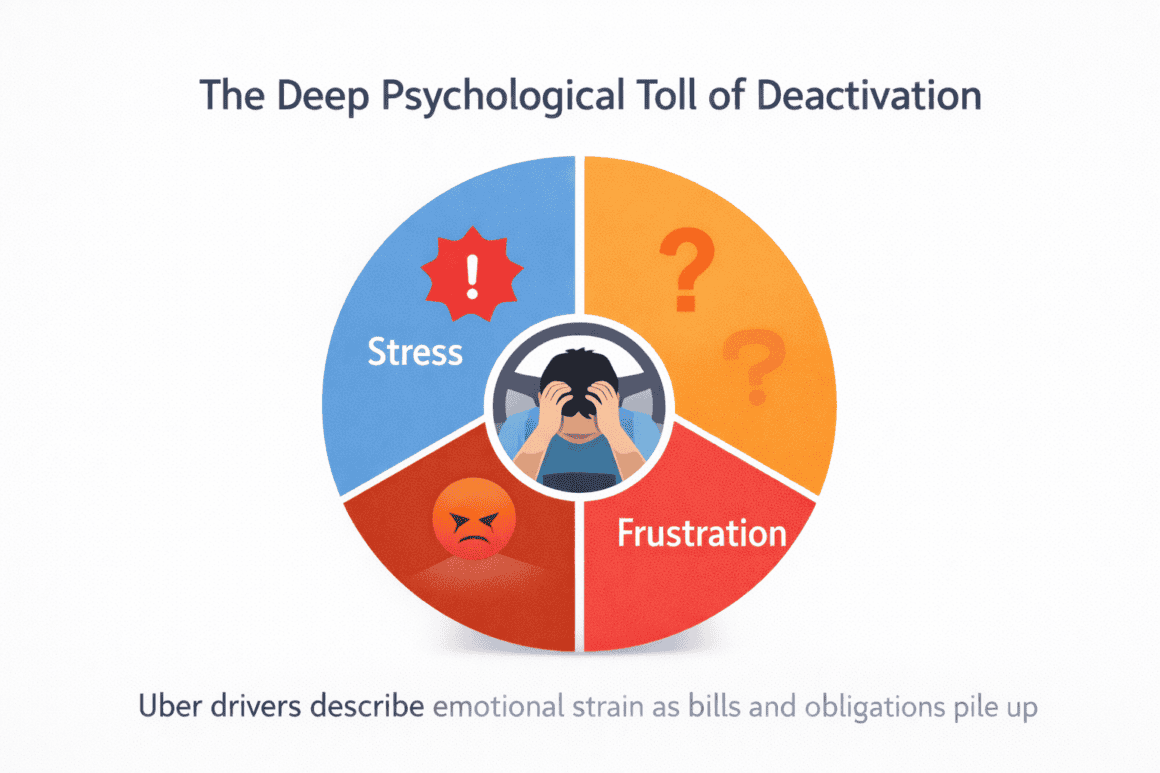
Beyond financial consequences, the appeals process contributes to stress, uncertainty, and frustration. The deep psychological toll. Drivers describe the experience as emotionally draining: waiting for responses that never clarify their situation while bills and obligations continue.
One post captured this sentiment:
“The worst part is waiting. You do not know if you should move on or keep hoping.”
This psychological burden compounds the financial impact of lost earnings.
Why appeals rarely succeed
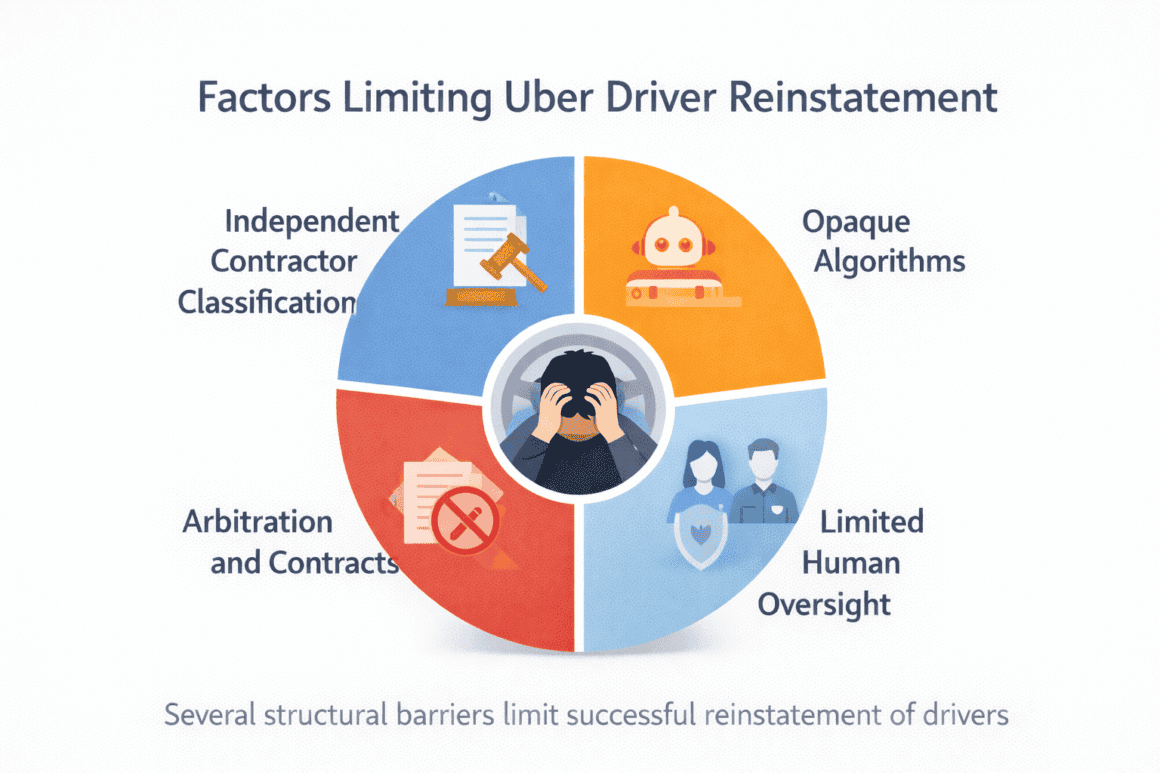
Several structural factors limit successful reinstatement:
- Independent contractor classification: Because Uber classifies drivers as independent contractors rather than employees, it has broad legal discretion to revoke access to the platform. Courts in the US and Canada have generally upheld that drivers do not have the same due process protections as employees. This means Uber is not required to provide advance notice, a detailed explanation, or a progressive discipline process before deactivation. According to research from NELP9, this classification shifts nearly all risk onto drivers while preserving Uber’s control over pricing, access, and work conditions. In practice, a driver’s account can be shut off overnight, cutting off income instantly, with little opportunity to contest the decision.
- Opaque algorithms: Uber relies heavily on automated systems to flag risk, detect fraud, or identify policy violations. These systems use internal scoring models, complaint weighting, and behavioral thresholds that are not disclosed to drivers. The Electronic Frontier Foundation10 has warned that such algorithmic decision making creates a black box problem. Drivers are judged by systems they cannot see, understand, or challenge. Even when deactivations are triggered by customer complaints, the algorithm decides how many complaints matter, how recent they must be, and which categories are considered severe. Drivers are rarely told what metric pushed them over the line.
- Limited human oversight: While Uber maintains Trust and Safety teams, most deactivation decisions are initiated and executed automatically. Human review typically happens only after a driver appeals, and even then it is often limited to confirming whether the automated system followed internal policy. Individual context such as language barriers, false reports, retaliation by riders, or technical errors is frequently overlooked. Former drivers have reported receiving templated responses that restate policy rather than address the specific facts of their case. This creates the perception that appeals are procedural rather than substantive.
- Arbitration and contract constraints: Uber’s Terms of Use require drivers to resolve most disputes through mandatory arbitration rather than court. This process can be costly, time consuming, and intimidating for individual drivers, especially those who rely on daily earnings. Arbitration does not guarantee reinstatement and outcomes are not public, which limits accountability and precedent. Class actions are largely waived, meaning drivers must pursue claims individually even when facing widespread or systemic issues. As a result, many drivers abandon appeals altogether, concluding that the legal pathway is stacked against them.
Together, these factors make appeals a procedural formality rather than a meaningful path to reinstatement.
When the Income Stops: The Financial Fallout for Uber Drivers
For drivers who rely on Uber as their primary source of income, deactivation is not just inconvenient. It is a sudden and serious economic shock.
Across driver forums, surveys, and civil rights reports, I repeatedly encountered the same pattern: drivers deactivated midweek or midmonth with bills due, rent unpaid, and no access to earnings. Even temporary deactivation can trigger financial hardship.
Despite Uber framing its platform as a source of supplemental income, many drivers rely on it full time. A 2021 report from the Economic Policy Institute found that over one-third of rideshare drivers depend on Uber as their main source of income EPI Report11. In metropolitan areas like New York, Los Angeles, and Chicago, that percentage is higher.
For these drivers, the app is not optional. Deactivation means immediate loss of essential income.
Fixed costs remain
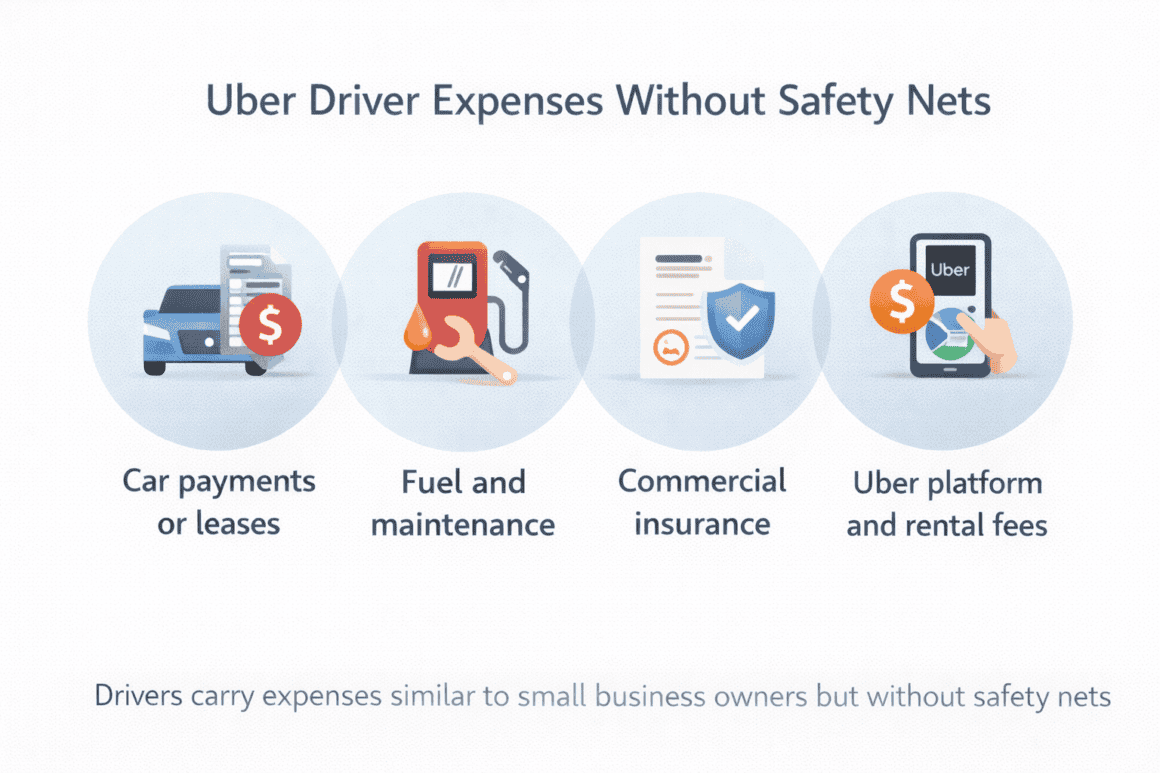
Drivers carry expenses similar to small business owners but without safety nets. These include:
- Car payments or leases
- Fuel and maintenance
- Commercial insurance
- Uber platform fees
- Rental program fees for vehicles leased through Uber
Drivers in rental programs often continue paying weekly fees even after deactivation. A New York driver reported:
“I rented the car through Uber. Got deactivated and still had to pay the weekly fee.”
These ongoing costs compound the financial strain of lost earnings.
Because appeals are slow and rarely successful, drivers may lose substantial income. Reports and forum posts show weekly losses of $1,000 to $1,500, sometimes more in high-demand cities.
A California driver shared:
“I was averaging about $1,200 a week. Lost a month waiting on appeal.”
Psychological and Social Impacts
Beyond the immediate financial consequences, deactivation has profound psychological and social effects on drivers. The sudden loss of access to the Uber platform often triggers stress, anxiety, and a persistent sense of uncertainty. Many drivers describe the experience as a kind of limbo, where the normal routines of work and income are interrupted, but there is no clear path to resolution.
One anonymous driver explained:
“It feels like being fired for a crime you never get to hear about. You can’t plan, you can’t make decisions. You’re just waiting, hoping someone at Uber will respond, but no one does.”
This uncertainty can erode confidence, impact decision-making, and even affect relationships at home. Drivers frequently juggle multiple responsibilities—rent, car payments, insurance, childcare, and family obligations. When deactivated, they must manage all these pressures without the income they rely on, often while trying to navigate a process that is opaque and slow.
The mental strain is compounded by the absence of a clear point of contact or accountability. Uber’s algorithmic enforcement creates a situation in which drivers do not know who is making decisions or how those decisions are reached. Appeals and support channels often provide generic responses, leaving drivers feeling ignored or powerless.
Civil rights organizations have documented these effects. A report by Advancing Justice ALC found that automated deactivation systems contribute to chronic stress, instability, and a sense of precarity for drivers, particularly those who rely on the platform as their main income source Advancing Justice Report12. The research highlighted that drivers experience not only economic consequences but also social consequences, including strained family dynamics and disrupted community ties.
Another anonymous driver described the social impact:
“I had to ask friends and family for help with rent. It’s embarrassing, it’s stressful, and it changes how you interact with people. You start second-guessing yourself all the time.”
The insight here is that Uber’s deactivation system does more than stop income—it creates ripple effects across mental health, social relationships, and overall well-being. For many drivers, the psychological burden persists long after the financial loss, highlighting a hidden cost of algorithmic management that is rarely acknowledged by the platform.
Disparate impact
Research from labor advocacy groups and academic studies consistently shows that immigrant drivers and drivers of color experience deactivation at disproportionately higher rates. A 2021 National Employment Law Project13 analysis of app based work found that immigrant workers are overrepresented in rideshare driving and face higher exposure to customer complaints and algorithmic enforcement, particularly in large urban markets. Similar findings appear in surveys conducted by the Human Rights Watch14 and the UC Berkeley Labor Center, which note that subjective rider ratings and complaints tend to reflect racial and linguistic bias rather than objective safety outcomes.
I encountered this pattern repeatedly while researching deactivation cases. The names, cities, and circumstances differed, but the confusion that followed the initial suspension was strikingly consistent.
Language barriers play a central role. Uber’s deactivation notices, appeal instructions, and policy explanations are primarily written in English and framed in legal or technical terms. In cities like New York, Toronto, and Chicago, where a significant share of drivers speak English as a second language, this creates immediate friction. Studies cited by the Electronic Frontier Foundation15 on algorithmic accountability emphasize that automated enforcement systems disproportionately harm users who lack the language fluency needed to contest decisions quickly and precisely.
Even when translation tools are available, nuance is lost. Drivers must respond to allegations using exact phrasing, often without knowing which words might trigger further scrutiny or be interpreted as admissions of fault. Missing an appeal deadline or selecting the wrong category in a form can quietly end a case. Many drivers abandon appeals not because they lack evidence, but because they do not understand what the platform is asking of them.
Legal literacy presents an even greater barrier. Mandatory arbitration clauses, opt out deadlines, and evidentiary standards are unfamiliar to many immigrant drivers, particularly those new to gig work or the US legal system. The UC Berkeley Labor Center16 has documented how arbitration requirements discourage claims by low income workers due to cost, complexity, and uncertainty of outcome. In practice, drivers often do not realize that failing to initiate arbitration within a specific window effectively closes their only remaining path to relief.
As I reviewed forum posts, survey data, and court filings, it became clear that many drivers never truly reach a human decision maker. Their cases stall long before that point.
In the absence of formal guidance, drivers turn to informal networks. Language specific WhatsApp groups, Facebook communities, Reddit threads, and YouTube channels have become de facto support systems. Drivers share screenshots of deactivation emails, compare complaint categories, and trade advice on how to phrase appeals. Studies by the Data and Society Research Institute17 has noted how marginalized platform workers increasingly rely on peer knowledge to navigate opaque algorithmic systems that offer little official transparency.
These forums function as informal advocacy spaces, but they also expose a deeper inequality. Drivers with stronger English skills, prior legal experience, or access to worker organizations are more likely to persist through the appeals process. Those without these resources often disappear from the platform entirely. Their exits are silent, undocumented, and statistically invisible.
In a system governed by automation and contractual asymmetry, vulnerability is not evenly distributed. The drivers least equipped to navigate opaque rules, linguistic hurdles, and legal complexity are often the ones most affected when the system decides they no longer belong..
Structural reasons for the fallout
Several structural factors amplify the financial impact of Uber deactivations, creating a system that shifts risk almost entirely onto drivers.
Independent contractor classification is at the core of this imbalance. According to NELP18, because Uber classifies drivers as independent contractors rather than employees, they are not entitled to procedural protections common in traditional workplaces, such as advance notice, formal hearings, or unemployment benefits. One anonymous full-time driver in New York explained:
“I got deactivated on a Thursday. Rent was due the next day. I called Uber repeatedly but there was nothing they could do. I had no rights to contest it in any formal way.”
Automated algorithms govern most deactivation decisions. Based on data from EFF19 on algorithmic transparency, these proprietary systems weigh rider complaints, ratings, trip patterns, and behavioral metrics against thresholds that are never disclosed. Another anonymous driver described their experience:
“I received a notification that my account was deactivated because of a safety complaint. I asked for specifics, but all they said was that the complaint met their criteria. I don’t even know what exactly I did wrong, and I can’t fight it.”
Without transparency, drivers are left guessing what triggers a shutdown, and even careful, experienced drivers are vulnerable to a sudden loss of income.
Appeals rarely restore access. Even when drivers submit detailed explanations and evidence, responses are often generic or automated, and reinstatement is rare. A driver who had relied on Uber as their main source of income explained:
“I spent two weeks submitting documents and emails explaining my side of the story. I got a short message saying my account would not be reinstated. My entire month’s income was gone.”
Arbitration clauses and restrictive contracts further limit recourse. Uber requires drivers to agree to arbitration for disputes related to deactivation and other platform matters. Arbitration can be expensive, time-consuming, and intimidating, particularly for those without legal support. One driver noted:
“I looked into arbitration. The process itself could have cost more than I would have made in two months. It was effectively impossible for me to pursue.”
The combination of contractor classification, algorithmic enforcement, and minimal successful appeals. And research20 suggests that the arbitration clauses create a system optimized for Uber’s scale, speed, and risk management. Operational efficiency and algorithmic control protect the company, but they externalize financial risk to drivers. For full-time Uber drivers, a single complaint or threshold crossing can erase earnings for weeks, sometimes months, forcing drivers to cover rent, car payments, insurance, and daily expenses without a safety net.
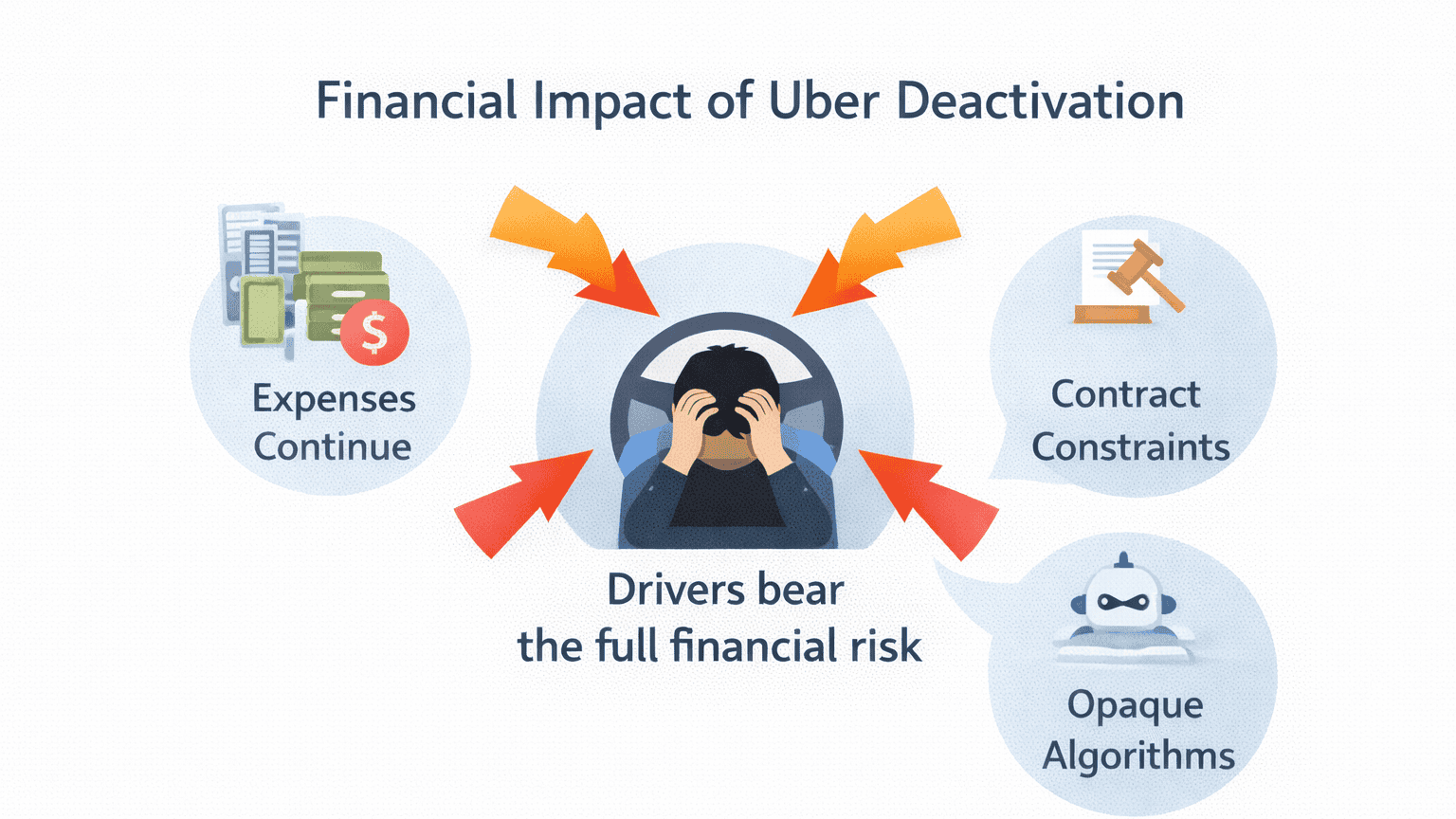
The insight is stark: Uber’s design prioritizes rapid enforcement and corporate protection. Safety and efficiency are emphasized, but fairness and financial security are secondary. The system succeeds for the company but often leaves drivers in precarity, exposing the human cost of algorithmic labor management at scale.
After reviewing reports, driver accounts, and company policies, it is clear that Uber’s deactivation system is efficient but precarious. Speed and safety are prioritized. Transparency and fairness often are not. Drivers are dependent on the platform but have limited recourse when flagged, leaving them vulnerable to sudden income loss.
While Uber defends its approach as necessary for rider safety, the consequences for full-time drivers are real: weeks of lost income, mounting expenses, and emotional strain. The system works as designed for the company, but for many drivers, it exposes the fragile reality of platform labor.
Sources
- Uber www.uber.com/in/en/about/leadership/dara-khosrowshahi/. Accessed 21 Jan. 2026. ↩︎
- Uber www.uber.com/us/en/about/leadership/. Accessed 21 Jan. 2026. ↩︎
- Uber www.uber.com/in/en/drive/driver-app/deactivation-review/. Accessed 21 Jan. 2026. ↩︎
- AALDEF, www.aaldef.org/press-release/aaldef-report-uber-and-lyft-deactivate-nyc-drivers-with-no-notice-no-due-process-and-no. Accessed 21 Jan. 2026. ↩︎
- Reddit www.reddit.com/r/uberdrivers/comments/1qccreh/got_deactivated_last_week/. Accessed 21 Jan. 2026. ↩︎
- Case, Legal. “Issues” Electronic Frontier Foundation, 24 Feb. 2017, www.eff.org/issues/algorithmic-transparency. Accessed 21 Jan. 2026. ↩︎
- Uber www.uber.com/legal/en/document/?name=general-terms-of-use&country=united-states&lang=en. Accessed 21 Jan. 2026. ↩︎
- AALDEF, www.aaldef.org/news/asamnews-op-ed-rideshare-companies-destroying-livelihoods-in-an-instant. Accessed 21 Jan. 2026. ↩︎
- 3 Apr. 2020, www.nelp.org/app/uploads/2018/01/www.nelp.org/app/uploads/2018/01/Uber-State-Interference-How-Transportation-Network-Companies-Buy-Bully-Bamboozle-Their-Way-to-Deregulation.pdf. Accessed 22 Jan. 2026. ↩︎
- Mir, Rory. “Open Data and the AI Black Box” Electronic Frontier Foundation, 18 Jan. 2023, www.eff.org/deeplinks/2023/01/open-data-and-ai-black-box. Accessed 22 Jan. 2026. ↩︎
- EPI, www.epi.org/publication/uber-and-the-labor-market-uber-drivers-compensation-wages-and-the-scale-of-uber-and-the-gig-economy/. Accessed 22 Jan. 2026. ↩︎
- 1 Mar. 2023, cdn.craft.cloud/5cd1c590-65ba-4ad2-a52c-b55e67f8f04b/assets/media/Fired-by-an-App-February-2023.pdf. Accessed 22 Jan. 2026. ↩︎
- Tomkiewicz, Steven. 1 Nov. 2021, www.nelp.org/app/uploads/2021/11/www.nelp.org/app/uploads/2021/11/App-Based-Workers-Speak-Oct-2021-1.pdf. Accessed 22 Jan. 2026. ↩︎
- “The Gig Trap” Human Rights Watch, 12 May 2025, www.hrw.org/report/2025/05/12/the-gig-trap/algorithmic-wage-and-labor-exploitation-in-platform-work-in-the-us. Accessed 22 Jan. 2026. ↩︎
- Walsh, Kit. “Fighting Automated Oppression: 2024 in Review” Electronic Frontier Foundation, 30 Dec. 2024, www.eff.org/deeplinks/2024/12/fighting-automated-oppression-2024-review-0. Accessed 22 Jan. 2026. ↩︎
- “The Public Cost of Low-Wage Jobs in the US Construction Industry” UC Berkeley Labor Center, 10 Jan. 2022, laborcenter.berkeley.edu/the-public-cost-of-low-wage-jobs-in-the-us-construction-industry/. Accessed 22 Jan. 2026. ↩︎
- 30 Jan. 2019, datasociety.net/wp-content/uploads/2019/02/datasociety.net/wp-content/uploads/2019/02/DS_Algorithmic_Management_Explainer.pdf. Accessed 22 Jan. 2026. ↩︎
- “On the NLRB Memo Finding Uber Drivers to Be Independent Contractors” National Employment Law Project, 14 May 2019, www.nelp.org/nlrb-memo-finding-uber-drivers-independent-contractors/. Accessed 22 Jan. 2026. ↩︎
- Case, Legal. “Issues” Electronic Frontier Foundation, 24 Feb. 2017, www.eff.org/issues/algorithmic-transparency. Accessed 22 Jan. 2026. ↩︎
- “ResearchGate”, www.researchgate.net/publication/395264742_THE_UBER_CHALLENGE_A_COMPARATIVE_ANALYSIS_OF_REGULATORY_SCHEMES_GOVERNING_TRANSPORTATION_APP_FIRMS. Accessed 23 Jan. 2026. ↩︎


