

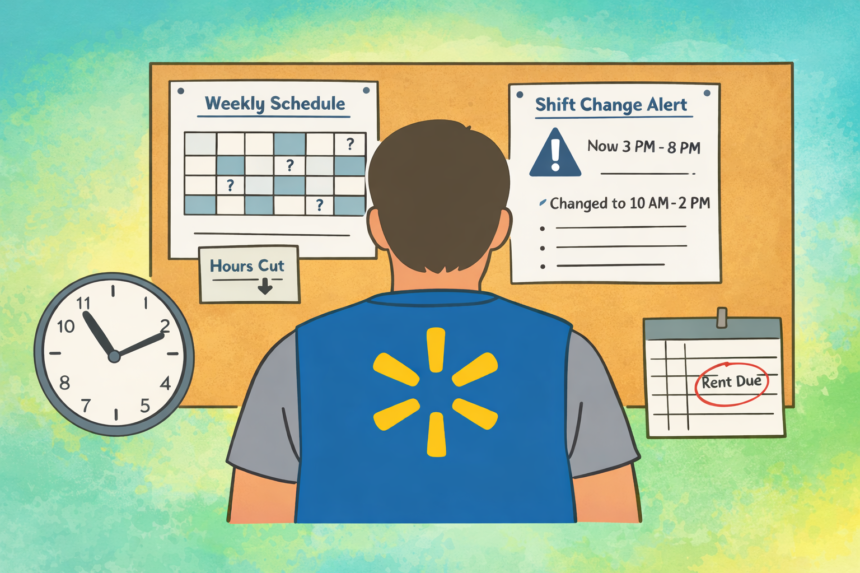

On paper, this sounds helpful. A system that uses data to schedule workers could reduce last-minute calls. It could limit on-call shifts. It could give workers a sense of security.
Walmart says its scheduling system is meant to give workers more control over their time. According to the company, its My Walmart Schedule1 tool lets employees see shifts, swap shifts, and pick up extra hours they choose. It also promises consistent “core hours” for some employees so they can plan around those times. The main goal, from the corporate view, is to match workers to customer demand efficiently and help associates balance life and work.
But if you read the worker conversations on public forums, what actually happens paints a different picture.
Many say they get very little warning when shifts change. Others say the system schedules them outside the availability they entered. Some even describe schedules that conflict with their lives in ways that make basic planning impossible.
One worker explained their frustration over the schedule on Reddit2:
“Wtf is up with my hours/shift? They keep jumping around … I’m actually going to get 40 hours next week. They found a way to make that as unpleasant as possible by breaking it up over 6 days.”
In another thread, a Walmart employee said their schedule was completely random until a manager finally fixed it at the last minute, but later the automated system restored the chaotic version again.
And yet another anonymous worker warned that last-minute changes sometimes arrive less than a day before the shift begins, leaving them unable to say no without risking attendance points.
All of these accounts share a common theme. Workers do not feel in control. The system seems to control them. But who is to blame for this chaos?
Responsibility for Walmart’s scheduling practices is diffuse, but it is not ambiguous. The systems that produce unpredictable schedules are the result of deliberate choices made at the corporate level, even if their effects are felt most acutely at the store level. Walmart relies on centralized workforce management software that forecasts demand, allocates labor hours, and sets tight payroll targets. These tools are designed, approved, and enforced by corporate leadership, not by hourly workers and not solely by individual store managers.
Store managers and supervisors are often the visible enforcers. They adjust shifts, cut hours, or call workers in on short notice. In practice, however, their discretion is limited. Many report being evaluated on labor cost metrics that leave little room to prioritize schedule stability without risking poor performance reviews. This creates a chain of pressure that flows downward while accountability flows upward.
Ultimate responsibility rests with Walmart’s executive leadership and board, who set the company’s labor strategy and define success through cost efficiency and flexibility. Human resources and operations teams translate those priorities into policies and algorithms that govern millions of schedules nationwide. When instability becomes routine, it reflects organizational values, not isolated managerial failures.

Why Unpredictable Schedules Matter
Unpredictable schedules are not just annoying. They are financially and psychologically harmful.
Research shows that scheduling volatility has real consequences. When workers get their schedule with less than one week’s notice, they are more likely to experience stress, trouble sleeping, and conflicts between work and life. EPIC3 reports that in case of such scenarios, parents are especially affected, as unpredictable hours make childcare planning difficult.
The Brookings Institution reported that workers with last-minute scheduling changes face difficulty planning everyday life tasks. This includes dentist visits. It includes appointments. It includes work on a second job. Brookings4 suggests that employers often believe flexibility is what workers want, but evidence suggests most people prefer a stable schedule over one that changes constantly.
Unpredictability can also affect children. PMC5 Research shows unstable schedules are linked to more informal childcare arrangements, siblings providing care, or situations where children are left without supervision because adults do not know when they will be working.
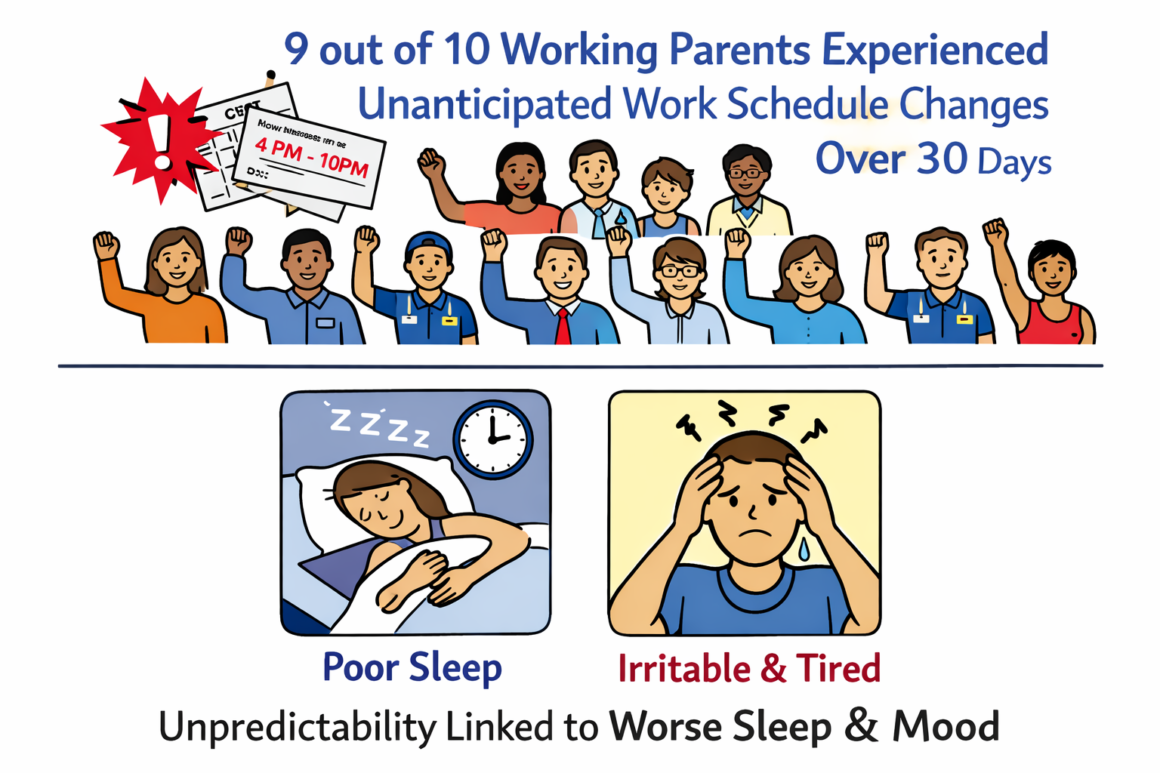
Another PMC6 longitudinal study of working parents found that 87 percent experienced what participants called unanticipated schedule changes on a typical 30-day period. On those days, mothers reported worse moods and poor perceived sleep quality.
This matters because Walmart is not a niche employer. It is the largest private employer in the United States. People working there often rely on every hour. Even small cuts can cause real hardship.
Income and the Invisible Costs of Scheduling
When hours change from week to week, it becomes impossible to know how much money you will actually earn. That uncertainty sits at the center of algorithmic scheduling. Workers are not paid salaries. They are paid by the hour. When hours fluctuate, income does too.
On various worker forums, Walmart associates describe weeks that feel financially unrecognizable from the ones before. One week brings close to full-time hours. The next drops sharply without warning. People plan their lives around one number and then watch it disappear.
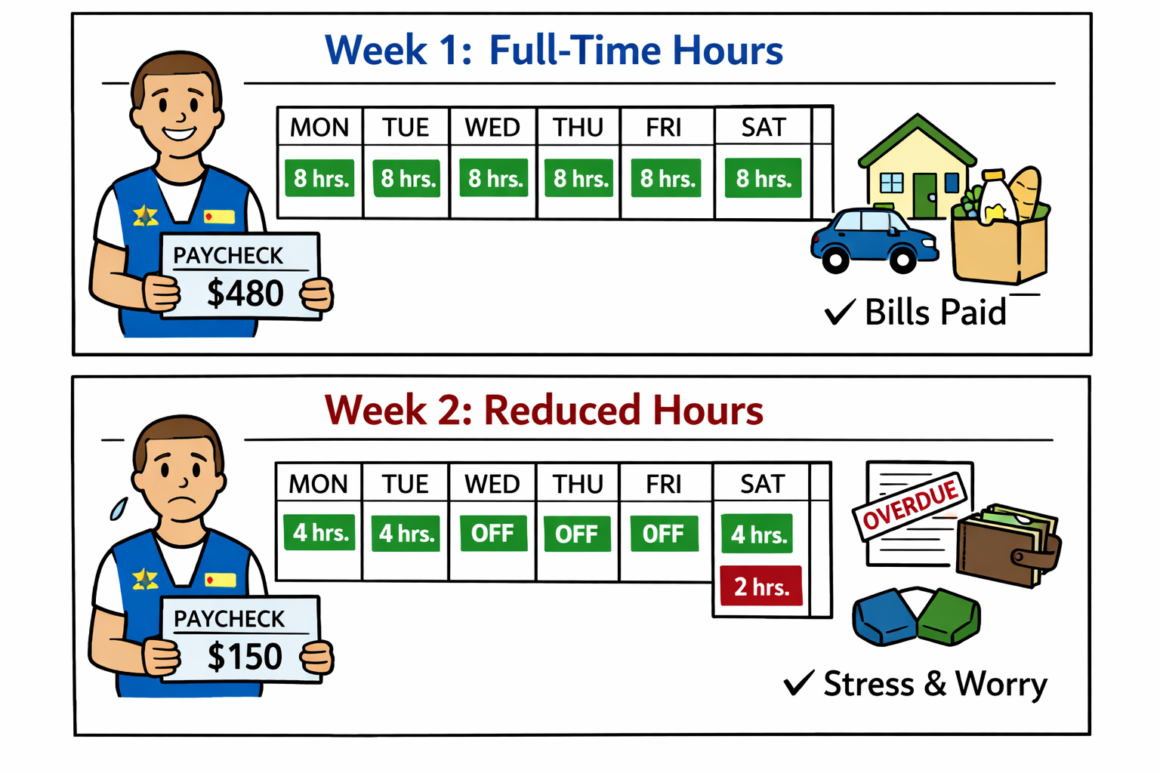
One associate wrote that they were suddenly scheduled for six days of varying shifts because the system found a way to give them forty hours while spreading those hours across too many days. The total pay stayed the same. The cost of commuting increased. Childcare became harder to arrange. Recovery time vanished. The worker described being exhausted and no better off financially.
Another account described how schedules were wiped and replaced with random hours. Shifts appeared and disappeared in the app. The worker had already committed to childcare and a second job. Both fell apart within days. The choice was simple but painful. Either obey the new schedule or lose the job.
These changes do not just feel chaotic. They show up directly on paychecks. A few lost hours can erase grocery money. A bad week can mean falling behind on utilities. Two bad weeks can mean borrowing. The damage rarely arrives all at once. It accumulates quietly.
Income volatility creates a constant budgeting problem. Rent is fixed. Phone bills are fixed. Transportation costs are fixed. Paychecks are not. Workers end up planning for the worst while hoping for the best. That mindset wears people down.
What makes this especially difficult is timing. Schedules often change with little notice. A worker may see fewer hours only days before the workweek begins. There is no time to adjust expenses. There is no time to pick up extra work elsewhere. The loss is immediate.
This volatility is not unique to Walmart. Retail and service workers across the country face similar problems. But Walmart’s scale amplifies the effect. Forbes7 reports that over 82 million hourly workers are in the United States. So, even small scheduling shifts affect a massive population. A system change that trims hours slightly across many stores translates into real hardship for thousands of households.
Researchers have studied this pattern closely. The Aspen Institute’s Economic Security Project8 links unstable scheduling to income volatility and financial stress. Their research shows that workers with unpredictable hours are more likely to struggle with bills, rely on high-interest credit, and delay medical care.
The key insight from this research is that instability itself causes harm. It is not just low pay. It is the inability to predict pay. Workers cannot plan. They cannot save. They cannot take risks that might improve their future.
Upward mobility depends on stability. Training programs require consistent attendance. Second jobs require reliable availability. Education requires time and money. When schedules shift week to week, those paths narrow. People stay where they are because they cannot afford disruption.
There is also an emotional cost. Constant uncertainty creates stress that spills into every part of life. Workers describe checking the scheduling app multiple times a day. They fear sudden changes. They hesitate to make plans. Time off stops feeling like time off.
In theory, algorithms are neutral. They respond to demand signals and staffing models. In practice, they move risk downward. The company gains flexibility. The worker absorbs instability. That tradeoff is rarely acknowledged.
What strikes me most in these accounts is how normalized this volatility has become. Workers talk about it as if it is weather. Something you prepare for but cannot change. That acceptance is itself a warning sign.
The algorithm is not just telling people when to work. It is deciding how predictable their income will be. It shapes whether a missed shift becomes a missed bill. It influences whether a bad month becomes a crisis.
For many Walmart workers, the paycheck is not simply smaller or larger. It is uncertain. And uncertainty, repeated week after week, becomes its own kind of cost.
Worker quotes provide raw insight into how these scheduling issues feel from the inside. These are not data or policy abstracts. These are people’s lives.
A Walmart employee posted:
“My schedule is 100% auto-generated … It gave me 6pm to 12:30am for the entire work week … It’s difficult to plan anything when they do stuff like this last minute.”
Another Reddit9 user said plainly:
“Wtf is the point of putting my availability in if the AI … is just going to blatantly ignore it? I share a car with my girlfriend and can only go in early in the morning … but I get scheduled 2 to 11pm shift.”
And then one more:
“I went to clock in only to discover they had changed my shift … I didn’t receive any notification … Now I get to sit in the break room for the next 45 minutes.”
These quotes show something quantitative research cannot always capture. They show how unpredictable scheduling feels.
Workers find themselves unable to commit to weddings. They find themselves cancelling family plans. They find themselves explaining to partners and children why they must go to work on short notice.
This is the human cost of algorithmic decision-making.
What Walmart Promises and What Happens
Walmart’s official statements10 about scheduling emphasize consistency and flexibility. The company claims that its scheduling tool allows employees to set their availability, view shifts weeks in advance, and even pick up extra hours if they choose. Walmart also highlights “core hours,” which are meant to remain stable for several weeks, giving workers the ability to plan their personal lives around those hours. The corporate message frames the system as a way to reduce unpredictability while still meeting business needs.
The idea was straightforward. By using an automated system, Walmart could anticipate staffing needs and distribute shifts fairly. In theory, workers would know their schedules ahead of time. They could plan childcare, doctor’s appointments, second jobs, or even simple family dinners. The company positioned the tool as a way to give workers more control over their own time.
But independent research paints a different picture. Scholars Strategy Network11 surveying thousands of retail employees found that the promises of consistency rarely matched reality. Before automated scheduling systems were introduced, roughly 39 percent of workers reported frequent schedule changes that made planning difficult. After the introduction of the new system, the figure remained nearly the same. Workers continued to experience last-minute shift changes, split shifts, and hours assigned outside of their stated availability.
The gap between corporate promises and workers’ lived experience is significant. While Walmart markets the scheduling tool as a step toward fairness, employees report that it often adds new layers of unpredictability. Shifts can be swapped or canceled with minimal notice, leaving workers scrambling to rearrange childcare, transportation, or a second job. Even when schedules are posted in advance, they can be adjusted at the last minute to respond to projected store traffic or staffing needs, sometimes with little explanation.
Workers’ stories reveal the human side of the problem. One associate described planning their week around the supposed “core hours,” only to have the algorithm replace part of their schedule with evening shifts that conflicted with school pickups for their children. Another explained how a schedule posted for the week was entirely changed the night before, forcing them to cancel plans and scramble to cover responsibilities at home. These disruptions are not minor inconveniences; they have real consequences for income, stability, and well-being.
The persistence of these problems suggests that technology alone cannot solve issues rooted in labor dynamics. Scheduling instability is not just a technical problem; it is an economic and organizational one. Algorithms optimize for cost and efficiency, not human well-being. When the system prioritizes minimizing labor expenses or balancing staffing against unpredictable customer demand, the burden falls on workers, not on the software or the company.
This contrast between promises and reality also highlights a deeper power imbalance. The algorithm gives managers and corporate decision-makers control over scheduling while limiting workers’ ability to negotiate or influence outcomes. Even when employees attempt to set preferences, the automated system can override them based on efficiency calculations. In other words, workers are expected to adapt to the system rather than the system adapting to them.
The takeaway is clear. While Walmart presents automated scheduling as a tool for fairness and flexibility, the lived reality for many employees remains marked by uncertainty. The technology did not eliminate the challenges of inconsistent hours. Instead, it shifted how those challenges appear, giving the appearance of control while leaving workers to absorb the real-world consequences. This gap between promise and practice underscores that solutions to unstable scheduling must address human needs and labor practices, not just corporate efficiency.
The Broader Context: Unpredictable Schedules in the Service Sector And How It Affects Family Life
Unpredictable scheduling practices in the service and retail industries are not isolated to one company or region. They reflect a larger shift toward just-in-time staffing models that treat labor hours as a flexible cost, adjusted up or down with little warning to control short-term expenses. These scheduling systems are especially concentrated in sectors like retail, restaurants, hospitality, and other hourly-wage service jobs.
Research from People Management12 shows that this trend profoundly affects workers’ lives. In a large survey of low-wage mothers working in the U.S. retail and food service sectors, more than two thirds of respondents reported receiving their schedules with less than one week’s notice, and 66% experienced last-minute timing changes such as earlier start times or shorter shifts in a given month. This unpredictability often coincides with variable and rotating schedules rather than fixed day shifts.
Because many service-sector workers are also parents, schedule volatility becomes a problem for entire households, not just individuals. Unpredictable hours are associated with a higher likelihood of difficulty arranging childcare, greater work-family conflict, and missing work due to care disruptions. Mothers in these jobs reported having to adjust childcare arrangements frequently and rely on informal networks (including relatives or friends), sometimes even leaving young children unsupervised because of sudden changes.
ResearchGate13 shows that nearly nine out of ten working parents in a separate study experienced at least one unanticipated work schedule change over a 30-day period. On days with schedule changes, parents reported worse sleep quality and more negative mood, linking instability directly to worker well-being and mental health.
The consequences extend further into long-term economic instability. Surveys from Oxford Academic14 indicate that over half of service sector workers receive their schedules with less than two weeks’ notice, and many experience cancelled or altered shifts without compensation, contributing to fluctuating weekly earnings and heightening material hardship. Workers facing the most variable schedules were significantly more likely to experience financial stress, including difficulty covering basic needs.
This pattern has been described sociologically as a “web of time,” where unpredictability in one person’s work hours ripples outward to affect spouses, children, caregivers, and informal support networks. When hours cannot be forecasted, families are forced to constantly reconfigure daily routines, making long-term planning for childcare, schooling, transportation, or even healthcare appointments extremely difficult.
These scheduling practices are tied to broader industry norms rather than isolated management decisions. “Just-in-time” scheduling tools match staffing to projected demand, often with narrow margins for error, and provide little advance notice to workers. This instability is now pervasive in sectors that employ large shares of the workforce, particularly younger, lower-wage, and part-time workers.
Attempts to regulate these practices have begun in some jurisdictions. Laws requiring advance notice of schedules and compensation for last-minute changes (often called “predictability pay”) have been enacted in cities like Seattle and San Francisco, and early evaluations suggest they can reduce scheduling volatility and improve worker well-being.
In short, Walmart’s scheduling challenges reflect a much broader trend in how labor is managed across the service sector. Unpredictable schedules do not just disrupt work; they disrupt family life, social support systems, financial stability, and mental well-being. The problem is structural, rooted in labor systems that prioritize short-term cost control over stability, leaving workers and their families to absorb the consequences.
Paths Forward and What Could Change
If we accept that scheduling instability harms workers’ lives, the question becomes: what changes?
Public policy experiments in some cities and states have required employers to give schedules with advance notice and to compensate workers when schedules change on short notice. Some research from National Institutes of Health15 suggests these policies improve worker well-being without harming business performance.
Corporate transparency also matters. Workers report feeling powerless because the algorithm’s logic is opaque. Clear explanations of why shifts are assigned could build trust.
Allowing workers real input on schedules, not just flexible shifts but actual control, could help. Managers could collaborate more with workers on availability and preferences in a meaningful way.
Finally, recognizing that time itself has value. Even separate from wages it is important. Workers often say they would trade a small amount of extra pay for a stable schedule. Predictability is worth more than flexibility without stability.
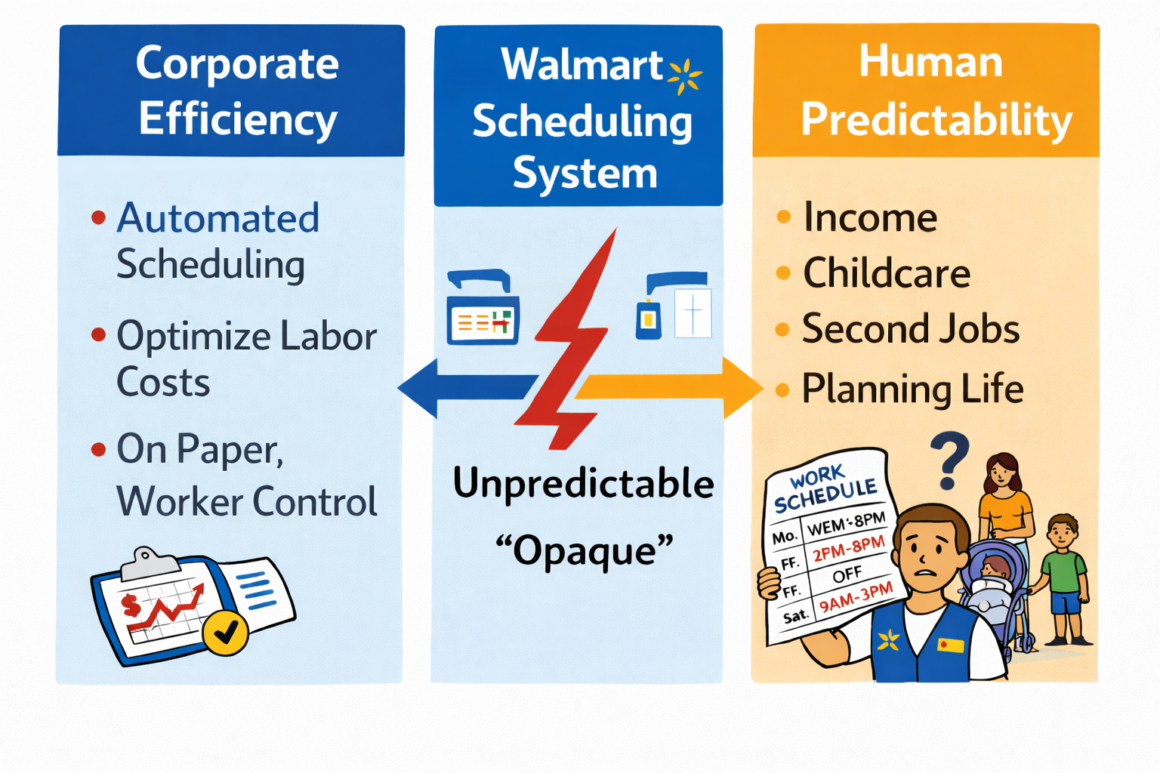
Walmart’s scheduling system represents a conflict between corporate efficiency and human predictability. On paper, the automation was meant to give workers control. But many workers perceive it as unpredictable and opaque. Unpredictability affects income, childcare, second jobs, and basic life planning.
Workers describe schedules that change with little notice. Research shows that unpredictable scheduling is linked to stress, poorer health, and childcare disruptions. Even with improvements advertised, many workers report no real change in scheduling stability. At a company that employs over a million people in the United States, this matters.
The solution is not just technical. It must be human. Schedules should be tools that support real lives. Until then, the cost of unpredictability will continue to be paid in hours lost, stress gained, and time that can never be recovered.
Sources
- “My Walmart Schedule” one.walmart.com/content/uswire/en_us/me/my-schedule.html. Accessed 29 Jan. 2026. ↩︎
- Reddit, www.reddit.com/r/WalmartEmployees/comments/1cwvip7/wtf_is_up_with_my_hoursshift_they_keep_jumping/. Accessed 30 Jan. 2026. ↩︎
- “EPIC The Issues – Issue Brief #1 – Income Volatility: Managing Swings” Aspen EPIC Dev Site, aspenepic.flywheelsites.com/epic-issues/income-volatility/issue-briefs-what-we-know/issue-brief-managing-swings/. Accessed 30 Jan. 2026. ↩︎
- Carmona, Tonantzin. “Unpredictable work hours and volatile incomes are long-term risks for American workers” Brookings, 18 Aug. 2020, www.brookings.edu/articles/unpredictable-work-hours-and-volatile-incomes-are-long-term-risks-for-american-workers/. Accessed 30 Jan. 2026. ↩︎
- “Who Cares if Parents have Unpredictable Work Schedules?: The Association between Just-in-Time Work Schedules and Child Care Arrangements” PMC , pmc.ncbi.nlm.nih.gov/articles/PMC10634609/. Accessed 30 Jan. 2026. ↩︎
- “Work Schedule Unpredictability: Daily Occurrence and Effects on Working Parents’ Well-Being” PMC , pmc.ncbi.nlm.nih.gov/articles/PMC8651235/. Accessed 30 Jan. 2026. ↩︎
- Caplan, John. “America’s Hourly Workers” 12 Mar. 2021, www.forbes.com/sites/johncaplan/2021/03/12/americas-hourly-workers/. Accessed 30 Jan. 2026. ↩︎
- 4 Dec. 2017, www.aspeninstitute.org/wp-content/uploads/2025/05/www.aspeninstitute.org/wp-content/uploads/2025/05/AFN_2017_Income-Volatility_Final.pdf. Accessed 30 Jan. 2026. ↩︎
- Reddit, www.reddit.com/r/walmart/comments/15kltws/wtf_is_the_point_me_putting_my_availability_in_if/. Accessed 30 Jan. 2026. ↩︎
- “New Scheduling System Gives Associates More Consistency and Flexibility” 30 Mar. 2018, corporate.walmart.com/news/2018/11/13/new-scheduling-system-gives-associates-more-consistency-and-flexibility. Accessed 30 Jan. 2026. ↩︎
- “Microsoft Word – Skocpol edit_SSN Key Findings Schneider and Harknett on Unpredictable and Unstable Work Hours_authedit.docx” 8 Jan. 2018, scholars.org/sites/scholars/files/scholars.org/sites/scholars/files/ssn-key-findings-schneider-and-harknett-on-unpredictable-and-unstable-work-hours_authedi.pdf. Accessed 30 Jan. 2026. ↩︎
- Brown, Jessica. “Two-thirds of shift workers given less than a week’s notice of hours, research finds” www.peoplemanagement.co.uk/article/1747201/two-thirds-of-shift-workers-given-less-than-weeks-notice-of-hours-research-finds. Accessed 30 Jan. 2026. ↩︎
- “ResearchGate” www.researchgate.net/publication/342908367_Work_Schedule_Unpredictability_Daily_Occurrence_and_Effects_on_Working_Parents’_Well-Being. Accessed 30 Jan. 2026. ↩︎
- “Oxford Academic” academic.oup.com/sf/article/99/4/1682/5890832. Accessed 30 Jan. 2026. ↩︎
- “Improving health and economic security by reducing work schedule uncertainty” PMC , pmc.ncbi.nlm.nih.gov/articles/PMC8545454/. Accessed 30 Jan. 2026. ↩︎


