

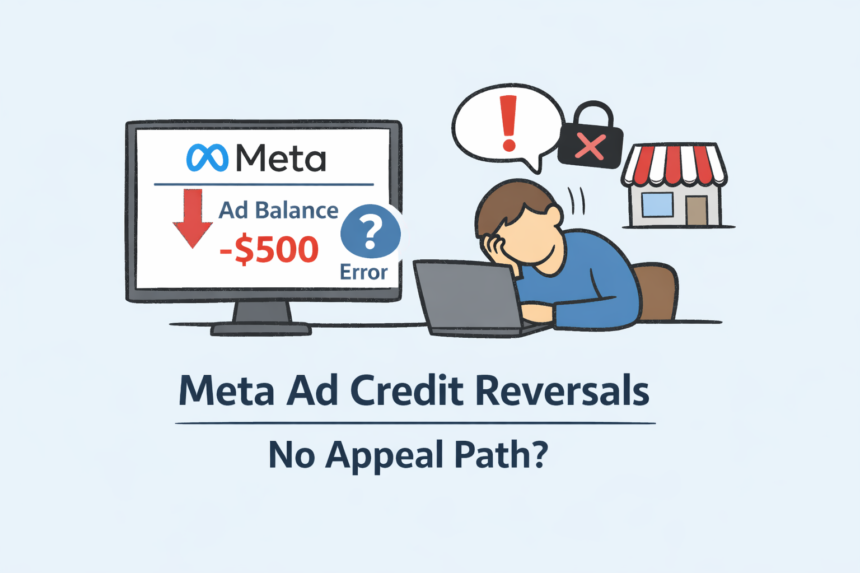

Meta’s advertising platform is the backbone of marketing for millions of small businesses. From local service providers to ecommerce startups, Facebook and Instagram ads are often the primary way entrepreneurs reach customers. The system promises efficiency, measurable results, and scalable growth. It also promises clarity. You set a budget. You launch a campaign. You monitor spending.
But over the past several years, a recurring complaint has surfaced across forums and industry reporting. Small businesses say ad credits or balances changed unexpectedly. In some cases, promotional credits appear to have been reversed. In others, charges post despite campaigns being paused. In still others, accounts are disabled after payment verification, leaving funds in limbo. What connects these stories is not always the specific billing event. It is the absence of a clear appeal path when something goes wrong.
Large digital platforms manage billions in advertising spend annually. Errors are inevitable at scale. Promotional credits have expiration terms. Fraud detection systems sometimes trigger legitimate accounts. But scale does not remove the obligation of transparency. If credits are reversed or funds are debited unexpectedly, small businesses need a clear explanation and a defined mechanism to challenge the decision.
This investigation draws on public reporting, Meta’s own documentation, and firsthand accounts shared in online communities. It does not claim proof of a systematic policy of unfair clawbacks. Instead, it examines a structural question. When an advertiser believes a credit was reversed or a charge was applied in error, what recourse actually exists?
How Meta’s Credit and Refund System Works in Practice
Meta’s advertising ecosystem is built for scale. Every day, millions of campaigns are launched, paused, optimized, and billed across Facebook and Instagram. To manage this volume, the company relies heavily on automation. Billing thresholds, payment authorizations, promotional credits, fraud detection triggers, and risk scoring are processed by internal systems with minimal human intervention.
For advertisers, the primary interface with this system is the Ads Manager or Business Manager dashboard. There, they see campaign performance metrics, current balances, invoices, and transaction histories. In principle, this dashboard offers transparency. It shows how much has been spent, what is owed, and what credits have been applied.
In practice, however, transparency often depends on interpretation. Transaction logs may show a line item adjustment without explaining the underlying trigger. A credit might appear and later disappear. A balance may shift from positive to negative. While the numbers are visible, the reasoning behind them is not always obvious.

Meta’s1 public documentation provides general guidance on billing and ad review standards. The company’s advertising policy pages focus primarily on content compliance and enforcement mechanisms rather than on billing dispute procedures.
There is comparatively less publicly available detail about how billing adjustments are escalated, reviewed, or overturned. Advertisers encountering an issue are typically directed to general support channels rather than to a specialized billing tribunal or structured appeal system.
Independent analysis of Meta’s refund practices suggests that refunds are discretionary and limited. Spider AF2, a digital advertising fraud prevention firm, describes Meta’s refund approach as case-by-case and emphasizes that poor campaign performance does not qualify for reimbursement.
This distinction is important. Dissatisfaction with ad results is treated differently from billing anomalies. Yet in user experience, the two can blur. If an advertiser believes a campaign did not run as intended due to a technical issue, they may view it as a billing error rather than a performance issue. The platform may categorize it differently.
When refunds are granted, they are not always returned as cash. Frequently, Meta issues advertising credits instead of direct financial reimbursements. Credits can be useful, but they often come with conditions. They may have expiration dates, usage windows, minimum spend requirements, or restrictions tied to specific ad accounts.
From an accounting standpoint, a credit is not the same as cash. Cash can be redeployed across vendors or operational needs. A credit must be spent within Meta’s ecosystem and under the terms attached to it. If a credit expires or is revoked due to policy enforcement, the advertiser experiences a financial impact similar to a clawback.
Understanding how promotional credits function is critical. These credits are often offered during onboarding campaigns, partnership promotions, or platform-wide initiatives. The terms governing them typically include:
• A requirement to spend a certain amount before the credit activates
• A defined activation window
• A specific expiration date
• Compliance with all advertising policies
If those conditions are not met, the credit may never apply or may later be reversed. The problem is not necessarily that such terms exist. The issue is that the operational logic behind credit activation or reversal is not always clearly surfaced within the billing dashboard.
In many cases, the relevant terms are contained in separate promotional documentation rather than prominently displayed next to the balance line item. A small business owner reviewing their billing page may see a number change without immediate access to a plain language explanation referencing the exact clause that triggered it.
Automation further complicates matters. Meta’s internal systems are designed to detect suspicious activity, payment anomalies, or policy violations. If an account triggers a fraud detection algorithm, certain credits or balances may be frozen or reversed pending review. While such safeguards are necessary at scale, they can produce false positives.
When automation flags an account, the advertiser may receive a generic notice about policy review or account restriction. The connection between that notice and a specific credit adjustment may not be explicit. From the advertiser’s perspective, funds appear to move without context.
For large advertisers, this ambiguity is often mitigated by direct account managers or agency intermediaries who can request clarification internally. For small businesses running campaigns independently, support interactions usually begin with standard forms or chat queues. Response times vary. The level of detail provided in replies varies as well.
Another layer of complexity involves billing thresholds and pre-authorization systems. Meta may pre-authorize charges before posting final amounts. If a payment method fails or a threshold is crossed, adjustments can appear in the account ledger. While technically accurate, these ledger entries may not clearly distinguish between pending authorizations, settled charges, and promotional offsets.
Currency conversion can introduce additional confusion for advertisers operating across borders. Exchange rate fluctuations may cause small differences between authorized amounts and final posted charges. These discrepancies are typically legitimate but may appear irregular to advertisers who are not familiar with payment processing mechanics.
Taken together, Meta’s credit and refund system reflects a design optimized for operational efficiency rather than narrative clarity. The platform provides the data, but not always the story behind the data.
For sophisticated advertisers with finance teams or agency partners, navigating these nuances is manageable. They understand promotional terms, track expiration dates, and reconcile invoices regularly. For small businesses managing ads alongside daily operations, the learning curve is steep.
A local retailer may not parse the difference between a revoked promotional credit due to expiration and a discretionary refund converted into credit form. Both manifest as a change in balance. Without contextual explanation, both can feel like money removed.
From a governance perspective, the key tension is not whether credits have terms. It is whether those terms and their operational consequences are presented clearly and consistently at the moment of adjustment. Transparency in financial systems requires more than accessible policies. It requires intelligible interfaces.
Meta’s credit and refund system operates within defined internal rules and contractual terms. It relies heavily on automation, conditional promotional structures, and discretionary refund evaluation. While these mechanisms are understandable at a global scale, their practical implementation can leave small advertisers uncertain about why balances shift and what recourse exists when they believe an adjustment is incorrect.
For a platform whose value proposition is data-driven precision, extending that precision to billing explanations may be the next logical refinement.
Public Reporting on Billing Disruptions and Glitches
In April 2023, CNBC3 reported that Meta experienced an ad delivery glitch that led to unexpected spending for some advertisers. Larger brands reportedly reached Meta quickly through account representatives. Smaller advertisers described delays in receiving refunds or credits.
Retail Media Labs4 similarly reported that small businesses were waiting for refunds after the glitch, while campaign budgets were affected.
These incidents involved acknowledged technical problems. Meta communicated publicly about the issue. Refunds and credits were eventually processed. However, the disparity in response speed highlighted a broader structural reality. Access to support often correlates with ad spend volume.
This dynamic matters when discussing credit reversals. Even if the reversal stems from a technical or policy trigger, the absence of timely human review can amplify frustration. A short-term negative balance can disrupt cash flow for a small operation. Delayed clarity can stall marketing plans.
Beyond glitches, broader legal disputes have surfaced around Meta’s advertising practices. In one Economic Times5 repoert we see that the Ninth Circuit allowed parts of a lawsuit alleging inflated advertising metrics to proceed. Meta has denied wrongdoing. The case centers on measurement rather than billing, but it reflects advertiser concerns about transparency and accountability in the broader ecosystem.
Taken together, these reports do not prove systematic unfair credit reversals. They do, however, illustrate tension between platform scale and advertiser oversight.
Online forums offer a form of real-time documentation. They are not legal records. They are not audited data sets. But they do reveal patterns in how billing issues are experienced by small advertisers.
Across threads and marketing communities, the tone is often less about outrage and more about confusion.
In one discussion on r/FacebookAds6, a user wrote that they were charged even though no campaigns were active. The advertiser claimed support responses were limited and that they were advised to contact their credit card provider if they wished to dispute the charge. The thread reflects a recurring frustration that initial support channels feel procedural rather than investigative.
In another Reddit thread, an advertiser described depositing funds into their ad account but being unable to launch ads due to repeated payment verification loops. According to the post, the system deducted funds while the ads never went live. When the user requested a refund, they reported being told the transaction fell under a non-refundable category. The language used in the thread captures the uncertainty.
The user wrote that they felt stuck in a system where “money goes in, but ads do not run.”
Other forum participants have described account restrictions occurring immediately after payment verification. One commenter wrote that their account was disabled “right after verifying payment,” leaving their balance inaccessible. The implication was not necessarily malice but opacity.
Hacked accounts represent some of the most severe examples discussed publicly. In one widely shared thread , a Reddit7 user reported that approximately forty-five thousand euros were spent overnight after their account was compromised. The advertiser wrote that Meta acknowledged the breach, but that refund timelines were unclear and evolving. The user stated,
“They confirmed it was unauthorized, but I still do not know when or how the money will be returned.”
That uncertainty, rather than outright refusal, became the central concern in the discussion.
These posts are anecdotal. They are not judicial findings. Some may involve misunderstandings of promotional credit terms. Others may stem from internal system errors, security breaches, or policy triggers. Forums often amplify edge cases. Yet what stands out is not the uniqueness of any single event but the consistency of themes.
Advertisers repeatedly describe limited visibility into decision logic. They describe templated responses. They describe the absence of a clearly defined escalation ladder.
Another recurring topic involves chargebacks. In digital marketing communities, users caution one another about disputing charges directly through banks. A discussion on BlackHatSEOForum8 outlines what some users believe can happen after initiating a chargeback against Facebook advertising charges.
One participant wrote that “a chargeback can trigger account review or restriction,” while others debated whether such outcomes are automatic or case-specific. The tone is advisory. The underlying message is caution.
For small businesses, this creates a practical dilemma. If an advertiser believes a charge is incorrect, they can attempt to resolve it internally through support channels. If the resolution is slow or unclear, they may consider disputing the transaction externally through their bank. Yet forum discussions suggest that doing so could risk account limitations.
For a company that depends heavily on Meta advertising for customer acquisition, that risk is not theoretical. Losing access to ad accounts can halt revenue generation. As a result, some advertisers describe absorbing disputed costs rather than escalating externally.
One forum user summarized this tension succinctly.
“You either fight the charge and risk the account, or accept it and move on.”
Whether that framing is universally accurate is unclear. What matters is that it reflects a perception shared across multiple discussions.
Perception, in platform ecosystems, has economic consequences. If small advertisers believe that dispute pathways are opaque or risky, they may alter behavior. They may limit spending. They may diversify platforms. Or they may build higher margins to hedge against unpredictable adjustments.
From a research perspective, forums provide early signals. They show how policies and billing systems are experienced on the ground. They do not prove systemic failure. But they do reveal recurring friction points that merit closer examination.
The consistency of these narratives suggests that billing governance is not only a technical function but also a trust function. When advertisers feel that disputes lack structured escalation or transparent timelines, confidence in the system can erode even if individual cases are eventually resolved.
In platform advertising, trust is cumulative. Each unresolved thread becomes part of a broader perception landscape.
Structural Challenges in Platform Governance and The Question of Appeal
Meta operates at an extraordinary scale. According to its financial disclosures, millions of businesses advertise on its platforms. Automated billing systems must detect fraud, enforce promotional terms, and reconcile global payment methods across jurisdictions. Mistakes and false positives are statistically inevitable in systems of this magnitude.
However, scale does not eliminate the need for due process. When automated systems reverse credits or post charges, affected advertisers require more than templated responses.
Large advertisers often benefit from direct account managers or agency intermediaries. Smaller businesses rely on standardized support channels. This asymmetry shapes outcomes. Even during acknowledged platform-wide issues, smaller advertisers have reported slower response times.
The imbalance is not unique to Meta. It reflects a broader pattern across digital platforms. Yet Meta’s dominance in social advertising amplifies its impact. For many small businesses, there is no equivalent channel with comparable reach and targeting precision.
A key structural issue is visibility. When a credit expires, is revoked, or adjusted due to policy triggers, the advertiser’s dashboard may show a numerical change without detailed explanation. If the explanation resides in promotional terms or internal risk assessments, it may not be surfaced clearly in the billing log.
Transparency requires not only publishing policies but integrating explanations into user interfaces. An itemized adjustment with plain language reasoning would reduce uncertainty significantly.
One of the clearest findings from this research is structural rather than anecdotal. There is no clearly defined, publicly documented appeal ladder dedicated specifically to billing disputes involving credit reversals, balance adjustments, or unauthorized debits inside Meta’s advertising system.
Meta9 does provide structured review mechanisms for content enforcement. If an advertisement is disapproved for violating policy, advertisers can request reconsideration through Account Quality tools. The company outlines those processes in its policy documentation.
These review flows include options such as requesting a manual review or appealing enforcement decisions. They are tied to ad content, account integrity, and policy compliance.
Billing disputes follow a different path.
When an advertiser believes they were charged incorrectly or that a credit was reversed in error, they are directed to general support channels. Meta’s10 help documentation for billing issues typically routes users to support forms or chat based systems within Business Manager.
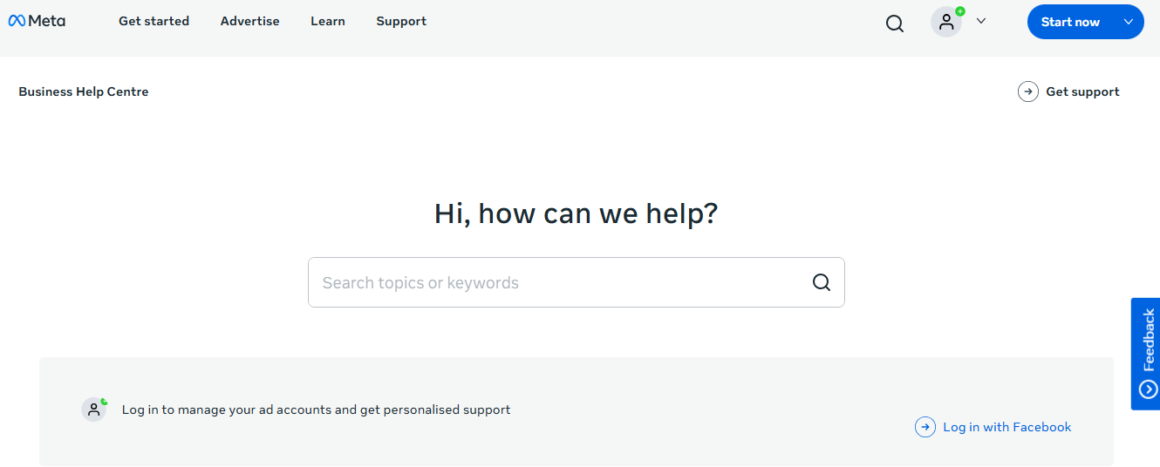
There is no separate, clearly labeled billing arbitration process. There is no publicly documented escalation tier specifically for credit clawbacks. There is no published timeline guaranteeing resolution within a defined number of business days.
This gap is not unique to Meta, but it is significant given Meta’s advertising scale. In 2023, Meta11 reported advertising revenue of 131.9 billion dollars in its annual report, representing the overwhelming majority of its total revenue.
When advertising represents more than 97 percent of revenue, billing governance becomes central to platform trust.
At the same time, Meta does not publish aggregated data on billing complaints, refund approval rates, or dispute resolution timelines. Unlike regulated financial institutions, which must often disclose complaint metrics under consumer protection laws, digital advertising platforms operate under broader contractual frameworks.
For comparison, financial regulators in the United States require banks to track and report complaint resolution metrics under the Consumer Financial Protection Bureau12 framework.
There is no equivalent transparency obligation for advertising credit disputes.
That absence becomes more noticeable when examining public complaint channels. On the Better Business Bureau13 website, Meta Platforms Inc has thousands of customer complaints, many related to account access and billing.
While BBB complaints cover a broad range of issues beyond advertising credits, they demonstrate the scale of unresolved support concerns. There is no publicly available breakdown isolating advertising billing complaints from other categories.
Similarly, Reddit threads in communities such as r FacebookAds and r facebook contain recurring reports of billing anomalies and support loops. For example, users have described unauthorized charges despite paused campaigns. Others report funds deducted during payment verification failures without successful ad delivery.
These posts are anecdotal, but their volume suggests a systemic perception gap. Advertisers do not always know where to escalate billing concerns beyond initial support contact.
Importantly, this does not mean disputes are universally ignored. Public reporting shows that Meta has issued refunds after technical incidents. However, even in that situation, smaller advertisers reported delays compared to larger brands with dedicated representatives.
The issue is not whether refunds ever occur. It is whether there is a predictable framework governing how and when they occur.
In regulated industries such as credit card processing, dispute resolution is governed by structured timelines. Under Visa14 and Mastercard chargeback frameworks, issuers and merchants must respond within defined windows, and outcomes follow documented arbitration steps.
Advertising billing disputes lack an equivalent standardized ladder inside Meta’s system. When advertisers escalate concerns, they rely on general support queues. The outcome depends on internal review and case handling rather than on a publicly described arbitration sequence.
The absence of published metrics compounds uncertainty. There is no transparency report detailing:
• The number of advertising billing disputes filed annually
• The percentage resolved in favor of advertisers
• Average time to resolution
• The breakdown between cash refunds and credit issuances
Meta15 does publish transparency reports on content moderation and government requests.
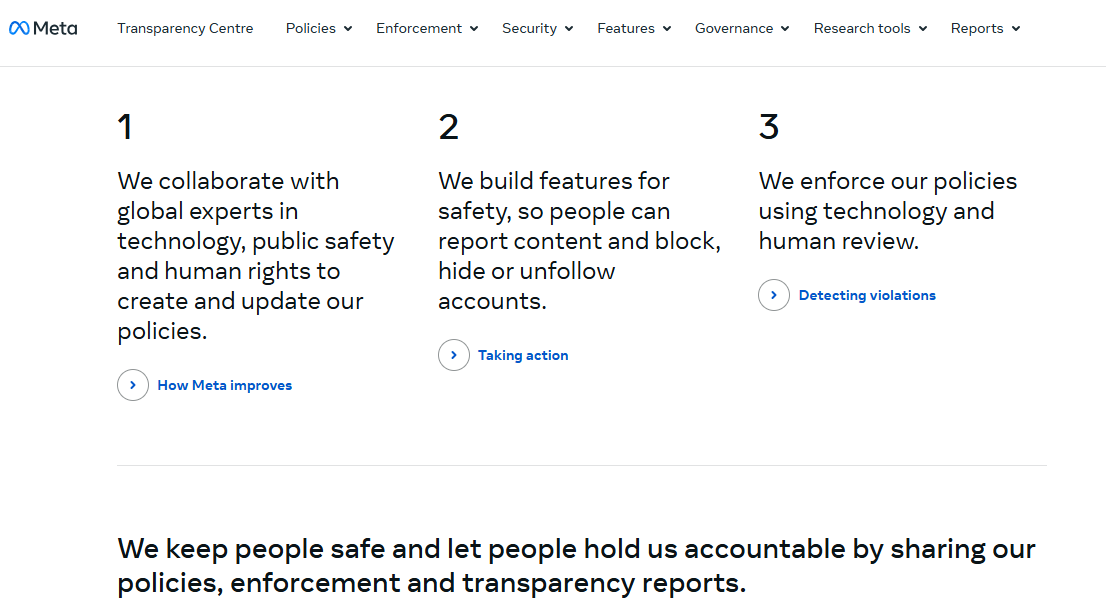
Those reports demonstrate that the company can produce detailed enforcement metrics when required or strategically beneficial. There is no comparable reporting on billing dispute resolution.
From a governance standpoint, this distinction matters. Advertising spend is not merely operational. For small businesses, it is working capital. When an unexpected debit or credit reversal occurs, the financial impact may be immediate.
Unpredictability carries cost. A small ecommerce company operating on thin margins cannot easily absorb a disputed four or five figure adjustment while waiting weeks for clarification. Cash flow disruptions may delay inventory purchases or payroll.
The current structure also creates incentives that may not align with platform interests. In the absence of a formal internal appeal ladder, some advertisers turn to external chargebacks through banks. Yet chargebacks can trigger account restrictions or further review, as discussed in digital marketing communities.
Chargebacks also impose processing costs on platforms. A clearer internal arbitration framework could reduce those external disputes.
From Meta’s perspective, publishing a standardized billing appeal process would not necessarily increase liability. It could instead reduce friction by clarifying eligibility criteria and timelines. It would also demonstrate procedural accountability in a space where advertiser trust is foundational.
Advertising is Meta’s16 primary revenue engine. According to the company’s 2023 Form 10K filing, advertising revenue represented nearly all of total revenue.
When a company derives the overwhelming majority of its income from advertiser payments, billing transparency becomes not just a support issue but a core governance question.
At present, the evidence suggests that Meta handles billing disputes through operational channels rather than through a formalized appellate structure. Disputes are processed. Credits are sometimes issued. Refunds sometimes occur. But there is no clearly documented, publicly accessible ladder that advertisers can reference when navigating a credit reversal or unexpected debit.
For small businesses, that uncertainty is itself a risk factor.
A defined appeal pathway with published timelines and outcome metrics would benefit both advertisers and the platform. It would reduce unnecessary escalation, standardize expectations, and signal accountability. In a system built on measurable advertising performance, measurable billing governance would be a logical extension.
Assessing the Evidence and Recommendations for Greater Transparency
It is important to separate perception from proof. The available public evidence does not establish a coordinated policy of unfair credit clawbacks targeting small businesses. Promotional credits often carry conditions. Risk detection systems may reverse suspicious activity. Expiration dates may pass unnoticed.
At the same time, the recurring forum accounts, combined with reporting on billing glitches and delayed refunds, indicate a pattern of opacity. The problem may be less about intent and more about process design.
Small businesses are not asking for guaranteed refunds of poor performing ads. They are asking for clarity when balances change unexpectedly. They are asking for defined escalation when support responses do not resolve discrepancies.
In financial services, dispute resolution frameworks are heavily regulated. In digital advertising, similar protections are less defined. Advertising platforms operate under contract law and internal policy rather than formal consumer banking standards.
This regulatory gap leaves advertisers dependent on platform goodwill and operational efficiency.
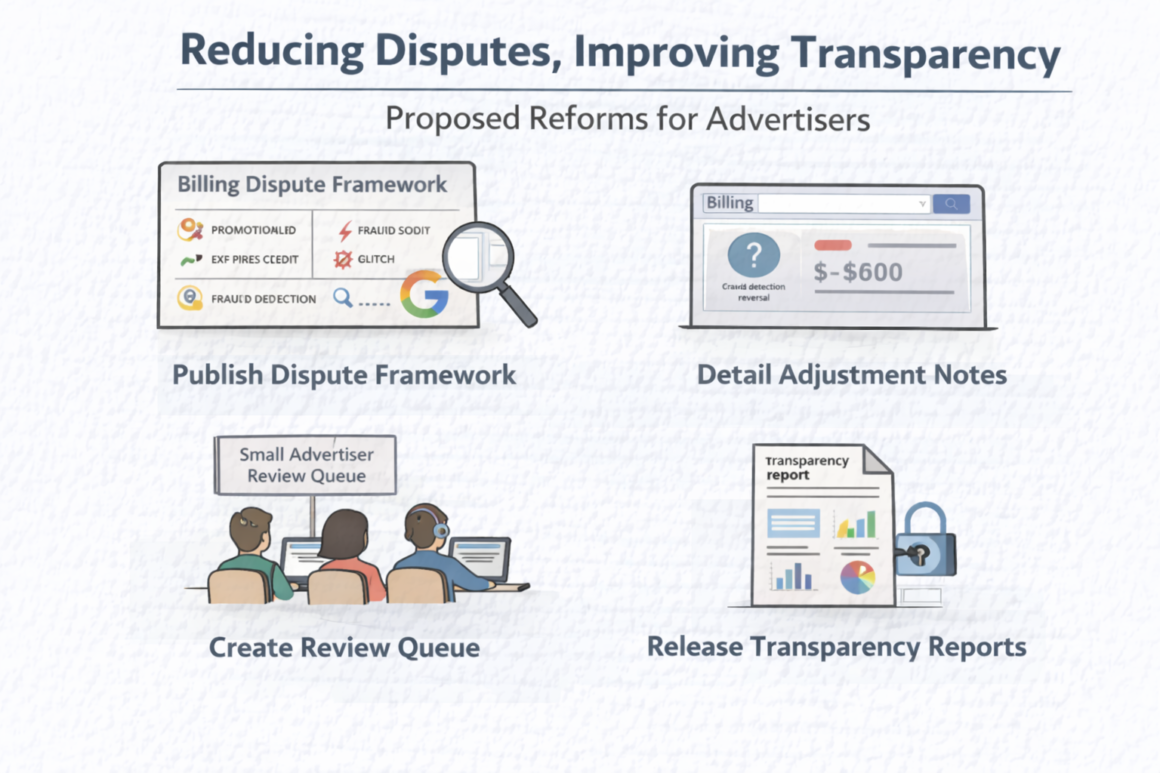
Based on the evidence reviewed, several practical reforms could reduce friction and restore confidence.
First, publish a dedicated billing dispute framework. Outline categories such as promotional credit expiration, fraud detection reversal, system glitch adjustment, and unauthorized access. Provide estimated review timelines.
Second, integrate detailed adjustment notes directly into the billing dashboard. Each reversal or debit should include a plain language explanation referencing the relevant policy clause.
Third, establish a small advertiser review queue for disputes under a defined monetary threshold. Even limited human oversight would improve trust.
Fourth, release aggregate transparency reports summarizing billing dispute volumes and resolution rates. Such data would contextualize the scale of the issue.
These measures would not eliminate every dispute. They would, however, demonstrate commitment to procedural clarity.
Meta’s advertising infrastructure is foundational to modern small business marketing. It delivers reach, targeting, and measurable outcomes at unprecedented scale. With that scale comes complexity. Billing systems are automated. Credits are conditional. Risk detection is algorithmic.
The evidence available today does not prove systemic abuse in credit reversals. What it does reveal is a recurring gap in communication and procedural transparency. When credits disappear or charges post without clear explanation, small businesses often struggle to find structured recourse.
For a platform built on measurable performance and data driven precision, the next step may be applying the same rigor to billing governance. Clear escalation paths, detailed adjustment logs, and publicly defined timelines would strengthen trust across the advertiser ecosystem.
As this research continues, further documentation from affected advertisers will help clarify whether the issue is episodic or structural. In either case, transparency is not only a reputational safeguard. It is a competitive advantage.
Small businesses rely on predictable systems. When predictability falters, confidence follows. Strengthening billing clarity is not a dramatic reform. It is an operational refinement. And for millions of advertisers navigating tight margins, refinement matters.
Sources
- “Facebook” www.facebook.com/business/ads/review-policy-guidelines. Accessed 20 Feb. 2026. ↩︎
- 10, September. “Meta Ads Refund Policy: Why Refunds Are Rare—and How to Avoid Needing One” Spider AF, 10 Sept. 2025, global.spideraf.com/articles/meta-ads-refund-policy-why-refunds-are-rare–and-how-to-avoid-needing-one. Accessed 20 Feb. 2026. ↩︎
- Vanian, Jonathan. “Major Facebook ad glitch has advertisers asking about refunds” 26 Apr. 2023, www.cnbc.com/2023/04/26/meta-suffered-a-major-facebook-ad-glitch-clients-asking-about-refunds.html. Accessed 20 Feb. 2026. ↩︎
- Rathore, Abhishek. “Facebook and Instagram Aren’t Refunding Small Businesses Fast Enough After Ad Glitch” Retail Media Labs, 17 May 2023, retailmedialabs.com/facebook-and-instagram-arent-refunding-small-businesses-fast-enough-after-ad-glitch/. Accessed 20 Feb. 2026. ↩︎
- Times, Economic. “No relief to Meta Platforms from advertisers’ lawsuit” The Economic Times, 13 Jan. 2025, economictimes.indiatimes.com/news/international/business/no-relief-to-meta-platforms-from-advertisers-lawsuit/articleshow/117213004.cms. Accessed 20 Feb. 2026. ↩︎
- Reddit, www.reddit.com/r/FacebookAds/. Accessed 20 Feb. 2026. ↩︎
- Reddit, www.reddit.com/r/FacebookAds/comments/1jl43kh/hacked_meta_ads_account_45k_spent_overnight_no/. Accessed 20 Feb. 2026. ↩︎
- Black Hat SEO Forum, Cloudflare, www.blackhatworld.com/. Accessed 20 Feb. 2026. ↩︎
- “About Advertising Restrictions” Meta Business Help Center, www.facebook.com/business/help/975570072950669?id=434838534925385. Accessed 20 Feb. 2026. ↩︎
- “Meta Business Help Center: Help, Support & Troubleshooting” Meta Business Help Center, www.facebook.com/business/help. Accessed 20 Feb. 2026. ↩︎
- Meta, Cloudflare, investor.atmeta.com/home/default.aspx. Accessed 20 Feb. 2026. ↩︎
- “Consumer Complaint Database” Consumer Financial Protection Bureau, www.consumerfinance.gov/data-research/consumer-complaints/. Accessed 20 Feb. 2026. ↩︎
- “Meta Technology Company | BBB Business Profile” Better Business Bureau, www.bbb.org/us/ca/menlo-park/profile/electronics-and-technology/meta-technology-company-1116-385674. Accessed 20 Feb. 2026. ↩︎
- “Dispute Resolution” Visa, usa.visa.com/support/small-business/dispute-resolution.html. Accessed 20 Feb. 2026. ↩︎
- “Transparency Center” transparency.meta.com/. Accessed 20 Feb. 2026. ↩︎
- Meta, investor.atmeta.com/home/default.aspx. Accessed 20 Feb. 2026. ↩︎




interesting