
The invisible workforce powering some of the world’s most powerful AI systems is being switched off, one account at a time, with no explanation and no recourse. This is what that looks like from the inside.
There is a particular kind of silence that comes from a company that has decided you no longer exist.
No phone call. No meeting. No explanation. Just an email, or sometimes nothing at all. Just a login screen that no longer recognizes you. You had work yesterday. You do not have work today. And no one, anywhere, will tell you why.
This is the experience of dozens of contractors who have worked for Appen1, the Australian AI data company now operating its crowdwork platform under the name CrowdGen. For years, these workers, called “contributors” in the language of the platform, trained the AI systems that power some of the most widely used products on earth. They labeled images. They rated search results. They evaluated the outputs of large language models for companies like Google, Apple, Microsoft, Meta, and Amazon. They were, in a very real sense, the hands and eyes inside the machine.
And then, for many of them, the machine turned off.
The Work Nobody Talks About
Before we get to the deactivations, it helps to understand what Appen contractors actually do, because most people who use the products their work improves have never heard of them.
Appen2 is a veteran data labeling firm based in Australia, in business since the 1990s. Appen built one of the largest global crowds of annotators, over one million contributors, and handles everything from search engine result evaluation to image tagging and speech transcription. Their growth came partly through acquisitions, buying up platforms like Figure Eight and crowdworking outfits across the globe, until they had assembled what looked, on paper, like an empire of invisible labor.
Data labelers carry the AI supply chain on their backs, yet their status in the gig economy ecosystem means they can and will be exploited by black box algorithms and unreasonable working conditions. Privacy International, which has tracked the data labeling industry closely, put it bluntly in a 2024 report. The workers behind the training datasets powering the biggest language models are caught in a system where the power differential is almost total.
The money, when it comes, is modest. Reviews on Glassdoor and Trustpilot describe pay of between five and fifteen dollars an hour for evaluations that require real cognitive effort. Glassdoor3 reviews from 2024 and 2025 describe low pay, no-notice termination, and a hiring process that is not transparent. One reviewer from New York in March 2025 put it plainly under the “Cons” column: “No notice termination. No good pay. Not so transparent hiring process.”
That is a remarkable thing to write about a company whose clients include the largest corporations in human history. But it describes exactly the bargain Appen offers. You work for us. You help make the products that generate billions in quarterly profit for our clients. And in return, you get a contract that can end any time, for any reason, or for no reason at all, with no warning and no path back.
The Deactivation Machine
According to CrowdGen’s4 own official documentation, if you are found to be in violation of the CrowdGen Contributor Standards, your account will be deactivated, and you will no longer be eligible for projects. If your account has been deactivated and you think this is an error, you may submit an appeal by contacting the platform.
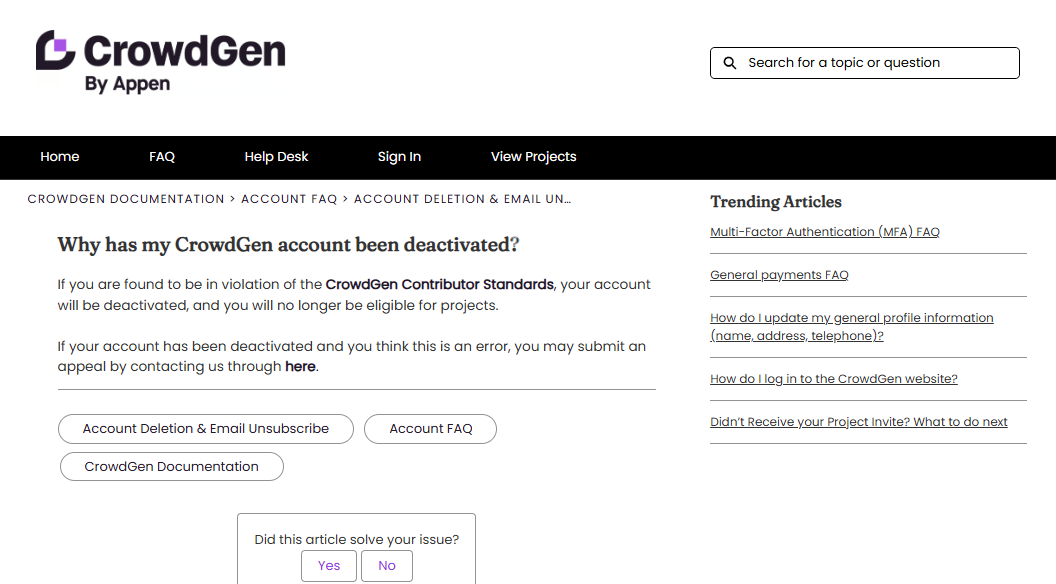
That is the full official text on the company’s support page addressing account deletion. It is thin. It tells you nothing about what the “Contributor Standards” actually require in practice, what conduct triggers a violation, how the determination is made, who makes it, or on what timeline a response to an appeal can be expected. The appeal process, such as it is, is a link to a generic help desk.
What people actually experience is a different matter.
On Trustpilot5, the reviews of CrowdGen make for uncomfortable reading. One contributor wrote: “I was deactivated from CrowdGen with a vague accusation of violating Contributor Standards, which I firmly believe is false. I followed all guidelines and was never warned or informed of any issue.” Another wrote that they had been working on the platform since 2020 and that in the last year and a half, Appen had become “a lot more inept and untrustworthy operation, with no actual work or projects it seems like, and have now deactivated my account.”
The same Trustpilot page carries another account, longer and more detailed, which describes a different flavor of the same problem. A contractor who had worked on Appen’s major projects for “over eleven years” described how after 2024, Appen somehow managed to lose two large projects. The reviewer described Appen’s website as “a ghost town these days,” and concluded:
“There are no redeeming qualities to this company; management seems clueless.”
Eight years. Eleven years. These are not new sign-ups who got confused about the terms. These are people who had organized their working lives, at least in part, around the income Appen provided, and who found themselves cut off without explanation.
One review, posted in March 2026 by a contributor who described themselves as a worker of nearly a decade, described the experience as “a masterclass in how to alienate long-term contractors through technical incompetence” and characterized months of account restrictions as “verification gaslighting.” They called it, simply, a shadowban.
The Google Collapse and What It Revealed
To understand why deactivations have accelerated, you have to understand what happened to Appen’s business.
In January 2024, Alphabet6 informed Appen that all contracts between the two companies would be terminated, effective March 19, 2024. Since contracts with Google accounted for roughly one-third of Appen’s business revenues, this decision had a devastating impact on at least two thousand subcontracted Alphabet workers and their families in the United States and Canada.
The Google contract, estimated to be worth $82.8 million, was a significant portion of the $273 million in total revenue Appen made the previous year. Google’s decision to end the contract was part of a broader approach to optimize vendor operations. Appen notified the Australian Securities Exchange in a filing that they had “no prior knowledge of Google’s decision to terminate the contract.”
That last line is worth sitting with. A company that employed, at its height, over a million contractors across the globe was not told in advance that its single largest client had decided to walk. The workers below Appen in the chain found out later still, if they found out at all.
The Alphabet Workers Union, a branch of the Communications Workers of America, had been warning that this was coming. In a press release issued in January 2024, the union said:
“This news should be a wake up call for workers in the tech industry and anyone concerned about the impacts of AI on working people. As subcontractors for Google we have been a canary in the AI coal mine calling out the precarious labor conditions we face being the human workers standing between large language models and their end users.”
The union called out what it said was a pattern of work without severance, transparency, or accountability. Many Appen raters, the union said, chose this work despite its downsides because they had obligations to care for family members at home, were themselves living with illness and disability, or lived in economically depressed regions where better wages were unavailable.
Google, for its part, told reporters it was working to make the transition “as smooth as possible.” The workers who lived through it might use different words.
The Union Fight That Appen Lost
The Google termination was not the first time Appen had clashed with the people it relies on most.
In 2023, the company had a reckoning in the form of the National Labor Relations Board. Workers received correspondence from Appen Human Resources informing them they would get their jobs back and receive back pay, after an NLRB-related dispute over the company firing contractors who had spoken out about their working conditions. One reinstated worker told the Alphabet Workers Union7:
“I am absolutely thrilled that we are being reinstated and getting back pay. I am also very happy for my co-workers because getting fired for speaking out caused a lot of stress and anxiety.”
The language here is precise and deliberate. The workers were fired for speaking out. Not for poor performance. Not for violating any code of conduct. For speaking.
This matters enormously to understanding the deactivation problem. When a company has already been found, at least in the NLRB context, to have fired workers for organizing or complaining, and when that same company operates a deactivation system that offers no explanation, no warning, and no meaningful appeal, the question of what exactly triggers a deactivation becomes urgent and unanswerable.
The Appen-Google relationship had been troubled for years, including a historical dispute over wages. CNBC8 reports that Google set a minimum wage requirement of $15 per hour for its contractors, a standard that Appen reportedly failed to meet, leading to conflicts and public letters from workers. Despite efforts to address labor concerns, the NLRB charges were filed in June 2023 for allegedly firing six freelancers who spoke out about workplace conditions. The reinstatement that followed was a legal victory, but it was also a glimpse into how readily the company had reached for the deactivation option when workers became inconvenient.
What “Appeal” Actually Means
The appeal process, on paper, exists. The CrowdGen documentation says you can contact the platform if you think the deactivation is an error. What it does not say is: how long a response will take, whether anyone will actually review your case, what information you are entitled to receive, or whether the outcome can be changed.
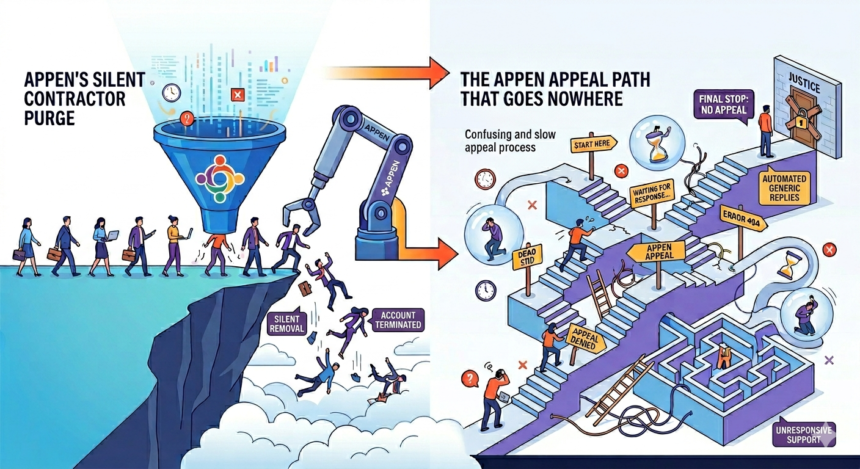
In practice, the accounts from workers suggest the appeal path leads to a wall.
This pattern is not unique to Appen. Across the gig economy, the combination of algorithmic decision-making and contractor status has created a class of workers with essentially no procedural rights. Automated systems may deactivate workers without warning, cutting off their sole source of income without due process. Workers are often subject to opaque decision-making systems that they cannot contest or even fully understand. These “black box” algorithms create extreme power imbalances. A delivery rider may be penalized for late arrivals without being aware of the criteria used to assess performance.
The ImpACT International human rights organization9, in a 2025 report on platform labor, described this as one of the defining human rights risks of the current economic moment. The word they used, “due process,” is borrowed from constitutional law. It means, in its simplest form, the right to know what you are accused of and to answer the accusation before punishment falls.
Appen’s contractors, it appears, have neither.
In 2025, Amazon, Google, and Meta refused to disclose which human annotation services they used to develop their AI models, making it nearly impossible to assess working conditions. This secrecy compounds the deactivation problem. Workers labor for companies whose identities they often do not know, on projects whose ultimate purpose is sometimes obscure, and they can be removed at any time by an entity several layers up the supply chain that does not acknowledge their existence.
Data labelers for Appen say they have little insight into how their work is used. Rest of World10, which has covered the global gig economy with remarkable depth, reported in February 2026 that gig workers in Africa had no idea they were helping the US military. A detail that underscores how far removed these workers are from any meaningful transparency about their role.
The Regulatory Vacuum (and One Small Exception)
The political and regulatory environment that might protect these workers has been, to put it plainly, in retreat.
According to NPR11, in January 2025, President Trump fired NLRB General Counsel Jennifer Abruzzo via email. Trump’s choice of replacement could determine what happens to the agency’s efforts to hold Amazon and Alphabet liable for the treatment of subcontracted staff, whom the companies claim are not their employees. Abruzzo had spent three and a half years pursuing cases against employers, including Starbucks, Apple, Tesla, and the New York Times.
For Appen contractors specifically, who won a modest victory through NLRB pressure in 2023, the neutering of the federal labor enforcement apparatus is not an abstract political development. It is the closure of their best available legal path.
There is, however, one bright spot in the regulatory landscape, and it is in Seattle.
Effective January 1, 2025, Seattle’s App-Based Worker Deactivation Rights Ordinance12 gives covered app-based workers the right to receive fair notice of a deactivation policy, 14 days’ notice before deactivation except in cases of egregious misconduct, and the right to challenge deactivation through an internal procedure. The notice must include the reason for deactivation, the specific incidents that violated the company’s policy, and all records the company relied on to make its decision.
That is a genuinely meaningful set of protections. It requires exactly the kind of transparency and procedural fairness that Appen’s current system lacks. Notice. Reasons. Evidence. A real challenge mechanism.
The problem is that it covers app-based workers in Seattle. Appen’s contractor base spans the globe. Most of them are in jurisdictions where no comparable law exists, and many of them are in countries where labor protections of any kind are limited. The Seattle ordinance is a model worth studying, but it is a life raft for a very small portion of a very large sea.
A Fairwork13 research project that assessed 15 digital work platforms, including Amazon Mechanical Turk, Scale AI, and Appen, found that all of them were “still far from safeguarding basic standards of fair work.” The researchers were not using some radical standard. They were applying basic principles: fair pay, fair conditions, fair contracts, fair management, and fair representation. Appen failed across the board.
The Bigger Picture
There is a version of this story that Appen and companies like it would prefer you focus on. In that version, contractors are independent workers who chose a flexible arrangement, who understood the terms, and who cannot reasonably expect the protections of employment when they have declined to be employees.
There is something to that argument, legally speaking. Independent contractor status, in most jurisdictions, does not come with just-cause protections. You can be let go. The relationship can end.
But the argument fails in practice for a simple reason: the “independence” in Appen’s arrangement is largely fictional. The CWA’s14 Ghost Workers in the AI Machine report documents that the AI data workforce lacks basic protections including meaningful notice of layoffs, protections against surveillance, and any severance in the event of termination. Workers who spent years becoming experts in Appen’s quality standards, who passed the company’s own qualification tests, who maintained the accuracy scores the platform required. These are not arm’s-length independent contractors exercising market autonomy. They are workers who have invested substantially in a relationship with a single platform that can be ended by a click.
The fight for better treatment of microworkers in the gig economy has been a long one, riddled by more platforms emerging in different sectors faster than policy can keep up. It took years for the European Parliament to even consider enshrining the rights of platform workers in the form of the Platform Work Directive. The International Labour Organisation15 has a report on decent work in the platform economy that could lead to new international labor standards. Could. Eventually. In the meantime, the deactivations continue.
Human Rights Watch16 wrote letters in March 2025 to officials within the US Department of Labor, the Federal Trade Commission, and the Texas Workforce Commission, sharing findings about algorithmic, wage, and labor exploitation in platform work in the US. The Department of Labor acknowledged receipt but did not provide a comment. None of the other agencies had responded.
What Workers Are Left With
Go to any forum where Appen and CrowdGen contractors gather and the same questions appear, over and over, unanswered.
Why was my account deactivated? Is anyone reviewing my appeal? Is there a human being on the other end of this ticket?
One contributor wrote on the CrowdGen Trustpilot page:
“Appen’s glory ended years ago. One day they decided to suspend my account for violating something.”
The sentence trails off with the incompleteness of the experience itself. Violating something. They could not even say what. Because Appen had not told them.
Another Trustpilot reviewer who described working on CrowdGen since 2019 wrote:
“In October 2024 the platform changed, and it has been downhill ever since. Little work is available, and I am rejected for the few projects I do apply for. Today I received an email asking me to verify my address. Really? After working with them for more than 6 years.”
The verification demand, after six years. That is the company signaling, without quite saying it, that your history with them counts for nothing. You are a number in a database, and the database has decided you need to re-prove yourself.
I find it hard to read these accounts and not feel something like anger. Not the clean, productive anger that leads to systemic change, but the low, grinding kind that comes from watching something unjust happen slowly, in plain sight, to people who did nothing wrong.
These workers trained the AI systems that now, in many cases, threaten to replace them. They built the tools of their own potential obsolescence, at poverty-adjacent wages, with no benefits, no sick pay, no job security, and now, it turns out, no meaningful right to know why they were let go.
The Question That Doesn’t Get Asked
The tech industry loves to talk about AI ethics. There are entire departments devoted to it, conference tracks, keynote speeches, think pieces, principles documents. Responsible AI. Trustworthy AI. Human-centered AI.
But the humans most directly involved in making AI systems work, the annotators, the raters, the evaluators, the people who spend hours a day making judgment calls so that machines can learn to approximate judgment, are almost never the humans whose interests get centered.
While AI may seem like a magic box of tricks, behind the scenes millions of people are working to annotate and correct data, often in poor conditions and for low pay.
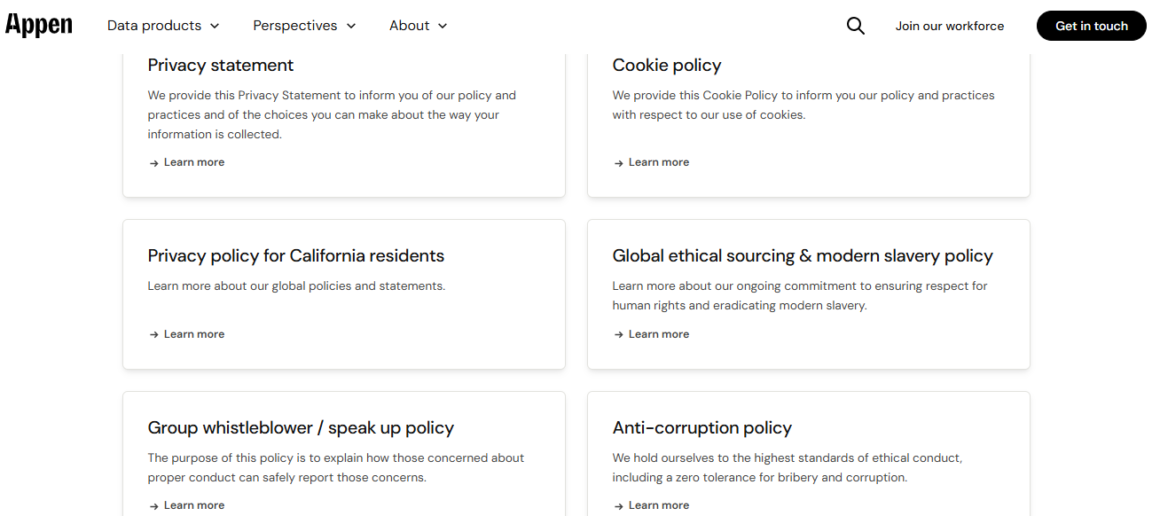
Appen17, for its part, has made some gestures toward reform. The company has said it introduced new pay rates to ensure all contributors are paid at least the local minimum wage equivalent, and it provides on-demand access to wellness services for contributors working on sensitive or high-risk projects. It has stated a zero-tolerance policy on forced labour. These are not nothing. Paying minimum wage is, after all, the legal floor.
But minimum wage with no job security, no appeal rights, and no explanation when you are removed is still a bad deal. A floor is not a ceiling.
As of early 2026, Appen continues to operate CrowdGen, continues to take on new contributors, and continues to lose them, suddenly and without explanation, in numbers that are difficult to track precisely because the company does not report them and the workers have no union to count their losses.
Yahoo!Finance18 reports that Appen’s annual revenues in 2024 were around $234 million, sizable but now dwarfed by newer rivals. The company that was once the dominant player in AI data services is fighting for relevance in a market that has moved past it. Scale AI, DataAnnotation, and newer platforms have taken significant market share. The Google contract is gone. The Meta relationship is uncertain. The share price has fallen, by some measures, more than 99% from its peak.
In that context, the sudden, silent deactivations of long-term contractors make a grim kind of business sense. A company under financial pressure, with fewer projects to assign, has an incentive to shrink its contractor base without going through the costly and complicated process of a formal layoff. The “Contributor Standards” become a convenient instrument. A vague policy, applied opaquely, can accomplish what an employment termination cannot: it cuts someone off without triggering any legal obligation to explain why.
That is not an accusation. It is a pattern that the available evidence supports.
The question for anyone who uses Google Search, who talks to Bard or Gemini, who relies on any of the dozens of AI products that Appen’s workers have helped build, is whether this matters to you. Not in an abstract sense. In a direct one.
The invisible people who made those products possible are owed, at minimum, a reason. The fact that they are not getting one is not an accident or an oversight. It is a choice.
Source
- “CrowdGen by Appen” CrowdGen by Appen, crowdgen.com/. Accessed 2 June 2026. ↩︎
- “About Appen – Excellence in AI is our Commitment” Appen, 2 Dec. 2024, www.appen.com/about-us. Accessed 2 June 2026. ↩︎
- Glassdoor, www.glassdoor.co.in/Reviews/Appen-Reviews-E667913.htm. Accessed 2 June 2026. ↩︎
- “CrowdGen Support” help.crowdgen.com/s/article/Why-has-my-CrowdGen-account-been-deactivated. Accessed 2 June 2026. ↩︎
- Trustpilot, www.trustpilot.com/review/crowdgen.com. Accessed 31 May 2026. ↩︎
- “Appen Contractors Speak Out Against Contract Cancellation” 22 Jan. 2024, www.alphabetworkersunion.org/press/appen-contractors-speak-out-against-contract-cancellation. Accessed 2 June 2026. ↩︎
- “Huge Win for Google Workers Union: Fired AI Raters Reinstated!” 23 June 2023, www.alphabetworkersunion.org/press/raters-reinstated. Accessed 2 June 2026. ↩︎
- Field, Hayden. “Alphabet cuts ties with Australian AI firm that helped train Bard and Google Search” 23 Jan. 2024, www.cnbc.com/2024/01/23/alphabet-ends-contract-with-appen-which-trained-bard-google-search.html. Accessed 2 June 2026. ↩︎
- ImpACT, impactpolicies.org/news/475/labour-rights-in-2025-tackling-exploitation-in-global-supply-chains. Accessed 2 June 2026. ↩︎
- “Rest of World on Instagram, Niamh McIntyre, Edwin Okoth, and Cam Wilson🎨 Oliver Kemp”” www.instagram.com/p/DVHMyGtE8FU/. Accessed 31 July 2026. ↩︎
- Hsu, Andrea. “Trump fires EEOC and labor board officials, setting up legal fight” 28 Jan. 2025, www.npr.org/2025/01/28/nx-s1-5277103/nlrb-trump-wilcox-abruzzo-democrats-labor. Accessed 2 June 2026. ↩︎
- “OLS_AppBasedWorkers_Deactivation2024_11x17poster_Final” 2 Dec. 2024, www.seattle.gov/documents/Departments/LaborStandards/www.seattle.gov/documents/Departments/LaborStandards/OLS_AppBasedWorkers_Deactivation2024_11x17poster_Final%20%281%29.pdf. Accessed 2 June 2026. ↩︎
- “Amazon Mechanical Turk (Cloudwork)” Amazon Mechanical Turk (Cloudwork), fair.work/en/ratings/platforms/cloudwork-amazon-mechanical-turk/. Accessed 2 June 2026. ↩︎
- “Ghost Workers in the AI Machine:” Communications Workers of America, cwa-union.org/ghost-workers-ai-machine. Accessed 2 June 2026. ↩︎
- International Labour Organization, www.facebook.com/ILO.ORG/videos/the-new-ilo-convention-no-193-on-decent-work-in-the-platform-economy-adopted-by-/1071676315433070/. Accessed 31 July 2026. ↩︎
- “The Gig Trap” 12 May 2025, www.hrw.org/report/2025/05/12/the-gig-trap/algorithmic-wage-and-labor-exploitation-in-platform-work-in-the-us. Accessed 2 June 2026. ↩︎
- “Appen Legal Policies” Appen, www.appen.com/legal-policies. Accessed 31 July 2026. ↩︎
- Yahoo!Finance, finance.yahoo.com/news/appen-ltd-appef-fy-2024-090056631.html. Accessed 2 June 2026. ↩︎