

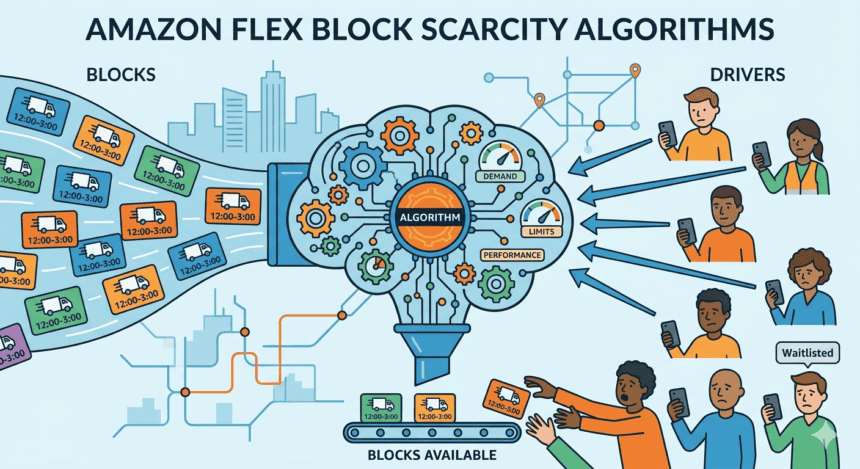

How one of the world’s wealthiest companies engineered artificial scarcity to extract maximum labor at minimum cost, and what it means for the millions chasing blocks that vanish before their fingers can tap
- How the Block System Actually Works
- The Tiered Visibility System
- Surge Pricing: Manufactured Urgency
- The Bot Problem Is Really a System Problem
- What the Algorithm Knows About You
- The Tip-Stealing Precedent and the Pay Squeeze Nobody Is Talking About
- The Scarcity Effect as Management Philosophy
- What Amazon’s Scheduler Favors
- The Reform Question
It is 4:47 in the morning, and someone in a Walmart parking lot in Stockton, California is staring at a phone screen, jabbing at a refresh button that hasn’t changed in forty minutes. The Amazon Flex app sits there, its orange interface almost mocking in its brightness against the predawn dark. No blocks available. No blocks available. No blocks available.
This is the daily ritual for hundreds of thousands of drivers across the United States. Some will do this for two hours and walk away with nothing. Others will hit refresh at precisely the right millisecond and land a four-hour block paying $72. And a small, quietly growing subset will let a piece of software do the tapping for them. An arms race that reveals, more than anything else, just how broken the underlying system has become.
Amazon Flex1, launched in 2015, promised something genuinely appealing: use your own car, set your own hours, earn between $18 and $25 per hour delivering packages. Over a decade in, that promise feels hollow to a lot of people living it. What they describe instead is a finely tuned psychological machine. One that uses artificial scarcity, behavioral manipulation, and algorithmic opacity to keep a surplus labor pool compliant, hungry, and competing against itself.
How the Block System Actually Works
To understand the algorithm, you first need to understand what a “block” is. A delivery block is a scheduled window of time, typically three to five hours, during which a driver picks up packages from a fulfillment center and delivers them. Drivers can reserve one to three blocks per day at Standard level, and the blocks themselves appear in the Flex app at irregular intervals throughout the day.
That irregularity is not an accident.
Amazon releases delivery blocks slowly, creating a perception of limited availability. The company controls the timing of when blocks appear, how many appear at once, and which drivers see which offers. Experienced drivers know there are typically two windows when new blocks drop, roughly mid-morning and mid-afternoon, but the exact timing is never published, and it shifts. As Chad Polenz, a Florida-based driver who documents the gig economy on YouTube, told NBC2:
“You start to learn when shifts become available, but there’s no guarantee you’ll open the app and something will be there. It’s completely unpredictable.”
The unpredictability is a feature, not a bug. When you cannot predict when your next paycheck opportunity will appear, you stay close to the app. You check it constantly. You structure your day around it. This is, in behavioral psychology terms, a variable ratio reinforcement schedule — the same mechanism that makes slot machines addictive. The unpredictable reward keeps you pulling the lever.
But the design choice that truly reveals Amazon’s intent is the window you have to accept a block once it appears. Drivers have seconds to claim a shift by swiping on the block, then tapping “accept.” If you are not already in the app, already watching, already alert, it is gone. The competition can be cutthroat, with hundreds of drivers competing for a handful of blocks at the same time.
That math of hundreds of drivers, a handful of blocks, is not incidental. It is the entire architecture.
The Tiered Visibility System
One of the least-discussed aspects of the Flex algorithm is that not all drivers see the same blocks at the same time. Amazon has built a tiered access system that quietly determines which opportunities reach which drivers. And it is more complex than the company lets on publicly.
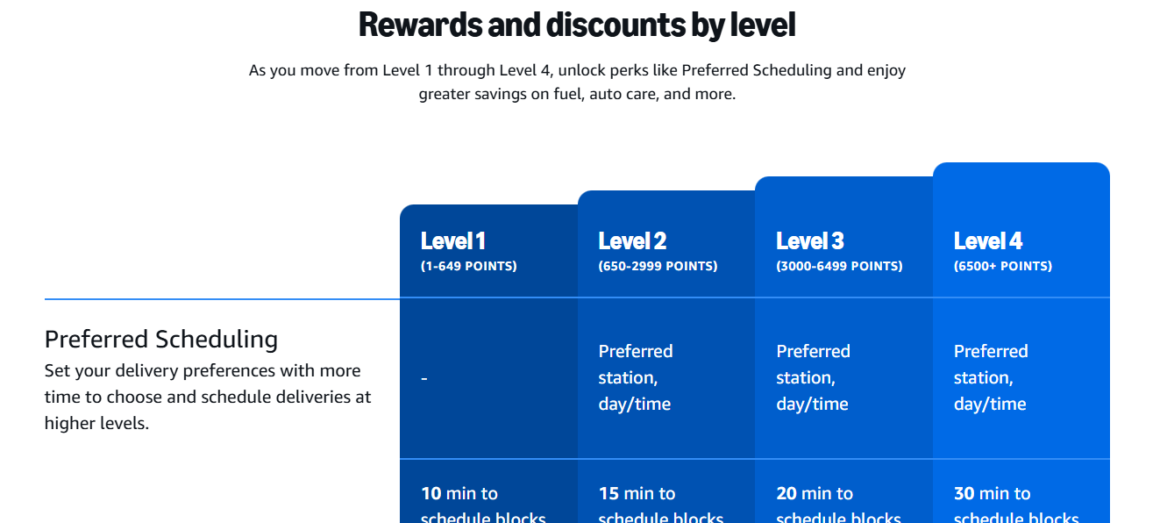
At the base level, new drivers sit at Standard status and see only basic logistics blocks at their home delivery station. Fresh and Whole Foods blocks, which pay more and include customer tips, are not available at Standard level. You cannot transfer regions. You see a limited pool.
According to Flex Assist3, to graduate to Level 2, a driver needs to complete somewhere between 15 and 30 blocks with strong performance metrics: on-time arrival of 95 percent or better, a completion rate at or above 98 percent, and no cancellations within 45 minutes of a block’s start time. Cross that threshold and the world opens up: Fresh and Whole Foods become available, surge-pay logistics blocks appear, and critically, you get priority access to next-day blocks released the evening before, before most of the driver pool even knows they exist.
The difference in earnings is not marginal. Level 2 is the level every Flex driver actually wants. It is the difference between $14 and $22 per hour in effective earnings.
Above Level 2 sit Premium and Reserved tiers, where scheduling priority means being the first to see new blocks as soon as they are released. Reserved status is rare, handed out to drivers in markets where Amazon wants to retain top performers. The algorithm essentially creates a caste system where the people at the top eat first, and everybody else fights over what is left.
The standing system, meanwhile, is ruthless. Your delivery quality score is calculated daily, incorporating on-time arrival, package completion rates, and customer feedback. Amazon4 indirectly says that low ratings reduce the number of offers you see. There are no published thresholds. There is no formal appeals process for a bad rating that came from a wrong address, a dog in the driveway, or a customer who left a false complaint. The system just quietly shows you fewer blocks and lets you figure out why.
Surge Pricing: Manufactured Urgency
Here is where the scarcity becomes most nakedly transactional. Amazon’s surge pricing system works like this: when blocks go unclaimed, usually because the pay rate is too low for the labor involved, Amazon increases the rate to attract drivers. Surge blocks can pay $5, $10, $15, or even $20 or more above the base rate. During the holiday season, block availability increases dramatically, and surge rates can climb $15 to $25 above base.
But the more interesting mechanism is the time-based escalation. As the start time for a block approaches, the pay rate may increase even more. This creates urgency for drivers waiting to grab the most profitable blocks. And then comes the twist: if drivers do not accept a surged block quickly, the algorithm may lower the pay rate again. Accept fast or lose the money. There is no time to think. Rational calculation is the enemy of the system.
When asked about this, Amazon gives the most anodyne possible response. According to Ridesharing Driver5, the company’s public explanation is:
“Earnings are based on a variety of factors. During high customer demand, Amazon’s contribution may increase, which will translate into higher earnings.”
That is the whole explanation. No formula. No thresholds. No transparency about what triggers the surge, when it reverses, or why two drivers in the same city might see different rates for the same block.
The opacity is not incidental either. Information asymmetry is a management tool. If drivers knew exactly when blocks would surge, they could wait strategically. If they knew the precise triggers, they could game them. The fog keeps them compliant and keeps Amazon’s labor costs down.
The Bot Problem Is Really a System Problem
The logical response to an irrational system is to build a better machine. And that is exactly what a growing population of Flex drivers has done.
Bots, combinations of hardware and software that mimic the action of tapping on blocks, have been part of the Flex ecosystem for years. Apps like Flexer, iGrabber, Myflexbot, and others automate the entire process: configuring preferred stations and hours, refreshing the app continuously, and grabbing matching blocks the instant they appear. One driver reviewing the Flexer app6 put it plainly:
“I’m using it because I have to get with the competition in my area — either that or I’ll never work.”
What makes this fascinating from a systems perspective is that the bots did not emerge from greed. They emerged from desperation. The game was already rigged. The bots are just the logical response of people trying to survive inside a rigged game.
Amazon says it prohibits bots. The company told NBC7 it is “committed to creating fair opportunities for our delivery partners to secure delivery blocks” and that “the use of third party tools to accept work creates an unfair advantage, is against our policies, and can result in” account deactivation. The irony is thick enough to taste: a company that deliberately released blocks in unpredictable bursts, knowing that human reaction times would be tested to their limits, now claims that automation is the unfair advantage.
Amazon uses advanced AI to watch for unusual activity like extremely fast and consistent clicking. If the system suspects a bot, it flags the account. CAPTCHAs appear, and by the time the driver solves them, the block is usually gone.
The battle escalates. New bot generations learn to randomize click timing to mimic human behavior. A band of tech-savvy people within the Flex community continuously develop new bots, dodging Amazon’s digital defenses. With each new defensive measure from Amazon met by a more sophisticated workaround. This is not a side-story to the Flex algorithm. It is the story. The scarcity design created the bot ecosystem. The bot ecosystem now shapes the experience of every manual driver, who watches blocks vanish before their human fingers can react.
Drivers in forums and Facebook groups describe the result with weary clarity. One driver from Ontario, California, left a Trustindex8 note that read simply:
“Getting blocks can be very difficult due to bots.”
Another driver who stopped doing Flex in 2024 wrote that “the amount of gas spent for $67 in NY with traffic in region makes it not worth it.”
What the Algorithm Knows About You
The block scarcity system does not operate in isolation. It sits on top of a comprehensive surveillance infrastructure that Amazon uses to evaluate, rank, and ultimately control its driver pool.
According to NELP9, through Amazon Flex’s Terms of Service, Amazon controls most aspects of its relationship with drivers through technological surveillance and algorithmic management. Amazon uses an app to match drivers to available shifts, set pay and delivery loads, and track drivers’ performance. This formed the basis of a 2024 amicus brief filed by the National Employment Law Project arguing that Flex drivers should qualify for unemployment insurance under Virginia law. Because what Amazon described as independence was, functionally, control.
The surveillance goes pretty deep. Every delivery is tracked. On-time arrival to the fulfillment center is monitored. Package completion rates are logged. Customer feedback is incorporated. The standing is updated every day, and Amazon says it delivers notices if your ratings drop. Some drivers report that the notices do not always come and that deactivation can sometimes be swift and, in some cases, ruthless.
What is algorithmically determined goes unseen by the driver. There is no number you can point to, no threshold clearly published. One Amazon Flex driver, writing on Medium10, described a TikTok video that resonated with hundreds of other gig workers. A clip about how one missed package results in a significant hit to a performance rating, despite countless successful deliveries. This, the writer argued, is a classic example of labor precarity in platform-based gig work:
“income, delivery routes, and job stability are controlled by an unforgiving algorithm that relies heavily on a performance rating system.”
There is something almost philosophical about this arrangement. Amazon knows far more about each driver than any driver knows about Amazon’s decision-making. That asymmetry of information is where the real power lives. The algorithm should not be a secret, one driver-turned-writer concluded. But it is, and that is the point.
The Tip-Stealing Precedent and the Pay Squeeze Nobody Is Talking About
To understand why it is reasonable to view the block scarcity algorithm with suspicion, it helps to understand what we already know Amazon did when it had the chance.
According to CBS News11, in late 2016, Amazon secretly switched to a variable-pay system, where the amount drivers earned would fluctuate based on an internal algorithm. Under this system, Amazon could advertise a payment of “$18 to $24” for a particular delivery, but if a customer tipped $6, Amazon would only pay the driver $12, for an $18 total payment. Customers thought they were rewarding their driver. Amazon was pocketing the difference.
FTC12 data shows that Amazon continued to divert drivers’ tips during this time despite hundreds of driver complaints about the practice, critical media reports, and internal recognition that its conduct was a “reputation tinderbox.” Through these practices, Amazon ultimately pocketed over $61 million in tips meant for drivers.
According to TechCrunch13, the FTC fined Amazon $61.7 million in 2021 to settle the charges. Amazon denied wrongdoing. The algorithmic system that made the theft possible. The “variable base pay” formula that used real-world tip data to calculate how much Amazon itself would contribute was shut down. But the case established something important: when Amazon’s algorithm processed financial data about workers in private, it used that data against them.
The scarcity algorithm deserves to be read in that light. What other variables is it optimizing for that drivers cannot see?
While the media focus has been on bots and deactivations, drivers tell a quieter, more corrosive story about pay. The block prices that felt reasonable in 2020 and 2021 have not kept pace with inflation or fuel costs.
At a rally outside an Amazon fulfillment center in Woodland Park, New Jersey, in April 2024, drivers described a pay trajectory that went backward. One driver told PBS14:
“Two years ago I was getting paid $160, sometimes even $190. We went down from 160 to 120, then now we’re all the way down to $86 for 4-hour blocks. Not only that, they’re also sending us out there instead of giving us the blocks we had before with 32 stops, now we’re getting up to 50 stops for that amount of money.”
More stops, less money, same hours. The block scarcity mechanism makes this easier to pull off. When drivers are competing intensely for limited work, they accept what is available. There is no collective bargaining. Amazon uses independent contractor misclassification, mandatory arbitration, and class action waivers to minimize the responsibility it bears for driver conditions, according to a detailed report from the National Employment Law Project15. These are not coincidental policy choices. They are load-bearing walls of the entire business model.
In June 2024, WKOW 2716 reported that more than 15,000 Amazon Flex drivers filed legal claims alleging the company’s classification of them as independent contractors had led to unpaid wages and other financial losses. That is not a fringe complaint. That is a mass action.
The Scarcity Effect as Management Philosophy
The deeper you go into the Flex algorithm, the clearer it becomes that the block scarcity mechanism is not a product of technical constraints. Amazon is not releasing blocks slowly because it lacks the technical capacity to release them all at once. It is releasing them slowly because artificial scarcity is effective. It is releasing them unpredictably because unpredictability is effective. These are deliberate design choices grounded in behavioral economics.
The scarcity effect is a psychological principle where people place a higher value on something they perceive as limited or hard to get. This effect is driven by feelings of FOMO and loss aversion — the fear of losing an opportunity can lead to quick, often impulsive decisions, overriding rational thinking. The scarcity effect is used strategically by Amazon’s algorithms to manage delivery driver behavior and control labor costs.
What that means in practice is that drivers accept lower-paying blocks rather than risk waiting. They grab a $54 three-hour block today because what if nothing better appears tomorrow? The algorithm exploits exactly the kind of financial precarity that drives people to Flex work in the first place. People who can afford to wait, who have savings, other income, financial cushion, can play the long game and hold out for surge blocks. People who cannot afford to wait take what comes.
The system is, in other words, regressive by design.
A 2025 Human Rights Watch17 report on gig economy platforms reached a conclusion worth quoting at length. Six of the seven companies it studied use algorithms with opaque rules to assign jobs and determine wages, meaning that workers do not know how much they will be paid until after completing the job. The report found that gig workers are governed by algorithms that are “frequently opaque, making it difficult to understand how they are monitored, paid, evaluated, and fired.” Amazon Flex was named explicitly among the platforms studied.
According to TechPolicy18, researcher Veena Dubal, studying ride-hail drivers, described workers who expected a predictable hourly wage but instead found themselves subject to “algorithmic wage discrimination.” Pay that fluctuates minute by minute under rules hidden entirely from workers. The phrasing maps precisely onto Flex’s block and surge pricing mechanics.
What Amazon’s Scheduler Favors
Buried in practical guides written by experienced Flex drivers is a detail that reveals just how much behavioral data the algorithm processes. The Flex App19 says that the standing system weights recent activity, and Amazon’s scheduler favors drivers who accept blocks regularly over those who appear and disappear. Consistency is algorithmically rewarded not just with good standing but with better block visibility.
This creates a peculiar trap. To get the best blocks, you need high standing. To get high standing, you need to accept blocks regularly. To accept blocks regularly in a competitive market, you need to be constantly available. But the blocks appear unpredictably, so “constantly available” means being tethered to the app for hours each day. Often earning nothing during those hours.
One of them summarized the dynamic bluntly:
“Three blocks per day for four days beats six blocks in one day followed by three days off.”
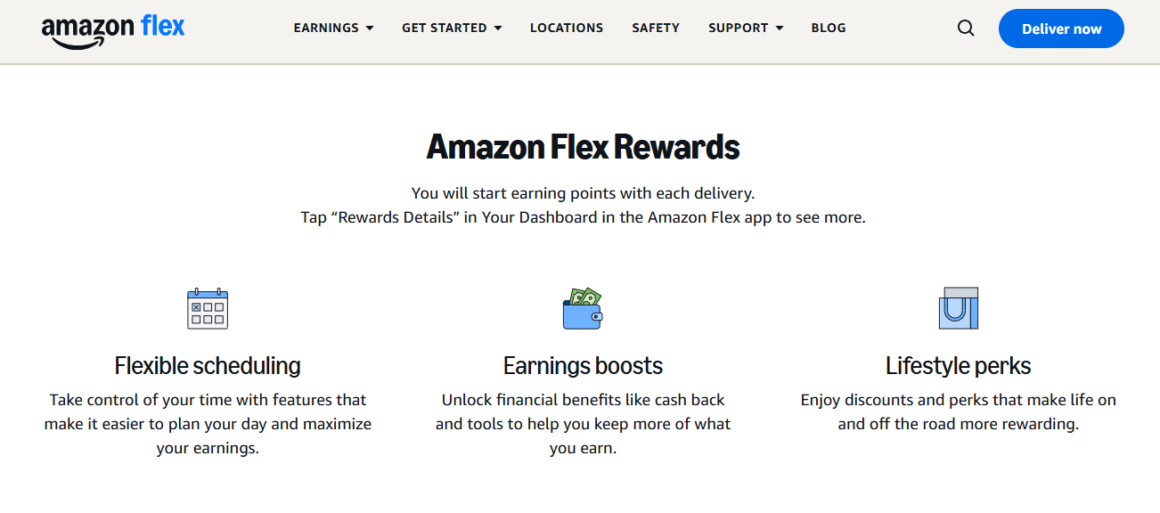
The algorithm does not care that a human being might have other obligations, children, medical appointments, or a second job. It optimizes for steady supply, and it rewards those who can restructure their lives around its preferences.
The appearance of freedom and flexibility remains the selling point of these jobs, but they mask a system where workers are exploited for their time by opaque algorithms, exposing them to risks without any formal safety nets.
This is the fundamental deception at the heart of the Flex model. The freedom is real in the narrowest sense: you can drive whenever you want. But you cannot drive when there are no blocks. And whether there are blocks, and which ones you see, and what they pay. All of that is controlled, in ways you cannot fully see or contest.
Jonathan Lee Provost, a former Flex driver, put it to NBC News20 with the most succinct framing I have found anywhere:
“Their business model is basically one that acts like someone tossing a fish into a bucket of lobsters. We all have to fight for a meal and literally have to manually tap several times per second, nonstop, until we see a block.”
The Reform Question
Advocates have begun to push back with both legal and policy tools. The National Employment Law Project21 published a landmark brief in 2025 outlining the full structure of what it calls Amazon’s dangerous Flex labor model. Among its core recommendations: policymakers should establish worker data rights, including the right to access and correct data used in work management. And regulate workplace digital surveillance and algorithmic management.
That last point is the one that matters most. The problem is not that Amazon uses an algorithm. Algorithms are inevitable in logistics at scale. The problem is that the algorithm operates in total darkness, with no obligation to be transparent, no external audit, and no mechanism for a driver to understand why they are seeing fewer blocks this week than last week, or why the same block pays $20 less than it did three months ago.
Omary, a current Flex driver at the Amazon Monroe, New Jersey, delivery station, captured the existential dimension of the situation:
“I am committed to my job as a Flex driver and providing a good service, but it is disheartening to know that the automated system could deactivate my account at any time, without warning, just as happened to other members of my family.”
Deactivation by algorithm. No appeal. No explanation. No recourse unless you can afford an arbitration attorney, which the Flex contract all but ensures you cannot. This is not a glitch in the system. It is the system.
There is a thought experiment worth running here. Imagine if Amazon published its block distribution algorithm. Imagine if drivers could see, in plain language, what factors determine who sees which blocks first, when surge pricing triggers, and how standing scores are actually calculated. Imagine if a driver could challenge a rating that came from a wrong address that was Amazon’s error.
That world would look nothing like the current one. In the current one, the information asymmetry is so severe that drivers build informal intelligence networks, Facebook groups where members alert each other when shifts are posted, just to partially compensate for what the algorithm withholds.
The Flex block scarcity algorithm is not a neutral tool for matching supply and demand. It is a sophisticated instrument for extracting labor from people who need money, designed to keep them just uncertain enough, just anxious enough, and just hopeful enough to keep showing up. It uses psychological principles Amazon’s engineers certainly understand. It deploys opacity as a management strategy. And it does all of this while classifying the people it controls as independent contractors, insulated from any of the obligations that would otherwise come with that level of control.
Amazon uses a system of interconnected labor practices, digital surveillance, algorithmic management, independent contractor misclassification, mandatory arbitration, and class action waivers, to maximize the labor value it can extract from Flex delivery drivers and to minimize the responsibility it bears for their job quality.
The person in that Stockton parking lot at 4:47 in the morning is not working for himself. He is feeding a machine that has been very carefully designed to look like freedom.
Sources
- “Amazon Flex” Use Your Own Vehicle to Deliver Packages, flex.amazon.com/. Accessed 13 July 2026. ↩︎
- Palmer, Annie. “Amazon Flex drivers are using bots to cheat their way to getting more work” 9 Feb. 2020, www.nbcnews.com/business/corporations/amazon-flex-drivers-are-using-bots-cheat-their-way-getting-n1133196. Accessed 13 July 2026. ↩︎
- “How Amazon Flex Works 2026: Blocks, Pay, Levels (Beginner Guide)” Flex Assist, 2 May 2026, flexassist.app/blog/amazon-flex-how-it-works/. Accessed 13 July 2026. ↩︎
- “Amazon Flex Rewards & Perks” Earn Points & Perks, flex.amazon.com/earnings/rewards-and-perks. Accessed 13 July 2026. ↩︎
- H, Doug. “Amazon Flex Surge! Drivers See $275 Offers and $55/Hour During Peak Season” Ridesharing Driver, 30 Nov. 2021, www.ridesharingdriver.com/amazon-flex-surge-pay/. Accessed 13 July 2026. ↩︎
- “Flexer App App” App Store, 1 May 2024, apps.apple.com/us/app/flexer-app/id1639489839. Accessed 13 July 2026. ↩︎
- Palmer, Annie. “Amazon Flex drivers are using bots to cheat their way to getting more work” 9 Feb. 2020, www.nbcnews.com/business/corporations/amazon-flex-drivers-are-using-bots-cheat-their-way-getting-n1133196. Accessed 13 July 2026. ↩︎
- “Amazon Flex Reviews 2026” Trustindex.io, trustindex.io/reviews/flex.amazon.com. Accessed 13 July 2026. ↩︎
- Gattie, Frank. “Flex Drivers Are Winning the Right to Unemployment Insurance Benefits” National Employment Law Project, 18 Nov. 2024, www.nelp.org/flex-drivers-are-winning-the-right-to-unemployment-insurance-benefits/. Accessed 13 July 2026. ↩︎
- Medium, medium.com/@dchungpaulson/uncertainty-and-unfairness-in-the-gig-economy-an-amazon-flex-drivers-experience-879c738b71af. Accessed 13 July 2026. ↩︎
- Ivanova, Irina. “Amazon kept $62 million in tips intended for drivers, FTC says” CBS News, 2 Feb. 2021, www.cbsnews.com/news/amazon-flex-62-million-tips-delivery-drivers/. Accessed 13 July 2026. ↩︎
- FTC, www.ftc.gov/system/files/documents/cases/www.ftc.gov/system/files/documents/cases/amazon_flex_complaint.pdf. Accessed 13 July 2026. ↩︎
- Perez, Sarah. “Amazon to pay $61.7M to settle FTC complaint over stolen Amazon Flex driver tips” TechCrunch, 2 Feb. 2021, techcrunch.com/2021/02/02/amazon-to-pay-61-7m-to-settle-ftc-complaint-over-stolen-amazon-flex-driver-tips/amp/. Accessed 13 July 2026. ↩︎
- “NJ Spotlight News | Amazon Flex drivers demand better pay, improved safety” Season 2024, 11 Apr. 2024, www.pbs.org/video/amazaon-drivers-rally-1712849642. Accessed 13 July 2026. ↩︎
- Pinto, Maya. “Delivering Precarity: How Amazon Flex Harms Workers and What to Do About It” National Employment Law Project, 17 Feb. 2026, www.nelp.org/insights-research/delivering-precarity-how-amazon-flex-harms-workers-and-what-to-do-about-it/. Accessed 13 July 2026. ↩︎
- “Wkow 27” Amazon faces legal claims from thousands of Flex.., www.facebook.com/27news/posts/amazon-faces-legal-claims-from-thousands-of-flex-drivers-alleging-unpaid-wages-a/870811811745243/. Accessed 22 Sept. 2026. ↩︎
- “The Gig Trap” Human Rights Watch, 12 May 2025, www.hrw.org/report/2025/05/12/the-gig-trap/algorithmic-wage-and-labor-exploitation-in-platform-work-in-the-us. Accessed 13 July 2026. ↩︎
- Bachmann, George Augustus. “The Game Behind the Gig Economy” TechPolicy.Press, 17 Dec. 2025, www.techpolicy.press/the-game-behind-the-gig-economy/. Accessed 13 July 2026. ↩︎
- Rivera, Marco. “Amazon Flex Level 2 in 2026: 650 Points, 4–7 Days (How-To Guide)” 25 Feb. 2026, flexassist.app/blog/amazon-flex-level-2-explained/. Accessed 13 July 2026. ↩︎
- Palmer, Annie. “Amazon Flex drivers are using bots to cheat their way to getting more work” 9 Feb. 2020, www.nbcnews.com/business/corporations/amazon-flex-drivers-are-using-bots-cheat-their-way-getting-n1133196. Accessed 13 July 2026. ↩︎
- Pinto, Maya. “Delivering Precarity: How Amazon Flex Harms Workers and What to Do About It” National Employment Law Project, 17 Feb. 2026, www.nelp.org/insights-research/delivering-precarity-how-amazon-flex-harms-workers-and-what-to-do-about-it/. Accessed 13 July 2026. ↩︎


