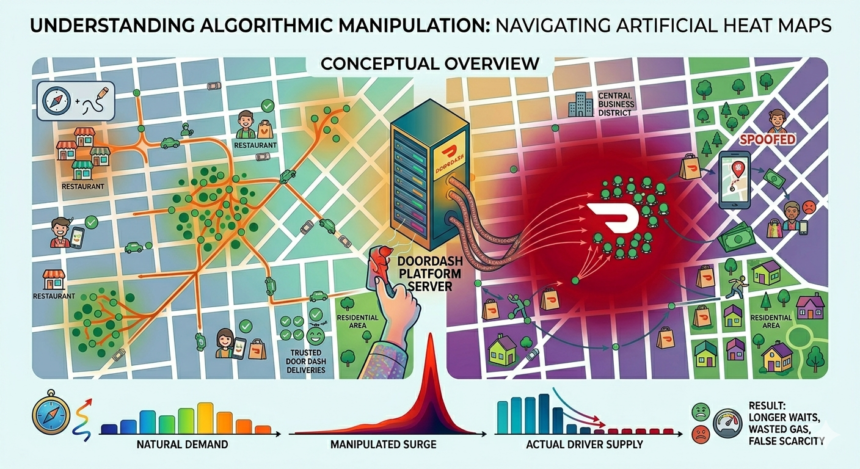

There is a color that governs the working lives of roughly seven million people in the United States. It is red. Deep, urgent, pulsing red. Open the Dasher app on any given Friday evening and the city spreads out before you like a war map. Some zones a flat gray, some a faint blush, others burning hot with the kind of crimson that tells your brain to move, now, before someone else gets there first. This is DoorDash’s heat map, and it is one of the most consequential pieces of interface design in American labor today. The question worth asking, and one the company has never fully answered, is whether the red means what drivers think it means.
- The Promise on the Screen
- Chasing the Red
- The Math Nobody Shows You
- Color Psychology and the Architecture of Nudging
- The “Desperation Score” and What It Suggests
- What DoorDash Sees That Drivers Don’t
- The Independent Contractor Problem
- What Experienced Drivers Already Know
- The Structural Silence
- The Color of the Algorithm
I have spent weeks reading through driver forums, academic papers, regulatory filings, and company engineering blogs. The picture that emerges is not a simple scandal. DoorDash has not been caught running a scam. What the evidence shows is something quieter and, in many ways, more troubling: a system designed to optimize platform efficiency that, by design or by side effect, costs drivers real money while giving them almost no way to measure the cost.
The Promise on the Screen
DoorDash’s1 official help page for drivers explains the map in plain language. The heat map “shows areas where there are more orders than Dashers available,” and darker red indicates busier areas. Drivers are encouraged to move toward these zones to increase their chances of receiving deliveries.
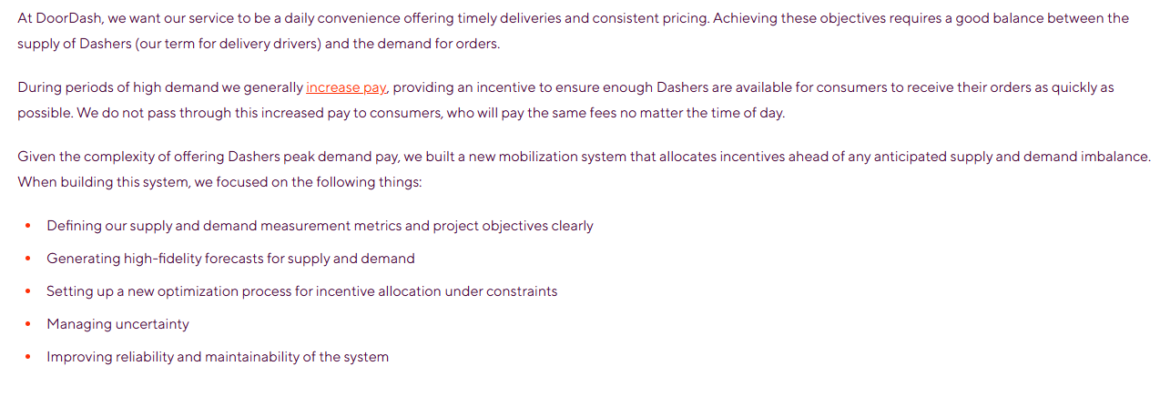
This makes intuitive sense. More orders, fewer drivers, more opportunity. That is the promise. The map is meant to reduce guesswork and help drivers self-distribute across a city so that no corner is left without coverage. DoorDash’s own blog2 confirms this framing, describing its machine learning mobilization system as a tool that “allocates incentives ahead of any anticipated supply and demand imbalance.” The company wants drivers in the right place before the orders arrive, not after. That is a reasonable goal for a logistics platform processing millions of deliveries every day.
The problem is that what serves the platform’s supply-demand balance does not necessarily serve the individual driver’s wallet. And there is no public documentation, anywhere, explaining what “red” actually means in quantitative terms. There is no number attached to it. No “47 unassigned orders in this zone.” No “12 drivers within two miles.” Just color.
Chasing the Red
On Reddit’s r/doordash_drivers3 community, which has hundreds of thousands of members, drivers return to the heat map with the kind of exhausted familiarity you see from people who have been fooled before but keep trying because they have no better option. The phrase that comes up again and again is “chasing the red.” Drivers describe driving several miles toward a glowing zone, only to find long waits, low-paying orders, or nothing at all.
A recurring complaint is lag. Drivers believe the map reflects order spikes that have already been filled by the time they arrive. This is not an unreasonable suspicion. If the heat map is updated on a delay, even a short one, then a driver repositioning toward a hot zone could be navigating toward yesterday’s demand.
This is not a minor omission. For a driver deciding whether to burn twenty minutes of unpaid time driving across town, the difference between real-time demand and a trailing average could be the difference between a profitable shift and one that ends below minimum wage.
On TikTok4, where gig workers have built an entire genre of shift-by-shift breakdown content, drivers film themselves following the heat map and coming up empty. “Hot zones may not guarantee good orders,” reads the caption on one video that has circulated widely among Dashers. This is mild compared to what drivers say on the forums, where the language is less curated.
The Math Nobody Shows You
What does chasing the red actually cost? The numbers are specific enough to sting.
The IRS5 standard mileage rate for business use in 2025 is $0.70 per mile, intended to approximate the full cost of operating a vehicle including fuel, depreciation, maintenance, and insurance. For a driver who repositions five unpaid miles toward a heat zone, that is three dollars and fifty cents in vehicle operating cost before a single second of their time is counted. If they arrive, wait fifteen minutes, and receive an eight-dollar order for five more miles, the gross payout looks reasonable. The net, once you account for the repositioning miles and the wait, looks considerably less so.
According to EarnifyHub6, more than 500 active Dashers found that a driver averaging twenty dollars per hour gross in a metro market takes home roughly eleven to thirteen dollars per hour after fuel, vehicle depreciation, and self-employment tax. In smaller markets, net earnings can fall below local minimum wage. Gridwise7, a platform that aggregates driver earnings data, reported average gross earnings for DoorDash drivers at $12.23 per hour in 2024, a figure that already includes inactive waiting time.
As the ShiftTracker8 breakdown observes, the invisible costs like gas, maintenance, and the IRS-estimated vehicle wear eat 35 to 45 percent of gross earnings before they reach a driver’s bank account. The heat map sends drivers chasing demand that may or may not materialize, and none of the repositioning cost appears anywhere on the platform’s earnings screen.
The Gridwise analysis put the compounding nature of dead miles in terms I find impossible to dismiss:
“one 8-mile repositioning trip to a bad pickup area can require three or four decent rides just to break even on the fuel and time you spent getting there.”
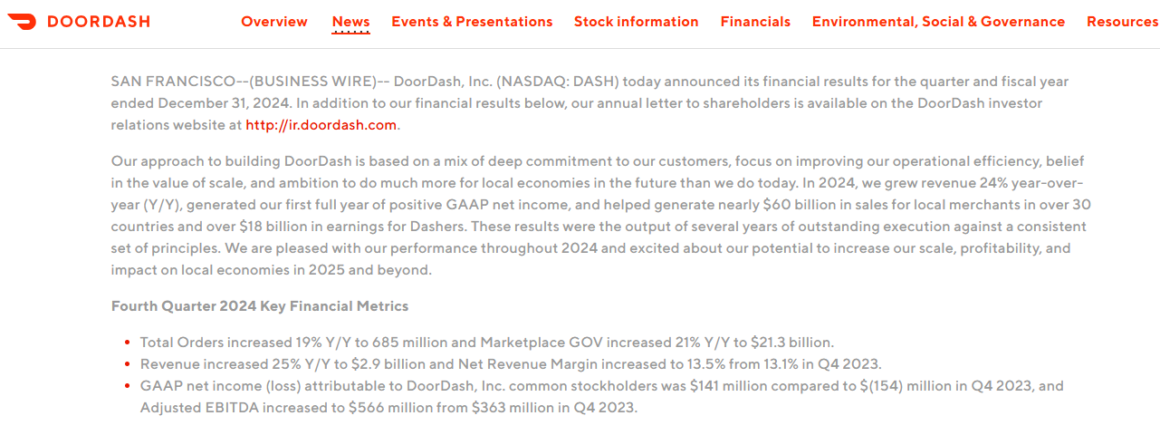
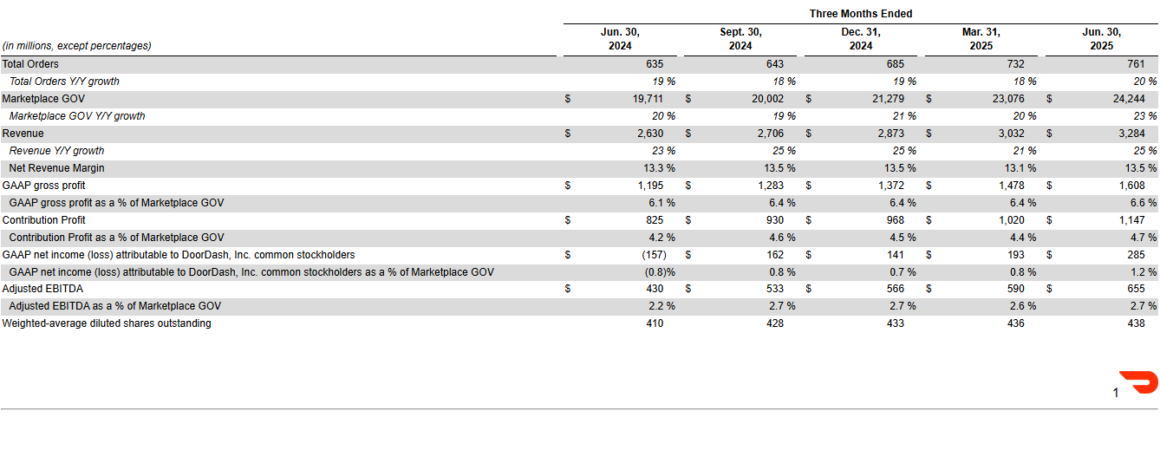
DoorDash9 reported $10.72 billion in revenue for 2024, a 24 percent year-over-year increase. As of April 2025, the company was valued at $81.03 billion. The drivers chasing red zones are not sharing proportionally in this growth.
Color Psychology and the Architecture of Nudging
Here is where the heat map becomes more interesting than a simple complaint about lag. The choice to use red, of all colors, is not arbitrary. Red signals danger, urgency, and opportunity. It activates something close to a fear-of-missing-out response in the human brain. A gray zone says: stay put. A red zone says: move, now, before it’s gone.
Behavioral research cited in analyses of gig economy design consistently shows that color and framing influence perception and action. The nudge built into a red zone is real, even if DoorDash’s intent is entirely neutral. Without numerical context, without knowing how many orders are actually unassigned, or how many drivers are already in the zone, drivers are left interpreting color as opportunity, when color is really just a relative indicator of busyness.
This matters because DoorDash knows exactly what red means in data terms. The platform has the unassigned order count, the driver supply figures, the lag on the last update, the probability that a driver repositioning from three miles away will actually receive an order. Drivers have a color. The information asymmetry is total.
A 2019 paper in Sage Journals10, which has become a foundational text in gig economy research, described this dynamic as “algorithmic despotism,” the way platforms use “information asymmetry, the surveillance of workers through customer ratings and other performance measures, and behavioral nudges like surge pricing” to manage a workforce that has no formal employment relationship with the company. The heat map is a behavioral nudge. It is perhaps the most elegant one the platform has designed, because it requires no pay incentive at all. The color alone is enough to move people.
The “Desperation Score” and What It Suggests
In early 2026, a Reddit post went briefly viral in gig economy circles. An anonymous user, claiming to be a recently-quit developer at a food delivery company, alleged that the platform assigned drivers a hidden “Desperation Score” that tracked how eagerly they accepted low-value orders and used that data to prevent them from seeing higher-paying ones. According to Fortune11, DoorDash CEO Tony Xu responded publicly, calling the claims “appalling” and saying he would “fire anyone who tolerated this.” The post was later declared a likely hoax by Platformer12.
But the episode reveals something important, independent of whether the post was real. Drivers believed it instantly. Not because they are credulous, but because the scenario described fit a pattern they already knew from experience: the sense that the platform sees everything about their behavior while they see almost nothing about how the platform operates. The outrage the post generated was not really about a desperation score. It was about the accumulated suspicion of a workforce that has learned, through long experience, that the information they receive from the platform is curated for the platform’s benefit.
The Reddit post may have been fiction. The information asymmetry it described is not.
What DoorDash Sees That Drivers Don’t
DoorDash’s engineering infrastructure is sophisticated in ways that drivers cannot access and that the company does not publicize for competitive reasons. The platform uses machine learning to forecast demand before it materializes, to pre-position drivers through bonus incentives, and to balance supply across hundreds of cities simultaneously. It tracks the driver GPS continuously. It knows, with considerable precision, where demand will spike in the next twenty minutes.
What it shares with drivers is a color.
A May 2025 Human Rights Watch13 report, “The Gig Trap: Algorithmic, Wage and Labor Exploitation in Platform Work in the US,” documented how DoorDash and six other major platforms “use opaque and ever-changing algorithms that keep workers in the dark about how their pay is calculated.” When HRW wrote to the companies in March 2025 with detailed questions about algorithmic transparency, DoorDash declined to share the underlying logic of its pay calculations. The report found that DoorDash drivers, like workers across the other platforms studied, often do not know how much they will be paid until after completing a job.
As the HRW report noted, this is not incidental.
“Six of the seven companies use algorithms with opaque rules to assign jobs and determine wages.”
The platforms have every incentive to maintain this opacity. A driver who understood, in real time, the probability of receiving a profitable order in a red zone versus their current location might make very different positioning decisions.
A Taylor & Francis14 academic paper on algorithmic control in the gig economy describes this dynamic through the concept of “algorithmic despotism,” where workers “bear the risk of repositioning” while platforms capture the efficiency gains. The paper notes that when delivery workers incur losses due to algorithmic routing errors, “the platform fails to disclose the underlying logic, leaving workers in a situation where they have grievances but no effective means to voice them.”
The heat map is part of this architecture. It redistributes labor efficiently for the platform. Whether it redistributes labor efficiently for the driver is a question that no one at DoorDash is obligated to answer.
The Independent Contractor Problem
None of this would matter quite as much if DoorDash drivers were employees. An employee who spent twenty minutes repositioning to a zone their employer directed them toward would be paid for that time. The cost of the repositioning would fall on the company, not the worker.
But DoorDash classifies its drivers as independent contractors. This classification, challenged repeatedly in California and other states, means that every unpaid mile, every dead wait, every tank of gas burned chasing a red zone that turned gray by the time the driver arrived is an expense borne entirely by the driver. The platform captures the upside of driver repositioning, better coverage, faster fulfillment, happier customers, while the driver absorbs the downside: fuel cost, time cost, vehicle wear, the self-employment tax on whatever they eventually earn.
Tech Policy15 found that many gig workers, after accounting for work-related expenses, earn an average of $5.12 per hour. This figure varies widely by market and work pattern, but the direction is clear. The labor is not free for drivers, even when the platform treats it as interchangeable.
According to OCCRP16, three-quarters of gig workers surveyed for the HRW report said they struggled to afford housing. More than one-third said they could not cover a $400 emergency. Nearly half of all algorithmic account deactivations were later reinstated, suggesting the system that governs these workers’ access to income makes significant errors, with no meaningful recourse offered to affected drivers.
What Experienced Drivers Already Know
The drivers who survive in this system long-term are not the ones who follow the heat map. They are the ones who stopped trusting it.
On the forums, the advice is consistent and hard-won. Treat the heat map as “one data point,” not a directive. Learn your own market. Track your own earnings per hour by zone and time of day. Tools like Gridwise have emerged specifically to give drivers the kind of real-time earnings data that the Dasher app withholds. Third-party services like Mystro’s17 live heatmap attempt to show restaurant order activity by time of day, essentially reverse-engineering what DoorDash already knows and could share with its drivers if it chose to.
Experienced Dashers have developed a minimum viable threshold: roughly $1.50 to $2.00 per mile as a floor for accepting orders. As Gridwise’s18 data analysis notes,
“an order offering $3.50 for a 7-mile drive is paying you $0.50 per mile — well below the cost of operating your vehicle.”
These drivers are building the rational framework that DoorDash’s app should provide but doesn’t.
The fact that a cottage industry of third-party apps, YouTube channels, and Reddit threads has grown up specifically to help drivers interpret and often override the heat map suggests something plainly. The map is not designed to help drivers maximize their earnings. It is designed to help DoorDash maximize its coverage.
The Structural Silence
What makes the heat map problem hard to resolve is that nothing DoorDash has done is clearly illegal. No regulator has formally concluded that the visualization is fraudulent or intentionally misleading. The company states that red zones reflect higher order demand relative to surrounding areas, and that is presumably true in a relative sense. It has not claimed that red zones guarantee profitable orders.
But the structural silence around the map’s methodology is a choice. DoorDash could publish the variables that determine color intensity. It could show drivers, in real time, the driver-to-order ratio in any given zone. It could provide expected earnings per hour for each zone based on current conditions. None of this would require revealing proprietary machine learning architecture. It would just require treating drivers as economic agents who deserve the information needed to make rational decisions.
The ILO is currently developing global labor rules for platform work, with final negotiations expected in 2026. HRW19 has called for those rules to require “minimum transparency requirements” around algorithmic management and to ban “ratings-based work allocation systems” that pose unacceptable risks to workers’ rights. The heat map, which nudges drivers to reposition without disclosing the economics of that repositioning, sits squarely in the territory these proposals are meant to address.
The Color of the Algorithm
I keep coming back to a specific question. When DoorDash’s engineers built the heat map, did they think about what it costs a driver to chase it? Did someone sit in a product meeting and calculate the average repositioning expense against the probability of order receipt in a given zone? Did anyone run those numbers and decide not to show them to drivers?
I don’t know. And neither does any driver, because the platform doesn’t say.
What I do know is that the heat map is an elegant piece of behavioral design. It turns a complex, probabilistic logistics problem into a simple visual instruction. Move toward the red. It works. Drivers move. Coverage improves. Fulfillment rates go up. DoorDash’s revenue climbed to $10.72 billion in 2024 and grew another 25 percent year-over-year by the second quarter of 2025. The system is efficient.
The question is: efficient for whom?
The seven million people driving toward the red every day are running their own small businesses, absorbing their own costs, making decisions based on information they cannot fully interpret because the company that has all the underlying data has chosen, for reasons it has never fully explained, to show them a color instead.
Red means busier. It does not mean better. It does not mean profitable. It does not mean that the order you burn three dollars of fuel to position yourself for will pay four.
That distinction, between what the map shows and what the map means, is where the money goes.
Sources
- “Dasher Support” DoorDash Help Center, help.doordash.com/dashers/s/article/Dasher-Guide-to-the-Dasher-App. Accessed 9 June 2026. ↩︎
- “DoorDash” careersatdoordash.com/blog/managing-supply-and-demand-balance-through-machine-learning/. Accessed 9 June 2026. ↩︎
- Reddit, www.reddit.com/r/doordash_drivers/. Accessed 10 June 2026. ↩︎
- “TikTok” Make Your Day, www.tiktok.com/discover/doordash-heat-map. Accessed 10 June 2026. ↩︎
- “Standard mileage rates” Internal Revenue Service, www.irs.gov/tax-professionals/standard-mileage-rates. Accessed 10 June 2026. ↩︎
- EarnifyHub, earnifyhub.com/freelancing-gig-work/doordash-driver-earnings-2026. Accessed 10 June 2026. ↩︎
- “How Much Do DoorDash Drivers Make in 2026? (Real Data from 500k+ Dashers)” Gridwise, gridwise.io/blog/how-much-do-doordash-drivers-make. Accessed 10 June 2026. ↩︎
- “DoorDash Earnings Calculator 2026: True Hourly Pay After Tax” ShiftTracker, shifttrackerapp.com/doordash-earnings-calculator. Accessed 11 June 2026. ↩︎
- DoorDash, ir.doordash.com/news/news-details/2025/DoorDash-Releases-Fourth-Quarter-and-Full-Year-2024-Financial-Results/. Accessed 10 June 2026. ↩︎
- Sage Journals, journals.sagepub.com/doi/10.1177/2378023119870041. Accessed 10 June 2026. ↩︎
- Pringle, Eleanor. “DoorDash’s CEO blasts ‘appalling’ claim that a major delivery app gives drivers a desperation score: ‘I would fire anyone who tolerated this’” Fortune, 6 Jan. 2026, www.fortune.com/2026/01/06/doordash-ceo-tony-xu-blasts-reddit-post-driver-claim. Accessed 10 June 2026. ↩︎
- Newton, Casey. “Platformer” 28 May 2026, www.platformer.news/. Accessed 10 June 2026. ↩︎
- “The Gig Trap” Human Rights Watch, 12 May 2025, www.hrw.org/report/2025/05/12/the-gig-trap/algorithmic-wage-and-labor-exploitation-in-platform-work-in-the-us. Accessed 10 June 2026. ↩︎
- Taylor & Francis, www.tandfonline.com/doi/full/10.1080/17450101.2025.2532399. Accessed 10 June 2026. ↩︎
- Bachmann, George Augustus. “The Game Behind the Gig Economy” TechPolicy.Press, 17 Dec. 2025, www.techpolicy.press/the-game-behind-the-gig-economy/. Accessed 11 June 2026. ↩︎
- “US Gig Workers Trapped by Exploitation, Says HRW” OCCRP, 12 May 2025, www.occrp.org/en/news/us-gig-workers-trapped-by-exploitation-says-hrw. Accessed 11 June 2026. ↩︎
- Driver, Mystro. “DoorDash Heatmap” Mystro Driver, mystrodriver.com/tools/doordash-heatmap/. Accessed 11 June 2026. ↩︎
- “How Much Do DoorDash Drivers Make in 2026? (Real Data from 500k+ Dashers)” Gridwise, gridwise.io/blog/how-much-do-doordash-drivers-make. Accessed 11 June 2026. ↩︎
- “ILO: Strengthen Global Rules to Protect Gig Workers” Human Rights Watch, 14 Nov. 2025, www.hrw.org/news/2025/11/14/ilo-strengthen-global-rules-to-protect-gig-workers. Accessed 11 June 2026. ↩︎