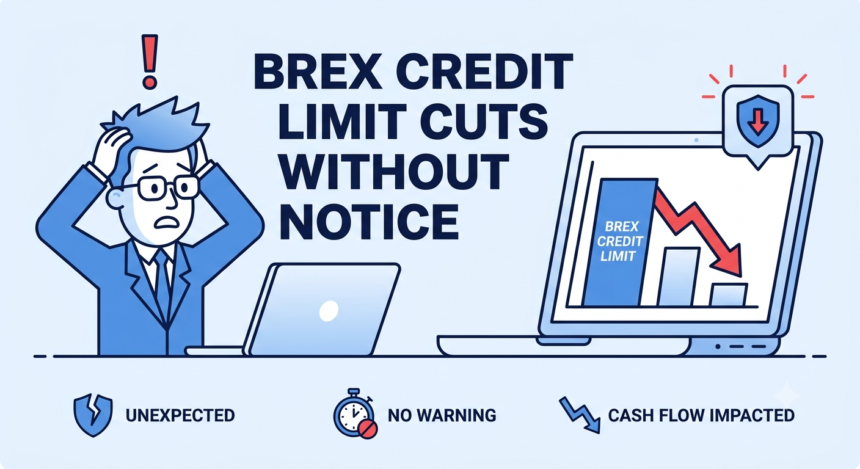

A founder in Austin once had her card declined at a hotel front desk. She was three days into a customer trip. The room was booked. The card had worked that morning. By afternoon it was dead weight in her wallet. She called support. Nobody could tell her why. Her credit limit had dropped overnight, and no email had explained it.
This is not a rare story. It is the plot of a hundred forum posts, a dozen Trustpilot reviews, and at least one very public restructuring. It is also, I think, the quiet cost of building a bank on top of an algorithm instead of a relationship.
I have spent months reading the terms of service that gig workers never open and the arbitration clauses that sellers never notice until it is too late. Brex is a different animal. It does not serve delivery drivers or Etsy shops. It serves founders, the same people who build the platforms. And yet the mechanism is identical. A company holds the switch. The company can flip it without asking. The person on the other end finds out only when the money stops moving.
What Brex Actually Promises
Brex built its name on a simple pitch. Traditional banks wanted personal guarantees and years of credit history before they would hand a startup a corporate card. Brex looked at a company’s cash balance instead. If you had money in the bank, Brex would give you a limit ten to twenty times higher than a legacy business card, according to Nav’s1 2026 review of the product. No annual fee. No personal liability. Approval in minutes.
That pitch worked. According to CNBC2, Brex grew from a Y Combinator project into a company that Capital One valued at $5.15 billion this year, down from a peak private valuation of $12.3 billion, according to Sacra’s3 financial breakdown of the company. Customers today include Anthropic, Robinhood, DoorDash, and Zoom.
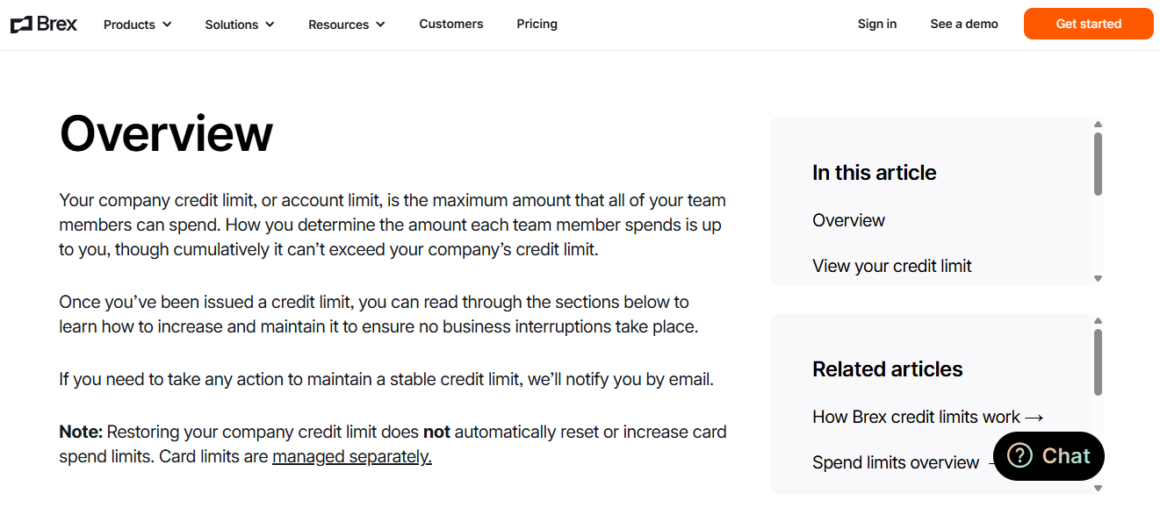
But the same mechanism that made approval instant makes revocation instant too. Brex’s own help documentation is candid about this, in the careful way that legal teams are candid. The company states plainly that credit limits are calculated by Brex’s4 ongoing, account specific determination of risk, and that limits are subject to change at any time at the company’s sole discretion. Read that sentence again. At any time. Sole discretion. There is no clause promising thirty days notice. There is no clause promising any notice at all.
The Sole Discretion Clause
Every credit product has risk language buried somewhere in its terms. What makes Brex different is how directly the limit is tied to a single number: your cash balance. For accounts on daily payments, the limit is the aggregate balance sitting in your Brex5 checking, treasury, and vault accounts. Spend it down and the ceiling drops with it, in real time, like a fuel gauge.
For accounts on monthly payments, the calculation loosens slightly to include cash flow and financial performance, pulled from a connected bank account or uploaded statements. But the volatility is still baked in. A bank connection lapses. A statement upload runs late. A single bounced autopay triggers an automatic reduction, and Brex will email you about the failure but not necessarily restore the limit until you fix it.
None of this is secret. It is published, searchable, sitting right there on Brex’s support site. The problem is not disclosure. The problem is design. A credit line that resets itself continuously based on an opaque internal risk score will always feel, from the outside, like it changed without warning. Because in practice, it often does.
What Founders Actually Say
I do not want to rely only on Brex’s own language, so I went looking for the people living with it.
On Trustpilot6, where Brex has accumulated hundreds of reviews, one recent poster described watching the company pull back hard from its original customer base. The reviewer, who said they had recommended Brex to early-stage clients for years, wrote that they were formally withdrawing that recommendation after watching multiple clients face account actions with zero notice, leaving critical funds frozen in transit. A Brex representative replied underneath, acknowledging that the company understood how disruptive an unexpected credit limit change could be, especially when it hit cash flow, and promising a review if the customer emailed in.
That exchange is worth sitting with. A public complaint. A public, polite non-denial. Brex did not dispute that the change happened without warning. It offered a case review. That is the entire remedy on offer for a company managing the operating capital of thousands of startups: email us and we will look into it.
This is not new. Back in 2020, when Brex cut 62 staff and restructured its credit card business for startups, TechCrunch7 reported that customers said the credit limit cuts came without warning or notice, even as the company had just closed a $150 million funding round. The pattern predates the current ownership change by six years. It is not a symptom of the Capital One deal. It is closer to a structural feature of the product.
Brex 2.0 and the Customers Who Got Cut Loose
In 2022, Brex made a decision that still ripples through founder communities today. It announced what insiders called Brex 2.0, a pivot away from smaller, self-funded companies toward venture-backed startups and larger enterprise clients. According to a fintech analysis from Lex Substack’s newsletter8, the company cut services to smaller clients during this period, and the newsletter estimates Brex dropped at least 15,000 customers in the process. Enterprise clients on the platform now represent an estimated market capitalization north of $2.9 trillion, up from roughly $200 billion a few years earlier.
Read plainly, that means Brex built its brand by rescuing small, unbanked startups from traditional lenders, then walked away from a large share of exactly those customers once bigger accounts became more profitable. If your company was on the wrong side of that shift, your credit line did not shrink gradually. In many documented cases it disappeared as part of a company wide policy change that had nothing to do with your own payment history.
Enter Capital One
On January 22, 2026, Capital One announced it would acquire Brex for $5.15 billion in cash and stock. CNBC9 reported the deal was 50 percent cash and 50 percent stock, with Brex CEO Pedro Franceschi telling the network the company did not need to sell, that its growth was strong enough to stay independent. The deal closed on April 7, 2026, according to Sacra’s reporting10, with Capital One paying roughly $2.75 billion in cash and issuing about 10.6 million shares. Franceschi stayed on as CEO.
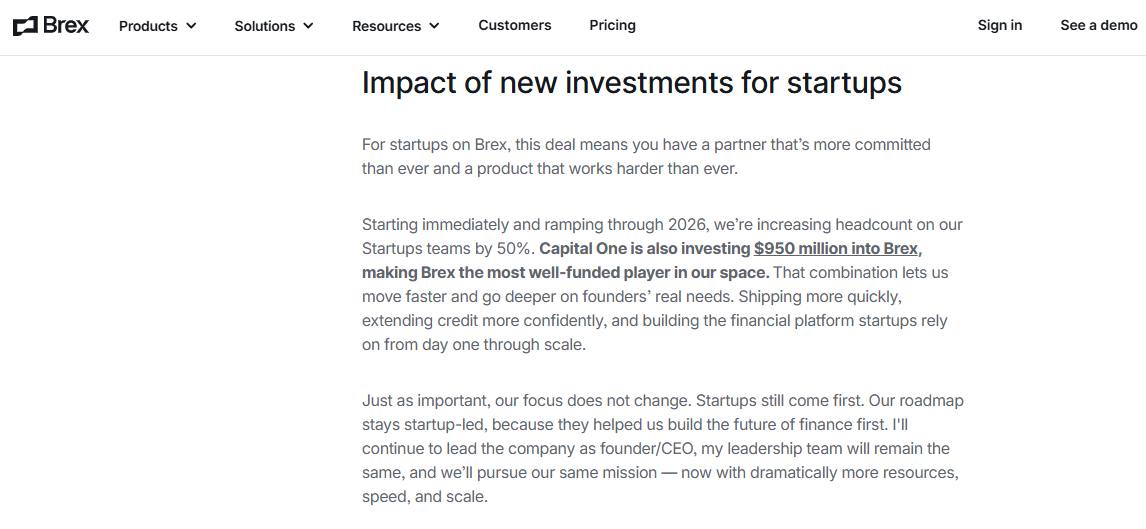
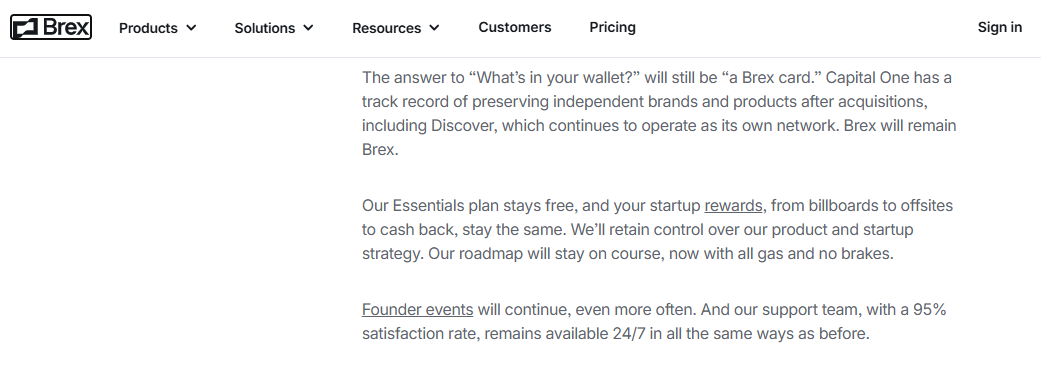
Franceschi wrote a company blog post trying to head off the obvious founder anxiety. He promised the Essentials plan would stay free, that startup perks would stay the same, and that Brex11 would retain control over its own product and startup strategy. He compared the arrangement to Capital One’s earlier acquisition of Discover, which continued operating under its own brand. He announced Capital One was investing $950 million directly into Brex.
The reassurance is worth reading against what independent analysts are actually saying. A comparison piece from a competing card issuer, KleerCard12, laid out the open questions bluntly: whether Brex keeps shipping product at the same pace under bank ownership, whether eligibility or pricing tightens as Capital One’s risk models layer onto Brex’s underwriting, and whether the customer base drifts toward Capital One’s traditional commercial clients. The piece notes plainly that none of those questions have public answers yet.
Ramp’s13 own comparison blog, unsurprisingly framed to favor its own product, still makes a fair technical point: following the acquisition it is unclear whether Brex’s underwriting criteria will remain unchanged, since banks typically run more conservative risk models than independent fintechs. Airwallex14, another competitor, frames the integration risk in similar terms, warning that embedding a fast-moving fintech’s culture inside a large regulated bank is a material execution risk that could slow the product roadmap.
I called around the industry analysis on this and could not find a single independent voice arguing the acquisition makes Brex’s underwriting more predictable in the near term. The consistent theme, across competitor blogs and neutral fintech newsletters alike, is uncertainty. Founders currently holding a Brex card do not know if the risk model that sets their limit today will be the same risk model in six months.
Why the Volatility Is Structural, Not Incidental
Here is the part that I think gets missed in most coverage of this story. Brex’s entire pitch to founders was speed. Approval in minutes. No paperwork. No personal guarantee. That speed is only possible because the underwriting is automated, continuous, and tied directly to live account data rather than a periodic human credit review.
A traditional bank sets your limit once and revisits it maybe once a year, with a human analyst attached to the decision and a formal adverse action notice if they cut you. Brex’s model recalculates constantly. The upside is fast growth. If your cash balance jumps after a funding round, your limit can jump with it, often within a day. The downside is the same mechanism running in reverse. If your balance dips, if a connected bank account goes stale, if a statement upload is a week late, the system can pull the limit down automatically, with no analyst in the loop to ask whether the dip is temporary.
Brex frames this as a feature. Its own marketing describes limits as dynamic by design, adjusted regularly based on spending patterns, cash balance, and sales. Dynamic is a generous word for what founders are actually describing. A limit that can vanish because a Plaid connection quietly broke is not dynamic in the sense of responsive and fair. It is fragile in a way that only surfaces when it fails you, usually at the worst possible moment, the way our Austin founder discovered at a hotel front desk three time zones from home.
The Bind Startups Are Stuck In
The deeper problem is that Brex’s target customer, by definition, has no good fallback. Brex exists because traditional banks turn down exactly this kind of company: young, unprofitable, thin on credit history, rich on venture cash they cannot always prove fast enough on paper. A startup on Brex chose Brex precisely because Chase or Amex would have asked for a personal guarantee or offered a limit a tenth the size.
That means when Brex cuts a limit without warning, the founder cannot simply walk across the street to a competitor and get an equivalent line the same afternoon. Ramp, the most direct alternative, uses a similar cash-based model with its own version of the same volatility, though its lower entry threshold of roughly $25,000 in cash reserves, as noted in Nav’s15 comparison, makes it marginally more accessible to smaller companies. Mercury, mentioned as an alternative in Airwallex’s review of the space, focuses on banking rather than high credit limits and is not really a substitute product. None of these options solve the actual problem, which is structural. Any platform built on the same automated, cash-tied underwriting model will carry the same risk of a sudden, unexplained cut.
I want to be fair here. Brex is not hiding the ball entirely. Its help center walks through common reasons a limit might drop: a lapsed bank connection, an overdue statement, a failed autopay, a general determination of risk. It offers concrete fixes. Connect another bank account. Upload a fresh statement. Make an early payment to free up room. Support is reachable, and Brex’s16 own marketing touts a 95 percent customer satisfaction rate on its support team, a number that is, notably, self-reported.
What Brex does not offer, as far as I can find in its published policies, is advance warning before a limit drop takes effect. The system flags problems after the fact. You learn your bank connection is stale when your limit is already gone, not before. You learn your statement is overdue when the account has already tightened, not with enough runway to fix it first. Compare that to how a mortgage lender or even most retail credit card issuers are required to operate under the Equal Credit Opportunity Act, which mandates a formal adverse action notice with a stated reason before certain credit decisions take effect for consumers. Brex serves businesses, not consumers, so those consumer protection statutes largely do not apply. The business-to-business corner of American finance runs on much thinner rules, and Brex has built an entire product category inside that gap.
The Human Cost, In Plain Terms
I keep coming back to the Trustpilot exchange because it captures something the corporate statements never will. A longtime advocate for the platform, someone who steered client after client toward Brex because it solved a real problem, reached a breaking point and said so publicly. Not because the product failed once. Because it failed the same way, for multiple clients, without pattern or predictability, until the unpredictability itself became the story worth telling.
That is the real cost of a sole discretion clause. It is not that Brex will always act unfairly. Most of the time the system probably works the way it is designed to. It is that a founder has no way to know, on any given morning, whether today is the day the fuel gauge reads empty. Payroll runs on that card. Vendor payments run on that card. A closing dinner with an investor runs on that card. When it declines without warning, the damage is not abstract. It shows up in a hotel lobby, in front of a client, at the exact moment a founder can least afford to look unstable.
There is one more piece of context that colors how founders read all of this, and it is not really about Brex at all. According to The New York Times17, in March of 2023, Silicon Valley Bank collapsed in 48 hours, and a huge share of the startup world spent a terrifying weekend wondering if payroll would clear. Brex, along with Mercury and a handful of other fintechs, absorbed a wave of panicked customers in the days that followed. The pitch those companies made at the time was implicit but clear. Diversify. Do not let one institution hold your whole operating life. Spread the risk.
Founders took that advice. Many of them now run banking through Brex and a second institution simultaneously, precisely because they learned in 2023 that any single financial partner can become unreliable overnight. That instinct is exactly why the credit limit story matters so much. A founder who diversified specifically to avoid single points of failure still finds herself dependent on Brex’s internal risk score for a meaningful share of her spending power, because no other partner offers the same limit for the same cash balance. The redundancy she built after 2023 does not fully protect her from the thing she is actually worried about, which is a partner that can cut her off without telling her first.
The Regulatory Gap Nobody Is Closing
I want to underline something I touched on earlier, because I think it explains why this pattern persists across the entire corporate card industry and not just at Brex. Consumer credit cards in the United States operate under real statutory protection. The Equal Credit Opportunity Act and the Fair Credit Reporting Act18 require lenders to send a formal adverse action notice, with a stated reason, before or shortly after a consumer’s credit line changes in a way that hurts them. A consumer who gets cut off has a paper trail and a legal hook to challenge it.
None of that framework extends cleanly to a business credit product like Brex’s. Commercial lending sits in a much lighter regulatory environment, built on the old assumption that a business, unlike an individual consumer, has the resources and sophistication to negotiate its own protections into a contract. That assumption made more sense when business credit meant a relationship banker at a regional bank, someone you could call, someone who owed you a conversation before pulling your line. It makes much less sense when the “business” on the other end of the transaction is a four-person startup running on a seed round, and the credit decision is made by a model that never has to explain itself to anyone.
Capital One inherits that regulatory gap along with Brex’s balance sheet. Whether the bank chooses to voluntarily narrow it, by adding a notice period or a human review step before a limit drop, is entirely a business decision, not a legal requirement. Nothing in the current commercial lending framework forces its hand either way.
If you run a company on Brex today, the practical advice mirrors what the company’s own support pages already say. Connect every bank account you can. Keep statements current even before they are technically due. Watch for lapsed Plaid connections like you would watch a smoke detector battery. None of that protects you from a policy level shift, the kind that hit 15,000 customers during Brex 2.0, or the kind that may or may not arrive as Capital One’s underwriting philosophy works its way into Brex’s engine over the coming year.
The honest answer is that nobody outside Brex and Capital One knows yet how this settles. The founders I would trust least right now are the ones who assume the product they signed up for in 2023 is the same product they are using in 2026. It is not. The ownership changed. The balance sheet changed. The risk appetite of the parent company is, by its own competitors’ admission, still an open question.
What has not changed is the clause. Sole discretion. Subject to change at any time. That sentence was true before the acquisition and it remains true after it. It is the one constant in a story that keeps rewriting everything around it.
I think about the founder in Austin sometimes. Her card came back online two days later. Brex support blamed a stale bank connection, fixed in an hour once someone actually looked at the account. She got her limit restored. She also got something else, a habit she has kept since. She checks her Brex dashboard every morning now, before coffee, the way some people check the weather. Not because she expects a storm. Because she has learned the sky can change before she has had the chance to look up.
Sources
- Vito, Gabriel. “Brex Business Credit Card review (2026): Credit limits that match your business, not your personal score – Nav” 20 Feb. 2026, www.nav.com/blog/brex-business-card/. Accessed 9 July 2026. ↩︎
- Son, Hugh. “Capital One is buying startup Brex for $5.15 billion in credit card firm’s latest deal” 22 Jan. 2026, www.cnbc.com/2026/01/22/capital-one-is-buying-startup-brex-for-5point15-billion-in-credit-card-firms-latest-deal.html. Accessed 9 July 2026. ↩︎
- “Brex revenue, valuation & funding” Sacra, sacra.com/c/brex/. Accessed 9 July 2026. ↩︎
- “Help with your Brex credit limit” www.brex.com/support/credit-limit-help. Accessed 9 July 2026. ↩︎
- “How Brex credit limits work” www.brex.com/support/brex-credit-limits. Accessed 9 July 2026. ↩︎
- Trustpilot, www.trustpilot.com/review/brex.com. Accessed 9 July 2026. ↩︎
- Mascarenhas, Natasha. “Brex, the credit card for startups, cuts staff amid restructuring” TechCrunch, 29 May 2020, techcrunch.com/2020/05/29/brex-the-credit-card-for-startups-cuts-staff-amid-restructuring/amp. Accessed 9 July 2026. ↩︎
- Milanovic, Michiel. “Fintech: Why Capital One Chose Brex in a $5B Deal” Fintech Blueprint , 10 Feb. 2026, lex.substack.com/p/fintech-understanding-brexs-5b-capital. Accessed 9 July 2026. ↩︎
- Son, Hugh. “Capital One is buying startup Brex for $5.15 billion in credit card firm’s latest deal” 22 Jan. 2026, www.cnbc.com/2026/01/22/capital-one-is-buying-startup-brex-for-5point15-billion-in-credit-card-firms-latest-deal.html. Accessed 9 July 2026. ↩︎
- “Brex revenue, valuation & funding” Sacra, sacra.com/c/brex/. Accessed 9 July 2026. ↩︎
- “How Brex + Capital One will accelerate how we serve startups” 29 Jan. 2026, www.brex.com/journal/brex-and-capital-one-great-for-startups. Accessed 9 July 2026. ↩︎
- Hill, Owen. “Ramp vs Brex 2026: Honest Comparison After the Capital One Acquisition” KleerCard, 15 May 2026, www.getkleercard.com/blogs/ramp-vs-brex. Accessed 9 July 2026. ↩︎
- Mercieca, Ali. “Brex Business Credit Card Requirements: What to Know (2026)” 17 Apr. 2026, ramp.com/blog/brex-business-credit-card-requirements. Accessed 9 July 2026. ↩︎
- Straut, Nicolas. “Brex Business Account Review: Is the Platform Worth It in 2026?” 4 June 2026, www.airwallex.com/en-us/blog/brex-business-account-review. Accessed 9 July 2026. ↩︎
- Vito, Gabriel. “Brex Business Credit Card review (2026): Credit limits that match your business, not your personal score – Nav” 20 Feb. 2026, www.nav.com/blog/brex-business-card/. Accessed 9 July 2026. ↩︎
- “How Brex + Capital One will accelerate how we serve startups” 29 Jan. 2026, www.brex.com/journal/brex-and-capital-one-great-for-startups. Accessed 9 July 2026. ↩︎
- “Nytimes.Com” 18 Mar. 2023, www.nytimes.com/2023/03/18/business/silicon-valley-bank-collapse.html. Accessed 9 July 2026. ↩︎
- “Fair Credit Reporting Act” 19 July 2013, www.ftc.gov/legal-library/browse/statutes/fair-credit-reporting-act. Accessed 9 July 2026. ↩︎