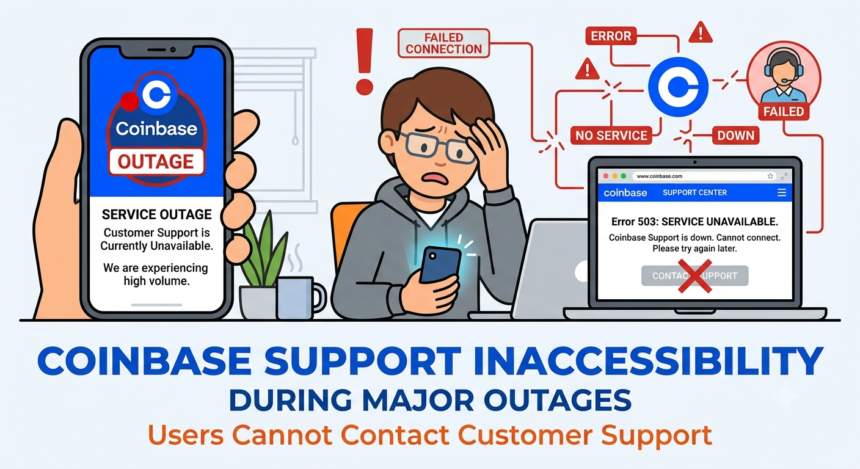

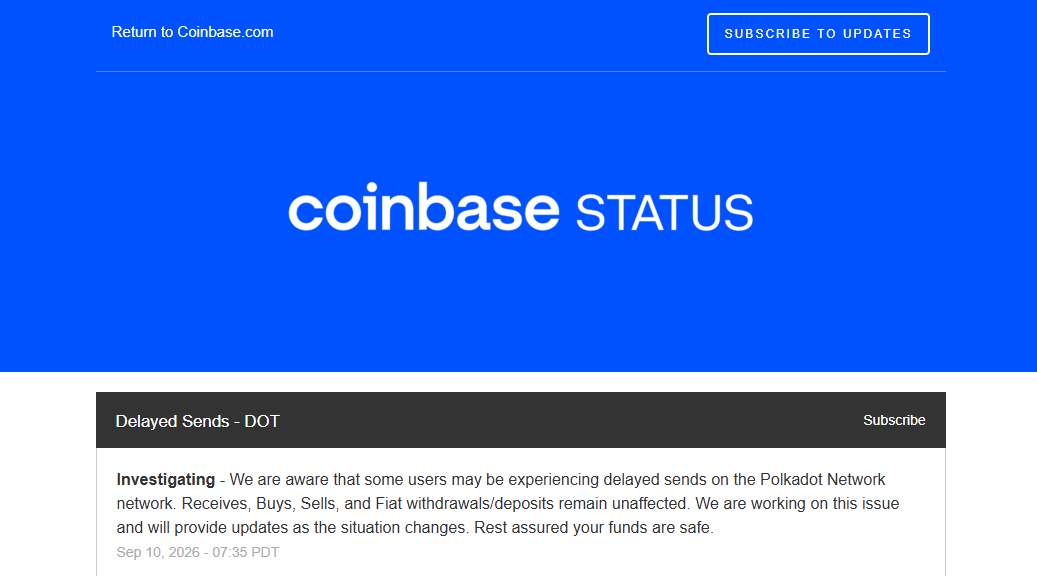
The email arrived at 6:53 p.m. Pacific on May 7, 2026. It did not say much. It said Coinbase was aware of “degraded performance.” It said funds were safe. It did not say when anyone could trade again, and it did not say how a customer with money stuck mid-transaction was supposed to reach a human being about it. Within the hour, Coinbase’s status page1 had turned the color of a bruise, and thousands of people were staring at spinning wheels where their balances used to be.
I have spent months reading complaint after complaint filed against this company, and what strikes me every time is not the outage itself. Servers fail. Cloud providers overheat. That is the cost of doing business on borrowed infrastructure. What strikes me is what happens next, in the hours and days after the outage, when a customer with real money on the line tries to find a human who can explain what happened to it. Almost every time, the answer is nobody. Not right away. Sometimes not for months.
This is a story about that gap. Not the outage. The silence that follows it.
A Company Built to Go Down at the Worst Possible Time
Start with the mechanics, because they matter. Coinbase runs its infrastructure largely on Amazon Web Services, and on May 7 an overheating data center in AWS’s US-EAST-1 region in Northern Virginia set off a cascade. According to CoinDesk’s reporting2, the company said its systems were designed to withstand a single-zone AWS failure, but this time multiple zones went down together, and core trading services buckled for hours. Coinbase eventually shifted the platform into what it calls “cancel only” mode, a purgatory where you can close a position but cannot open one, before restoring full service.
The timing did the company no favors. The outage landed days after Coinbase posted weaker-than-expected first quarter results, announced a 14 percent workforce reduction, and watched its stock slide. One crypto commentator, quoted in the same CoinDesk3 piece, called it unfortunate optics for an exchange whose own chief executive had recently bragged about non-technical staff shipping code to production.
But here is the part that gets lost in the technical postmortems. This was not Coinbase’s first rodeo, and it will not be its last. CCN4 traced the outage back to a thermal event that took down EC2 instances and EBS storage volumes, the unglamorous plumbing of the internet. Reasonable enough. What is less reasonable is a pattern going back a decade in which Coinbase goes dark almost exactly when its customers need it most, during the sharpest price swings, when every minute of inaccessibility can cost real money.
In May 2021, as bitcoin fell as much as 31 percent in a single session, both Coinbase and Binance suffered outages at the same time, according to Fortune’s5 coverage of that crash. More than 775,000 traders were liquidated across the industry that day. Jon West, a former head trader at a digital asset brokerage, told Fortune that “Coinbase always goes down.” He was not being cute. He meant it as a statement of fact about the business.
Five months later, on October 27, 2021, it happened again. Shiba Inu was hitting an all-time high, trading volume spiked, and Coinbase went offline for roughly 90 minutes, locking out traders who wanted in on the rally or out of a falling position. In September of that same year, as bitcoin plunged during a flash crash, Fast Company6 reported that users were once again unable to log in or execute trades, with the company blaming “a sudden increase in network traffic and market activity.”
Then came May 2022, when the Terra Luna collapse wiped out billions in value in days. Data Center Dynamics7 reported that Coinbase again told customers their funds were safe while many of them found themselves unable to sell as the market cratered around them. Even earlier, in 2020, the exchange went down twice within two weeks during periods of sharp bitcoin volatility, while competitors like Kraken stayed online, according to CoinDesk’s retrospective in its May 2026 coverage.
You start to notice something after reading enough of these accounts back to back. The outages cluster around volatility because volatility is what drives trading volume, and trading volume is what the infrastructure cannot always absorb. It is not a coincidence. It is closer to a design flaw that only reveals itself under stress, the way a bridge holds fine until the wind picks up.
Your Funds Are Safe. Your Access Is Not.
Every one of these incidents comes wrapped in the same phrase. Your funds are safe. It is technically true, and it is also almost beside the point. Nobody panicking during a liquidation cares whether the custody layer is secure. They care whether they can act. A locked door does not become less locked because the house behind it is not on fire.
This is where the customer support story really begins, because an outage is a temporary problem. What turns a temporary problem into a lasting grievance is what happens when a customer tries to get help understanding it, disputing a loss connected to it, or recovering funds that got stranded in the chaos. And on that front, Coinbase’s record is not good.
Reporters interviewed Coinbase users across the country and reviewed thousands of complaints, finding a consistent pattern where customers experienced sudden account access problems, reached out to a support system built almost entirely around email, and then waited. And waited. The Better Business Bureau, after reviewing the complaints, formally determined that Coinbase has “a pattern of complaints from customers who state they are locked out of their accounts, even after providing required information or updates.” The BBB told CNBC8 it never received a response from Coinbase addressing that pattern.
David Silver, an attorney who represents cryptocurrency theft victims, put it bluntly to CNBC. Most of the people who come to him are not primarily upset about losing money to a hacker or an outage. They are upset about what happens after, when they cannot get Coinbase on the phone. “They’re being almost victimized twice,” Silver said, because losing access to your own funds and then losing access to the company holding them creates a second layer of powerlessness on top of the first.
I want to sit with that phrase for a second, victimized twice, because it captures something the technical postmortems never do. An outage is a single bad hour. A support system that cannot be reached is a condition you live inside for weeks.
The Ticket Nobody Answers
Trawl through Coinbase’s page on the Better Business Bureau site9 today and the language repeats itself with almost eerie consistency. Accounts paused with no explanation. Funds flagged as suspicious and frozen for a month. Customers told to verify their identity again, and again, only to be asked for the same documents a third time. One recent complaint describes a customer locked out after 90 minutes on the phone, unable to get back into an account that had been closed “without any warning for unknown reasons.” Another describes a customer whose small remaining balance became functionally unreachable because the withdrawal fees exceeded the amount left in the account, and no support agent could offer an alternative way to get the money out.
Coinbase does respond to some of these, eventually, with a form letter that reads like it was written once and pasted a thousand times. Thank you for reaching out. We’ve created a support case for you. Your case number is attached. Please reply to your ongoing case for updates. It is polite. It is also, functionally, a door closing softly rather than slamming.
The forums fill the silence. On Reddit’s r/CoinBase10, users trade ticket numbers like trading cards, hoping a company representative browsing the subreddit will notice and intervene where the official channel failed. According to reporting from Cult of Money11 on filing complaints against crypto exchanges, Coinbase support staff do occasionally respond to posts on the subreddit and expedite cases that had gone nowhere through normal channels. Think about what that means. The functioning support system, for a company holding hundreds of billions of dollars in customer assets, is partly a public subreddit where enough visibility might shame a case out of the queue.
The same piece notes that the Consumer Financial Protection Bureau had logged more than a thousand complaints against Coinbase since the start of 2021 alone. A search of the CFPB’s public complaint database12 turns up years of similar stories, funds delayed well past the promised window, withdrawal requests that fail silently with no green checkmark and no explanation, and specialists who get assigned to a case and then never follow up. One complaint I read described a withdrawal that Coinbase quoted at four to five days and that stretched past a month with nothing but a repeated promise that a specialist was looking into it.
A widely cited comment from a Hacker News thread, referenced in Swan Bitcoin’s13 rundown of the company’s problems, sums up the texture of the experience better than any statistic. The user wrote that they had waited more than five months for Coinbase to unlock their account and had never heard of another company leaving an open support ticket untouched that long. Another customer, quoted in the same piece, described putting more than $125,000 into the platform over four years before giving up entirely, writing that Coinbase would “security lock” the account and then ask for a brand new phone number before offering any further help.
I do not think these are outliers dressed up as a trend. I think they are the trend, described by different people in different years, using almost identical language, because the underlying system has not meaningfully changed.
No Phone Number Is Not an Accident
There is a specific detail that shows up again and again in these accounts, and it is worth pulling out on its own. Coinbase does not really offer phone support in the way a bank does. A BBB customer review14 from a five-year customer described being paused by the compliance department, notified by an email that landed in spam, and then told there was no phone line to call about it, only a chat window staffed by rotating agents. Coinbase does maintain a limited number for account compromise emergencies, and some third-party sites list a general customer service line, but the company itself steers almost every routine interaction toward email tickets and an AI-assisted chat interface first.
That is a business decision, not an accident. Phone support is expensive at scale, and Coinbase has more than 68 million users worldwide, a number cited back in 2021 that has only grown since.
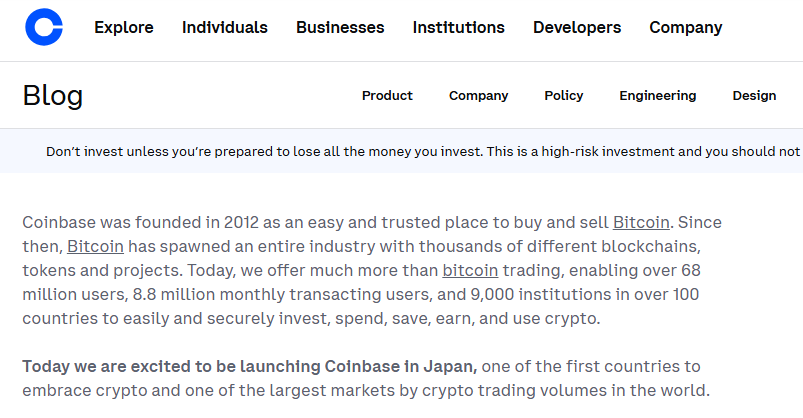
But there is a real cost to routing every dispute through an asynchronous channel. When your account gets frozen in the middle of a market crash, you do not want to compose an email and wait for a reply that might land days later. You want a person, now, and the entire architecture of the support system is built around making sure you cannot easily get one.
Former Coinbase employees told CNBC that the support department has historically struggled to keep pace with demand, with representatives falling behind and customers left waiting days just for an initial response. A company spokesperson told CNBC at the time that Coinbase was working on the problem and planned to roll out more support channels soon. That was in 2021. Five years on, the complaints read almost exactly the same.
What This Looks Like Next to a Bank
I keep coming back to a comparison that a communications executive made to Fortune during the May 2021 crash. Aubrey Strobel, who worked at a bitcoin rewards company called Lolli, said it plainly. It is a bad experience for people used to a traditional brokerage account, and it feels like it should be better, especially at a company as large as Coinbase.
She is right, and the comparison is instructive precisely because traditional finance has already been through this reckoning. Robinhood was fined $70 million by FINRA15, the industry’s self-regulator, in part for outages during the volatile early days of the pandemic that left retail traders locked out of their accounts while the market moved without them, a penalty Fast Company16 referenced in its own coverage of Coinbase’s outages. That fine sent a signal through the entire brokerage industry. Downtime during volatility is not just bad luck, it is a regulatory liability, and regulators can and will treat it that way.
Crypto exchanges have mostly escaped that same level of scrutiny, partly because the regulatory framework around digital assets is still being written, and partly because the industry has trained its users to accept a lower baseline. Blockchains themselves are marketed as decentralized and resilient, no single point of failure, no bank holiday, no closing bell. But the exchanges that most people actually use to buy and sell on those blockchains are centralized in every practical sense, running on the same commercial cloud infrastructure as any e-commerce site, guarded by the same overworked support queues as any subscription service. The decentralization pitch and the lived experience of using Coinbase are, in this particular way, almost opposites.
Arbitration, Not Escalation
Even when a customer decides to fight, the path is narrower than it looks. Coinbase’s user agreement requires most disputes to go through the company’s internal “Formal Complaint Process” before anything else, and if that fails, the case typically heads to arbitration rather than a courtroom.
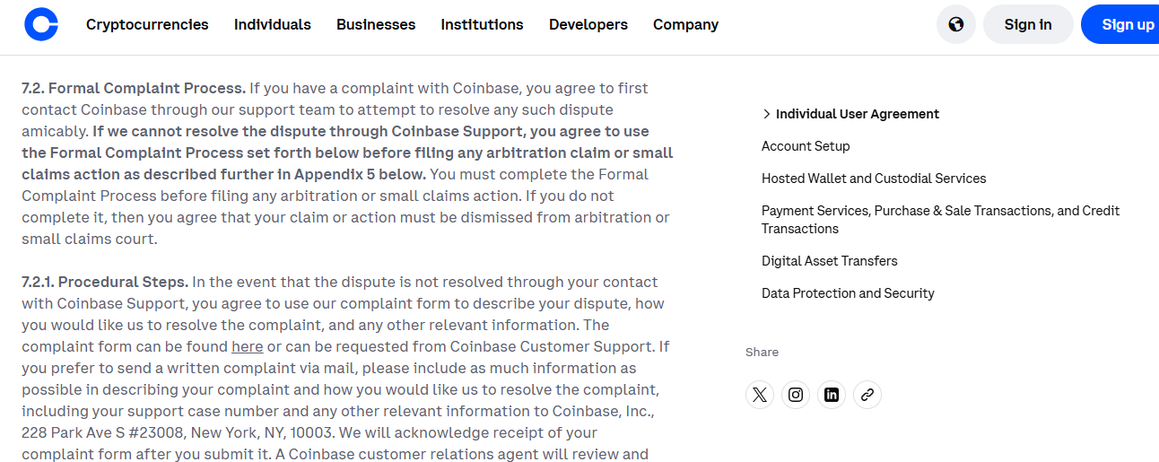
According to a breakdown from Justice Direct17 on how to sue Coinbase, a customer has to file a formal complaint through Coinbase’s own web form first, wait for a response, and only then consider small claims court or arbitration under the company’s terms. The same guide notes that even a Better Business Bureau complaint gets routed back through Coinbase, which is then asked to respond within 14 days, with a second request sent if the company stays quiet the first time.
Layer the CFPB on top of that. Coinbase told CNBC it takes those complaints seriously, and the agency does forward every complaint it receives to the company for a response. But a review of the CFPB’s public complaint database18 turns up the same shape of story again and again, funds frozen without explanation, identity verification requested a second and third time, and specialists assigned to a case who never circle back. One filer described sending crypto worth nearly $800 to Coinbase, hitting an “internal server error” trying to withdraw it, and then waiting almost a month past the company’s own quoted resolution window with nothing but a vague promise that the issue had been escalated. Another wrote plainly that Coinbase’s failure to release funds that were rightfully theirs amounted, in their words, to theft. That is a strong accusation, and I am not in a position to adjudicate it. But I understand why someone would reach for that word after weeks of silence.
What all of this adds up to is a system with plenty of formal, documented off-ramps for a frustrated customer and very few fast ones. You can file with the BBB. You can file with the CFPB. You can hire a lawyer and start the arbitration clock. Every one of those paths takes weeks at minimum. None of them helps you the night your account locks during a flash crash and you are watching a position you cannot close.
The Human Cost, One Ticket at a Time
I want to end where these stories usually end, with an individual account, because the aggregate numbers can make the whole thing feel abstract. Tanja Vidovic, a Coinbase customer profiled by CNBC, got a series of alerts one day about someone changing access to her account. It was the beginning of what security researchers call a SIM swap, where a fraudster convinces a phone carrier to move a victim’s number onto a new device and then uses that access to intercept two-factor codes and drain linked accounts. David Silver’s firm represented Vidovic in the aftermath, and Silver told CNBC that once someone loses their phone in a SIM swap, professional attackers can empty a crypto account in less than 30 minutes.
Thirty minutes to lose everything. Then, by most accounts I have read, weeks or months to get anyone at the company to explain what happened, let alone make anyone whole. One customer described in the CNBC19 piece eventually received a $200 credit from Coinbase along with an apology acknowledging that:
“Your Coinbase experience and your wait for a response to your formal complaint was not up to our standards.”
Two hundred dollars, after losing far more, after months of waiting. Some of these customers organized on a Facebook group with nearly a thousand members, trading advice on how to escalate a case, because the official channel had given them nothing better to go on.
I do not think Coinbase set out to build a support system this porous. I think it is what happens when a company scales from a niche product to tens of millions of users faster than its operations team can follow, and when the volatility that drives its business also happens to be the exact condition under which its infrastructure is most likely to buckle. The outages are a technical story. The silence afterward is an operational choice, made over and over, to route human problems through channels that were never built to handle a crisis at scale.
Coinbase says it is still working on this. It said so in 2021. It said something close to it again after May 2026, promising a full investigation once AWS publishes its own retrospective. Maybe that investigation changes something. Maybe the next outage lands during a quiet market, and nobody notices. Or maybe it lands during the next crash, and a new subreddit thread fills up with ticket numbers, and somewhere a customer sits refreshing an email that will not come for months. I genuinely do not know which. Neither, I suspect, does anyone at Coinbase.
Sources
- “Coinbase Status” 10 May 2026, status.coinbase.com/. Accessed 10 Sept. 2026. ↩︎
- 8 May 2026, www.coindesk.com/business/2026/05/08/coinbase-disruption-tied-to-aws-outage-draws-criticism-amid-staff-layoffs-and-q1-losses. Accessed 10 Sept. 2026. ↩︎
- Coindesk, 8 May 2026, www.coindesk.com/business/2026/05/08/coinbase-disruption-tied-to-aws-outage-draws-criticism-amid-staff-layoffs-and-q1-losses. Accessed 10 Sept. 2026. ↩︎
- CCN, www.ccn.com/news/crypto/coinbase-outage-explained-why-what-how-2026-may/. Accessed 10 Sept. 2026. ↩︎
- Leising, Matthew. “Coinbase and Binance’s outages show the fragility of crypto exchanges” Fortune, 20 May 2021, fortune.com/2021/05/19/coinbase-binance-outage-crypto-bitcoin-crash/. Accessed 10 Sept. 2026. ↩︎
- “Fastcompany.Com” www.fastcompany.com/90673529/furious-coinbase-users-report-access-problems-as-bitcoin-and-other-cryptocurrency-prices-plummet. Accessed 10 Sept. 2026. ↩︎
- DCD, www.datacenterdynamics.com/en/news/coinbase-hit-by-major-outage-during-crypto-crash-mining-gpu-demand-falls/. Accessed 10 Sept. 2026. ↩︎
- Zamost, Scott. “Coinbase slammed for what users say is terrible customer service after hackers drain their accounts” 24 Aug. 2021, www.cnbc.com/2021/08/24/coinbase-slammed-for-terrible-customer-service-after-hackers-drain-user-accounts.html. Accessed 10 Sept. 2026. ↩︎
- Better Business Bureau, www.bbb.org/us/ca/san-francisco/profile/cryptocurrency-exchange/coinbase-inc-1116-454104/complaints. Accessed 10 Sept. 2026. ↩︎
- “Reddit” www.reddit.com/. Accessed 10 Sept. 2026. ↩︎
- Blake, Tom. “How To File A Complaint Against A Crypto Exchange [Crypto Regulators]” Cult Of Money, 17 Oct. 2022, www.cultofmoney.com/file-a-complaint-against-a-crypto-exchange/. Accessed 10 Sept. 2026. ↩︎
- “Search the Consumer Complaint Database” Consumer Financial Protection Bureau , www.consumerfinance.gov/data-research/consumer-complaints/search/detail/7111474. Accessed 10 Sept. 2026. ↩︎
- Showalter, Jeremy. “Is Coinbase in Trouble? 4 Reasons to Avoid Coinbase in 2024 (July Update)” Swan Bitcoin, www.swanbitcoin.com/industry/is-coinbase-in-trouble/. Accessed 10 Sept. 2026. ↩︎
- Better Business Bureau, www.bbb.org/us/ca/san-francisco/profile/cryptocurrency-exchange/coinbase-inc-1116-454104/customer-reviews. Accessed 10 Sept. 2026. ↩︎
- “A vibrant market is at its best when it works for everyone” FINRA.org, www.finra.org/. Accessed 10 Sept. 2026. ↩︎
- “Fastcompany.Com” www.fastcompany.com/90673529/furious-coinbase-users-report-access-problems-as-bitcoin-and-other-cryptocurrency-prices-plummet. Accessed 10 Sept. 2026. ↩︎
- Lopez, Camila. “How to sue Coinbase” justicedirect.com/post/how-to-sue-coinbase. Accessed 10 Sept. 2026. ↩︎
- “Search the Consumer Complaint Database” Consumer Financial Protection Bureau , www.consumerfinance.gov/data-research/consumer-complaints/search/detail/7111474. Accessed 10 Sept. 2026. ↩︎
- Zamost, Scott. “Coinbase slammed for what users say is terrible customer service after hackers drain their accounts” 24 Aug. 2021, www.cnbc.com/2021/08/24/coinbase-slammed-for-terrible-customer-service-after-hackers-drain-user-accounts.html. Accessed 12 Sept. 2026. ↩︎