

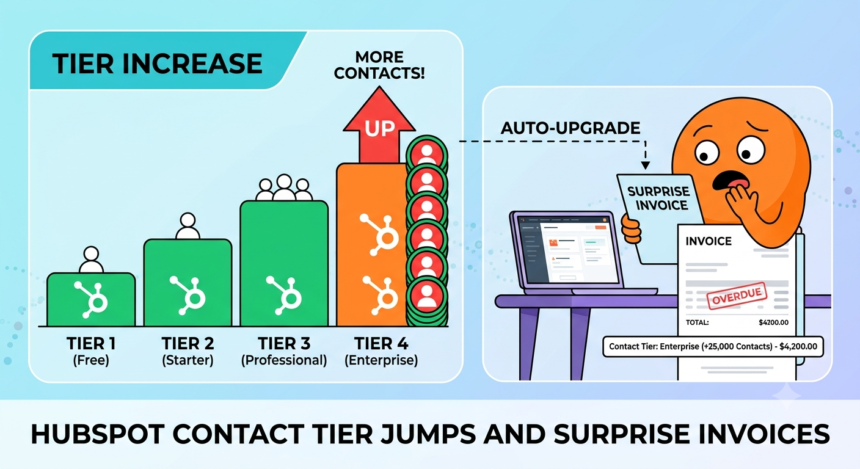

I want to start with a number. Seventy. That is how many contacts one small marketing team went over their HubSpot limit by, on a Tuesday at the end of July, while doing the unglamorous work of cleaning a list. They caught the mistake the same day. They deleted the contacts. They called support before the sun went down. None of it mattered. HubSpot had already generated the invoice, and that invoice did not bill them for the overage. It rebilled their entire account, at the new tier, for every month remaining in a two year contract. The team described it on HubSpot’s own community forum1, asking, essentially, whether anyone else had lived through this. A lot of people had.
That is the story I kept finding, in different clothes, across three years of complaints, reviews, and community threads. A company crosses a contact threshold, sometimes by a handful of names, sometimes because a workflow misfires overnight, and the bill does not creep up. It jumps, and it stays jumped, often for the length of the contract. I spent the last two weeks reading through HubSpot’s own documentation, its terms of service, hundreds of Trustpilot reviews, Better Business Bureau complaints, and forum threads going back years. What I found is not a story about a company doing anything illegal. It is a story about a pricing mechanism built with a ratchet in it, one that only turns one way, and about how many businesses learn that the hard way.
HubSpot’s Marketing Hub charges on two axes at once. You pay per seat, and separately, you pay per “marketing contact,” meaning any contact you actually reach with a marketing email, an ad, or a workflow action. Contacts you never market to can sit in your database for free, in unlimited numbers. On paper this is a fair model. You pay for what you use.
The trouble sits in what happens when you cross the line. According to HubSpot’s2 own Product Specific Terms, the subscription fee increases immediately during the billing period the moment you exceed your Maximum Contacts Limit, and the new fee applies for the remainder of the current contract term. Not the month you went over. The remainder of the term. If you are two years into a two year deal, you eat two years of the higher rate for a spike that might have lasted an afternoon.
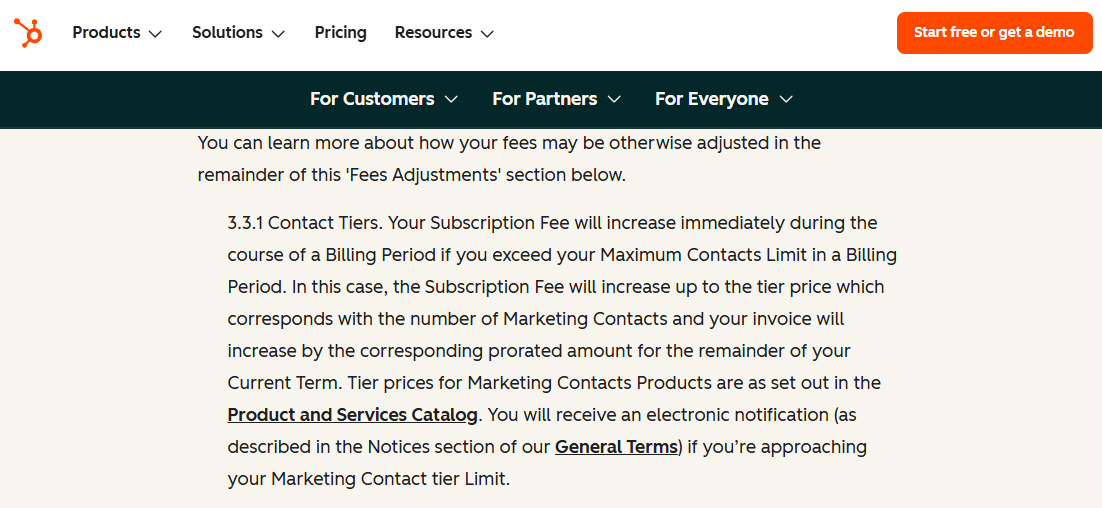
HubSpots’s3 own knowledge base article confirms the second half of the trap:
“You are billed for the higher contact tier until your subscription’s next renewal date, even if your marketing contact count later drops. HubSpot doesn’t downgrade contact tiers mid-term.”
The upgrade is instant and automatic. The downgrade requires a renewal date, a request submitted at least five business days ahead of it, and, in many cases, a Contract Manager who has to agree to let you go back down.
I keep coming back to the asymmetry of that design. A system that upgrades in real time but downgrades only on request, only at renewal, is not a neutral measurement tool. It is a one way valve, and somebody built it that way on purpose.
Seventy Contacts, Thousands of Dollars
Back to the team that went over by seventy. Their account manager, according to the thread, was sympathetic in person. A face to face meeting was held. An apology was extended. Then, in writing, the answer changed.
“A few days later I got an email saying that it could not be rescinded,” the original poster wrote in HubSpot Community4, describing how the company shifted into what they called “the blanket corporate response” that it was all covered under the terms. Every escalation, to billing, to the account manager’s manager, produced the same templated language.
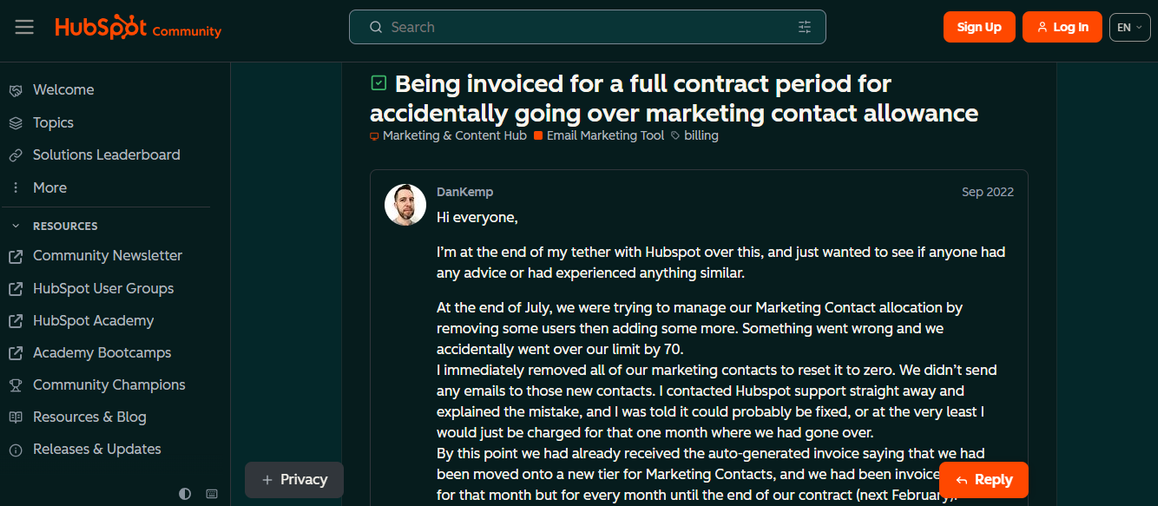
A HubSpot community moderator did eventually respond publicly on the thread, writing that the company was “truly sorry to hear about the frustration and disappointment” the team had felt, and promising to flag the case internally. That is a real response, and I do not doubt it was sincerely meant by the person who typed it. But sympathy from a moderator and a policy written into a contract are two different things, and only one of them determines what gets billed.
A second commenter on the same thread described what reads like the identical pattern at a different company, writing that HubSpot had charged them for a starter package and then automatically billed them for more than two thousand contacts after a contact upload tool failed to work correctly, with no response from support afterward. Two companies, two different months, the same shape of complaint, filed on HubSpot’s own forum where anyone can read it.
The Workflow that Ate a Company’s Budget Overnight
Not every overage comes from a mistake typed in by a human. Some come from the software itself, working exactly as configured, until the configuration changes underneath someone’s feet.
Vantage Point5, a consulting firm that audits HubSpot accounts for a living, describes a case in which a client’s marketing contact count went from roughly twelve thousand to roughly a quarter million overnight, the result of a single workflow whose enrollment criteria widened after an unrelated list change. Nobody added two hundred thousand people to a mailing list on purpose. A rule that used to catch a narrow group started catching a much wider one, and HubSpot’s system did exactly what it is designed to do. It counted every one of them as a marketing contact, crossed the tier line, and locked in the upgrade before the first usage alert reached anyone’s inbox.
That timing gap is worth sitting with. HubSpot does notify account holders when marketing contact usage hits seventy five, ninety, and ninety eight percent of the tier limit, a fact the company documents itself in its support materials. But those notifications, according to Vantage Point’s account, can take twenty four to forty eight hours to arrive, and an automated workflow can process thousands of contacts in a single evening. The alert is often still sitting unread in an inbox by the time the invoice has already been generated at the new tier.
I think this is the part of the story that gets lost when people frame this as a story about careless customers. A careless customer forgets to check a number. A structural risk is a system where the punishment for a software bug can outpace the notification that a bug even occurred.
I read through pages of Trustpilot6 reviews for HubSpot, and a pattern in the language surfaced fast. People do not describe this as a fee. They describe it as a trap. One reviewer, writing about a two year fixed term, said flatly that HubSpot “automatically upgraded our contact tier and then locked it in for the remainder of our fixed term,” adding that weeks later the company told them half those newly billed contacts were not even engaged. Another reviewer used the word “subscription traps” to describe what happens when old or fake contacts, including ones added by spam bots trying to abuse a signup form, push an account over its threshold before anyone gets a chance to clean the list.
One user wrote:
The pricing structure unfortunately is very bad. With all other SaaS products I have encountered, you get the chance to upgrade your seat from one tier to the next. Not with Hubspot though as I have learned now. Very much a blocker in the natural growth of a company.
Another simply said:
Good software, no interest in keeping customers
A Better Business Bureau complaint I found tells a related but distinct version of the same story, this one about contract lock in more broadly rather than the contact tier specifically. A sole proprietor described discovering, only after trying to downgrade to a free plan for financial reasons, that they were bound to a twelve month commitment they said was never clearly disclosed at signup. HubSpot’s BBB complaint page7 shows the company’s offered resolution was a ten percent discount, which the complainant called inadequate given the business was running at a documented six figure loss.
One such reviewer wrote:
HubSpot has withheld payouts twice within a three-week period, once when we were one month late on a subscription invoice and again when we were 18 days late.The withheld funds are payments made by our customers for services already rendered. These funds are not disputed, not subject to chargebacks, and not tied to fraud or compliance flags.
Another claimed:
HubSpot is engaging in deceptive billing practices and overcharging our boutique physical therapy clinic. They are mischaracterizing the facts of the services we have already paid for, as documented in our payment history
None of these are isolated cranks venting into the void. They are dated, specific, and they rhyme with each other across years and continents, which is usually the signal that you are looking at a system, not a string of bad luck.
The Cliff Before the Trap
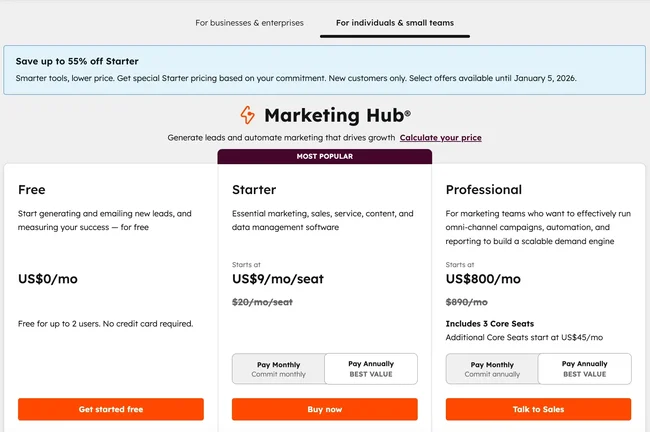
There is a second HubSpot pricing story that compounds the first one, and it deserves its own paragraph because it changes how painful a tier jump actually feels. Marketing Hub’s pricing does not scale smoothly. It has what one analysis called, accurately, a cliff. The jump from the Starter tier, priced in the range of nine to twenty dollars per seat monthly, to Professional lands you somewhere around eight hundred to sixteen hundred dollars a month, plus a mandatory, non negotiable onboarding fee of three thousand dollars that shows up on the first invoice regardless of how you pay. Enterprise starts even higher.
One vendor comparison site called Carly AI8 put it well:
“There’s no middle tier to break the fall.”
A company outgrowing Starter is not stepping up a staircase. It is jumping a canyon, and a contact tier overage that forces an unplanned upgrade lands you on the far side of that canyon with no warning shot.
A commenter on Reddit’s r/CRMSoftware9, quoted in a third party pricing breakdown, summed up the entire structure in one line that I have not been able to shake since I read it. They wrote:
HubSpot pricing is more like a pyramid than a price list. you start at one tier, then 2-3 hubs deep, plus seat creep and contact-tier creep all stacking at once.
Comment
by u/Purple-Talk4301 from discussion
in CRMSoftware
Climb it, and each new level costs more than the one below it implied.
I want to be fair to HubSpot here, because there is a version of this story that treats automatic tier upgrades as inherently sinister, and I do not think that is quite right. Usage based billing has to have some mechanism for handling overages. A gym cannot let you bring fifteen guests and charge you for one membership. A phone company has always billed for the data you actually used. The marketing contact model, in isolation, is arguably more generous than the flat per contact pricing that older platforms like Mailchimp popularized, since HubSpot10 lets you store unlimited non marketing contacts for free.
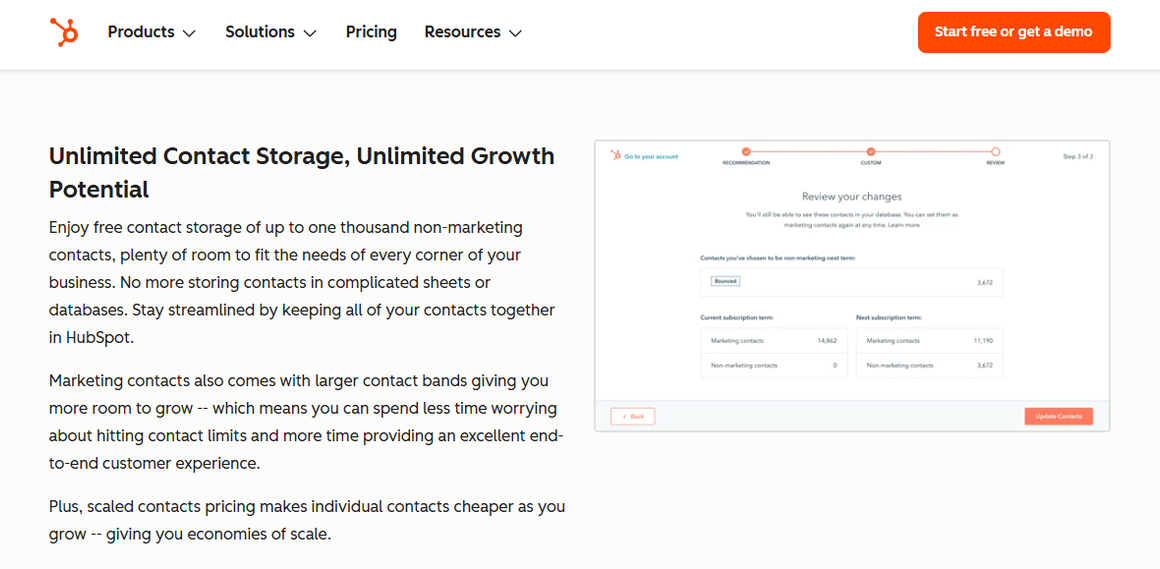
What makes this different from an ordinary usage meter is the direction the ratchet turns. A cell phone company that overcharges you for data usually lets the bill go back down the next billing cycle once your usage drops. HubSpot’s11 own terms specify the opposite. The upgrade is instant. The downgrade requires you to ask, to wait for a renewal date, and in many contract types, to get someone at HubSpot to agree to it. That is not a technical necessity of usage based billing. It is a choice about which direction friction gets applied, and the company chose to put all the friction on the side that costs the customer money to remove.
I have written enough of these pieces no, to recognize the shape of this argument when I see it again. The mechanism is rarely fraud. It is asymmetry, quietly engineered, defensible line by line in a terms of service document that almost nobody reads until the invoice arrives.
What Actually Protects You
Buried in HubSpot’s own advice to customers is a tacit admission of how fragile this all is. The company’s guidance amounts to: watch your numbers constantly, downgrade contacts to non marketing status before your monthly update date if you are not actively using them, audit which of your own tools default new contacts to marketing status, and restrict which employees have permission to flip that switch at all. Consultants like Vantage Point and Avidly have built entire service lines around doing this auditing for companies that do not have a RevOps team to spare. One Avidly Agency12 analysis calls the phenomenon the “Marketing Contact Trap” and estimates that most mid market companies could cut their monthly HubSpot bill significantly just by reclassifying dormant contacts nobody was actually emailing.
That advice is sound. It is also, if you step back, a strange thing to have to say out loud about a piece of billing software. The official fix for “our vendor might silently double our invoice overnight” is “hire someone to babysit the vendor.” Companies that can afford a RevOps specialist or a HubSpot focused consultancy absorb this cost quietly. Companies that cannot, the sole proprietors and small agencies whose complaints fill the BBB and Trustpilot pages, do not get the same soft landing. They get a bill, a locked contract, and a support queue.
I do not think HubSpot set out to design a trap. I think it built an efficient, technically fair usage meter, and then, somewhere in a contracts meeting nobody wrote down, decided that the meter should only run in one direction unless the customer does the work to reverse it. That is a smaller sin than fraud. It is also a real one, and it is the kind of decision that gets made by companies of every size, in every industry, whenever growth in revenue and growth in customer goodwill stop pointing the same direction.
The team that went seventy contacts over their limit never got their invoice reversed, as far as the public thread shows. They got an apology, a moderator’s promise to advocate internally, and a bill for two years at the new tier. Somewhere, right now, another team is quietly crossing the same invisible line, and they probably have no idea yet.
Sources
- Hubspot, community.hubspot.com/t5/Email-Marketing-Tool/Being-invoiced-for-a-full-contract-period-for-accidentally-going/m-p/696839. Accessed 16 Sept. 2026. ↩︎
- “Product Specific Terms” legal.hubspot.com/product-specific-terms. Accessed 17 Sept. 2026. ↩︎
- “Understand marketing contacts billing” 14 Aug. 2026, knowledge.hubspot.com/account/understand-marketing-contacts-billing. Accessed 17 Sept. 2026. ↩︎
- HubSpot, community.hubspot.com/t/being-invoiced-for-a-full-contract-period-for-accidentally-going-over-marketing-contact-allowance/65677. Accessed 18 Sept. 2026. ↩︎
- Cockrum, David. “HubSpot Marketing Contacts Billing: How Workflows Inflate Your Bill” Vantage Point, 26 June 2026, vantagepoint.io/blog/hs/hubspot-marketing-contacts-billing-workflow-risk. Accessed 17 Sept. 2026. ↩︎
- Trustpilot, www.trustpilot.com/review/hubspot.com?page=9. Accessed 18 Sept. 2026. ↩︎
- Better Business Bureau, www.bbb.org/us/ma/e-cambridge/profile/computer-software/hubspot-0021-121432/complaints. Accessed 18 Sept. 2026. ↩︎
- Team, Carly. “8 Best HubSpot Alternatives in 2026 (Escape the Seat Cliff)” Carly AI Blog, 15 July 2026, www.usecarly.com/blog/hubspot-alternatives/. Accessed 18 Sept. 2026. ↩︎
- Reddit, www.reddit.com/r/CRMSoftware/. Accessed 18 Sept. 2026. ↩︎
- “Marketing Contacts” 15 July 2024, www.hubspot.com/marketing-contacts. Accessed 18 Sept. 2026. ↩︎
- “Customer Terms of Service” legal.hubspot.com/terms-of-service. Accessed 18 Sept. 2026. ↩︎
- Öijer, Josefine. “HubSpot marketing contacts pricing: How to avoid the €10k/Month trap” Avidly, 26 Nov. 2025, www.avidlyagency.com/blog/hubspot-marketing-contacts-pricing-cost-reduction. Accessed 18 Sept. 2026. ↩︎


