
I keep coming back to one sentence in the Texas lawsuit against Discord, because it reads less like a legal filing and more like a verdict on the last decade of the internet.
Attorney General Ken Paxton wrote in his May 2026 complaint:
“Discord presents itself to the world as a platform built on community, connection, and safety. It is not.”
That is not how lawyers usually write, and it is not how a company that once told its own employees that safety was “at the core of everything we do” wants to be described in a courtroom in Collin County. But there it is, on the record as documented by Courthouse News1.
Discord2 has more than 200 million monthly users. Ninety percent of them are there to play games, according to the company’s own job listings, which is a strange thing to learn about a platform now facing a state lawsuit that quotes federal prosecutors calling it “a hunting ground to find, manipulate, and sextort our most vulnerable.” The platform did not build a newsroom or a shopping mall. It built something closer to a city of private rooms, invitation only, most of them small, most of them invisible to anyone outside the friend group that made them. And then it staffed the security desk with volunteers.
I want to be careful here, because the story of Discord moderation is not one story. It is three, stacked on top of each other, and each one hides the next.
The First Layer: Unpaid and Untrained
Walk into almost any Discord server with more than a few hundred members and you will find a moderator. Maybe two. They have a badge, a role color, and the power to mute, kick, or ban. What they do not have, in the overwhelming majority of cases, is a paycheck. Discord’s own recruitment guidance warns server owners that placing too many responsibilities on too few moderators can quickly cause members of the team to lose interest, which is a polite corporate way of describing burnout in people who are not employees and therefore have no HR department to complain to.
This is not a new arrangement, and it is not unique to Discord. Reddit has run on the same model for years, and researchers at Northwestern3 calculated that unpaid Reddit moderators perform labor worth at least $3.4 million a year on that platform alone, a figure equal to roughly 2.8 percent of Reddit’s 2019 revenue. Before Reddit, there was AOL, whose 14,000-strong volunteer “Community Leader” program ended in a 1999 class-action lawsuit and, eventually, a $15 million settlement in 2008. The pattern is old enough to have its own case law. Platforms build communities on the backs of people who are told the work is a privilege, a badge of trust, a line on a resume. Then the platform scales past the point where trust and goodwill can substitute for training and oversight, and something breaks.
Researcher J. Nathan Matias4, writing in the journal Social Media + Society, called this “the civic labor of volunteer moderators,” a phrase that dignifies the work while quietly conceding that it is unpaid civic labor holding up a for-profit company’s entire safety architecture. A University of Michigan study led by doctoral candidate Angela Schöpke-Gonzalez found that volunteer moderators experience burnout driven by interpersonal conflict, time pressure, and daily exposure to toxic behavior, the same three ingredients that show up in every study of this kind, regardless of platform.
Texas is now arguing that this arrangement is not just exploitative. It is dangerous. The state’s complaint claims Discord “relies heavily on volunteer moderators to manage safety risks within servers” and that the company’s own Moderator Academy training program is voluntary, not mandatory, even in servers built explicitly for children. The lawsuit points to Discord’s internal discussions of moderator burnout as evidence the company knew exactly what kind of weight it was asking amateurs to carry, a detail reported by Texas Policy Research5. New Jersey’s attorney general filed a nearly identical claim around the same time, alleging Discord relied on “unpaid, untrained volunteer moderators even in servers that catered explicitly to children,” according to court filings summarized by personal injury attorneys tracking the litigation.
Paxton’s office opened its investigation into Discord in October 2025, after reports surfaced that the platform had been used by the man accused of murdering Charlie Kirk, according to the Texas Attorney General’s6 own press release. That is the kind of event that turns a slow-burning policy debate into a subpoena. It usually takes a body, or a name in a headline, before anyone in a position to regulate a platform actually reads its moderation policy closely enough to notice the gaps.
The Second Layer: Paid, But Not by Discord
Here is where the story gets less discussed, because it is less visible even to the people living inside it.
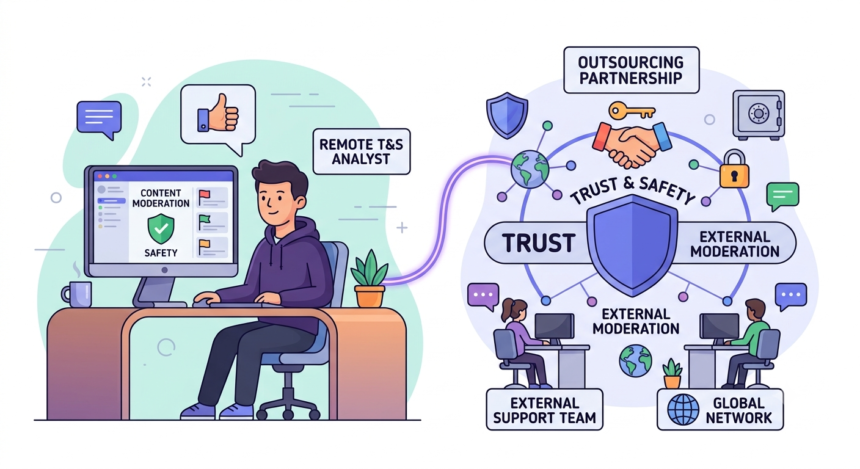
Above the unpaid volunteer tier sits a second layer of paid moderation, and Discord does not run most of it directly. The company has, for years, quietly built out what its own hiring materials call a “global Trust & Safety vendor” operation. A 2026 Discord job posting for an “Outsourcing Specialist, Safety” describes a role that provides “essential technical support to our global Trust & Safety vendor teams,” serves as “first responder for access and troubleshooting issues,” and reports to a “Manager of Outsourcing,” a title that confirms outsourcing is not an occasional stopgap at Discord. It is a managed function.
The numbers Discord submitted to the Senate Judiciary Committee, disclosed in written testimony reported by NBC News7, tell the shape of this arrangement plainly. In 2019, Discord had 22 full-time employees devoted to trust and safety. By 2023 that had grown to 90. Then came a round of layoffs in 2024, and the full-time team shrank back down to 74, roughly its 2021 size. But alongside that full-time headcount, Discord told the committee it has “consistently grown its contract workforce,” which now includes 400 additional contract agents, described in the company’s own words as “external, virtual Special Operations Center, other support functions.” Read that ratio again. Seventy-four full-time staff. Four hundred contractors. The people actually doing the bulk of enforcement work are, by the company’s own accounting, mostly not Discord employees at all.
One of Discord’s named vendors is 5CA, a Netherlands-based business process outsourcing firm that describes itself as “the fan-made CX company” and boasts of “gamer agents” recruited from more than 75 countries who work remotely and, per its own marketing, are hired precisely because they already love the games and platforms they will be moderating. 5CA8 runs customer support and trust and safety functions for major names in gaming, and it has publicly framed trust and safety as no longer “a side function or a reactive task for customer support” but a core business offering, which tells you something about how normalized this outsourcing model has become across the industry, not just at Discord.
Then the breach happened. In 2023, hackers compromised a support agent’s account inside 5CA and gained access to a queue of Discord customer service and Trust & Safety tickets. Discord’s9 own incident disclosure confirmed the vendor by name and said roughly 70,000 users may have had government ID photos exposed, images that 5CA’s agents used to review age-verification appeals. Read that sentence twice. A third-party contractor, hired to save money on a support function, was holding scanned passports and driver’s licenses submitted by users trying to prove their age to a platform that markets itself on child safety, and those documents ended up in the hands of hackers demanding ransom. The Infosecurity Magazine10 writeup notes the stolen trove also included internal training materials and presentations, meaning the company’s own playbook for how it trains contractors to handle sensitive cases was potentially exposed too. It was not the first time. Discord had already disclosed a smaller breach through a different third-party support provider in March 2023.
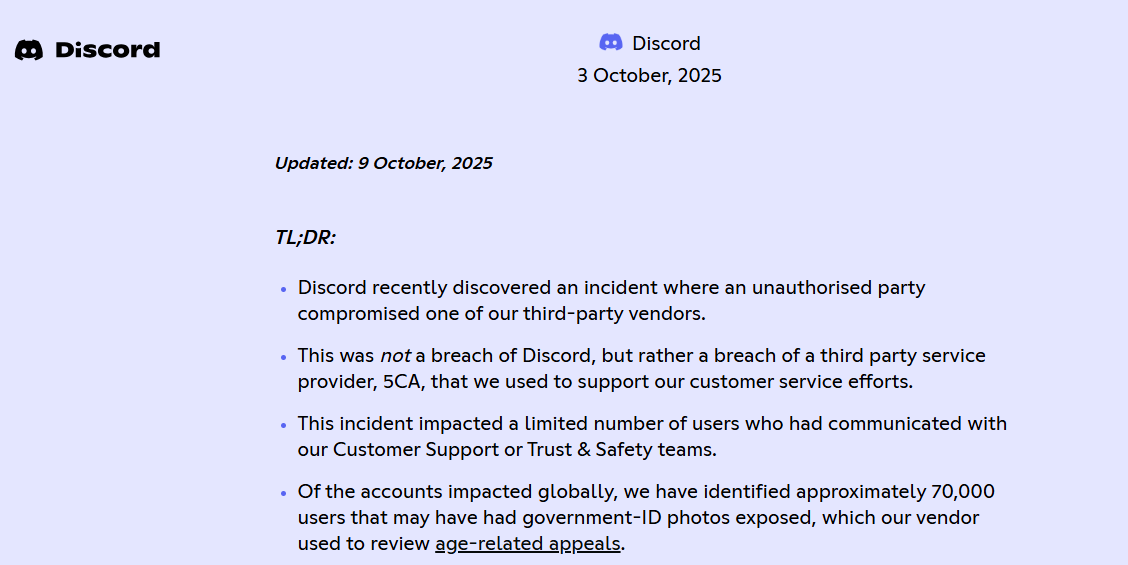
I do not think this is a story about one bad vendor. I think it is a story about what happens structurally when a company decides that the cheapest way to scale a trust function is to hand the most sensitive part of it, the part that touches minors’ identity documents and abuse reports, to whichever outside firm can staff it fastest and for the least money. Keywords Studios, a Dublin-based agency, has also done content moderation work tied to Discord, according to reporting from the independent PNLY blog11, which tracks the platform’s reporting infrastructure more closely than most mainstream outlets bother to. The blog’s writer put it plainly: agents at outsourcing firms “aren’t Full-Time Employees and don’t have the same rigorous guarantees that vetted employees would.”
The Wages Behind the Wall
Outsourced trust and safety work does not happen in San Francisco. It happens where labor is cheapest. Glassdoor12 data puts the average content moderator salary in the Philippines at around 20,000 to 25,000 pesos a month, roughly $340 to $420, with entry-level postings advertising wages as low as ₱8 an hour. The average Philippine content moderator salary seems to be closer to ₱264,000 a year, moderators in Mexico and Brazil earn somewhere between $29,000 and $40,000 annually, a wide enough spread across the global south that it is hard to pin one number on the job, except to say it is consistently a fraction of what the same title pays in the United States.
The job itself, wherever it is done, carries a documented psychological cost. A qualitative study of eleven commercial content moderators exposed to child sexual abuse material found symptoms consistent with post-traumatic and secondary traumatic stress, including intrusive thoughts, avoidance of children, and what one moderator, identified only as CM5, described this way:
“My trigger is bestiality. I cannot work on the bestiality content, but I had to do it at some point, and it was really tough for me because I have my dog.”
Another moderator, CM8, told researchers that “it leads to a lot of burnout,” and that turnover in the child exploitation and terrorism review queues happens fast because “it’s traumatic for them,” a finding published in Cyberpsychology: Journal of Psychosocial Research on Cyberspace13. A separate review from Middlesex University researchers Elena Martellozzo and Jeffrey DeMarco notes that moderators can face daily quotas requiring them to screen hundreds of items with accuracy targets attached, and that “the reliance on outsourcing means the level of support for moderators varies greatly,” a line that could serve as the thesis statement for this entire industry, published by the child protection organization End Violence14.
A philosophy paper published in the Journal of Applied Philosophy15 goes further, arguing that human content moderation of CSAM is close to morally indefensible given what it does to the people doing it, noting that some moderators report being unable to interact with children without crying, a year after quitting. That is not a Discord-specific finding. It applies to every platform that still uses human eyes on the worst material the internet produces. But Discord’s own structure, small private servers, ephemeral voice channels, encrypted-feeling intimacy between strangers, arguably generates more of that material per user than a public feed ever could, because predators have long understood that private, poorly staffed rooms are safer for them than open ones.
The Numbers Discord Would Rather You Not Compare
Every electronic service provider in the United States is legally required to report suspected child sexual exploitation material to the National Center for Missing and Exploited Children’s CyberTipline. In 2023, Discord submitted 339,412 reports. In 2024, that number fell to 241,354, a 28 percent drop, according to a letter Senator Marsha Blackburn16 sent directly to Discord CEO Jason Citron in April 2025, calling the decline “both puzzling and deeply troubling.” NCMEC’s own annual data confirmed that Discord was among a handful of major platforms, alongside Google, X, and Microsoft, that all submitted at least 20 percent fewer reports in 2024 than the year before, a drop reported by NBC News17 as part of the largest single-year decline in CyberTipline history.
The number rebounded some in 2025. Senator Chuck Grassley’s committee later disclosed that Discord submitted nearly 490,000 reports to NCMEC that year, but flagged that a significant share of those reports were “inactionable” because Discord had failed to include location or account information investigators needed to actually do anything with them, a finding detailed in Grassley’s own press release. A report that cannot be acted on by law enforcement is, in the most literal sense, a report that exists mainly to satisfy a legal obligation on paper.
Zoom out and the industry-wide trend gets darker. NCMEC’s CyberTipline received more than 20 million reports in 2024 and more than 21 million in 2025, including over 61 million individual images, videos, and files, according to the organization’s own 2025 data summary. Reports of online enticement rose 156 percent year over year. Generative AI-related exploitation reports rose more than 1,300 percent between 2023 and 2024, a trend the Department of Homeland Security’s own outlet HSToday18 tied specifically to activity on “gaming and messaging platforms such as Discord, Roblox, and other public channels.” NCMEC’s John Shehan put it bluntly in that reporting:
“These statistics are not just numbers. They represent children experiencing unthinkable harm.”
Discord is not alone in cutting trust and safety staff even as the volume of harm climbs. X told the Senate it had roughly 3,317 trust and safety employees and contractors in May 2022, before Elon Musk’s acquisition, and around 2,300 by early 2024, a 43 percent reduction according to the same NBC News19 reporting that surfaced Discord’s own figures. Snap’s trust and safety headcount peaked at 3,051 in 2021 and fell to 2,226 by 2023, a 27 percent cut. This is not a Discord problem in isolation. It is what happens across an entire industry once the growth phase ends and shareholders start asking why safety, a cost center with no revenue line of its own, keeps expanding while everything else gets trimmed.
What the Business Model Actually Optimizes For
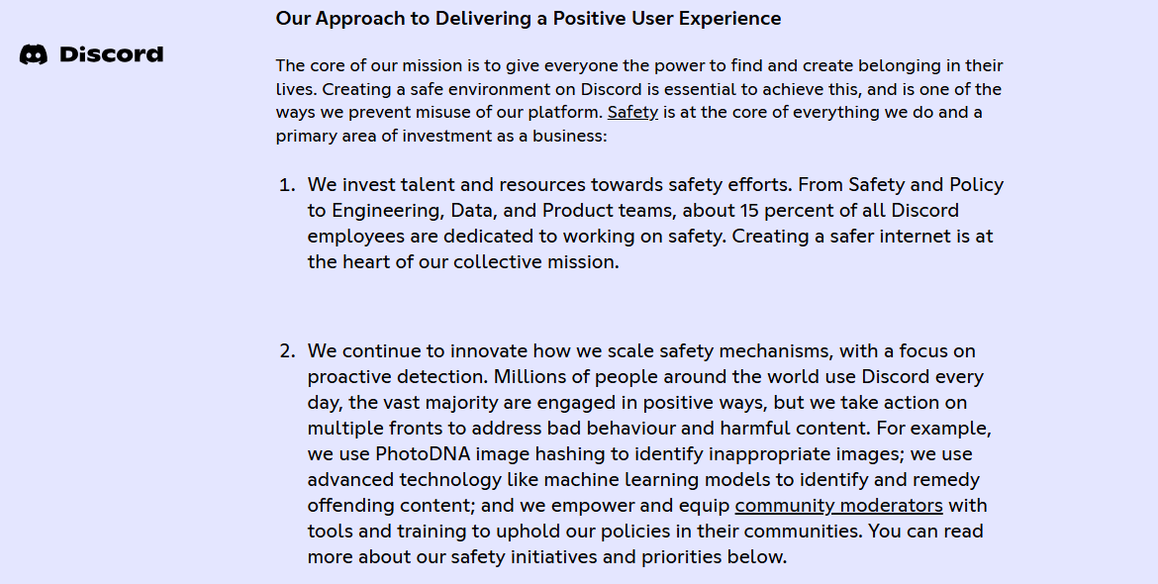
Here is what I keep circling back to. Discord’s public safety messaging, the transparency reports, the “15% of all employees” statistic the company has repeated in nearly every biannual disclosure since 2019, is technically true and structurally misleading at the same time. Fifteen percent of employees “dedicated to this area” sounds like a company with safety baked into its bones. It does not tell you that a meaningful share of the actual review work, the part where a human being looks at a reported image or a flagged message and decides whether it crosses a line, happens through vendors whose names rarely appear in a press release, whose wages are set by BPO market rates in Manila or wherever labor is cheapest that quarter, and whose access to Discord’s most sensitive systems has already produced at least two publicly disclosed data breaches.
Outsourcing is not inherently a scandal. Every large platform does some version of it, and companies like 1Point120 and Conectys market themselves openly on the premise that content moderation is now a board-level risk category best handled by specialists who can staff multilingual teams around the clock at a fraction of in-house cost. There is a real argument that dedicated vendors, done well, can bring more consistent training and psychological support than a startup’s internal team ever could on its own. PartnerHero21, another vendor in this space, advertises that its moderation teams come with dedicated mental health resources to keep the work “psychologically safe,” which is precisely the kind of promise worth testing against what actually happens once a contract is signed and a quota is set.
But Discord’s own numbers suggest something closer to a hollowing out than a careful hybrid strategy. A platform that cut its full-time trust and safety staff from 90 to 74 in a single year, while simultaneously growing a 400-person contractor bench for the same function, is not building redundancy. It is shifting cost and liability outward, toward workers who are cheaper, less visible in press coverage, and legally one step removed from the parent company when something goes wrong. When something did go wrong, when 5CA got breached, Discord’s statement was careful to note “this was not a breach of Discord, but rather a breach of a third party service provider,” a sentence that is accurate and also does a great deal of quiet work distancing the company from a failure inside a system it built and chose to rely on.
An Ending That Refuses to Close
I do not have a tidy conclusion here, and I am suspicious of anyone who claims to. Texas wants Discord to default every safety setting to maximum protection, verify user ages under the SCOPE Act, and pay back revenue tied to what the state calls unlawful conduct, a remedy outlined in the AG’s own filing. New Jersey wants something similar. Whether either lawsuit survives Discord’s legal defense, and whether age verification laws hold up under the free speech challenges that have already gutted parts of the SCOPE Act elsewhere, is genuinely unresolved, and I would not bet either way with confidence.
What I do know is this. Somewhere tonight, an unpaid teenage moderator is deciding whether to ban a stranger from a server built around a video game, with no training beyond a voluntary academy course and no one to call if it goes wrong. Somewhere else, a contractor earning a few hundred dollars a month is reviewing a queue of flagged images, working toward an accuracy target set by a company whose name may not even appear on the paycheck. And somewhere in San Francisco, a transparency report is being drafted that will describe all of this, accurately, as 15 percent of the workforce being dedicated to safety. All three of those sentences are true at once. That is the part that should unsettle you more than any single lawsuit.
Sources
- Courthouse News, www.courthousenews.com/texas-ag-claims-discord-serves-as-hunting-ground-for-child-predators/. Accessed 11 Oct. 2026. ↩︎
- Citron, Jason. “Discord’s Next Chapter” 27 Feb. 2025, discord.com/blog/discords-next-chapter. Accessed 11 Oct. 2026. ↩︎
- “Unpaid social media moderators perform labor worth at least $3.4 million a year on Reddit alone” Northwestern Now, 31 May 2022, news.northwestern.edu/stories/2022/05/unpaid-social-media-moderators. Accessed 11 Oct. 2026. ↩︎
- J. Nathan Matias, journals.sagepub.com/doi/10.1177/2056305119836778. Accessed 11 Oct. 2026. ↩︎
- Staff, TPR. “Texas Sues Discord Over Child Safety and Online Predator Allegations” Texas Policy Research, 26 May 2026, www.texaspolicyresearch.com/texas-sues-discord-over-child-safety-and-online-predator-allegations/. Accessed 11 Oct. 2026. ↩︎
- “Attorney General Ken Paxton Files Landmark Lawsuit Against Discord for Deceiving Parents and Exposing Texas Children to Predators” Office of the Attorney General, www.texasattorneygeneral.gov/news/releases/attorney-general-ken-paxton-files-landmark-lawsuit-against-discord-deceiving-parents-and-exposing. Accessed 11 Oct. 2026. ↩︎
- Goggin, Ben. “Big Tech companies reveal trust and safety cuts in disclosures to Senate Judiciary Committee” 29 Mar. 2024, www.nbcnews.com/tech/tech-news/big-tech-companies-reveal-trust-safety-cuts-disclosures-senate-judicia-rcna145435. Accessed 11 Oct. 2026. ↩︎
- “Trust & Safety in Gaming | 5CA” 6 May 2025, 5ca.com/blog/trust-safety-in-gaming/. Accessed 11 Oct. 2026. ↩︎
- “Update on a Security Incident Involving Third-Party Customer Service” discord.com/press-releases/update-on-security-incident-involving-third-party-customer-service. Accessed 11 Oct. 2026. ↩︎
- Coker, James. “Discord Reveals Data Breach Following Third-Party Compromise” Infosecurity Magazine , 7 Oct. 2025, www.infosecurity-magazine.com/news/discord-data-breach-third-party/. Accessed 11 Oct. 2026. ↩︎
- PNLY, blog.pnly.io/discords-reporting-system/. Accessed 11 Oct. 2026. ↩︎
- Glassdoor, www.glassdoor.com/Salaries/philippines-content-moderator-salary-SRCH_IL.0,11_IN204_KO12,29.htm. Accessed 11 Oct. 2026. ↩︎
- Spence, Ruth. “The psychological impacts of content moderation on content moderators: A qualitative study | Cyberpsychology: Journal of Psychosocial Research on Cyberspace” cyberpsychology.eu/article/view/33166. Accessed 11 Oct. 2026. ↩︎
- End Violence, www.end-violence.org/articles/invisible-risks-content-moderators-and-trauma-child-sexual-abuse-materials. Accessed 11 Oct. 2026. ↩︎
- Wiley Online Library, onlinelibrary.wiley.com/doi/10.1111/japp.70024. Accessed 11 Oct. 2026. ↩︎
- Blackburn, www.blackburn.senate.gov/services/files/2DCCC15A-5004-4640-9F08-B56C98F6D3E6. Accessed 11 Oct. 2026. ↩︎
- Goggin, Ben. “Child exploitation watchdog says Meta encryption led to sharp decrease in tips and reports” 9 May 2025, www.nbcnews.com/tech/security/child-exploitation-watchdog-says-meta-encryption-led-sharp-decrease-ti-rcna205548. Accessed 11 Oct. 2026. ↩︎
- HSToday, “Just a moment…” www.hstoday.us/subject-matter-areas/cybersecurity/surge-in-online-crimes-against-children-driven-by-ai-and-evolving-exploitation-tactics-ncmec-reports/. Accessed 11 Oct. 2026. ↩︎
- Goggin, Ben. “Big Tech companies reveal trust and safety cuts in disclosures to Senate Judiciary Committee” 29 Mar. 2024, www.nbcnews.com/tech/tech-news/big-tech-companies-reveal-trust-safety-cuts-disclosures-senate-judicia-rcna145435. Accessed 11 Oct. 2026. ↩︎
- “How Content Moderation Outsourcing Helps Brands Protect Trust and Safety at Scale” 1Point1 Solutions, 24 July 2026, www.1point1.com/blogs/how-content-moderation-outsourcing-helps-brands-protect-trust-and-safety-at-scale. Accessed 11 Oct. 2026. ↩︎
- “Trust & Safety Services” PartnerHero, www.partnerhero.com/trust-and-safety. Accessed 11 Oct. 2026. ↩︎