


I spent weeks reading recruiter forums, and the same sentence kept showing up in different words. Something like: I paid for this account. Why does it feel like I am being punished for using it.
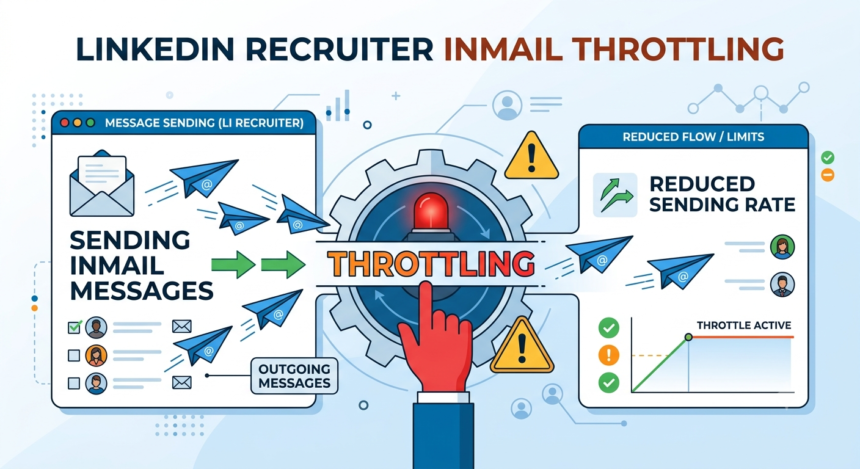
That question sits at the center of a system most job seekers never see and most recruiters barely understand until it happens to them. LinkedIn’s InMail product, the paid messaging feature that lets a recruiter reach a stranger without a mutual connection, comes wrapped in a set of limits, thresholds, and silent penalties that LinkedIn calls quality control. Recruiters call it something closer to a trap. Send too many messages that go unanswered and the platform can quietly restrict your account for two weeks at a time, sometimes longer, with your pipeline stalled and your quota clock still running.
This is not a rumor. It is written into LinkedIn’s own help documentation, and it shapes the daily work of hundreds of thousands of recruiters who pay for the privilege of contacting people who never asked to hear from them.
The Credit You Already Paid For
InMail is not free, and it was never meant to be free. A Premium Career subscriber gets five InMail credits a month for $29.99, which works out to roughly six dollars per message before a single word gets typed. A Sales Navigator Core subscriber pays $119.99 a month for 50 credits, closer to two dollars forty per credit. Recruiter Corporate accounts, the ones staffing agencies and in-house talent teams actually run their business on, come with 150 credits per seat, and enterprise contracts can push that number into the thousands when pooled across a team.
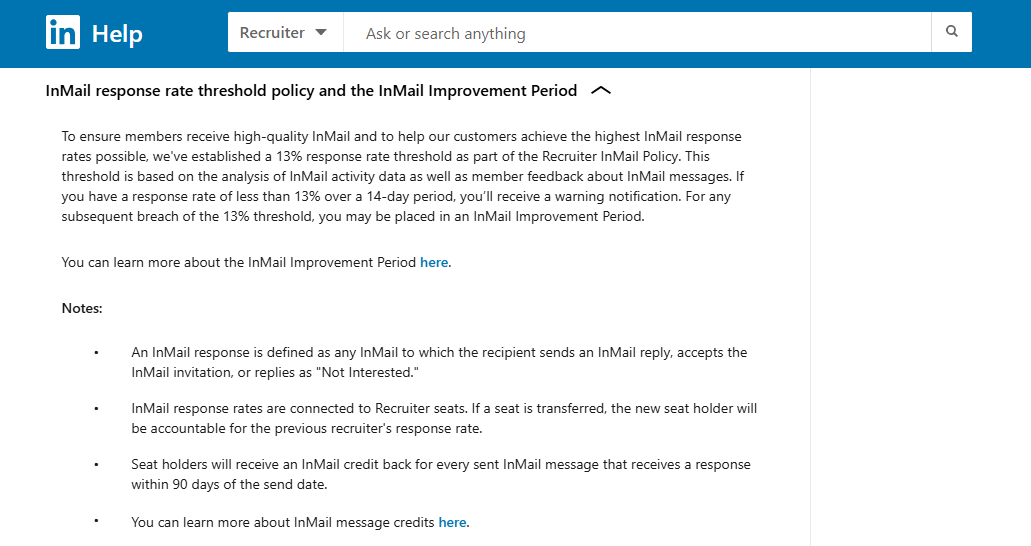
Here is the part that stings. If a recipient never responds, that credit does not come back. LinkedIn1 frames the system as a two-way courtesy: you get your credit refunded if the person you messaged replies within 90 days, even if the reply is a flat no.
That refund mechanic sounds generous until you notice what it actually incentivizes. A job seeker on the workplace forum Blind2 admitted the quiet part out loud.
I assume most of us get at least a few cold hits on LinkedIn with high frequency. Do you reply to them all? What do you say? If I ask the recruiter, “TC or GTFO” am I doing it right?
Recruiters get their credit back if you reply, even to decline, so the poster said they answer every single one, calling it a matter of simple math rather than manners. Another commenter on that same thread noted the flip side. If credit refunds only reward replies, ignoring a recruiter costs that recruiter money, which means silence has become a weapon candidates can wield without knowing they are wielding it.
I find that detail almost funny in a dark way. LinkedIn built a billing system that turns basic professional courtesy into a transaction, then acts surprised when the entire user base starts gaming it from both sides.
The math gets worse once you’re inside an agency. A recruiter working a full desk of open requisitions can burn through a monthly allocation in a matter of days. One recruiter, quoted in Kondo3 on InMail credits, put the frustration bluntly, saying two hundred credits disappear within two or three days when the pipeline demands it, and the boutique teams sharing a shrinking pool feel that scarcity fastest. Once the allocation runs dry, LinkedIn sells overage packs at eight to twelve dollars a credit, most commonly ten dollars flat. There is a cap on how many overage packs an account can buy in a given month, but LinkedIn does not publish the number. It gets negotiated privately, contract by contract, which means two recruiters at two different firms doing identical work can hit two entirely different ceilings without either one knowing why.
The 13 Percent Line
Running out of paid credits is only the first wall. The second one is quieter and, in my reporting, the one that seems to generate the most resentment.
LinkedIn’s Recruiter InMail Policy sets a response rate floor. If a recruiter sends more than 100 InMails in a rolling 14-day window and fewer than 13 percent of recipients respond, LinkedIn issues a warning. Miss the bar again and the account enters what LinkedIn4 calls an InMail Improvement Period, during which bulk InMail sending is suspended for two weeks. Fail to climb back over 13 percent by the end of that window and the suspension resets for another 14 days, with no fixed end date attached.
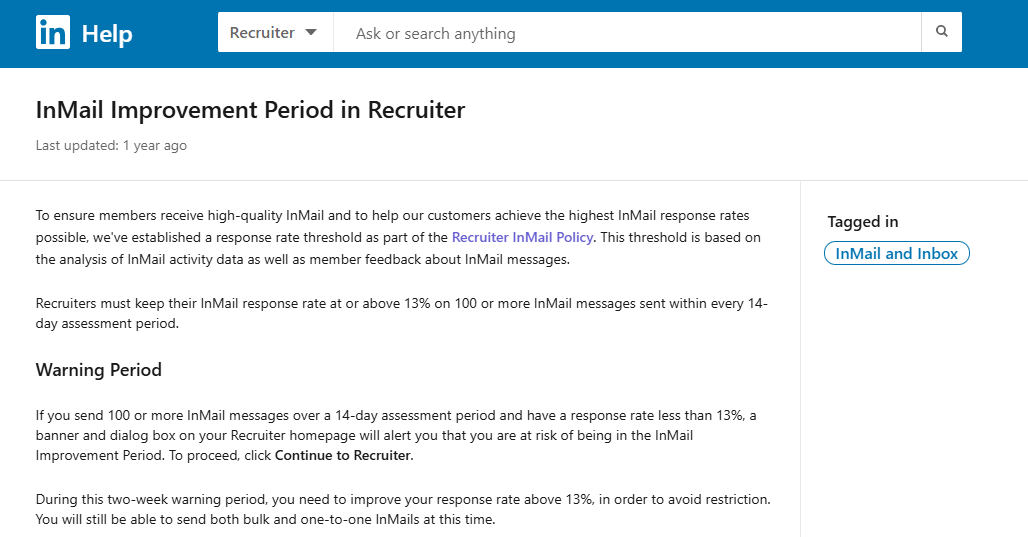
Notice what counts as a response under this rule. LinkedIn defines it as any reply at all, including a candidate marking the message “Not Interested.” A flat rejection counts the same as a job offer accepted on the spot. That detail matters because it exposes what the metric is actually measuring. It is not measuring whether a recruiter found the right candidate or ran a good search. It is measuring whether the platform’s inbox felt disturbed enough to generate a click.
Workology5 covering the policy change years ago captured the mood of recruiters watching the rule tighten in real time. The writer described LinkedIn cracking down on response-rate offenders and noted that anyone dipping below the 14 percent line at the time lost bulk send privileges for two full weeks, adding, almost as an aside, that more restrictions were probably coming. They were right. The threshold has shifted over the years, and the enforcement has gotten sharper, not softer.
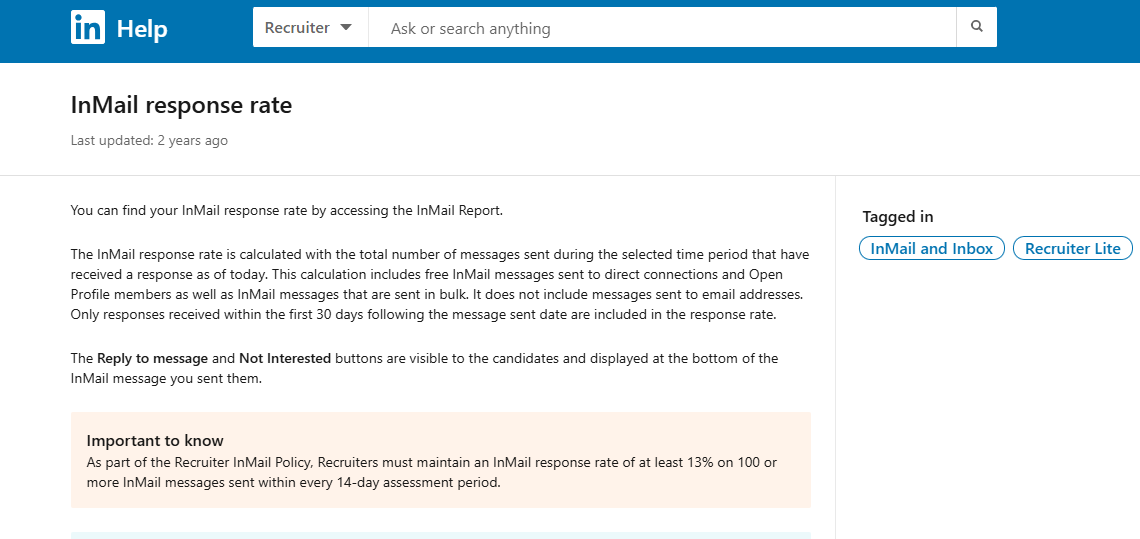
What makes the 13 percent floor genuinely brutal is the gap between LinkedIn’s own marketing numbers and what recruiters actually experience. Pin6 cites an 18 to 25 percent average response rate across industries, with talent acquisition landing closer to 12 percent specifically, which is already dangerously close to the suspension line before a recruiter sends a single message. Independent benchmarking from Engagekit documented by Glozo7 tells a rougher story, putting cold outreach without personalization at just 3 to 8 percent. Both figures can be true at once, since they describe different populations doing different kinds of outreach, but the practical effect is the same. A recruiter working a high-volume technical search, the kind where you have to message hundreds of people to find five who are open to a conversation, is operating inside a margin so thin that a single bad week of subject lines can trigger a two-week platform suspension.
I went looking for how that plays out for an actual working recruiter, and I found the thread on Blind8 that made the abstraction concrete. A technical recruiter described sending 900 InMails across three follow-up touches for a single EdTech role and landing exactly 13 percent in return, the precise number sitting right on the edge of the platform’s own suspension threshold.
I’m reaching out to 300 people per role on LinkedIn 3 times (900 Inmails in total) and I’m only getting a 13% response rate!
The replies in that thread are worth reading closely, because they reveal the other side of the equation that LinkedIn’s policy never accounts for. One candidate explained they ignore anything that reads like it came from a template scraped off a search, and said they block the sender outright if the message leans on a phrase like claiming to have carefully studied the recipient’s profile. Another described politely declining only when the message shows real thought, meaning the recruiter has to write well enough to earn a “no thank you,” just to keep their account in good standing.
That is the trap in full. The response rate threshold assumes low reply rates mean spam. But a recruiter can write a thoughtful, well-targeted, individually customized message and still get ignored, because the candidate is employed, not looking, or simply too busy to click reply. LinkedIn’s system cannot tell the difference between a bad recruiter and a good recruiter working a hard market. It only counts silence.
Voices From the Other Side of the Inbox
Every recruiter I read about frustration with credits and thresholds. Every candidate I read had a mirror complaint, and reading both sides back to back is where this story actually gets interesting.
On Blind9, a recurring theme is candidates describing InMail fatigue almost like spam fatigue. One thread asked recruiters directly whether they even read the messages they receive, and a self-identified recruiter answered that 90 percent of the InMails flooding their inbox come from new graduates with no relevant background for the roles they’re posting, adding that responding to every one of them simply is not possible given the volume. Another Blind10 thread, titled with a question about why recruiters InMail and then vanish, drew a sharp theory from a commenter who guessed recruiters message a wide net, gauge interest, and then stop responding once they’ve gathered enough signal for whatever internal report they need to file.
I had such experience recently. In my LinkedIn inmail , I got a message from a recruiter at ARM #semiconductor who appreciated my experience in industry and asked if I am open for new positions. Although I was reluctant but I wanted to know what position he was recruiting . When I responded to the message, I got ghosted .
Whether that theory is accurate or just candidate folklore, it tells you something important. The InMail relationship has broken down into mutual suspicion. Candidates assume recruiters are farming engagement data. Recruiters assume candidates are unqualified spam. LinkedIn sits in the middle, charging both sides a fee for the privilege of talking past each other, and enforcing a response-rate rule that punishes the recruiter for the candidate’s silence without ever asking why the silence happened.
I want to be careful here, because it would be easy to write this as a simple story about greedy platform, victimized worker. It is not that simple. Recruiters using LinkedIn Recruiter accounts are, in aggregate, sending an enormous volume of templated, low-effort outreach. The Blind thread with the 900-InMail campaign is instructive precisely because the poster’s own subject lines read like a parody of recruiter spam, complete with stacked emoji and a “third time’s the charm” callback. LinkedIn’s response-rate policy exists because the platform’s own inbox was drowning, and recruiters were a major reason why. Glozo11 writing about InMail benchmarks in 2026 put it plainly, noting that buyers who run out of credits often blame their messaging only after the fact, when the real problem was a targeting error carried forward from quarter to quarter rather than a platform conspiracy.
That is a fair point, and it deserves to sit next to the recruiter complaints rather than replace them. LinkedIn built a genuine spam problem for itself. The 13 percent rule is a real attempt to solve it. But the solution LinkedIn chose has a cost, and that cost falls almost entirely on working recruiters rather than on LinkedIn’s own revenue line, which brings me to the part of this story that I think matters most.
The Business Underneath the Policy
LinkedIn does not lose money when a recruiter’s InMail account gets throttled. If anything, the opposite happens. A recruiter who burns through allocated credits and then hits the response-rate wall has exactly two paths back to functioning normally. Improve the response rate, which usually means writing fewer, better-targeted messages, or buy more capacity, whether that means overage credits, a higher subscription tier, or one of LinkedIn’s newer AI-assisted sourcing products.
Microsoft’s own earnings disclosures make the shape of that incentive visible. According to StaffingIndustry12, LinkedIn brought in 4.83 billion dollars in revenue in the quarter ending March 2026, up 12 percent year over year, with growth confirmed across every line of business. On the same earnings call, CEO Satya Nadella singled out LinkedIn’s agentic AI products, the tools that automate sourcing, screening, and message drafting for hiring teams, as having already crossed a 450 million dollar annualized revenue run-rate. That is not a side project. That is one of the fastest-growing product lines LinkedIn has, and it is being sold, in large part, as the answer to the exact scarcity the platform’s own throttling rules create.
Read those two facts side by side and a pattern starts to form. LinkedIn caps how much outreach a human recruiter can send by hand. LinkedIn then sells that same recruiter an AI tool designed to write and send messages more efficiently within the cap, or an upgraded tier with a bigger cap, or overage credits priced well above the per-message cost baked into a subscription. I am not accusing LinkedIn of engineering artificial scarcity as some kind of secret plan. I have no internal memo proving intent, and I would not print one if I did not have it. But I don’t need intent to describe an effect. The effect is a system where the friction recruiters feel every day happens to align, almost perfectly, with the products LinkedIn most wants to sell them.
A competitor’s marketing blog, of all places, gave me the clearest outside articulation of this dynamic. SeekOut13, a rival sourcing platform that obviously has its own incentive to make LinkedIn look bad, quoted a director of recruiting who said most of their team would be giving up their LinkedIn licenses by June 2026 in favor of a tool that could get the job done without the same friction. Take that quote with the grain of salt it deserves, since it comes from a company selling the alternative. But the underlying complaint it references, a recruiter describing InMail as a message they sent thirty times in a week that returned two replies with zero real interest, tracks with everything else I found in independent recruiter forums that have no product to sell.
The Seat, Not the Person
One detail buried in LinkedIn’s help documentation deserves its own paragraph, because it reveals something about who actually carries the weight of this policy.
Response rates are tied to the Recruiter seat, not to the individual recruiter. If a company transfers a Recruiter license from one employee to another, whether because someone quit, got promoted, or moved teams, the new seat holder inherits the old seat holder’s response-rate history. LinkedIn14 states this outright: a new seat holder is held accountable for the previous recruiter’s response rate for the remainder of the evaluation window. A recruiter can walk into a new job, open their freshly assigned Recruiter account, and discover they are already halfway into an improvement period because of messages a stranger sent months earlier.
I have not found a single forum post from someone who experienced this firsthand, which tells me it is probably rare enough that most recruiters never think about it until it happens to them, the same way nobody reads a lease agreement’s default clauses until they are already in default. But the policy exists, and it says something honest about how LinkedIn’s entire throttling architecture is built. It treats the seat as the unit of trust, not the human sitting in it. A license is a license, and its reputation travels with the login credentials rather than the person typing the messages. That is a strange thing to build into a professional networking product whose entire pitch is that professional identity belongs to the individual.
The Arms Race Nobody Chose
There’s a second layer to this story that only becomes visible once you start reading InMail advice content rather than InMail complaints, and it is the layer where I think the real damage is happening.
LinkedIn’s own data, filtered through Salesflow15 actually use to write their messages, tells them that shorter InMails outperform longer ones by a wide margin. Messages under 400 characters see response rates running roughly 22 percent higher than average, while anything past 1,200 characters underperforms by about 11 percent. Personalization matters even more. The Muse16 simply said personalizing a message instead of sending a canned template can lift response rates by 15 percent on its own.
Put those two data points together and you get the exact behavior the candidates on Blind were complaining about. Recruiters facing a hard 13 percent floor and a shrinking credit balance have every incentive to write short, individually tailored messages that reference something specific about the recipient’s profile. That is good advice in isolation. But it is also precisely the behavior that reads, to a wary candidate, as manufactured intimacy. The commenter who described blocking any recruiter who claims to have carefully studied their profile was not describing a lazy recruiter. He was describing a recruiter who had followed LinkedIn’s own best-practice guidance to the letter, and got treated as suspicious for it anyway.
This is the part of the throttling story that I think gets missed most often, because it does not show up in any policy document. LinkedIn’s response-rate rule does not just filter out spam. It trains recruiters, through sheer economic pressure, toward a specific style of message, the short, warm, personally-referenced note, and that style has been used so widely now that candidates have started treating it as a red flag rather than a compliment. The very techniques LinkedIn recommends to help recruiters survive the 13 percent threshold are the same techniques quietly souring the candidate experience LinkedIn claims to be protecting. Nobody designed that loop on purpose. It emerged anyway, the way most bad incentive structures do, one rational individual decision at a time.
What Gets Lost in the Gap
Here is my own read on this, for what it’s worth, after three weeks living inside recruiter complaints and LinkedIn’s own policy language.
The 13 percent threshold is not unreasonable on its face. Nobody benefits from an inbox flooded with copy-pasted spam, least of all the candidates on the receiving end, and LinkedIn has a legitimate interest in protecting the thing that makes InMail valuable in the first place, which is that people still open it more than they open a cold email. But a rule built around aggregate response behavior will always punish the recruiters working the hardest searches hardest. A recruiter filling a niche technical role, reaching out to people who are almost certainly employed and almost certainly not looking, is doing exactly the kind of patient, targeted work LinkedIn claims to want. That recruiter is also the one most likely to dip under 13 percent through no fault of their own, simply because the addressable pool of interested candidates is small by definition.
Meanwhile the recruiter blasting a wide, low-quality net across a large candidate pool for a generic role can often clear 13 percent by volume alone, since even a bad message finds a few desperate replies when it reaches enough inboxes. The rule, in other words, can end up rewarding exactly the spam behavior it was built to punish, while quietly suspending the more careful, more selective recruiters LinkedIn says it wants on the platform.
Nobody I read across dozens of threads seemed to think LinkedIn was doing this on purpose, as some grand scheme against recruiters. What I found instead was something more mundane and, honestly, more familiar to anyone who has worked inside any large platform’s monetization model. A system built to solve one problem, spam, ends up creating a second problem, scarcity, and the fastest available fix for that second problem happens to be a paid product LinkedIn is very eager to sell. Whether that is deliberate design or just gravity, the outcome looks the same from where the recruiter is sitting. Pay more, write less, or wait out the suspension clock while your open requisitions pile up.
I keep thinking about that recruiter and their 900 InMails, sitting at exactly 13 percent, one bad week away from losing bulk send privileges for a role they still had not filled. LinkedIn would call that recruiter’s outreach borderline. I would call it a person doing their job inside a system that was never built to reward patience, only volume that happens to land.
Sources
- “Recruiter and Recruiter Lite InMail Policy” Recruiter Help, www.linkedin.com/help/recruiter/answer/a413279. Accessed 16 Oct. 2026. ↩︎
- “Your Anonymous Workplace Community” Blind, www.teamblind.com/post/do-you-reply-to-every-linkedin-recruiter-o5dbxxse. Accessed 16 Oct. 2026. ↩︎
- Kondo. “How Many LinkedIn InMail Credits Do You Get Per Month? 2026 Guide” Kondo, 28 May 2025, www.trykondo.com/blog/how-many-inmail-credits-can-you-send-on-linkedin-each-month-the-complete-guide. Accessed 16 Oct. 2026. ↩︎
- “InMail Improvement Period in Recruiter” Recruiter Help, www.linkedin.com/help/recruiter/answer/a413271. Accessed 16 Oct. 2026. ↩︎
- Workology, workology.com/linkedin-recruiter-announces-new-restrictions-on-inmail-open-rates/. Accessed 16 Oct. 2026. ↩︎
- Stacy, Erica. “LinkedIn InMail Automation: A Practical Guide for Recruiters” 3 Sept. 2025, www.pin.com/blog/linkedin-inmail-automation/. Accessed 16 Oct. 2026. ↩︎
- Drozdov, Anton. “LinkedIn InMail cost in 2026: credits, rates, real ROI” Glozo, 18 Apr. 2026, www.glozo.com/blog/linkedin-inmail-cost-response-rate-math. Accessed 16 Oct. 2026. ↩︎
- “Your Anonymous Workplace Community” Blind, www.teamblind.com/post/linkedin-inmail-response-only-13-ahqgwmcc. Accessed 16 Oct. 2026. ↩︎
- “Your Anonymous Workplace Community” Blind, www.teamblind.com/post/recruiters-do-you-respond-to-linkedin-inmail-messages-piyn6mkn. Accessed 16 Oct. 2026. ↩︎
- “Your Anonymous Workplace Community” Blind, www.teamblind.com/post/why-do-recruiters-inmail-on-linkedin-and-ghost-you-atnjdbk1. Accessed 16 Oct. 2026. ↩︎
- Drozdov, Anton. “LinkedIn InMail cost in 2026: credits, rates, real ROI” Glozo, 18 Apr. 2026, www.glozo.com/blog/linkedin-inmail-cost-response-rate-math. Accessed 16 Oct. 2026. ↩︎
- StaffingIndustry, www.staffingindustry.com/news/global-daily-news/linkedin-revenue-rises-microsoft-ceo-highlights-sites-agentic-ai. Accessed 16 Oct. 2026. ↩︎
- “7 Alternatives to LinkedIn InMail” SeekOut Blog, www.seekout.com/blog/alternatives-to-linkedin-inmail/. Accessed 16 Oct. 2026. ↩︎
- “Recruiter and Recruiter Lite InMail Policy” Recruiter Help, www.linkedin.com/help/recruiter/answer/a413279. Accessed 16 Oct. 2026. ↩︎
- Salesflow, salesflow.io/blog/linkedin-inmail-best-practices-improve-response-rates. Accessed 16 Oct. 2026. ↩︎
- Company, Fast. “Here’s How to Send InMail That Actually Gets a Response (Based On Real LinkedIn Data)” The Muse, 19 June 2020, www.themuse.com/advice/heres-how-to-send-inmail-that-actually-gets-a-response-based-on-real-linkedin-data. Accessed 16 Oct. 2026. ↩︎


