
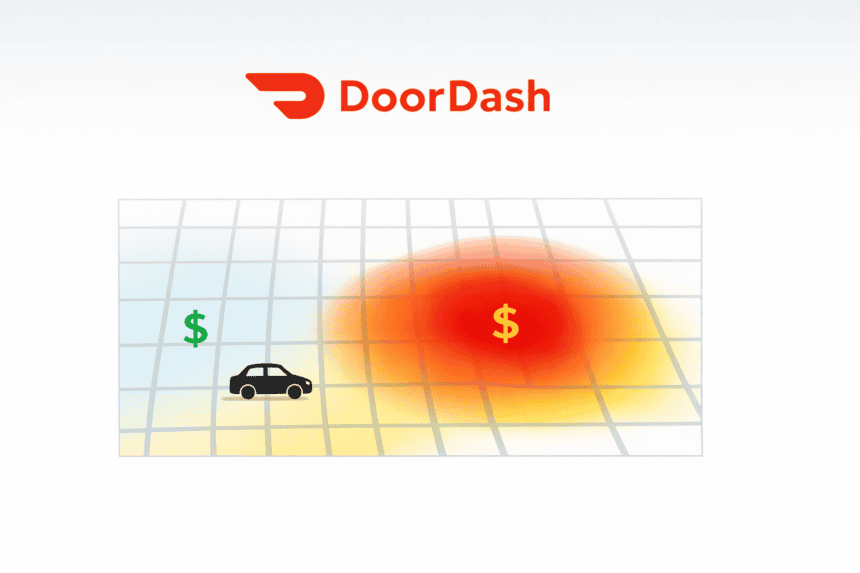

Open the Dasher app, and you will see a city divided into zones. Some are gray. Some are light pink. Others glow deep red. According to DoorDash1, the color reflects demand.
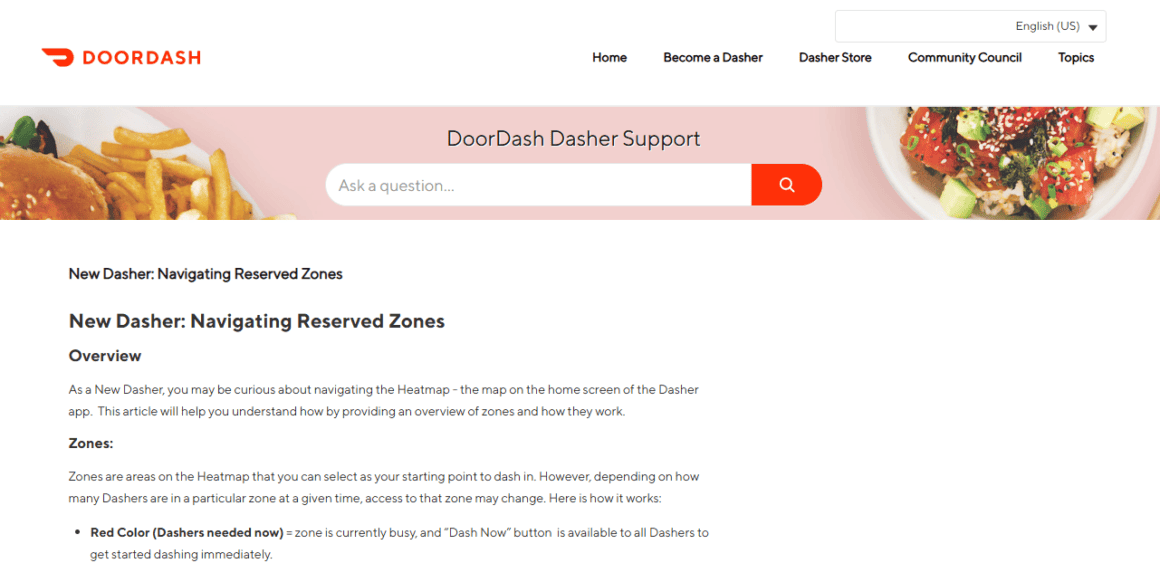
On its official help page for drivers, the company explains that the heat map “shows areas where there are more orders than Dashers available” and that darker red indicates busier areas. Drivers are encouraged to move toward these zones to increase their chances of receiving deliveries.
That is the promise. The map is meant to reduce guesswork.
But the promise is not the same thing as the outcome.
After reviewing driver forums, earnings discussions, academic research, and regulatory materials, a more complicated picture emerges. The core question is not whether the map lies. There is no public evidence of that. The question is whether the visual framing of demand nudges drivers into patterns that are less profitable for them, even if the system overall becomes more efficient.
What Drivers Say Online
On Reddit’s r/doordash_drivers2 community, which has hundreds of thousands of members, drivers regularly debate the heat map.
In a thread titled “Sure it’s very busy?”, one driver posted a screenshot of a bright red zone and wrote that they had been waiting more than thirty minutes without receiving an order.
One commenter replied,
“The heat map is usually showing where it was busy, not where it is busy.” Another wrote, “By the time you get there, so did everyone else.”
These comments are anecdotal. They are not controlled studies. But they are consistent.
In other threads, drivers describe what they call “chasing the red.” They drive several miles to reach a highlighted zone, only to find long waits or low-paying orders. A recurring theme is lag. Drivers believe the map reflects recent order spikes that may have already been filled.
There is no public documentation from DoorDash confirming or denying whether the heat map is purely real-time or partly based on recent trends. The company’s help page says it uses real-time data, but does not detail the calculation method.
What stands out in the forums is not anger alone. It is an adaptation. Experienced drivers often advise newcomers to treat the heat map as “one data point” rather than a directive.
How DoorDash Makes Money and Why Density Matters
To understand the incentive structure, it helps to look at DoorDash’s public filings.
In its annual reports and earnings releases filed with the U.S. Securities and Exchange Commission (SEC) and published on its investor relations site, DoorDash, Inc.3highlights growth in total orders and Marketplace Gross Order Value (GOV) as key operational metrics reflecting demand expansion, which the company views as central to improving its unit economics and long-term profitability. The company regularly reports increases in orders and revenue year-over-year, emphasizing that higher engagement and scale allow it to improve logistics efficiency and reinvest in the business to drive future growth and returns.
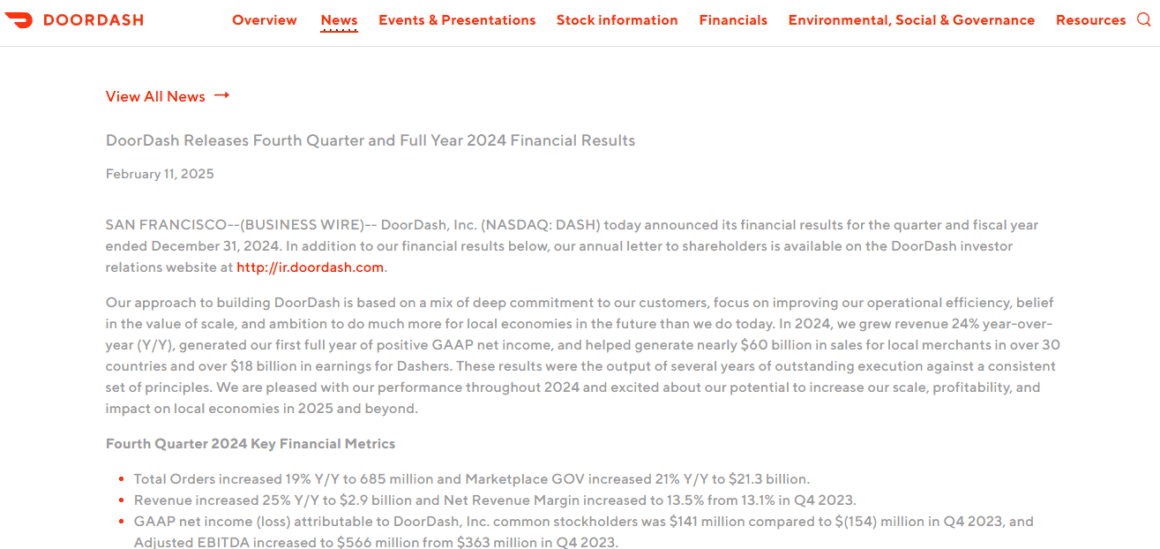
Analysts and industry sources note that delivery platforms like DoorDash benefit from greater “order density,” meaning more orders in a given geographic area. Higher density typically reduces delivery times and allows drivers (Dashers) to complete more orders per hour, which can enhance operational efficiency and lower per-order costs. Factors that contribute to better overall profitability. Although DoorDash’s SEC filings do not always use the exact phrase “order density,” the concept is reflected in discussions of improved logistics and driver utilization as part of efficiency gains.
In its Form 10K filings, the company explains that improving the balance of supply and demand is critical to reducing consumer wait times and improving retention.
From a platform perspective, encouraging drivers to move toward areas with rising demand makes sense. If too few drivers are available in a neighborhood during dinner rush, orders sit unassigned. That increases delivery times and risks losing customers.
A heat map is a coordination tool.
But coordination at the system level does not guarantee profitability at the individual level.
Algorithmic Management Without Direct Orders
The idea that demand signals can lead to clustering is not speculative. It is documented in research.
A working paper from researchers at the Georgia Institute of Technology4 examines how providing location specific demand information influences gig worker positioning decisions. The study finds that when workers are shown localized demand cues, they tend to converge on the same areas. This convergence can reduce earnings per worker if supply increases faster than demand.
The authors describe a coordination problem. If every worker acts on the same signal, the signal loses value. The first movers may benefit. Late arrivals may not.
This logic applies directly to a color-coded map. If a zone turns red because demand briefly exceeds supply, drivers who respond quickly may receive orders. If many respond, the imbalance disappears.
The map does not show how many other drivers are en route.
Legal scholars have described gig platforms as systems of algorithmic management. Rather than assigning shifts or issuing commands, platforms use incentives, ratings, and visual cues to guide behavior.
An analysis in the Yale Journal of Law and Technology5 discusses how interface design shapes worker autonomy. The article notes that workers appear independent but are steered by data-driven signals embedded in the app interface.
The heat map fits within this framework. It does not force drivers to move. It invites them to move.
The invitation carries economic weight because drivers are paid per order, not per hour in most markets. Time spent driving to a red zone without receiving orders is unpaid.
What the Heat Map Does Not Show
According to DoorDash’s official Dasher help documentation, pay generally consists of base pay plus 100 percent of customer tips. Base pay is calculated using factors such as time, distance, and the desirability of the order. DoorDash6 explains this structure in its Dasher help center, including a breakdown of base pay and promotional incentives.
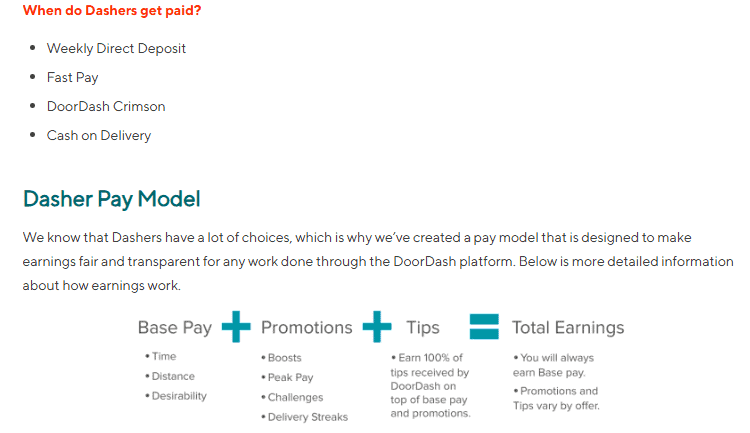
Base pay is not fixed. It varies by order and market conditions. A longer distance order or one that is less desirable may carry a higher base pay. Tips are added on top, and DoorDash states that Dashers receive the full tip amount left by customers.
What the heat map does not display is equally important. It does not show the average payout per order in a given zone. It does not reveal the average tip rate for that area. It does not display how many drivers are currently active in that zone. It does not estimate wait times between orders. Instead, the map uses color intensity to show relative demand compared to nearby areas.
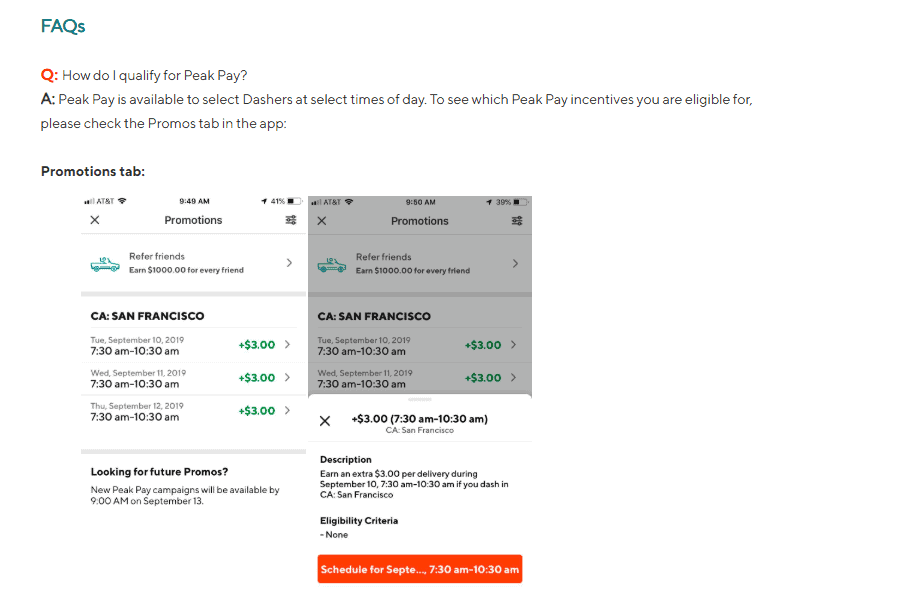
In some markets, DoorDash7 offers Peak Pay during busy periods. Peak Pay adds a fixed dollar amount to each delivery completed in a qualifying zone during a defined window. This is displayed numerically in the app, such as an additional two or three dollars per order.
Unlike the heat map, Peak Pay is transparent and quantifiable. A driver can calculate expected earnings by adding the listed bonus to base pay and projected tips. Many drivers report that red zones combined with Peak Pay are more reliable indicators of stronger earnings potential. Red zones without bonuses are less predictable. High order volume alone does not guarantee higher net income.
This distinction has financial consequences. A high demand area populated by customers who tip minimally may generate more deliveries but lower earnings per mile once fuel, maintenance, and depreciation are considered. By contrast, a lower volume suburban zone with generous tipping behavior could produce higher net earnings per delivery, even if the map color appears less intense. The heat map does not differentiate between these economic variables.
Public company disclosures emphasize operational density rather than individual driver earnings. In filings with the U.S. Securities and Exchange Commission, DoorDash highlights “order volume,” “marketplace efficiency,” and “order density” as drivers of profitability. Higher order density means more deliveries completed within a concentrated geographic area, which can reduce travel time between orders and increase throughput per hour. From a platform perspective, density improves efficiency. From a driver perspective, however, density alone does not fully determine take home income.
The heat map relies heavily on color gradients. In digital interface design, red is widely associated with urgency, action, and heightened importance. Designers across industries use red to signal limited time offers, warnings, or priority status.
The Federal Trade Commission8 has examined how interface design can shape decision making. In its report Bringing Dark Patterns to Light, the agency describes how digital layouts, visual cues, and framing techniques can steer users toward particular behaviors without explicit coercion.
The DoorDash heat map is not identified in that report, nor has any regulator formally labeled it a deceptive practice. There is no public allegation in regulatory filings that the heat map misrepresents earnings. However, the report underscores a broader principle. Interface design influences behavior.
A gray zone appears quiet. A red zone appears urgent and active. Even though Dashers are independent contractors who choose where and when to work, the visual hierarchy of the app communicates priorities. The color framing signals where attention should go.
The psychological pull can be subtle. A driver may rationally understand that driving several miles toward a red zone carries the risk of unpaid travel time. Yet the visual intensity suggests opportunity. Behavioral economists often note that framing effects shape decisions even when participants are aware of them. Color is not neutral. It conveys meaning instantly and emotionally.
The heat map therefore operates at two levels. Functionally, it signals relative demand. Psychologically, it creates a sense of movement and urgency. It does not guarantee higher earnings, and it does not provide full economic transparency. But it powerfully frames where drivers perceive opportunity to exist.
Is There Evidence of Manipulation
There is no publicly available evidence that DoorDash manipulates its heat map to intentionally send drivers into unprofitable areas. No regulator has formally accused the company of falsifying demand signals, and no court has issued findings that the heat map is deceptive.
DoorDash’s own public explanation is relatively narrow. In its Dasher help materials, the company describes heat maps as areas that are “busier than usual” and where there may be more delivery opportunities. The language stops short of promising any earnings outcome. The map signals relative demand, not guaranteed pay. The company does not claim that entering a red zone will result in a minimum number of orders or a certain dollar amount per hour.
That distinction is important. A demand signal is not an earnings promise. A red zone may indicate more incoming orders than surrounding areas, but it does not disclose how many drivers are already present, how quickly those orders will be assigned, or what the payout structure looks like for each delivery.
The absence of disclosed methodology leaves room for speculation among drivers. Dashers do not know whether the color intensity is based on:
• The number of currently unassigned orders
• Projected demand based on historical data
• Short term surges in customer app activity
• A combination of real time and predictive modeling
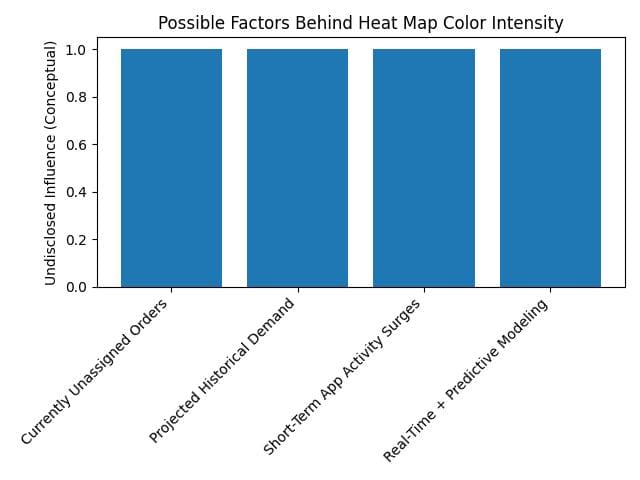
DoorDash does not publicly describe the precise variables or thresholds used to generate the heat map. Like most technology platforms, it treats its matching and dispatch algorithms as proprietary.
In regulatory filings, DoorDash emphasizes marketplace efficiency and order density rather than individual driver profitability. In its filings with the U.S. Securities and Exchange Commission, the company has explained that increasing order density improves efficiency by reducing travel time and allowing more deliveries per hour within a concentrated area. Those disclosures focus on platform level performance metrics, not on how heat map colors are calculated or how they correlate with net driver income.
Academic work at ResearchGate9 on gig platforms has repeatedly noted that algorithmic management can create information asymmetry between companies and workers. Drivers see interface signals but not the underlying logic. Scholars often describe this as a structural feature of app based labor markets, where the platform controls data visibility.
There is currently no documented proof that DoorDash artificially inflates red zones to reposition drivers strategically. At the same time, there is limited public transparency about how the demand visualization is generated. That gap between perception and disclosure fuels debate in driver communities.
Greater transparency could reduce distrust. For example, if drivers were told that a red zone reflects more than a specific number of unassigned orders at that moment, or that projected demand exceeds available drivers by a certain ratio, they could make more informed decisions about repositioning. Even a simple range, such as “high demand equals 10 or more unassigned orders,” would anchor expectations.
At present, that level of operational detail is not publicly disclosed. The heat map remains a relative indicator of busyness without quantitative benchmarks attached. As a result, while there is no confirmed evidence of manipulation, there is also no independent way for drivers to verify how closely the red shading aligns with real time, order level opportunity.
Independent drivers bear the cost of repositioning. When a driver travels several miles toward a busier zone without receiving an order, the expense is not theoretical. Fuel, maintenance, tire wear, insurance, and vehicle depreciation all continue to accumulate.
The Internal Revenue Service sets a standard mileage rate each year to estimate the deductible cost of operating a vehicle for business use. For 2024, the IRS standard mileage rate for business use is 67 cents per mile. According to the IRS10, this rate is intended to cover “the costs of operating an automobile for business use,” including fixed and variable expenses such as fuel, maintenance, repairs, tires, insurance, registration fees, licenses, and depreciation.
While the standard mileage rate is primarily a tax deduction tool rather than a guaranteed measure of actual out of pocket cost, it provides a widely used benchmark for estimating per mile vehicle expenses. For independent delivery drivers, that means a five mile repositioning trip could represent roughly 3.35 dollars in operating cost before accounting for unpaid time.
Because gig drivers are classified as independent contractors, these costs are not reimbursed by the platform. The economic risk of moving toward a red zone without securing an order is borne entirely by the driver.
For a driver who travels five unpaid miles chasing a red zone, that is more than three dollars in estimated vehicle cost before accounting for time.
If the resulting delivery pays eight dollars for another five miles, the gross payout may look decent. The net profit may be modest.
These micro calculations shape driver behavior. Over time, many drivers report relying less on the heat map and more on personal data.
A Tool That Works Better for the System Than the Individual
From a systems engineering standpoint, a heat map is a classic marketplace coordination mechanism. Platforms such as DoorDash use heat maps to redistribute supply (drivers) toward estimated demand, smoothing gaps in coverage across a city. The goal is to reduce idle time on average and improve delivery fulfillment rates. In its public regulatory filings, DoorDash emphasizes “order density” and “marketplace efficiency,” noting that reduced travel times between orders benefit the system as a whole.
From individual driver perspectives, the experience is uneven, and conversations on online forums capture that divide vividly.
Many drivers describe chasing red or “hotspot” zones only to find limited actual demand once they arrive. One user wrote,
“Stop chasing hotspot zones. Hotspot zones means absolutely nothing… I’ve sat in hotspot zones for up to an hour many times without ever getting an offer”
Another driver described the frustration of going from one red zone to the next:
“Spent an hour and a half driving from hotspot to hotspot, without a single delivery… stop chasing the surge!!!”
Some discussions go further, suggesting the map is influenced by driver availability as much as actual orders. In one thread, a commenter said,
“It means there is a … order that nobody will pick up. That one order turns a grey map into a blood red busy zone… The heat maps are a scam.”
Other drivers emphasize that local knowledge matters more than the map. One report noted their own strategy:
“I have my spots… I never sit anywhere else whether it’s a hot zone or not.”
These real world quotes show how driver behavior diverges based on experience. Newer drivers often chase the red because it feels like a clear signal of activity. Veteran drivers tend to treat the map as one input among many, relying on self-identified “sweet spots” and understanding of local order patterns. The pain of wasted time and fuel chasing visual cues has led some to avoid heat map signals entirely.
The platform benefits from this dynamic even without deception. When drivers reposition based on heat map signals, supply shifts toward potential demand zones. This can reduce overall market inefficiencies. The company sees aggregate data across the city and can adjust these signals continuously. Drivers see color gradients and must interpret them without full transparency into the underlying algorithm.
The result is an information asymmetry common to app-based gig work. Drivers can discuss and debate what works best, but their experiences, often reflect trial and error more than certainty. The system’s incentives nudge drivers where demand might be higher, but for individuals the outcome can vary dramatically based on timing, competition from other drivers, and local tipping patterns.
The Larger Debate Over Algorithmic Transparency
Debates about gig worker protections increasingly include algorithmic transparency. Lawmakers and labor regulators are asking how automated systems assign work, determine pay, and shape worker behavior.
In the European Union, the Platform Work Directive formally addresses algorithmic management. In 2024, the European Parliament11 approved new rules requiring digital labor platforms to provide greater transparency about automated decision making. The directive includes provisions requiring platforms to inform workers about how algorithms affect task allocation, performance evaluation, and pay setting. It also introduces human oversight requirements for significant automated decisions such as account suspension.
The directive reflects a broader concern that gig workers are managed by opaque systems. As one European Parliament summary explained, digital labor platforms must ensure “transparency in algorithmic management” and provide workers with information about how automated monitoring and decision making systems function.
In the United States, there is no federal equivalent yet, but algorithmic management has drawn attention from regulators and policymakers. The Federal Trade Commission has examined how automated systems and interface design can shape user decisions. In its report Bringing Dark Patterns to Light, the FTC warned that digital design choices can influence behavior in ways that are difficult for users to detect or evaluate.
At the state and city level, lawmakers have also moved toward greater transparency in app based labor markets. In New York City, rules adopted by the New York City Department of Consumer and Worker Protection require food delivery platforms to provide workers with more detailed information about pay calculations and to comply with minimum pay standards for app based delivery workers. Those rules reflect growing scrutiny of how algorithmic systems affect worker compensation.
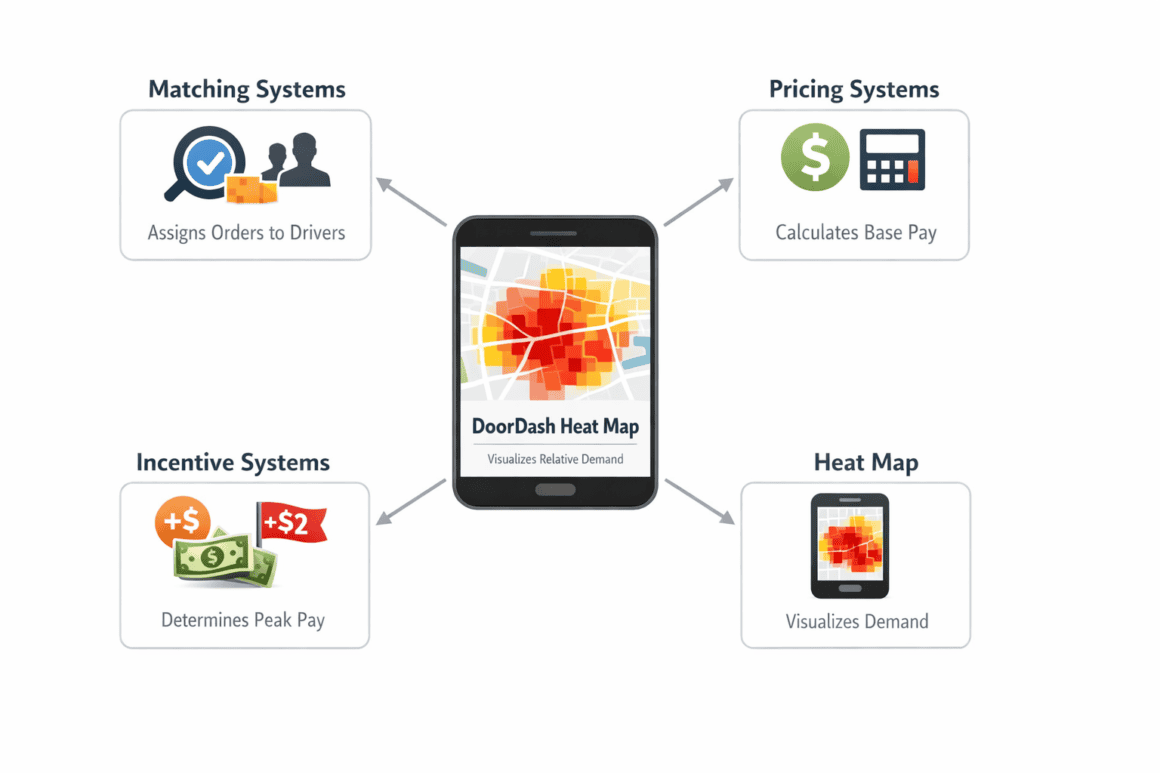
Against that backdrop, the DoorDash heat map is only one small part of a much larger algorithmic infrastructure. Matching systems determine which driver receives which order. Pricing systems calculate base pay. Incentive systems determine when Peak Pay appears. The heat map simply visualizes relative demand.
Yet it illustrates the central tension in the debate.
On one hand, platforms emphasize efficiency. In its filings with the U.S. Securities and Exchange Commission, DoorDash highlights improvements in “order density” and marketplace efficiency. Higher density can reduce travel time and increase completed deliveries per hour across the network.
On the other hand, drivers are repeatedly described as independent contractors running their own businesses. Entrepreneurs rely on data to make rational decisions. They evaluate margins, demand trends, and opportunity costs. When the core signal about where to work is expressed as a color gradient without numerical context, autonomy becomes more complicated.
A driver sees red. The platform sees a live demand supply ratio, predictive modeling inputs, and aggregate citywide data. That information gap is at the heart of the transparency debate.
Academic research on algorithmic management often frames this as information asymmetry. The company has granular visibility. The worker receives simplified cues. There is no proven deception, but there is limited disclosure about how decisions are made or signals are generated.
After reviewing driver forum discussions, academic research on gig work, regulatory materials from Europe and the United States, and public company filings, one conclusion stands out.
There is no verified proof that DoorDash’s heat map is designed to deceive drivers or deliberately push them into guaranteed losses. The company states that red zones reflect higher order demand relative to surrounding areas. No regulator has formally concluded that the visualization is fraudulent or intentionally misleading.
At the same time, visual design matters. Behavioral research shows that color and framing influence perception and action. A red zone communicates urgency and opportunity. Without numerical context such as unassigned order counts or driver supply levels, drivers may over interpret what red signifies in earnings terms.
The nudge is real, even if the intent is neutral.
The heat map is best understood as a coordination tool optimized for system performance. It helps redistribute supply toward potential demand, improving fulfillment rates and marketplace efficiency. It is not a guarantee of higher hourly income for any specific driver.
For drivers, the safest approach may be to treat the red glow as information, not instruction. It signals relative activity, not promised profit. In a marketplace governed by algorithms, experience, cost awareness, and local knowledge remain as important as any color on a screen.
Sources
- “DoorDash Dasher Support” help.doordash.com/dashers/s/article/New-Dasher-Navigating-Reserved-Zones?language=en_US. Accessed 4 Mar. 2026. ↩︎
- Reddit, www.reddit.com/r/doordash_drivers/comments/1qe5l7g/sure_its_very_busy/. Accessed 4 Mar. 2026. ↩︎
- DoorDash, ir.doordash.com/news/news-details/2025/DoorDash-Releases-Fourth-Quarter-and-Full-Year-2024-Financial-Results/ Accessed 4 Mar. 2026. ↩︎
- GA Tech, repository.gatech.edu/bitstreams/ae1ec70e-bb58-48b9-87a7-0b0948c2090c/download. Accessed 4 Mar. 2026. ↩︎
- Lior, Anat. “Yale Journal of Law & Technology” yjolt.org/volume/25. Accessed 5 Mar. 2026. ↩︎
- “DoorDash Dasher Support” help.doordash.com/dashers/s/article/How-is-Dasher-pay-calculated?language=en_US. Accessed 5 Mar. 2026. ↩︎
- “DoorDash Dasher Support” help.doordash.com/dashers/s/article/Peak-Pay?language=en_US. Accessed 5 Mar. 2026. ↩︎
- “Bringing Dark Patterns to Light” 15 Sept. 2022, www.ftc.gov/reports/bringing-dark-patterns-light. Accessed 5 Mar. 2026. ↩︎
- “ResearchGate”, www.researchgate.net/publication/383823071_Algorithmic_management_in_the_gig_economy_A_systematic_review_and_research_integration. Accessed 5 Mar. 2026. ↩︎
- Internal Revenue Service, www.irs.gov/newsroom/irs-issues-standard-mileage-rates-for-2024. Accessed 5 Mar. 2026. ↩︎
- “EU directive on platform work” 15 Apr. 2024, www.europarl.europa.eu/RegData/etudes/ATAG/2024/760437/www.europarl.europa.eu/RegData/etudes/ATAG/2024/760437/EPRS_ATA(2024)760437_EN.pdf. Accessed 5 Mar. 2026. ↩︎