

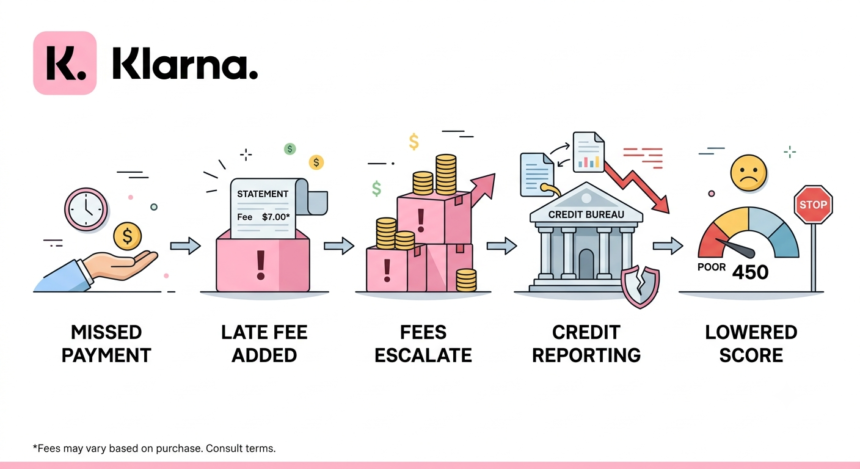

For most of its existence, Klarna sold itself on a simple promise. Split your purchase into four payments, pay no interest, and walk away with nothing on your credit file either way. It was credit without the paper trail. Millions of people used it precisely because it felt consequence-free. That promise is dissolving, and it’s dissolving unevenly, in a way that’s landing hardest on the people who can least absorb a surprise.
The Fee that isn’t the Whole Story
Start with the fee itself, because it’s smaller than you’d think, and that’s part of what makes it dangerous. In the U.S., Klarna1 charges up to $7 per missed installment on a Pay in 4 plan if the payment goes uncollected for ten days. Total late fees on a single order are capped at 25 percent of the purchase price. Pay in 30, the pay-the-whole-thing-in-a-month option, doesn’t carry late fees in the U.S. at all, at least for now.
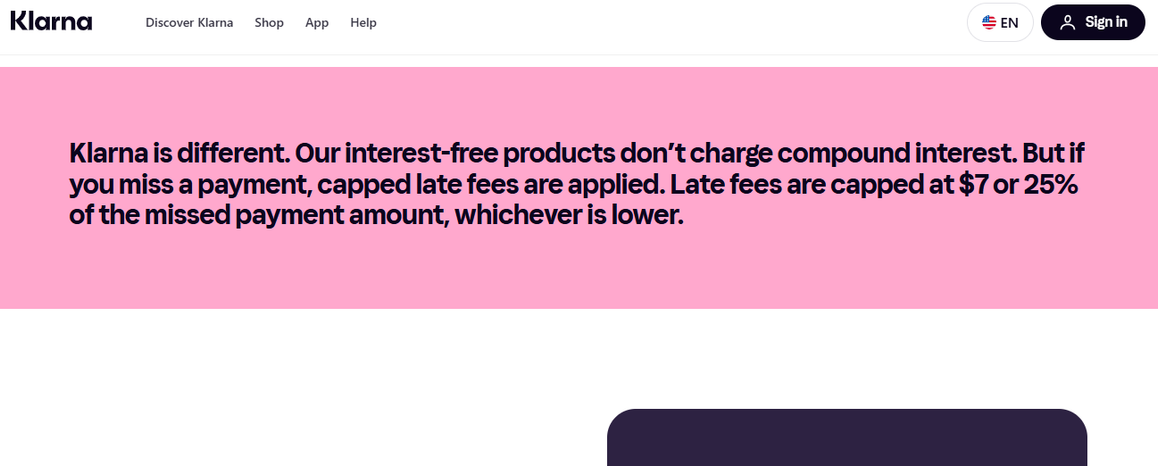
Seven dollars won’t ruin anyone. That’s not the mechanism. The mechanism is what happens after the fee, when a missed payment stops being a fee problem and starts being a file problem. Klarna’s own guidance says once an account is genuinely delinquent, the debt can move to internal collections and then, if it drags on, to an outside collection agency. Once that handoff happens, the agency reports it, not Klarna, and a seven dollar fee on a ninety dollar purchase becomes a derogatory account that can sit on a credit file for seven years.
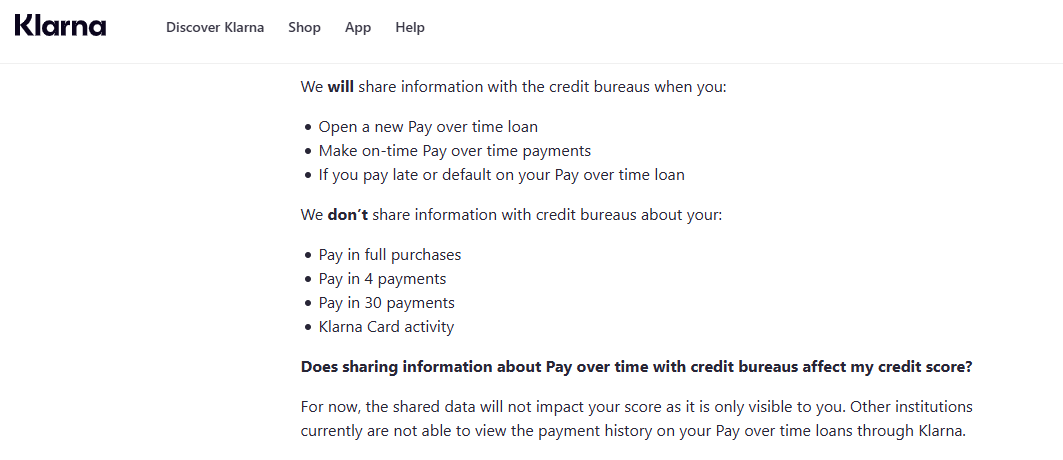
I want to be precise here because the precision is the whole story. Klarna’s short-term products, Pay in 4 and Pay in 30, generally do not report routine, on-time activity to Experian, Equifax, or TransUnion. Klarna’s longer financing product, the six-to-thirty-six-month installment loans issued through WebBank, does report, and always has, both the good and the bad. That distinction sounds like a technicality. It isn’t. It means two people can use “Klarna” for very different financial products and end up with completely different exposure. The person financing a mattress over eighteen months has always been in a real credit relationship with real stakes. The person splitting a hundred-dollar order into four payments believed, reasonably, based on how the product was marketed, that they were operating outside that system entirely. Klarna’s own FAQ2 tells consumers as much, on a page written in the reassuring, low-stakes tone of a company that knows the reassurance is doing a lot of work.
When the Invisible Debt Goes to Collections
Here’s where the reassurance runs out. On-time Pay in 4 payments stay invisible. Late ones don’t, not once they cross a threshold. Klarna3 does not report a single day’s lateness, and for most users the credit file stays clean until thirty or more days pass. But thirty days is not a high bar for someone juggling four separate BNPL apps against a paycheck that hasn’t moved. And once an account crosses into collections territory, typically sixty to ninety days out, the mark that lands on the credit report doesn’t read “missed a nine dollar payment on a phone case.” It reads “collections account,” the same category a hospital bill or a repossessed car falls into. According to the The Credit People4, collection entries can drag a score down 60 to 100 points. That’s not proportional. That’s a cliff dressed up as a fee schedule.
The Better Business Bureau’s5 complaint file on Klarna reads like a catalog of that cliff. One user described paying off two Klarna accounts in full as part of an arranged repayment plan, only to have both accounts reported as thirty days late to Experian regardless. The complaint alleges Klarna gave one answer to the BBB, that its credit team was correcting the marks, and a contradictory answer to a state regulator on the same date, that the reporting was accurate. Another user wrote that Klarna had begun reporting to the bureaus and would list a final payment as unpaid for months even after the user supplied photographic proof of payment. A third described a prescription subscription that was canceled correctly on the merchant’s end, only for Klarna to keep billing and eventually report the balance to credit anyway.
I don’t think these are isolated. I think they’re what happens structurally when a company bolts credit reporting onto a payment product that was never built with dispute infrastructure in mind. A credit card company has decades of practice reconciling a $40 charge with a refund, a cancellation, a merchant error. Buy now, pay later companies built their entire pitch around speed and simplicity at checkout. Speed and simplicity are exactly the things dispute resolution doesn’t reward.
The stranger part of this story is that Klarna itself has been inconsistent about whether it wants to be in the credit reporting business at all, which tells you something about how unresolved the underlying question still is.
Affirm, Klarna’s biggest U.S. rival, began reporting its pay-in-4 loans to Experian and TransUnion in the spring of 2025, positioning itself as the responsible, transparent option. Klarna and Afterpay did not follow. In August 2025, both companies told the Wall Street Journal they would hold their short-term loan data back from the bureaus. According to PYMNTS6, a Klarna spokesperson said the company welcomed FICO’s ambition to modernize scoring but argued the U.S. credit reporting framework doesn’t yet reflect how short-term BNPL products actually get used. As stated by Axios7, Afterpay’s head of credit and underwriting put it more bluntly, saying the company wouldn’t report until it saw concrete evidence that BNPL data would help rather than hurt its customers’ scores. A trade group spokesperson made the underlying fear explicit: if every BNPL purchase counts as a new line of credit, a person who buys four things in a month could look, to a scoring algorithm, like someone opening four new credit accounts, which is exactly the kind of pattern that tanks a score regardless of whether every payment was made on time.
That’s a real concern, and it’s worth sitting with, because it cuts against the simple narrative that reporting is automatically good for consumers. Positive reporting sounds like a gift, an extra way to build history for people locked out of traditional credit. But scoring models built around long-lived accounts don’t necessarily know how to reward a person who opens and closes four short obligations a month responsibly. Certuity8 reported that FICO’s own testing with Affirm data found most users saw movement of roughly ten points in either direction, which sounds mild until you remember that ten points is sometimes the difference between an approval and a denial on a mortgage rate lock.
And yet Klarna’s resistance was never absolute. The company already reports BNPL data in the U.K., where regulation forced its hand, and it has reported its longer U.S. financing loans to bureaus for years. So the holdout wasn’t a principled stand against reporting. It was a selective one, applied to exactly the product line, Pay in 4, that makes up the bulk of Klarna’s U.S. business and the bulk of its risk exposure if things go sideways. I don’t think that’s cynicism, necessarily. I think it’s a company trying to have it both ways, marketing itself as a credit-building tool in some contexts and a consequence-free convenience in others, and hoping regulators and consumers don’t notice the seam.
The FICO Score 10 BNPL and Score 10 T BNPL models, announced in June 2025 and rolled out to lenders that fall, were supposed to close the gap. According to Fox Business9, FICO called them the first scores from a major provider to formally incorporate buy now, pay later activity. The pitch was reasonable on its face. Ninety million Americans were expected to use BNPL in 2025. A huge amount of real financial behavior, good and bad, was invisible to lenders. A model that could see it would, in theory, give people who pay reliably a way to prove it, and give lenders a fuller picture of who’s overextended.
But a model is only as good as what feeds it, and one industry newsletter put the problem better than I could. The new score was trained on 500,000 users from a single joint study with a single provider, Affirm10, which is still the only major BNPL company actually furnishing pay-in-4 data to the bureaus at scale.
No Klarna. No Afterpay. No Zip. Just Affirm, whose user base and business mix skew differently from the rest of the industry. Building a national scoring model for BNPL behavior on one company’s data is a little like forecasting weather for the whole Midwest using sensors installed only in one city. It might be directionally right. It is not comprehensive, and lenders adopting the new score in phases over the coming years will be relying on a picture that’s missing most of the market that matters.
None of this is happening in a vacuum, and the vacuum itself is part of the story. The Consumer Financial Protection Bureau spent the Biden years building toward exactly this moment. In 2024 it issued an interpretive rule treating BNPL lenders like credit card issuers, which would have extended cardholder-style protections, the right to dispute a charge, the right to demand a refund investigation, to Klarna-style purchases. The Trump administration withdrew that rule shortly after taking office and the agency stopped prioritizing BNPL enforcement.
Congress noticed the gap opening up. In November 2025, five Senate Democrats, Elizabeth Warren, Richard Blumenthal, Cory Booker, Tammy Duckworth, and Mazie Hirono, sent formal letters to seven BNPL companies, Klarna included, asking for data on late payments, dispute volumes, and how each company decides what gets reported to credit bureaus. The senators wrote plainly that the CFPB rollback meant lawmakers knew less about these products than at any point since the sector’s growth took off. Two weeks later, attorneys general in seven states sent a nearly identical round of letters, asking the same six companies plus one more how they resolve payment disputes and what data flows to reporting agencies. California’s attorney general framed the risk in seasonal terms, warning that shoppers turning to BNPL for holiday spending might not fully understand how quickly a manageable installment plan can curdle into real debt.
The CFPB’s own research as presented by Payments Dive11, quietly published in December 2025 with what one reporter called little fanfare, found the average BNPL loan had grown to $848 in 2023, up 14 percent from the year before. A consumer advocate quoted in that coverage pushed back on reading the numbers as reassuring, noting that late fees and charge-offs only capture part of the strain, since providers often require autopay and get paid even when a debit triggers an overdraft fee somewhere else in a person’s finances. A LendingTree survey cited in the same reporting found 41 percent of BNPL users had made a late payment in the prior year, up seven points from the year before that. That’s not a fringe outcome. That’s on track to be closer to the median experience than the exception.
Company statements and Senate letters tell you the shape of the problem. The complaint boards tell you what it feels like from inside it. Reading through Trustpilot and BBB12 threads, a pattern repeats often enough that it stops looking like bad luck and starts looking like a design flaw. People pay off a balance, get a confirmation, and months later find a derogatory mark anyway. People dispute in writing, get a promise of correction, and watch the mark sit there regardless. One user, describing a subscription medication canceled through the merchant, wrote that Klarna kept billing after cancellation and then, when the user couldn’t resolve it, started reporting the disputed balance to credit as though the underlying question of whether the money was even owed had already been settled.
One of them complained:
Terrible experience. Got scammed through Klarna and Klarna didnt help with the dispute at all. Now itll affect my credit. Submitted proof and police report but thats didnt help
Another user wrote:
The worst part was the customer service. I asked for a manager follow up or an email to reach out and apparently they don’t have emails or contact information to take care of policies or concerns. This may be a scam and people need to stay away from this brand.
What strikes me isn’t that mistakes happen. Mistakes happen at every lender. It’s the asymmetry of leverage once a mistake occurs. A credit card dispute triggers a federal process with hard deadlines under the Fair Credit Billing Act. A BNPL dispute, for the products that don’t carry those protections, triggers a customer service queue. According to the United States Senate13, the senators’ letter to Klarna makes this exact point, noting that BNPL products generally don’t receive the ability-to-repay checks, the standardized statements, or the merchant dispute rights that credit cards are required to offer, even though a BNPL late mark can now hit a credit file with the same weight as a credit card late mark. The obligations look increasingly like a credit card. The protections don’t.
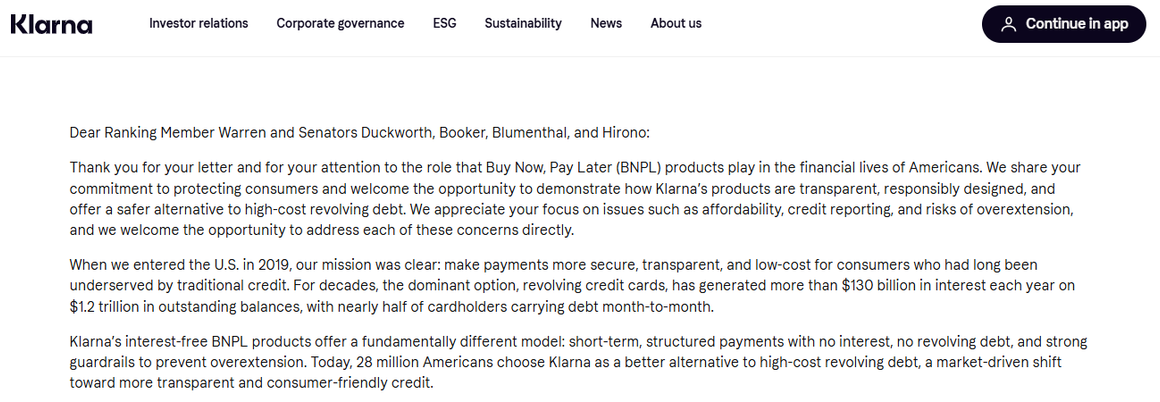
Klarna14 posted a response to the senator’s letter and emphasized on their commitment to to the rules of the U.S. Financial System. They wrote:
Klarna remains committed to setting the highest standards for safety, transparency, and responsible innovation in the U.S. financial system.
An Amount Too Small to Notice, a Mark Too Big to Ignore
Here’s the thing I keep coming back to. Every part of this system was designed, individually, to feel small. A ninety dollar purchase. A four-payment split. A seven dollar fee. An app notification instead of a bill. Nothing about the experience of using Klarna signals that you are entering a relationship with the same structural stakes as a credit card. And for years, for the Pay in 4 product specifically, that was true. The debt really was invisible to the rest of your financial life.
The invisibility is what’s ending, unevenly, product by product, company by company, while the protections that are supposed to come bundled with visibility haven’t caught up. You can have Klarna history on your credit file now, at least in some circumstances, without the dispute rights that make a credit card survivable when something goes wrong. You can have a company that markets itself as the friendly alternative to predatory lending sending accounts to collections over amounts that wouldn’t cover a week of groceries. You can have a federal agency that used to police exactly this kind of gap sitting largely on the sidelines while state attorneys general and a handful of senators try to reconstruct oversight through information requests instead of rules.
I don’t think Klarna is uniquely villainous here. I think it’s a company that grew fast by selling frictionlessness, and frictionlessness and accountability tend to be in tension. The friction is the part that protects you. It’s the part that makes a lender double check before ruining seven years of your credit history over a canceled prescription. Strip it out at checkout and you’ve also, quietly, stripped it out everywhere else.
There’s also a generational angle here that the coverage tends to skip past. BNPL adoption skews young, toward people building a credit history from nothing, often with student debt already on the books and rent eating a bigger share of income than it did for their parents. These are exactly the consumers for whom a single collections mark does the most damage, because they have the least existing history to absorb the hit. A fifty-five-year-old with two decades of on-time mortgage payments can shrug off a stray Klarna mark. A twenty-three-year-old with three months of credit history cannot. The industry likes to describe itself as a bridge into the credit system for people the traditional system overlooks. That framing only holds if the bridge doesn’t collapse under the first person who trips on it, and right now, based on what the complaint boards show, it collapses more often than the marketing admits.
I also keep thinking about the mismatch in scale between cause and consequence. A missed nine dollar installment is not, in any reasonable accounting, equivalent to a missed mortgage payment. Yet once that installment crosses into collections, the credit file treats them almost identically, a negative mark is a negative mark, regardless of whether it represents four figures of unpaid debt or the price of a phone case. Credit scoring was built for an earlier generation of lending, where the size of the obligation roughly tracked the size of the consequence. Buy now, pay later broke that correlation on the way in, selling itself as too small to matter, and now risks reproducing the old consequence on the way out, without ever adjusting the scale to match.
Now, millions of people are using these apps every month, and it is starting to look less like an adjustment and more like a cost the industry has quietly shifted onto the people least equipped to absorb it.
Where this settles, whether FICO’s new scores actually get wide adoption, whether Klarna eventually reports Pay in 4 activity the way Affirm already does, whether Congress or a future CFPB writes rules with real teeth, is still genuinely open. Nobody involved, not the company, not the regulators, not the senators asking the questions, has landed on an answer yet.
Sources
- Klarna, www.klarna.com/us/articles/what-does-interest-free-really-mean/. Accessed 14 Sept. 2026. ↩︎
- Klarna, www.klarna.com/us/customer-service/does-klarna-report-to-credit-bureaus/. Accessed 14 Sept. 2026. ↩︎
- Klarna, www.klarna.com/uk/help/payments/what-happens-if-i-can-t-pay-on-time/. Accessed 14 Sept. 2026. ↩︎
- “Does Klarna Report to Credit Bureaus?” www.thecreditpeople.com/bureaus/does-klarna-report-to-credit-bureaus. Accessed 14 Sept. 2026. ↩︎
- Better Business Bureau, www.bbb.org/us/oh/columbus/profile/payment-processing-services/klarna-inc-0302-70091034/customer-reviews. Accessed 14 Sept. 2026. ↩︎
- “Klarna and Afterpay Keep BNPL Data From Credit Bureaus | PYMNTS.com” Klarna and Afterpay Keep BNPL Data From Credit Bur, 5 Aug. 2025, www.pymnts.com/buy-now-pay-later/2025/klarna-afterpay-keep-bnpl-data-from-credit-bureaus/. Accessed 15 Sept. 2026. ↩︎
- Axios, www.axios.com/2025/08/05/credit-score-klarna-afterpay. Accessed 15 Sept. 2026. ↩︎
- “New FICO Credit Scoring Models: What You Need to Know About “Buy Now, Pay Later” Loans” Certuity, 14 Aug. 2025, certuity.com/insights/new-fico-models/. Accessed 15 Sept. 2026. ↩︎
- Genovese, Daniella. “Buy now, pay later loans will now impact Americans’ credit scores” Fox Business, 23 June 2025, www.foxbusiness.com/personal-finance/buy-now-pay-later-loans-now-impact-americans-credit-scores. Accessed 15 Sept. 2026. ↩︎
- “Affirm expands credit reporting with TransUnion to all pay-over-time products” Affirm Holdings, Inc., 22 Apr. 2025, investors.affirm.com/news-releases/news-release-details/affirm-expands-credit-reporting-transunion-all-pay-over-time. Accessed 15 Sept. 2026. ↩︎
- Cooley, Patrick. “BNPL loan values rise, CFPB says” Payments Dive, 15 Dec. 2025, www.paymentsdive.com/news/bnpl-loan-values-rise-cfpb-says/807866/. Accessed 16 Sept. 2026. ↩︎
- Better Business Bureau, www.bbb.org/us/oh/columbus/profile/payment-processing-services/klarna-inc-0302-70091034/customer-reviews. Accessed 16 Sept. 2026. ↩︎
- “2025.11.18 Letter to Klarna re BNPL” 18 Nov. 2025, www.banking.senate.gov/imo/media/doc/www.banking.senate.gov/imo/media/doc/20251118lettertoklarnarebnpl.pdf. Accessed 16 Sept. 2026. ↩︎
- Klarna, www.klarna.com/international/press/klarnas-response-to-the-senators-letter/. Accessed 16 Sept. 2026. ↩︎


