

In fast fashion, the clock is everything.
Few brands embody that clock more clearly than Zara. Its parent company, Inditex, built a retail empire on one core idea. Move faster than everyone else. Design fast. Produce fast. Ship fast. Replace fast.
In business schools, this is praised as operational brilliance. In investor calls, it is described as agility. In stores, it feels like abundance.
But when I trace the speed backward through the supply chain, I see something else. I see compressed timelines. I see sudden production spikes. I see factories scrambling during peak seasons. I see workers staying late because the shipment must leave tonight.
This investigation examines how Zara’s rapid design-to-shelf model intersects with overtime and wage violations at supplier factories during high-demand periods. It draws on reporting from new outlets, labour rights groups, corporate disclosures, and worker testimonies shared in interviews and forums. It also reflects my own analysis of purchasing systems and production incentives.
Speed is not neutral. It moves pressure. The question is where that pressure lands.
The Fifteen-Day Promise
Zara’s supply chain has been described for years as one of the fastest in the world. A case study from ResearchGate1 cites a design to store a timeline that can be as short as fifteen days for certain items. Twice-weekly deliveries to stores keep inventory fresh. Store managers feed real-time sales data back to headquarters in Spain. Designers adjust quickly.
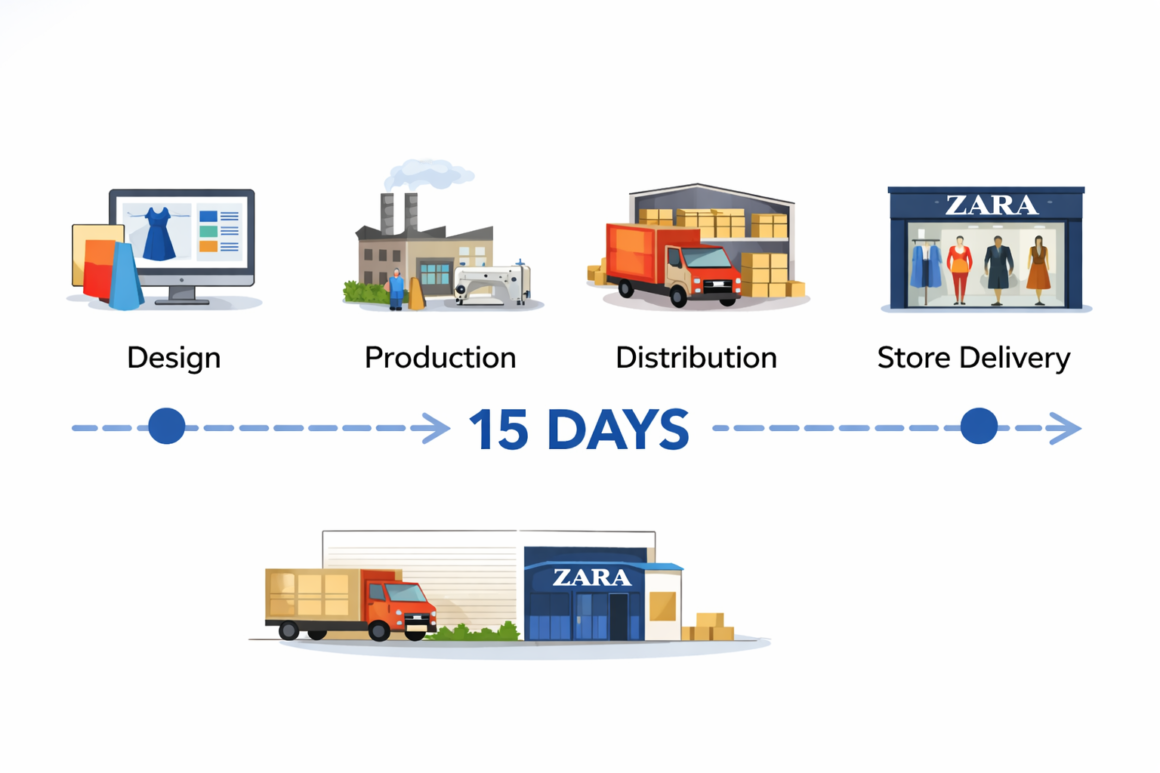
Inditex2 has highlighted this model in annual reports and investor communications. The company emphasizes flexibility, proximity sourcing in Spain, Portugal, Morocco, and Turkey, and centralized logistics hubs that dispatch products worldwide.
This speed delivers measurable results. Inditex consistently ranks among the most profitable fashion retailers globally. Its inventory turnover often outpaces competitors. Scarcity drives consumer urgency. If you hesitate, the item may vanish.
But flexibility at the top requires flexibility at the bottom. If a dress suddenly sells out, replenishment orders may be placed within days. Factories must respond. When a trend surges on social media, production schedules shift overnight.
A sourcing executive quoted anonymously once described the dynamic bluntly.
“If they want it in three weeks, we have to make it in three weeks.”
Three weeks is short in garment manufacturing. Fabric must be sourced. Patterns cut. Sewing lines organized. Quality checks completed. Packing done. Customs cleared.
If demand spikes during peak season, the only variable left is labor time.
Peak Seasons and Production Surges
Retail demand is cyclical. Holiday periods, back-to-school, summer launches, and promotional events generate concentrated spikes in orders. Fast fashion adds micro seasons on top of traditional calendars. Limited drops. Influencer collaborations. Weather-responsive capsules.
Each spike translates into production surges.
In Bangladesh, where garment exports form the backbone of the economy, peak season often means twelve-hour days. The legal workweek is typically capped at sixty hours, including overtime. Reports from labour groups show that during high-demand periods, workers exceed that limit.
BILS3 reports have revealed the same scene inside Bangladesh’s garment districts: production floors humming long after sunset, supervisors tracking output by the hour, and workers calculating how little sleep they can survive on. In interviews documented by the paper, Bangladeshi garment workers described fourteen-hour shifts during peak seasons tied to orders from Western brands. One woman recounted leaving home before sunrise and returning well after dark, sometimes for weeks at a stretch. The exhaustion was not framed as an exception. It was described as the rhythm of busy periods when export deadlines tightened and shipment windows narrowed.
The reporting did not single out one brand. Instead, it situated these accounts within a broader fast fashion system built on compressed timelines. When retailers demand rapid turnarounds, factories absorb the shock. Short lead times mean fabric must be cut and stitched almost immediately after designs are approved. Last-minute order changes ripple through production lines. A delayed fabric delivery in one week can translate into mandatory overtime the next. The pressure travels downstream, landing squarely on sewing operators and helpers paid by the month or by the piece.
The advocacy network Clean Clothes Campaign4 has echoed similar concerns in factory audits and worker testimonies. In multiple reports, the group has flagged excessive overtime in supplier facilities producing for major global brands. During peak export seasons, workers have described schedules that leave little room for family life or rest. One testimony captured the strain with painful simplicity: peak season meant no time to see our children.
Across articles, reports, and interviews, the language varies. Some workers speak of fatigue. Others speak of fear of losing wages if they refuse extra hours. Managers cite deadlines. Brands cite demand. Yet the structure underneath remains constant. When speed becomes the defining metric of competitiveness, time itself turns into a cost to be squeezed. And in factory towns thousands of miles from flagship stores, that cost is measured not just in minutes, but in missed evenings, strained bodies, and childhoods glimpsed only in passing.
In 2011, Brazilian authorities found workers in São Paulo workshops producing garments for Zara in conditions described as analogous to slavery. According to Reuters5, inspectors said workers, including Bolivian migrants, labored long hours in cramped conditions for little pay.
Inditex responded by cutting ties with the supplier involved and strengthening monitoring. The company signed agreements with Brazilian prosecutors and committed to improved oversight.
The case became an early test of Zara’s accountability. The garments carried their label. The workshops were subcontracted. The brand did not own them. Yet public scrutiny focused on Zara.
This is the structural feature of modern apparel supply chains. Brands outsource production but retain reputational responsibility.
The Brazil case also illustrated how rapid order flows can cascade through subcontracting layers. First-tier suppliers may subcontract during peak periods to meet deadlines. Oversight weakens with each layer.
When orders surge, subcontracting often increases. With it, risk increases.
In 2017, BBC News6 reported that shoppers in Istanbul discovered handwritten notes inside Zara garments. The notes said,
“I made this item you are going to buy, but I did not get paid for it.”
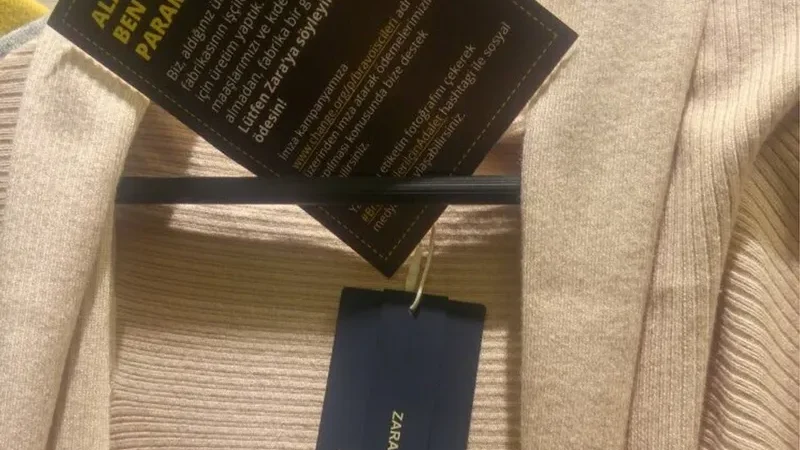
The workers had been employed at a factory that produced for Zara and other brands before it shut down without paying wages and severance.
The BBC reported that Inditex worked with local partners to establish a hardship fund to compensate affected workers.
The images of those notes traveled globally. They punctured the polished surface of fast fashion.
The Turkish case was not about overtime alone. It was about wage theft and factory closure. Yet the context matters. When suppliers operate on thin margins and face volatile order patterns, financial instability rises. If a factory collapses under debt or canceled orders, workers bear the cost.
Peak season intensifies financial strain. If production must be completed quickly, factories may rely on credit to purchase materials and pay wages upfront. If payments from buyers are delayed or penalties are imposed for late shipment, liquidity shrinks.
Wage violations often emerge where margins are tight and oversight is fragmented.
Purchasing Practices and the Pressure Chain
To understand overtime, I look at purchasing contracts. Brands set prices and delivery deadlines. Suppliers calculate whether they can comply profitably. If deadlines are aggressive and prices are low, factories squeeze efficiency.
Efficiency can mean improved machinery and workflow. It can also mean longer shifts.
The International Labour Organization7 sets standards on working hours and forced labor. Overtime should be voluntary and compensated at premium rates.
On paper, most supplier codes of conduct reflect these principles. Inditex’s Code of Conduct8 for Manufacturers and Suppliers prohibits forced labor and requires compliance with local overtime laws.
Yet voluntary overtime in a context of poverty is complicated. If refusing overtime means losing future shifts, the voluntariness becomes questionable.
The Worker Rights Consortium9 has noted in monitoring reports that excessive overtime often correlates with short lead times and unpredictable order volumes.
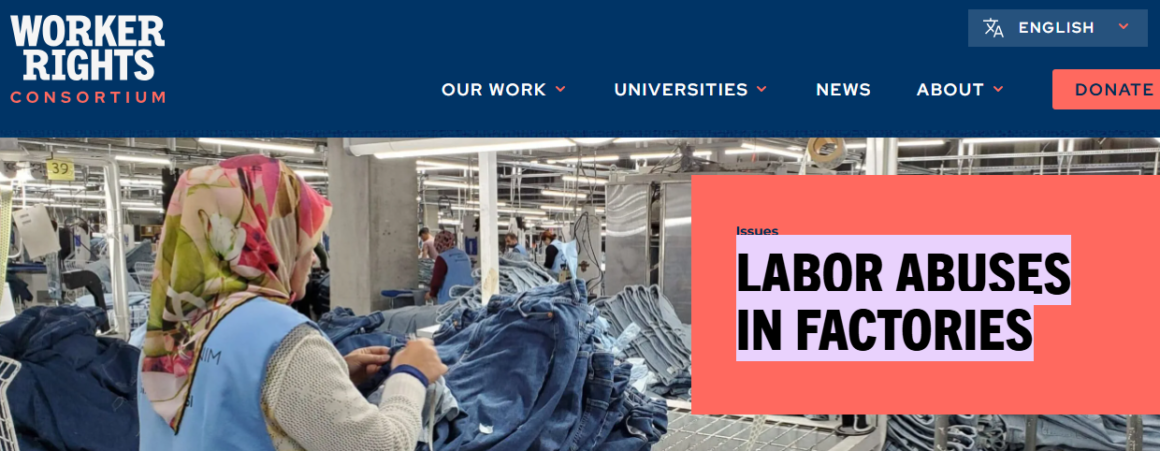
In interviews collected by labour groups, workers frequently describe being told that failure to meet production targets could lead to job loss. One sewing operator quoted in a report said that during rush periods,
“If we say no, they say many others are waiting for this job.”
That statement captures the economic asymmetry. Labor markets in major garment-producing countries are saturated. Workers have limited bargaining power. Peak season magnifies employer leverage.
Quantifying overtime across Zara’s supply chain is difficult. The company publishes aggregate audit data but does not disclose detailed factory-level hour logs.
However, industry-wide data provides context. According to ILO estimates10, garment workers in several Asian producing countries often work beyond legal overtime limits during peak periods. Studies in Bangladesh have documented workweeks exceeding sixty hours despite statutory caps.
Minimum wages in major garment-producing countries remain below living wage benchmarks calculated by labor groups. In Bangladesh, minimum wages for garment workers were increased in 2018 and again in 2023 after protests, yet labour advocates argue they still fall short of living costs.
When wages are low, overtime becomes a survival strategy. Workers accept long hours to supplement their income. Factories rely on that willingness to meet tight delivery schedules.
From a procurement perspective, if a buyer consistently places rush orders without adjusting prices to reflect overtime premiums, the financial burden shifts to suppliers. Suppliers may underpay overtime or misreport hours to protect margins.
This dynamic is not unique to Zara. It is endemic to fast fashion. But Zara’s speed amplifies frequency.
Other brands operate with similar pressures. H&M has faced scrutiny over wage disputes and excessive overtime in supplier factories. Shein was the subject of a Channel 4 investigation in 2022 that found workers in Guangzhou working extremely long hours in workshops producing garments sold through the platform.
Research from Scribd11 suggests that what distinguishes Zara is its hybrid model. A significant portion of production is nearshore in Spain and surrounding countries for rapid turnaround items. That proximity can reduce lead times and theoretically improve oversight.
However, for high volume basics and cost-sensitive items, Zara still relies on global suppliers in lower wage countries. During peak demand, both nearshore and offshore suppliers can face overtime spikes.
In some respects, Zara has taken more visible steps than certain competitors in signing international framework agreements with global unions and participating in safety accords after the Rana Plaza disaster.
Yet participation in safety initiatives does not automatically resolve wage and hour violations. Building safety improved dramatically in Bangladesh under the Accord framework. Overtime compliance remains uneven.
Audits, Living Wage, and the Price Question at Zara
Corporate social audits sit at the center of Zara’s labor governance model. Its parent company, Inditex, publishes annual sustainability reports stating that it conducts thousands of social compliance audits across its global supplier network each year. In recent years, Inditex12 has reported working with more than 1,500 suppliers and several thousand factories worldwide, with monitoring programs that include announced and unannounced visits, corrective action plans, and potential termination for severe breaches.
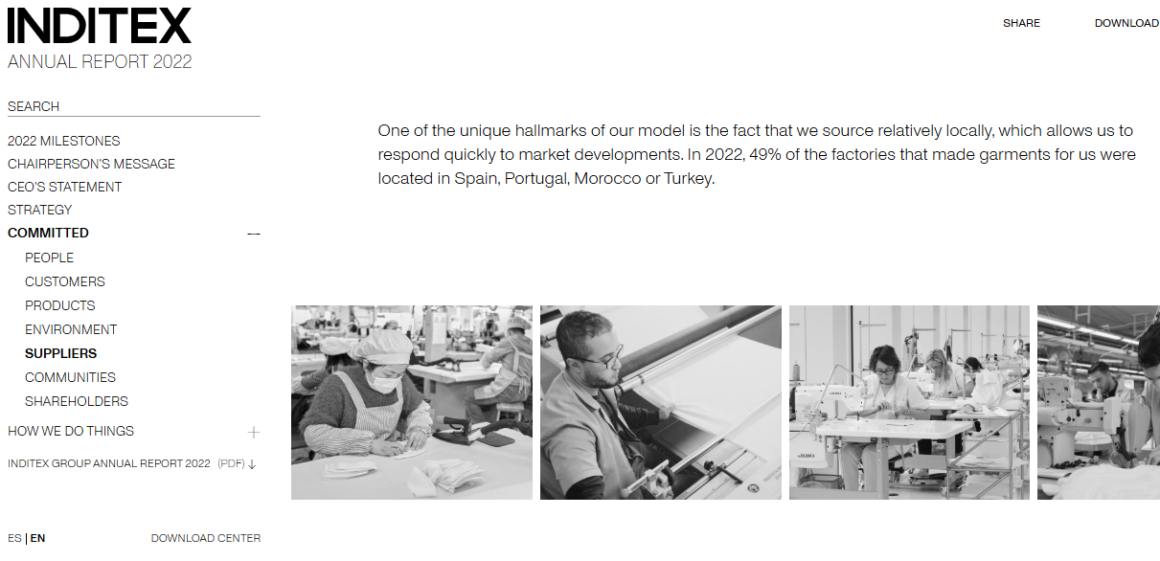
On paper, the system is robust. Inditex’s Code of Conduct for Manufacturers and Suppliers prohibits excessive overtime, child labor, and unsafe conditions. It requires compliance with local labor laws and International Labour Organization standards. Factories found non-compliant must implement corrective action plans, and repeated or serious violations can lead to the end of commercial relationships.
Audits can and do uncover real abuses. Across the garment industry, inspections have identified falsified payroll records, locked emergency exits, underage workers, and undeclared subcontracting. Inditex has disclosed that it has terminated suppliers for non-compliance in prior years, including cases involving unauthorized subcontracting and labor rights breaches.
Yet the structural limits of auditing are well documented. Corporate audits are often scheduled in advance, giving factories time to prepare documentation and coach workers on what to say. Surprise inspections remain relatively rare across industries, and auditors typically review samples of records rather than every transaction. When incentives favor speed and low cost, compliance systems can struggle to capture the pressure points that generate violations in the first place.
The problem is especially acute for a company like Zara, whose business model depends on rapid design to store cycles. Zara has built its competitive advantage on short lead times and frequent new collections. While Inditex emphasizes proximity sourcing in countries such as Spain, Portugal, Turkey, and Morocco, it also sources from countries including Bangladesh, India, and Vietnam, where labor costs are lower.
Short lead times can compress production schedules. When orders are modified at the last minute, or volumes are increased to meet surging demand, factories must absorb the shock. Peak season surges often occur between audit windows. Overtime records can be adjusted to meet legal caps on paper, while workers continue beyond statutory limits in practice. Subcontracting can be concealed temporarily by shifting production to smaller workshops when primary facilities reach capacity.
The Covid 19 pandemic exposed these vulnerabilities with unusual clarity. In early 2020, as lockdowns spread across Europe and North America, fashion brands canceled or suspended billions of dollars in orders. According to the Business and Human Rights Centre13, factories in Bangladesh and other producing countries were left with completed goods and unpaid invoices, pushing workers into layoffs and wage arrears.
Public campaigns, including PayUp, pressured brands to honor commitments. The Fashion.Industry14 stated that Inditex promised in March 2020 that it would pay for completed orders and continue honoring commitments to suppliers, distinguishing itself from some competitors that initially withheld payment. That decision was widely noted by campaigners as comparatively responsible within the sector.
But the episode revealed a deeper imbalance of power. Brands control purchasing decisions. Factories operate on thin margins and depend on those orders to survive. When demand evaporates, workers lose jobs. When demand returns, as it did sharply during reopening phases in late 2020 and 2021, factories swing from collapse to overload. The burden of volatility is borne by workers first through layoffs and then through extended overtime.
Living wage debates are central to this cycle. In many garment-producing countries, statutory minimum wages fall below independently calculated living wage benchmarks. When base wages are insufficient to cover food, housing, healthcare, and education, workers rely on overtime premiums to reach subsistence levels. Overtime becomes normalized rather than exceptional.
Inditex15 has publicly stated that it supports living wage progress and collective bargaining. The company has had a Global Framework Agreement with IndustriALL Global Union since 2007, renewed multiple times, aimed at promoting freedom of association and social dialogue within its supply chain. Inditex has also participated in industry initiatives focused on wage improvements in specific sourcing regions.
However, implementation remains uneven across countries and suppliers. Living wage initiatives often operate as pilot programs rather than binding, price-integrated commitments across all contracts. Without systematic adjustments to purchasing prices to reflect higher base pay and lawful working hours, suppliers face a double squeeze. They are expected to comply with labor standards while delivering speed and low unit costs.
If a brand insists on rapid replenishment and tight margins, labor becomes the primary adjustment lever. Overtime extends. Temporary workers are hired. Subcontracting increases. In extreme cases, time sheets are falsified to satisfy audit limits while production continues.
Worker testimonies published by investigative outlets reinforce this pattern. The Guardian16 has reported on Bangladeshi garment workers describing fifteen-hour shifts during peak periods for Western brands, leaving home before sunrise and returning after dark for weeks at a time. One worker told the paper that during busy seasons, she saw her children only on Sundays. Clean Clothes Campaign17 researchers have documented similar accounts, including workers reporting pressure to sign blank overtime forms or to underreport hours to pass inspections.
These reports do not always name Zara specifically. But Zara operates within the same sourcing ecosystems and competitive dynamics as other major fast fashion buyers. When multiple investigations across regions and years describe similar experiences, the pattern cannot be dismissed as isolated anecdotes.
Zara’s defenders argue that its model reduces waste. Because it produces in smaller batches and replenishes based on real-time sales data, it avoids the deep overproduction and heavy markdown cycles that plague other retailers. There is evidence supporting this claim. Inditex consistently reports lower inventory write-downs relative to revenue than many traditional apparel brands. Agile production can reduce unsold stock and textile waste.
Yet agility has a human dimension. The capacity to ramp up production quickly depends on labor flexibility. The question is whether that flexibility is voluntary and fairly compensated, or coercive and normalized.
Technically, it is possible to design a fast response model without excessive overtime. Brands can plan demand more conservatively. They can build buffer capacity into supplier contracts. They can pay prices that explicitly cover living wages within legal working hour limits. They can accept slightly slower replenishment in exchange for predictable schedules.
Economically, those choices may reduce margins or moderate growth rates. Strategically, they require prioritizing labor stability alongside speed and profitability.
For Zara and Inditex, the tension is not primarily about whether audits exist. They do. It is about whether purchasing practices align with the standards that those audits are meant to enforce. As long as speed and low cost remain dominant performance metrics, compliance systems operate downstream of the real pressure point.
The hidden subsidy of fast fashion is not only environmental. It is temporal. It is the extra hours workers contribute when demand spikes and wages fall short. Integrating living wage benchmarks directly into pricing contracts and decoupling compliance from unrealistic lead times would shift that burden back up the supply chain.
Until then, the fear described by workers in interviews remains a rational response to structural imbalance. Brands can cancel. Factories cannot. Workers, at the end of the chain, adjust their lives to absorb the shock.
What Reform Would Require
Meaningful reform in fast fashion supply chains would include several elements.
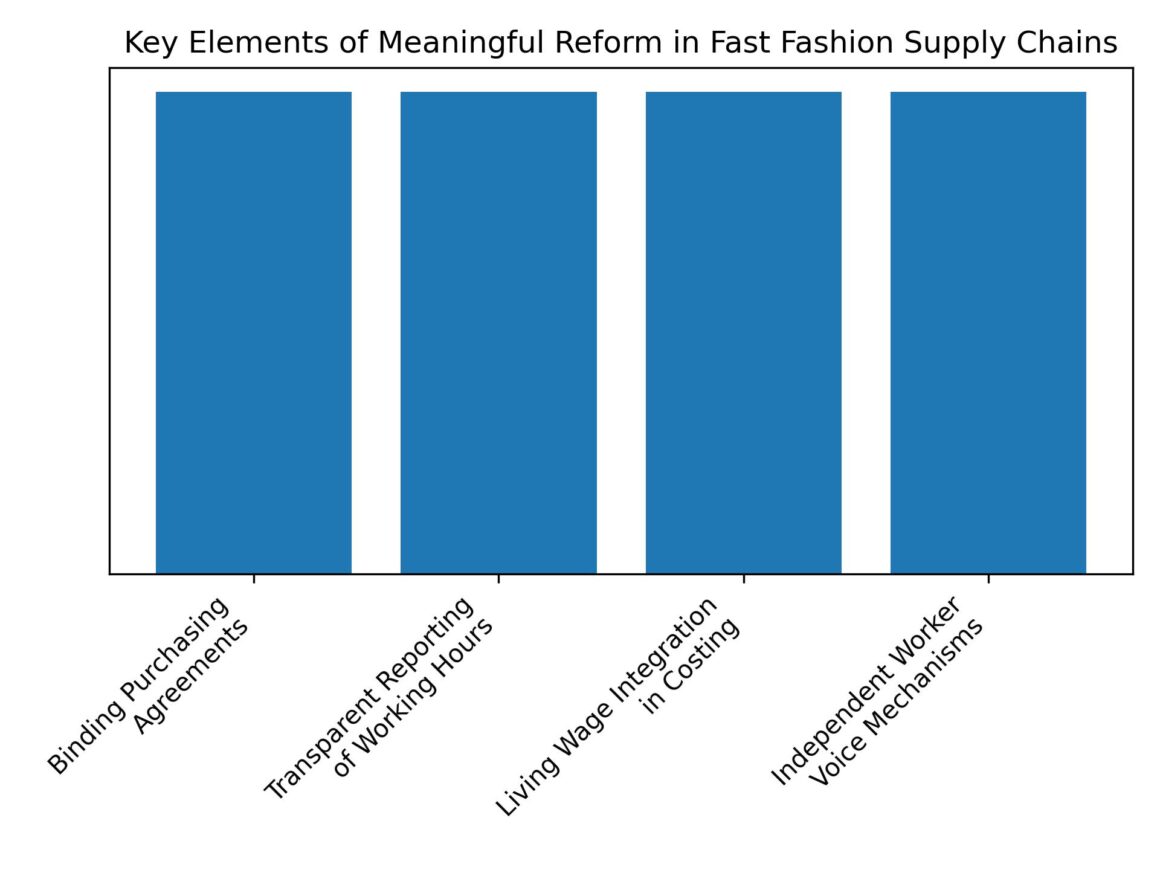
First, binding agreements that link purchasing practices to labor standards. If a brand places orders with unrealistic deadlines, it shares liability for resulting violations.
Second, transparent reporting of average working hours at supplier factories during peak seasons. Aggregate audit counts are insufficient.
Third, integration of living wage benchmarks into cost calculations. Overtime should be exceptional, not essential.
Fourth, worker voice mechanisms independent of factory management, with protection against retaliation.
Some progress exists. Inditex has signed global framework agreements with union federations and participates in multi-stakeholder initiatives. But voluntary frameworks often lack enforcement teeth.
Regulation may shift incentives more decisively.
When you walk into a Zara store, you see a choreography of freshness. New racks twice a week. Trend-responsive silhouettes. Affordable prices.
But what you should also see is the invisible chain behind each garment.
Think about the Brazilian workshops exposed by the media. Think about the Turkish workers who slipped notes into their pockets. Think about Bangladeshi sewing operators describing fourteen-hour days during rush periods.
The connection between a trendy blouse and a tired worker is not immediate. It is mediated by contracts, logistics, and data systems. Yet it exists.
Fast fashion’s promise to consumers is novelty without waiting. The cost of that promise often appears as time taken from workers’ evenings and weekends.
Speed feels glamorous at the retail level. It feels different on a sewing line at 10 pm.
Zara did not invent garment outsourcing. It refined urgency.
Urgency drives consumer behavior. Limited stock. Constant change. Fear of missing out. Urgency also drives production behavior. Tight deadlines. Flexible shifts. Compressed calendars. If urgency is structural, labor strain becomes structural.
Inditex has demonstrated adaptability in response to scandals. It has improved transparency and engaged with unions. Yet the fundamental equation of fast fashion remains.
High velocity retail requires high velocity production. Unless velocity slows or costs are recalibrated to protect workers fully, overtime spikes will remain a recurring feature during peak seasons.
Every garment carries a timestamp. When it was designed. When it was cut. When it was sewn. When it was shipped.
In fast fashion, that timestamp is short.
Behind that short timeline is a longer human story. It includes overtime forms signed late at night. It includes pay envelopes that sometimes fall short. It includes workers who calculate how many extra hours they must accept to pay rent.
As a researcher, I try to remain analytical. I examine data, policies, and contracts. But the more I study Zara’s speed model, the clearer the pattern becomes.
The clock that drives retail excitement can also drive factory exhaustion. The solution is not simple outrage. It is a structural change in how fashion is priced, planned, and paced.
Until then, when peak season arrives, and racks refill overnight, somewhere a shift extends. And the clock keeps moving.
Sources
- “ResearchGate”, www.researchgate.net/publication/362568585_ZARA’S_CASE_STUDY_-the_Strategy_of_the_Fast_Fashion_Pioneer_The_Strategy_of_the_Fast_Fashion_Pioneer. Accessed 13 Feb. 2026. ↩︎
- Inditex, www.inditex.com/itxcomweb/api/media/604197b9-50de-4f4f-ab84-c1e379cb3fd0/www.inditex.com/itxcomweb/api/media/604197b9-50de-4f4f-ab84-c1e379cb3fd0/Inditex_Group_Annual_Report_2024.pdf. Accessed 13 Feb. 2026. ↩︎
- BILS bilsbd.org/wp-content/uploads/2024/07/bilsbd.org/wp-content/uploads/2024/07/Research-paper-Final-for-web.pdf. Accessed 13 Feb. 2026. ↩︎
- “What are the issues plaguing fashion?” cleanclothes.org/faq/why. Accessed 13 Feb. 2026. ↩︎
- “Reuters.Com” www.reuters.com/article/world/europe/zara-supplier-accused-of-slave-labor-in-brazil-idUSN1E77G18N/. Accessed 13 Feb. 2026. ↩︎
- News, BBC. “Turkey: Zara shoppers find labour complaints inside clothes” BBC News, 15 Nov. 2017, www.bbc.co.uk/news/world-europe-41981509. Accessed 13 Feb. 2026. ↩︎
- “Q&As on business and working time” International Labour Organization, 1 Feb. 2012, www.ilo.org/resource/qas-business-and-working-time-0. Accessed 13 Feb. 2026. ↩︎
- Inditex, www.inditex.com/itxcomweb/api/media/8cd88d29-0571-43d5-a6c3-a6c34671e4c1/www.inditex.com/itxcomweb/api/media/8cd88d29-0571-43d5-a6c3-a6c34671e4c1/inditex_code_of_conduct_for_manufacturers_and_suppliers.pdf. Accessed 13 Feb. 2026. ↩︎
- WRC, www.workersrights.org/our-work/issues/labor-abuses/. Accessed 14 Feb. 2026. ↩︎
- ILO, www.ilo.org/media/435246/download. Accessed 14 Feb. 2026. ↩︎
- Rainu, Gurpreet. “ZARA Question1” Retail, www.scribd.com/document/47068413/ZARA-Question1. Accessed 14 Feb. 2026. ↩︎
- Inditex, static.inditex.com/annual_report_2022/en/committed/suppliers/. Accessed 14 Feb. 2026. ↩︎
- “Bangladesh: Factories forced to close and lay off workers, amid declining demand and rising costs – Business and Human Rights Centre” Business and Human Rights Centre , 20 Mar. 2022, www.business-humanrights.org/fr/derni%C3%A8res-actualit%C3%A9s/bangladesh-factories-forced-to-close-and-lay-off-workers-amid-declining-demand-and-rising-costs/. Accessed 14 Feb. 2026. ↩︎
- Roberts, Lauretta. “Zara parent Inditex pledges support for suppliers during COVID-19 crisis” TheIndustry.fashion, 5 Aug. 2020, www.theindustry.fashion/zara-parent-inditex-pledges-support-for-suppliers-during-covid-19-crisis/. Accessed 14 Feb. 2026. ↩︎
- Inditex, www.inditex.com/itxcomweb/es/en/press/news-detail/b637cbc4-6e87-400e-9bd3-97b7d01dd8de/inditex-and-industriall-to-cooperate-on-garment-industry-recovery-plan. Accessed 14 Feb. 2026. ↩︎
- Butler, Sarah. “Workers for Lidl, H&M and Gap in Bangladesh work 15-hour shifts” The Guardian, 23 Sept. 2013, www.theguardian.com/fashion/2013/sep/23/workers-in-bangladesh-long-hours. Accessed 14 Feb. 2026. ↩︎
- “Out of sight” Informal employment in the garment industry., cleanclothes.org/news/2022/out-of-sight-informal-employment. Accessed 14 Feb. 2026. ↩︎