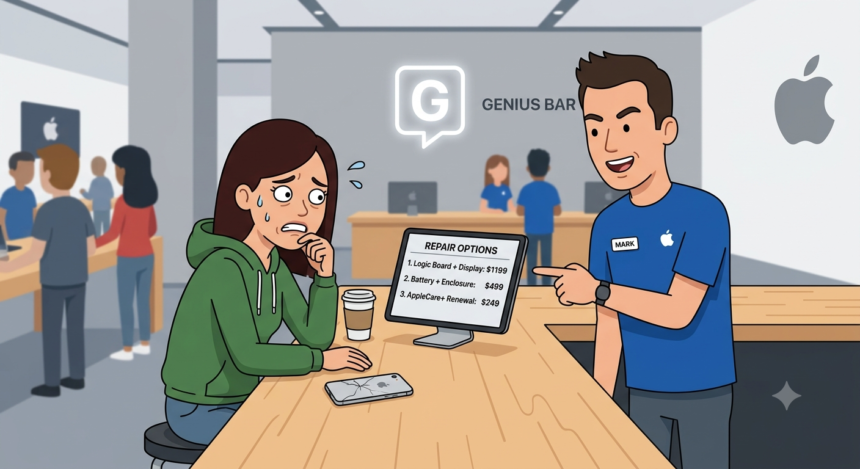

For twenty years Apple sold the Genius Bar as the opposite of a sales floor. No commissions. No quotas. Just calm, competent help from someone who happened to know more about your device than you did. That pitch worked so well it became part of the company’s mythology, repeated in magazine profiles and business school case studies about the cult of Apple retail. One widely circulated training document at Scribd1 quoted an internal manual telling employees their job was to “understand all of your customers’ needs, some of which they may not even realize they have,” and noted that staff worked without commissions or quotas. That framing was not spin. It was the entire architecture of the brand.
I wanted to know what happened to that architecture. So I went looking, through court filings, leaked training documents, Bloomberg reporting, and more Reddit threads and MacRumors forum posts than I care to admit, and what I found was a company that never technically broke its own promise. Nobody at the Genius Bar earns a commission. Nobody gets a bonus check for pushing AppleCare+. And yet if you have walked into an Apple Store in the last decade and felt something shift underneath the friendly small talk, you were not imagining it. The pressure just moved somewhere else. It moved into the metrics.
The Promise and the Fine Print
The Genius Bar concept dates back to the early Apple Store era, when Ron Johnson built the retail division around the idea that a computer store did not have to feel like a computer store. He oversaw the creation of 350 Apple stores during his roughly 12-year stint at the brand according to Inventions Insider2.
Genius Bar staff, per company materials and later reporting, were trained to focus on troubleshooting rather than selling, positioned as the local face of AppleCare+ support. The employees were called Geniuses. The bar itself, with its stools and casual layout, was designed to feel like a friend’s kitchen table rather than a Verizon counter.
For a long time this worked exactly as advertised. A 2011 Fortune3 piece drawing on a Popular Mechanics interview with an anonymous retail worker described the internal culture in blunter terms, with the employee saying it could feel like a cult and that behind the scenes it was “all sell, sell, sell”. Even then, more than a decade ago, there was a gap between the calm surface and what was happening underneath. The Week’s4 2015 rundown of Apple Store secrets noted that despite the no-quota policy, former employees said the company had found other ways of measuring and rewarding sales performance, including scripted language for handling upset customers and strict rules against acknowledging product rumors or known defects.
None of that constitutes an upsell in the traditional sense. It constitutes something more durable: a culture where the appearance of helpfulness was itself carefully engineered, tested, and enforced, long before anyone got near your credit card.
Battery-gate and the turn toward “All-In on iPhone”
The clearest account I found of how that engineered helpfulness curdled into something closer to a sales campaign comes from a former Genius Bar technician named Matt Herbst, who worked at an Apple Store in Ohio from 2016 until he resigned in 2022. He published a long, detailed account of his tenure on Medium5, and it is the single most useful primary document I turned up in weeks of reporting on this subject, because Herbst was not trying to build a following. He was quitting, and he wrote it as his exit.
Herbst describes 2018 as the year everything changed, when Apple slashed the price of out-of-warranty battery replacements after admitting it had throttled older iPhones, a scandal that became known as “battery-gate.” His store, he writes, opened every morning to customers “ready to axe our heads for policy decisions far out of our control,” and the Genius Bar spent months replacing batteries nonstop. For a company built on device longevity as a selling point, this was a genuinely uncomfortable moment. iPhones were lasting too long, and cheap batteries meant customers had less reason to replace them.
What followed, according to Herbst, was a corporate pivot with an actual internal slogan. He calls it “All-In on iPhone.” Sales were down, he explains, because so many customers had refreshed their aging phones with the discounted batteries rather than buying new ones, and “leadership unleashed a pressure campaign” that reversed the previous emphasis on repair and longevity in favor of pushing upgrades. Morning meetings, which he calls “Daily Download,” stopped being about troubleshooting technique and started being about accessory sales, business leads, and AppleCare+ attach rates. Employees who did not produce a handful of forced upgrades a day were pulled aside and scolded.
This is the part that matters most, because it explains how Apple can be telling the truth about no commissions while still running something that functions like a sales floor. Herbst quotes a former colleague speaking to NBC News6 during a 2020 Covid outbreak at an Apple store in Texas. The employee described the shift plainly: “It’s not just the net promoter score anymore. Now it’s, ‘Hey make sure we’re selling iPhones and AppleCare and accessories.’ There’s so much pressure on the leadership team”. The customer satisfaction survey, once the sole yardstick, had become one input among several, and the newer ones were explicitly commercial.
Apple’s genius, and I mean that without irony, was building a performance system that never had to call itself a sales quota, because it did not need to. Net Promoter Score, or NPS, gave the company a single number attached to every employee, every store, and every region, refreshed constantly through post-visit surveys. Apple has publicly credited its high NPS to a culture of listening to customers immediately after purchase and closing the loop on complaints within 24 hours, and the company’s average NPS across product lines has hovered in the low sixties for years, an enviable number in retail.
What that framing leaves out is what else got folded into the same review process. Herbst is specific about this: AppleCare+ attach rate, meaning the percentage of device sales that also include an extended warranty, became a tracked figure discussed in daily meetings. Accessory attach rate, meaning cases, AirTags, cables, became another. None of these were framed to employees as sales targets. They were framed as “opportunities” and “conversations,” a linguistic sleight of hand that let the company preserve its no-quota branding while still measuring, ranking, and pressuring staff on numbers that had nothing to do with fixing anything.
An earlier document from 2016 makes clear this was not entirely new. GSMArena7 reported at the time that Apple had rolled out an incentive structure for retail employees explicitly tied to iPhone sales volume, prompting one reader to write that the program “should step back to when the customer could buy a iPhone at a reasonable price” rather than pressuring staff to sell more. The company’s public language about commission-free retail never changed. The internal machinery clearly did.
What It Looks Like from the Other Side of the Counter
I spent a chunk of an afternoon reading through Apple’s own community discussion boards, MacRumors forums, and old AnandTech threads, because I wanted to know if any of this internal pressure was visible to ordinary customers who had no idea about attach rates or Daily Download meetings. It was, constantly, just described in different language. People do not say “I think I was upsold.” They say things like “I’ve lost faith in the Genius Bar.”
That exact phrase comes from a 2022 MacRumors8 forum thread where a user described taking his father’s iPhone 11 in for a minor issue. A Genius reportedly told him, without prompting, that it did not make sense to fix a phone that would soon be “obsoleted” that year, a claim the original poster called “a new level of incompetence or deception”. Whatever was actually wrong with the phone, and it may well have been something simple, the conversation had already pivoted toward a new purchase before diagnosis was complete.
On what frickn planet would a GENIUS at the Apple Store tell people that an iPhone 11 is going to be obsolete this year due to the LTE being eliminated?????!!! Have we gone mad? I would expect this at a back alley repair shop trying to make a few bucks off of a 72 year old man, but THE APPLE STORE? Com’n man! That’s a new level of incompetence or deception…I can’t really tell which it is. It gets better.
That pattern shows up again and again. On eBay’s9 community forum, a user asked what to do with an iPad that a Genius Bar technician had declared dead, quoting the tech’s estimate that repair would cost about as much as the device was worth used. Another forum member’s response pointed toward independent repair advocate Louis Rossmann, writing that “the Genius Bar is notorious for telling you that it will cost hundreds or thousands to repair simple problems that take Louis about five minutes to fix, without replacing any parts”. On an AnandTech10 thread about a different repair dispute entirely, a commenter summed up the business logic in a single blunt line: Apple’s hardware is sealed and glued tight because “they WANT you to buy either new HW or pay for AppleCare and they will just swap it with another one”.
Another user said:
The name Apple translates directly to ‘rip off’. I thought everyone knew this.
Rossmann himself is worth dwelling on for a moment, because he is the industry’s most consistent thorn in Apple’s side on exactly this question, and his critiques have held up under scrutiny for years. In an undercover CBC11 investigation, Rossmann examined a MacBook Pro that an Apple Genius had quoted at roughly $1,200 to repair, attributing the damage to liquid exposure. Rossmann diagnosed a bent connector pin, pushed it back into place in a couple of minutes, and said he would not have charged a customer for that fix at all. Apple’s retail policies, to be fair, are built around board-level swaps rather than component-level fixes for reasons of consistency and liability, and AppleInsider has pushed back hard on some of the sensationalized framing of these undercover segments. But the price gap between what Apple quotes and what independent shops charge for the same underlying problem keeps showing up in story after story, and it is hard to read that gap as anything other than structural.
Even Apple’s own official discussion boards, moderated and sanitized as they are, carry traces of the same friction. One thread on Apple’s community forum12 includes a user recounting being told they needed a new display for their MacBook Pro, only to have a second Genius fix it for free by tightening a few screws. The advice offered to the frustrated customer was not to file a complaint about the diagnosis. It was to go back and talk to someone else, a workaround so common among Apple’s own users that it has become a kind of folk wisdom.
The people doing the pitching are not thrilled either
It would be easy to write this story as customers versus a faceless corporation, but that misses half of it. The employees pushing AppleCare+ and accessory bundles are, by most accounts, deeply uncomfortable with the role, and increasingly vocal about it. A May 2016 anonymous account of a UK Apple Store employee described an internal culture that felt “like a cult,” with a lack of meaningful bonuses even for landing large business contracts and pay so low that some workers could not afford Apple products despite employee discounts.
The Verge’s13 Zoe Schiffer spoke with sixteen current and former Apple retail and support employees for a widely read 2021 investigation, and one told her, “They say ‘our soul is our people’ but it really didn’t feel like that to me.” Herbst, the Ohio technician, put a number on the gap between effort and reward that stuck with me. On the store’s busiest days, he writes, an individual employee might personally move tens of thousands of dollars in product and services in a single shift, all while forbidden from earning commission or accepting tips, while managers alone collect quarterly bonuses tied to the exact sales metrics the frontline staff are pressured to hit.
That arrangement produces a very particular kind of employee, someone trained to sound like a friend while operating under numbers they cannot see and cannot negotiate. I do not think most Geniuses set out to upsell anyone. I think many of them are doing what any employee does when a number appears next to their name in a system they do not control. They adapt.
The Redesign, and What It Says Out Loud
The most interesting new evidence I found while reporting this piece came out this month, not from a leaked memo but from Bloomberg’s14 Mark Gurman, whose retail reporting on Apple is about as close to a primary source as exists outside the company itself. Gurman reported in his “Power On” newsletter that Apple is planning a sweeping retail overhaul, bringing back standalone, wood-finished Genius Bars, carving out dedicated “bays” for pickup and Today at Apple sessions, and tearing out the oversized video walls that defined Apple’s stores under former retail chief Angela Ahrendts. Gurman frames it as a shift away from the store-as-public-square vision Ahrendts pursued, toward something built around service and fulfillment.
Read the fine print of that same report and the picture gets sharper. Gurman notes that Apple has tightened expectations during pre-opening staff meetings, requiring employees to stay on their feet, keep phones and drinks put away, and applaud when the doors open each morning. That detail landed for me, because a company does not choreograph applause for customers walking through a door unless it has decided the emotional tone of the sales floor is itself a metric worth managing.
The MacRumors15 comment section under that story turned out to be its own small piece of evidence, and I want to be careful here, because forum comments are not survey data. Still, one reply stood out enough that I went back and read it three times. A commenter describing thirty years of experience with Apple’s ecosystem, and a 90-year-old mother who relies on her local store for help, wrote that when her mother shows up with a problem, instead of getting someone whose job is to sort her genuine confusion from an actual defect, “she gets a clerk frequently motivated by upselling her on something she doesn’t actually need”. The commenter called it insulting, and said flatly that a return to real customer service, staffed by people who are not doing double duty as salespeople with scripts, would be welcome.
Here is my read, for whatever it is worth after weeks with this material. Apple never lied about commissions. That part of the brand promise has held up remarkably well across two decades of scrutiny, and it is a real point of difference from carrier stores, where the sales pressure is blunt and openly financial. What Apple built instead is subtler and, in some ways, more effective: a system where the pressure to sell runs through customer satisfaction infrastructure itself, so that an employee’s daily performance number, the one tied to raises and scheduling and standing with management, quietly absorbed line items for AppleCare+ attach and accessory revenue without ever being renamed a quota.
That distinction matters enormously to Apple’s legal and PR posture. It barely matters at all to the guy standing at the counter being told his three-year-old phone is basically obsolete before anyone has actually opened the diagnostic tool. The battery-gate reversal in 2018 is the clearest evidence I found that this is a deliberate corporate response to financial pressure rather than an organic drift in employee behavior. When cheap battery swaps threatened iPhone upgrade revenue, the company did not shrug. It launched an internal campaign with a name, and pushed the resulting pressure down through management to frontline staff who had almost no power to push back.
The 2026 redesign, if Gurman’s reporting holds, suggests Apple itself has registered how visible this has become. Standalone Genius Bars, pulled back out of the general retail floor and away from the merchandise tables, read as an attempt to recreate the sense of a dedicated service counter rather than a showroom with a repair window bolted onto the side. Whether that actually changes what happens once a customer sits down, or whether it is mostly architecture dressed up as intent, is something only time and a few thousand more Genius Bar appointments will tell.
Sources
- “Client Challenge” www.scribd.com/document/262752243/Secrets-From-Apples-Genius-Bar-Full-Loyalty-No-Negativity. Accessed 30 Sept. 2026. ↩︎
- “Inventions Insider” Inventions Insider, www.facebook.com/Insiderinventions/posts/ron-johnson-oversaw-the-creation-of-350-apple-stores-during-his-roughly-12-year-/1396410785685375/. Accessed 1 Oct. 2026. ↩︎
- Elmer-DeWitt, Philip. “Apple store employee tells all” Fortune, 18 Feb. 2011, fortune.com/2011/02/18/apple-store-employee-tells-all. Accessed 29 Sept. 2026. ↩︎
- Staff, The Week. “Revealed: 10 big Apple Store secrets” The Week, 16 June 2011, theweek.com/articles/483963/revealed-10-big-apple-store-secrets. Accessed 29 Sept. 2026. ↩︎
- Medium, medium.com/@mattxherbst/apples-retail-staff-are-second-class-employees-dba6ad6e4998. Accessed 29 Sept. 2026. ↩︎
- Schiffer, Zoe. “Apple store in Texas closes in Covid outbreak” 9 Dec. 2021, www.nbcnews.com/tech/apple/apple-store-texas-closes-covid-outbreak-rcna8000https://www.nbcnews.com/tech/apple/apple-store-texas-closes-covid-outbreak-rcna8000. Accessed 29 Sept. 2026. ↩︎
- “GSMArena Turnstile check” www.gsmarena.com/newscomm-16742.php. Accessed 30 Sept. 2026. ↩︎
- Macrumors, forums.macrumors.com/threads/ive-lost-faith-in-the-genius-bar.2363221/. Accessed 30 Sept. 2026. ↩︎
- “eBay Community | eBay Community” EBay Community, community.ebay.com/t5/Electronics/What-to-Do-With-iPad/m-p/32703448. Accessed 30 Sept. 2026. ↩︎
- “Checking your browser” forums.anandtech.com/threads/apple-genius-bar-repair-ripoff.2555390/post-39685772. Accessed 30 Sept. 2026. ↩︎
- CBC, amp.cbc.ca/lite/story/1.4859099. Accessed 30 Sept. 2026. ↩︎
- Apple, discussions.apple.com/thread/4201968. Accessed 30 Sept. 2026. ↩︎
- The Verge, www.theverge.com/c/22807871/apple-frontline-employees-retail-customer-service-pandemic. Accessed 30 Sept. 2026. ↩︎
- “Bloomberg” Apples iPhone Duo will go down as one of the…, www.facebook.com/bloombergbusiness/posts/apples-iphone-duo-will-go-down-as-one-of-the-companys-historic-products-markgurm/1502355275083894/. Accessed 1 Oct. 2026. ↩︎
- Charlton, Hartley. “Apple Stores Said to Lose Video Walls, Regain Dedicated Genius Bars” MacRumors, 14 Sept. 2026, www.macrumors.com/2026/09/14/apple-stores-to-lose-video-walls/. Accessed 30 Sept. 2026. ↩︎