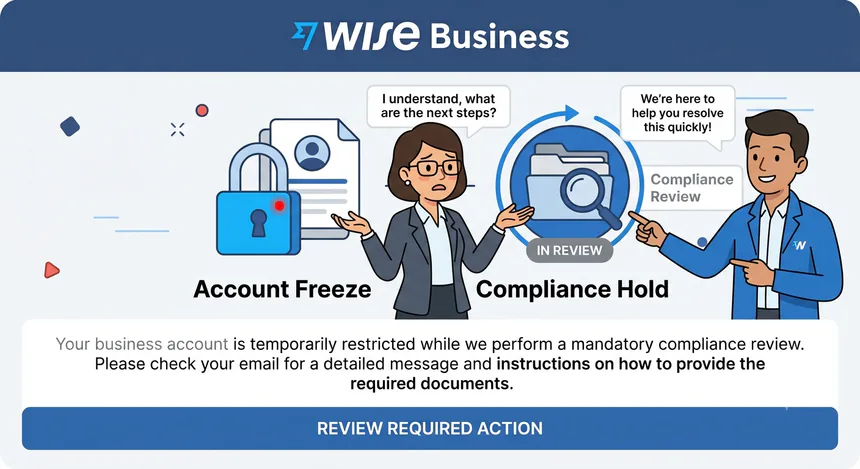

I keep coming back to one detail in a Texas complaint filed with the Better Business Bureau1. A business owner had bought photographic chemicals from a supplier overseas, wired the money through a Wise Business account, and watched Wise cancel the transfer, freeze the funds, and schedule the account for closure, all without returning the $7,230 involved. The owner had already handed over bank documents and a Texas Secretary of State filing. None of it mattered. The account closure date came and went, and as far as the public record shows, the money sat where Wise put it, waiting on a process nobody outside the company could see the end of.
That is the story I want to tell here. Not fraud, not a scam in the criminal sense, but something stranger and in some ways more unsettling. A regulated financial company holding your working capital hostage to its own compliance machinery, sometimes for weeks, sometimes for months, and telling you almost nothing about why.
A Company Built on Speed, Now Defined by Delay
Wise built its name on being fast. Send money from London to Lagos and watch it land in seconds. That pitch made Wise one of the most trusted names in cross-border payments for freelancers, agencies, and small importers who got tired of paying banks 6 percent to move their own money. The company’s own regulatory filing puts a number on that promise: 63 percent of transfers arrive instantly or within twenty seconds, and 94 percent within a day, according to a filing Wise2 submitted to the Office of the Comptroller of the Currency in June 2025. That filing was for something bigger too. Wise wants to become a nondepository trust bank in the United States, which would let it bypass intermediary banks entirely and settle dollar payments directly with the Federal Reserve.
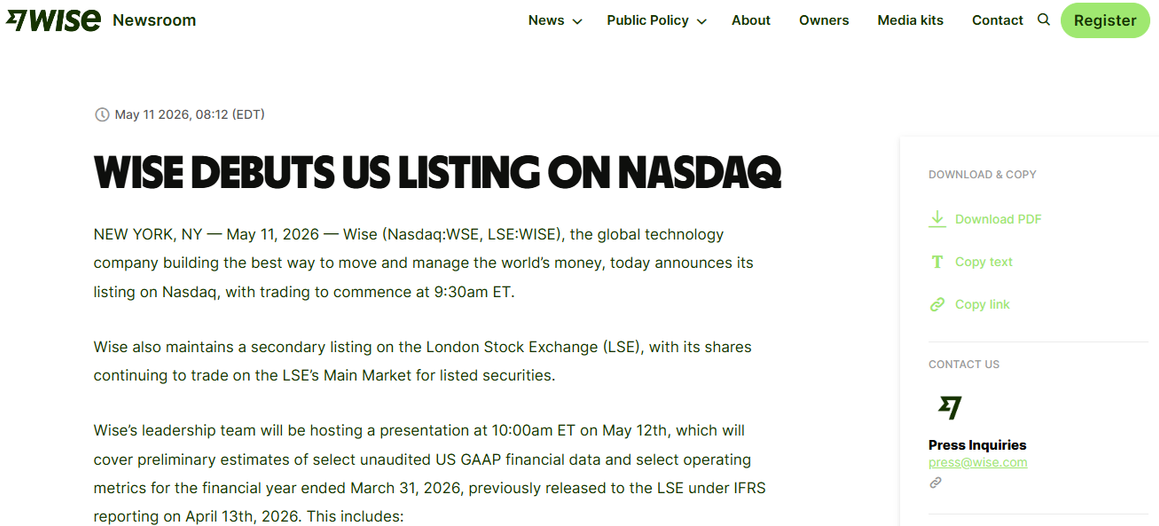
Wise3 has already moved its main stock listing from London to Nasdaq, and it processed 243 billion dollars in cross-border volume last fiscal year, up 31 percent, serving 18.9 million active customers.
That is the growth story. Here is the other one, running in parallel, mostly out of view. In July 2025, six state financial regulators, New York, California, Massachusetts, Texas, Minnesota, and Nebraska, hit Wise US with a coordinated enforcement action. As stated by DFPI4, the states secured a $4.2 million settlement after finding Wise’s Bank Secrecy Act and anti-money-laundering program inadequate. New York’s Superintendent of Financial Services, Adrienne Harris, framed it as routine oversight of a money transmitter, but the mechanics of the settlement tell a fuller story. Wise agreed to a lookback review of previously closed accounts, tighter suspicious activity reporting, stronger due diligence procedures, and better systems for data integrity around customer accounts, all verified by an independent third party and reported quarterly to regulators for two years. California’s share of the penalty came to $700,000, and the state’s press release noted this followed a similar multistate settlement with Block, Inc. only months earlier, which tells you this is not an isolated case of one company falling short. It is a pattern regulators are actively hunting for across the fintech sector.
American Banker5 reported that examiners found the deficiencies dated back to a review period between July 2022 and September 2023, and that the fine landed just as Wise was pursuing a US banking license. Read that timing again. A company found wanting on anti-money-laundering controls is simultaneously asking federal regulators to trust it with direct access to the Federal Reserve’s payment rails. The irony writes itself, but the practical consequence for small business owners is less funny. When a company is under a consent order requiring it to look back at closed accounts and tighten suspicious activity reporting, the accounts still open feel that pressure too. Compliance teams do not relax after a settlement. They tighten.
What the Freeze Looks Like From the Inside
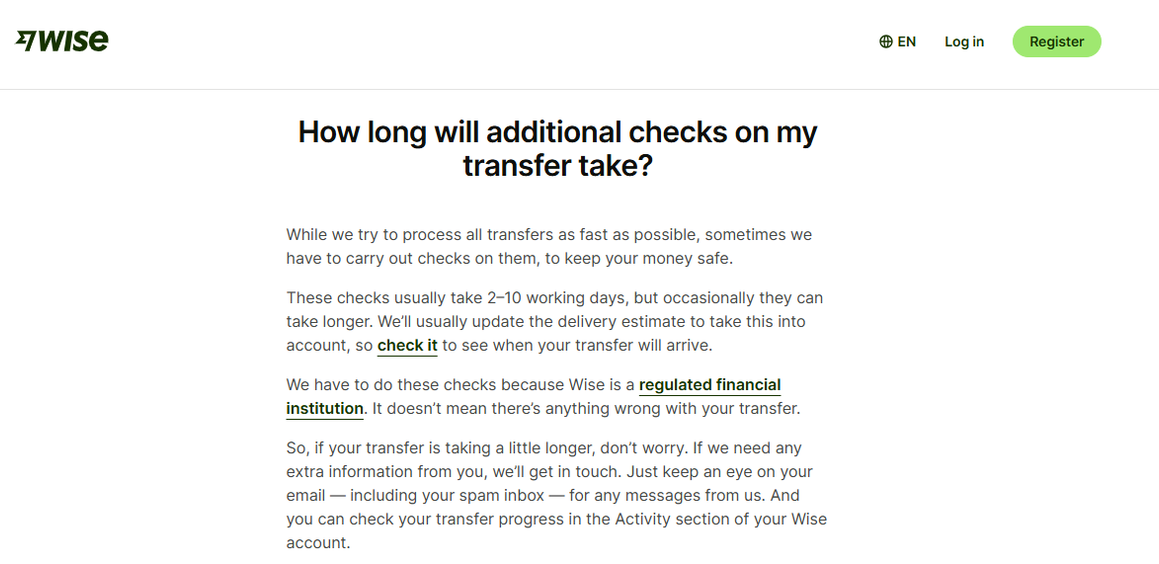
I want to walk through what actually happens, because the language Wise uses in public is careful in a way that tells you something. The company’s help center describes delays in gentle terms. Additional checks usually take between 2 and 10 working days, occasionally longer, and Wise6 says the checks don’t mean anything is wrong with your transfer. That is the official line. It is also, based on the volume of complaints filed against the company, not the whole story.
Consider the case documented in a September 2025 legal advisory from a European consumer conflict management firm. A business account was closed and roughly $4,000 in funds initially retained, with Wise citing due diligence checks that were expected to take around 60 working days. Sixty working days is three months. For a small business paying rent, payroll, or suppliers out of that account, three months is not a delay. It is an existential threat. The same advisory catalogued five separate Better Business Bureau complaints from the summer of 2025, and the pattern across them is almost mechanical.
An account gets blocked after the first salary payment lands and the customer has to fight to arrange a refund. A business account closes with no response and Wise eventually refers the customer to the European arbitration body, offering a goodwill gesture of 30 dollars on a much larger dispute. Unauthorized card transactions get disputed, the account closes, and Wise cites regulatory reasons without further explanation. An account closes with no explanation beyond a reference to the terms and conditions. Five different businesses, five different transaction histories, and nearly identical outcomes.
The BBB7 complaints filed directly against Wise US read the same way. One business owner described a $350 international transfer to family members abroad that Wise held for over a week, during which the compliance team asked for the same information twice, adding delay on top of delay, before telling the customer it would take up to five more days to process.
One user wrote:
I have been a Wise (and TransferWise) customer since 2019. I’m extremely disappointed because today my personal Wise account was closed, without reason and my appeal was automatically denied. Wise has been a company that I’ve recommended to other people,so I am very upset. This is particularly alarming because I have not done anything that could possibly trigger an account closure, and I will illustrate below with complete transparency to make this CLEAR that I have not done anything wrong nor violate any terms! I pushed/transferred $2500 from my personal checking account into Wise on 7/29/26.
Another owner, the one with the photographic chemicals, wrote that Wise restricted the account, cancelled the transfer, and refused to issue a refund despite repeated requests and supporting documentation, with the account scheduled for closure while the money sat unreturned. A third case involved a payment where the beneficiary bank had already confirmed receipt of the funds through official reference numbers, yet Wise’s own dashboard mislabeled the transfer as completed, which the customer said prevented the company’s automated reconciliation system from releasing a manual return, leaving the account holder to invoke commercial banking law in a consumer complaint just to be heard.
A different complaint stated:
Wise deactivated my account mid-transaction without explanation… I did not violate ToS in any way and broke no laws. My money is clearly sourced from legitimate employment and all funds are sent to friends or family I have met in person.
I don’t think these people are lying. I don’t think Wise is either, not exactly. What I think is happening is a company scaled past the size where a compliance team can look at each flagged account and use judgment. The flags fire, the account locks, and a queue forms. You are not being punished. You are being processed.
If you want the rawest version of this story, skip the corporate blog and go to the forums where small business owners actually compare notes. On OffshoreCorpTalk8, a message board built for entrepreneurs navigating offshore banking and cross-border compliance, the Wise threads read like group therapy. One poster summed up a widely shared theory about who gets caught in these freezes. Most people don’t actually understand what they’ve done wrong, or how high risk their profile is based on their passport, their activity, or their residency, and the poster argued Wise should tell customers their risk category before locking them out rather than after. Another user pushed back harder, arguing Wise’s own employees wield too much power, the automation is excessive, and the company flags accounts seemingly at random, even for low-risk European businesses that had done nothing unusual.
One recurring theory on that board deserves real attention because it matches the regulatory record almost exactly. A poster described what they saw as Wise’s onboarding strategy.The company makes it easy to open an account with minimal friction, then scrutinizes and freezes it once a meaningful amount of money starts coming in. That same poster mentioned Wise’s unusually strict policies around crypto-adjacent activity and described watching a personal account get frozen for months over a transfer of a few thousand dollars to their own account in Puerto Rico. Their conclusion was blunt. If you can open an account with Wise, you can probably open one with a comparable EMI like Amnis or WorldFirst, and those platforms are less likely to lock you out without warning.
Another exchange on the same forum pointed at something structural. A user argued that Wise is exploiting its position in the electronic money institution market by attracting new customers with minimal know-your-customer requirements and fast verification, only to block accounts and investigate them in detail afterward, once the customer no longer fits the risk profile Wise is willing to carry. Whether or not you buy the framing of exploitation, the sequence described, easy onboarding followed by retroactive scrutiny, lines up with what regulators found in the multistate settlement. A company under pressure to tighten its anti-money-laundering program does not necessarily tighten its front door. It is often cheaper and faster to tighten the back end, flagging accounts after the money has already arrived.
A second thread on the same forum, focused specifically on account closures rather than freezes, documented a case where a business owner had never even been asked for a source of funds. Their business was a straightforward e-commerce operation, but Wise closed every account connected to a nominee director who had been listed on a separate company that engaged in improper activity, sweeping in unrelated accounts through simple association. The thread’s moderators, describing the pattern across dozens of similar posts, summarized it this way. Accounts are closed suddenly without prior warning, appeals get rejected with limited explanation, remaining balances take a long time to release, and customers are sometimes asked to withdraw funds to third-party accounts instead of their own. That last detail, the request to redirect funds to a third party, is the kind of thing that should make any small business owner’s stomach drop, since it inverts the entire logic of a fraud check. The very same forum offered a plainer, more cynical read from one user responding to a case where funds sat unreturned with no legal basis. The user argued Wise was holding money it had no entitlement to hold, since there was no third-party hold or freeze order attached to the account, only Wise’s own internal review.
The Reviews Tell the Same Story
Trustpilot is a strange archive. It holds five-star raves about exchange rates sitting two inches above accounts of businesses locked out of their own payroll. Wise’s overall rating stays high, around 4.3 out of 5 across more than 250,000 reviews, and most of that reputation is earned. The transfers really are fast. The rates really are close to the mid-market number. But scroll long enough and the freeze stories accumulate their own gravity.
One business owner, writing from what reads like genuine confusion rather than anger, described their company’s experience plainly. Their company used a Wise Business account for international transactions, understood and respected Wise’s AML and KYC obligations, and responded promptly to every document request, including invoices, supporting documents, payment confirmations, and explanations of business relationships. Despite full cooperation, the verification process dragged on for weeks with repeated requests for information already provided, and during that stretch the account’s functionality was restricted and incoming customer payments were not credited. That is the part that should sting anyone running a business on thin margins. It is not just that your funds are frozen. Your customers’ payments to you stop registering, which means from the outside, to the people paying you, it looks like your business has stopped working.
Another reviewer described a business account blocked mid-review with no defined endpoint. The account was blocked during an undefined verification process, leaving the business unable to access its own funds or make supplier payments. Wise’s response, posted publicly under the review, leaned on the same language the help center uses. The company said it understood how frustrating a restriction is, especially with supplier payments and operational funds at stake, but explained that as a regulated financial institution it is legally required to run periodic security and verification checks, while promising to move as quickly as possible and to reach out directly if specific documents were needed. I believe that Wise means this sincerely. I also think sincerity and adequacy are not the same thing when a supplier is waiting on a wire and the business owner has no timeline to give them.
A review aggregator that analyzed the broader Trustpilot and Capterra sentiment landscape around Wise Business summed up the tension well. Users highlight the ease of sending and receiving international payments, fast transfers, and transparent fees, but common complaints center on sudden account freezes and limited support when issues arise, particularly for business users facing urgent payment problems. On Capterra specifically, reviewers describe unexpected account freezes, delayed fund access, and difficult customer support interactions as the dominant negative theme, with one reviewer, a COO at a small company, writing that they had been asking for help for over a week while support sent generic template responses, apparently not registering that being locked out of a business bank account for that long is simply unacceptable.
Consumer Affairs9 carries a review that captures the emotional arc better than any regulatory filing could. The reviewer described Wise’s holds as a kind of bait and switch built into the business model itself. The company happily takes fees upfront but freezes funds the moment they land in the system, describing the security checks as a standard tactic to hold customer capital for days without a specific reason or a human being to speak with, calling the process a predatory hold on legitimate transfers dressed up as protection. That reviewer’s closing verdict was simple. Wise is no longer the reliable disruptor it once was, but a bloated, automated system hiding behind regulatory language to justify holding customer money when it matters most.
I don’t fully agree with that framing, not because I think it’s dishonest, but because I think it flattens something that deserves more nuance. Wise is not hiding behind regulation. It is genuinely subject to it, more so now than before the multistate settlement. The problem is that regulation written to catch money launderers does not distinguish well between a criminal enterprise and a photography supply importer in Texas.
The Ombudsman’s math
For a more formal look at how these disputes resolve, the UK’s Financial Ombudsman Service has ruled on cases where customers challenged Wise’s compliance holds directly. In one decision, a customer argued that Wise’s own terms should have let him cancel a payment before conversion, even while a compliance check was underway, and that Wise’s system failed to honor that right. The Ombudsman10 noted that Wise’s terms allow verification checks to extend processing time, but the same terms let a customer cancel a payment order before the funds convert, and in this case Wise’s system restrictions prevented that right from being honored.
The ombudsman ultimately sided partly with the customer, but the reasoning matters more than the outcome. The ombudsman found that financial businesses like Wise, being strictly regulated in the UK, carry overriding legal obligations, including ensuring no sanctions are breached, and that these obligations take precedence over the general timeframes customers might otherwise expect for their payments to process. The customer was awarded 75 pounds for distress and inconvenience. Seventy five pounds, for a delayed international payment and the anxiety of not knowing if it would arrive at all.
That is what a formal, ombudsman-sanctioned remedy looks like for the person on the other end of one of these holds. It is not nothing. It is also not much.
Why This Keeps Happening
Wise is not a bad actor in the way that word usually gets used. It is not scamming people, and the vast majority of its transfers move exactly as advertised, fast and cheap. What Wise is, instead, is a company caught in the gap between two identities. It markets itself and increasingly structures itself like a bank, complete with an OCC application seeking direct Federal Reserve access, but it operates the compliance infrastructure of an electronic money institution that has already been fined once this year for falling short on anti-money-laundering controls. A parallel remediation effort in Europe, driven by the National Bank of Belgium after what the Financial Times described as a large-scale failure to collect proof of address documentation, has produced the same downstream effect, a wave of EU-wide account suspensions tied to compliance catch-up. Two continents, two regulators, one shared consequence for the customer. When a company is told by regulators to tighten its house, the tightening does not land evenly. It lands hardest on the accounts that already look slightly unusual, the ones with irregular deposit patterns, the ones tied to industries regulators consider higher risk, the ones connected by a shared director or a shared IP address to something else entirely.
The frustrating part, the part that keeps showing up across BBB filings, Trustpilot reviews, and OffshoreCorpTalk threads, is the silence. Not the freeze itself, which most business owners seem to accept as a cost of doing business with a regulated fintech, but the refusal to explain. Wise’s own customer agreement and its public statements to the press consistently invoke regulatory obligation as the reason it cannot say more. That may well be true in a narrow legal sense. Anti-money-laundering law genuinely restricts what a financial institution can tell a customer about an active investigation, since tipping someone off can compromise a suspicious activity report. But there is a wide gulf between what the law requires and what a company chooses to disclose, and Wise, like most fintechs operating at this scale, has generally chosen the minimum.
If you are running a small business on a Wise account right now, the advice that emerges from all of this is not complicated, even if it is unsatisfying. Keep only what you need for operations in the account. Diversify across at least one other provider, whether that is a traditional bank or another EMI, so a freeze at one institution does not stop your business entirely. Respond immediately and completely to any document request, even if it feels redundant, since the BBB and ombudsman records both show that slow or partial responses extend the review far longer than the stated 2 to 10 day window. And if a freeze does happen, document everything, because the paper trail is what eventually moves these cases, whether toward a regulator like the CFPB and state financial regulators in the US, or Ombudsfin and the Financial Ombudsman Service in Europe and the UK.
None of that fixes the underlying problem, though. The underlying problem is that a company built its entire brand promise on speed and now finds itself, at the very moment it is trying to become something closer to a real bank, unable to guarantee the one thing that made people trust it in the first place. Money that is yours, until, for reasons a compliance algorithm decided and a support agent cannot explain, it isn’t.
Sources
- Better Business Bureau, www.bbb.org/us/ny/new-york/profile/money-transfers/wise-us-inc-0121-166054/complaints?page=2. Accessed 8 Sept. 2026. ↩︎
- Langbridge, Lauren. “Why exceptional payment experiences are vital for US financial service providers” Wise, 19 Dec. 2024, wise.com/gb/blog/instant-global-payments. Accessed 8 Sept. 2026. ↩︎
- Wise, newsroom.wise.com/en-NAM/265506-wise-debuts-us-listing-on-nasdaq/. Accessed 5 Sept. 2026. ↩︎
- “California Joins $4.2 Million Multistate Enforcement Action Against Wise US, Inc. for BSA/AML Violations” DFPI, 9 July 2025, dfpi.ca.gov/press_release/california-joins-4-2-million-multistate-enforcement-action-against-wise-us-inc-for-bsa-aml-violations/. Accessed 5 Sept. 2026. ↩︎
- American Banker, www.americanbanker.com/payments/news/wise-fined-4-2-million-for-multi-state-compliance-lapses. Accessed 5 Sept. 2026. ↩︎
- “How long will additional checks on my transfer take?” Wise Help Centre, wise.com/help/articles/2977963/how-long-will-additional-checks-on-my-transfer-take. Accessed 5 Sept. 2026. ↩︎
- BBB, Better Business Bureau, www.bbb.org/us/ny/new-york/profile/money-transfers/wise-us-inc-0121-166054/complaints. Accessed 5 Sept. 2026. ↩︎
- OffshoreCorpTalk, www.offshorecorptalk.com/threads/wise-business-account-in-2026-real-user-experience-setup-and-compliance-guide.49388/. Accessed 5 Sept. 2026. ↩︎
- Consumer Affairs, www.consumeraffairs.com/finance/transferwise.html. Accessed 8 Sept. 2026. ↩︎
- Service, Financial Ombudsman. “Decision Reference DRN-4057115” 6 Oct. 2023, www.financial-ombudsman.org.uk/decision/www.financial-ombudsman.org.uk/decision/DRN-4057115.pdf. Accessed 5 Sept. 2026. ↩︎