


Over the past year, I began noticing a recurring pattern in conversations with recruiters across industries. It did not surface as a formal complaint or a widely discussed issue, but rather as a consistent observation. Outreach that once performed reliably would begin to decline without any clear change in strategy. Response rates would fall, and over time, so would the effectiveness of InMail as a channel.
At first glance, this looks like a normal fluctuation. Hiring markets shift. Candidate behavior evolves. Message quality varies. But when the same pattern repeats across geographies, company sizes, and experience levels, it suggests something more structural.
This article examines what many recruiters informally describe as “InMail throttling” on LinkedIn. It is not an official term, and LinkedIn does not publicly frame it this way. However, the mechanics of the platform, combined with recruiter experiences and available documentation, point to a feedback system where response rates influence future reach. The effect is subtle, but its implications for hiring are significant.
The Mechanics Behind InMail
LinkedIn’s InMail product was built to address a structural limitation in hiring. Traditional recruiting channels depend heavily on inbound interest. Candidates apply, recruiters respond, and the process unfolds within a visible pipeline. That model breaks down when hiring depends on passive talent, which in many industries represents the majority of qualified candidates.
InMail effectively repositioned LinkedIn from a static professional directory into an active sourcing platform. It gave recruiters a sanctioned way to initiate conversations with people who had not expressed explicit interest. The framing mattered. Unlike cold email, which often feels intrusive or transactional, InMail operates within a professional context where outreach is expected, even if not always welcomed.
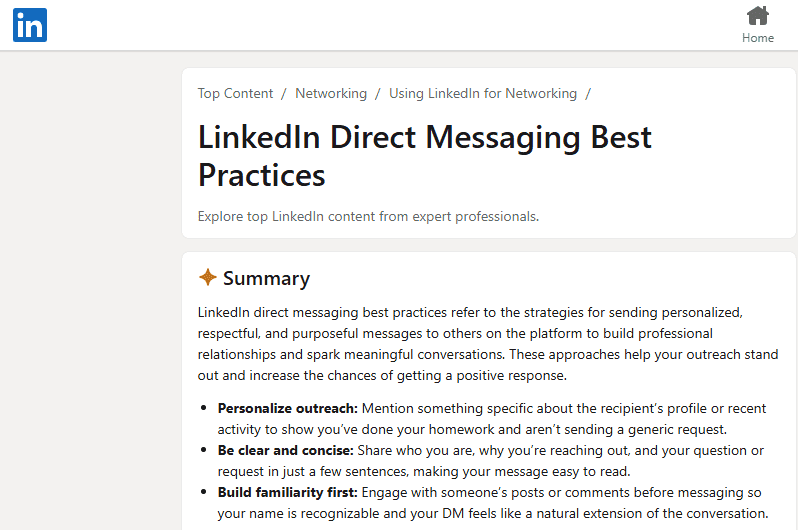
LinkedIn has consistently reinforced this positioning in its own guidance. The company emphasizes that effective InMails are concise, personalized, and clearly tied to the recipient’s experience or interests. According to LinkedIn’s1 published best practices, messages that demonstrate relevance and intent are significantly more likely to receive responses.
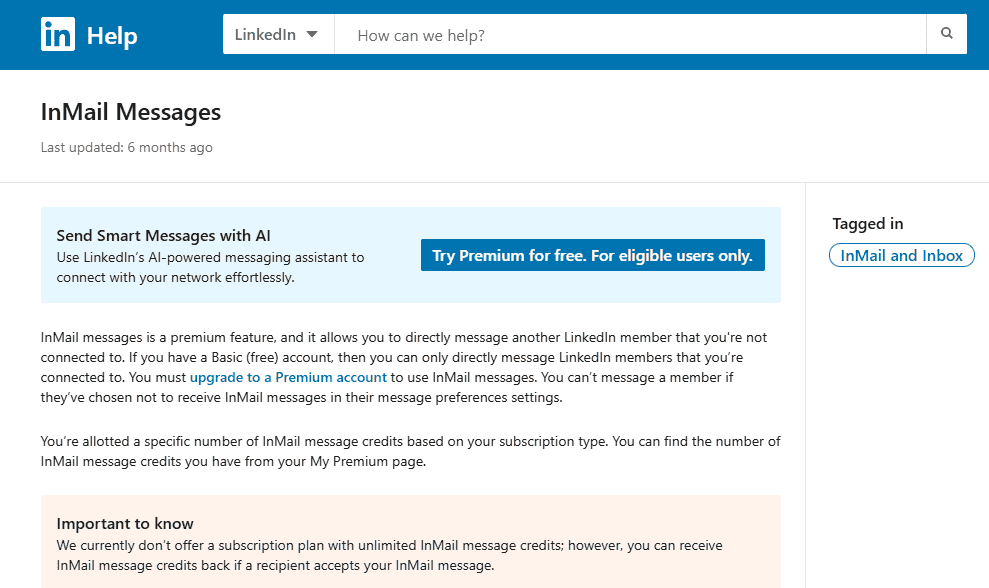
What makes InMail distinct is not just the ability to send messages, but the economic model behind it. The system is governed by credits, which function as both a limit and a feedback mechanism. Recruiters receive a fixed number of credits based on their subscription tier. According to LinkedIn2, each message sent consumes one credit, but if the recipient responds within a 90-day window, that credit is returned.
At a basic level, this creates a self-regulating loop. High-quality outreach sustains itself because responses replenish credits. Low-quality outreach depletes the available pool. Over time, this encourages recruiters to be more selective and thoughtful in their messaging.
However, in practice, this system does more than enforce discipline. It introduces a form of performance-based access. Recruiters who consistently receive responses maintain their ability to reach candidates at scale. Those who do not gradually lose that capacity, even if their overall credit allocation remains unchanged month to month.
There is also a subtle behavioral shift embedded in this design. Because credits are tied to responses rather than outcomes like hires or interviews, the system optimizes for engagement rather than hiring efficiency. A message that receives a quick reply but leads nowhere is still rewarded. A message that is ignored but might have been relevant at a different time is penalized. Over time, this can shape how recruiters prioritize candidates and craft outreach.
On the surface, the mechanics appear simple and even elegant. But they are only one part of a broader system that determines how messages are distributed and received.
Response Rates as a Performance Signal
LinkedIn provides general benchmarks to help recruiters evaluate their performance. According to Closely3, a response rate between 18 percent and 25 percent is often cited as a healthy range, though this varies significantly depending on industry, geography, and role type.
These benchmarks serve as a reference point, but they do not fully explain how the platform reacts when performance falls below them. There is no explicit threshold where access is reduced or privileges are revoked. Instead, the impact appears to be gradual and cumulative.
In conversations with recruiters, a consistent pattern emerges. As response rates decline, the effectiveness of outreach decreases in ways that are not fully explained by credit loss alone. Messages that previously generated replies begin to underperform. Targeting similar candidate profiles yields fewer responses. Even after improving message quality, recovery is often partial and slow.
This suggests that response rate functions as more than a simple metric. It likely acts as a signal within LinkedIn’s internal systems, influencing how messages are treated after they are sent. While the exact mechanics are not publicly documented, the behavior aligns with common practices in large-scale platforms where engagement data informs distribution and prioritization.
One way to understand this is to look at how LinkedIn handles content in other parts of the platform. Its feed ranking system relies heavily on engagement signals such as clicks, comments, and shares to determine visibility.
Although InMail operates in a private messaging context, the same principle can apply. Messages from senders with strong engagement histories are more likely to be surfaced prominently or delivered in a way that encourages attention. Messages from senders with weaker engagement may be deprioritized, whether through subtle interface changes, notification timing, or other mechanisms that influence visibility.
From LinkedIn’s perspective, this approach is rational. The platform must balance the needs of recruiters with the experience of its broader user base. If members are overwhelmed by irrelevant outreach, they are less likely to engage with the platform overall. By using response rate as a proxy for message quality, LinkedIn can filter out lower-relevance interactions without explicitly restricting access.
However, this creates a feedback loop that is difficult for recruiters to see or control. A decline in response rate does not just reduce available credits. It may also reduce the likelihood that future messages are noticed or engaged with. This compounds the initial drop in performance, making recovery more challenging.
Another layer of complexity is that the response rate itself is influenced by factors outside the recruiter’s control. Brand recognition, role attractiveness, timing, and even broader market conditions all play a role. A recruiter working for a well-known company during a hiring boom is likely to see higher response rates than one working for an unknown firm during a slowdown. Yet both are evaluated through the same metric.
This raises an important question about how performance is measured and interpreted. If response rate is used as a signal of quality, but is also shaped by external variables, then it becomes an imperfect proxy. Over time, relying heavily on this signal can reinforce existing advantages and make it harder for certain recruiters or organizations to compete on equal footing.
In this sense, response rate operates as both a metric and a gatekeeper. It reflects how candidates engage with outreach, but it also influences how much opportunity a recruiter has to engage in the future. The line between measurement and control becomes blurred, and that is where the concept of throttling begins to take shape, even if it is never formally defined.
To better understand this dynamic, I looked for remarks from recruiters working in technology, financial services, and healthcare. While their contexts differed, their experiences followed a similar trajectory.
Initial outreach efforts tended to perform well, particularly when targeting in-demand roles or well-known companies. Over time, as outreach scaled, response rates declined. Once those rates dropped below a certain threshold, recruiters reported that their messages appeared to generate significantly fewer replies, even when targeting comparable candidate profiles.
One recruiter described the shift as gradual but noticeable. Outreach that once yielded steady responses became inconsistent and eventually unreliable. Another recruiter in Toronto noted that even after revising messaging strategies, it was difficult to return to earlier levels of engagement.
These observations are not limited to private conversations. On public forums such as Reddit, similar experiences are discussed openly. In one thread, a user commented:
“Once your response rate drops, it becomes much harder to get replies, even if you improve your messages later.”
Another discussion highlighted operational adaptations:
“We monitor response rates closely and adjust outreach between team members to maintain performance.”
The Hidden Structural Divide in LinkedIn Recruiting — And Why It Matters
One of the most consequential and least discussed dynamics on LinkedIn is how the platform quietly distributes opportunity unevenly across recruiters and organizations. The mechanics are not written into any policy. They emerge organically from the interaction of system design and human behavior. And once you understand the pattern, it is difficult to unsee.
Recruiters representing well-known companies enter every InMail campaign with a structural head start. According to DSMN84, companies that invest in employer branding are three times more likely to make quality hires, and that gravitational pull begins long before an offer is extended. It begins the moment a candidate sees who is reaching out. For expample, Vouchfor5 states that 83% of job seekers research a company’s reviews and ratings before deciding where to apply, which means brand perception is already shaping engagement before a recruiter even hits send.
This translates directly into measurable response rate differences. Sales So6 reports that LinkedIn InMail achieves response rates between 18 and 25% on average, but that average conceals enormous variance driven by employer brand strength. A recognizable company name signals credibility and career value. An unfamiliar one triggers hesitation, particularly among passive candidates who have no pressing reason to engage.
The downstream effects compound quickly. On LinkedIn Recruiter, response rates are not just a vanity metric. They feed directly into credit replenishment and, potentially, algorithmic visibility. Recruiters with strong engagement sustain their outreach capacity. Those with lower rates watch their effective reach narrow, independent of how thoughtfully they craft their messages. According to Belkins7 Including a personalized message in a connection request boosts reply rates from 5.44% to 9.36%, yet even that meaningful lift may not fully offset the disadvantage of working with a lesser-known brand.
The result is a form of cumulative advantage operating beneath the surface. LinkedIn’s8 own Future of Recruiting research underscores the crucial role of employer branding, finding that companies known for delivering on candidate priorities are more likely to make quality hires, which reinforces the loop where strong brands attract stronger signals and in turn sustain stronger platform access.
For talent acquisition professionals at emerging or lesser-known organizations, this is not merely an inconvenience. Employers with a weaker brand report cost-per-hire that is almost double those with a strong brand, and the difficulty compounds when outreach itself becomes harder to sustain.
The structural constraint is real, but it is also navigable. Investing in employer brand, prioritizing personalization, and building credibility through content before launching outreach campaigns are levers that smaller organizations can pull. What matters is recognizing that the playing field is not level by design. It is shaped by a system that rewards prior success, and understanding that dynamic is the first step toward competing on it deliberately.
Candidate Behavior and Attention Constraints
Any analysis of InMail performance must also account for the realities of candidate behavior. Professionals today operate in an environment of constant communication. Email, messaging platforms, and social networks all compete for attention, often within the same workday.
Data from the Radicati Group9 estimates that the average professional receives more than 120 emails per day, a figure that continues to grow over time.
Although InMail exists within LinkedIn rather than traditional email, it competes for the same cognitive resources. Candidates must quickly assess incoming messages and decide where to allocate their limited attention. This process is often fast and heuristic-driven, relying on cues such as sender identity, subject relevance, and perceived effort.
Timing also plays a role. Martal Group10 shows how a well-crafted message sent at the wrong moment may go unnoticed, while a simpler message that arrives when a candidate is actively browsing LinkedIn may receive a response. These variables introduce a level of randomness that is difficult for recruiters to control.
Importantly, non-response is not always a reflection of message quality or job fit. It often reflects prioritization. Candidates may intend to reply later and never do. They may overlook a message entirely. Or they may choose not to engage simply due to time constraints.
However, the system interprets all non-responses in a similar way. LinkedIn’s11 report rate analysis shows how each unanswered message contributes to a lower response rate, which then feeds back into the recruiter’s performance metrics. This creates a disconnect between intent and signal. What is, from the candidate’s perspective, a neutral decision becomes, from the system’s perspective, a negative indicator.
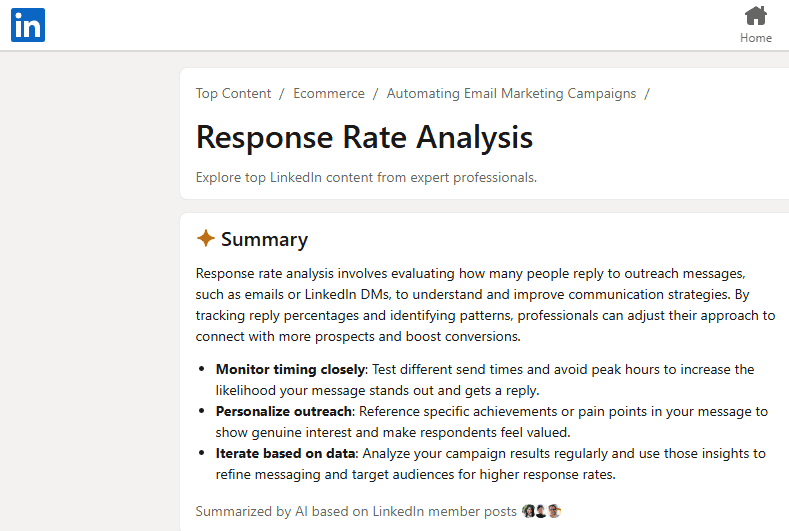
Over time, this aggregation of small, individual decisions shapes the broader dynamics of the platform. Recruiters adjust their behavior in response to declining metrics, while the system continues to optimize for engagement. The result is a tightly coupled loop where human attention and algorithmic interpretation continuously influence each other.
Adaptation, Transparency, and the Shaping of Hiring Outcomes
As recruiters begin to recognize these constraints, their behavior adapts in ways that are both practical and revealing. What starts as an effort to improve response rates often evolves into a broader attempt to navigate a system that is only partially visible.
Personalization is usually the first and most immediate response. Recruiters invest more time in researching candidates, referencing specific experience, and tailoring messages to signal relevance. In many cases, this does improve response rates. Candidates are more likely to engage when outreach feels intentional rather than generic. However, the trade-off is clear. Personalization reduces scale. What was once a high-volume channel becomes more selective and time-intensive, forcing teams to reconsider how they allocate effort across roles.
Beyond personalization, many teams begin to experiment more systematically. Message length, tone, subject lines, and call-to-action structure are tested and refined. Some recruiters track open rates and response patterns over time, treating outreach almost like a marketing funnel. Timing also becomes a variable. Messages sent during certain days or hours may perform better, though results are often inconsistent and highly context-dependent.
These adjustments reflect an underlying shift in mindset. Outreach is no longer just about matching candidates to roles. It becomes an exercise in optimizing for engagement within a constrained system. The goal is not only to find the right person, but to ensure that the message itself generates a measurable response.
In more pressured environments, adaptation can move into less formal territory. Some organizations quietly redistribute outreach across multiple recruiter accounts to maintain higher average response rates. Others experiment with rotating ownership of candidate pools or limiting activity on accounts that have seen declining engagement. These practices are rarely documented and may conflict with platform policies. Yet their existence points to a deeper issue. When access is tied to performance signals that are not fully understood, users begin to reverse engineer the system through trial and error.
This brings the question of transparency into sharper focus. Recruiters generally understand that response rates matter, but the extent to which those rates influence future reach remains unclear. There is no direct visibility into how messages are prioritized, how sender reputation evolves, or how long it takes to recover from a period of low engagement.
Greater transparency could, in theory, improve outcomes. More detailed analytics on message performance, clearer benchmarks across industries, or even guidance on how to rebuild response rates after a decline would allow recruiters to make more informed decisions. It would also reduce the reliance on anecdotal strategies and informal workarounds.
At the same time, complete transparency presents its own challenges. Platforms like LinkedIn must protect against manipulation. If ranking mechanisms were fully exposed, it could lead to behavior designed to exploit the system rather than improve genuine relevance. This tension between clarity and control is not unique to LinkedIn, but it is particularly visible in a context where professional opportunity is at stake.
The cumulative effect of these dynamics extends well beyond recruiter workflows. It shapes the composition of hiring pipelines in ways that are subtle but meaningful. Candidates who are more likely to respond, whether due to availability, interest, or familiarity with the hiring company, become more visible within the system. Their engagement reinforces the signals that drive further outreach.
Conversely, candidates who are less responsive, even if they are equally or more qualified, may gradually fall out of view. This does not happen through explicit exclusion, but through the aggregation of small signals. Each missed reply slightly lowers a recruiter’s response rate. Each decline in response rate slightly reduces future reach. Over time, these effects compound.
Companies are affected in similar ways. Organizations with strong employer brands benefit from higher engagement, which sustains their access to talent. Smaller or lesser-known companies face a more constrained environment, where breaking through requires not only strong roles and messaging but also sustained engagement performance.
What emerges is a form of bias rooted not in qualifications, but in interaction patterns. The system rewards responsiveness and familiarity, which are not always aligned with skill or fit. While this may be an unintended consequence of optimizing for user experience, it has real implications for how opportunities are distributed.
In this context, LinkedIn’s InMail system functions as more than a communication tool. It becomes an active participant in shaping hiring outcomes. Recruiters adapt to it, candidates respond within it, and the platform continuously recalibrates based on those interactions. The result is a dynamic system where visibility is earned, maintained, and sometimes quietly reduced, all through signals that are only partially understood by the people using it.
LinkedIn’s InMail system remains a powerful tool for connecting recruiters and candidates. Its design encourages relevance and discourages spam, which benefits the overall ecosystem.
However, the interaction between response rates, credit systems, and algorithmic prioritization creates a feedback loop that is not always visible to users. Recruiters who fall below certain performance thresholds may find their reach constrained, even as they attempt to improve.
Understanding this dynamic is essential for teams that rely on LinkedIn as a primary sourcing channel. It also raises important questions about transparency, fairness, and the role of platform design in shaping access to opportunity.
The system does not need to explicitly limit outreach to create a ceiling. The combination of incentives and signals is enough to produce one.
Sources
- “LinkedIn Direct Messaging Best Practices” www.linkedin.com/top-content/networking/using-linkedin-for-networking/linkedin-direct-messaging-best-practices/. Accessed 19 Mar. 2026. ↩︎
- “InMail message credits and renewal process” LinkedIn Help, www.linkedin.com/help/linkedin/answer/a543695/inmail-message-credits-and-renewal-process. Accessed 21 Mar. 2026. ↩︎
- Andrews, John. “LinkedIn Outreach Response Rates: Industry Averages and How to Beat Them” Closely, 14 Jan. 2026, blog.closelyhq.com/linkedin-outreach-response-rates-industry-averages-and-how-to-beat-them/. Accessed 20 Mar. 2026. ↩︎
- Neal, Emily. “60+ Employer Branding Statistics You Need To Know” DSMN8, 23 Aug. 2024, dsmn8.com/blog/employer-branding-statistics/. Accessed 21 Mar. 2026. ↩︎
- Zurnamer, Gary. “25 Employer Brand Statistics To Know in 2026: Updated” Vouch, 3 Dec. 2025, www.vouchfor.com/blog/employer-brand-statistics. Accessed 21 Mar. 2026. ↩︎
- Ricci, Sophie. “LinkedIn Recruitment Stats 2026: Key Hiring Trends & Data” Sales So –, 3 Dec. 2025, salesso.com/blog/linkedin-recruitment-statistics/. Accessed 21 Mar. 2026. ↩︎
- “What are B2B LinkedIn Outreach Benchmarks? (2025 Study)” belkins.io/blog/linkedin-outreach-study. Accessed 21 Mar. 2026. ↩︎
- “The Future of Recruiting 2025” LinkedIn, business.linkedin.com/talent-solutions/resources/future-of-recruiting. Accessed 21 Mar. 2026. ↩︎
- Team, Radicati. “The Radicati Group, Inc. » Other » 2014” www.radicati.com/?p=12796. Accessed 21 Mar. 2026. ↩︎
- Pallikaraki, Rachana. “10 LinkedIn InMail Best Practices for B2B Outreach Success in 2026” Martal Group – Martal Group – B2B Lead Generation , 30 Jan. 2026, martal.ca/linkedin-inmail-best-practices-lb/. Accessed 21 Mar. 2026. ↩︎
- “Response Rate Analysis” www.linkedin.com/top-content/ecommerce/automating-email-marketing-campaigns/response-rate-analysis/. Accessed 21 Mar. 2026. ↩︎


