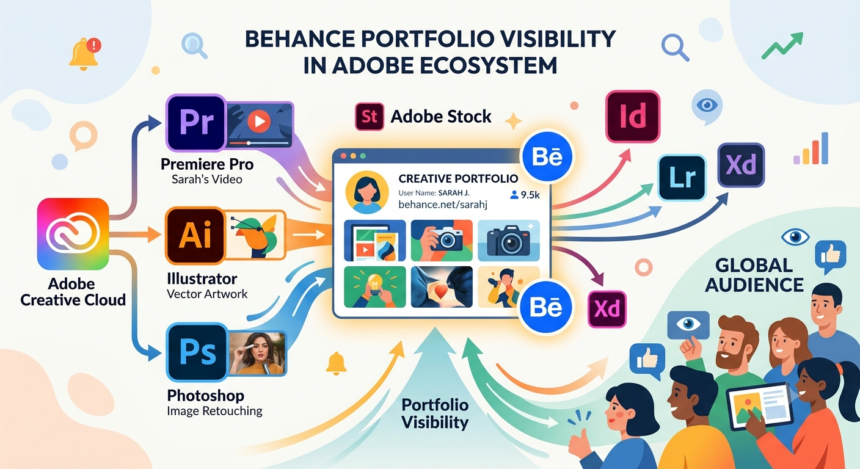

I opened a Behance profile last month that had forty thousand views logged over a decade, a thousand appreciations, work from a small Australian air conditioning company that had been showcasing its branding since 2014. One day the page returned an error. “Oops, we can’t find that page.” No email. No warning. The owner posted to Adobe’s community forum1 begging for help. Nobody from Behance answered.
That story is not rare. It is the plot of Behance in 2026, told over and over by illustrators, motion designers, UX researchers, and photographers who log into the platform expecting the same deal Adobe sold them: post your work, get seen, get hired. The deal still exists. It has just gotten a lot more conditional.
I’ve spent the last few weeks reading through hundreds of complaints on Adobe’s own support forums, on Trustpilot, on design subreddits, and on niche communities like Graphic Design Forum. I’ve read Adobe’s press materials too, the cheerful year-end recaps and the Behance Pro launch copy. Both things are true at once. Behance is still, by member count, the largest creative portfolio network on the internet. And for a meaningful share of the people who use it, their work has become functionally invisible.
A Platform Built on Being Seen
Scott Belsky and Matias Corea founded Behance in November 2005, before it even had outside funding, on a premise that sounds almost naive now: creative people deserved a place to be discovered on the strength of their work rather than their connections. According to TechCrunch2, the company raised its first $6.5 million round in May 2012 from investors including Jeff Bezos’s personal fund. Seven months later Adobe bought the whole thing for more than $150 million in cash and stock, folding a scrappy 32-person startup into a company that was, at that exact moment, engineering the biggest pivot of its own history. Adobe had just launched Creative Cloud. It needed a social layer. Behance was it.
Belsky3 stayed on for years, eventually rising to chief product officer before leaving Adobe in 2023 to join A24.
after 7 years since returning to Adobe (post the acquisition of @Behance), i’ll be shifting gears over the coming months + jumping into the fast-evolving world of filmmaking and storytelling (a longtime passion). excited to join @A24 – an independent studio i have long admired -…
— scott belsky (@scottbelsky) January 30, 2025
In interviews looking back at the deal, he described Behance’s early utility in almost anthropological terms. Members shared not just finished images but the brief, the client, the tools, the thinking behind the work. That context was the product. It was also, not incidentally, a goldmine of user behavior data and a built-in distribution channel for whatever Adobe wanted to sell next.
I don’t think that trade was dishonest. I think it was a trade, and trades have terms, and the terms shifted quietly enough that most users never got a clear look at the new contract.
Where the Views Went
Search Adobe’s4 community forums for “Behance visibility” and you’ll find a genre of post that repeats with eerie consistency. A user describes years of activity, sometimes a decade or more, a sudden drop in views, and total silence from support. One post from November 2025 read simply:
“My recent projects are getting very low views and don’t appear in search or the Discover section, even though I use proper tags, detailed descriptions, and stay active on the platform.”
A community volunteer, not an Adobe employee, told the poster to “ask at the proper place.” The thread ends there.
Another, from September 2024, came from a user named Abdulrahman who had been active on the platform for years.
He wrote:
“I have noticed a significant decline in the visibility and engagement of my portfolio projects, which is unusual compared to the performance of my earlier work.”
He asked whether his account had been flagged. He never got a definitive answer either, at least not one visible in the public thread.
The most striking case I found came from April 2026. A user named luizabola, a paying Behance Pro subscriber, described getting an email from Adobe explaining that her account visibility had been limited because of “suspicious” activity on a project that was receiving an unusually high number of likes. Her work stopped appearing in Explore, Discover, and Search. She said she had never used third-party promotion services. The engagement, she wrote, came from organic shares on her own Instagram and LinkedIn.
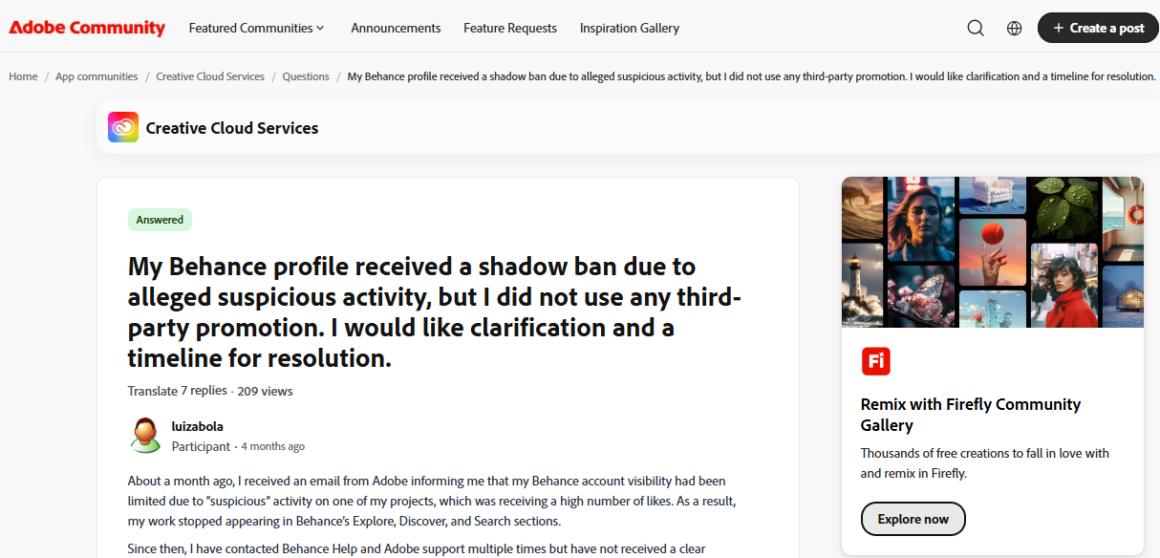
A month went by. No clear explanation. Other users piled into the thread with their own versions of the same story. One, going by alisonfedel, put it bluntly:
“Behance’s lack of support is ridiculous, there’s no human touch, and it feels like there’s a bot handing out shadowbans for no reason. I went months without receiving a single inquiry for no explainable reason, until I had to get aggressive with their support team to finally get things back to normal.”
I want to sit with that phrase for a second. A bot handing out shadowbans. Whether or not that’s literally what’s happening inside Adobe’s trust and safety systems, it’s the mental model users have built to explain their own disappearance. When a platform won’t explain its decisions, people fill the silence with the worst plausible story. That silence is a design choice, even when nobody intended it as one.
The Algorithm Nobody Will Name
Adobe has never published a detailed account of how Behance ranks or surfaces work. What’s public is a kind of folklore, assembled by users comparing notes across forums for over a decade. A 2022 thread on Adobe’s5 own community, titled “Behance and the lack of being featured on the platform,” captured the frustration early.
“It feels like if you do not have a big following then you are destined to never get featured on Behance, no matter what you create,” the original poster wrote. “Or is there an algorithm that is place that we are not aware about?”
A community expert redirected him to Behance’s separate help desk, run on Zendesk, walled off entirely from the forum where the question was asked.
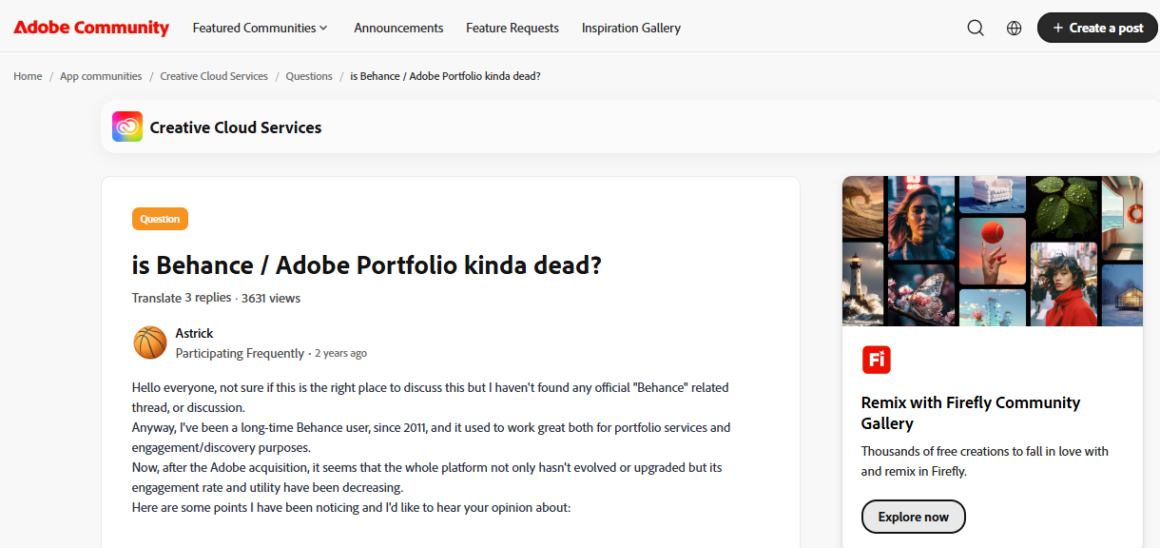
A year later, a longtime member posted a more sweeping diagnosis under the title “is Behance / Adobe Portfolio kinda dead?” He’d been on the platform since 2011. He listed what had eroded since the Adobe acquisition: no more Portfolio Reviews, no more supported local communities, an engagement rate that kept sliding while the product itself sat mostly still.
By 2026, third-party analysts had started quantifying what forum users had been describing anecdotally for years. Inspo AI6, reviewing alternatives to Behance, wrote that the platform “faces growing frustration from designers over a poor search algorithm, low organic visibility for new work, and no AI-driven discovery tools,” adding that “the platform’s algorithm rewards established accounts over fresh talent, search results surface bland corporate work above innovative new voices, and the tool set has not kept pace with how modern designers actually research and build.” That’s a competitor’s blog, so read it with the skepticism you’d read any sales pitch with. But the specific complaint, that new and unestablished creators get buried while big accounts compound their advantage, matches what I found independently in the Adobe forums, the Trustpilot reviews, and the design forums, none of which have any commercial reason to agree with each other.
One Trustpilot7 reviewer described a support interaction that captures the whole dynamic in miniature. “Behance support closed my ticket as ‘Solved’ without answering a single question,” they wrote.
“I asked why my projects receive zero impressions on their platform for years, no explanation was given. Instead of addressing the issue, the representative simply closed the case.”
Another reviewer, describing themselves as a professional designer who’d used Adobe products for over two decades, called their Behance Pro experience “worse than Fiverr.”
Visibility, now sold separately
Here is where the story gets interesting, and where I think the coverage so far has missed the real thesis. Adobe didn’t just let Behance’s organic discovery quietly degrade. It built a paid tier, launched on March 14, 2024, called Behance Pro, that bundles in the exact things creators have been begging for since the acquisition: better analytics, promotional tools, a linked Adobe Portfolio website, a badge that signals seriousness to clients. Creative Bloq8 covered the launch as a potential “game changer,” noting that Pro members would keep all revenue from sales made through the platform with no commission taken.
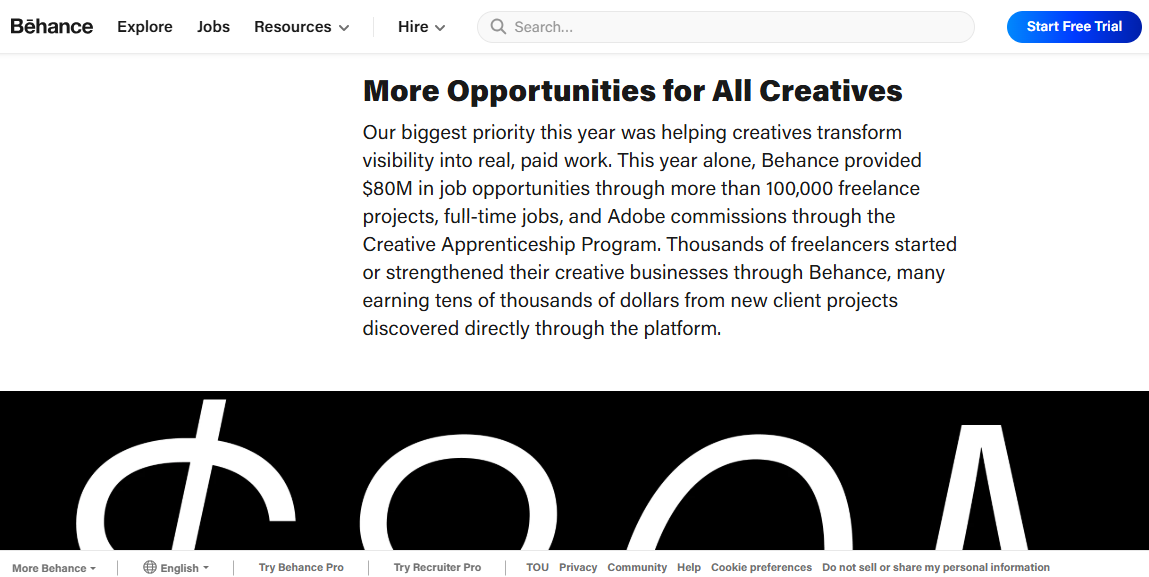
The pitch is not unreasonable on its face. Creators do keep 100 percent of what they earn. Behance’s9 own Year in Review for 2025 claims the platform generated $80 million in job opportunities through more than 100,000 freelance projects, full-time roles, and Adobe-run apprenticeship commissions. One illustrator quoted in that recap, Laurentiu Gabriel Dumitru, said Behance had become more valuable to him than other freelancing platforms combined. Those numbers are real and I have no reason to doubt the individual stories behind them.
But zoom out and a pattern emerges that the encyclopedia-style entry on Grokipedia10 states more plainly than Adobe ever has. Reviewing churn data, it notes that “creators receiving fewer than five views in their first year face 2.5 times higher dropout rates compared to those with over 100 views,” and that Behance Pro’s 2024 launch “has also drawn scrutiny, with users viewing it as a paywall that locks essential tools behind a subscription model.” The tier “bundled advanced analytics and zero platform fees but integrated previously free elements like Adobe Portfolio, prompting concerns over accessibility for non-professional users.”
Read those two facts side by side. New creators who get almost no early visibility are the ones most likely to quit. And the tools that might help a new creator understand why they’re invisible, and do something about it, sit behind a subscription that a struggling newcomer is least equipped to justify. A student posting a thesis project doesn’t yet know whether Behance is worth the investment. The system asks them to pay before it will tell them if anyone is looking.
I don’t think Adobe designed this as a trap. I think it’s what happens when a company inherits a platform whose entire value proposition was free, organic reach, and then needs that platform to generate direct revenue inside a subscription business. The incentive isn’t to make everyone visible. It’s to make visibility itself a graduated resource, free enough to keep the community alive, scarce enough that paying for more of it feels like a rational move. A user on Graphic Design Forum11 summarized the actual mechanics with more clarity than any Adobe marketing page I found:
“Paying for Pro does not push you to the top of searches or feature lists. You still have to put in the hours creating great projects, tagging them well.”
Pro doesn’t buy visibility. It buys the tools to chase visibility that the algorithm may or may not ever grant.
The noise problem
Layered on top of the discovery issue is a newer one. Adobe has spent the last three years pushing generative AI, specifically Firefly, into every corner of its ecosystem, and Behance sits downstream of that push in an uncomfortable way. Behance’s12 own help center FAQ confirms that AI-generated work is welcome on Behance as long as it follows community guidelines, and that Adobe is “exploring automated ways to detect and tag work created using generative AI models.”
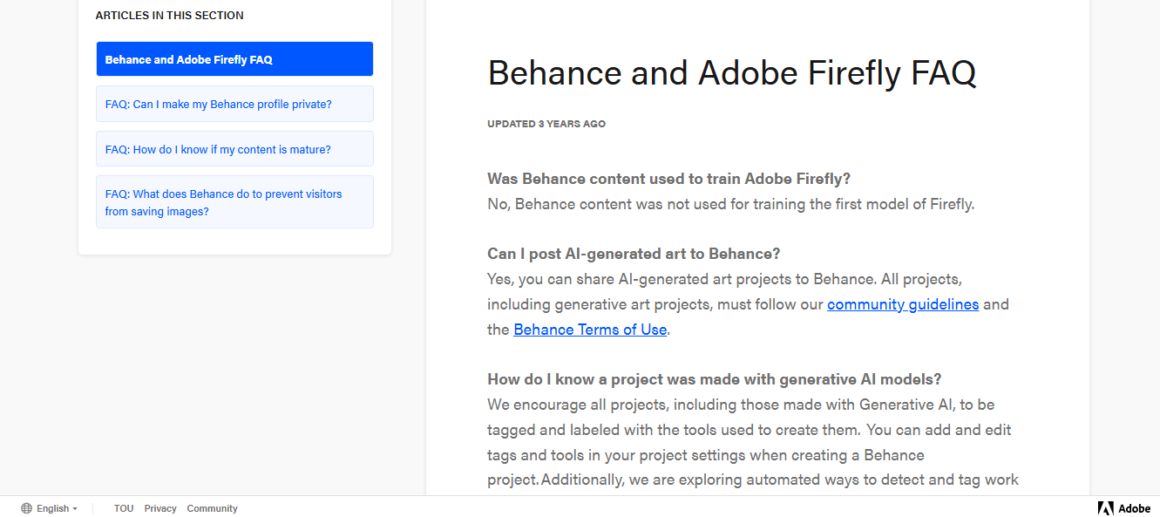
That detection system does not appear to be reliable yet. One illustrator posted to the Adobe community forum13 in genuine distress after Behance’s own content credentials system flagged a hand-drawn poster, built from scanned 35mm film textures, as AI-made. “I feel insulted,” they wrote. They had to strip the metadata and reupload the piece just to get the false flag removed.
Meanwhile, human illustrators worry about the opposite problem, an ocean of AI output crowding the same Explore feed their own portfolios depend on. One essayist, writing under the byline Design Nerd14, framed the anxiety honestly:
“As an artist who’s spent years honing my craft, I get the worries about AI art flooding the platform. But before we hit the panic button, let’s take a breath and explore this from all angles.”
That’s a generous read. Scroll through enough forum complaints and you find a less generous one, from creators who feel like their years of technique are now competing for the same square inch of screen real estate as a five-second prompt.
Where People Are Going Instead
None of this has killed Behance. It has pushed a lot of its most engaged users into a multi-platform strategy that would have seemed redundant a decade ago. A portfolio-strategy guide from late 2025 recommended treating Behance as one node among several, alongside Dribbble, Adobe Portfolio, and a personal site, noting that Dribbble favors quick single-image “shots” while Behance still supports the longer, process-oriented case study format that many designers still consider its real strength.
On Reddit-adjacent forums the sentiment gets blunter. One product designer, answering a question about portfolio strategy on the anonymous professional network Blind15, wrote that Behance “has better design related stuff because people typically show process, but I’m not sure Behance is popular anymore,” and recommended job seekers look instead to Medium, Google, and Reddit for case studies that demonstrate design thinking. A reply in the same thread agreed, arguing Dribbble had pulled ahead because “many designers there aspire to become better at their craft, not just for their jobs,” implying Behance had settled into something closer to a static resume than a living community.
Even a Substack16 essayist who set out to defend Behance’s continued relevance ended up conceding most of the critique before making the case for it. “As these platforms gained traction, the number of views and appreciation on Behance began to decline. However, Adobe, the designing behemoth and parent company of Behance, seemed not to worry about it too much,” they wrote, before landing on a more hopeful note that recruiters “still have no better option than to stand with lanterns at the crossroads” looking for curated creative talent. It’s a nice image. I’m not sure it’s a strategy.
There’s also a quieter migration happening that the platform comparisons don’t always capture. It’s not just designers leaving Behance for Dribbble or a personal site. It’s designers keeping their Behance profile alive purely as a resume line, a link they paste into a job application, while doing their actual daily posting and networking somewhere else entirely. That’s a different kind of decline than an exodus. Nobody deletes the account. Nobody writes an angry goodbye post. The profile just stops being where the work happens. It becomes an archive with a URL, not a living portfolio. A platform can carry tens of millions of registered members and still be quietly hollowing out in exactly this way, one dormant profile at a time, and the member count on Adobe’s own slide decks would never show it.
What Behance Actually Sells Now
Behance was never just a portfolio host. Portfolio hosting is commodity infrastructure, cheap to replicate, easy to leave. What Behance actually sold, from day one, was attention, the promise that strangers with hiring power would stumble across your work without you having to hunt them down. That promise scaled beautifully when Behance was small and hungry and needed every creator to succeed in order to prove the model. It scales much less cleanly inside a company the size of Adobe, where Behance is a retention feature for Creative Cloud subscribers first and an independent creative economy second.
Under Adobe, attention became something the platform could parcel out unevenly without ever admitting it was doing so. Established accounts compound their visibility because the algorithm favors proven engagement. New accounts start in a hole that looks, to the person standing in it, indistinguishable from a shadowban. Some of it probably is exactly that, deliberate spam and fraud enforcement catching real users in its net. Some of it is almost certainly just cold math, an inheritance curve baked into any recommendation system that rewards existing popularity. From the outside, sitting in the forums reading hundreds of confused, frustrated posts, those two explanations look identical. That ambiguity is doing a lot of work for Adobe. It lets the company avoid ever having to say, plainly, that visibility on Behance is now a managed resource rather than a guaranteed feature of membership.
I keep coming back to the woman who lost her Explore placement over a spike in organic likes she never asked for. She did everything right. She built an audience the honest way, on her own social channels, and brought that audience back to her portfolio, which is precisely the behavior any platform should want to reward. Instead it read as suspicious. A system built to catch manipulation caught success and couldn’t tell the difference. Nobody at Adobe seems to have explained to her, in the month she waited, what actually went wrong.
Adobe will keep publishing year-end recaps with big, real dollar figures, because those numbers are true for the creators they’re true for. The forums will keep filling with people asking, politely at first and then less politely, why their work went quiet. Both things will keep being true. That’s not a contradiction Behance is likely to resolve soon, because resolving it would mean admitting that the platform’s original promise, that good work finds its audience, was quietly renegotiated somewhere along the way, and nobody sent out the new terms.
Sources
- Smith, John T. “Our Behance portfolio is not available” Community, 1 Apr. 2022, community.adobe.com/questions-606/our-behance-portfolio-is-not-available-577130. Accessed 15 Aug. 2026. ↩︎
- Dillet, Romain. “Adobe Acquired Portfolio Service Behance For More Than $150 Million In Cash And Stock” TechCrunch, 21 Dec. 2012, techcrunch.com/2012/12/21/adobe-acquired-portfolio-service-behance-for-more-than-150-million-in-cash-and-stock/. Accessed 15 Aug. 2026. ↩︎
- “scott belsky (@scottbelsky) on X” An independent studio i have long admired -” / X, 30 Jan. 2025, x.com/scottbelsky/status/1885074400304652731. Accessed 15 Aug. 2026. ↩︎
- “My Behance Projects Are Getting Very Low Views and Not Appearing in Search” Community, 7 Nov. 2025, community.adobe.com/questions-606/my-behance-projects-are-getting-very-low-views-and-not-appearing-in-search-581303. Accessed 15 Aug. 2026. ↩︎
- OShea, Nancy. “Behance and the lack of being featured on the platform” Community, 10 Aug. 2022, community.adobe.com/t5/creative-cloud-services-discussions/behance-and-the-lack-of-being-featured-on-the-platform/m-p/13123905. Accessed 15 Aug. 2026. ↩︎
- “Inspo AI: AI Design Search, Moodboards & Brand Intelligence” Inspo AI, www.inspoai.io/blogs/behance-alternatives. Accessed 15 Aug. 2026. ↩︎
- Trustpilot, www.trustpilot.com/review/www.behance.net. Accessed 15 Aug. 2026. ↩︎
- Foley, Joe. “Adobe’s Behance Pro could be a game changer for creatives who sell on the platform” Creative Bloq, 15 Mar. 2024, www.creativebloq.com/news/adobe-behance-pro. Accessed 15 Aug. 2026. ↩︎
- “Blog :: Behance Year in Review 2025 :: Behance” www.behance.net/blog/year-in-review-2025. Accessed 15 Aug. 2026. ↩︎
- “Behance — Grokipedia” 26 Mar. 2026, grokipedia.com/page/Behance. Accessed 15 Aug. 2026. ↩︎
- “Behance Pro” Graphic Design Forum, 28 Apr. 2025, www.graphicdesignforum.com/t/behance-pro/32341. Accessed 15 Aug. 2026. ↩︎
- Behance, help.behance.net/hc/en-us/articles/13850092907931-Behance-and-Adobe-Firefly-FAQ. Accessed 15 Aug. 2026. ↩︎
- Marsh, Stephen. “Published a work on behance and is tagged as AI generated using Firefly!” Community, 27 Sept. 2024, community.adobe.com/questions-712/published-a-work-on-behance-and-is-tagged-as-ai-generated-using-firefly-1173117. Accessed 15 Aug. 2026. ↩︎
- Medium, medium.com/@design_nerd/should-behance-ban-ai-generated-art-ab150658b4fd. Accessed 15 Aug. 2026. ↩︎
- “Your Anonymous Workplace Community” Blind, www.teamblind.com/post/how-competitive-are-entry-lvl-design-roles-cjrwqx1x. Accessed 15 Aug. 2026. ↩︎
- “Is Behance still Alive?” Zen Concern, 6 Apr. 2025, zenconcern.substack.com/p/is-behance-still-alive. Accessed 15 Aug. 2026. ↩︎