
There is a video. Let us say it is a young woman in Jakarta, filming herself dancing on a rooftop with the city skyline behind her. She posts it to TikTok. Her friends in Indonesia see it. Then it goes quiet. The algorithm buries it. The views stop at a few hundred.
- The Illusion of Universal Standards
- The Geography of Moderation Staff
- The Paper Trail: When Internal Documents Leaked
- Race, Language, and the Algorithm’s Invisible Hand
- The LGBTQ Problem: Different Rules for Different Latitudes
- Palestine, Israel, and the Content War
- Pakistan: A Case Study in Negotiated Censorship
- The Algorithm’s Original Sin
- The Regulatory Gap: Europe vs. Everywhere Else
- Forum Voices: What Users See That Researchers Cannot
- What TikTok Says
- A Billion People, One Algorithm, No Referee
Now imagine the same woman with the same video, but this time her account is registered in London. The For You Page picks it up. It reaches half a million views in three days.
The video has not changed. The content has not changed. What changed is the geography of the account behind it.
I have spent weeks digging into TikTok’s content moderation system, reading internal documents, academic research, court filings, and forum threads where ordinary users piece together the rules no one will explain to them. What emerges is a picture of a platform that presents one face to the world, a face of community, creativity, and consistent global standards, while running a deeply uneven system underneath. One where geography, language, political convenience, and corporate self-interest shape which voices get amplified and which ones disappear.
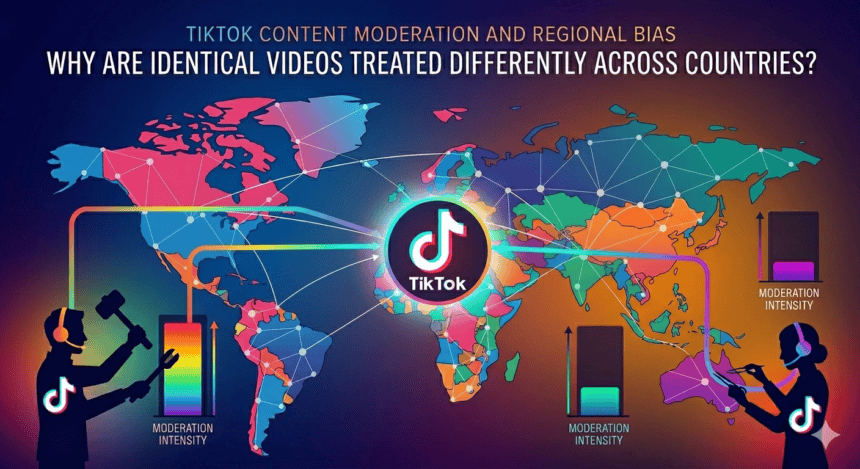
The platform has over one billion active users spread across more than 150 countries. The rules, on paper, apply to everyone. In practice, they do not.
The Illusion of Universal Standards
TikTok’s Community Guidelines open with a sentence that sounds reassuring. The platform says it works “with local experts to make sure that our global approach considers the way harms are experienced across regions” while “upholding human rights standards.” It sounds balanced. It sounds fair.
But a 2024 academic study published in the Wiley Online Library1, which mapped TikTok’s moderation controversies across South and Southeast Asia, found something different. It found that TikTok localises its moderation based on pragmatic necessity rather than moral obligation, and that this produces what the researchers call an accountability vacuum. Governments push hard to control online speech. TikTok sidesteps the most contentious controversies. And the users caught in the middle have nowhere to go.
The study examined five countries: Indonesia, Pakistan, Vietnam, the Philippines, and Thailand. In each place, the story was the same. Local laws were vague and politically motivated. TikTok’s responses were inconsistent. Content that violated identical community guidelines was treated differently depending on who was asking for the removal and what was being removed.
TikTok’s own guidelines acknowledge regional variation. The company says it “provides more information about how our policies are applied in different regions to reflect and respect local cultures and norms.” The trouble is that this framing, which sounds like cultural sensitivity, can just as easily become a justification for compliance with authoritarian demands dressed up as respect.
The Geography of Moderation Staff
Numbers tell part of the story. Under Europe’s Digital Services Act, TikTok is legally required to publish transparency reports about its EU operations. What those reports reveal is striking. According to TikTok’s third DSA transparency report2 published in October 2024, TikTok had over 6,000 dedicated moderators covering EU language content for its 150.5 million monthly EU users. That is roughly one moderator for every 25,000 users.
Compare that with what we know about moderation resources in Sub-Saharan Africa, South Asia, or Latin America. There are no DSA-style requirements in those regions. There are no published numbers. There are no transparency reports. There is, effectively, no accountability.
The Al Jazeera Media Institute3 reported in late 2025 that the effort social media companies invest in content moderation differs significantly by region. Where moderation is weak, disinformation spreads more easily. The report cited experts who noted the absurdity of expecting moderators working out of a hub in Southeast Asia to speak all the languages of the region. In 2024, the Centre for Democracy and Technology found that Arabic-speaking moderators were sometimes assigned to moderate dialects they could not understand.
The language gap is not trivial. Statista4 data from the first quarter of 2024 showed that English was by far the dominant language among TikTok’s human moderators, followed by Arabic at roughly 10 percent, then Indonesian and Spanish. Swahili, Bengali, Amharic, Hausa, Tagalog, in its many varieties, Punjabi: these do not appear as significant categories at all. Hundreds of millions of users are moderated by systems that cannot fully parse what they are saying.
What this means in practice is a two-tier internet. Europe gets a legal framework, thousands of human reviewers, detailed reports, and the ability to appeal decisions. A creator in Nigeria gets an automated system that barely recognises her language, a set of rules written and optimised for a Western context, and, if she is removed, no meaningful path to challenge it.
The Paper Trail: When Internal Documents Leaked
In March 2020, The Intercept5 published what remains one of the most revealing pieces of reporting on TikTok’s internal logic. Internal documents obtained by the publication showed that TikTok had instructed its moderators to suppress posts by users deemed too ugly, too poor, or physically disabled. As RapTV6 posted, the guidelines were explicit. “Abnormal body shape,” “ugly facial looks,” “obvious beer belly,” “too many wrinkles,” “eye disorders” were all listed as reasons to keep a video out of the For You Page.
The rationale, written into the document itself, was commercial. If the person filming a video “is basically the only focus of the video” and their appearance or environment is substandard, the document stated, the video would be much less attractive, not worth being recommended to new users. The company wanted aspiration. It wanted beautiful rooms, smooth skin, and the appearance of prosperity. Rural poverty, cracked walls, and “disreputable decorations” were explicitly flagged as problems.
Think about what that means for a creator in a working-class neighbourhood in Lahore, or a small town in rural Brazil, or a village in Ghana. Their content was being suppressed not because it violated any rule about safety or harm, but because TikTok had decided it was not aesthetically pleasing enough to attract new users. The app’s commitment to community ran, at that time, exactly as deep as its growth metrics required.
TikTok’s spokesperson called these guidelines “an early blunt attempt at preventing bullying” that were no longer in use. But sources told The Intercept the policies were active through at least late 2019. The explanation that suppressing videos of ugly people was a kindness to them, an act of anti-bullying, requires a degree of credulity most people will not extend.
Race, Language, and the Algorithm’s Invisible Hand
The pattern does not stop at economics. Black creators on TikTok have documented systemic suppression for years. In the summer of 2020, as protests against police violence swept the United States, Black TikTok users organized a blackout protest after finding that content tagged with #BlackLivesMatter and #GeorgeFloyd was returning zero views. NBC7 reported that TikTok called it a technical glitch and apologized.
But the complaints kept coming. In 2021, NBC News8 documented the case of Ziggi Tyler, a prominent Black creator, who found that he could not include phrases like “Black Lives Matter,” “Black people,” or “Black success” in his Creator Marketplace bio without being immediately flagged for “inappropriate content.” TikTok apologized again, blaming the hate speech detection system for being “erroneously set to flag phrases without respect to word order.”
The error is instructive. The hate speech classifier had learned, apparently, that the word “Black” in certain combinations was suspicious. It had been trained on data that reflected existing biases in what people report and flag. The algorithm was not conjuring racism from nothing. It was encoding and amplifying the racism already present in its training data.
Research published in April 2024 in Proceedings of the ACM9 on Human-Computer Interaction found that marginalized users, those with LGBTQ+ identities, disabilities, or from ethnic minorities, reported experiencing content suppression for content that did not violate community guidelines. They described developing what the researchers called “folk theories” of the algorithm: informal maps of the system built through collective experimentation, shared in Discord servers and creator forums, because TikTok would not tell them how the system worked.
A separate 2024 study from the University of Oxford10 examined TikTok experiences across marginalised UK users and found that 627 surveyed TikTok users reported feeling subject to censorship for content that did not break any rules. The suppression function of the For You Page recommendation algorithm was being used to enforce a kind of moderation that fell below the threshold of deletion but above the threshold of visibility. Call it invisible erasure.
One TikTok creator quoted in reporting by The Week11 described the experience plainly:
“There’s a line we have to toe. It’s an unending battle of saying something and trying to get the message across without directly saying it. It disproportionately affects the LGBTQIA community and the BIPOC community because we’re the people creating that verbiage and coming up with the colloquialisms.”
The LGBTQ Problem: Different Rules for Different Latitudes
Here is where the geography of moderation becomes most stark. In Western Europe and North America, TikTok officially prohibits content that discriminates against LGBTQ+ people. The GLAAD Social Media Safety Index of 202412 gave TikTok a score of 67 out of 100, a ten-point improvement from the previous year, and praised the platform for prohibiting advertisers from targeting users based on sexual orientation.
But travel south or east on the map and the story changes. In 2023, TikTok was reported by Pink News13 and Firstpost14 to be in talks with Kenya’s government to remove LGBTQ+ content from the platform in compliance with Kenyan law. Kenya was, at that point, the global leader in TikTok engagement. A Reuters Institute survey in 2023 found that 54 percent of Kenyan users engaged with TikTok content, with 29 percent using it as a primary news source. TikTok clearly had reason to keep the Kenyan government happy.
The Middle East Institute has documented TikTok’s pattern of quietly removing content featuring LGBTQ+ people, plus-size individuals, trans people, and disabled people, particularly in the Middle East and South Asia, describing it as an unofficial policy resembling the accommodations made earlier by Google and Facebook. TikTok has been remarkably willing to follow governments’ takedown requests, even when those requests target content that would be considered protected expression in other jurisdictions.
What this produces is a fractal of different standards. A same-sex couple dancing together might be pushed to millions in Amsterdam and buried in Jakarta. A video discussing gender identity might trend in Toronto and be removed quietly in Riyadh. The same people, doing the same thing, living different digital lives depending on which side of a border their SIM card is registered to.
TikTok’s defense in these situations tends to follow a familiar pattern. It says it respects local laws and cultures. It says it is not in a position to override national legislation. This is a reasonable position on its face. But it sidesteps the harder question: when local laws require discrimination against a minority group, and TikTok complies with those laws, is it protecting users or persecuting them?
Palestine, Israel, and the Content War
No case makes the political dimensions of TikTok’s moderation more visible than the Israel-Gaza conflict. After the October 7, 2023, attacks and Israel’s subsequent military campaign in Gaza, TikTok became the platform where young people overwhelmingly encountered information about the war. A study cited by Waging Nonviolence15 in December 2025 found that by September 2025, for roughly every one pro-Israel post on TikTok, around 17 supported Palestinian perspectives.
The Palestinian Observatory of Digital Rights Violations, as reported by EuroNews16, documented more than 1,350 instances of online censorship across major platforms between October 7, 2023, and July 2024. Most related to Meta, TikTok, X, and YouTube.
TikTok17 has its own account of this period. Its newsroom reports that the company removed more than 3.1 million videos and suspended more than 140,000 livestreams in Israel and Palestine between October 7, 2023, and September 2024 for violations including hate speech, violent extremism, and misinformation. The platform says it acts against content promoting Hamas, against antisemitism, and against incitement on all sides.
But users and digital rights organisations noticed an asymmetry. Advox18 documented over 25,000 violations against Palestinian digital content across major platforms in 2024. Their survey found that a majority of Palestinian users reported experiencing content restrictions, specifically when posting about Gaza. TikTok at that point had also added “Zionist” to its hate speech policy when used as a proxy for Jewish or Israeli identity, a move critics said was applied unevenly, restricting one type of speech while similar language in the other direction remained unmoderated.
I am not in a position to adjudicate which videos deserved removal and which did not. Nobody outside TikTok can do that, because TikTok does not show its working. But the opacity itself is part of the problem. In a conflict where information is a weapon, a platform with a billion users deciding in secret which content to suppress and which to amplify holds extraordinary power. That power is not being exercised through a transparent set of rules applied consistently. It is being exercised through a black box.
Pakistan: A Case Study in Negotiated Censorship
Pakistan offers one of the most detailed case studies in how TikTok negotiates with governments. The platform has been banned in Pakistan at least four times since 2020, always over complaints about “immoral content.” Each ban ends with an agreement, usually vague, about TikTok’s compliance with local standards. According to Digital Spartans19, in the first quarter of 2025 alone, TikTok removed nearly 25 million videos in Pakistan with a 99.4 percent proactive removal rate.
That is an extraordinary number. For comparison, TikTok removed about 22 million pieces of content across all 27 EU member states in the first half of 2024.
Pakistan has a population of roughly 240 million. The EU has about 450 million people. The removal rates suggest that Pakistani content is being policed at a rate several times more intensive than European content, either because Pakistani users are generating far more violative content (implausible) or because the threshold for removal is set much lower in Pakistan, shaped by government pressure rather than community need.
The Oxford research on South and Southeast Asia found that TikTok’s responses to governmental removal requests showed “considerable discretion,” with fluctuating action rates across most countries. The exceptions were Pakistan and Singapore, where response rates were “consistently high.” Singapore operates under strict media regulations with legal consequences for non-compliance. Pakistan has repeatedly threatened to ban the platform outright. In both cases, TikTok’s compliance appears shaped primarily by the threat of market loss rather than by principled content standards. As the academic paper put it, TikTok “aligns with norms just enough to enable growth while limiting backlash.”
The Algorithm’s Original Sin
Here is a thought that I keep returning to. The TikTok algorithm was designed first in China, for a Chinese audience, by a Chinese company. The early version of the platform, Douyin, operated within a context where the Chinese Communist Party defines what appropriate speech, what images of poverty or dissent are acceptable, and what political content can circulate.
When TikTok exported itself to the rest of the world, it brought those foundational assumptions with it. The early suppression policies targeting ugly and poor users were not random cruelties. They reflected a corporate aesthetic developed in a country where the party controlled the aspirational image of national life. Poverty was something to be hidden from view. Political dissent was dangerous. Social harmony meant an absence of visible conflict.
TikTok has since updated those policies. It has hired content experts, built local moderation teams, and published a set of community principles rooted, at least rhetorically, in international human rights frameworks. But the architecture of the recommendation system, the For You Page, was built to keep users engaged and keep regulators happy. Those two goals do not always point in the same direction. LGBTQ Nation20 report found that TikTok’s algorithm was promoting anti-LGBTQ+ content in some markets even though it violated the platform’s own hate speech policies. The algorithm had learned that such content drove engagement in specific demographics. Engagement is the metric that matters.
This is the foundational problem with leaving moderation to machine learning. The machine learns from human behavior. Human behavior contains centuries of bias, prejudice, and inequality. The machine encodes those patterns and scales them to a billion users. When TikTok’s hate speech detector suppresses Black creators for discussing Blackness, it is not malfunctioning. It is doing exactly what it was built to do: reflect and amplify patterns found in the data. The discrimination is not a bug. In a very uncomfortable sense, it is a feature.
The Regulatory Gap: Europe vs. Everywhere Else
The Digital Services Act is the most serious attempt any jurisdiction has made to hold TikTok accountable. Under the DSA, TikTok must publish transparency reports, maintain dedicated moderation staff, allow appeals, and submit to audits. In September 2024, the European Parliament21 raised concerns after TikTok fired its entire moderation team of 300 people in the Netherlands, asking how a platform with 5.7 million Dutch monthly users could comply with DSA obligations without staff who speak the language and understand the local context.
The question answers itself. It cannot. But Europe at least has the legislative architecture to ask the question. The question cannot be asked, and therefore cannot be answered, in most of the world.
What would it take to create equivalent protections globally? At minimum, it would require national legislation modeled on the DSA, an international framework for platform accountability, and the political will to enforce it in countries where TikTok has significant market power and governments have significant interest in using the platform for their own ends. None of those things exists right now.
Until they do, TikTok will continue to offer different versions of itself to different parts of the world. The European version, constrained by law, comes with some transparency and some accountability. The version available in Lagos, Karachi, and Manila comes with none of those protections. Users are subject to the same algorithm, with less recourse, less visibility into how decisions are made, and less power to challenge them.
Forum Voices: What Users See That Researchers Cannot
The academic papers and news reports tell one story. The forums tell another, which is sometimes messier but often more honest.
On Reddit’s r/Tiktokhelp22, a thread from early 2025 has several hundred replies from users in Southeast Asia and Africa describing the experience of watching views tank after posting in local languages. One user from the Philippines writes that he switched to posting in English and his reach tripled.
“My Filipino audience is gone, but at least the algorithm sees me now,” he says.
Another, from Nigeria, describes spending months trying to understand why videos that performed well on Instagram vanished on TikTok. He eventually concluded that his account’s regional registration was limiting its global distribution, though TikTok never told him this.
On creator forums and Discord servers, an informal knowledge base has grown up around navigating TikTok’s regional weirdness. Creators share information about which hashtags trigger suppression in which markets. They discuss the theory that accounts registered in certain countries get lower initial distribution scores. They experiment with VPNs and regional account settings. This is folk knowledge, developed in the absence of official information, by people trying to make a living on a platform that will not explain its own rules.
One comment that stuck with me came from a creator who makes educational content about health in Swahili. She wrote:
“I do not know if TikTok is suppressing me because of language, because of location, because of content, or because of some combination I cannot see. What I know is that identical information in English, posted by someone with a UK IP address, gets shown to thousands of people. My version, for my community, gets shown to almost no one. That is not neutral. That is not fair.”
She is right. It is not neutral. It never was.
What TikTok Says
TikTok’s public position on all of this is predictable and carefully worded. The company maintains that its community guidelines apply globally and that regional variations reflect local law and cultural sensitivity. It points to its growing investment in moderation technology. According to Social Media today23, Tiktok said that 96.3% percent of violative content is now removed before anyone reports it. It publishes quarterly enforcement reports showing removal statistics by category.
The company’s community principles page says the platform works “with local experts” to ensure its approach considers regional harms while upholding human rights standards. It invites researchers to examine its systems. It has set up advisory councils in various markets. All of these are real things that represent real effort.
But the transparency is selective. The DSA reports cover Europe. The quarterly enforcement reports give global numbers broken down by violation category but not by region or language. There is no public breakdown of how many human moderators cover Hausa-speaking content versus Dutch-speaking content. There is no public data on appeal outcomes by geography. There is no independent audit of whether the algorithm applies its engagement-limiting functions equally across demographics and regions.
The platform’s commitment to transparency extends precisely as far as it is legally required to extend. In Europe, where that requirement is substantial, the transparency is substantial. Everywhere else, TikTok reports what it chooses to report and reveals what it chooses to reveal.
A Billion People, One Algorithm, No Referee
There is something quietly extraordinary about what TikTok has built. A single recommendation system, operating across more than 150 countries, processing content in hundreds of languages, making billions of micro-decisions every day about which voices get heard and which ones do not. No human institution has ever had this kind of reach or this kind of influence over information flow.
And it operates, for most of the world, without a referee.
The decisions it makes are not neutral. They cannot be neutral. Every algorithmic choice embeds a value judgment: about what content is interesting, what environments are aspirational, what political speech is acceptable, what bodies deserve visibility. In a world where digital reach increasingly determines economic opportunity, political participation, and cultural influence, those decisions matter enormously.
When a health educator in Nairobi gets fewer views than a lifestyle influencer in New York posting the same information in English, that is not a technical quirk. It is a distribution of power. When a queer creator in Dubai has their content suppressed because TikTok has decided to accommodate local law, and a queer creator in Berlin does not face the same restriction, those two people are living in different Internets.
The promise of a global platform was always something like universality: the idea that good content travels regardless of its origin. TikTok launched on that promise. Its early growth was built on the genuine delight of discovering videos from people you would never otherwise encounter. That promise was partly real. But it was never the whole story.
The whole story is that TikTok is a business, headquartered in Singapore and Los Angeles, answering to shareholders, to regulators in Beijing, Brussels, and Washington, to advertisers who want certain kinds of audiences, and to governments who want certain kinds of compliance. In navigating those pressures, it has built a system that is not one platform but many, wearing a single face.
The face tells you that the same rules apply everywhere. The system beneath it tells a different story to a creator in Lagos than it tells to a creator in Los Angeles. Both of them are staring at the same app, but they are not seeing the same world.
Sources
- Wiley Online Library, onlinelibrary.wiley.com/doi/full/10.1002/poi3.388. Accessed 1 May 2026. ↩︎
- “Digital Services Act: Publishing our third transparency report on content moderation in Europe” TikTok, 24 Oct. 2024, newsroom.tiktok.com/en-eu/dsa-third-transparency-report. Accessed 1 May 2026. ↩︎
- “Lost in Translation: The Global South and the Flaws of Content Moderation” Al Jazeera Media Institute, institute.aljazeera.net/en/ajr/article/3419. Accessed 1 May 2026. ↩︎
- D, Thuy. “TikTok content moderators covering languages 2025| Statista” 25 Nov. 2025, www.statista.com/statistics/1405643/tiktok-language-covered-moderators/. Accessed 4 May 2026. ↩︎
- Biddle, Sam. “TikTok Told Moderators: Suppress Posts by the “Ugly” and Poor” 16 Mar. 2020, theintercept.com/2020/03/16/tiktok-app-moderators-users-discrimination/. Accessed 1 May 2026. ↩︎
- “RapTV on Instagram: “#TikTok reportedly buried posts from ‘ugly, poor, obese and disabled users’. According to the New York Post, TikTok reportedly “instructed moderators to suppress posts created by users deemed too ugly, poor or disabled for the platform,”.”” www.instagram.com/p/B93FpKuFfq6/?utm_source=ig_embed&utm_campaign=loading. Accessed 20 Aug. 2026. ↩︎
- Rosenblatt, Kalhan. “Months after TikTok apologized to Black creators, many say little has changed” 9 Feb. 2021, www.nbcnews.com/pop-culture/pop-culture-news/months-after-tiktok-apologized-black-creators-many-say-little-has-n1256726. Accessed 1 May 2026. ↩︎
- Murray, Conor. “TikTok algorithm error sparks allegations of racial bias” 9 July 2021, www.nbcnews.com/news/us-news/tiktok-algorithm-prevents-user-declaring-support-black-lives-matter-n1273413. Accessed 1 May 2026. ↩︎
- ACM, dl.acm.org/doi/10.1145/3637431. Accessed 1 May 2026. ↩︎
- “Experiences of Censorship on TikTok Across Marginalised Identities” arxiv.org/html/2407.14164v1. Accessed 1 May 2026. ↩︎
- Coleman, Theara. “How content creators cope with discriminatory algorithms” The Week, 16 May 2023, theweek.com/briefing/1023338/algorithm-ai-discrimination. Accessed 1 May 2026. ↩︎
- Glaad, glaad.org/smsi/2024/tiktok/. Accessed 1 May 2026. ↩︎
- Condon, Ali. “TikTok reportedly in talks with Kenyan government to remove LGBTQ+ content” 28 Sept. 2023, www.thepinknews.com/2023/09/28/tiktok-kenya-government-remove-lgbtq-content/. Accessed 1 May 2026. ↩︎
- #FirstpostAfrica, Firstpost, www.facebook.com/firstpostin/videos/kenya-ruto-govt-orders-tiktok-to-remove-sexual-content-exposing-minors-firstpost/1028119912567457/. Accessed 20 Aug. 2026. ↩︎
- Awadalla, Farah. “How the pro-Palestine movement is outsmarting the algorithms” Waging Nonviolence , 2 Dec. 2025, wagingnonviolence.org/2025/12/palestine-movement-outsmarting-algorithms/. Accessed 1 May 2026. ↩︎
- Desmarais, Anna. “Human rights NGOs say social media platforms continue to censor pro-Palestine content” Euronews, 7 Oct. 2024, www.euronews.com/next/2024/10/07/human-rights-ngos-say-social-media-platforms-continue-to-censor-pro-palestine-content. Accessed 1 May 2026. ↩︎
- “Our continued actions to protect the TikTok community during the Israel-Hamas war” TikTok, 15 Oct. 2023, newsroom.tiktok.com/en-gb/protect-tiktok-community-israel-hamas-war. Accessed 1 May 2026. ↩︎
- “Digital erasure: How social media platforms are silencing Palestinians in 2024” 12 May 2025, advox.globalvoices.org/2025/05/12/digital-erasure-how-social-media-platforms-are-silencing-palestinians-in-2024/. Accessed 1 May 2026. ↩︎
- “Digital Spartans on Instagram, www.instagram.com/p/DMc_zjaR0Bg/?hl=en. Accessed 20 Aug. 2026. ↩︎
- Villarreal, Daniel. “How will the TikTok ban affect the massively popular app’s LGBTQ+ users?” LGBTQ Nation, 3 May 2024, www.lgbtqnation.com/2024/05/how-will-the-tiktok-ban-affect-the-massively-popular-apps-lgbtq-users/. Accessed 1 May 2026. ↩︎
- “Parliamentary question | Lay-off of TikTok’s entire content moderation team in the Netherlands and the DSA | E-002454/2024 | European Parliament” E-002454/2024, www.europarl.europa.eu/doceo/document/E-10-2024-002454_EN.html. Accessed 4 May 2026. ↩︎
- Reddit, www.reddit.com/r/rTiktokhelp/. Accessed 4 May 2026. ↩︎
- “Social Media Today” Social Media Today, www.facebook.com/socmediatoday/posts/tiktok-says-that-963-of-the-content-that-it-removed-for-breaking-its-rules-was-t/1363970382439928/. Accessed 20 Aug. 2026. ↩︎