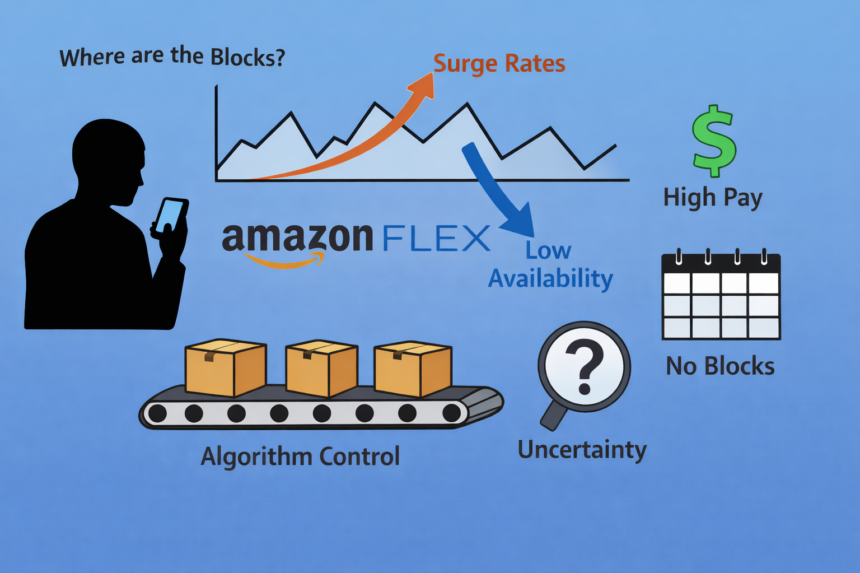

Amazon Flex is marketed as a flexible income opportunity. Drivers choose delivery blocks that fit their schedules. Each block lists a guaranteed payout. The process appears transparent.
Yet across online forums and driver communities, a recurring concern has emerged. Many drivers report sudden drops in block availability, especially after periods when surge pricing was common. Some believe these fluctuations are not purely the result of customer demand but part of a broader structural dynamic that lowers earnings expectations over time.
In researching this issue, I reviewed driver discussions, academic research on gig work, public earnings reports, and third-party analysis of algorithmic management. What emerges is not proof of deliberate manipulation, but a system whose design may produce downward pressure on pay through controlled scarcity and information asymmetry.
How Amazon Flex Scheduling Works
Amazon Flex operates through a simple promise. Independent contractors open an app, browse available delivery blocks, and select the ones that fit their schedule. On the surface, it feels direct and transparent. The official Amazon Flex website1 explains that drivers choose from available blocks that list both the time commitment and the expected payout in advance.

The platform emphasizes flexibility. Drivers are not assigned fixed shifts. They are not required to commit to weekly minimums. Instead, they log in and accept blocks as they appear. The company describes block availability as dependent on customer demand and operational needs, as stated in its FAQ section2.
Blocks usually range from two to five hours. The pay for each block is displayed upfront and is guaranteed for the duration of that block, even if deliveries are completed early. In many markets, this advertised guarantee is part of the platform’s appeal. A driver sees a clear dollar amount and a fixed time window. That clarity is powerful. It reduces uncertainty at the point of acceptance.
But the clarity ends there.
When I reviewed how the interface functions, I noticed that drivers only see the blocks the system chooses to show them. There is no dashboard displaying total regional inventory. There is no counter showing how many other drivers are refreshing their screens at that same moment. There is no historical rate chart visible in the app. Drivers cannot see how pricing has changed hour by hour or day by day. They cannot see how many blocks were posted earlier and taken quickly. They only see what appears in that instant.
From a design perspective, the interface is minimal. It avoids clutter. It avoids raw operational data. It presents an opportunity as a list of selectable offers.
Behind that simplicity, however, is a dynamic scheduling system that appears to adjust based on multiple variables. Those variables likely include order volume, warehouse capacity, geographic density, time sensitivity, and the number of active drivers in a given region. While Amazon does not publish detailed algorithmic documentation for Flex scheduling, the broader company has publicly discussed its use of demand forecasting and machine learning in logistics operations. It is widely known that Amazon relies on predictive analytics to manage fulfillment networks at scale.
For drivers, this creates an asymmetry of information.
They know when blocks are visible. They know the posted payout. They know whether they managed to secure a slot. What they do not know is whether the number of available blocks was intentionally limited, whether rates were adjusted downward after a surge period, or whether the visibility of blocks varies by account performance or region saturation.
The app does not display rejected bids. It does not show how many times a block was attempted by other drivers before disappearing. It does not show how many blocks will be released later in the day. Instead, drivers often rely on refreshing the app repeatedly, hoping to catch newly released blocks before they are claimed.
This structural opacity is central to the concerns many drivers raise. When availability fluctuates, drivers have no independent way to verify whether demand has truly dropped or whether block release timing has changed. When rates appear lower than previous weeks, drivers cannot see a public rate sheet to compare against.
In traditional employment, a worker can view a posted schedule or negotiate pay through visible channels. In Amazon Flex, the system mediates both schedule and compensation through software logic that is not disclosed in detail.
The platform’s official explanation is straightforward. Blocks reflect customer demand and operational needs. Drivers choose what they want to work. Pay is displayed and guaranteed. From a contractual standpoint, that may be sufficient.
Yet from an economic standpoint, the absence of aggregate visibility shapes behavior. Drivers adapt based on what they can observe. If blocks become scarce, they compete more aggressively. If rates decline, they may accept lower payouts to maintain income continuity. If surge pricing appears temporarily, they learn to monitor the app more frequently.
The simplicity of the interface masks the complexity of the scheduling engine behind it. And that gap between what is shown and what is withheld is at the core of the broader discussion about algorithmic management in gig work.
Reports of Sudden Block Scarcity
In online communities such as Reddit’s Amazon Flex Drivers forum3, drivers frequently describe abrupt reductions in block availability.
The complaints are not framed as gradual slowdowns. They are described as sudden shifts.
One driver wrote,
“There were consistent offers last year. Now I refresh for long stretches and see nothing.”
Another posted,
“Blocks disappeared right after drivers stopped accepting base rate.”
A third user described logging into the app at the same time each evening for months, only to find that the usual wave of offers stopped appearing without warning. The driver wrote that nothing else had changed. Same region. Same warehouse. Same performance rating. The only difference was the volume of visible blocks.
These statements are anecdotal. They are not controlled data. Yet they appear repeatedly across threads, regions, and time periods. When dozens of drivers who do not know each other describe a similar pattern, it becomes difficult to dismiss the reports outright.
What stands out in many of these discussions is not simply the reduction in available blocks. It is the unpredictability. Drivers describe a system that feels stable for months, then shifts abruptly. They cannot identify a public announcement or policy change that explains the change. There is no notice in the app. There is no formal communication stating that block volumes will decrease.
Instead, the experience is this: yesterday, there were offers. Today, there are none.
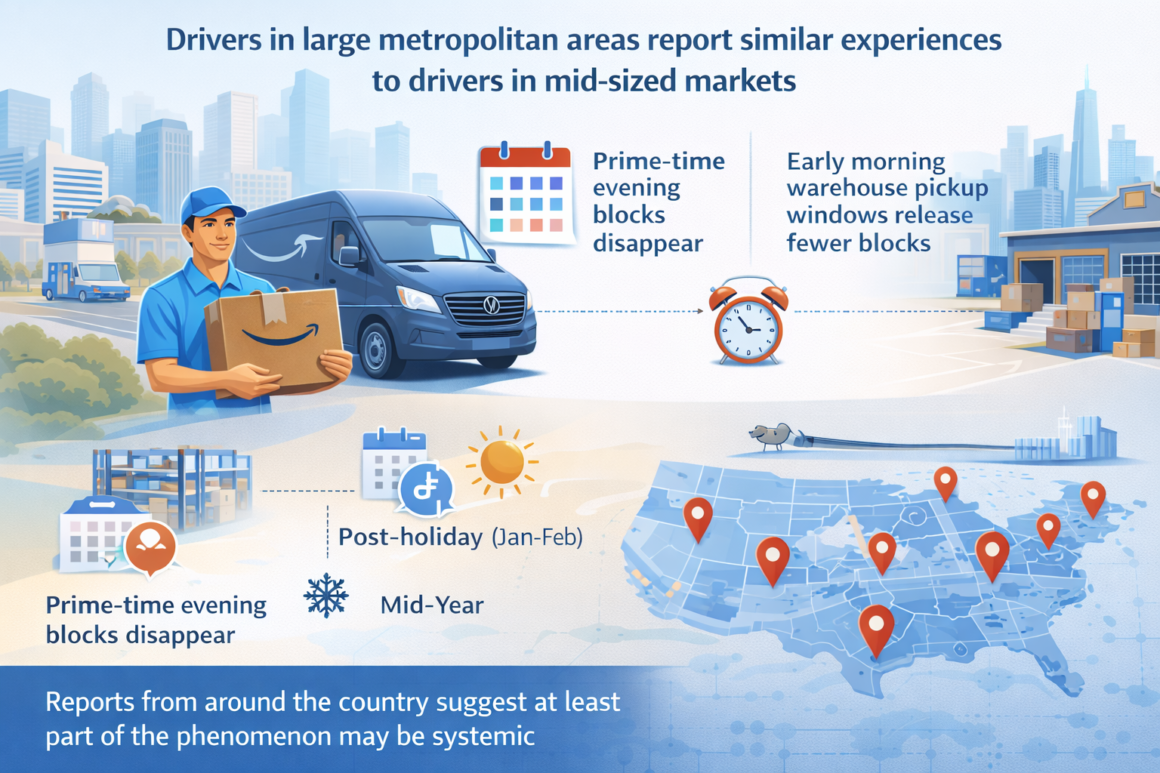
When reviewing forum posts over multiple months, I noticed that scarcity complaints are not limited to one city. Drivers in large metropolitan areas report similar experiences to drivers in mid-sized markets. Some describe prime-time evening blocks disappearing. Others report that early morning warehouse pickup windows are releasing in smaller quantities than before.
The time periods vary. Some threads cluster around post-holiday months, particularly January and February. Others appear during mid-year stretches that would not normally be associated with dramatic retail slowdowns.
This geographic spread weakens the argument that scarcity is purely local mismanagement. It suggests that at least part of the phenomenon may be systemic.
There are several plausible explanations for visible reductions in block supply. Each could reduce availability without any public acknowledgment.
Retail volume fluctuates throughout the year. Post-holiday slowdowns are well-documented in the logistics industry. If customer orders decline, fewer delivery blocks would naturally be needed. This explanation is straightforward and consistent with Amazon’s official statement that block availability depends on demand and operational needs.
However, many drivers argue that their local demand appears steady, especially in dense urban markets where same-day and next-day delivery remain strong year-round. The perceived mismatch between consumer demand and visible blocks fuels suspicion.
If Amazon increases the number of approved Flex drivers in a region, the same number of blocks would be distributed across a larger pool. The result would be more competition and fewer visible offers per driver.
Amazon does not publicly release onboarding numbers by region. Drivers, therefore, cannot determine whether scarcity reflects oversupply of labor. This creates uncertainty. Some drivers speculate that waitlists open and close strategically. Others believe onboarding surges before peak seasons, then remains elevated afterward.
Fulfillment centers may change routing practices, consolidate deliveries, or shift volume between contractors and internal Amazon Delivery Service Partners. A warehouse that moves more packages to DSP vans could reduce Flex block volume without reducing overall deliveries.
From a business standpoint, this would be an efficiency adjustment. From a driver’s perspective, it appears as a sudden scarcity.
Several drivers describe logging in at their usual time and seeing no blocks, only to discover that blocks were released earlier or later than expected. If release timing shifts by even thirty minutes, drivers who rely on routine may miss most of the available inventory.
This explanation aligns with reports that block drops appear to move without warning. A driver accustomed to a 6 pm release might find that blocks were posted at 5:20 pm and claimed within minutes.
In that scenario, block volume may not have decreased significantly. Visibility windows may simply have narrowed.
It is important to distinguish between the actual reduction in total block supply and the perceived reduction in visible supply. Drivers see what is displayed in their app. They do not see the full regional dataset.
If blocks are released in smaller batches more frequently, drivers who refresh less often might interpret this as scarcity. If high-demand drivers secure blocks quickly, slower devices or weaker connections may contribute to missed opportunities.
Yet even these explanations reinforce a central issue. The system does not provide aggregate transparency. Drivers cannot verify whether supply has changed or whether competition has intensified.
When dozens of forum posts describe extended refresh cycles with no visible blocks, the emotional response is predictable. Drivers feel squeezed. They question whether pay expectations are being recalibrated. They wonder whether refusing lower base rates triggered reduced visibility.
The phrase that appears often in these threads is “something changed.”
The absence of formal communication makes that perception powerful. In a traditional workplace, a reduction in shifts would be announced. In a gig platform environment, the reduction appears as silence. The screen simply shows nothing.
Even if each fluctuation has a rational operational explanation, the broader pattern points to structural forces inherent in algorithmic scheduling.
A dynamic system that adjusts supply visibility in real time can create the appearance of scarcity without a formal reduction in total capacity. When drivers respond to scarcity by accepting lower-paying blocks more quickly, the market resets.
Whether this outcome is intentional or an emergent behavior of a complex system is difficult to prove. But the repeated reports of abrupt changes suggest that drivers experience the scheduling system as reactive, opaque, and sometimes punitive.
Scarcity in itself is not evidence of manipulation. Demand does fluctuate. Workforce supply does expand and contract. Warehouses do optimize.
What makes this issue significant is not simply that blocks disappear. It is that they disappear without explanation, without metrics, and without visibility into the broader operational picture.
For independent contractors whose income depends on timely access to blocks, unpredictability is not just inconvenient. It shapes expectations, acceptance behavior, and long-term earning strategies
Oversupply, Competitive Pressure, and Expectation Reset
Research on gig platforms consistently shows that maintaining a labor pool larger than immediate demand can reduce upward pressure on pay. This dynamic is not unique to one company. It is widely discussed in academic and business reporting on platform-based work.
Business Insider4 has reported that many gig companies recruit more workers than are strictly necessary at any given moment to ensure service coverage and stabilize costs.
Similarly, the UC Berkeley Labor Center5 analyzed ride-share and gig labor models and concluded that worker oversupply increases competition for tasks and suppresses average earnings.
The principle is simple. When more workers compete for the same number of tasks, bargaining power shifts toward the platform. Even without cutting nominal pay rates, the presence of excess labor reduces the likelihood that workers can collectively hold out for higher compensation.
Amazon does not publicly disclose how many active Flex drivers operate in each region. That absence of data makes it impossible for drivers to assess whether scarcity reflects lower demand or higher labor supply. If onboarding increases while order volume remains stable, the number of visible blocks per driver would decline even if total delivery volume stayed constant.
In that environment, competition intensifies quietly. Drivers refresh the app more frequently. Blocks disappear faster. Acceptance decisions happen more quickly. A driver who hesitates in the hope of a higher rate may lose the opportunity entirely.
This shift does not require a formal pay reduction. It does not require an announcement. It operates through distribution.
When available work becomes harder to secure, many drivers may accept lower-paying blocks to avoid earning nothing. Over time, what once felt like a low offer begins to feel like a safe one.
From an economic perspective, this is a competitive market dynamic. From a driver’s perspective, it feels like a shrinking opportunity.
According to CNBC6, during high-demand periods, Amazon Flex blocks sometimes include surge pricing. These higher payouts are typically associated with peak shopping seasons, weather disruptions, or unexpected spikes in order volume.
Another CNBC7 report states that during the height of pandemic-driven e-commerce growth, Amazon reported record earnings and elevated delivery volume.
Many drivers during that period reported unusually high block payouts in online forums. Rates that were once occasional became more common. A four-hour block might offer significantly more than base pay. For drivers who worked through that period, higher earnings became part of their lived experience.
Behavioral economics helps explain why this matters.
People anchor expectations to recent reference points. When higher pay becomes normal for several months, it establishes a psychological baseline. A later return to lower rates is experienced not as a neutral adjustment but as a loss.
Even if base rates technically remain unchanged, a decline in surge frequency can feel like a pay cut. The memory of elevated earnings lingers.
Some drivers in online forums describe a pattern in which surge opportunities appear less frequently after drivers collectively begin waiting for higher offers. There is no public evidence that Amazon deliberately suppresses blocks to discourage strategic waiting. The company attributes block pricing to demand conditions and operational needs.
However, in a system shaped by oversupply and predictive demand forecasting, surge pricing will naturally decline if enough drivers accept base rates. When blocks are filled quickly at lower payouts, there is less incentive for the system to raise rates to attract labor.
The effect can resemble expectation management.
If drivers grow accustomed to refreshing until a surge appears, and then surges become rare, many will eventually adjust their behavior. Some will accept base pay earlier. Others may leave the platform. Over time, the market resets around a lower reference point.
This adjustment does not require explicit coordination. It emerges from the interaction between supply, demand forecasting, and worker decision-making.
What once felt temporary becomes standard.
In this way, oversupply and surge variability interact. A larger labor pool reduces the need for higher incentives. A decline in surge frequency reshapes psychological expectations. Competitive pressure does the rest.
From the outside, the system appears neutral and automated. From the inside, drivers experience it as tightening margins and shrinking leverage.
The critical question is not whether scarcity exists. Scarcity is common in competitive labor markets. The deeper question is whether the combination of opaque supply data, variable surge incentives, and growing driver pools creates conditions where pay expectations reset downward without a visible wage cut.
That question sits at the heart of ongoing debates about algorithmic management in gig work.
Algorithmic Management, Opacity, and the Hidden Cost of Access
Amazon Flex operates within what management scholars describe as algorithmic management. One Harvard Review8 has defined algorithmic management as the use of software systems to assign, monitor, and evaluate workers.
In traditional workplaces, a human supervisor schedules shifts and evaluates performance. In Flex, those functions are embedded in software. The app determines when opportunities appear, how long they remain visible, and which drivers see them first.
Within the Flex ecosystem, algorithms influence several core areas:
• When blocks are released
• How many blocks are displayed at a given time
• Dynamic pricing adjustments based on demand and acceptance rates
• Performance-based eligibility for certain delivery types
Drivers are rated on metrics such as on-time delivery, reliability, and completion rates. While Amazon does not publish detailed criteria linking ratings to block access, third-party guides such as Gridwise9 advise drivers that maintaining a high standing may improve access to opportunities.
This guidance reflects a broader belief among drivers that ratings may influence block visibility. Yet Amazon does not publicly disclose whether higher-rated drivers receive earlier access to certain blocks, greater volume, or priority placement.
The absence of clarity produces uncertainty.
Drivers cannot determine whether they are competing on equal footing or whether internal prioritization systems rank accounts differently. A driver who experiences fewer visible blocks cannot verify whether the cause is regional oversupply, personal performance metrics, or algorithmic release timing.
Opacity does not automatically imply misconduct. Large-scale logistics systems are complex and often proprietary. However, opacity concentrates informational power with the platform. Drivers must make economic decisions without access to the variables shaping their opportunities.
In that environment, perception fills the gaps left by silence.
One of the least discussed aspects of gig work is unpaid search time. The visible portion of the job begins when a block is accepted. But before that moment, there may be extended periods spent refreshing the app.
In online forums, drivers frequently describe this search phase as a job in itself. One Reddit user wrote,
“I spend more time hunting blocks than delivering them.”
The time cost matters. If a driver spends an hour refreshing the app to secure a four-hour block, that hour is unpaid. It reduces effective earnings even if the displayed block rate appears competitive.
The Economic Policy Institute10 has documented that gig workers often earn less than minimum wage after accounting for expenses such as fuel, vehicle depreciation, and insurance.
When unpaid scheduling time is added to that calculation, effective hourly income declines further. A block advertised at a fixed payout may look attractive on paper, but the true hourly rate depends on the total time invested, including search and waiting.
In traditional employment, scheduling costs are internalized. Workers are assigned shifts and compensated for their time on duty. In gig platforms, scheduling costs are externalized. Workers absorb the burden of monitoring availability and competing for access.
If block release timing is predictable, drivers can structure their day efficiently. If release timing is unpredictable, drivers may remain on standby for extended periods, reducing their ability to pursue alternative income.
The platform maintains flexibility. The worker bears uncertainty.
At the center of driver discussions lies a more pointed question. Is block scarcity used strategically to influence pay acceptance behavior?
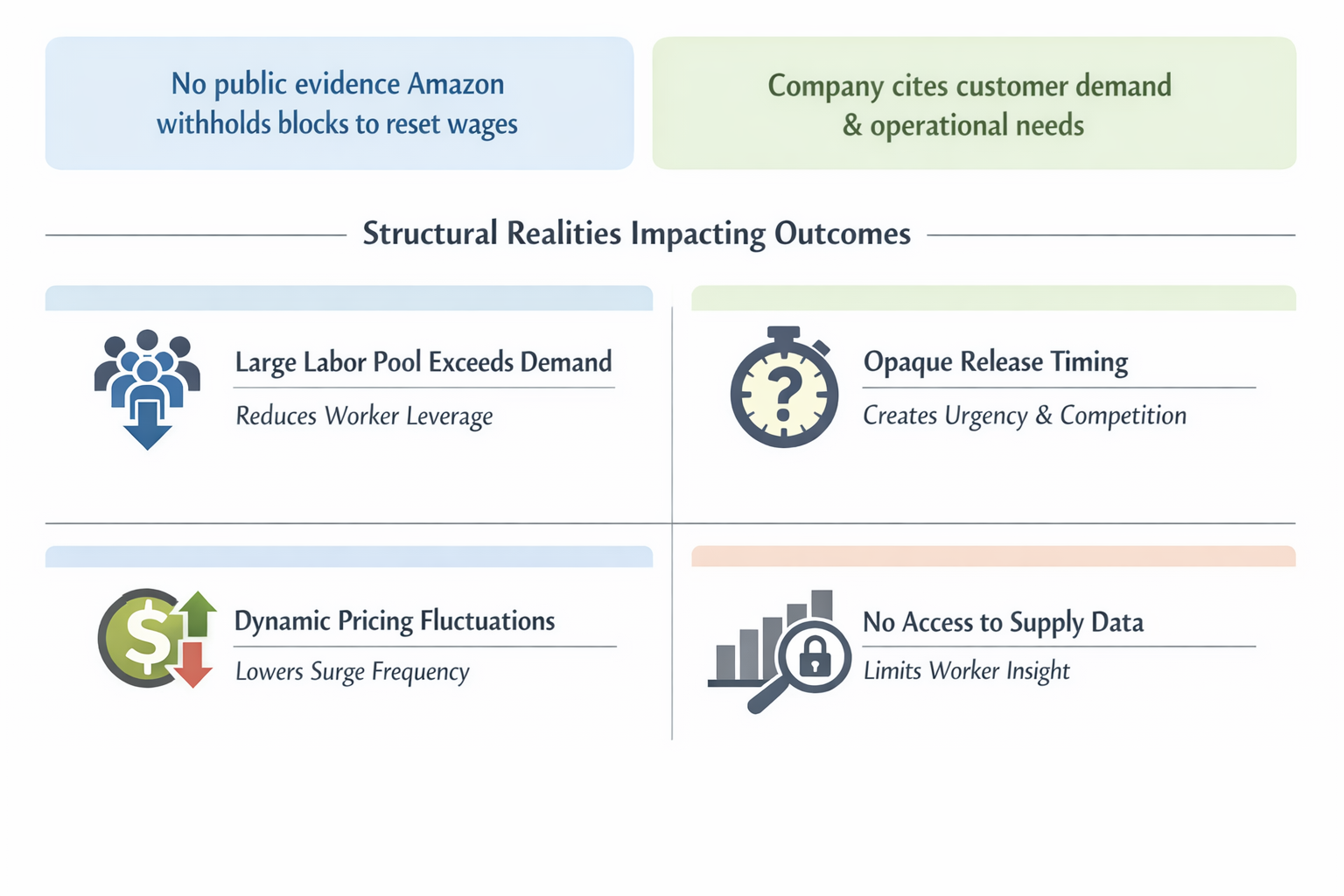
There is no publicly available evidence proving that Amazon deliberately withholds blocks to reset wage expectations. The company consistently attributes block availability and pricing to customer demand and operational needs.
Yet several structural realities shape outcomes regardless of intent:
• A labor pool larger than immediate demand reduces worker leverage
• Opaque release timing increases urgency and competition
• Dynamic pricing tied to acceptance patterns can reduce surge frequency over time
• Workers lack access to aggregate supply data
In economic terms, these conditions create downward pressure on earnings without requiring explicit wage reductions. If drivers compete intensely for limited visible blocks, they are more likely to accept base rates. If surge pricing appears only when blocks remain unclaimed, and blocks are claimed quickly, higher rates become rare.
Whether scarcity emerges from deliberate calibration or from automated optimization processes responding to supply and demand, the effect can be similar. Earnings stabilize at levels determined less by negotiation and more by algorithmic equilibrium.
The critical distinction may not be intent but structure.
Algorithmic management systems optimize for operational efficiency. They forecast demand, allocate labor, and adjust pricing dynamically. Workers operating within these systems experience the outputs without visibility into the inputs.
For drivers, the lived experience is straightforward. Blocks appear or do not appear. Rates are high or low. Time is spent refreshing or delivering.
For the platform, the system balances cost, coverage, and fulfillment speed at scale.
The tension between those perspectives defines much of the modern gig economy. Flexibility and uncertainty are distributed unevenly. The platform retains strategic adaptability. Workers adapt to what they see.
Scarcity, whether intentional or emergent, functions as a powerful economic signal. It shapes behavior. It influences acceptance decisions. It recalibrates expectations over time.
And in a system governed by code rather than conversation, those signals often speak louder than policy statements.
Regulatory Context and Broader Implications for Gig Work
Algorithmic management practices are receiving increasing regulatory attention.
The Federal Trade Commission11 has launched inquiries into algorithmic pricing systems. According to the Business and Human Rights Centre12, in the European Union, the Platform Work Directive aims to improve transparency and working conditions for gig workers.
Although these initiatives do not target Amazon Flex specifically, they reflect broader concerns about opacity in digital labor markets.
Greater transparency around block allocation and pricing mechanisms could address some driver uncertainty.
The Flex model reflects a broader shift in labor markets.
Workers gain flexibility but lose predictability. Platforms gain efficiency but centralize information.
When scarcity and opacity combine, workers must make decisions without knowing the full structure of the market.
In theory, dynamic pricing aligns supply and demand efficiently. In practice, oversupply and limited transparency can skew bargaining power.
The result is not necessarily overt exploitation. It is a structural imbalance.
Amazon Flex offers real income opportunities and flexibility for many drivers. The system is not inherently flawed simply because it is algorithmic.
However, the recurring reports of sudden block scarcity raise important questions.
If block visibility fluctuates in ways drivers cannot understand, and if those fluctuations coincide with downward shifts in pay expectations, then the system deserves scrutiny.
Scarcity in digital labor markets does not need to be fabricated to influence behavior. It only needs to be unevenly distributed and poorly explained.
The broader issue is transparency. Drivers do not see the total supply. They do not see total competition. They do not see pricing thresholds. They see only what appears on their screen.
In a marketplace defined by algorithms, that difference matters.
Sources
- “How Delivering Packages With Amazon Flex Works” flex.amazon.com/lets-drive. Accessed 18 Feb. 2026. ↩︎
- “Amazon Flex Frequently Asked Driver Questions” flex.amazon.com/faq. Accessed 18 Feb. 2026. ↩︎
- Reddit, www.reddit.com/r/AmazonFlexDrivers/. Accessed 18 Feb. 2026. ↩︎
- Kaplan, Juliana. “The number of people doing gig work on apps like Uber and DoorDash more than doubled during the pandemic” Business Insider, 20 July 2023, www.businessinsider.com/gig-economy-trends-workers-delivery-ride-hailing-apps-uber-doordash-2023-7. Accessed 18 Feb. 2026. ↩︎
- “Labor Center Research on the Rideshare Industry” UC Berkeley Labor Center, 4 Oct. 2021, laborcenter.berkeley.edu/labor-center-research-on-the-rideshare-industry/. Accessed 18 Feb. 2026. ↩︎
- Palmer, Annie. “Amazon Flex drivers hit by surging gas prices demand relief after Uber, Lyft offer help to workers” 17 Mar. 2022, www.cnbc.com/2022/03/17/amazon-flex-drivers-hit-by-surging-gas-prices-are-demanding-relief-.html. Accessed 18 Feb. 2026. ↩︎
- Palmer, Annie. “Amazon’s sales surge 44% as it smashes earnings expectations” 29 Apr. 2021, www.cnbc.com/2021/04/29/amazon-amzn-earnings-q1-2021.html. Accessed 18 Feb. 2026. ↩︎
- 9 July 2019, www.hks.harvard.edu/sites/default/files/centers/mrcbg/files/www.hks.harvard.edu/sites/default/files/centers/mrcbg/files/AWP_130_final.pdf. Accessed 18 Feb. 2026. ↩︎
- Sellers, Brandon. “Demystified: Your Guide To Amazon Flex Standings” Gridwise, 12 Sept. 2023, gridwise.io/blog/rideshare/demystified-your-guide-to-amazon-flex-standings/. Accessed 18 Feb. 2026. ↩︎
- “National survey of gig workers paints a picture of poor working conditions, low pay” Cloudflare, www.epi.org/publication/gig-worker-survey/. Accessed 18 Feb. 2026. ↩︎
- FTC, www.ftc.gov/news-events/news/press-releases/2024/07/ftc-issues-orders-eight-companies-seeking-information-surveillance-pricing. Accessed 18 Feb. 2026. ↩︎
- Council, “Author: European. “EU Council formally adopts platform directive to improve working conditions for platform & gig economy workers – Business and Human Rights Centre” Business and Human Rights Centre , 24 Feb. 2021, www.business-humanrights.org/en/latest-news/eu-council-adopts-platform-directive-to-improve-working-conditions-for-platform-gig-economy-workers/. Accessed 18 Feb. 2026. ↩︎