

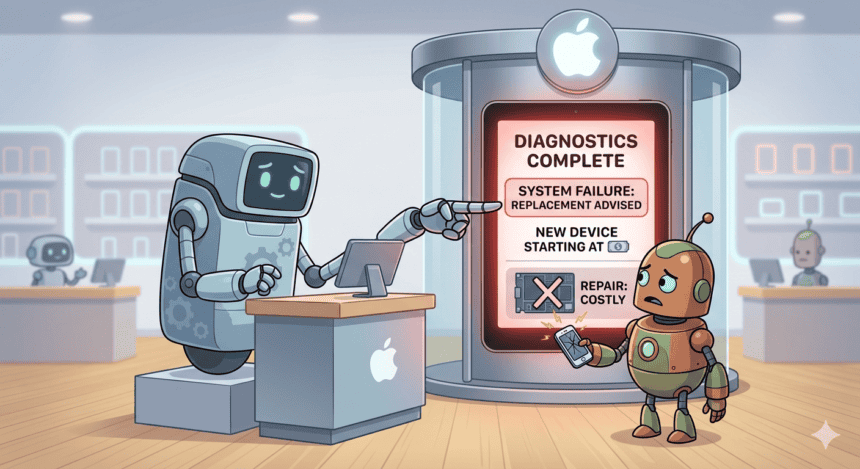

There is a particular kind of silence that settles over you at the Genius Bar. The store hums with white light. The tables are scrubbed aluminum. Somewhere behind a frosted glass wall, your laptop is being examined by a person with a lanyard and a confident manner. Then they come back. They set the machine down gently. They tell you, with what sounds like regret, that the logic board needs replacing. That the cost is close to buying a new computer. That fixing it in the store, in their words, is not really an option.
- The Machine Behind the Diagnosis
- The Liquid Contact Indicator Problem
- The Performance Pressure Nobody Calls Commission
- When the Diagnosis Gets the Math Wrong
- Parts Pairing: The Software Lock That Changes Everything
- The $109 Billion Motivation
- The Right to Repair Movement and What It Has Exposed
- What Independent Repair Actually Looks Like
- The Corrosion Question
- The Language of the Bar
- What You Can Actually Do
- The Larger Picture
You walk out lighter in the pocket and heavier in the chest. Maybe you can buy a new machine. Maybe you go home and let the old one gather dust in a drawer. What you probably do not do is take that same laptop down the street to an independent repair technician who bends a single misaligned pin back into place and hands it back to you in ten minutes, for free.
That is not a hypothetical. That is what happened in Toronto in 2018 when The National ran an undercover operation at an Apple Store. The MacBook Pro they carried in had a screen that had lost its backlight. The Genius Bar, after inspecting the liquid contact indicators, determined it would cost at least $1,200 to fix, possibly $1,980 if the display also needed replacing. They were told the store could not do partial repairs.
Louis Rossmann, the owner of a repair shop on First Avenue in Manhattan and a YouTube channel with millions of subscribers, examined the same machine minutes later. He found a bent pin in the display connector. He pressed it back. The screen lit up. His estimate for the job, in most cases: zero dollars.
“Ninety-nine per cent of the time, just bending the pin back, it’ll allow it to last until the end of the life of the computer.” — Louis Rossmann, independent repair technician
Apple, asked to comment by the CBC1, declined to provide a spokesperson but issued a statement saying customers are best served by Apple’s certified experts using genuine parts, and denied that the company systematically overestimates repair costs.
That denial has aged in a particular way. In the years since, the story has grown larger, not smaller. It has accumulated lawsuits, legislative battles, forum testimonials from people who were told their devices were unfixable and then fixed them cheaply elsewhere, and a growing body of evidence that suggests the gap between what Apple’s diagnostics recommend and what independent technicians actually find is not incidental. It is structural.
The Machine Behind the Diagnosis
The Genius Bar is not, technically, a repair shop. It is a customer service interface. According to MacRumors2, the actual diagnostic work is performed using Apple’s proprietary Apple Service Diagnostic (ASD) software, a tool that is not made available to the public and is not available to independent repair shops operating outside Apple’s authorized framework.
What this means in practice is that the diagnostic layer between your broken device and the repair estimate is controlled entirely by Apple. The technician running the test cannot deviate from what the software surfaces. If ASD flags a logic board as compromised, the Genius Bar will quote a logic board replacement. The question of whether the logic board actually needs replacing, whether the fault might be a two-cent capacitor or a bent connector pin, is not a question the software is designed to ask.
This is not a secret. On MacRumors forums, users have long noted that the Genius Bar uses ASD to test systems extensively, but the tool was never made available officially. Independent technicians have had to find it through other channels just to understand what Apple’s own repair infrastructure is seeing. The asymmetry is not accidental. It is the product.
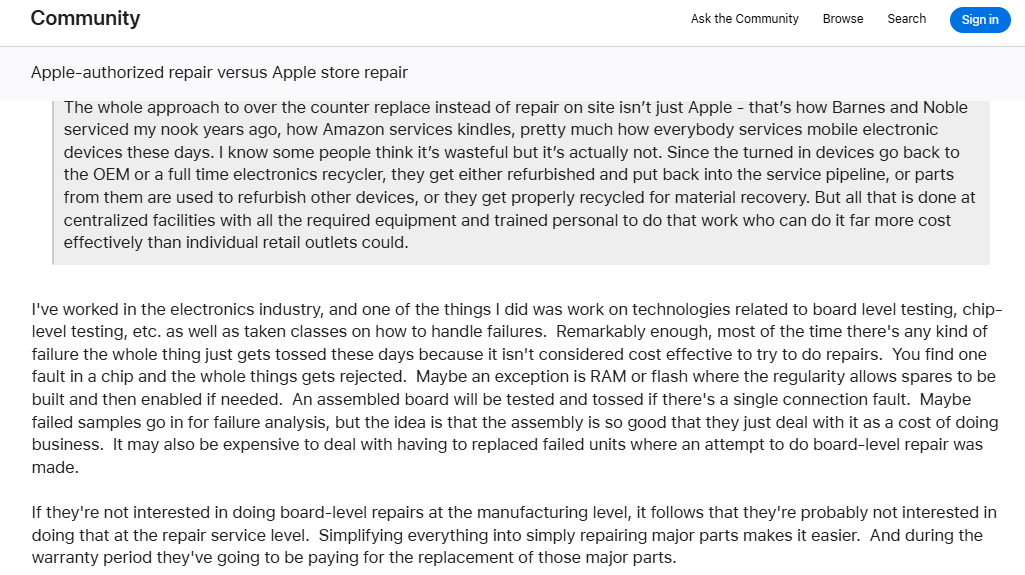
Apple’s repair model is built around whole-unit replacement rather than component-level repair. As one Apple community user3 explained:
“Remarkably enough, most of the time there’s any kind of failure the whole thing just gets tossed these days because it isn’t considered cost effective to try to do repairs.”
The logic, such as it is, holds internally: if a device has multiple potential failure points, replacing everything ensures reliability. But the cost of that reliability is transferred entirely to the customer.
The Liquid Contact Indicator Problem
There is a small sticker inside every iPhone and MacBook that Apple has ever made. It is called a Liquid Contact Indicator, or LCI. When dry, it is white. When it has been exposed to enough moisture, it turns red. A triggered LCI is Apple’s primary evidence of liquid damage, and a triggered LCI means, in most cases, that any warranty claim is void.
The problem is that these indicators can be triggered by humidity. Not by submersion. Not by a spilled coffee. By humidity alone, the kind you walk through every time you step outside on a warm day, the kind that exists inside a bathroom or a kitchen or a monsoon-adjacent city like mine.
Apple has known about this for a long time. According to Apple Insider4, in 2010, the company was sued in a class action that alleged Apple’s corporate policy required personnel to refuse warranty coverage to customers whose external LCI had been triggered, even though the indicators could not reliably distinguish between liquid submersion and ordinary humidity exposure. The suit raised questions about whether the indicators were designed to produce false positives and whether Apple was aware of the problem.
Across Apple’s own community forums5, the stories pile up. One user in 2017 wrote:
“It doesn’t matter who made the faulty sensors the fact is Apple says sensors can be triggered by humidity, getting hot or cold too fast and if triggered doesn’t mean the phone came into contact with liquid.”
The user added that despite Apple acknowledging this, their warranty was still being denied.
A repair technician posted in the same thread:
“Many things can cause the sensor to test positive for getting wet even though liquid wasn’t spilled on it. Heat, cold, working in basements… we still can’t do any repair.”
That final phrase is the crux of it. We still can’t do any repair. The indicator is not evidence. It is a gate. And the gate only opens one way: toward a replacement quote that is, as one Genius Bar employee told the CBC undercover team, “very close to the cost of buying a new computer.”
The Performance Pressure Nobody Calls Commission
Apple is very proud of the fact that its retail employees do not work on commission. It has been a marketing point since the first Apple Store opened in 2001, and it has genuine meaning. Unlike a car dealership or a phone carrier store, an Apple specialist does not get a direct financial bonus for pushing you toward the more expensive option.
But commission is not the only mechanism by which institutions shape individual behavior. There is also metrics.
A former Apple employee confirmed on AppleInsider forums6:
“I can confirm the attachment metrics… no commission but ALWAYS pressure to do better with something. You know, they train you to think you are there to help people but deep down inside they PUSH in subtle ways to just sell the hell out of everything they have.”
The specific metric at stake is AppleCare attachment rate: the percentage of device sales or service interactions that result in an AppleCare protection plan being added. Apple has tracked this religiously. A 2004 internal report leaked to AppleInsider7 showed Apple monitoring weekly AppleCare attach rates per store, comparing them to competitor figures, and circulating the results. During that period, Apple retail stores were attaching AppleCare to more than 57% of CPU purchases.
That attachment pressure has downstream consequences at the Genius Bar. When a customer arrives with a broken device, the conversation has two possible outcomes from a business standpoint. The first is a repair that costs the customer less money, keeps the device in use, and generates minimal ongoing revenue. The second is a replacement or upgrade that may include a new AppleCare plan, accessories, and setup services.
The Week’s8 reporting on Apple Store secrets noted:
“There may be no quotas, but former employees say selling service plans along with iGadgets is a must. Those who don’t ring up enough service plans are retrained, or given a different job.”
No commission. But a job requirement, functionally.
The Indeed9 reviews page for Apple Genius employees is studded with accounts that describe a gap between the company’s stated mission and its actual pressure points.
“I came into this job genuinely excited,” wrote one former Genius Admin. “I believed in the brand, loved the products… I thought it would be a cool, behind-the-scenes role helping things run smoothly at the Genius Bar. I was wrong.”
Another reviewer described the Genius Bar environment as “fast-paced” and noted the “constant pressures and expectations that can often feel overwhelming.” Session time, NPS scores, and repair success rates are all tracked. The invisible hand of performance management is always present, even if the commission check never arrives.
When the Diagnosis Gets the Math Wrong
The Apple Community forums are, if you know how to read them, one of the most honest documents in the history of consumer technology. Thousands of people have gone there over the years to describe what happened at the Genius Bar and what happened after.
One user described taking a MacBook Pro to the Genius Bar on Fifth Avenue in New York after the machine stopped responding. The technician, after fifteen minutes in the back, came out and quoted $450 for a logic board replacement, while also suggesting the five-year-old machine might not be worth investing in. The user, on the advice of a friend, took the machine to a local authorized repair shop instead. The technician there opened the back, disconnected and reconnected the battery. The MacBook booted immediately. The user bought a new iMac that they did not need.
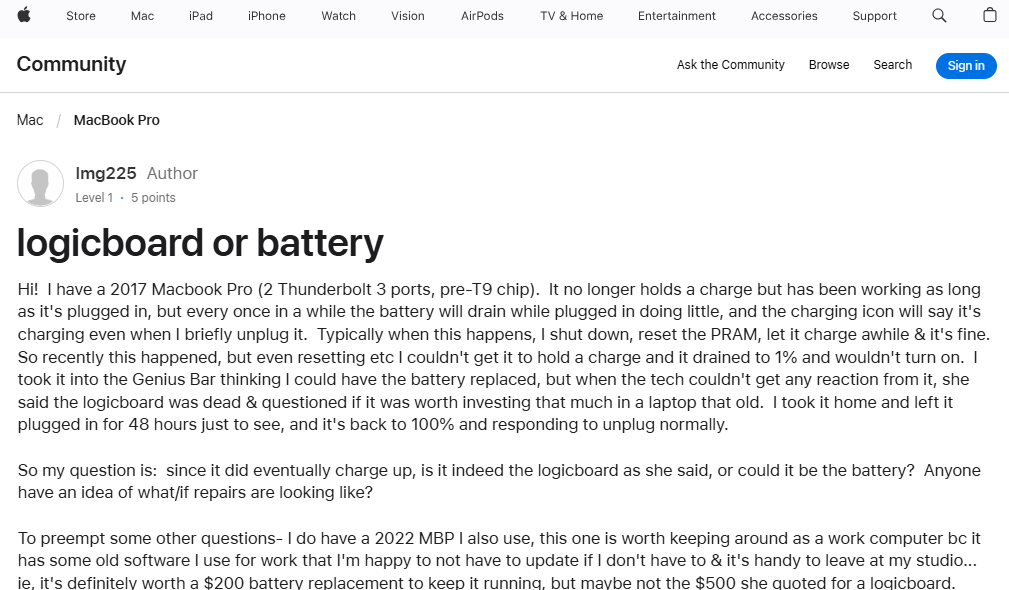
This is not an isolated case. On a discussion forum at Apple.com10 thread discussing a 2017 MacBook Pro, a user described taking their laptop to the Genius Bar, thinking the battery needed replacing. The technician, unable to get a reaction from the machine, declared the logic board dead and questioned whether it was worth repairing at all. The user took it home, left it plugged in for 48 hours, and it returned to 100% battery health and normal function.
The AnandTech forums11 contain a thread that has become something of a reference document for this conversation. Users describe being quoted large sums for repairs that turned out to be simple fixes, and one commenter put it plainly:
“The problem is, your ‘dead’ MacBook Pro may not be. It might just need a .02 cent fix that someone like Rossmann could fix in five minutes, but the Genius wouldn’t have a clue about or simply would never tell you about.”
The charge there, that Geniuses wouldn’t rather than couldn’t tell you, is the harder accusation to evaluate. The more charitable reading is structural: Genius Bar technicians are trained to run Apple’s diagnostic software, interpret its outputs, and quote from Apple’s parts catalog. They are not trained in board-level microsoldering. They do not have the tools to bend pins, reflow solder joints, or replace individual capacitors. The system they operate within has no category for a repair that costs nothing.
Parts Pairing: The Software Lock That Changes Everything
Even if you decide to take your device to an independent technician after a Genius Bar visit, Apple has engineered a set of obstacles to make that choice uncomfortable. The mechanism is called parts pairing, and it is one of the more quietly consequential technical policies in the consumer electronics industry.
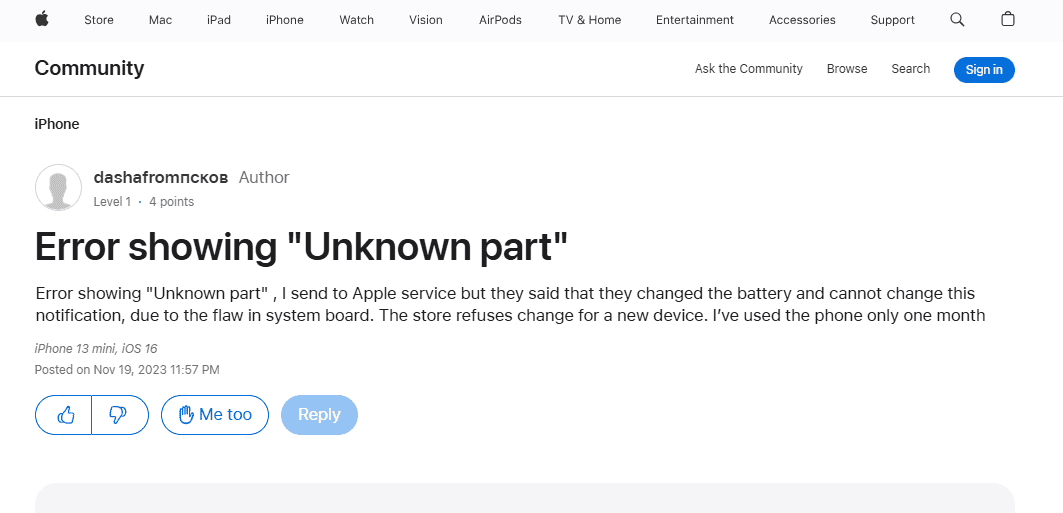
Parts pairing means that the hardware components inside an Apple device are cryptographically linked to that specific device’s serial number. When an unauthorized technician replaces a battery, a screen, or a camera module with a component that has not been paired through Apple’s System Configuration software, the device registers an “Unknown Part” warning. Features stop working. Battery health data disappears. Face ID may not calibrate correctly. The warnings persist through every reboot.
iFixit12, whose business depends on the health of the independent repair ecosystem, has documented this in detail. As they reported: “No matter how expertly you may install that battery, you lose features, and you’re stuck with dubious warnings. Of course, when Apple does the same procedure, they have access to the button that makes those problems go away. And therein lies the core issue of parts pairing.”
When Apple performs the same repair with an identical part, those warnings do not appear. The hardware is the same. The software treatment is entirely different. The practical effect is that every repair Apple’s own diagnostics recommend becomes harder to accomplish outside Apple’s ecosystem, which pushes customers back toward Apple’s pricing or toward replacement.
Oregon became the first state to ban parts pairing outright in its 2024 Right to Repair law, effective January 2025. According to Jason Garcia13, Apple quietly lobbied against similar legislation in Florida in 2025, where records show the company maintains 15 lobbyists. In Oregon, when lawmakers passed the first ban on parts pairing, Apple’s argument was that allowing the use of parts “of unknown origin” would “undermine the security, safety, and privacy” of users.
The security argument is worth examining. The component being paired is, in most cases, an Apple battery, an Apple screen, or an Apple camera module purchased through an authorized channel. The part is not of unknown origin. The origin is Apple. What is unknown, from Apple’s perspective, is whether the person who installed it went through an Apple-authorized process.
The $109 Billion Motivation
Apple’s services division generated $109.2 billion in revenue in fiscal year 2025 as reported by MarkHub2414, a figure that includes AppleCare, the App Store, iCloud, and Apple Pay, among other categories. Services revenue grew approximately 13.5% year over year and now represents more than a quarter of Apple’s total revenue.
The critical number is the margin. Services operate at significantly higher gross margins than hardware. Apple CFO Kevan Parekh said on the company’s January 2025 earnings call that the services business in aggregate is “accretive to the overall company margin.” In plain language: every dollar of services revenue contributes roughly twice the profit of a hardware dollar.
AppleCare sits inside the services segment. It is not broken out separately in Apple’s disclosures, but its role in that margin picture is not incidental. A customer who buys a new device and an AppleCare plan is, from a margin standpoint, a significantly better outcome than a customer whose existing device is repaired cheaply and kept running for another three years.
None of this proves that individual Genius Bar technicians are consciously steering customers toward replacements to serve a corporate margin agenda. The incentive structure works at an institutional level, not an individual one. But it does establish that the economic logic of Apple’s business points clearly in one direction, and that direction is away from repair.
The Right to Repair Movement and What It Has Exposed
The right to repair movement did not emerge from nowhere. It emerged from people who kept showing up at Genius Bars and walking out with quotes they could not afford, then watching someone on YouTube fix the same device for the cost of a cup of coffee.
Louis Rossmann became the face of that movement partly by accident. His videos, in which he diagnoses and repairs MacBook logic boards while explaining what went wrong in plain language, attracted millions of viewers not because electronics repair is inherently fascinating but because they revealed something most people had not understood: that the devices they were being told were dead were often not dead.
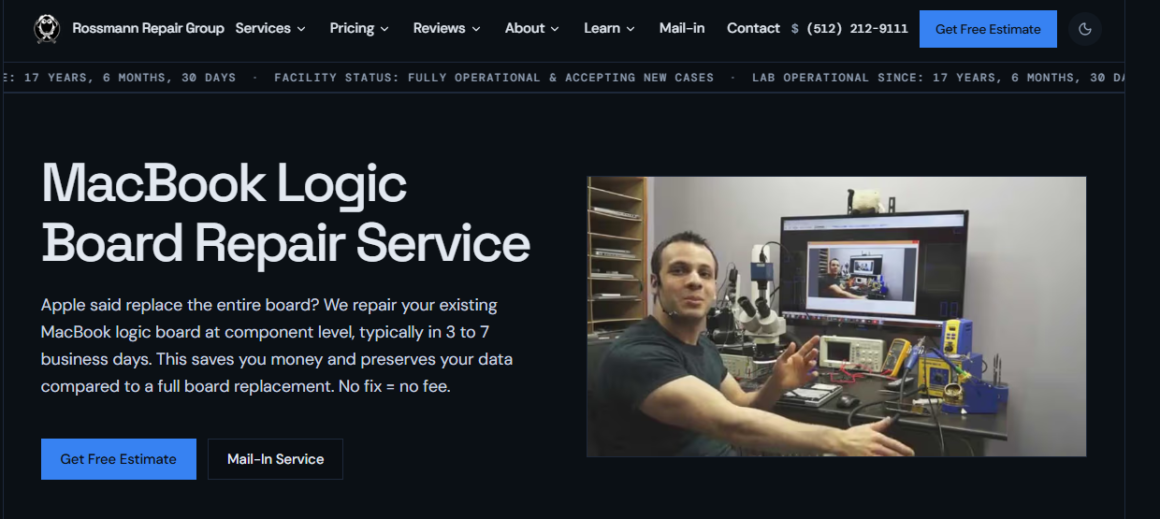
The Right to Repair movement pushed for legislation requiring manufacturers to provide diagnostic tools, repair manuals, and replacement parts to the public and to independent repair shops. The movement’s implicit argument was that the repair ecosystem was being deliberately constrained, and that the diagnostic layer was a key mechanism of that constraint.
As the Repair Association15 noted:
“Apple has been known to lock certain diagnostic features behind proprietary software, accessible only by authorized providers.”
When Apple announced it would provide diagnostic tools to independent shops as part of its concessions under California’s Right to Repair Act, the Repair Association welcomed it, while noting that the devil would be in the details of what exactly those tools could and could not do.
The EU moved more aggressively. The EU Right to Repair Directive, finalized in July 2024 and set to become law across all EU countries by July 2026, requires manufacturers to provide repair manuals, diagnostic tools, and spare part pricing information. It explicitly prohibits using software or hardware techniques to impede repair. Apple expanded its Self Service Repair program to 32 European countries in June 2024 in partial response to this pressure.
In the United States, the legislative picture is messier but moving. According to iFixit16, Right to Repair bills have now been introduced in all 50 US states, with over 40 bills in at least 20 states proposed or passed in 2025 alone. New York’s Digital Fair Repair Act took effect in December 2023. California’s Right to Repair Act followed in July 2024.
Apple’s response has been, to put it diplomatically, calibrated. The company backed California’s bill while simultaneously lobbying for carveouts. It was announced in April 2024 that iOS 18 devices could accept used genuine parts with a new Repair Assistant tool. iFixit tested the implementation in October 2024 and found it “promising but flawed”: Face ID still would not calibrate correctly, activation-locked parts remained unusable, and third-party parts continued triggering warnings.
What Independent Repair Actually Looks Like
Walk into Rossmann Group on First Avenue in Manhattan, or into any of the hundreds of independent repair shops that have built their reputations partly on fixing things Apple said were unfixable, and you enter a different logic entirely.
CBC17 reported how the Rossmann approach involves board-level diagnosis: looking at what is actually broken, not what a diagnostic category suggests might be broken. It involves free estimates. It involves telling customers when a repair is not worth doing, which happens, but it also involves finding out that most of the time it is.
In one Hacker News discussion18 of the CBC investigation, a commenter offered a defense of the Genius Bar that is worth taking seriously:
“An Apple store tech is going to swap out parts with OEM replacements because the customer is sitting at the Genius Bar waiting for their stuff to be fixed. Also, Apple gives a worst-case price quote. If the tech in back just needs to swap out a cable, then you won’t actually be charged the $1,200.”
That is a fair point, and it complicates the narrative. The Genius Bar is not a scam in the crude sense. There are genuine technicians there who are genuinely trying to help. The company has processes, certified parts, and accountable service. An independent repair shop may fix your device cheaply and confidently and then tell you eighteen months later, when something else fails, that it has nothing to do with them.
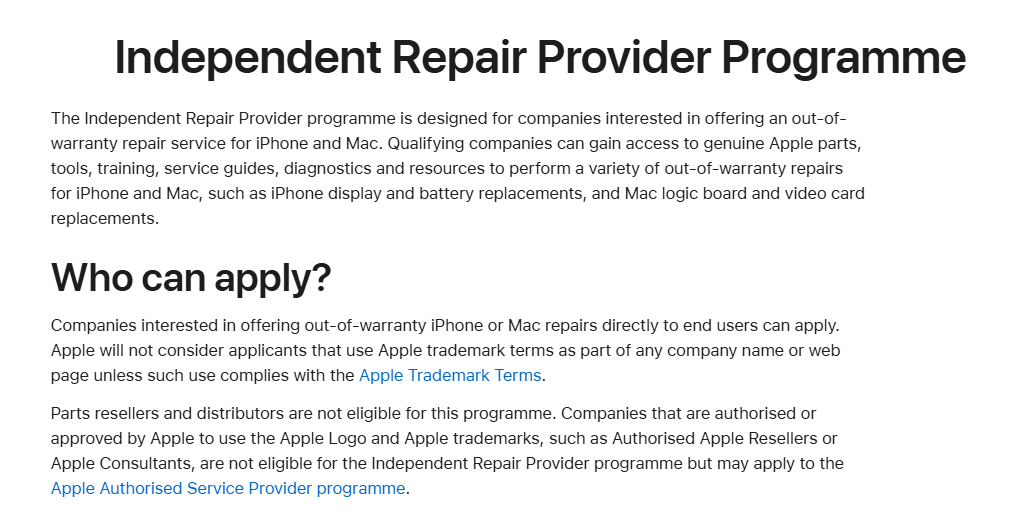
But the structural reality remains. As the AppleInsider forums19 observed, even when Apple opened its Independent Repair Provider program to third-party shops, it explicitly excluded circuit-level diagrams. Repair shops would still be limited to full assembly swaps. The logic board you replace will always be a logic board, not the specific chip on the logic board that stopped working. The system is designed that way.
The Corrosion Question
There is a recent case that captures the current state of the issue with particular clarity. A user on MacRumors20 in September 2025 described taking a MacBook Pro in for a routine battery replacement covered under AppleCare. Two days later, they received a call. The Genius Bar had found evidence of corrosion on the logic board during the inspection and was now demanding payment for that additional repair before proceeding.
The user, who had spent time in a humid Southeast Asian country several years earlier, noted that the MacBook had functioned perfectly for four years since the humidity exposure had occurred and passed without incident. Their question was simple: why could Apple not just replace the battery, leave the logic board alone, and hand the machine back?
The answer, which the thread explored at length, is that Apple’s policy in cases of detected liquid or corrosion damage is to treat the device as a holistic liability. If they repair the battery and the corroded logic board subsequently fails, Apple is potentially on the hook for the failure. If they refuse to complete the repair without addressing every identified concern, they limit their exposure. The customer, in this logic, becomes the bearer of all downstream risk.
Whether or not that logic is defensible from a warranty standpoint, the effect from the customer’s perspective is straightforward: a covered repair becomes a gateway to an uncovered one, and the device that was supposed to be fixed under a paid insurance plan now comes with a supplemental invoice or sits unrepaired in a box.
The Language of the Bar
Apple’s employee training manuals have leaked periodically over the years, and they reveal a company that thinks very carefully about the language its representatives use. The Week’s21 account of Apple Store training noted that Genius Bar employees are trained to avoid negative language entirely. They are instructed to say “as it turns out” rather than “unfortunately.” When they cannot solve a technical issue, they are told to frame it as a discovery rather than a failure.
This is not sinister on its face. Language training in customer service is standard practice, and softening bad news is a human kindness. But the specific configuration of this language, applied in a context where the bad news is usually a large repair bill, has a particular effect. It keeps the interaction pleasant. It keeps the customer from feeling attacked or dismissed. It does not, however, change the recommendation.
The manual’s instruction to listen to emotional customers with simple reassurances like “Uh-huh” and “I understand” while limiting substantive responses is a technique drawn from de-escalation training. It is useful when a customer is being unreasonable. It is worth examining when the customer is simply asking questions about a diagnosis they do not fully understand and are not being given the tools to evaluate.
One of the things I keep returning to, having read through years of forum posts and community threads and undercover investigations, is how rarely customers think to ask for a second opinion before accepting a Genius Bar diagnosis. We have been trained, by years of Apple’s retail experience design, to trust the bar. The table is scrubbed aluminum. The employee has a lanyard. The diagnostic software is proprietary. The whole system whispers: this is the end of the inquiry. It is not.
What You Can Actually Do
The practical question, for anyone who walks out of an Apple Store with a repair quote that feels too large, is what to do next. The answers have become clearer as the repair ecosystem has matured.
The first step is to understand what Apple’s diagnostic software found versus what it recommended. The finding (a triggered liquid contact indicator, a flagged component in ASD, evidence of corrosion) is not the same as the recommendation (replace the logic board, replace the display assembly, replace the device). Ask the technician to explain specifically which component failed the diagnostic test, and why that failure requires whole-assembly replacement rather than component repair.
The second step is to get a second opinion. Independent repair shops that specialize in Apple products, and in particular those that perform board-level repairs rather than whole-assembly swaps, often diagnose the same machine differently. According to Apple Support22, the Independent Repair Provider program has made genuine Apple parts available to some independent shops since 2019, meaning parts quality is no longer a definitive argument in Apple’s favor.
The third step is to understand your rights. In states where Right to Repair legislation has passed, and in EU countries, manufacturers are increasingly required to provide repair information and parts access. The EU’s Right to Repair Directive explicitly bans the use of software techniques to impede repair. Oregon’s 2024 law bans parts pairing. These are meaningful protections, and invoking them, where applicable, changes the conversation.
The fourth step, the one nobody wants to do but which is often the most effective, is to wait. Technicians who have spent years fixing Apple devices describe cases where machines declared dead by the Genius Bar came back to life after being left to charge, after an SMC reset, after 48 hours of rest. Not always. But often enough to be worth trying before spending $900 on a logic board replacement.
The Larger Picture
Apple is not uniquely villainous in this landscape. Every major electronics manufacturer controls its own repair ecosystem to some degree. Samsung has its own parts pairing practices. Google’s Pixel devices carry their own restrictions. The right to repair movement is aimed at the industry as a whole, not one company in particular.
But Apple occupies a specific place in this story because of scale and because of brand architecture. The Apple Store experience, with its emphasis on trust, simplicity, and the Genius Bar as a place of expert authority, creates a customer relationship in which the diagnostic recommendation carries unusual weight. When a company has spent twenty years teaching its customers to rely on a single point of contact for all hardware decisions, the question of what that point of contact is optimized for becomes a serious one.
According to Apple Magazine23, the services business generated $109 billion in 2025. The service margin is higher than the hardware margin. AppleCare is part of the services. The diagnostic system that feeds AppleCare attachment rates is proprietary. The independent repair ecosystem that competes with that system has been constrained through parts pairing, tool access restrictions, and aggressive lobbying against legislation that would open it up.
None of those facts, taken individually, proves that the Genius Bar is designed to mislead customers. Taken together, they describe a system whose incentives align consistently in one direction. That direction is away from the cheap repair and toward the new device, the extended warranty, and the services subscription. Individual Geniuses may operate with complete integrity within that system. The system itself has a different agenda.
The bent pin in the Toronto MacBook cost nothing to fix. The Genius Bar quoted $1,200. Louis Rossmann bent it back in two minutes. Apple declined to comment.
That gap, between what is broken and what we are told is broken, between what a repair costs and what we are charged, is not a gap in knowledge. It is a gap in incentives. And until the diagnostic tools, the parts catalogs, and the repair manuals are fully open, we have only the word of the person with the lanyard to go on.
Sources
- Shprintsen, Alex. “’Complete control’: Apple accused of overpricing, restricting device repairs” 21 Oct. 2018, www.cbc.ca/news/thenational/complete-control-apple-accused-of-overpricing-restricting-device-repairs-1.4859099. Accessed 31 May 2026. ↩︎
- MacRumors, forums.macrumors.com/threads/how-do-the-guys-at-the-genius-bar-check-our-macbooks-hardware.1884969/. Accessed 11 Apr. 2026. ↩︎
- Black, Michael. “Apple-authorized repair versus Apple stor…” Apple Community, 19 Feb. 2020, discussions.apple.com/thread/251138228. Accessed 11 Apr. 2026. ↩︎
- Apple Insider, appleinsider.com/articles/10/04/16/apple_sued_over_use_of_moisture_indicators_to_deny_free_repairs. Accessed 11 Apr. 2026. ↩︎
- CK, Sam. “Water Damage Or Product Defect?” Apple Community, 3 Aug. 2013, discussions.apple.com/thread/5113982. Accessed 11 Apr. 2026. ↩︎
- Apple Insider, forums.appleinsider.com/discussion/118813/competitive-secretive-world-of-apple-store-employees-profiled. Accessed 11 Apr. 2026. ↩︎
- Apple Insider, appleinsider.com/articles/04/05/03/apple_struggles_to_achieve_compusa_attach_rates. Accessed 11 Apr. 2026. ↩︎
- Staff, The Week. “Revealed: 10 big Apple Store secrets” The Week, 16 June 2011, theweek.com/articles/483963/revealed-10-big-apple-store-secrets. Accessed 11 Apr. 2026. ↩︎
- Indeed, Indeed.com, www.indeed.com/cmp/Apple/reviews?fjobtitle=Genius. Accessed 11 Apr. 2026. ↩︎
- Galt, John. “Logicboard Or Battery” Apple Community, 28 Sept. 2022, discussions.apple.com/thread/254232147. Accessed 11 Apr. 2026. ↩︎
- “Apple Genius Bar repair ripoff.” AnandTech Forums: Technology, Hardware, Software, , 16 Oct. 2018, forums.anandtech.com/threads/apple-genius-bar-repair-ripoff.2555390/. Accessed 11 Apr. 2026. ↩︎
- Greenlee, Lauren. “How Parts Pairing Kills Independent Repair” IFixit, 11 Apr. 2026, www.ifixit.com/News/69320/how-parts-pairing-kills-independent-repair. Accessed 11 Apr. 2026. ↩︎
- Garcia, Jason. “Apple quietly lobbied to stop ‘Right to Repair’ bill, records show” 17 July 2025, jasongarcia.substack.com/p/apple-quietly-lobbied-to-stop-right. Accessed 12 Apr. 2026. ↩︎
- Hub24, Mark. “Apple Inc.: Services Revenue as a Margin Expansion Strategy” MarkHub24, 11 Mar. 2026, www.markhub24.com/post/apple-inc-services-revenue-as-a-margin-expansion-strategy. Accessed 31 May 2026. ↩︎
- Zieminski, Matt. “The Tide is Turning: Apple’s Right to Repair Concession is a Big Win, But Don’t Unpack Your Toolkits Just Yet — The Repair Association” 25 Oct. 2023, www.repair.org/blog/2023/10/25/the-tide-is-turning-apples-right-to-repair-concession-is-a-big-win-but-dont-unpack-your-toolkits-just-yet. Accessed 15 Apr. 2026. ↩︎
- Cooper, Liz. “How Right to Repair Laws Can Reduce E-Waste” Human-I-T, 18 Mar. 2026, www.human-i-t.org/right-to-repair-e-waste/. Accessed 15 Apr. 2026. ↩︎
- Shprintsen, Alex. “’Complete control’: Apple accused of overpricing, restricting device repairs” 21 Oct. 2018, www.cbc.ca/news/thenational/complete-control-apple-accused-of-overpricing-restricting-device-repairs-1.4859099. Accessed 31 May 2026. ↩︎
- “Allegations of overpriced repair charges at Apple Store ” Hacker News, news.ycombinator.com/item?id=18211161. Accessed 31 May 2026. ↩︎
- AppleInsider, “Just a moment…” forums.appleinsider.com/discussion/212660/apple-opening-up-repair-parts-and-tools-to-more-third-party-repair-shops. Accessed 31 May 2026. ↩︎
- “Repair Question: Is this actually a corroded logic board, and who could replace just the Battery + Top Case without touching the logic board?” MacRumors Forums, 24 Sept. 2025, forums.macrumors.com/threads/repair-question-is-this-actually-a-corroded-logic-board-and-who-could-replace-just-the-battery-top-case-without-touching-the-logic-board.2467428/. Accessed 7 May 2026. ↩︎
- Staff, The Week. “Revealed: 10 big Apple Store secrets” The Week, 16 June 2011, theweek.com/articles/483963/revealed-10-big-apple-store-secrets. Accessed 7 May 2026. ↩︎
- “Apple Repair and Repair Status Check” Apple Support (CA), support.apple.com/repair. Accessed 7 May 2026. ↩︎
- Apple Magazine, applemagazine.com/apple-services-growth-02/. Accessed 7 May 2026. ↩︎


