

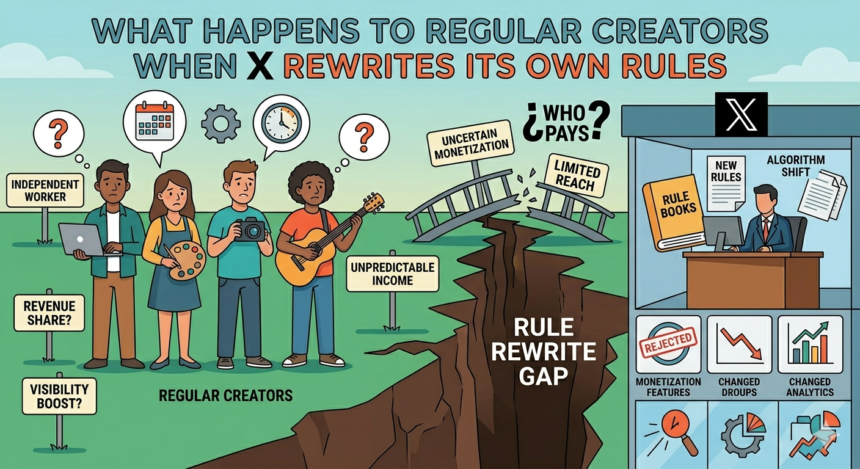

Sometime in October 2024, a writer on X woke up to a pay cut she did not ask for and was not warned about. Her engagement numbers had held steady. Her follower count had grown. Her posting frequency had not changed. But her monthly revenue from X’s creator program had fallen by roughly forty percent.
- The Promise That Started It All
- The Formula Nobody Published
- Four Major Changes in Three Years
- The Advertiser Problem the Creators Are Paying For
- The Engagement Farming Trap
- What Creators Are Actually Making
- Creators Without Borders: The Regional Pay Divide
- The Suspension Problem: Revenue Paused, No Explanation
- The Contract That Protects Nobody But X
- What the Forum Threads Tell You
- The Circular Logic of Premium
- Where This Leaves the Creators
She spent two days trying to understand why. She filed a support request. She got an automated reply. She searched the platform’s newsroom and eventually found an announcement buried in the feed of X’s official account: the company had switched from an ad-revenue-sharing model to a system based on engagement from Premium subscribers. The change had been announced on October 9th. It went live on November 8th. Nobody emailed her. Nobody sent a notification. The formula that determined her income had simply changed.
I have been thinking about her experience for months, because it is not unusual. It is the template. Since Elon Musk acquired Twitter for $44 billion in October 2022 and rebranded it as X, the platform has changed its creator monetization rules at a pace that no one outside the company can reliably track. The formula has been overhauled at least four distinct times in roughly three years. Eligibility thresholds have moved up and down. The revenue pool has been redefined. Geographic weighting has been proposed, sparked a global revolt, and been paused within a single working day. Payouts that were once tied to ad impressions are now tied to Premium subscriber engagement, which itself is now being quietly adjusted to favor what X calls ‘Verified Home Timeline impressions.’
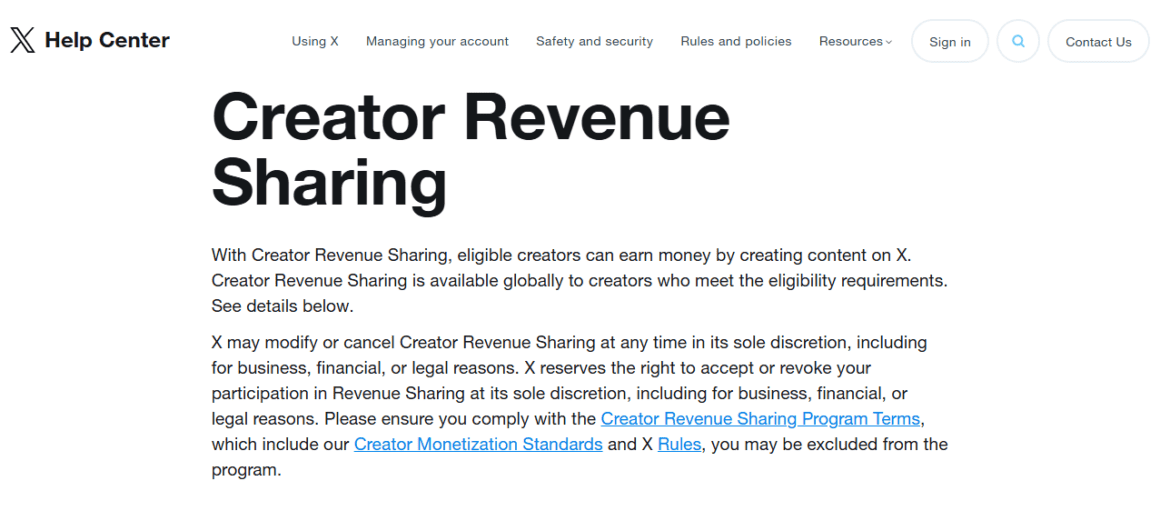
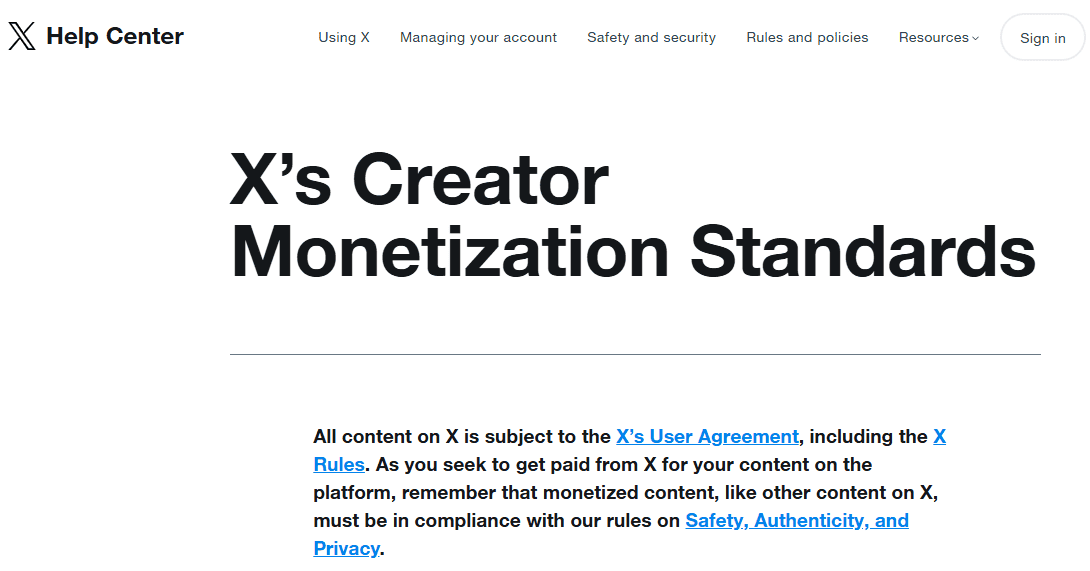
Through all of this, the creators whose livelihoods depend on the platform have been told very little. There is no changelog. There is no advance notice requirement. The company’s Terms of Service give it the right to modify the program at any time, for any reason, with the only obligation being to post an update somewhere on the platform that most creators will never see.
This is a story about what happens when you build a business on rented land. And it is a story about why the landlord keeps moving the property lines.
The Promise That Started It All
The Creator Revenue Sharing program was announced in July 2023 with the energy of a press release for a gold rush. Elon Musk had been trying to lure major content creators to X since before the rebranding was complete. He had publicly wooed MrBeast, the YouTube megastar. He had talked about turning X into an ‘everything app’ that would pay creators the way YouTube had never dared to. And in the summer of 2023, the program launched.
The early numbers looked good, selectively. A report by Search Engine Land1 documented that lawyer and creator Robert Freund, who had fewer than 8,000 followers, earned $291 in July 2023. YouTube creator Roberto Blake, with 87,000 subscribers, earned $307. These numbers were reported widely, as they were meant to be. They made the program sound accessible, generous, and fair.
What nobody discussed in the initial excitement was the structural problem sitting underneath the headline figures. The program was built on a foundation of advertising revenue. And X’s advertising business had already begun to collapse.
According to MM+M2, X’s advertising revenue dropped 46.4 percent between 2022 and 2023, falling from $4.5 billion to $2.2 billion. By 2024, it had fallen further to an estimated $2 billion. WARC estimated that X had lost a hypothetical $5.9 billion in ad revenue overall since the Musk acquisition, compared with what it would have earned had it maintained pre-acquisition growth trends relative to the wider social media market. Instagram was growing its ad revenue by nearly 25 percent over the same period. Snapchat was up 14 percent. Pinterest was up 18 percent. X was falling off a cliff.
The UK numbers make it even plainer. Financial filings cited by Fortune3 showed that X’s UK arm posted revenue of just $39.8 million for the year ending December 2024, down from $95.2 million in 2023. That is a 58 percent drop in a single year. The filings themselves acknowledged what was happening, noting a decline ‘primarily driven by a reduction in spend from large brand advertisers due to concerns about brand safety, reputation, and/or content moderation.’
A creator revenue-sharing program funded by advertising revenue, running on a platform with a collapsing advertising business, was always going to produce volatility. What nobody told the creators signing up was just how volatile it would get.
The Formula Nobody Published
Here is the thing about X’s payout formula: it does not exist in any publicly accessible document. The platform does not publish the calculation. It does not offer a breakdown of how individual payouts are derived. It does not show you your monetizable impressions separate from your total impressions. As a detailed analysis on Medium4 put it, the system is built so that ‘X does not publish an official public formula,’ and whatever estimate we have of how it works comes from ‘creator reports, and observed payout patterns’ rather than any formal disclosure.
What we know, from those same observed patterns, is something like this: Your payout is calculated as a proportional share of a total creator revenue pool for each pay cycle. That pool is derived either from advertising revenue (under the old model) or from a percentage of Premium subscription revenue (under the new model). Your share of the pool depends on how much of the total premium engagement in that cycle came from interaction with your content. Because it is proportional, your payout can fall even if your own numbers stay constant, simply because other creators had an unusually strong cycle and took a larger share of the pot.
There is no publicly visible live running balance that updates in real time. Earnings are credited after each payout window closes. The formula changed multiple times between 2023 and 2025.
This proportional structure creates a problem that is almost impossible to plan around. You can have a record month for engagement and still receive less money than the previous month, because the pool shrank, or because more creators were competing for the same pool, or because X quietly adjusted the weighting of different types of engagement. You will not be told which of these things happened. You will simply receive a lower number.
The lack of transparency was apparent from the program’s first month of payouts. Social Media Today5 noted in August 2023 that X’s initial payments came with almost no information attached: no impression counts, no reach stats, no reporting periods. The platform eventually added slightly more detail to its payout listings, but the underlying calculation remained hidden. Creators were expected to trust a number that appeared in their account, with no means of verifying how it had been reached.
Four Major Changes in Three Years
Let me lay out the timeline as plainly as I can, because the pace of change is itself the story.
The program launched in mid-2023. At that point, the model was straightforward, at least in concept: creators would earn a share of ad revenue from ads displayed in the replies to their posts, but only ads shown to Premium subscribers counted. TechCrunch6 reported in August 2023 that X lowered the follower requirement from 5,000 to 500 to qualify for the program, in what sounded like a democratizing move. But that came with a simultaneous caveat: creators still needed 5 million organic impressions in the prior 90 days, a bar that excluded the vast majority of the people the follower-count reduction was supposedly welcoming in.
In the autumn of 2023 and into 2024, something else was happening that the company did not advertise. Payouts were declining. The advertising exodus was accelerating. A record number of advertisers were pulling spend, according to a Kantar7 global survey that found only 4 percent of marketers felt X offered brand safety. That same survey found 26 percent of advertisers planned to reduce their X spending in 2025. The revenue pool available for creator payouts was shrinking even as the number of creators in the program was growing.
Then came October 2024 and what X called ‘the biggest update to Creator Revenue Sharing yet.‘ As Social Media Today8 documented, the platform announced it was abandoning ad-revenue sharing entirely. Instead, creators would be paid based on engagement with their content from Premium users.
Ads in replies will no longer impact your payout,’ the platform announced.
The new system went live on November 8, 2024. No advance notice to individual creators. No email. No guaranteed transition period.
Creators! We’re excited to unveil our biggest update to Creator Revenue Sharing yet.
— X (@X) October 9, 2024
Payouts are increasing and you'll now be paid based on engagement with your content from Premium users – not ads in replies.
Here’s what’s changing:
December 2024 brought another adjustment. X quietly raised the minimum verified follower threshold from 500 to 2,000, a change that stripped eligibility from many smaller creators who had structured their activity around the existing threshold. The company’s public justification was that it wanted ‘to focus on making our top creators successful.’ Creators who had already done the work of reaching 500 verified followers, which had been the stated requirement, were told retroactively that the floor had moved.
January 2026 brought the next overhaul. TechExclusive9 reported that X announced it had doubled its revenue-sharing pool, citing growth in Premium subscriptions. Payouts would now be tied to ‘Verified Home Timeline’ impressions, meaning views of posts in the main feed rather than reply-based engagement. The company called 2026 ‘the year of the creator.’ The change sounded positive. But it came without any documentation of what exactly the new formula was, and without any commitment to not changing it again.
And then, in March 2026, came the episode that makes the entire history of the program impossible to ignore. As TechCrunch10 reported, X’s Head of Product Nikita Bier announced a new weighting system that would give more payout credit to impressions from a creator’s home region. Foreign audiences, even loyal, paying Premium subscribers in the United States, would count for less. The rationale was that the platform wanted to ‘encourage content that resonates with people in your country’ and reduce incentives for creators to chase American audiences.
The backlash was immediate and global. Within hours, creators across Africa, Europe, and Latin America were posting about the financial consequences. One creator noted that 43 percent of their engagement came from US users. Another from France explained that they posted in English to reach a global readership. Bier had also specifically invoked Nigeria as a case study of engagement manipulation, saying he wanted ‘fewer Ivanka Trump fan accounts based in Nigeria, and more Nigerians sharing their thoughts about Nigeria.’ That comment landed hard.
By the end of the same day, The Cable11 reported that Elon Musk had posted a two-sentence reversal on the platform:
‘We will pause moving forward with this until further consideration.’
The rollout was suspended indefinitely. A policy that would have materially affected the livelihoods of thousands of creators had been announced, triggered a revolt, and been reversed within a single working day. The creators who had begun panicking at breakfast were, by evening, told to stand down.
The Advertiser Problem the Creators Are Paying For
It is worth pausing here to understand what is actually driving all of this turbulence, because it is not primarily about creators. It is about advertisers. When Musk took over Twitter in late 2022, he immediately began cutting staff, loosening content moderation, and promoting a philosophy of radical free speech. Within weeks, major brands began pulling advertising. Within a year, according to Fortune12, X’s quarterly ad revenue had fallen from more than $1 billion to roughly $600 million.
In November 2023, Musk personally endorsed an antisemitic post on the platform. IBM, Apple, Disney, Paramount, and dozens of other major advertisers suspended their spending. A Kantar survey cited by multiple outlets13 found that only 4 percent of marketers trusted X to be brand safe. That compared to 39 percent for Google. X filed a lawsuit against the Global Alliance for Responsible Media, accusing advertisers of an illegal boycott. The lawsuit was eventually dropped. The advertisers did not return.
What this meant for creators was that the foundation of their income was collapsing beneath them in real time, through no fault of their own. A creator who had built an audience, optimized their content for the ad-revenue-sharing model, and begun treating their X payouts as income was now watching that income decline not because they had done anything differently, but because Elon Musk had made the platform hostile to the companies that funded the pool they were drawing from.
The October 2024 switch to Premium-based payouts was, at least in part, a direct response to this. As Tubefilter14 reported, the shift insulated the creator monetization program from the advertising exodus, but it also moved creators to a significantly smaller pool. Under the ad model, even a shrinking ad business was still a multi-billion-dollar industry. Under the Premium model, the pool comes from subscription revenue. X said it would share ‘up to 25%’ of Premium subscription revenue with creators. If you have approximately 2 million Premium subscribers paying an average of $8 per month, 25 percent of that is $4 million per month, split across more than 150,000 participating creators. The average creator share is around $27 per month. The ‘whales’ take most of it.
The math is not being hidden. It is just not being presented plainly. X announces changes in the language of opportunity: bigger pools, more payouts, better alignment between creators and the platform. The reality is that the pool, while growing modestly as Premium subscriptions increase, is structurally much smaller than what an ad-funded model could deliver, and the distribution within that pool is heavily skewed toward a small number of high-engagement accounts.
The Engagement Farming Trap
There is a deeper problem with the model that goes beyond the money. The structure of X’s creator program does not just reward creators. It shapes what they create. And the shape it is pushing things toward is not good.
When payments were tied to ad impressions in replies, the incentive was simple: generate replies. The most reliable way to generate replies on X is not to write insightful analysis or report the news. It is to provoke. A controversial post, a hot take designed to make half your audience agree and the other half furious, will generate more replies in twenty minutes than a carefully reported thread generates in a week. Multiple outlets documented that controversial content had already increased markedly since the program began, with creators openly describing their strategies for using divisive content to generate high-engagement, high-revenue posts.
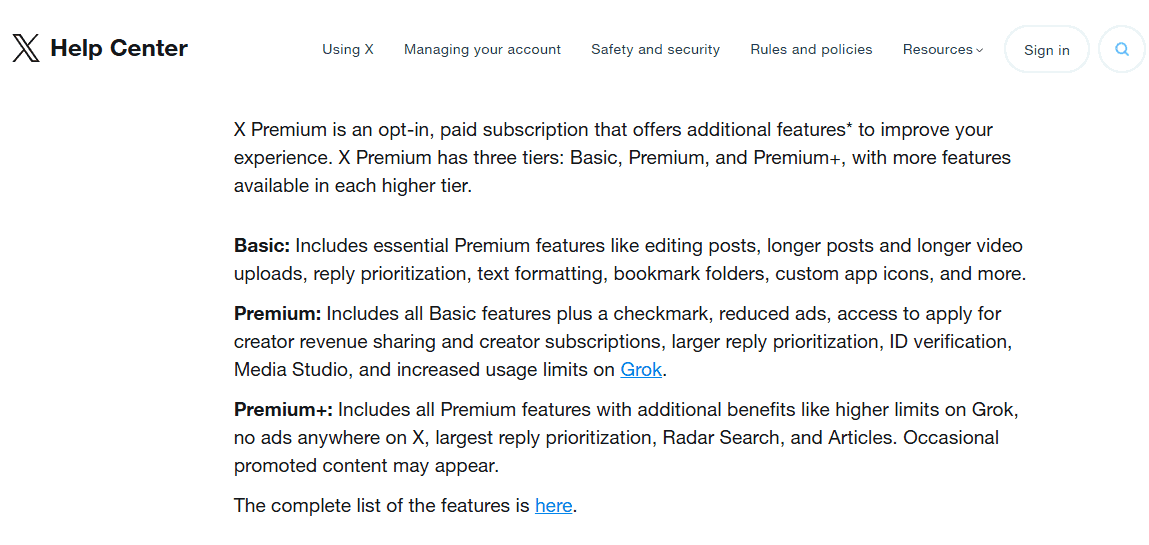
When X shifted to engagement-based payouts from Premium subscribers, the incentive structure did not get better. It got more complex. Now the question was not just ‘how many replies can I generate’ but ‘how many replies from Premium subscribers.’ Premium subscribers are disproportionately male, politically engaged, and English-speaking, with a skew toward American and Japanese users, the two markets with the highest CPM values. As one creator analysis on MakeUseOf15 noted, ‘on a platform already besieged by engagement farming, rewarding engagement seems an odd choice.’ But odd choices are what you make when your advertising business has cratered, and you need to keep your creator base from leaving for YouTube.
When you build a system that pays per engagement, you should not be surprised when people optimize for engagement at the expense of everything else. That is not a human failing. That is a rational response to the incentive.
The January 2026 switch to ‘Verified Home Timeline impressions’ was described as a correction to this problem, a way to reward content that gets into feeds organically rather than content that manufactures replies. But TheStreet16 reported that Musk himself acknowledged in late 2025 that the earlier version of the program had incentivized engagement hacks rather than quality posts. The new system was, in other words, an attempt to fix a problem the old system had created. But nobody went back to the creators who had watched their income fall during the ad-revenue crisis and said: We changed the rules in a way that hurt you, and here is what we are doing about it.
What Creators Are Actually Making
Let me give you the numbers as honestly as they can be given, because honest numbers are hard to come by on this topic. According to a detailed analysis by PostEverywhere17, X pays approximately $8 to $12 per one million verified-user impressions under the ad-revenue model. For context, YouTube’s RPM (revenue per thousand views) ranges from $3.50 to $40, meaning a creator on YouTube earns between $3,500 and $40,000 per million views, depending on their niche. X’s payout works out to a CPM of less than one cent.
The early high payouts that generated so much press were, in some cases, retroactive calculations covering extended periods of content. They were not representative of ongoing monthly income. An analysis18 noted that X’s total reported payouts had reached $45 million by March 2024, which was already $5 million less than what consistent $5 million-per-month payouts would have produced. Payouts were declining even before the major model switch in late 2024.
For large creators with 100,000 to 500,000 followers, estimates put quarterly ad-revenue-sharing payouts at $500 to $3,000. That is a wide range, reflecting the enormous variance in how much of any given creator’s audience is Premium-subscribed and active. For creators below 50,000 followers, payouts are typically in the tens of dollars per month, assuming they meet the 5 million impression threshold at all.
Under the Premium-based model, the math is even starker. Tubefilter19 did the arithmetic plainly: if X has 2 million Premium subscribers at $8 per month on average, 25 percent of that is $4 million per month. Split across 150,000 or more creators, and accounting for the heavy skew toward top earners, most creators are looking at income that does not justify treating X as a primary platform. The creators who are making real money from X, and some are making significant money, are mostly using the platform as a distribution channel to drive traffic to Substack, paid communities, sponsorships, or merchandise. The platform payout itself is, for most, a secondary consideration.
That reality sits uncomfortably against X’s marketing of its creator program. The platform routinely announces new initiatives, bigger pools, and higher potential earnings. In January 2026, it offered a $1 million payout prize for top creators. But the structural economics of the program have not changed: a small number of high-volume, controversy-optimized accounts capture most of the revenue, while the long tail of quality creators makes very little.
Creators Without Borders: The Regional Pay Divide
The March 2026 regional weighting episode deserves its own chapter, because it reveals something important about how X thinks about creators outside its core Western markets. The proposal that lasted less than a working day was not random. It was a response to a real and documented problem. Data cited by Techish 20 showed that Nigeria and South Africa led the world in reply spam, with creators in those markets heavily represented in patterns of artificial engagement boosting. X was not wrong that this was happening.
But the solution on offer was a blunt instrument that would have punished legitimate creators alongside the bad actors. As Innovation Village21 reported, Nigerian creators who write in English and have built genuine global audiences discussing tech, politics, and culture would have seen their earnings cut simply because their home country has a lower ad rate and a smaller Premium subscriber base. The policy did not distinguish between a Lagos-based journalist with 50,000 American followers earned through years of quality reporting and a bot farm running engagement loops. It would have cut both.
This is not an X-specific problem. YouTube, TikTok, and Meta have all faced similar criticism for revenue structures that pay African, South Asian, and Latin American creators significantly less than their counterparts in Western markets. But X’s approach was particularly heavy-handed: announcing the change publicly, having a senior product executive specifically name Nigeria as the source of the problem, and then retreating in less than 24 hours. The episode left Nigerian creators who had been wrongly profiled in the announcement with no apology and no clarity about what comes next.
The February 2026 mass suspension of Nigerian creator payouts, which preceded the regional weighting proposal by just a few weeks, adds context. According to Techpression22, X’s AI tool Grok flagged approximately 80 percent of Nigerian creator accounts and suspended their revenue sharing, citing spam and artificial engagement. No advance warning. No individual review. An AI system decided that most Nigerian creators on the platform were gaming the system, and their income stopped.
The creators who were wrongly flagged, and many certainly were, had no meaningful appeal mechanism. They had no way to see what specific content or behavior had triggered the flag. They had no timeline for when or whether their payments would resume. They were simply cut off.
The Suspension Problem: Revenue Paused, No Explanation
The pattern of unexplained payment suspensions is not limited to Nigerian creators. A Medium23 post documented a broader wave of payment pauses that hit creators across regions in 2025.
‘Many creators checked their accounts and found that creator revenue sharing paused for many with no big announcement, no real explanation,’ she wrote. ‘Some people have been waiting for months, even almost a year, hoping to get paid. Meanwhile, subscriptions are still active, posts are getting views, but the cash is stuck somewhere.’
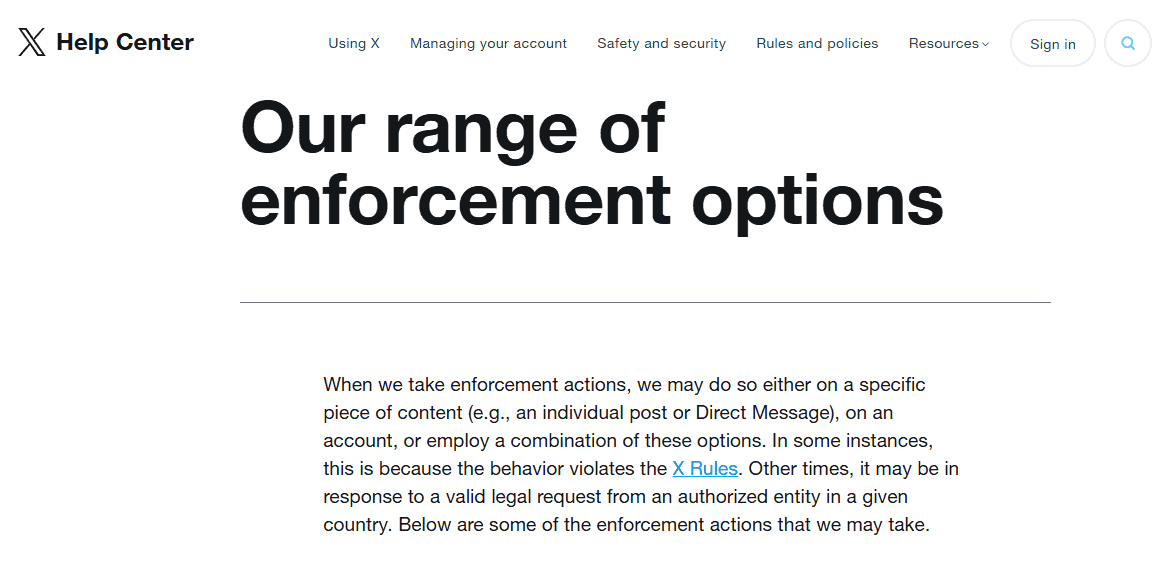
X’s stated policy is that if an account is flagged for policy violations, payments are paused and the creator is notified by email with an opportunity to appeal. In practice, creators report receiving no email, discovering the suspension only when they notice their revenue dashboard has frozen, and finding the appeal process opaque and slow.
The PYMNTS24 coverage of creator uncertainty on X quoted podcaster Samir Chaudry, who told Musk directly:
‘They have to start showing us the path to building a business on the platform.’
There is a pattern here that goes beyond individual cases. The platform changes the rules. Creators adapt. The platform changes the rules again. Creators adapt again. The platform suspends payments for a category of creators with no individual review. The suspension is eventually lifted for some, not for others. Nobody explains the criteria that determine who gets reinstated and who does not. The ground is always moving. The only certainty is that whatever you built your income strategy around last month may not apply this month.
The Contract That Protects Nobody But X
Buried in the legal architecture of X’s creator program is a set of terms that make the volatility not just possible but legally protected. The platform’s creator agreements give X the right to modify program terms at any time. The definition of what constitutes a policy violation is broad and vaguely worded. The eligibility thresholds, the revenue pool allocation, and the weighting of different types of engagement: all of these are at X’s discretion, changeable without formal notice, and not subject to any external audit or accountability.
This is not unusual among tech platforms. YouTube changed its monetization terms multiple times in what creators have called ‘Adpocalypse’ events. TikTok’s Creator Fund was widely criticized for paying out fractions of a cent per view, with no explanation of how the payout was calculated. Meta’s revenue sharing on Reels was adjusted several times without a clear explanation to creators.
But X’s volatility is on a different scale. The company went from an ad-revenue model to a Premium-engagement model to a home-region-weighted model and back, across a period of roughly 30 months. It raised the follower threshold, then lowered it, then raised it again. It launched the program, failed to send initial payouts on time (X acknowledged in August 2023 that it had underestimated the program’s popularity and needed more time to process payments), issued a series of updates, and then made a fundamental structural change with four weeks’ notice. The pace is not normal. It reflects a company that is improvising its creator strategy in response to a financial crisis that it cannot resolve, while asking creators to treat the program as a reliable income.
What the Forum Threads Tell You
The most honest accounting of what X’s creator program has meant to working creators does not come from the company’s newsroom or the platform’s official announcements. It comes from the creator forums, the Reddit threads, and the Discord servers where people who make content for a living talk to each other without a PR filter.
On Reddit’s r/CreatorEconomy, a thread from late 2024 asked creators to share their monthly X payouts alongside their engagement numbers. The responses are illuminating. A writer with 45,000 followers and roughly 8 million impressions in a quarter reported a payout of $34. A political commentator with 180,000 followers who posts six to eight times daily reported $210 per month, describing it as ‘better than nothing, not remotely a livelihood.’ A creator with 900,000 followers who posts video content reported $1,100 in one month and $280 the next, with no change in posting frequency or engagement, and no explanation from X for the swing.
‘The thing that kills you is not the low numbers,’ one commenter wrote. ‘It is the randomness. You cannot plan around random.’ Another creator, who described using X as part of a three-platform strategy alongside a Substack and an Instagram account, put it simply: ‘I treat X like a slot machine. Sometimes it pays out, mostly it doesn’t, and I never know which it will be.’
On creator-focused forums, the recurring complaint is not that X pays badly, although many creators believe it does. The complaint is that X cannot tell you what you will make next month because nobody at X knows what you will make next month. The formula changes. The pool changes. The eligibility changes. The weighting changes. And none of these changes come with advance warning, a transition period, or anything that resembles a sincere commitment to the people who are supposed to be the platform’s partners.
The Circular Logic of Premium
There is something structurally strange about the current version of X’s creator economy, something I have not seen discussed plainly enough. Under the Premium-based payout model, creators earn money based on engagement from Premium subscribers. The more Premium subscribers X has, the larger the pool. But who drives people to subscribe to Premium? Partly the creators. The creator program exists, in part, to incentivize high-quality content that keeps users on the platform and motivates them to subscribe.
In other words, creators are being asked to help grow the pool from which they are paid, while having no say in how that pool is allocated, no guarantee that the allocation rules will stay the same, and no protection against being cut out of the pool at any time for reasons they cannot challenge. The platform captures the value that creators generate through audience-building and content quality. The creators capture whatever fraction the platform decides to offer, under whatever rules the platform decides to apply, for as long as the platform decides to allow it.
This is not a partnership. It is tenancy. And the lease is month-to-month, with no notice period required for changes. As the Influencer Marketing Hub25 analysis of X subscriptions put it, ‘agencies working with polarizing creators must account for higher volatility in subscription income compared to lifestyle or entertainment niches.’ The practical advice for creators is to not rely on X payouts as stable income, to treat incentive bonuses as surprises rather than expectations, and to build subscriber bases on platforms that cannot change the rules mid-season. That is a reasonable adaptation strategy. It is also a fairly damning indictment of the platform’s reliability as a business partner.
Where This Leaves the Creators
I want to be clear about something before I close this out. There are creators making real money on X. There are people who have built genuine audiences, figured out what the Premium subscriber base wants to engage with, and constructed an income that works. The platform is not a fraud, and it is not nothing. But it is not what it was sold as.
Musk’s original pitch for the creator program was, more or less, that X would become the platform that finally paid creators what they deserved, that the people who made the content that kept users on the platform would share fairly in the revenue that content generated. The reality is a program with an opaque formula, a compressed revenue pool, an eligibility threshold that has moved three times, a payment suspension mechanism that operates by AI without individual review, and a structural dependence on advertising revenue from an advertising market that spent two years fleeing the platform.
The March 2026 episode, where a policy change was announced and reversed within a day, is the clearest illustration of the underlying problem. A company that is genuinely committed to its creators does not announce income-affecting policy changes without extended consultation, transition periods, and a clear explanation of the reasoning. It does not reverse course because of a day’s worth of backlash. It does not fire 80 percent of a country’s creator payouts via an AI decision with no appeal mechanism.
What those behaviors tell you is that creators are not the priority. They are a feature. They are part of the pitch to users, advertisers, and potential Premium subscribers. But when the advertising market collapsed and the formula needed changing, the creators were not consulted. When the eligibility threshold needed to be raised, the creators were not warned. When the regional weighting plan needed testing, the creators were the test.
The writer I mentioned at the start, the one who woke up to a 40 percent pay cut in October 2024, eventually figured out what had happened. She adapted. She started posting the kinds of content that Premium subscribers engage with more heavily. Her revenue partly recovered. But she also shared something I have not been able to shake:
‘I stopped thinking of this as a job. Now I think of it as a game where they keep changing the rules. You can win, but not because you played well. Only because you got lucky when the rules happened to favor what you were already doing.’
That is not a creator economy. That is a slot machine with extra steps. And until X publishes its formula, commits to advance notice for material changes, and treats its creators as partners rather than traffic generators, that is what it will remain.
Sources
- Search Engine Land, searchengineland.com/x-twitter-fails-ad-revenue-sharing-payouts-delay-430430. Accessed 12 Apr. 2026. ↩︎
- MMM, www.mmm-online.com/news/xs-ad-revenue-continues-to-fall-after-musk-takeover-warc/. Accessed 12 Apr. 2026. ↩︎
- Lazarus, Lily Mae. “New filings exposing Elon Musk’s financials for X in the UK show revenue plummeted 58%” Fortune, 27 Jan. 2026, fortune.com/2026/01/27/x-uk-twitter-financial-filings-revenue-decline-58-percent/. Accessed 12 Apr. 2026. ↩︎
- Medium, medium.com/@amanyadavspeak/the-complete-guide-to-x-twitter-monetization-payout-system-99c1e41ebb8e. Accessed 12 Apr. 2026. ↩︎
- Hutchinson, Andrew. “X Adds Additional Information to Creator Ad Revenue Share Payouts” Social Media Today, 28 Aug. 2023, www.socialmediatoday.com/news/x-adds-additional-information-creator-ad-revenue-share-payouts/692072/. Accessed 12 Apr. 2026. ↩︎
- Mehta, Ivan. “X, formerly Twitter, lowers requirements for its ad-revenue sharing program…with a catch” TechCrunch, 10 Aug. 2023, techcrunch.com/2023/08/10/x-formerly-twitter-lowers-requirements-for-its-ad-revenue-sharing-program/. Accessed 12 Apr. 2026. ↩︎
- “More marketers to pull back on X (Twitter) ad spend than ever before” 5 Sept. 2024, www.kantar.com/press-center/more-marketers-to-pull-back-on-x-ad-spend-than-ever-before. Accessed 1 May 2026. ↩︎
- Hutchinson, Andrew. “X Removes Ad Revenue Share from Creator Payments Program” Social Media Today, 9 Oct. 2024, www.socialmediatoday.com/news/x-removes-ad-revenue-share-creator-payments-program/729408/. Accessed 12 Apr. 2026. ↩︎
- “Elon Musk’s X Revamps Creator Earnings, Offers $1 Million Payout In 2026” Techlusive, 17 Jan. 2026, www.techlusive.in/apps/elon-musks-x-revamps-creator-earnings-offers-1-million-payout-in-2026-1640268/. Accessed 13 Apr. 2026. ↩︎
- Mehta, Ivan. “Elon Musk pauses changes to X’s creator revenue-sharing program after backlash” TechCrunch, 25 Mar. 2026, techcrunch.com/2026/03/25/elon-musk-pauses-changes-to-xs-creator-revenue-sharing-program-after-backlash/. Accessed 13 Apr. 2026. ↩︎
- Bodunde, Deborah. “After backlash, Elon Musk pauses X plan to prioritise local content in revenue sharing” TheCable, 25 Mar. 2026, www.thecable.ng/elon-musk-to-pause-x-revenue-sharing-update-after-backlash/. Accessed 13 Apr. 2026. ↩︎
- Wagner, Kurt. “Elon Musk’s X is seeing ad revenue plunge by half from prior years and is expected to bring in just $2.5B this year” Fortune, 12 Dec. 2023, fortune.com/2023/12/12/elon-musks-x-is-seeing-ad-revenue-plunge-by-half-from-prior-years-and-is-expected-to-bring-in-just-2-5b-this-year/. Accessed 13 Apr. 2026. ↩︎
- Keverenge, Hillary. “Is X’s creator payout update a response to advertisers fleeing the platform?” TechIssuesToday.com, 15 Oct. 2024, techissuestoday.com/is-xs-creator-payout-update-a-response-to-advertisers-fleeing-the-platform. Accessed 13 Apr. 2026. ↩︎
- “Sucuri WebSite Firewall” Access Denied, 10 Oct. 2024, www.tubefilter.com/2024/10/10/x-premium-creator-payouts-changing-ad-revenue/. Accessed 13 Apr. 2026. ↩︎
- Parrack, Dave. “X’s New Creator Payouts Will Make Engagement Farming Worse Than Ever” 10 Oct. 2024, www.makeuseof.com/new-x-creator-payouts-make-engagement-farming-worse/. Accessed 13 Apr. 2026. ↩︎
- “Thestreet.Com” www.thestreet.com/entertainment/elon-musk-quietly-tests-bold-new-payout-plan-for-x-creators. Accessed 13 Apr. 2026. ↩︎
- Partridge, Jamie. “How Much Does Twitter/X Pay Creators? Ad Revenue Data” PostEverywhere, 21 Mar. 2026, posteverywhere.ai/blog/how-much-does-twitter-x-pay-creators. Accessed 13 Apr. 2026. ↩︎
- “X Creator Payouts 2026” Blackwire.World, 14 Mar. 2026, blackwire.world/articles/x-payouts-creator-revenue-statistics-2026.html. Accessed 13 Apr. 2026. ↩︎
- “Sucuri WebSite Firewall” Access Denied, 10 Oct. 2024, www.tubefilter.com/2024/10/10/x-premium-creator-payouts-changing-ad-revenue/. Accessed 13 Apr. 2026. ↩︎
- Keverenge, Hillary. “Nigeria and South Africa lead in X (Twitter) reply spam, new data shows” Techish Kenya, 26 Mar. 2026, tech-ish.com/2026/03/26/nigeria-south-africa-x-twitter-reply-spam/. Accessed 13 Apr. 2026. ↩︎
- Innovation Village, innovation-village.com/x-pauses-creator-revenue-changes-after-nigerian-backlash/. Accessed 13 Apr. 2026. ↩︎
- Techpression, techpression.com/x-halts-payouts-for-nigerian-creators-spam-bots-blamed/. Accessed 13 Apr. 2026. ↩︎
- Medium, medium.com/readers-club/x-suspends-creator-earnings-program-for-many-ae7948f153d4. Accessed 13 Apr. 2026. ↩︎
- “Creators Unsure About X’s Revenue Potential as Numbers Drop | PYMNTS.com” 24 Mar. 2024, www.pymnts.com/news/social-commerce/2024/creators-unsure-about-xs-revenue-potential-as-numbers-drop/. Accessed 13 Apr. 2026. ↩︎
- Atkins, Dan. “X (Twitter) Subscriptions & Payouts: Pricing, Eligibility, Cadence” 6 Oct. 2025, influencermarketinghub.com/x-twitter-subscriptions/. Accessed 13 Apr. 2026. ↩︎


