

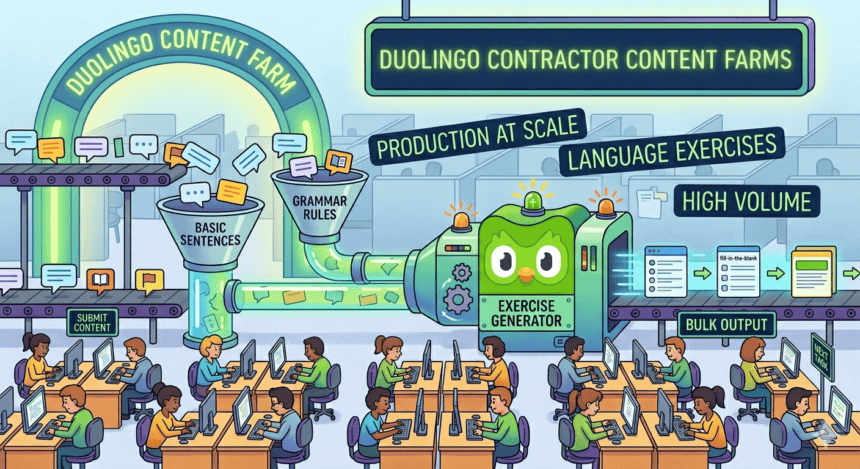

There is a sentence somewhere inside the Duolingo app that has been seen by more people than most published novels. It is probably about a bear buying a newspaper, or a boy eating an apple, or a woman who needs to find a hospital. It was almost certainly written by a contractor working from home, paid by the piece, reviewed once or twice, fed into a database, and then served to thirty million daily users who tapped at their phones while waiting for the bus.
I started thinking about this because of an owl. Specifically, because of the green cartoon owl that every Duolingo user knows. The one that goes from cheerful to menacing if you miss your daily practice streak. The owl is a mascot, a meme, and, increasingly, a symbol of a larger and stranger story about how the internet produces knowledge at scale. The story of how language learning content actually gets made, tested, packaged, and pushed to half a billion registered users is not one Duolingo talks about very much. But there is enough of a paper trail, enough former contractors willing to speak, and enough internal blog posts to piece together something close to the truth.
What that truth reveals is a system that, at its peak, depended on a quiet army of linguists, translators, and content curators working under contractor arrangements, and that is now rapidly replacing those people with the very AI systems they were, in some cases, asked to help train.
The Sentence Factory
Most people who use Duolingo have no idea where the exercises come from. The app feels effortless, almost trivially simple. You tap a translation, hear a voice read a phrase, get a cheerful animation when you are right. What happens behind that interface is considerably more complicated. According to Duolingo’s1 own engineering blog, building out a single course from scratch required around 600 hours of manual content work. The company had fewer than 1,000 employees serving a base of over 21 million daily active users at the time those figures were published. That ratio alone tells you something important: Duolingo could not possibly produce everything its users consume using full-time staff alone.
The gap was filled by contractors. Linguists and native speakers hired on project terms, paid to write sentences, validate translations, record audio, and check that exercises conformed to the Common European Framework of Reference for Languages (CEFR), the international standard that rates language proficiency from beginner A1 to near-native C2. These were not low-skill jobs. Writing a sentence that teaches the past tense, sounds natural in the target language, uses vocabulary appropriate for a B1 learner, and also fits neatly into a translation exercise with exactly one unambiguous correct answer is harder than it looks.
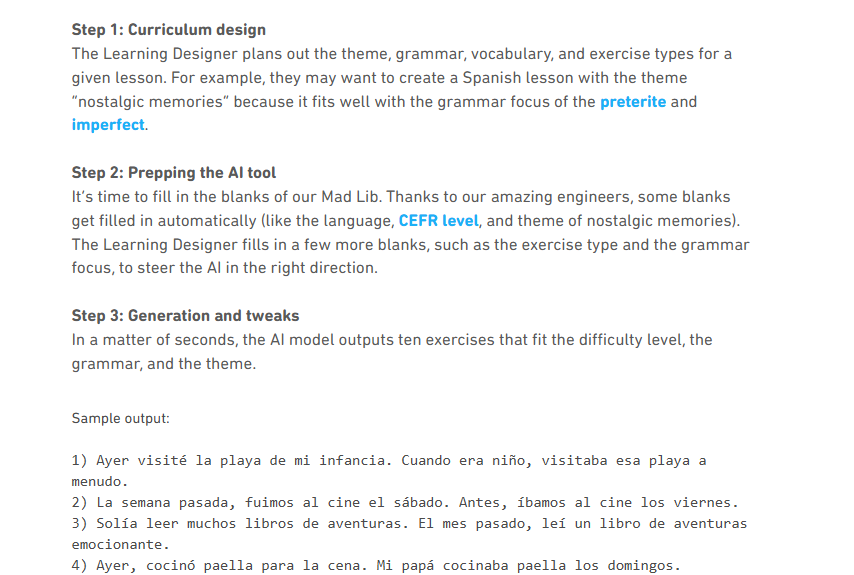
The work was also, by most accounts, relentless. Duolingo’s internal documentation2 of its content creation workflow describes a process in which a Learning Designer (the company’s name for its in-house curriculum experts) first plans the theme, grammar focus, vocabulary targets, and exercise types for a given lesson. Only then does the sentence-writing begin. The sentences need to be pedagogically sound, culturally neutral enough to avoid confusing learners in different countries, and varied enough that users don’t see the same examples over and over. At Duolingo’s scale, that means millions of individual pieces of content across dozens of languages.
The Birdbrain Underneath
Running beneath all that human-created content is a proprietary AI model Duolingo calls Birdbrain. Dr. Philippa Hardman’s3 detailed analysis of Duolingo’s AI architecture notes that Birdbrain processes roughly 1.25 billion daily exercises, using logistic regression and statistical pattern recognition to assign difficulty scores to concepts and predict the probability that any given user will answer any given exercise correctly. When large numbers of Spanish learners keep stumbling on the preterite versus imperfect tense distinction, Birdbrain flags it. When a particular sentence is generating a high error rate, the system marks it for review.
This kind of adaptive system is genuinely impressive. It is also, in a certain light, a mechanism for generating a very large amount of behavioral data about which content works and which does not. Every user who taps an answer is, in a small way, rating the exercise they just saw. Multiply that by millions of users and hundreds of millions of sessions and you have something that starts to look like a very detailed map of the content landscape, annotated with human judgments about what is hard, what is confusing, and what teaches well.
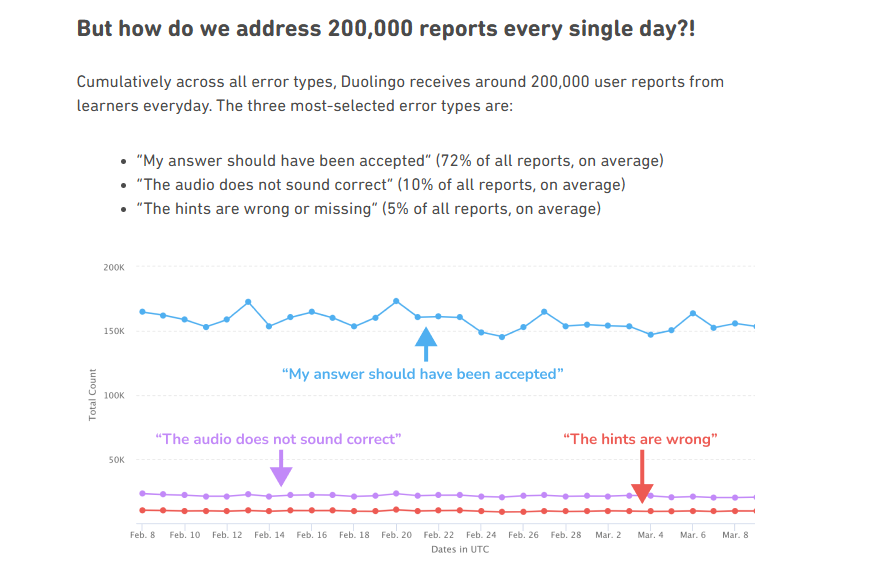
Duolingo4 has also used a separate Report Quality Estimation Tool to manage the roughly 200,000 bug reports it receives per day from users who believe their answers should have been accepted. Only about 15% of those reports, according to Duolingo, turn out to be genuinely correct. The rest are users who are wrong but confident. The system tries to tell the difference automatically, prioritizing reports where many different users have flagged the same answer. It is, in miniature, a crowd-sourced quality control operation.
What this architecture reveals is that Duolingo has, for a long time, been running a feedback loop between human-created content and machine-generated quality signals. The content needed humans to exist in the first place. The quality signals needed millions of users to have meaning. The system held together because both sides were functioning.
The December Offboarding
The first indication that the balance was shifting came in December 2023. TechCrunch5 reported that a Reddit post in r/duolingo by a user identified as No_Comb_4582 described receiving an email informing them they had been offboarded as a contractor. The post spread quickly. The user explained that they had worked for Duolingo for five years as part of a four-person team. Two team members were let go. The remaining two, they wrote, would stay on to review AI-generated content for acceptability.
The practical logic was clear enough. If a large language model can generate a plausible Spanish sentence in seconds, the cost of producing content drops dramatically. If the model can also generate the acceptable alternative translations for that sentence, the number of humans you need to check its work is a fraction of what you needed to produce the work in the first place. What had been a creative and linguistic job became a quality-control job, and quality-control jobs, almost by definition, require fewer people than creative ones.
Duolingo acknowledged it had offboarded roughly 10% of its contractor workforce at the end of 2023. The company’s spokesperson said the reductions were not “layoffs” because the contracts had simply concluded, and attributed them partly to “improvements to content creation operations.” A phrase that serves as a polite way of describing automation. CEO Luis von Ahn had already told investors in an August 2023 earnings call that the company was using generative AI to speed up content scripts and scale course material more efficiently.
In December 2023, former Duolingo contractor, via Reddit, posted
“Our team had four core members and two of us got the boot. The two who remained will just review AI content to make sure it’s acceptable.”
Former contractor Benjamin Costello, a Russian-language translator, told Baseline Magazine6 that he had noticed numerous errors in the app’s content following his departure. This tracks with a consistent pattern of user complaints about AI-generated language content across the industry: the outputs are grammatically defensible but culturally thin, contextually odd, and occasionally wrong in ways that a native speaker would catch immediately but a language model would not.
The Mad Libs Engine
What replaced those contractors was, at least initially, not fully automated. Duolingo’s7 own blog post from 2023 describes a system in which Learning Designers would fill in a template, described internally using the metaphor of Mad Libs, the word game where you substitute nouns and verbs into a fixed sentence structure, specifying the theme, grammar point, vocabulary list, and exercise type. The LLM would then generate a batch of candidate sentences. The designer would choose their favorites, make edits for naturalness, and approve them for the app.
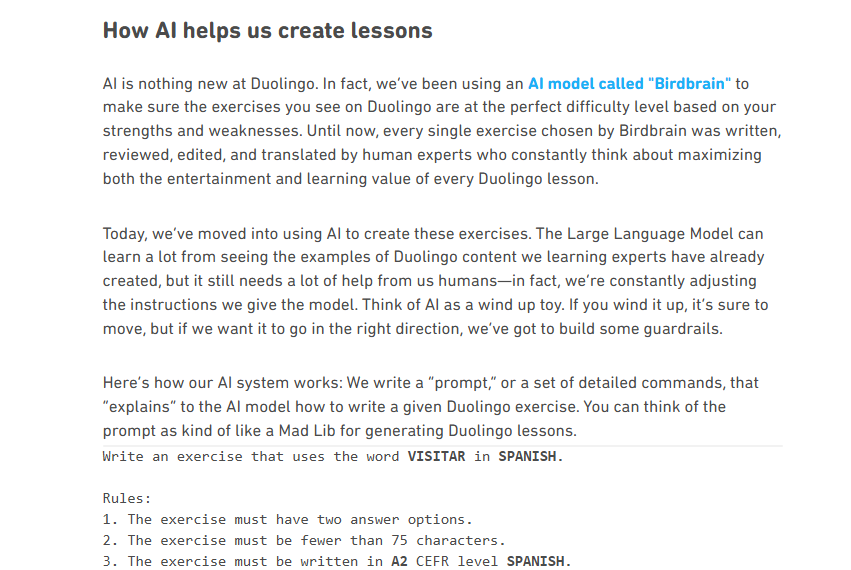
This is a meaningful distinction. Duolingo was not, at that stage, simply pressing a button and uploading whatever came out. The Learning Designer still reviewed every sentence and retained final approval. The LLM was functioning more like a very fast first draft than a fully autonomous author. But the practical effect on the contractor workforce was the same: the job that had existed, writing first drafts of exercises, no longer needed to be done by a human.
The ZenML LLMOps8 case study of Duolingo’s approach notes that naive application of LLMs to content generation initially produced outputs that failed to meet production quality standards without substantial human review. The team discovered that the best results came from feeding the LLM existing curriculum content, proven sentences and exercises already developed by human Learning Designers, as examples. The model was being trained, in a sense, on the work of the people it was replacing.
There is something uncomfortable about that dynamic. The contractors who spent years building the sentence bank were, without necessarily knowing it, providing the training data that would eventually make their own roles redundant. One French contractor, speaking to the newspaper Libération in 2025, used an arresting phrase to describe the experience. They said they felt they had been “asked to dig their own grave.”
DuoRadio and the 99% Cost Cut
If the Mad Libs system represents the first stage of Duolingo’s9 AI content push, the DuoRadio expansion represents something far more aggressive. DuoRadio is the app’s podcast-style listening feature, offering short audio episodes in the language a user is learning. The original version was built by hand, and it showed: only a small percentage of learners ever had access to it, because the cost and time of producing audio content at scale was prohibitive. Episodes had to be scripted, recorded, translated, quality-checked. It took months to produce a handful of shows.
What happened next is, depending on your perspective, either a triumph of engineering or a stark case study in how AI displaces creative labor. According to Duolingo’s10 own account, the team ran an internal hackathon, a tradition at the company, and emerged with a prototype pipeline that used LLMs to generate DuoRadio scripts and text-to-speech technology to produce the audio. They tested it, showed it to leadership, and got the green light to scale.
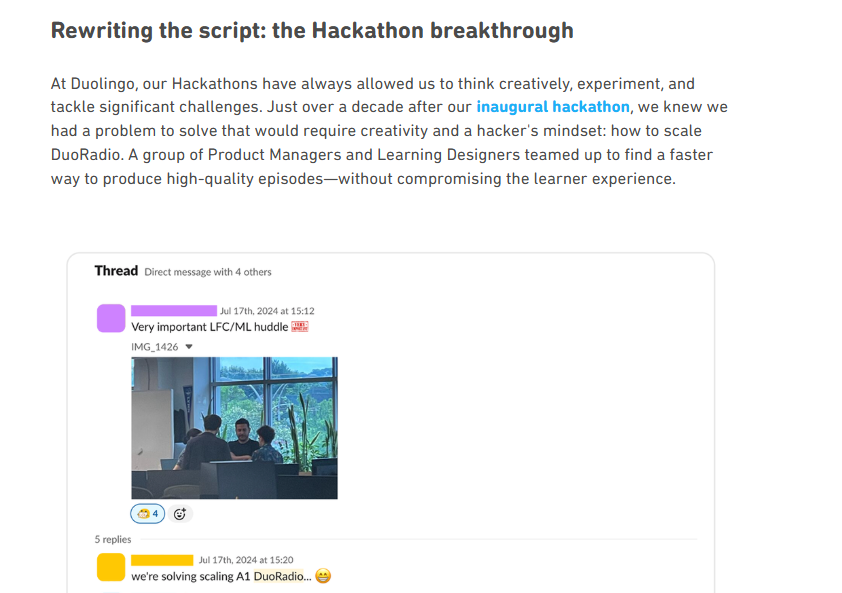
The results were extraordinary by any measure of production efficiency. The company went from roughly 300 episodes to more than 15,000, across more than 25 language courses, in under six months. Costs dropped by approximately 99%. Daily active users of the feature grew from 100,000 to 5.5 million.
The human cost is harder to quantify. Duolingo does not publish figures on how many people were involved in the manual DuoRadio production process, or what happened to them after the pipeline went live. The company’s public communications consistently frame the story as one of expansion, more content, more learners reached, more mission fulfilled, without dwelling on what those numbers mean for the people who used to do the work.
Luis von Ahn, CEO of Duolingo, stated in April 2025
“AI isn’t just a productivity boost. It helps us get closer to our mission. To teach well, we need to create a massive amount of content, and doing that manually doesn’t scale.”
The April Memo and the Backlash
Everything came to a head on April 28, 2025. According to Fortune11, on that day, Luis von Ahn posted an internal memo to LinkedIn that he had sent to all Duolingo employees. The memo declared the company would become “AI-first.” It announced that Duolingo would “gradually stop using contractors to do work that AI can handle,” that headcount would only be allowed to grow “if a team cannot automate more of their work,” and that AI use would be factored into performance reviews. The memo also contained a line that would be quoted in almost every subsequent news story:
“We’d rather move with urgency and take occasional small hits on quality than move slowly and miss the moment.”
The response was swift and severe. Users flooded Duolingo’s TikTok and Instagram accounts with angry comments. On a video where the app’s owl character asked for a cookie, the top comment read: “mama may I have real people running the company.” Users announced they were canceling subscriptions and deleting the app. Von Ahn was placed in his own TikTok video opposite someone in a green owl mask demanding accountability.
The backlash touched something real. Duolingo’s users are not just customers in the ordinary sense — many of them have used the app daily for years, building streaks that run into the hundreds or even thousands of days. They have a relationship with the app, and with the characters and stories it contains, that feels more like a personal commitment than a product subscription. When von Ahn said he was willing to accept quality hits in exchange for speed, they heard him saying he was willing to accept quality hits in their education.
A week after the memo, von Ahn walked most of it back. He posted a clarifying statement on LinkedIn saying he did not “see AI as replacing what our employees do” and that AI was meant to be “a tool to accelerate what we do, at the same or better level of quality.” But the company maintained the core policy: contractors doing work AI could handle would still be phased out. The performance review metric for AI use would remain, at least initially.
By April 2026, Duolingo had reversed the performance review policy entirely, after employees began asking whether the company simply wanted them to use AI for its own sake rather than for meaningful outcomes. Von Ahn told the Silicon Valley Girl podcast that the metric had been removed. He also acknowledged that AI-generated code can be difficult to debug and that the technology is not consistently reliable for content creation tasks like writing Duolingo Stories.
Quality: The Uncounted Cost
The question of quality runs through every part of this story, and it resists easy answers. Duolingo’s defenders will point to the DuoRadio numbers: 15,000 episodes reaching 5.5 million daily listeners. If the content were bad, people would stop using it. The engagement data suggests otherwise.
But engagement and learning are not the same thing. A platform optimized for daily return visits and streak maintenance is not necessarily optimized for language acquisition. Users return because the app is designed to be returned to, because the notifications are persistent and the gamification is effective. Whether the sentences they are translating are the best possible sentences for their level, or merely adequate ones that passed an automated filter, is harder to measure.
The Hacker News12 community has been skeptical about Duolingo’s quality for years, with one commenter noting in a widely-upvoted thread that the app “regularly insists on English translations that no native speaker would say” and almost never explains why a particular answer is wrong. “Is it actually incorrect, or is it a shortcoming in the phrase bank?” the commenter asked. That question, posed before the AI push intensified, is even more pointed now.
Users flagged specific patterns after the AI transition.Users reported hallucinations. Instances where the AI provided incorrect historical dates, repeated words nonsensically, or defended grammatically wrong answers when challenged. These are exactly the failure modes that experienced linguists are trained to catch and that automated quality filters, however sophisticated, are prone to miss.
A Change.org13 petition asking Duolingo to stop sacrificing quality for AI gathered thousands of signatures, with the text arguing: “AI technology, while incredibly advanced, can’t always capture the nuances and cultural intricacies that real human tutors bring to the table. We have already witnessed errors in translations and inaccuracies that would have been avoided with human oversight.”
The 148 Courses and What They Mean
In April 2025, alongside the controversy over the memo, Duolingo14 announced the launch of 148 new AI-generated language courses. This effectively doubled the company’s catalog. Von Ahn pointed out that it took Duolingo roughly 12 years to build its first 100 courses. The new 148 were produced in approximately one year. That number is striking and it is also, depending on your values, either a story about democratizing language education or a story about flooding the market with content produced without the human expertise that makes language education meaningful.
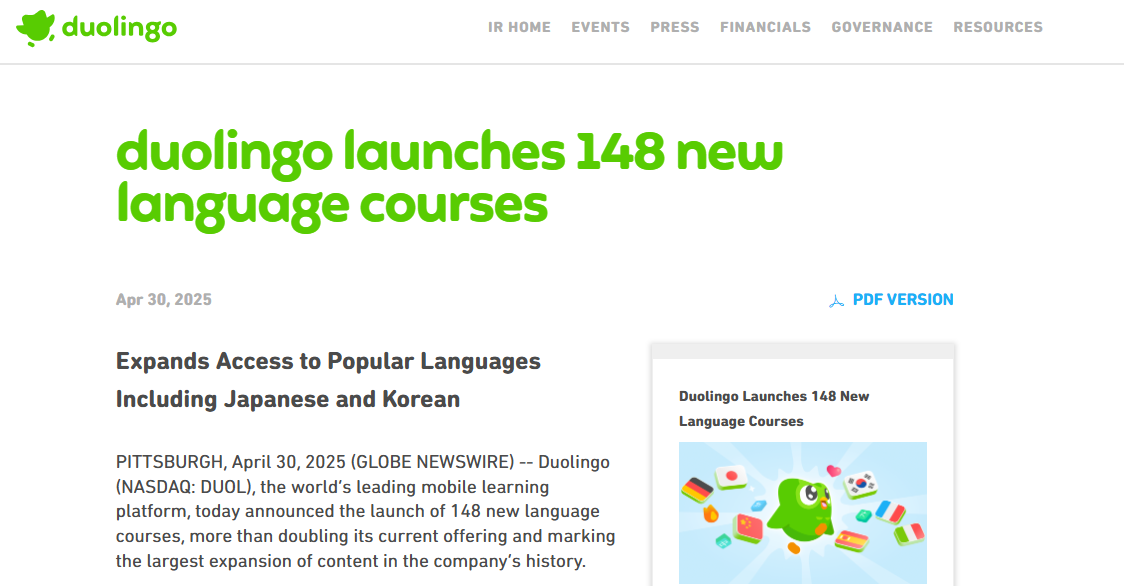
The new courses are, almost entirely, beginner-level. This matters. Beginner content is, in some ways, the easiest to automate. The vocabulary is small, the grammar is predictable, the sentences are short. “The bear drinks water” is not a culturally loaded statement. Getting it wrong in Swahili is a different proposition from getting an intermediate Japanese honorific system wrong, or producing a French sentence that is grammatically acceptable but would mark you immediately as a foreigner to any Paris shopkeeper.
Duolingo’s move into higher proficiency levels with AI-generated content is where the real test will come. The company has not provided transparency about how those courses are built, what human review they receive, or how errors are caught and corrected before they are served to learners at scale.
The Structural Invisibility of Contractor Work
One thing that struck me in reporting this piece is how thoroughly invisible the contractor workforce had been before the layoffs made it newsworthy. Duolingo’s marketing emphasizes its algorithms, its gamification, its learning science, its owl. The people who wrote the sentences, who decided that a Spanish lesson on family vocabulary should include a grandmother who likes to cook, rather than, say, a father who works in an office, are not named anywhere in the app. Their choices are not credited. Their expertise is rendered invisible by the interface.
This is not unique to Duolingo. It is a structural feature of platform economics. Platforms aggregate labor and present it as product. The human choices embedded in an exercise, why this sentence, why this vocabulary, why this level of difficulty, are absorbed into the user experience as seamlessly as the algorithm that decides which exercise to show next. When AI replaces that human labor, the interface looks the same. The user has no way of knowing whether the sentence they are translating was written by a linguist with a master’s degree in applied linguistics or generated in 200 milliseconds by a transformer model.
According to TechCrunch15, the journalist Brian Merchant, writing about the Duolingo situation, argued in a widely-shared piece that the AI jobs crisis “is here, now,” and pointed to Duolingo as a leading example. His reporting found that contractor cuts had happened in waves: translators in December 2023, writers in October 2024, and then the broader announcement in April 2025. Each wave had been soft-pedaled or denied as something other than AI displacement. Each wave had followed the same logic: AI can do this faster and cheaper, so the humans who were doing it are no longer needed.
Duolingo’s numbers remain, by any measure, impressive. The company reported its Q2 2025 earnings showing 40% year-over-year growth in daily active users and 10 million paying subscribers generating 38% more revenue than the same quarter in 2024. The New Stack16 reported that the company has over 113 million monthly active users and is a listed company on NASDAQ. The business is growing. But growth and the question of what is being taught are separable questions, and the financial metrics do not answer the pedagogical ones.
Von Ahn, to his credit, has shown some willingness to acknowledge complexity. He admitted he “did not expect the blowback” and that his April memo had “really struck a nerve.” He told the New York Times he “did not give enough context.” These are concessions, of a kind, though they leave untouched the core decisions about contractor replacement and automated content generation.
There is also the question of what happens to the contractors themselves. These were not anonymous, interchangeable workers. They were linguists, teachers, translators, and language enthusiasts who had built expertise in the specific demands of language learning content production. That expertise does not have an obvious home elsewhere in the economy. The work they did is being automated. The related jobs, quality review, prompt engineering, AI evaluation,require a different kind of training and exist in much smaller numbers.
I think about the sentence somewhere in the app about the bear and the newspaper. Someone wrote it. Someone checked it. Someone decided it was the right sentence to teach a particular grammar point to a particular kind of learner. That person had opinions, instincts, and knowledge that are now, at least in part, encoded into the training data of a model that does not know it learned from them.
The Bigger Picture
Duolingo’s situation is, in the end, not really about Duolingo. It is about the nature of knowledge work in a world where large language models can produce plausible first drafts of almost anything, at almost no cost, at essentially infinite scale. Every industry that runs on content, journalism, education, marketing, customer service, is facing the same pressure. The question is not whether AI will change these industries but how much human oversight will survive the change, and who will bear the costs of getting it wrong.
In language education, getting it wrong has consequences. A learner who internalizes a wrong translation, a culturally inappropriate phrase, or a grammatically plausible but contextually bizarre sentence is not just wasting time. They are building a mental model of the language that will need to be unlearned later, at greater cost. The feedback loop between bad content and bad learning outcomes is long, diffuse, and hard to measure. It is the kind of harm that is real but does not show up in quarterly revenue figures.
The MIT State of AI in Business 2025 report, cited in Fortune’s17 coverage of the Duolingo controversy, found that AI is primarily displacing offshore and contractor roles rather than domestic full-time ones, with a return on investment for automation of $2 million to $10 million per implementation. From a purely financial perspective, the case for automation is clear. From a pedagogical perspective, the question of whether what gets produced is actually good teaching has no obvious champion in the corporate structure.
Duolingo’s Learning Designers, the people with the genuine language expertise who still hold editorial control, at least in theory, number in the dozens for a platform with hundreds of millions of users. They cannot read every sentence. They cannot catch every error. They are, increasingly, the last human checkpoint in a production pipeline that runs mostly on inference at machine speed.
That is the content machine as it actually exists, stripped of the gamification and the cheerful owl. A vast industrial process for generating language exercises, optimized for speed and coverage, with human judgment applied sparingly at the margins. It is not, by itself, a scandal. But it is worth knowing. The next time you tap an answer in Duolingo and wonder why it sounds slightly odd, you have your answer.
Sources
- “Duolingo Blog” blog.duolingo.com/content-production/. Accessed 4 May 2026. ↩︎
- Henry, Parker. “How Duolingo uses AI to create lessons faster” 22 June 2023, blog.duolingo.com/large-language-model-duolingo-lessons/. Accessed 14 May 2026. ↩︎
- Hardman, Dr Philippa. “Duolingo’s AI Revolution” By Dr Philippa Hardman, 8 May 2025, drphilippahardman.substack.com/p/duolingos-ai-revolution. Accessed 8 Aug. 2026. ↩︎
- Mockler, Rowan. “We hear you! How learner feedback helps improve course content” 29 Mar. 2022, blog.duolingo.com/how-user-reports-improve-course-content/. Accessed 12 Aug. 2026. ↩︎
- Forristal, Lauren. “Duolingo cuts 10% of its contractor workforce as the company embraces AI” TechCrunch, 9 Jan. 2024, techcrunch.com/2024/01/09/duolingo-cut-10-of-its-contractor-workforce-as-the-company-embraces-ai/. Accessed 12 Aug. 2026. ↩︎
- Jones, Howie. “Page not found” Baseline, 18 Aug. 2022, www.baselinemag.com/artificial-intelligence-ai/duolingo-embraces-ai-the-impact-on-language-learning/. Accessed 12 Aug. 2026. ↩︎
- Henry, Parker. “How Duolingo uses AI to create lessons faster” 22 June 2023, blog.duolingo.com/large-language-model-duolingo-lessons/. Accessed 12 Aug. 2026. ↩︎
- “Duolingo: AI-Powered Lesson Generation System for Language Learning” ZenML LLMOps Database, www.zenml.io/llmops-database/ai-powered-lesson-generation-system-for-language-learning. Accessed 12 Aug. 2026. ↩︎
- Castillo, Luis Mas. “Using generative AI to scale DuoRadio 10x faster” 11 Mar. 2025, blog.duolingo.com/scaling-duoradio/. Accessed 12 Aug. 2026. ↩︎
- Castillo, Luis Mas. “Using generative AI to scale DuoRadio 10x faster” 11 Mar. 2025, blog.duolingo.com/scaling-duoradio/. Accessed 12 Aug. 2026. ↩︎
- Braun, Sara. “Duolingo’s CEO outlined his plan to become an ‘AI-first’ company. He didn’t expect the human backlash that followed” Fortune, 9 June 2025, fortune.com/2025/06/09/duolingo-ceo-surprised-backlash-ai-first-company-announcement/. Accessed 12 Aug. 2026. ↩︎
- Hacker News, news.ycombinator.com/item?id=28547473. Accessed 12 Aug. 2026. ↩︎
- “Sign the Petition” United States Change.org, www.change.org/p/stop-duolingo-from-sacrificing-quality-for-ai. Accessed 12 Aug. 2026. ↩︎
- “Duolingo Launches 148 New Language Courses” Duolingo, Inc., 30 Apr. 2025, investors.duolingo.com/news-releases/news-release-details/duolingo-launches-148-new-language-courses. Accessed 12 Aug. 2026. ↩︎
- Ha, Anthony. “Is Duolingo the face of an AI jobs crisis?” TechCrunch, 4 May 2025, techcrunch.com/2025/05/04/is-duolingo-the-face-of-an-ai-jobs-crisis/. Accessed 12 Aug. 2026. ↩︎
- Cassel, David. “Duolingo Grapples With Its ‘AI-First’ Promise Before Angry Social Mob” The New Stack, 1 June 2025, thenewstack.io/duolingo-grapples-with-its-ai-first-promise-before-angry-social-mob/. Accessed 12 Aug. 2026. ↩︎
- Coacci, Jessica. “Duolingo CEO admits his controversial AI memo ‘did not give enough context’ and insists the company never laid off full-time employees” Fortune, 18 Aug. 2025, fortune.com/2025/08/18/duolingo-ceo-admits-controversial-ai-memo-did-not-give-enough-context-insists-company-never-laid-off-full-time-employees/. Accessed 12 Aug. 2026. ↩︎


