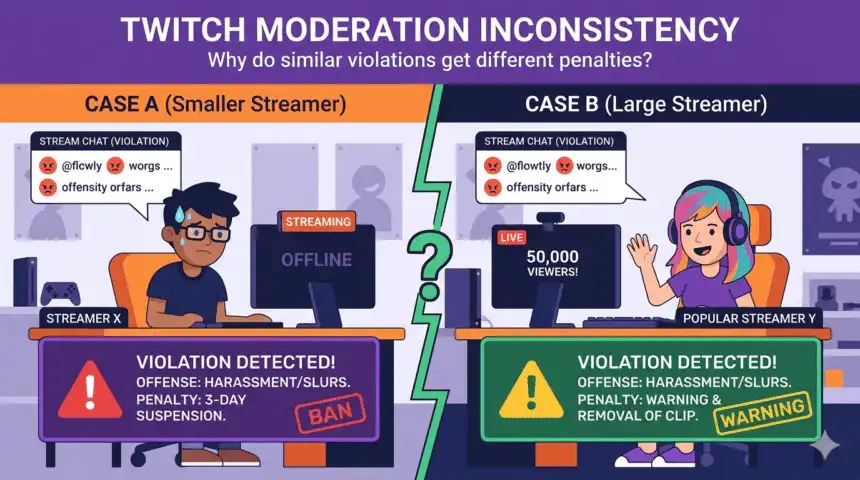

There is a game every Twitch streamer learns to play whether they want to or not. It has no written rules, no reliable referee, and the penalties are handed out with all the consistency of a coin toss in a hurricane. You can use a slur and be back in 10 days. You can drink three glasses of cream liqueur and lose 30. You can have your channel hacked, inappropriate content broadcast to your entire audience, and be back online inside 36 minutes if you know the right phone number. Everyone else waits in silence, banned without explanation, appealing into a void.
- The Numbers Game Nobody Can Win
- The Slur Arithmetic
- The Phone Call That Broke the Narrative
- The Leaked Paper Trail
- The Destiny Problem
- The VTuber Problem: Gender and the Invisible Rulebook
- The Scale Problem That Nobody Wants to Talk About
- The 2026 Reforms: Necessary, But Not Enough
- What Streamers Actually Want
I’ve spent weeks combing through ban histories, reading academic research on Twitch governance, scrolling through r/LivestreamFail threads, and watching streamers document what has happened to them in real time. What I found is not some secret conspiracy. It is something almost more troubling: a platform so vast, so reactive, and so structurally opaque that fairness has simply stopped being the point. Twitch is a private company that can ban anyone for any reason at any time. It says so. What it cannot do, and what it persistently fails to acknowledge, is pretend that the same actions produce the same outcomes.
The Numbers Game Nobody Can Win
According to TheViewBot1, over 85,000 bans were issued on Twitch in 2024 for various policy violations, according to the platform’s March 2025 Transparency Report executive summary. That is a staggering number. And yet, 70 percent of streamers say they don’t fully understand what can get them banned. Think about that arithmetic for a moment. You are on a platform that bans tens of thousands of accounts a year, for violations a majority of content creators cannot actually define. The platform is not teaching people the rules. It is punishing them for not knowing rules that were never clearly explained.
Twitch’s Community Guidelines2 exist, of course. They run to thousands of words, covering everything from hateful conduct and sexual content to harassment and DMCA violations.
The platform’s previous approach was widely criticized as “all-or-nothing”, meaning a chat violation and an on-stream slur could both result in the same total lockout. In early 2026, Twitch announced a revised system of “targeted penalties,” where streaming violations trigger streaming suspensions and chat violations trigger chat suspensions. On paper, this is progress. In practice, it does not address the central complaint: two people committing what looks like the same violation can still walk away with wildly different punishments, and nobody will tell them why.
“Twitch bans are still an inconsistent, unpredictable guessing game, lacking transparency for both streamers and their communities.”Dexerto, October 2024
The Slur Arithmetic
Let’s talk specifics, because the details matter. In 2019, Dexerto3 reported that streamers Destiny and m0E were each handed 30-day bans for using a homophobic slur. That same year, Adin Ross received 30 days for hateful conduct violations. The number 30 became the number. It was the established precedent for that category of offense. Consistent, clear, repeatable.
Then came June 2024. Nick “NICKMERCS” Kolcheff, one of Twitch’s biggest names with over 6.7 million followers, used a transphobic slur during a Call of Duty stream. GameRant4 revealed that he was back on the platform in just 10 days. Not 30. Not 14. Ten. The precedent set by nearly identical hateful conduct violations would have suggested a 30-day suspension. Nobody at Twitch explained the reduction. NICKMERCS himself said on his return stream that he was told the slur was like “the N word,” adding, “I didn’t know that. Why would I?” The confusion in that statement is revealing, but the inconsistency is more so. Twitch offered no public accounting of why a well-documented hateful conduct violation received a 20-day discount.
Around the same time, a VTuber named Fallenshadow received a 30-day ban. Her crime was drinking on stream. She had “three glasses of cream liquor” and asked publicly, “Is drinking on stream against TOS now? Or is it just against the made-up second set of rules that my partner manager admitted moderation has for me (that I’m not allowed to see or hear about, by the way) because I am a petite woman with a high soft voice using a VTuber model?” You can argue the merits of both decisions. What you cannot do, with a straight face, is argue that drinking three glasses of alcohol and using a slur targeting a protected group should produce the same length of suspension.
The platform is not teaching people the rules. It is punishing them for not knowing rules that were never clearly explained.
The Phone Call That Broke the Narrative
On January 4, 2025, FaZe Lacy’s Twitch account was hacked. A bad actor used the compromised channel to broadcast explicit content to Lacy’s 1.1 million followers. Twitch acted quickly and banned the account. What happened next is the story that wouldn’t die.
Fellow FaZe Clan member Jasontheween called Twitch CEO Dan Clancy directly.
“I called him, and he was like, ‘Did someone get suspended?’ He didn’t even know what was going on,” Jason said on stream.
Moments later, his chat informed him that Lacy’s account had already been reinstated. The whole thing, from ban to unban, took 36 minutes and 18 seconds, according to StreamerBans.
Clancy later clarified that he had not personally intervened and that Lacy’s strategic partner manager was already handling the case when Jason called. The technicality may be accurate. But the optics were catastrophic. Accordinng to The Recent Times5, the rapid resolution of Lacy’s case drew immediate comparisons to similar situations, such as streamer DavyJones in 2023, who faced a ban after hackers hijacked his channel but waited several hours before reinstatement. The community reaction was instant as shown by Dexerto6.
“So if you’re friends with the right people, rules just don’t apply? Interesting,” one user posted.
Another wrote:
“It’s frustrating to see Twitch quickly unban certain individuals while others, like us, remain wrongfully suspended and completely ignored.”
Reasonable people can accept that hacked accounts deserve faster processing than standard violations. But the visibility of that phone call, the theatrical speed of the unban, and the contrast with nameless streamers who wait days or weeks for identical appeals to be acknowledged: that contrast does not live in the realm of policy. It lives in the realm of perception, and Twitch has never understood how much perception drives trust.
The Leaked Paper Trail
The favoritism accusation is not new, and it is not merely speculation. In October 2021, BBC7 reporetd that Twitch suffered a massive data breach that dumped approximately 125 gigabytes of internal data onto 4chan. Among the leaked materials was a file with a name that made the entire streaming community sit up: “do_not_ban_list.”
Among data in the breach was evidence that some Twitch partners had their channels flagged to alert staff that instead of suspending these users, any issues should be raised with a specific Twitch employee for review. The Washington Post8 investigated further by speaking to former Twitch staffers. Their findings were uncomfortable reading.
“RiceGum got partnership removed way back in the day, but Twitch refused to ban him outright because he got viewership,” said a former Twitch staff member. “So even though he wasn’t a partner, he was treated like one and given partner outreach when he broke the rules instead of being suspended.” The same former employee said:
“I do remember RiceGum and Tyler1 both being given way more grace than they should have been. And if one of us admins reported them anyway, we were told to kick rocks and pay attention to the do not ban list. It wasn’t quite a ‘get out of jail free’ card, but there were clearly some streamers who got treated with more chances or abilities than others.”
Twitch confirmed that the list was historical and is no longer in use. But the architectural logic it represents, that some streamers’ violations go upstairs while everyone else’s violations go straight to a ban, maps almost perfectly onto the pattern people still complain about today. The list is gone. The two-tier system, many argue, is not.
The Destiny Problem
If you want a single case study for how Twitch moderation can become personal, look no further than the saga of Steven “Destiny” Bonnell. Destiny was permanently banned from Twitch in March 2022. For two years, he did not know the precise reason. Twitch told him “a violation occurred on stream” and offered three possible reasons: posting a combination of words and emotes in chat to promote denigration based on race, praising or supporting a hate crime, or advocating for the exclusion of a group of people based on disability. He was not told which of the three applied.
In October 2024, nearly two and a half years after the ban, Destiny finally shared the specific clip that he believed caused the ban. When fellow streamer Asmongold watched it on his first stream back from his own two-week suspension, the reaction was blunt:
“It was pretty obvious that Twitch was just looking for a reason to ban him.”
Asmongold had himself been slapped with a two-week ban in October 2024 after making inflammatory remarks about Palestinians during a stream, calling them “terrible people” with an “inferior culture.” He apologized. He got 14 days. Destiny, for a clip that many found far less clear-cut, got permanence. Their situations were not identical. But they were not so different that the gap could be explained by policy alone.
“Because people are going to think about you and they’re going to think about liars, double standards and unfairness, and they’re not going to like you, and you know what, they shouldn’t.”Asmongold, on Twitch’s handling of Destiny’s ban appeal
The VTuber Problem: Gender and the Invisible Rulebook
The inconsistency is not just about bans. It runs through every corner of moderation. In 2024, Twitch updated its wording regarding attire and appropriate coverage to specifically warn VTubers about covering the “hips” of their animated models. The VTubing community was incensed, and the reason they were incensed was rational. While VTubers received written warnings about cartoon hip exposure, IRL streamers continued to broadcast with cameras angled at their own bodies in ways that would seem to violate the spirit of the same rules.
One widely-cited example showed an IRL streamer with a camera dedicated to their buttocks. They apparently escaped a ban, possibly because an empty hot tub was visible in the background, placing them in the “Pools, Hot Tubs & Beaches” category. The category, created in 2021 to corral hot tub streamers after a wave of community complaints, has become a legal grey zone. If a real person in minimal clothing avoids a ban by standing near an empty hot tub, but an animated model with a covered midriff gets a policy memo, the logic of that enforcement has to be questioned.
This is not a minor grievance. Academic works at ResearchGate9 have analyzed Twitch’s Community Guidelines and documented contextual exceptions for safety, attire, and nudity that they argue demonstrate inconsistent governance benefiting some groups over others. Their findings note that Twitch’s Terms of Service forbid discriminatory behavior and harassment, but many streamers from marginalized communities have been victimized while their harassers go unpunished.
Fallenshadow’s complaint about a “second set of rules” for petite women with soft voices using VTuber models hits harder in this context. She is describing a system where the same platform policy produces different outcomes based on how a streamer’s body presents, whether in real life or via an animated avatar. That is not moderation. That is interpretation, and interpretation creates exactly the kind of disparate outcomes that breed resentment.
The Scale Problem That Nobody Wants to Talk About
Here’s the thing that gets lost in every individual ban controversy: moderation at Twitch’s scale is genuinely, structurally hard. The platform hosts millions of simultaneous streams. Content happens in real time. A moderator reviewing a live stream cannot pause and rewind. They are making calls under pressure, in seconds, with incomplete context. Automated systems catch certain violations, miss others, and apply rules without nuance in a medium that is almost entirely made of nuance.
Research at SagePub10 on content moderation practices at Twitch notes that “live chat means that content moderation practices happen much quicker” than on asynchronous platforms, creating unique challenges that volunteer and paid moderators must navigate without relevant training or support. The human beings doing this work are under enormous pressure. Many of them are volunteers in individual channels, without any real power over platform-level bans. The Trust and Safety team that handles the serious stuff is not large enough to provide consistent, precedent-based review of every case.
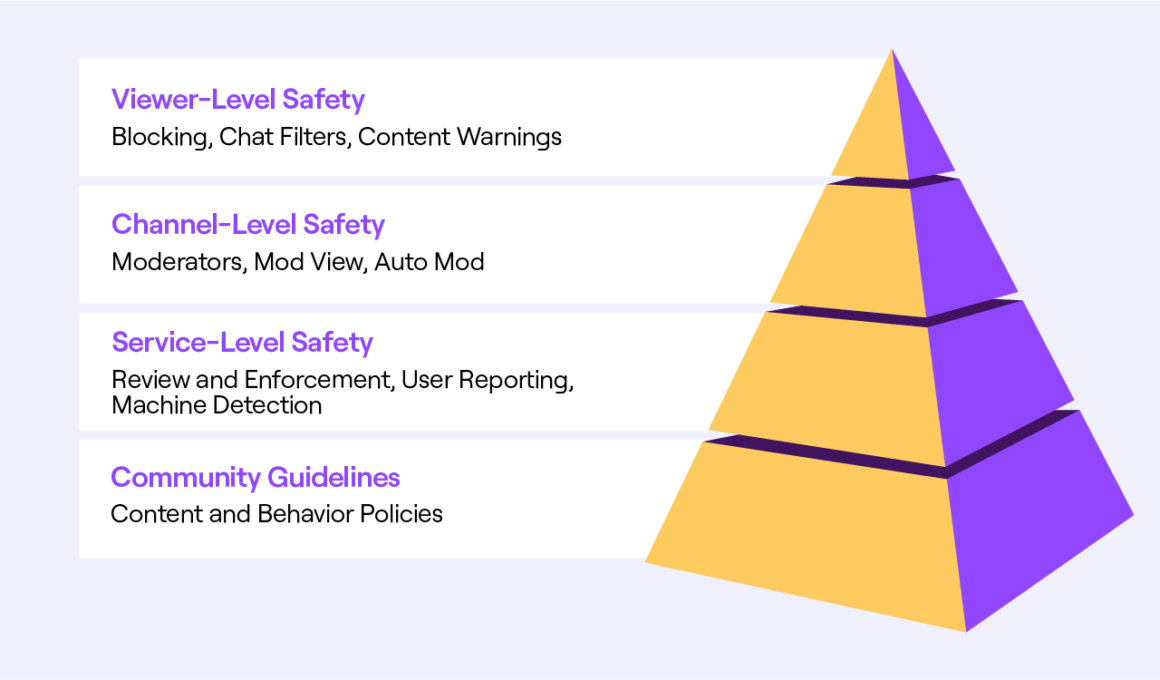
This is where Twitch’s structural failure becomes clearest. It is not that the people moderating the platform are malicious. It is that the system they work within does not require consistency, does not enforce it, does not publish its reasoning, and does not hold itself accountable when two identical violations produce opposite outcomes. Researchers studying Twitch’s governance have identified how regulatory inconsistencies are directed at historically marginalized streamers, describing platform governance as an iterative process that frequently targets vulnerable creators.
The 2026 Reforms: Necessary, But Not Enough
Twitch’s new tiered penalty system, announced in early 2026, separates streaming and chat suspensions based on where a violation occurred. Chat violations now result in chat bans only. On-stream violations result in streaming bans. A streamer can theoretically still watch content and access their dashboard while suspended. This is a genuine improvement over the previous all-or-nothing approach, and it mirrors what YouTube and Discord have been doing for years.
But creators will still want faster appeal timelines, consistent case law, and plain-language explanations. The structural problem is not which features get turned off when you break a rule. It is the absence of any public record of how length is determined, any precedent that can be cited or challenged, and any accountability mechanism for reviewers who produce radically different outcomes from the same set of facts.
What Twitch needs, and does not have, is something closer to case law. Every significant ban decision should be documented, categorized, and made searchable. Not to protect bad actors by giving them a roadmap around rules. But to give everyone else, the hundreds of thousands of streamers trying to build something on this platform, the ability to understand what they signed up for.
What Streamers Actually Want
When you read through the Reddit threads, the Twitter/X threads, the comment sections under every ban controversy, a consistent picture emerges. Streamers are not asking for zero moderation. They are not asking for the right to say anything and face no consequences. What they are asking for is legibility. They want to know, in advance, what the rules are. They want to know, when they are banned, exactly what they did. They want to know that someone who does the same thing they did will receive the same outcome.
According to GamingHQ11 any streamers advocate for better protections against harassment and more consistent enforcement of the rules, and argue that until Twitch addresses these systemic issues, the platform risks alienating a significant portion of its user base. That is a measured, reasonable ask. It is also an ask the platform has heard, acknowledged, and partially addressed for the better part of a decade without solving the core problem.
I keep coming back to the image of Fallenshadow, sitting in front of her camera, asking whether drinking three glasses of liqueur was somehow a worse offense than a slur used against a protected class. She was not wrong to ask. The question answers itself. But the fact that it is a question at all, that it requires asking, is the indictment.
Twitch is a platform that generates hundreds of millions of dollars in revenue annually. It sits inside one of the most powerful technology companies on earth. It has the resources to build a moderation system with consistent outcomes and public accountability. It has chosen not to, or has failed to, for long enough that the distinction stops mattering.
The streamers who get lenient bans because they bring in viewers are not anomalies. They are the product of a system that has never required fairness, only the appearance of it. The small streamer who waits three weeks for an appeal response on a ban that contradicts published policy is also not an anomaly. They are the product of the same system.
What Twitch calls “context-sensitive moderation,” its critics call favoritism. What Twitch calls “mitigating and aggravating factors,” people who have been banned without explanation call a mystery. The gap between the official description of the system and the lived experience of being inside it is the story. And until Twitch closes that gap with actual transparency, actual published precedents, and actual accountability, the phone calls to the CEO will keep happening. And the unanswered appeal tickets will keep piling up.
One rule for some. A lottery for everyone else.
Sources
- TheViewBot, blog.theviewbot.com/complete-guide-to-twitch-bans-in-2026-policies-prevention-appeals/. Accessed 13 June 2026. ↩︎
- “Community Guidelines” Twitch.tv, link.twitch.tv/community-guidelines. Accessed 13 June 2026. ↩︎
- Patterson, Calum. “Twitch bans still make no sense” Dexerto, 18 Oct. 2024, www.dexerto.com/twitch/twitch-bans-still-make-no-sense-2953270/. Accessed 13 June 2026. ↩︎
- Edwards, Trevor. “Twitch Lifts Nickmercs Ban” 9 July 2024, gamerant.com/twitch-lifts-nickmercs-ban/. Accessed 13 June 2026. ↩︎
- Kumar, Shivam. “Twitch CEO Denies Favoritism After FaZe Lacy’s Quick Unban Following Account Hack” TheRecentTimes, 7 Jan. 2025, therecenttimes.com/news/twitch-ceo-denies-favoritism-after-faze-lacys-quick-unban-following-account-hack. Accessed 15 June 2026. ↩︎
- Taylor, Josh. “Twitch faces criticism over “favoritism” after Lacy gets instantly unbanned” Dexerto, 5 Jan. 2025, www.dexerto.com/twitch/twitch-faces-criticism-over-favoritism-after-lacy-gets-instantly-unbanned-3021655/. Accessed 15 June 2026. ↩︎
- News, BBC. “Twitch confirms massive data breach” 6 Oct. 2021, www.bbc.com/news/technology-58817658. Accessed 15 June 2026. ↩︎
- 15 Oct. 2021, www.washingtonpost.com/video-games/2021/10/15/twitch-leak-do-not-ban-streamers-tyler1-ricegum/. Accessed 13 June 2026. ↩︎
- “ResearchGate”, www.researchgate.net/publication/343102027_Gender_moderation_and_moderating_gender_Sexual_content_policies_in_Twitch’s_community_guidelines. Accessed 15 June 2026. ↩︎
- SagePub, journals.sagepub.com/doi/full/10.1177/14614448221109804. Accessed 15 June 2026. ↩︎
- “Twitch’s Content Moderation Crisis: Inconsistent Bans and Profit-Driven Priorities” GamingHQ, 7 Sept. 2024, gaminghq.eu/2024/09/07/twitchs-content-moderation-crisis-inconsistent-bans-and-profit-driven-priorities/. Accessed 15 June 2026. ↩︎