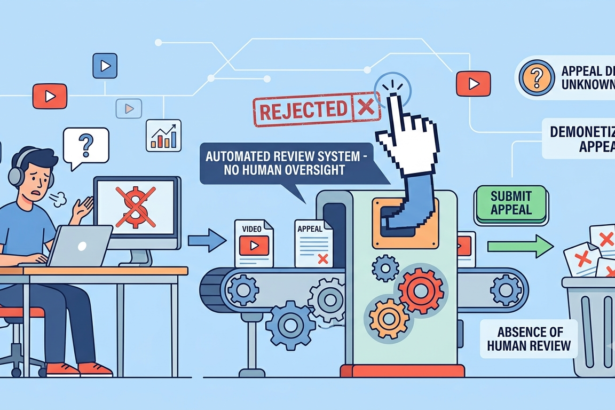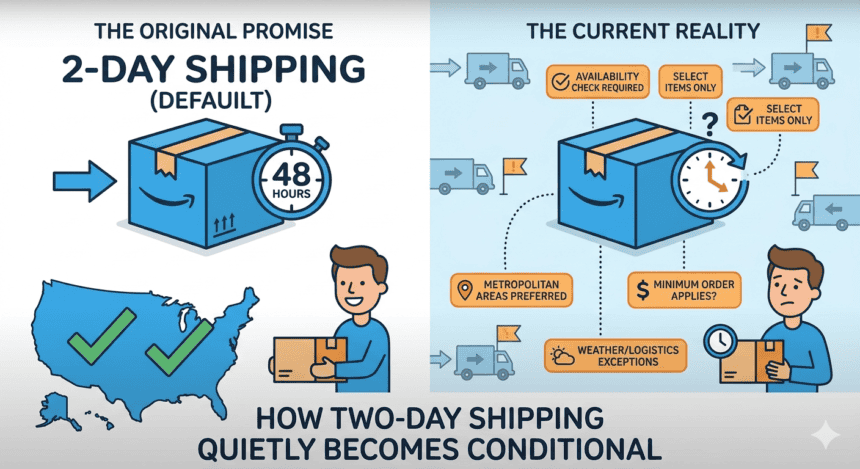

There is a moment, and if you are an Amazon Prime member, you have probably had it. The one where you place an order on a Monday morning, see the familiar blue Prime badge, and then watch the estimated delivery date land somewhere around the following Thursday. You do the math. That is not two days. That is not close to two days. And yet, somewhere in the architecture of the checkout page, it still counts as Prime.
This is not a story about shipping delays. Delays happen. Supply chains hiccup, weather comes in sideways, packages get lost. This is a story about something quieter and more deliberate: the systematic dismantling of a promise that 197 million people worldwide are paying for, done so gradually and with so much corporate language that most people never noticed it happening until they were already years deep into a membership they would not cancel because of the TV show.
The Original Bargain
Amazon Prime1 launched on February 2, 2005, with a proposition so simple it barely needed explaining. Seventy-nine dollars a year. Free two-day shipping on eligible items. That was it. Jeff Bezos understood, better than almost anyone in retail at the time, that the friction of shipping costs was what kept people from buying online as reflexively as they picked something off a store shelf. Remove the cost, promise the speed, and you change the psychology of shopping itself.
It worked beyond any reasonable projection. The Prime flywheel spun. Members bought more. More buying justified more fulfillment centers. More fulfillment centers made faster shipping cheaper to execute. Faster shipping attracted more members. By 2019, Amazon was delivering roughly half of its own Prime packages through its in-house logistics operation, having built from scratch what amounted to the third-largest parcel carrier in the United States.
The price has since risen considerably. According to Amazon News2, a standard Prime membership now costs $139 per year or $14.99 per month in the United States, representing a 76 percent increase from that original $79 annual fee. Over that same period, the unambiguous guarantee at the heart of the membership has been replaced by something much softer and much harder to pin down.
The Fine Print Nobody Read
Here is a thing Amazon figured out early, and has never really stopped leveraging: the difference between “two-day shipping” and “delivered in two days” is legally significant and practically invisible to most consumers.
Amazon Prime guarantees that an item will arrive within two days after it ships, not two days after it is ordered. That distinction is enormous.
“If the item you’re ordering is out of stock or unavailable to ship immediately,” Amazon states on its help pages, “the shipping method time starts when the item ships.” There is no stated timetable for how long Amazon can hold an order before it ships.
In the early Prime years, this clause existed but was rarely triggered. Inventory management was good, fulfillment centers were near most population centers, and Amazon’s own logistics network was operating with competitive urgency. The two-day window from order to door was the lived experience of the product, if not always its legal guarantee. That alignment between the advertisement and the reality was what built customer loyalty.
That alignment has eroded. One Quora3 answer from a longtime Prime member captured the shift clearly:
“I ordered an item on Thursday and it was delivered the following Wednesday. Today, same thing. I looked to place an order very early — 7am on a Thursday morning — and Prime 2 Day shipping says it will be delivered next Wednesday. If I pay $3.99 extra for one day shipping I can have it by Tuesday.”
That last sentence deserves to sit still for a moment. A member is being asked to pay extra, on top of their annual membership fee, to receive an approximation of what the membership already promised. The two-day badge is on the product page. The delivery date is six days away. Both of these things are true simultaneously.
The Language Shift
The most sophisticated part of this erosion is that it happened in language before it happened in logistics. Amazon quietly modified its promotional copy over time, shifting from unqualified language about two-day delivery to phrases like “FREE One-Day or Two-Day Delivery if available.” That two-word addition “if available” is doing an enormous amount of legal work while being presented in the same blue Prime font as everything else on the page.
The system is now explicitly SKU- and location-based:
“Two-day shipping is no longer a blanket, guaranteed feature of Prime; it has been replaced by a dynamic, SKU- and location-based delivery system that balances speed, capacity, and cost.”
Amazon now shows an estimated delivery window per item and per address, rather than a universal guarantee. The mechanics of this are not explained to members when they sign up or when they renew. The checkout page shows a date. Most people assume that a date is the product of a guarantee. It is the product of an algorithm.
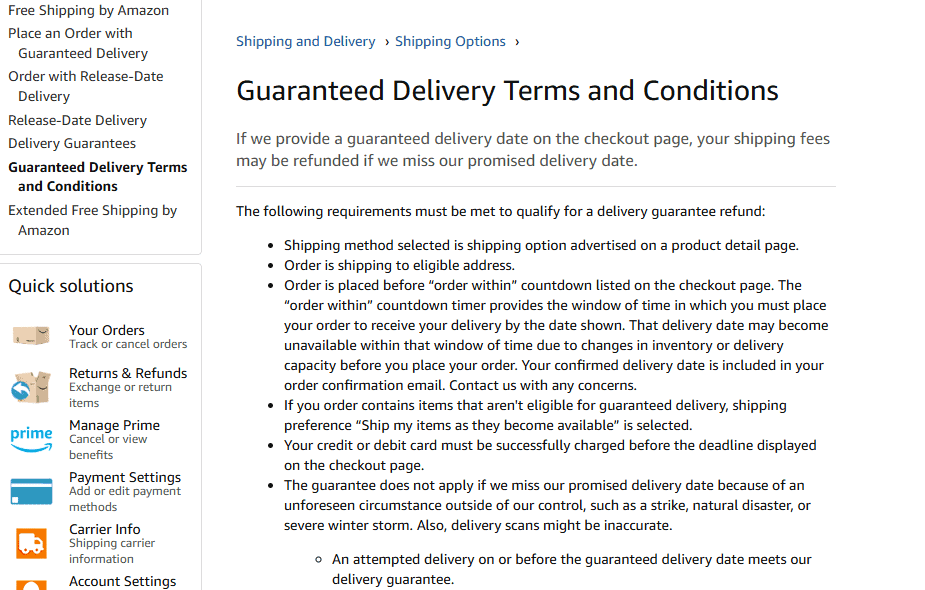
Amazon’s4 own guaranteed delivery terms and conditions page specifies that refunds for missed delivery dates require the member to have placed the order before a countdown timer shown at checkout. A countdown that can expire before the order is completed due to “changes in inventory or delivery capacity.” In other words, the window to qualify for a refund can close while you are still shopping.
The Lawsuit Nobody Heard About
In 2022, two California Prime members filed a class action lawsuit against Amazon. The case alleged that Amazon “falsely advertises and deceptively markets” its one- and two-day shipping speeds. According to ClassAction.org5, the 18-page suit stated that Prime subscribers “often must wait substantially beyond the same day and more than two days” for ordered items. It further alleged that Amazon switched delivery dates midway through shipments, after the purchase was already complete, showing members a fast delivery date at checkout and a later one on the tracking page.
The lawsuit argued that consumers make decisions about where to buy things based substantially on delivery speed, and that Amazon was aware of this and was exploiting it. “Had plaintiffs and other class members known that defendant Amazon fails to provide the marketed benefits of Prime and fails to deliver items within the advertised time frames,” the complaint read, “they would not have purchased the product or would have paid significantly less.”
Reuters6 reported that in March 2025, a U.S. District judge dismissed the case, ruling that the plaintiffs had not provided sufficient evidence or a consistent pattern of deceptive conduct. The dismissal did not mean Amazon was delivering on its promises. It meant the plaintiffs had not built a tight enough legal case to survive a motion to dismiss. Amazon won on procedure, not on substance.
The complaints on social media, however, have only grown louder. An X user posting about their household receiving ten packages a week from Amazon, with half arriving up to a week late, drew widespread engagement. One response came from someone claiming to be a former Amazon box truck driver:
“You have to load your truck up with 300 packages and deliver to 160-200 houses/apartments/businesses. No way to finish in 10 hours unless you jog your route at every stop or sometimes skip lunch.”
That comment points to something structural. The delivery failure is not random. It is the predictable output of a system stretched past its design limits.
The Humans at the End of the Chain
The story of Prime’s delivery erosion cannot be told without the people who put the packages at the door. Amazon has built what amounts to a vast, semi-invisible army of contracted delivery workers: Delivery Service Partners (DSPs), which are small trucking companies that lease Amazon vans and hire drivers under Amazon’s operational rules, and Amazon Flex gig workers who deliver from their own vehicles.
The structure is intentional. According to Labor Notes7, Amazon mandates that DSP fleets are limited to 40 vans, a ceiling that, critics argue, complicates unionization efforts and keeps each contractor too small to gain leverage against Amazon. Drivers wear Amazon uniforms. They drive Amazon-branded vans. They follow Amazon’s routing algorithms. But they do not formally work for Amazon, which means Amazon’s liability for labor violations is substantially limited.
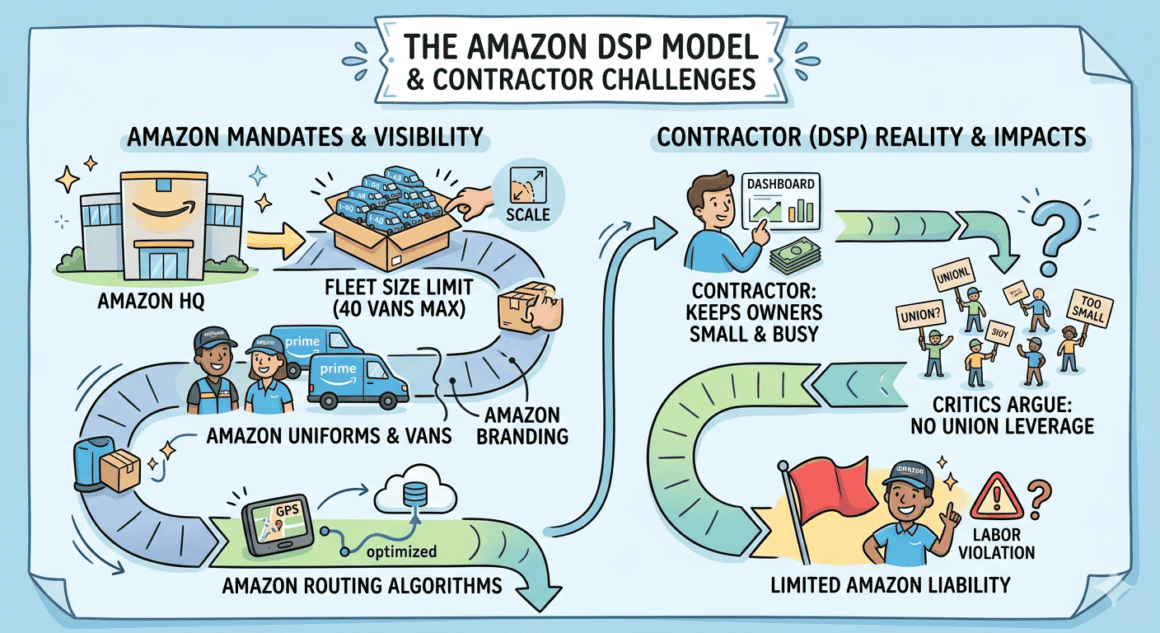
According to Vice8, drivers regularly report being assigned more than 300 packages per shift, with ten-hour shifts that routinely stretch to twelve or thirteen hours.
“You don’t take your lunch break. You don’t use the bathroom,” Karamo Rowe, who delivered Amazon packages for a contracted company, told NBC News9. “There were guys peeing in bottles in the van. You speed. You run stop signs in a neighborhood. You start conditioning yourself to just go as fast as possible.”
This is the operational reality underneath the promise of two-day delivery. The speed you are sold at checkout depends, in the final mile, on a driver who is probably late, probably underpaid for their actual hours, and probably being tracked by an Amazon app that notices if they idle at a stop for more than a couple of minutes.
When the driver does not finish the route, the package is marked as attempted or delayed. From the customer’s side of the screen, this shows up as a push notification that says delivery has been rescheduled.
The Washington, D.C. Case: When Geography Becomes the Fine Print
In December 2024, Washington D.C.’s Attorney General Brian Schwalb filed what may be the most important Prime-related lawsuit in the membership’s history. The target was not random delays or vague marketing language. The suit alleged that since June 2022, Amazon had secretly excluded two ZIP codes east of the Anacostia River (20019 and 20020) from its fastest delivery service, while continuing to charge the roughly 48,000 Prime members living there the full membership price.
The numbers in the lawsuit are striking. According to CNBC10, before Amazon made the change, more than 72 percent of Prime packages in those ZIP codes arrived within two days of checkout. After the exclusion was implemented, that number dropped to as low as 24 percent. The rest of D.C. saw its two-day delivery rate rise to 74 percent over the same period. The people in Wards 7 and 8, two of the city’s most historically underserved areas, predominantly Black communities, were being charged the same $139 a year for a service that had become, for them, functionally unrecognizable.
The kicker, according to the lawsuit, was what Amazon told customers who called to complain. Amazon representatives told residents the slow delivery times were “never on purpose” and implied they were one-time occurrences caused by circumstances outside Amazon’s control. This was not true. There was a deliberate internal policy. Amazon’s own documents, cited in the complaint, described an “exclusion” mechanism. A formal designation that suspended Amazon’s own delivery fleet from a ZIP code and rerouted all packages through slower third-party carriers like USPS and UPS.
Amazon’s public response was that the exclusion was for driver safety, citing “specific and targeted acts” against drivers in those ZIP codes. Axios11 reported that Attorney General Schwalb’s reply was pointed:
“While Amazon has every right to make operational changes, it cannot covertly decide that a dollar in one ZIP code is worth less than a dollar in another.”
This case illuminates something that Amazon’s national marketing language carefully obscures: the Prime badge, and the delivery speed it implies, is available for “nearly all addresses in the contiguous U.S.” — a phrase that does not acknowledge exclusions and qualifications that Amazon applies at the ZIP code level without telling the affected members.
It is worth noting that Amazon has faced similar geographic fairness complaints before. A 2016 Bloomberg investigation found that Black residents in several major American cities were about half as likely to be eligible for same-day delivery as white residents in the same cities. Amazon expanded access after that investigation. The pattern it exposed,of delivery service quality correlating with neighborhood demographics, did not fully disappear.
The Third-Party Problem
The Prime badge does not only appear on items that Amazon fulfills itself. A significant portion of Amazon’s marketplace is run by third-party sellers, many of whom participate in either Fulfillment by Amazon (FBA), where they ship their inventory to Amazon’s warehouses and Amazon handles delivery, or Seller-Fulfilled Prime (SFP), where the seller ships directly but has agreed to meet Prime delivery standards.
Prime members account for approximately 75 percent of Amazon’s customer base, according to 2024 data from AMW12, which means the Prime badge is enormously valuable for third-party visibility. Sellers will accept conditions to keep it. But when those sellers’ own inventory or shipping pipelines run into problems, the Prime promise on the product page does not disappear. It just becomes inaccurate.
During peak seasons, Amazon’s receiving process for FBA inventory can stretch from the standard three to five days to several weeks, leaving seller inventory in a state where it is not available for sale but is still technically in the system. Customers ordering these items see a Prime badge and a delivery estimate that assumes the inventory is where Amazon’s systems say it is. When it is not, the delivery window shifts after purchase.
Amazon13 introduced a new Guaranteed Delivery Windows system in early 2026, replacing the previous blanket two-day Prime guarantee with a system that uses what the company calls Smart Route Tags on 92 percent of packages to optimize delivery routes and timing. The official framing is that this provides more accuracy. The practical effect is that the variability in delivery estimates, which used to be hidden behind a universal “two days” promise, is now openly embedded in the checkout experience. The promise has not been made again. The date shown is all you get.
The Math of Membership
Let me try to work out honestly whether Prime is worth it, because this is the calculation that Amazon has correctly bet most members will not complete. The annual fee is $139. Amazon also offers a streaming service in Prime Video, music through Amazon Music, grocery discounts at Whole Foods, photo storage, and a rotating set of other benefits. If you use all of these things, the math probably works. Most members do not use all of these things.
For shipping alone, the break-even point is roughly one qualifying order per month that saves at least $11-12 in shipping fees. For frequent shoppers, Prime has always made economic sense. What has changed is not the fee structure but the reliability of what the fee purchases. If “free two-day shipping” has been replaced by “free estimated delivery, timing variable, check the date on checkout and probably allow two extra days,” the product is genuinely less valuable than it was. Even if the price tag is the same.
According to WCPO 9 News14, a Prime member in Cincinnati named Emily Hedger put it plainly to a local TV station:
“I’m paying $150 a year already. Why am I not getting my stuff on time?”
Another member named Mary Ellen Poast Berger said she felt two-day shipping had been gone for a while. Nobody at Amazon disputed these accounts. The company’s spokesperson offered that “delivery times can be affected by product availability, shipping location, and other factors.”
That response is accurate. It is also a description of a different product than the one that was sold.
Why Amazon Keeps the Language
Here is the business logic, stated as plainly as possible: Amazon benefits from keeping the two-day framing even when it cannot reliably deliver on it, because the framing drives membership retention, and membership retention is the engine of Amazon’s entire retail ecosystem. Parcel Path15 reported that with 197 million Prime members as of early 2025, each paying $139 annually, the membership fee revenue alone exceeds $27 billion. That money arrives before a single package ships.
Prime membership creates behavioral lock-in that goes beyond any individual purchase. Members buy more on Amazon because they have already paid for shipping. They buy more on Amazon because their payment information is stored. They buy more on Amazon because they are using Amazon’s streaming service and they do not want to think too hard about leaving. Amazon has correctly understood that a significant portion of its membership will tolerate a degraded delivery experience rather than go through the friction of cancellation.
The question of what Amazon actually owes Prime members in exchange for that $139 is not clearly answered anywhere in public-facing materials. The Terms and Conditions reserve Amazon’s right to change or terminate benefits at any time. The marketing materials show vans arriving at cheerful front porches in two days. The gap between these two things is where the product actually lives.
What Happens Now
The DC lawsuit is the most significant legal development in Prime’s history. If the court rules against Amazon, or if the case forces a settlement, it establishes a precedent that operationally reducing delivery quality for a subset of members without notification is not just bad service but potentially illegal. That precedent would apply beyond Washington D.C.
Regulators in other jurisdictions are watching. Consumer protection frameworks in several states have been updated in recent years to address digital subscriptions and promised service quality more directly. The FTC’s ongoing broader action against Amazon, filed in 2023 over allegedly deceptive enrollment and cancellation practices, has already put the company’s subscription practices under federal scrutiny.
For members, the practical advice is not complicated, even if it is a little dispiriting to have to give it: check the estimated delivery date on every checkout page, because the Prime badge on the product page tells you almost nothing reliable. If you are in a rural area, a historically underserved urban area, or ordering from a third-party seller, apply some skepticism to any date shown. If a package is late and you paid for expedited shipping, Amazon’s own terms allow for a refund of those shipping fees. And customer service can sometimes be pressed to credit Prime accounts for significant delays, though the threshold for what counts as significant is undefined.
The deeper question, whether a company can build its brand on a promise, collect annual fees for that promise, quietly renegotiate the terms of the promise over twenty years, and face no meaningful accountability for the gap, is one that regulators, courts, and ultimately consumers will have to answer.
Most people renewed their Prime membership this year. I imagine you did too. And we will probably both keep watching the delivery date, doing the math, and sighing quietly when it comes back as six days.
Sources
- Center, US Press. “Amazon.com Announces Record Free Cash Flow Fueled by Lower Prices and Free Shipping; Introduces New Express Shipping Program — Amazon Prime” US Press Center, 2 Feb. 2005, press.aboutamazon.com/2005/2/amazon-com-announces-record-free-cash-flow-fueled-by-lower-prices-and-free-shipping-introduces-new-express-shipping-program-amazon-prime. Accessed 29 Apr. 2026. ↩︎
- Staff, Amazon. “Here’s how much a Prime membership costs, and how to make the most of its benefits” 17 Feb. 2023, www.aboutamazon.com/news/retail/prime-membership-cost-benefits. Accessed 29 Apr. 2026. ↩︎
- Quora, www.quora.com/What-happened-to-the-two-day-shipping-in-Amazon-Prime. Accessed 29 Apr. 2026. ↩︎
- Amazon, www.amazon.com/gp/help/customer/display.html?nodeId=GZ5R2Y8QHENSLW75. Accessed 29 Apr. 2026. ↩︎
- Class Action, www.classaction.org/news/class-action-claims-amazon-has-misrepresented-same-day-two-day-prime-delivery-benefits. Accessed 29 Apr. 2026. ↩︎
- “Reuters.Com” www.reuters.com/legal/amazon-defeats-shareholder-lawsuit-related-third-party-sellers-capacity-2025-03-17/. Accessed 29 Apr. 2026. ↩︎
- “Building Its Own Delivery Network, Amazon Puts the Squeeze On Drivers” Labor Notes, 17 Dec. 2020, labornotes.org/2020/12/building-its-own-delivery-network-amazon-puts-squeeze-drivers. Accessed 29 Apr. 2026. ↩︎
- Gurley, Lauren Kaori. “Amazon Delivery Drivers Are Overwhelmed and Overworked by Covid-19 Surge” 1 July 2020, www.vice.com/en/article/amazon-delivery-drivers-are-overwhelmed-and-overworked-by-covid-19-surge. Accessed 29 Apr. 2026. ↩︎
- Ingram, David. “Inside Amazon’s delivery push: Employees and drivers say an overworked system is lax on safety as packages pile up” 27 Nov. 2019, www.nbcnews.com/tech/tech-news/inside-amazon-s-delivery-push-employees-drivers-say-overworked-system-n1087661. Accessed 29 Apr. 2026. ↩︎
- Palmer, Annie. “Amazon sued by DC attorney general for allegedly excluding neighborhoods from Prime delivery” 4 Dec. 2024, www.cnbc.com/2024/12/04/amazon-sued-by-dc-ag-over-excluding-areas-from-prime-delivery.html. Accessed 29 Apr. 2026. ↩︎
- Axios, www.axios.com/local/washington-dc/2024/12/04/amazon-lawsuit-dc-attorney-general. Accessed 7 May 2026. ↩︎
- Arcega-Punzalan, Cristina. “Inside the World of Amazon Third Party Sellers and Their Impact on Retail” AMW, 18 Aug. 2025, amworldgroup.com/blog/amazon-third-party-sellers. Accessed 7 May 2026. ↩︎
- Staff, Amazon. “Amazon introduces faster delivery with new 1-hour and 3-hour options” 17 Mar. 2026, www.aboutamazon.com/news/retail/amazon-fast-delivery-orders. Accessed 7 May 2026. ↩︎
- Nimmo, Taylor. “Amazon Prime’s two-day shipping promise falls short for frustrated customers” 8 Jan. 2026, www.wcpo.com/money/consumer/dont-waste-your-money/amazon-primes-two-day-shipping-promise-falls-short-for-frustrated-customers. Accessed 22 May 2026. ↩︎
- Parcel Path, parcelpath.com/what-happened-to-two-day-prime-shipping/. Accessed 22 May 2026. ↩︎