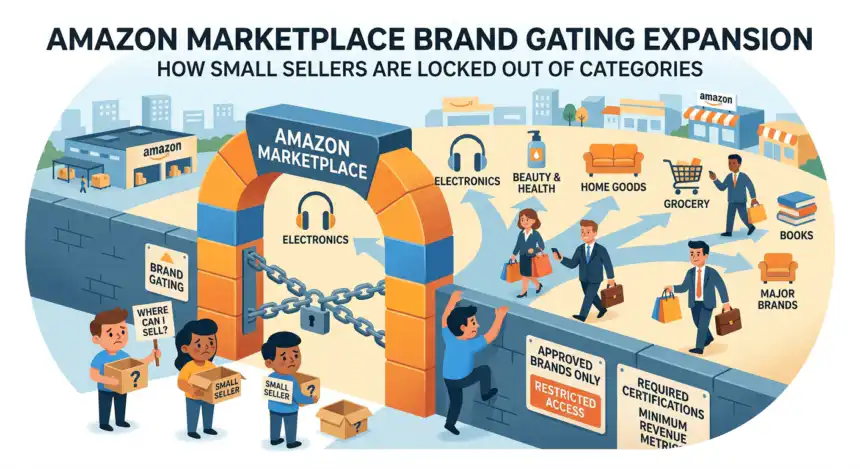

There is a locked door inside Amazon’s marketplace, and it moves. Walk up to it one morning, and it might swing open after a modest stack of paperwork. Come back ten days later, and the same door has a new sign on it demanding ten times the documentation and a hundred units of inventory you never budgeted for. Ask why, and you get silence on the phone. Post about it on the discussion boards, and a moderator types something polite about contacting the “partner team.” The partner team does not call back.
- Where It Started
- How the System Works, and Where It Breaks
- The Mass Re-Gating Wave
- The Three-Level Trap and the Small Seller Math
- The Parallel Economy of Workarounds and Amazon’s Own Interest in the Gate
- The Regulatory View From the Outside
- What Sellers Are Left With
- The Ungating Economy That Has Grown Up Around Desperation
- The Larger Stakes
This is the daily reality of brand gating on Amazon, and it is getting worse.
I want to be clear about something before we go further. Counterfeiting is a real, destructive problem. According to Business Standard1, Amazon seized over 15 million counterfeit products in 2024 alone, more than double the 7 million it seized the previous year, and the damage those fakes cause to legitimate brands and to the people who unknowingly buy them is not trivial. The gating system did not come from nowhere. It came from a crisis. But the way Amazon has expanded and operationalized that system over nearly a decade has produced a set of consequences that go well beyond counterfeit prevention, and those consequences fall almost entirely on small, independent sellers.
Where It Started
The year 2016 is the one that matters. According to CNBC2, Birkenstock USA CEO David Kahan sent a letter to the company’s several thousand retail partners. He wrote that Amazon’s marketplace, “which operates as an ‘open market,’ creates an environment where we experience unacceptable business practices which we believe jeopardize our brand.” Birkenstock was being undercut by Chinese sellers listing the flagship Arizona sandal for $79.99, twenty dollars below retail, with product that may or may not have been genuine. Policing the activity internally and in partnership with Amazon, Kahan wrote, had proven impossible. So Birkenstock pulled out entirely from the U.S. Amazon marketplace, effective January 1, 2017.
Nike followed a different path before eventually reaching the same conclusion. It tried working with Amazon, entering into an arrangement that was supposed to give it more control over its listings. Counterfeit items continued to be sold on the site regardless, and some listings for counterfeit goods showed up in search results above genuine Nike products. By November 2019, Nike stopped selling directly to Amazon as posted by Nice Kicks3.
CNBC4 also reported that the sneaker giant stopped selling its goods wholesale six years ago as part of a push to distribute more directly to customers and have greater control over the shopping experience. (Nike returned to direct Amazon sales in May 2025, under terms that were favorable enough to bring it back but restrictive enough to keep small sellers largely squeezed out.)
Amazon’s response to the Birkenstock and Nike situations, and to the broader counterfeit epidemic that was threatening its reputation, was brand gating. Before it existed, virtually any seller could list products under any brand with zero verification. The intention was reasonable. The execution has become something else entirely.
How the System Works, and Where It Breaks
Amazon gates products at three levels: by brand, by category, and by individual ASIN. Brand-level gates lock out all sellers attempting to list under a specific manufacturer. Category-level gates cover entire shelves. ASIN-level restrictions can lock single listings even when the broader brand and category are open. The result is a layered obstacle course that interacts with itself in ways that are not always predictable and almost never transparent.
To get approved, a seller working through Seller Central must find the gated product, click through the “Listing limitations apply” notice, complete a category questionnaire, and upload supporting documents. Those documents almost always include commercial invoices and may include additional certifications, like a Children’s Product Certificate for kids’ gear. As reported by Sequence Commerce5, Amazon specifies its invoice requirements with considerable precision: invoices must come from authorized distributors or manufacturers, not retail stores, must be dated within the last 30 to 180 days, depending on the category, and must show the purchase of at least 30 units across all invoices for some brands. Retail receipts from Walmart or Target, online order confirmations, packing slips, and pro-forma invoices are all explicitly rejected.
This would be a reasonable system if the goalposts stayed in place. They do not.
In April 2025, a seller posted on Amazon’s discussion boards with a story that should embarrass any organization that claims to be running a fair marketplace. According to EcommerceBytes6, the seller explained that Amazon ungated them, requiring them to purchase 10 units from the brand. After buying and listing the 10 units, they discovered Amazon had re-gated them just 10 days after ungating them. The new requirement was not another 10 units. It was 100.
“This absolutely DESTROYS trust between Amazon and the seller,” the seller wrote. “I called support and was told the ‘only option is to re-apply’. I asked the agent how I could TRUST that Amazon wouldn’t re-gate me again and ask for even MORE units? SILENCE.”
The seller’s conclusion carried the quiet devastation of someone who has just understood something they would rather not have understood:
“No communication that I was gated again. No transparency as to why they are requiring more units. Just an endless circle of hoops that seems like they don’t really want anyone to jump through successfully.”
Another seller responding in the same thread said:
“I also have not yet gotten a single email about recent re-gatings. I don’t even want to attempt to try to ungate anything at this point as nothing is accepted even with legitimate documents. Then if they do accept it you may be back to being gated the next day.”
This is not a fringe experience. It is documented, recurring, and systemic.
The Mass Re-Gating Wave
If the individual seller experience reads like Kafka, the macro picture reads like a slow-motion squeeze. ASGTG7 posted that there are many reports of large brands being re-gated, including Nike, Under Armour, Adidas, Puma, Oral-B, and others, without any notice and with a great deal of chatter on social platforms. Sellers who had spent months building legitimate sourcing relationships and clearing approval hurdles woke up one morning to find themselves locked out of brands they had been selling legally for years.
The ASGTG newsletter, which is one of the more reliable aggregators of seller-side Amazon intelligence, reported that Amazon restricted hundreds of items overnight in the UK, with active listings for brands including Crest, Listerine, Aquaphor, Solgar, and Philips suddenly barred from receiving new inventory. For sellers who had stocked those brands in good faith, the restriction created an immediate cash flow problem. You cannot send in new inventory to replace what sells through. You are effectively managing a liquidation of your existing stock with no path back in.
The newsletter also noted a case where a seller was out $1.5 million because of an unfair Funko ungating situation, with larger sellers appearing to be affected harder. The phrasing Amazon itself deploys when rejecting sellers has become its own kind of art:
“To maintain a safe and trustworthy shopping experience, certain products cannot be listed or sold on Amazon or may be subject to additional requirements because of supply chain authenticity risks. Your account does not currently meet the criteria required to list these products due to account metrics, distribution pathways of the brand, or other factors.”
The phrase “or other factors” is doing enormous work there. It is a catch-all that closes every door of appeal.
There is also the timing problem. In early 2024, Amazon sent sellers an email on March 18 stating that on May 17, the brand Too Faced would no longer be allowed to be sold. As of April 13, Amazon changed the release date to May 29 on most of that catalog, removing the items from being searchable and purchasable by customers ahead of schedule. The same treatment was applied to Clinique and Smashbox. For sellers sitting on inventory of those brands that suddenly became invisible to shoppers, the losses were real and immediate.
The Three-Level Trap and the Small Seller Math
The financial logic of brand gating, when you trace it honestly, is not neutral. It functions like a filter calibrated to screen out the sellers least able to absorb friction.
Consider the basic math of ungating. According to WebyCorp8, to unlock restricted categories and brands, sellers must subscribe to the Professional seller plan, priced at $39.99 per month. Sell on Amazon9 further explains the process.
That is the floor. Above that floor, the real costs begin. An authorized distributor relationship for a gated brand like Adidas, Nike, or L’Oreal is not available to most small sellers. Those distributors have minimum order requirements, credit terms, and authorized dealer agreements that presuppose a business of a certain scale. A seller moving a few hundred units a month does not get a call back from the authorized Nike distributor. A seller moving fifty thousand units might.
The invoice requirements compound this. Amazon wants invoices from manufacturers or authorized distributors showing recent purchases of 30 or more units across multiple transactions, sometimes 100 units for certain brands, from suppliers who can be directly contacted and verified. Amazon explicitly rejects retail receipts, online order confirmations, packing slips, sales orders, pro-forma invoices, or sales quotes. This means a small seller who legitimately sourced product through a Costco wholesale run or a liquidation channel has documentation that Amazon will not accept, even if the product is completely genuine. The authenticity of the goods is irrelevant to the approval system. The approval system is measuring the supply chain relationship, not the product.
And the supply chain relationships that Amazon’s system recognizes are, almost by definition, the relationships that large-volume sellers can secure and small sellers cannot.
The Parallel Economy of Workarounds and Amazon’s Own Interest in the Gate
Where there is a locked door, there will always be people selling keys, real or fake. The brand gating system has generated a shadow industry of “ungating services” that promise to navigate the approval process on behalf of sellers, usually for fees ranging from a few hundred to a few thousand dollars.
These services are, with rare exceptions, fraudulent.
Ungating services typically falsify invoices and submit them on behalf of the seller. They may create documents, alter real invoices, or cultivate contacts at supplier companies who will answer verification calls from Amazon confirming that fake invoices are genuine. Whatever method they use, it is both against Amazon’s terms of service and, in many cases, outright fraud. Amazon has sophisticated scanning capabilities that use AI as part of the document review process, and most gated brands have close relationships with Amazon that allow verification of suspicious distributors or documents. When those verification calls come back as fakes, the seller whose account was used is the one who loses everything. The ungating service is still operating its website.
The most cynical part of this dynamic is that the ungating service scam exists as a direct consequence of the opacity and inaccessibility of the legitimate approval process. If Amazon’s requirements were consistent, transparent, and applied fairly, there would be no market for fraudulent workarounds. Desperation creates demand for shortcuts, and the shortcuts destroy the people who use them.
Here is the question that does not appear often enough in the coverage of brand gating: who benefits from the restrictions?
The official answer is consumers, who get protection from counterfeits, and brands, whose products are sold only by verified sellers. Both of those things are true to a degree. But they are not the whole answer.
According to Marketplace Pulse10, third-party seller services generated $156.1 billion in revenue for Amazon in 2024, representing nearly 25% of Amazon’s total net revenue. Third-party sellers account for roughly 62% of units sold on Amazon’s platform. Fortune11 reported that Amazon earns fees on every transaction those sellers make, fees that have grown from 22% of Amazon’s non-AWS revenue in 2019 to more than 29% by 2024, a 32% increase in the revenue share from seller fees despite only a 15% increase in third-party seller share. Put plainly, Amazon is extracting more from each seller dollar than it did six years ago.
Brand gating serves this financial architecture in a specific way. By concentrating approval access among sellers who can meet the documentation and volume requirements, it reduces competition within gated categories, which tends to support higher prices and higher margins for approved sellers. Those higher-margin sellers generate more revenue per transaction. Amazon’s percentage cut is larger on a $50 sale than on a $30 sale. And MetaRouter12 reported that Amazon’s advertising products, which generated $56.2 billion in 2024, up nearly 20% year-over-year, are themselves partly a product of gating. Sellers who cannot compete organically in gated categories pay for sponsored placements to hold their position. The gate creates pressure that converts into advertising spend.
None of this means that Amazon designed brand gating as a revenue extraction mechanism rather than a consumer protection tool. The causal story is more complicated than that. But the financial incentives and the operational outcomes have converged in ways that are worth naming directly.
The Regulatory View From the Outside
Regulators on multiple continents have been watching Amazon’s marketplace behavior with increasing attention, and some of the concerns they have raised map directly onto the dynamics that brand gating creates.
The FTC13, 18 state attorneys general, and Puerto Rico sued Amazon in 2023, alleging that the company is a monopolist that uses a set of interlocking anticompetitive and unfair strategies to illegally maintain its monopoly power. The complaint accuses Amazon of conditioning sellers’ ability to obtain Prime eligibility on using Amazon’s costly fulfillment service, penalizing sellers who list products for lower prices elsewhere, and biasing search results to preference Amazon’s own products. According to Tech Policy14, a district court denied Amazon’s motion to dismiss the FTC’s federal antitrust claims in September 2024, allowing the case to proceed into what will be expensive, extended discovery.
Brand gating is not the central theory of the FTC case. But the structural argument the FTC makes, that Amazon uses its dual role as marketplace operator and competitor to construct barriers that harm smaller sellers, rhymes with exactly what brand gating accomplishes at the category level. Amazon lures small businesses into its third-party seller marketplace, where it controls those businesses’ prices and punishes those that resist, as one Washington and Lee law journal note on the case summarized the FTC’s theory.
In Europe, the EU has been investigating whether Amazon’s marketplace favors its branded products, with the Digital Markets Act now in effect barring Amazon and other designated gatekeeper firms from showing preference to their own products and services. According to The Economic Times15, India’s Competition Commission found in 2024 that Amazon violated local competition laws by giving preferred sellers advantages in search listings, with a 1,027-page report concluding that preferred sellers appeared higher in search results, elbowing out other sellers.
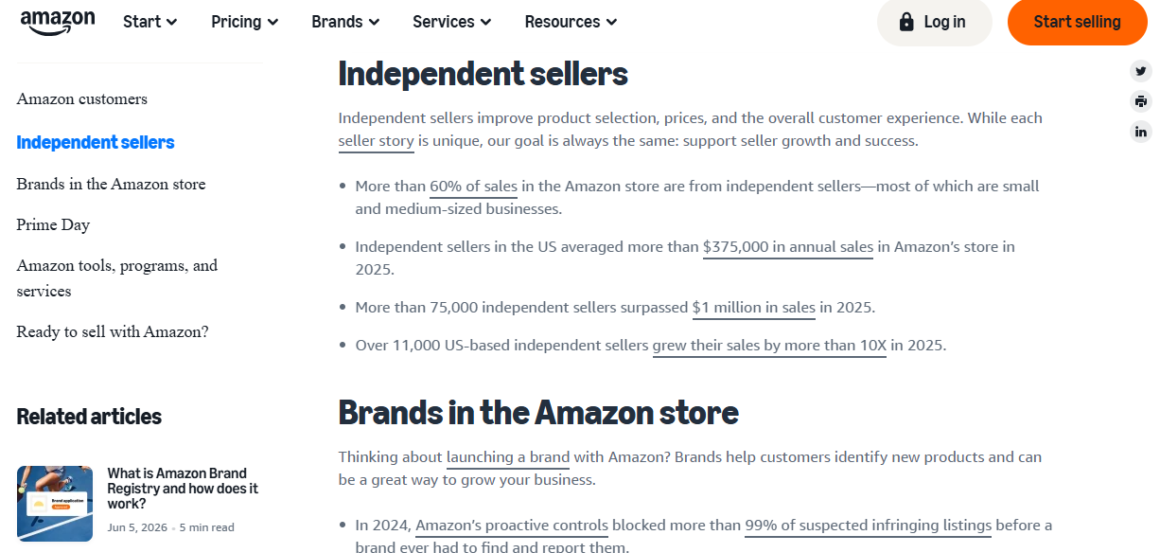
Amazon maintains that these accusations fundamentally misread how competition works in retail. In its public response to the FTC lawsuit, Amazon News16 said that if the commission’s case succeeded, it would force Amazon to engage in practices that actually harm consumers, such as featuring higher prices and offering slower or less reliable Prime shipping. The company argues that its 500,000 independent U.S. selling partners have created 1.5 million American jobs and that it works hard to help them succeed. Inside Amazon17 reported that over 60% of their sales come from independent sellers.
That last point is worth sitting with. Amazon does, in a genuine sense, depend on the sellers it squeezes. The marketplace is the product. Without the long tail of independent sellers filling out the catalog with depth and variety, Amazon’s retail moat disappears. That dependency should theoretically create alignment between Amazon’s interests and the interests of small sellers. In practice, the alignment breaks down precisely at the point where Amazon’s platform fees, advertising revenue, and brand relationships come into conflict with the cost of keeping entry barriers low.
What Sellers Are Left With
I spent time reading through Amazon seller forums, Reddit’s r/FulfillmentByAmazon, and the seller discussion boards on Seller Central, looking for what actual people caught in this system say when they think the audience is other sellers rather than journalists or Amazon employees.
The dominant tone is not anger. It is exhaustion.
One thread on Seller Cental18, which mirrors the dynamics of the U.S. marketplace, captures the feeling precisely. A seller wrote:
“You have literally spoken the heart out of thousands of Small Sellers on Amazon, as you have correctly mentioned that Amazon plays a bias against small sellers and big brands with regards to listing of products. They have clearly mentioned in their listing policies that no such words like ‘New Arrivals’ or ‘Best Seller’ are to be used in the product title. But we spotted so many top brands during this festive sale that when they launch any new product, they are allowed to enter those words in the title and Amazon just does nothing about it. Literally, such a total biased attitude.”
Another user in the same thread replied with eight words that probably landed heavier than intended:
“KEEP COMPLAINING ABOUT AMAZON POLICIES AND SOON AMAZON WILL SUSPEND YOUR ACCOUNT.”
That second reply is not paranoia. Sellers have had their accounts suspended or flagged after public criticism of Amazon policies. The power asymmetry is total. Amazon sets the rules, enforces them inconsistently, and holds the nuclear option of account suspension over every seller’s head at all times.
A podcast episode from The Ecommerce Blueprint19 in April 2025 by a seller with $7 million in Amazon sales since 2015 laid out the situation plainly, describing gating restrictions tightening even on seasoned sellers, a broken reimbursement system, and return of restock limits squeezing the ability to scale.
“These aren’t just rumors,” the host said. “They’re the REAL issues I’m facing in my own business.”
The Ungating Economy That Has Grown Up Around Desperation
The brand gating system has produced one clear winner group that nobody planned for: consultants and services charging sellers for help navigating the approval process. The legitimate end of this market, people who advise on sourcing documentation, distributor relationships, and proper invoice formats, provides real value. The illegitimate end, which is larger, provides fake invoices and destroyed accounts.
The sellers forum community at ASGTG regularly warns against services claiming to facilitate ungating by supplying documents that Amazon will reject or flag. The irony is that sellers who are sophisticated enough to recognize the scam are often sophisticated enough to navigate the real process themselves. The sellers who fall for the ungating scam are typically newer, smaller sellers who are most desperate to break into restricted categories and least equipped to absorb the loss of an account suspension.
At least once a week, according to attorneys who specialize in Amazon seller law, a seller account is deactivated for forged or manipulated documents. The sellers who pay for these services do not know the documents are fake. They receive a bill, a submission confirmation, and sometimes a temporary approval. Then the AI-assisted document review catches the forgery, or the brand’s Amazon contact makes a verification call, and the account is gone. The ungating service’s website stays up.
I am not arguing that Amazon should throw its doors open to any seller who wants to list any product under any brand. The counterfeit problem is real, the brand damage is real, and the consumer harm is real. A world with no gating at all was the world that drove Birkenstock out and pushed Nike to exit for six years. That world did not work.
What I am arguing is that the current system has specific, identifiable failures that Amazon could address without dismantling the legitimate protections that gating provides.
First, the goalposts need to stay in place. A seller who gets ungated after buying 10 units should not find themselves re-gated and required to buy 100 units ten days later with no notice and no explanation. That is not consumer protection. That is a broken process wearing consumer protection’s clothes.
Second, there needs to be a meaningful appeals path. Right now, the appeal for a gating rejection is to re-apply, which means restarting the same process that just failed, with the same requirements that already proved impossible, to a faceless review team that provides no feedback. A real appeals path would include specific reasoning for rejections, a named point of contact, and a timeline.
Third, the document requirements should accommodate the actual economics of small sellers. A seller who sources 30 legitimate units of a brand from an authorized regional distributor is not a counterfeiter. An invoice from a verifiable, legitimate distributor that does not happen to be on Amazon’s preferred-vendor list should not be automatically disqualifying. The supply chain verification goal could be met with phone verification, distributor background checks, or spot-inspection of inventory, not just invoice formatting requirements that track the paperwork preferences of Fortune 500 supply chains.
Fourth, the enforcement should be consistent. Sellers have documented instances where major brands are allowed to include language like “New Arrivals” or “Best Seller” in product titles during peak periods, while small sellers are flagged and suspended for the same violations. A rule that applies asymmetrically is not a rule. It is a preference dressed as a policy.
The Larger Stakes
Edesk20 reports that there are over 9.7 million sellers on Amazon’s platform, with roughly 1.9 million actively selling. More than 60% of all Amazon21 sales come from third-party or independent sellers, most of which are small- to medium-sized businesses. These are not abstractions. They are people who built their businesses on a platform they do not control, under rules they did not write, subject to changes they cannot predict or appeal.
The brand gating expansion is one chapter in a longer story about what it means to build a business inside someone else’s infrastructure. Amazon is not a public utility. It does not owe any seller a listing. But it has become something close to essential for retail in a way that changes the moral and potentially legal calculus of how it exercises its power.
The FTC case, the EU investigation, and the Indian antitrust findings are all circling the same question: at what point does a platform’s control over access to its marketplace become an exercise of monopoly power that harms competition, rather than a legitimate business decision that protects consumers?
That question does not have a clean answer yet. But every seller who bought ten units of a gated brand in good faith, listed them, watched them sell, and then got re-gated with a 100-unit requirement and a customer service agent’s silence is living inside the question. The velvet rope moves. The people on the outside of it are wondering who decides where it goes, and whether anyone is watching.
Sources
- Business Standard, www.business-standard.com/companies/news/amazon-seized-15-million-counterfeit-products-in-2025-using-ai-tools-126042201285_1.html. Accessed 15 June 2026. ↩︎
- Levy, Ari. “Birkenstock quits Amazon in US after counterfeit surge” 20 July 2016, www.cnbc.com/2016/07/20/birkenstock-quits-amazon-in-us-after-counterfeit-surge.html. Accessed 15 June 2026. ↩︎
- Nice Kicks on Instagram, www.instagram.com/p/B4z_9-uhDah/. Accessed 21 Aug. 2026. ↩︎
- Palmer, Annie. “Nike to resume selling directly on Amazon for first time since 2019” 21 May 2025, www.cnbc.com/2025/05/21/nike-to-resume-selling-directly-on-amazon-for-first-time-since-2019.html. Accessed 15 June 2026. ↩︎
- Sequence Commerce, sequencecommerce.com/brand-gating/. Accessed 15 June 2026. ↩︎
- Steiner, Ina. “Amazon Raised the Bar 10 Days after Ungating a Seller” EcommerceBytes, 27 Apr. 2025, www.ecommercebytes.com/2025/04/27/amazon-raised-the-bar-10-days-after-ungating-a-seller/. Accessed 16 June 2026. ↩︎
- 11, June. “No New Fees / Mass Brand Gating / Ruthless Suspensions – ASGTG – Amazon Sellers Group TG” 21 Nov. 2024, asgtg.com/no-new-fees-mass-brand-gating-ruthless-suspensions/. Accessed 16 June 2026. ↩︎
- “Amazon Gated Categories: How To Get Ungated On Amazon In 2025” WebyCorp.com, 20 Sept. 2024, webycorp.com/glossary/amazon-sales-analytics/what-are-amazon-gated-categories/. Accessed 16 June 2026. ↩︎
- “Sell on Amazon” When you sell on Amazon, you have access…, www.facebook.com/SellonAmazon/posts/when-you-sell-on-amazon-you-have-access-to-flexible-selling-plans-depending-on-y/1020113020150595/. Accessed 21 Aug. 2026. ↩︎
- Donovan, Ben. “Amazon Steers Third-Party Seller Share To All-Time High” Marketplace Pulse, 13 Feb. 2025, www.marketplacepulse.com/articles/amazon-steers-third-party-seller-share-to-all-time-high. Accessed 16 June 2026. ↩︎
- Rey, Jason Del. “Amazon is boasting record profits but one mystery remains: How much are seller fees boosting the bottom line?” Fortune, 8 Feb. 2025, fortune.com/2025/02/07/amazon-2024-earnings-third-party-seller-fees-profits/. Accessed 16 June 2026. ↩︎
- “The History of Retail Media Networks” MetaRouter Blog, 16 Dec. 2025, www.metarouter.io/post/the-history-of-retail-media-networks. Accessed 16 June 2026. ↩︎
- FTC, www.ftc.gov/legal-library/browse/cases-proceedings/1910129-1910130-amazoncom-inc-amazon-ecommerce. Accessed 16 June 2026. ↩︎
- Press, Tech Policy. “FTC v. Amazon.com” TechPolicy.Press, www.techpolicy.press/tracker/ftc-v-amazoncom/. Accessed 16 June 2026. ↩︎
- Times, Economic. “ED raids offices of sellers using Amazon, Flipkart over foreign exchange violation allegations” The Economic Times, 7 Nov. 2024, m.economictimes.com/industry/services/retail/india-raids-offices-of-sellers-using-amazon-flipkart-platforms-sources-say/articleshow/115051861.cms. Accessed 16 June 2026. ↩︎
- Zapolsky, David. “The FTC’s lawsuit against Amazon would lead to higher prices and slower deliveries for consumers—and hurt businesses” 26 Sept. 2023, www.aboutamazon.com/news/company-news/amazon-ftc-antitrust-lawsuit-full-response. Accessed 16 June 2026. ↩︎
- “Inside Amazon” More than 60% of sales on Amazon come from…, www.facebook.com/InsideAmazon/posts/more-than-60-of-sales-on-amazon-come-from-independent-sellers-most-of-which-are-/1297063729271503/. Accessed 21 Aug. 2026. ↩︎
- “Imp Checkpoint On Unfair Amazon Policies From My Experience” 13 Nov. 2023, sellercentral.amazon.in/seller-forums/discussions/t/03f1914e-e269-4769-9f3c-b0af2fc208fc. Accessed 16 June 2026. ↩︎
- “Episode 123: Amazon Broke the System. Now What?” The eCommerce Blueprint w/ AskJimmySmith, 25 Apr. 2025, theecommerceblueprint.podbean.com/e/amazon-broke-the-system-now-what. Accessed 16 June 2026. ↩︎
- O, “Ann. “Amazon Marketplace Statistics 2025” 1 May 2025, www.edesk.com/blog/amazon-statistics/. Accessed 16 June 2026. ↩︎
- Toogood, Mickey. “Amazon selling stats” Sell on Amazon, 10 May 2024, sell.amazon.com/blog/amazon-stats. Accessed 16 June 2026. ↩︎