

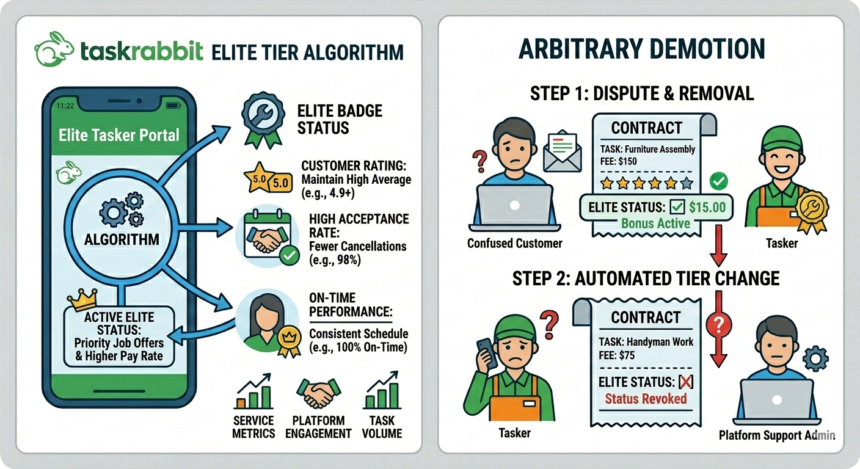

An investigation into how a digital badge became the difference between getting work and going dark, and why the workers who earned it have no right to fight back.
- The Promise of the Badge
- The Shifting Goalposts
- The Problem with Invitations You Never Chose
- No Right of Appeal
- The Relative Ranking Problem
- What Workers Are Saying
- The Gig Economy’s Accountability Deficit
- The Dilution Problem: When “Elite” Means Everyone
- The Case for a Better System
- A Badge, and What It Costs
There is a kind of cruelty that lives inside corporate euphemism. TaskRabbit, the IKEA-owned gig marketplace where independent contractors assemble furniture, mount televisions, and move boxes for strangers, calls its top workers “Elite.” The badge, a small digital mark that appears next to a Tasker’s name in client search results, is the difference between being seen and being invisible. Earn it, and clients find you. Lose it, and you slide down the algorithmic pile, competing with hundreds of others for whatever scraps of visibility remain.
The problem is that the rules for keeping that badge keep changing. And when they change, they change without warning, without appeal, and with TaskRabbit’s1 official document that tells workers, flatly, that there is “no need to dispute” the result.
I’ve spent time reading through TaskRabbit’s official support documentation, its blog announcements, the reviews workers and clients have left on Trustpilot, G2, and Complaintsboard, and the scattered but telling complaints that appear across gig economy forums. What emerges is a portrait of a system where elite status is dangled as both incentive and reward. But can be yanked away through mechanisms the worker barely controls, measured against competitors the worker never sees, in a city-by-city ranking that the company calculates in secret.
The Promise of the Badge
TaskRabbit2 was founded in 2008 as RunMyErrand by Leah Busque, pivoting through several business models before landing in the hands of IKEA in 2017. The Swedish furniture giant paid an undisclosed sum, though TaskRabbit had been valued at around $50 million in a 2015 financing round, according to the Wall Street Journal. Today, according to SupplyChainBrain3, the platform connects clients to more than 60,000 freelance workers (“Taskers”) for chores including furniture assembly, handyman work, moving help, and more.
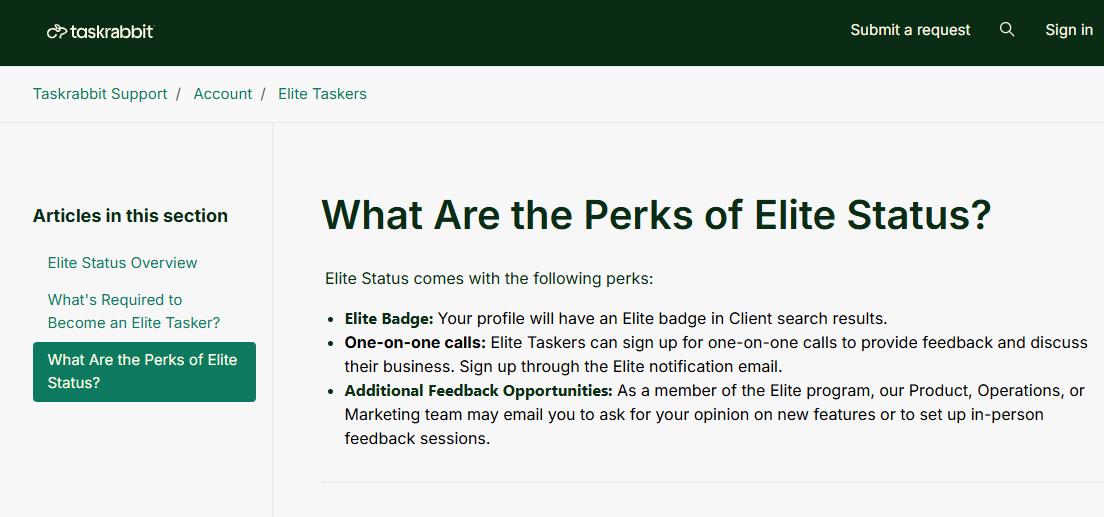
The Elite badge, introduced as part of the platform’s quality-signaling infrastructure, was meant to solve a fundamental gig economy problem: how does a stranger decide which worker to trust? TaskRabbit4 claims that he Elite badge appears in client search results and signals to the client that this particular Tasker is among the platform’s best. It also comes with perks: a one-on-one call with a Tasker Success Manager, promotional visibility, and the kind of credibility that leads to more bookings.
According to TechCrunch5, for full-time Taskers (and there are many), some earning between $5,000 and $8,000 a month doing three to five tasks a day, that badge is not a vanity metric. It is their income. Lose it, and your bookings drop. Lose enough bookings, and you lose your livelihood.
The Shifting Goalposts
Here is where things get complicated. The criteria for Elite status have changed multiple times in a short period. Between early 2024 and late 2024 alone, the threshold shifted in opposite directions within the same calendar year.
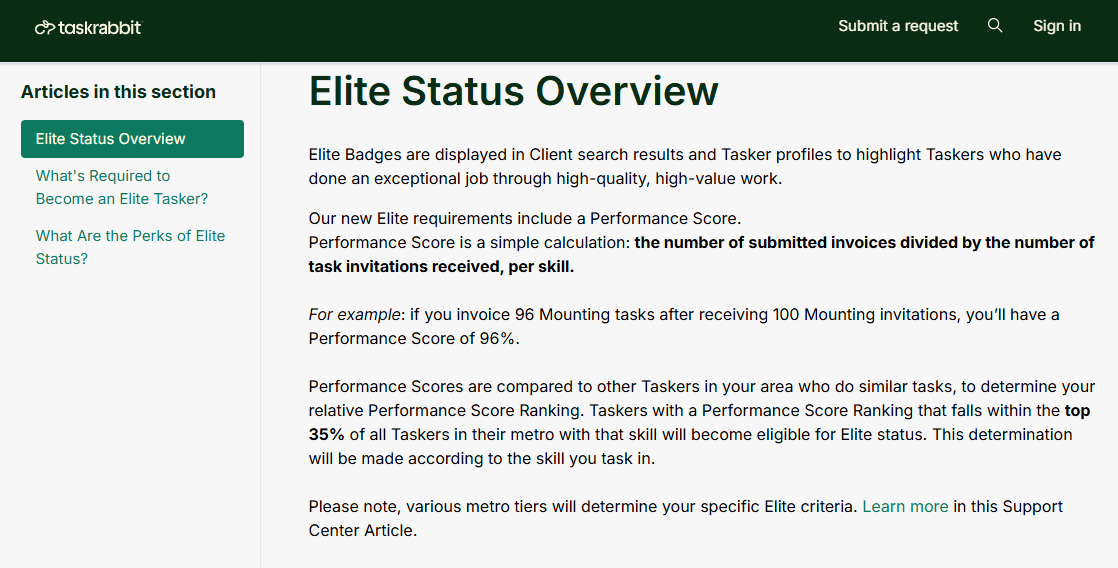
In April 2024, TaskRabbit6 announced a simplified Performance Score system. The calculation became straightforward: the number of invoices you submit, divided by the number of task invitations you receive. Miss an invitation, and it counts against you — even if you forfeited it, even if you had a legitimate reason. The threshold to reach Elite was set at the top 15% of all Taskers in your metro area and category.
Then, in September 2024, TaskRabbit7 quietly updated the threshold again and expanded it to the top 35%. The company’s explanation was candid, if also revealing:
“We see more success with client booking when we have a higher number of Elite Taskers available.”
In other words, the badge was diluted for commercial reasons, not merit-based ones.
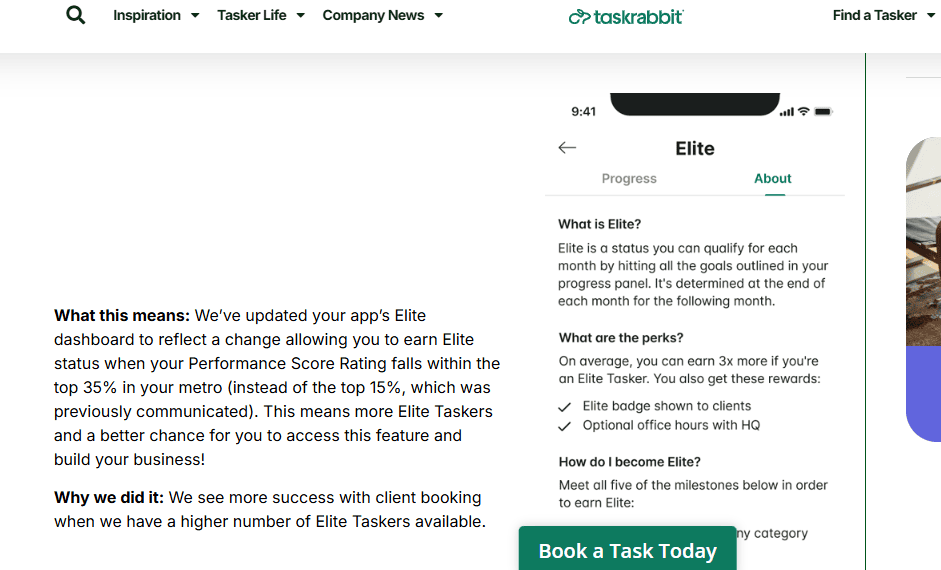
By November 2024, the top-35% threshold was made the official, permanent standard.
The math alone should give pause. If 35% of all Taskers in a metro hold the Elite badge, then “Elite” means little more than “not in the bottom two-thirds.” That is a strange definition of excellence. A Tasker who joined the platform yesterday, completed a handful of jobs, and received a lucky streak of invitations might carry the same badge as a five-year veteran with 500 five-star reviews. The badge’s meaning gets hollowed out by its own expansion.
But the more revealing problem is the flip side: workers who built their income around the old threshold, who hustled to maintain the top-15% standard, suddenly found themselves measured against a new curve populated by more competitors. A Tasker who held Elite status for two years under one set of rules woke up one morning to find the rules had changed. No notice in the app. No email explaining the shift. Just a different number when they logged in.
The Problem with Invitations You Never Chose
The Performance Score system has a structural flaw that TaskRabbit has never fully addressed. An invitation is counted toward your score regardless of whether you accept or forfeit the task. This sounds fair at first. If you accept an invitation and complete the job, great. But if you forfeit an invitation, say, because you are already booked that day, or the job is across town, or the scope turned out to be outside your skill set, it counts against you anyway.
The system essentially asks workers to be available for everything, always, or pay a reputational penalty. For independent contractors managing their own schedules, this is a significant constraint. The entire premise of gig work, as legal scholars and labor economists have noted for years, is that flexibility is the trade-off for the absence of benefits. TaskRabbit workers are classified as independent contractors, not entitled to holiday pay or benefits, and work when they want and where they want. At least in theory. The invitation-counting mechanism cuts directly against that autonomy.
Here is a scenario that plays out across the platform. A Tasker who works full-time on TaskRabbit decides to take a week off for a family emergency. During that week, the platform continues to send them invitations. Invitations that, because they are unavailable, they forfeit. Each one damages their Performance Score. If enough invitations pile up unanswered, the Tasker can lose Elite status before they return to work. They went on an unpaid vacation, because they have no paid vacation; they are not employees, and came back to find their rank penalized for it.
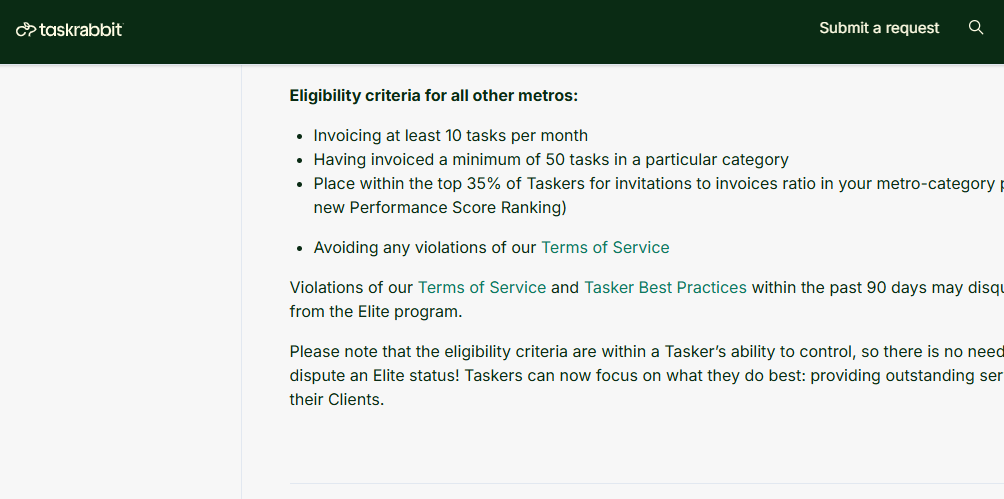
TaskRabbit’s8 own support documentation addresses none of this. It simply states that the eligibility criteria are “within a Tasker’s ability to control” and therefore there is no need to dispute a demotion. It is a philosophical claim dressed up as a logical one. Of course accepting every invitation is technically within a Tasker’s ability to control, provided they never rest, never get sick, never have a scheduling conflict, and live in perfect geographic proximity to every job the algorithm sends their way.
No Right of Appeal
The “no need to dispute” clause is perhaps the most revealing piece of language in TaskRabbit’s Elite documentation. It is not simply a customer service policy. It is a statement about power.
When an airline demotes a frequent flyer from Gold to Silver status, the traveler can usually call and ask why. When a credit card company changes your credit limit, there is a formal process and often a regulatory one behind it. When TaskRabbit removes your Elite badge, the support page tells you not to bother asking.
TaskRabbit’s official language reads:
“Please note that the eligibility criteria are within a Tasker’s ability to control, so there is no need to dispute an Elite status!”
The exclamation mark at the end is its own kind of insult. It is designed to sound cheerful rather than dismissive. But read it plainly: you lost your status, we believe it is your fault, and there is nothing to discuss. The matter is closed before it is opened.
This matters not just because it is frustrating, but because the demotion carries real income consequences. When a Tasker loses their Elite badge, their profile moves lower in client search results. Fewer clients see them. Fewer bookings come in. That is a wage reduction imposed by an algorithm, with no review process, no appeal mechanism, and no explanation beyond a formula that is computed internally and compared against a competitive ranking the worker has no visibility into.
The irony is that TaskRabbit has positioned its workers as small business owners. The company’s blog and support language consistently refers to Taskers as people “building their businesses.” But real small business owners have recourse. They can negotiate. They can push back. They can demand an explanation. They can take a vacation.
The Relative Ranking Problem
There is another layer to the arbitrariness. Elite status is not determined by an absolute score. It is determined by a relative ranking. A Tasker’s Performance Score is compared to other Taskers in their metro area doing similar tasks, and only those in the top 35% qualify.
This means your Elite status is not fully in your control even by TaskRabbit’s own generous framing. You could maintain a perfect Performance Score, accepting every invitation, completing every job, and still lose Elite status if enough new Taskers flood your metro and outperform you. Your absolute quality is irrelevant. What matters is your position in a competitive ranking of people you will never meet, operating in circumstances you will never see, measured by a formula computed behind closed doors.
This is a zero-sum game built into the structure of the program. For every new Tasker who enters your metro and earns Elite status, someone else has to fall out. The total number of Elite badges in any metro is capped at 35% of the worker pool by definition. Growth in the platform, which TaskRabbit actively pursues, and which is in IKEA’s commercial interest, means more workers competing for the same pool of Elite slots.
TaskRabbit’s9 year-end 2024 blog post celebrated increasing task invitations to Taskers by expanding the number of task categories shown to clients.
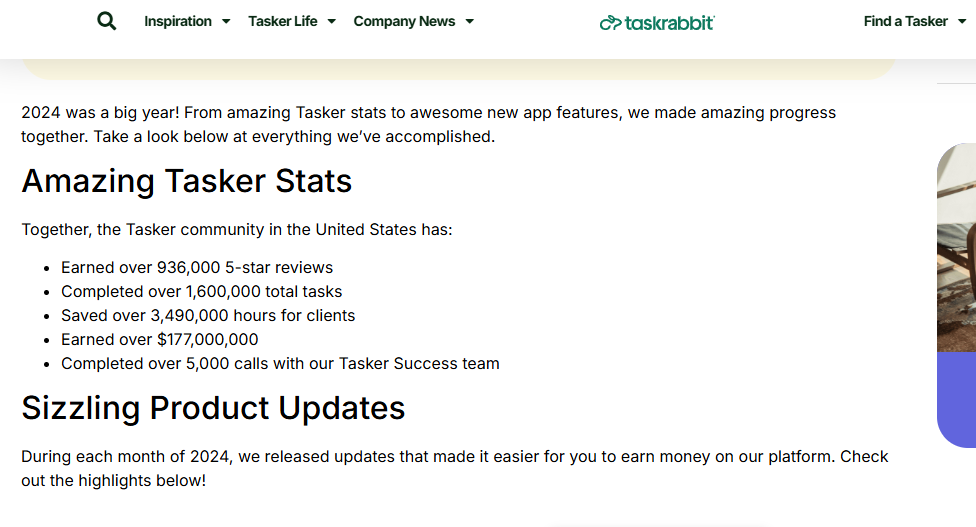
More clients, more tasks, more invitations. That sounds like good news for Taskers. But more invitations also means more opportunities to forfeit an invitation, more chances to miss a job, and more competition in each metro as the platform scales. The worker who once comfortably sat in the top 15% may find that the new inflow of workers pushes them to the 37th percentile, just outside the Elite threshold, through no change in their own behavior.
What Workers Are Saying
You do not have to look hard to find the frustration. It shows up in the form of quiet rage across review platforms, forums, and complaint boards, rarely attached to the specific language of “Elite demotion” but unmistakably shaped by it.
On Trustpilot’s10 page for TaskRabbit, a Tasker wrote in early 2026:
“I’ve been a Tasker with years of experience, always doing my best to offer quality service at very reasonable rates… TaskRabbit sided with the client, suspended my account for 10 days.” A single complaint, a platform decision, and a worker on the outside looking in — with no clear mechanism for appeal.
On G211, a verified reviewer noted that a Tasker “has no skills” but had been “branded elite.” That is the other side of the demotion problem. If the system can mislabel the unqualified as Elite, it can also mislabel the qualified as non-Elite. The badge is not a reliable signal in either direction.
On ComplaintsBoard12, a former Tasker described being removed from the platform entirely after “a copy and paste response” about failing to meet client expectations, with no specific explanation and no avenue for appeal. That is a more extreme version of what Elite demotion represents in miniature: a platform decision that reduces a worker’s earning power, delivered without explanation, with no path to contest it.
One user on the professional networking site Blind13, when discussing TaskRabbit, offered what has become a piece of common wisdom among gig clients:
“Find an elite tasker who has great reviews.”
The advice is well-meaning, but it illustrates exactly why the badge matters so much. Clients use it as a proxy for quality. When it disappears from a worker’s profile, for algorithmic reasons the worker cannot fully control or contest, the worker becomes less trustworthy in the client’s eyes through no fault of their own.
The Gig Economy’s Accountability Deficit
TaskRabbit is not operating in a vacuum. What it is doing with the Elite tier is a specific, refined version of what virtually every large gig platform does: use algorithmic status systems to shape worker behavior without assuming the legal responsibilities of employment.
TaskRabbit workers are classified as independent contractors. That classification means they have no right to collectively bargain, no entitlement to benefits, and no statutory protection against the kinds of unilateral policy changes that would require advance notice under a traditional employment relationship. As legal scholars at Foley14 have noted,
“Gig workers are frequently classified as independent contractors, which — if properly classified — excludes them from protections under the National Labor Relations Act.”
The result is that a company can change the rules of the Elite game at will, as TaskRabbit has done at least twice in a single year, and workers have no formal mechanism to object.
According to Ilearnlot15, the platform-based labor market generated an estimated $556.7 billion in 2024 and is projected to grow at roughly 16% annually. The people building that economy often have no voice in how it is governed. Massachusetts voters approved a measure in November 2024 allowing rideshare drivers to form unions and collectively bargain. But TaskRabbit’s Taskers are not rideshare drivers, and their situation has attracted far less legislative attention.
There is a broader contradiction embedded in the Elite tier that the platform has never resolved. TaskRabbit asks Taskers to think of themselves as small business owners building their own client relationships and reputations. Yet the most visible signal of a Tasker’s reputation, the Elite badge, is controlled entirely by the platform, calculated by the platform’s private formula, and revocable by the platform at any time without explanation or appeal. That is not how small business ownership works. That is how employment works, except without any of the protections that come with it.
The Dilution Problem: When “Elite” Means Everyone
When the threshold expanded from the top 15% to the top 35%, TaskRabbit explained the move straightforwardly: the company sees better client booking rates when more Taskers carry the Elite badge. That admission deserves unpacking.
If Elite status were a genuine quality indicator, diluting it would harm client outcomes. Clients would encounter more mediocre workers wearing the badge, grow disappointed, and eventually stop trusting the badge entirely. The fact that TaskRabbit believes broader Elite distribution leads to more bookings suggests that the badge functions less as a quality signal and more as a conversion tool. A reassurance that nudges uncertain clients to commit to a booking.
That is a legitimate business strategy. But it is worth being clear about what it means for the workers who busted themselves to make the top 15% under the old rules. They worked harder, accepted more invitations, and delivered more jobs to earn a distinction that has since been handed to the bottom third of the market they outperformed. Their effort was real. The distinction they earned has been retroactively devalued.
Whether or not that specific worker was actually unskilled is unknowable from the outside. But the concern is genuine and structural. The faster TaskRabbit expands the Elite pool, the less the badge means, and the more veteran, skilled workers find their visible differentiation from newcomers eroded.
The Case for a Better System
None of this is to say that TaskRabbit should not have a performance-based tier system. Some mechanism for surfacing quality workers is essential for a marketplace like this to function. The question is whether the current system is designed primarily to serve workers or primarily to serve the platform’s engagement metrics.
A more defensible system would look different in several key respects. It would count only invitations the worker had the capacity to respond to, pausing the score calculation during periods when the worker has marked themselves unavailable. It would offer some form of review process, however limited, for workers who believe they were incorrectly demoted. It would be transparent about the competitive ranking. Workers should be able to see where they stand relative to their metro peers, not just receive an opaque pass or fail. And it would not change the threshold twice in a calendar year without warning, retroactively reshuffling the competitive landscape for workers who had planned their businesses around the old rules.
The absence of these protections is not an oversight. It is a choice. TaskRabbit, like most large gig platforms, has found that maximizing platform control over worker status, without bearing the costs of employment, is commercially efficient. Workers who want to earn more adapt their behavior to whatever the current rules demand. Workers who cannot adapt fall off. The system produces the behavior the platform wants without the platform having to pay for it.
A Badge, and What It Costs
There is something almost poignant about the intensity of feeling around a small digital icon. Talk to any full-time Tasker and the Elite badge comes up quickly. They know what it does to their booking rate. They know when it is gone. They know that losing it is not just a dent to their pride. It is a dent to their income in a job that has no floor.
According to data from Investopedia16, TaskRabbit Taskers earned the highest average hourly pay among gig platform workers in 2025, at $38 per hour. That is not nothing. It is a real wage for real work, earned by people who show up on time, carry their own tools, deal with difficult clients, and build a reputation one job at a time. What they cannot do is appeal the algorithm.
The company’s support documentation tells them there is no need to dispute. That is a sentence that will look bad in retrospect, the way a lot of gig economy language looks bad once the lawsuits and regulations catch up to the reality. It tells workers that their status in the system is both their responsibility and outside their control. It is a contradiction the platform has lived with comfortably for years, and workers have lived with at a cost.
The badge is small. The principle behind it is not.
Sources
- “What’s Required to Become an Elite Tasker?” Taskrabbit Support, support.taskrabbit.com/hc/en-us/articles/360034622812-What-s-Required-to-Become-an-Elite-Tasker. Accessed 30 May 2026. ↩︎
- Brown, Liz. “Taskrabbit’s 15th Anniversary: Celebrating a Decade and a Half of Milestones” Taskrabbit Blog, 13 Nov. 2023, www.taskrabbit.com/blog/taskrabbits-15th-anniversary/. Accessed 31 May 2026. ↩︎
- “Ikea Enters ‘Gig Economy’ by Acquiring TaskRabbit” SupplyChainBrain, 4 Oct. 2017, www.supplychainbrain.com/articles/26886-ikea-enters-gig-economy-by-acquiring-taskrabbit. Accessed 31 May 2026. ↩︎
- “What Are the Perks of Elite Status?” support.taskrabbit.com/hc/en-us/articles/360034623292-What-Are-the-Perks-of-Elite-Status. Accessed 31 May 2026. ↩︎
- Perez, Sarah. “Following A Drop In Completed Jobs, Errands Marketplace TaskRabbit Shakes Up Its Business Model” TechCrunch, 17 June 2014, techcrunch.com/2014/06/17/following-a-drop-in-completed-jobs-errands-marketplace-taskrabbit-shakes-up-its-business-model. Accessed 31 May 2026. ↩︎
- Beier, Matt. “Tasker Roundup: April 2024” Taskrabbit Blog, 8 Apr. 2024, www.taskrabbit.com/blog/tasker-roundup-april-2024/. Accessed 31 May 2026. ↩︎
- Beier, Matt. “Tasker Update (App Version 4.60.0)” Taskrabbit Blog, 25 Sept. 2024, www.taskrabbit.com/blog/tasker-update-app-version-4-60-0/. Accessed 31 May 2026. ↩︎
- “What’s Required to Become an Elite Tasker?” support.taskrabbit.com/hc/en-us/articles/360034622812-What-s-Required-to-Become-an-Elite-Tasker. Accessed 31 May 2026. ↩︎
- Beier, Matt. “Tasking Through 2024—Our Best Year Yet” Taskrabbit Blog, 19 Dec. 2024, www.taskrabbit.com/blog/tasking-through-2024-our-best-year-yet/. Accessed 31 May 2026. ↩︎
- Trustpilot, br.trustpilot.com/review/taskrabbit.ca. Accessed 31 May 2026. ↩︎
- “G2.Com” g2.com/products/taskrabbit/reviews. Accessed 31 May 2026. ↩︎
- Johnston, R. “TaskRabbit Taskers And Clients Reviews and Complaints” ComplaintsBoard, 20 Apr. 2023, www.complaintsboard.com/taskrabbit-b124438. Accessed 31 May 2026. ↩︎
- “Your Anonymous Workplace Community” Blind, www.teamblind.com/post/task-rabbit-qcodz2vs. Accessed 31 May 2026. ↩︎
- “From the Pickup Line to the Picket Line: What Employers Need to Know About the Gig Economy Labor Movement” Foley & Lardner, 24 Mar. 2025, www.foley.com/insights/publications/2025/03/pickup-line-picket-line-employers-gig-economy-labor-movement/. Accessed 31 May 2026. ↩︎
- Das, Nageshwar. “Gig Platform: Best Gig Work Websites 2026” Ilearnlot, 23 Mar. 2026, www.ilearnlot.com/gig-platform-2026/2516241/. Accessed 31 May 2026. ↩︎
- Investopedia, www.investopedia.com/how-much-gig-workers-earn-per-hour-and-how-wages-compare-across-apps-11927475. Accessed 31 May 2026. ↩︎


