


How a Target-owned grocery delivery giant cuts off workers’ livelihoods with a form email, a black-box algorithm, and no real answers
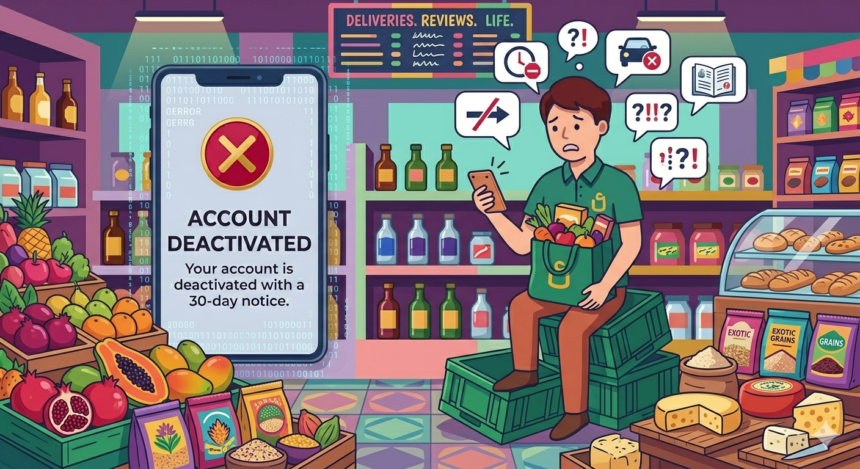
Anyone who has ever lived off the gig economy knows the exact dread people talk about online. It comes as a push notification, or sometimes it doesn’t come at all. You open the app on a Tuesday morning, ready to pick up orders, and the screen just tells you that you are no longer authorized. No call. No explanation. No severance. Just silence.
This is the Shipt deactivation experience, and tens of thousands of people who drive for the Target-owned grocery delivery service have lived it.
Shipt, acquired by Target1 in 2017 for $550 million, markets itself as a flexible opportunity platform. The pitch is simple: sign up, shop for groceries, earn money on your schedule. For many workers, it became a primary income source. Reliable shoppers with thousands of five-star deliveries built entire financial lives around the app. And then, often without any advance notice, it was gone.
The story of Shipt’s deactivation practices is not simply a story about bad customer service. It is a window into a broader, structural problem at the heart of the American gig economy: companies that exert near-total control over workers’ livelihoods while claiming those workers are “independent contractors” with none of the legal protections that come with employment.
The Day the App Went Dark
Go to Glassdoor2 and search for Shipt reviews filtered by the word “deactivated.” What comes back reads like a wall of grief. Worker after worker describing the same experience in slightly different language.
“You work late, weekends, holidays and go above and beyond for customers and then get deactivated with no warning or explanation. There is nobody you can call to talk about it with and you’re just cut right off. A real slap in the face for busting your butt.”
On Indeed, the reviews are equally stark. One seven-year veteran wrote that they delivered over 5,500 orders before being deactivated because the app’s chat function stopped working on two orders.
“They definitely will discard you without much cause,” they wrote.
Another shopper described opening the app after a year of service, a great rating, and no warnings, only to find their account gone.
“Then one day I get an email saying my account has been deactivated. I tried appealing it, but they said I was permanently banned. This company doesn’t care about their employees.”
The Better Business Bureau3 complaint section for Shipt tells the same story. One shopper filed a complaint stating they were deactivated without being provided any reason, explanation, or evidence.
“I was never informed of any specific incident, date, or policy violation,” the complaint reads. “I have repeatedly requested clarification, but Shipt has not given me: The reason code for the deactivation, the date of the alleged incident, any evidence or customer complaint, any explanation whatsoever.”
What makes the pattern so corrosive is not just the deactivation itself. It is the helplessness that follows. On Glassdoor, one reviewer wrote:
“Account was deactivated indefinitely for absolutely no reason and I was given zero communication. Once you are deactivated they ignore any efforts you make to contact them.”
One Indeed reviewer summed it up in terms that stuck with me:
“On the appeal form there is a spot to upload any evidence to support your appeal, but if you don’t know what you’re essentially being ‘charged’ with, how are you supposed to produce evidence to refute it?”
That question has no good answer.
How the System Works, On Paper
Shipt4 does publish a deactivation policy page. The page is dedicated, Shipt says, to “providing transparency regarding losing access to the shopper app and identifying some of the most common situations that can lead to the loss of access.”
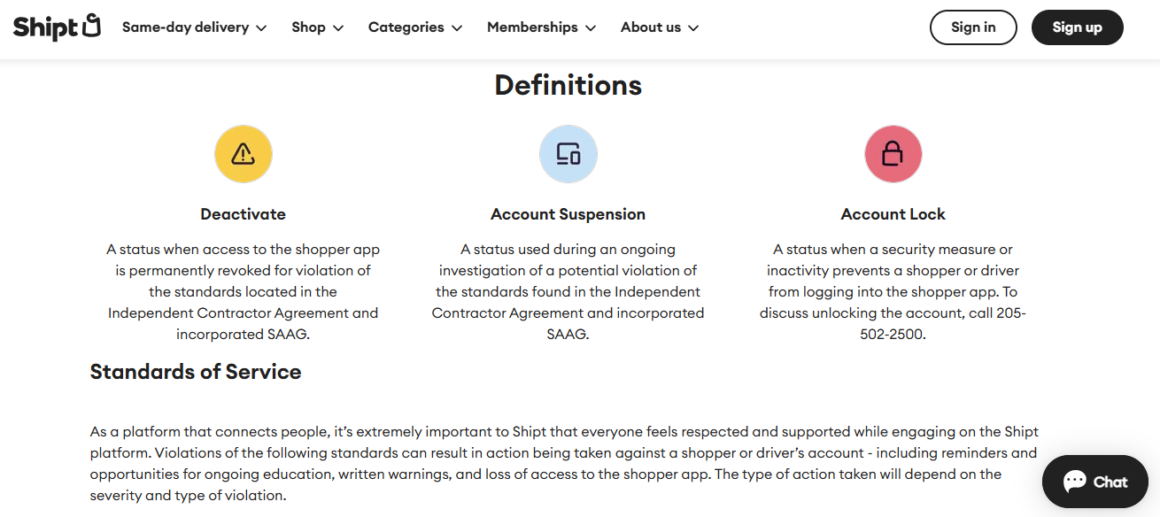
On paper, the framework looks reasonable. Shipt says it does not make deactivation decisions lightly, and that “all decisions are made after an investigation performed by dedicated teams.” Shoppers who believe they have been improperly deactivated can complete an appeal form and upload documentation for the review team to consider.
The reality, in practice, is considerably grimmer.
According to Shipt’s own policy and confirmed by numerous shoppers, you get deactivated if your last 50 ratings drop below 4.7, or if your on-time delivery percentage drops below 90 percent. That 4.7 threshold sounds close to perfect, and it is. A single bad review can drag a shopper toward the edge. One shopper on Indeed described needing almost 40 five-star ratings to recover from just four bad reviews.
Other triggers include canceling too many orders, shopping with another person in the vehicle, purchasing items for yourself and billing them to the customer, and failing to scan IDs when delivering alcohol. According to a Gridwise analysis, Shipt is especially sensitive to these performance issues, and gig workers are largely at the mercy of account deactivation procedures that are primarily conducted via email. Many report never getting a response or spending hours on hold.
The high ratings threshold creates a perverse dynamic: customers who are never satisfied, who return items, who complain about things outside the shopper’s control, can collectively push a worker below the floor. And the shopper has no real mechanism to contest a specific one-star review, no ability to see which customer left it, and no way to explain their side until it is already too late.
The Algorithm Nobody Can See
The deactivation problem sits inside a larger opacity problem at Shipt. When Shipt rolled out an algorithmic pay model several years ago, the company claimed the new approach was fairer to workers and better matched pay to labor required. Many workers, however, saw their paychecks dwindle. Since Shipt did not release detailed information about the algorithm, it was essentially a black box that workers could not see inside.
Workers who organized against the pay cuts gathered data and partnered with researchers to audit the algorithm. According to Gizmodo5, it had given 40 percent of workers substantial pay cuts.
The same opacity that governed pay governs deactivation. Workers frequently report receiving termination emails citing violations of “Shipt Shopper Guidelines” with no specifics attached. As one Indeed reviewer described:
“They gave no specific reason for the deactivation besides a generic email stating I had not adhered to ‘Shipt Shopper Guidelines.’ I always followed guidelines, had amazing reviews and stats. I tried to reach out to management for answers but was told only to attempt to appeal. I gathered pics of reviews, pics of shopper milestones, wrote out a long, heartfelt, well-thought-out appeal only to get a robotic email in response that they denied my appeal again for ‘not adhering.’ It stated that, due to privacy reasons, they could not tell me who, what store, or when I broke any rules.”
This is a pattern that repeats across platform after platform in the gig economy. Opaque policy enforcement, algorithmic judgment with no human review, and appeals processes that exist on paper but function mainly as rejection machines.
The Fear of Speaking Out
The culture inside Shipt’s worker community adds another layer to the deactivation problem. Workers who criticize the company publicly live in fear that the criticism itself will cost them their income.
One shopper from Iowa who asked to remain anonymous described the vibe of Shipt’s official Facebook group as “brainwashing.” They said the group would not let workers post negative things.
“If you do there’s a good chance you’ll be deactivated.”
As reported by TechCrunch6, another worker, identified as Solis, described how Shipt created what he called a “cult-like environment” where the company deleted negative comments in Facebook groups and allowed shoppers to see only “feel-good stories in an attempt to keep up shopper morale.” He described the fear plainly: “I wake up in the middle of the night scared that I forgot an order and will get deactivated. That’s the type of fear they instill into you.”
One shopper named Michael told Vice that he was kicked out of his local Shipt-moderated Facebook group after arguing with a moderator about pay. “It took me a couple days to realize I had been banned from the group,” he said.
When asked about these reports, a Shipt spokesperson said the company’s official social channels exist as a “supportive online community,” and that shoppers are asked not to post inflammatory, rude, or threatening content. The spokesperson added that Shipt “does not make deactivation decisions based on shopper feedback consistent with those guidelines.”
That caveat, “consistent with those guidelines,” does a lot of work. Who decides what’s inflammatory? The same company doing the deactivating.
The Legal Reckoning
Shipt’s deactivation practices did not stay a worker grievance forever. They became a legal problem.
In October 2022, Minnesota Attorney General7 Keith Ellison filed a lawsuit against Shipt alleging that the company had misclassified its workers as independent contractors to avoid providing them with employment protections. The AG’s office applied Minnesota’s nine-factor test for determining employment status, concluding that shoppers were employees due to economic dependence on Shipt. The complaint stated that Shipt gained an unlawful competitive advantage by avoiding legally required benefits and protections.
The District of Columbia’s Attorney General8 filed a parallel lawsuit. “At every step of the way Shipt cheats, putting profits over workers and violating its employees’ basic rights just to make another dollar,” D.C. AG Karl Racine said in a statement.
In September 2025, AG Ellison9 announced a settlement with Shipt. The company agreed to pay $800,000 to the state and to improve working conditions for shoppers, with the settlement terms crafted based on input from shoppers themselves about the most common difficulties they face on the job.
The settlement’s most meaningful provisions go directly to the deactivation problem. Shipt must now provide a written explanation to delivery workers when they lose access to the app, and must allow workers to appeal deactivation decisions. This sounds like basic fairness. And it is. The fact that it took a state attorney general lawsuit and an $800,000 settlement to compel a company to tell a worker why they were fired tells you everything about how Shipt, and platforms like it, have operated in the absence of legal pressure.
Notably, the settlement did not require Shipt to reclassify its workers as employees. The $800,000 payment, spread across a company owned by one of America’s largest retailers, is more rounding error than deterrent.
While federal labor law has moved slowly on gig worker protections, some cities have moved faster. Seattle10 passed the App-Based Worker Deactivation Rights Ordinance in 2023, which took effect in January 2025.
The ordinance makes certain types of deactivations unlawful, requires network companies to provide workers with their deactivation policies in advance, mandates that companies follow specific procedural steps before most deactivations, and requires that workers be given notice and access to records substantiating the deactivation before they are cut off.
The Seattle Office of Labor Standards11, which enforces the law, published a full worker’s guide explaining the rights, how to challenge a deactivation, and how to file a complaint.
This is the model. Notice. Transparency. A real appeals process with access to the evidence. A regulatory body with enforcement authority. None of these things are radical. All of them would be transformative for the hundreds of thousands of gig workers who currently have none of them.
The question is whether Seattle’s model spreads, or whether it remains an island of protection in a sea of at-will digital termination.
A Structural Problem, Not a Policy Glitch
There is a temptation to frame the Shipt deactivation12 problem as a customer service failure, something fixable with a better FAQ page or a phone number for appeals. That framing lets the real problem off the hook.
The real problem is classification. When a company can tell you exactly when to work, exactly how to shop, exactly what rating you must maintain, exactly what you can say on social media, and then claim you are an independent contractor when it is time to fire you without cause or explanation, something has gone wrong with the entire framework.
One Shipt shopper put it plainly:
“I like being an independent contractor but I am not an independent contractor with Shipt in any sense of the word.”
The independent contractor label does two things simultaneously. It strips workers of the employment law protections they would otherwise have, like the right to notice before termination, the right to unemployment benefits, and the right to workers’ compensation. And it allows the platform to externalize all the risk of the work onto the workers themselves, from wear on the car to health insurance to the sudden loss of income when the algorithm decides, for reasons it will not explain, that you are no longer needed.
Consider what this means in human terms. A shopper who has delivered 5,500 groceries, who has built a 4.97 rating, who has spent years cultivating relationships with regular customers, can lose that entire professional identity in an instant, with no recourse, no explanation, and no severance. As one analysis notes, the socioeconomic impact of deactivation is significant, particularly for those who rely heavily on this flexible source of income. This abrupt closure strips gig workers of their financial buffer instantly, leaving them scrambling for alternative means of livelihood.
The Minnesota settlement is a start, not an end. The requirement to provide written explanations and allow appeals is the floor of basic dignity, not the ceiling. And without reclassification, the fundamental imbalance of power that makes sudden, opaque deactivations possible remains intact.
There are real stakes here for Shipt and companies like it. Gig economy platforms have a massive issue with worker churn. If they do not have workers to fulfill customer demand, their service will not work. Every shopper arbitrarily deactivated is a worker who takes their knowledge, their reliability, and their customer relationships with them.
But the market has not solved this problem. Shipt and DoorDash and Instacart continue to recruit new workers faster than they lose existing ones, because there is always someone else who needs money. The individual worker is replaceable. The structural power imbalance is not, without legal intervention.
What you can do, practically, if you are a Shipt shopper or are considering becoming one: document everything. Screenshot your ratings, your delivery confirmations, your customer messages. If deactivated, complete the appeal form immediately and upload every piece of evidence you have, because documents submitted outside the form will not be reviewed during the appeal process. Check whether your city has passed gig worker protection ordinances, and know what your rights are before you need them.
And understand, clearly, that the platform’s interest in your continued employment lasts exactly as long as your metrics are acceptable and there is no cheaper or more compliant worker available to replace you.
The day the app goes dark is not the beginning of a process. For most shoppers, it is the end of one.
Sources
- “Target to Acquire Same-Day Delivery Platform Shipt, Inc. to Bolster Fulfillment Capabilities” 13 Dec. 2017, corporate.target.com/press/release/2017/12/target-to-acquire-same-day-delivery-platform-shipt,-inc-to-bolster-fulfillment-capabilities. Accessed 9 June 2026. ↩︎
- Glassdoor, www.glassdoor.co.in/Reviews/Shipt-Reviews-E1181337.htm. Accessed 15 July 2026. ↩︎
- BBB, Better Business Bureau, www.bbb.org/us/al/birmingham/profile/grocery-delivery/shipt-0463-90146509/complaints. Accessed 14 July 2026. ↩︎
- “Why shoppers or drivers may lose access to the shopper app” Shipt Grocery Delivery, www.shipt.com/shopper/deactivations. Accessed 9 June 2026. ↩︎
- Noor, Dharna. “Shipt’s ‘Effort-Based’ Model Is Cutting Pay for 40% of Workers, Study Shows” 15 Oct. 2020, gizmodo.com/shipts-effort-based-model-is-cutting-pay-for-40-of-wor-1845374119. Accessed 15 July 2026. ↩︎
- Dickey, Megan Rose. “Shipt shoppers are the latest gig workers to organize” TechCrunch, 24 Feb. 2020, techcrunch.com/2020/02/24/shipt-shoppers-are-the-latest-gig-workers-to-organize/. Accessed 15 July 2026. ↩︎
- “Attorney General Ellison sues Shipt for misclassifying ‘Shoppers’ as independent contractors instead of employees” 27 Oct. 2022, www.ag.state.mn.us/Office/Communications/2022/10/27_Shipt.asp. Accessed 14 July 2026. ↩︎
- “AG Racine Sues Gig Economy Company “Shipt” for Stealing Workers’ Wages, Denying Employees Basic Rights Including Minimum Wage, Overtime, and Paid Sick Leave” 27 Oct. 2022, oag.dc.gov/release/ag-racine-sues-gig-economy-company-shipt-stealing. Accessed 14 July 2026. ↩︎
- “Attorney General Ellison reaches settlement with Shipt over allegations of misclassification” 26 Sept. 2025, www.ag.state.mn.us/Office/Communications/2025/09/26_Shipt.asp. Accessed 14 July 2026. ↩︎
- “App-Based Worker Deactivation Rights Ordinance” Seattle.Gov, www.seattle.gov/laborstandards/ordinances/app-based-worker-ordinances/app-based-worker-deactivation-rights-ordinance. Accessed 14 July 2026. ↩︎
- “Deactivation Cheat Sheet.v4” 1 Nov. 2024, www.seattle.gov/documents/Departments/LaborStandards/www.seattle.gov/documents/Departments/LaborStandards/English_WhatCanOLSEnforce.v4_ADA.pdf. Accessed 15 July 2026. ↩︎
- “Why shoppers or drivers may lose access to the shopper app” Shipt Grocery Delivery, www.shipt.com/shopper/deactivations. Accessed 15 July 2026. ↩︎


