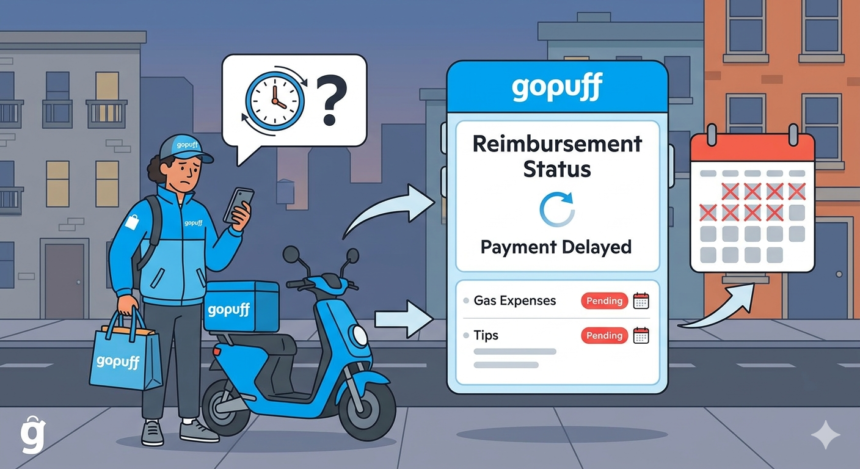

For a growing number of Gopuff drivers, the daily hustle has morphed into a frustrating, repetitive loop. It is the low, grinding kind that comes from doing work, then waiting to be paid for it, then waiting some more, then sending emails that bounce back in pre-written language, then waiting again.
Gopuff1, the Philadelphia-born instant delivery company founded in 2013 by former Drexel University students Yakir Gola and Rafael Ilishayev, built its brand on speed. Order something, and it arrives in minutes. Snacks, beer, household essentials, late-night cravings, delivered to your door fast. The irony, according to hundreds of drivers across the country, is that the people making those fast deliveries possible have been waiting months, sometimes longer, to be made whole on their own pay disputes, missing earnings, and unresolved reimbursement claims.
This is not a story about a single bad week. It is a story about a structural problem inside a company whose business model depends on worker flexibility but whose support infrastructure has struggled, badly, to keep pace.
The Pay Structure and Where It Breaks Down
To understand where reimbursement delays happen, you have to understand how Gopuff pays its drivers. The company classifies all its delivery workers as independent contractors, not employees. That classification is important, because it means Gopuff is not legally obligated. At least not under its own interpretation, but to provide minimum wage guarantees, overtime, sick pay, or expense reimbursements beyond what it chooses to offer voluntarily.
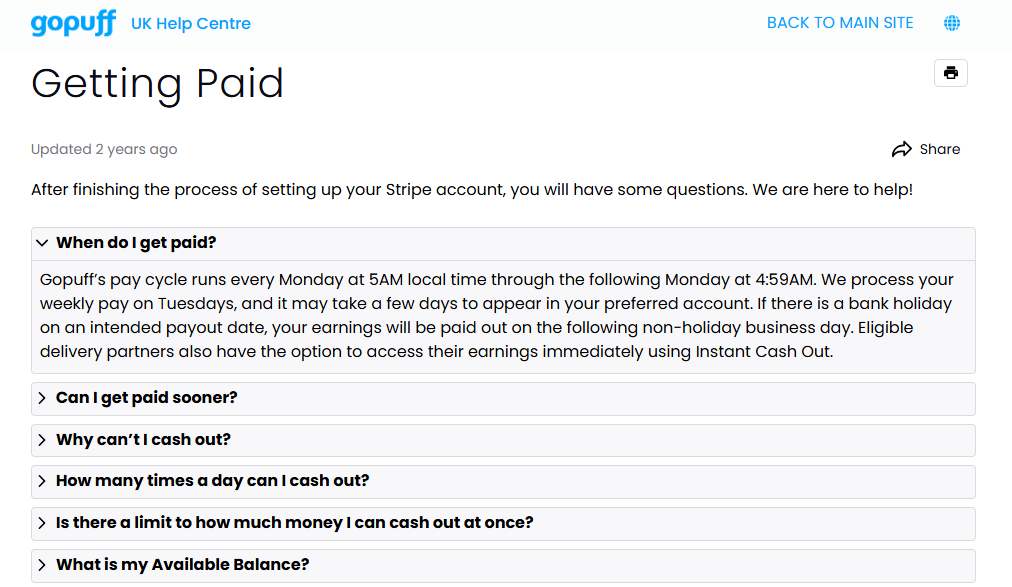
According to Gopuff’s2 own support documentation, pay cycles run every Monday at 5 AM local time through the following Monday, with processing on Tuesdays and deposits hitting accounts on Tuesday or Wednesday. If a driver wants their money sooner, there is the Instant Cash Out option: a feature built in partnership with Stripe that lets drivers pull their earnings balance at any time. The catch is a $1.99 fee per transaction, deducted automatically from the earnings. Use it every day for a month, and you are paying roughly $60 for the privilege of accessing wages you already earned.
Gridwise3, a gig economy analytics platform, reported on this structure and noted that Gopuff does offer a minimum hourly rate guarantee in some markets. If deliveries for a given hour fall below the local minimum, Gopuff theoretically pays the balance. In theory.
The gap between theory and practice is where the complaints live.
On ComplaintsBoard4, where Gopuff’s driver portal holds a 1.8 average rating from 18 reviews, one verified driver laid out the pattern that many others have described:
“Like a lot of you, I’ve emailed support many times over pay. I just keep at it and usually get anywhere from three-quarters of what I should get to the whole thing reimbursed.”
That account, patient, persistent, getting partial restitution, reads almost as a best-case scenario compared to other reports. The same platform includes a complaint from a driver who showed up to her shift on a holiday weekend after scheduling blocks in advance, only to find her account had been deactivated through no fault of her own. She wrote that she was “getting automatic response emails” and that no one was “comprehending or reading the emails thoroughly.” Her desired outcome, listed in the complaint form, was reimbursement for the delivery blocks she could not work because of an agent’s error. Whether she received it is not recorded.
These are not isolated anecdotes. On Indeed’s5 reviews page for Gopuff’s delivery driver role, which aggregates hundreds of worker testimonials, the pattern recurs. One driver, reviewing in January 2025, described the wait-pay structure:
“The wait pay, which they calculate by the minute and breaks down to maybe 12 bucks per hour, is better than what you get when you’re actually delivering. They have you driving an hour for less than $10, which doesn’t even cover gas.”
Another, writing from Portland in August 2024, put it bluntly:
“I thought DoorDash and UberEats had horrible pay. GoPuff redefines bad pay. Below the federal minimum wage. You will actually lose money working here when you factor in gas and vehicle wear and tear.”
A third, writing from Miami around the same time, noted the per-delivery rate had dropped significantly:
“At first they paid $4.50 for each delivery and now they pay you $5 for five deliveries hoping you get paid some tips from the customers, and that never happens.”
The Mileage Reimbursement Illusion
One of the most common grievances in driver communities involves mileage. Gopuff does not provide mileage reimbursement as a standard benefit. Drivers use their own vehicles, pay for their own gas, and absorb their own wear and tear. This would be defensible if the per-delivery pay were generous. It is not.
As one Indeed reviewer noted succinctly:
“You use your own vehicle and no reimbursement for gas or wear and tear on the car.”
That is the system Gopuff has designed and defended. The company has framed this as a feature, not a bug, of independent contractor work. Drivers are their own bosses. They set their own hours. They bear their own costs.
But what happens when those costs balloon because Gopuff has expanded delivery zones without raising base pay? ComplaintsBoard captures this too:
“The GoPuff company is doing so bad that they continue to close facilities due to the irregularities from their employees, and now drivers have to pay for the consequences of that — instead of delivering within 5 miles, which was the limit before, now you will have to drive over 11 miles, almost 35 minutes, for $3.50 with no guaranteed tip at all.”
That is the mileage reimbursement question hiding in plain sight. It is not that drivers are owed a formal reimbursement and not receiving it. It is that the economics of the job have deteriorated to a point where drivers are effectively subsidizing the platform through their own vehicles and fuel costs, with no mechanism to recover those losses except tips that are inconsistent and a per-delivery rate that has, by numerous accounts, been cut substantially.
I looked into this further and found a broader pattern in the gig economy that helps explain the structural dynamic. TechCrunch6 reported in 2024 that California’s Proposition 22 mandated vehicle expense reimbursements for gig drivers at $0.30 per mile when actively engaged, with inflation adjustments required annually. Gopuff operates in California, as it does across more than 1000 US and UK cities, but the company’s vehicle cost structure does not reflect those obligations uniformly. When state law compels reimbursement, Gopuff pays it. When it does not have to, the evidence suggests it does not.
The Support System That Cannot Keep Up
Let me be honest about what makes this issue particularly maddening: it is not just the missing money. It is the wall drivers hit when they try to recover it.
The Gopuff driver support channel is supposed to be accessible through the app and via the partners@gopuff.com email address. According to Financial Content7, Gopuff claimed to have quadrupled the size of its delivery partner support team in the 12 months leading up to August 2022 and introduced in-app chat to make it easier for partners to resolve issues quickly. That announcement was made four years ago. Driver complaints about unresponsive or automated support responses suggest the system has not kept pace with the scale of drivers using the platform.
When drivers raise pay disputes, what many describe is not a responsive human process. They describe form emails, ticket numbers that expire without resolution, and instructions to resubmit documentation they already submitted. One ComplaintsBoard reviewer described sending “screenshots of being approved and everything” only to receive “automatic response emails” that ignored the prior approval entirely.
There is a word for this dynamic in labor economics: administrative burden. When the cost of claiming a benefit or correction, measured in time, effort, and emotional energy, exceeds the value of the benefit itself, most people stop trying. Companies that make the disputes process exhausting enough end up paying out less, not because the claims were invalid but because the claimants gave up. It is hard to look at Gopuff’s support structure and not wonder whether some of that is by design.
If individual driver complaints represent the ground-level evidence of a broken system, the legal record provides the structural proof.
In March 2023, the Massachusetts Attorney General’s office8 issued citations totaling over $6.2 million against Gopuff for misclassifying employees as independent contractors, failing to provide suitable pay stubs, and failing to maintain an earned sick leave policy. The citations covered 968 workers. Attorney General Andrea Joy Campbell put it plainly:
“When employers misclassify their workers, they deprive them of basic employee protections and benefits, and create an unfair playing field for other law-abiding companies.”
The Massachusetts citations were not about abstract legal definitions. They went to the very heart of the reimbursement issue: Gopuff failed to provide pay stubs that listed hours worked, hourly rates, and deductions. If a driver cannot see a clear breakdown of what they earned and what was deducted, they cannot dispute errors. The opacity itself is the mechanism of the problem.
Gopuff appealed the Massachusetts decision and, as of late 2024, the case remained active.
Then, in March 2025, the District of Columbia9 raised the stakes considerably. DC Attorney General Brian Schwalb filed a lawsuit against GoBrands, Inc. and GB Logistics, LLC, the entities behind Gopuff, alleging violations of the Minimum Wage Revision Act, Sick and Safe Leave Act, Wage Payment and Collection Law, Unemployment Compensation Act, Universal Paid Leave Act, Workers’ Compensation Act, and the False Claims Act. The AG alleged that since 2014, Gopuff had systematically misclassified all of its delivery workers to avoid paying minimum wage, overtime, and sick leave while also dodging contributions to the District’s unemployment insurance and paid family leave programs.
Bloomberg Law10 reported that the complaint argues Gopuff “hires and fires them; trains them; unilaterally determines their rate of pay; depends on their performance for its own success; and maintains full control over their working conditions.” All indicia of employment, not independent contracting.
Gopuff’s response, delivered through General Counsel Jonathan Schoenfeld, was:
“We strongly disagree with the D.C. Attorney General’s allegations and representation of the facts and will vigorously defend both ourselves and the right to earn as independent contractors.”
The lawsuit seeks back wages, damages, civil penalties, and compliance with District law. WTOP11 also noted that this follows a pattern across multiple jurisdictions. Massachusetts. DC. Seattle, where in early 2021, Gopuff settled an inquiry by the city’s Office of Labor Standards under the Premium Pay for Gig Workers Ordinance, paying $7,500 to a complainant.
That $7,500 Seattle settlement should not pass by too quickly. It is a small number. But what it represents is a company that, in city after city, state after state, has found itself on the wrong side of regulators examining how it pays the people who do its work.
The Strike That Went Nowhere
The grievances predated the lawsuits. According to Axios12, in November 2021, Gopuff drivers staged a one-day strike outside the company’s Philadelphia headquarters, demanding a $20 minimum wage, guaranteed minimum working hours, and protection from unfair termination. Several hundred drivers took part across multiple states. Sage Wilson of the pro-labor group Working Washington, which helped organize the walkout, said at the time that some warned worker conditions had nosedived.
One striking driver, Sharon Wildman, told Axios she struggles to make $500 in a week working full time. “We’re out here struggling just to pay our bills,” she said.
The company’s response was to note that nearly 70% of drivers chose to work fewer than 20 hours per week. Using voluntary part-time status as a counter-argument against demands for a living wage. It was a telling deflection. When 70% of your workforce chooses not to work full-time hours, that is not necessarily evidence of a happy, flexible workforce. It is just as likely evidence of a pay structure that makes full-time work economically irrational. Why drive more hours when the cost of gas and vehicle wear makes each additional hour less profitable than the last?
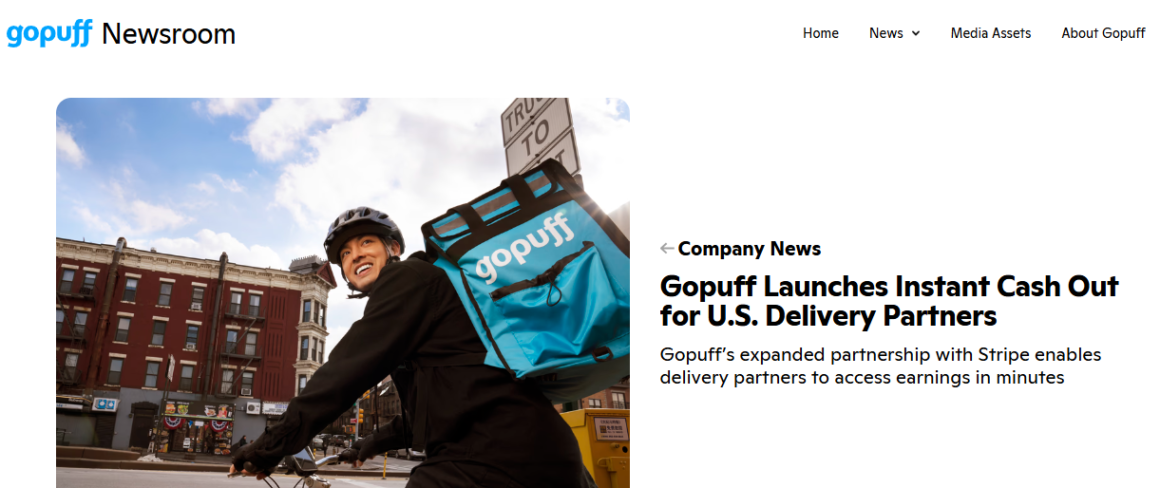
Gopuff13 went on to announce, in 2022, a raft of new driver-facing improvements including the Instant Cash Out feature via Stripe and expanded perks like vehicle maintenance discounts through Openbay and mileage tracking via Stride. These were genuine improvements. But they did not address the root structural complaint: that the per-delivery pay has declined substantially, delivery zones have expanded, mileage costs are borne entirely by drivers, and the support system for contesting incorrect pay remains dysfunctional.
The Instant Cash Out Paradox
It is worth sitting with the Instant Cash Out feature for a moment, because it is a telling example of how gig economy companies repackage a problem as a solution.
The problem: drivers do not want to wait a week to be paid for work they completed today. They have gas to buy now. They have bills due now.
The solution Gopuff offers: pay $1.99 every time you want access to money you already earned.
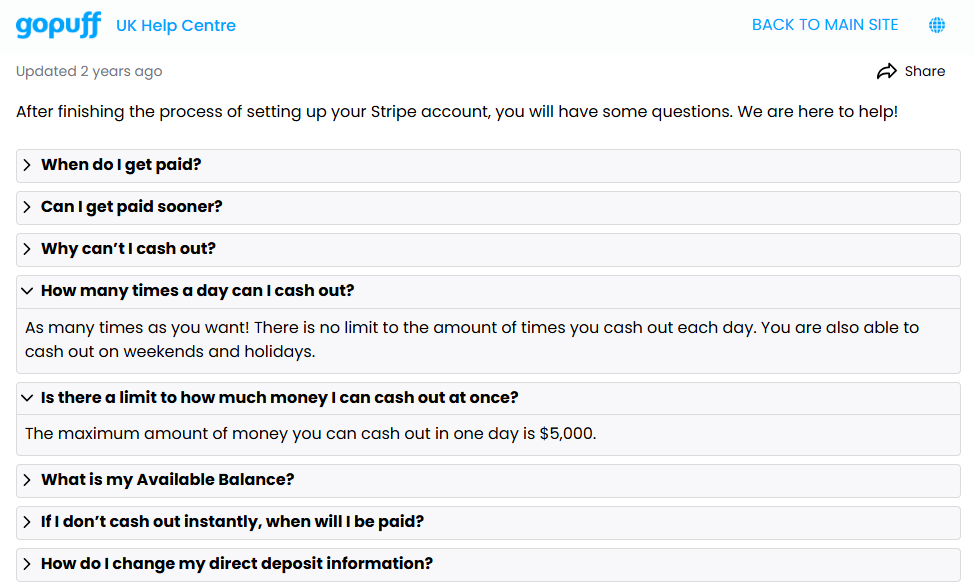
Gopuff’s14 own help page confirms the fee and the structure. The maximum daily cashout is $5,000. There is no limit on how many times a day you can cash out, which sounds generous until you realize each transaction costs $1.99.
In the gig economy at large, this fee model has become a flashpoint. A Giggle Finance15 analysis of same-day pay across gig platforms noted that Gopuff’s instant pay runs a 3% fee on the payout amount with a $1.99 minimum, meaning smaller cashouts, the kind a driver taking out $20 for gas money would make, proportionally cost the most. A $20 cashout costs $1.99, nearly 10% of the withdrawal. That fee structure falls hardest on the drivers with the tightest margins.
The broader irony is that Gopuff’s advertised partnership with Stripe was positioned as a driver benefit. According to the company’s August 2022 press release as reported by Business Wire16:
“Gopuff is one of the first instant commerce businesses to offer an instant pay option for delivery partners.”
That framing papers over the fact that access to your own earnings should not carry a fee.
To its credit, Gopuff has not been entirely silent. The company has consistently argued that its driver classification gives workers genuine flexibility and that the independent contractor model is what its drivers prefer. “Our model empowers DC residents to earn on their own terms,” a spokesperson told WTOP17 after the DC lawsuit was filed. “Those who choose to engage with Gopuff as delivery partners tell us time and again that they value the flexibility of independent work and we remain committed to protecting these vital earning opportunities.”
That line, variations of which appear in almost every Gopuff response to labor scrutiny, is not wrong. Plenty of Gopuff drivers do value the flexibility. Some have said so in their own reviews. On Indeed, one El Paso driver wrote in December 2025:
“It’s simple and you can go back to pick up another order. You are your own boss.”
A Fort Worth driver noted the platform has “been there for me when times were total disasters.”
Flexibility has real value. For someone juggling childcare, another job, or school, the ability to log in for two hours and log out is meaningful. No one is disputing that.
But flexibility is not compensation for eroded pay rates, unexplained deductions, unresolved pay disputes, expanding delivery zones, no mileage reimbursement, and a support system that drivers across multiple platforms and forums describe as automated and unresponsive. Those are distinct things that the company has a tendency to conflate.
The Broader Gig Economy Picture
Gopuff is not alone in this. The story of driver pay disputes in the gig economy is as old as the gig economy itself. California’s Prop 22 fight, the Uber driver lawsuits, the DoorDash minimum wage battles in New York City: all tell some version of the same story: platforms that classify workers as independent contractors to minimize labor costs, then use the complexity and opacity of their pay systems to make recovering unpaid wages difficult.
What distinguishes Gopuff from some of its peers is the combination of factors bearing down on drivers simultaneously. Declining per-delivery pay. Expanded delivery zones. No gas or mileage reimbursement. A pay structure that charges drivers to access their own earnings early. And a legal record, from Seattle to Boston to Washington, that suggests the company has been systematically avoiding the obligations it would carry if it classified its workers correctly.
The DC lawsuit complaint18 itself captures the fundamental problem with algorithmic pay opacity:
“Gopuff’s app is programmed so that delivery workers do not learn what customers pay Gopuff for a delivery.”
Drivers cannot see the margin Gopuff captures on each order. They can only see what they are offered, with no negotiation possible and no ability to assess whether they are being paid fairly relative to what the customer paid.
That information asymmetry is not accidental. It is a feature of the platform’s design. And it makes meaningful pay disputes nearly impossible to resolve, because the driver does not have the underlying data needed to identify whether a discrepancy exists.
The timing of these grievances matters. Gopuff is not operating from a position of strength. As of May 2024, the company’s valuation had fallen to $5.45 billion, down from $15 billion at its peak in 2021, as stated by Sacra19. The company conducted multiple rounds of layoffs, including roughly 600 employees in 2024 alone, about 6% of global staff. Earlier rounds cut 1,500 employees in July 2022 and another 250 in October 2022.
When a company is contracting, its drivers feel the squeeze before anyone else. Facilities close, delivery zones expand to compensate, and the economics of each individual delivery erode. Drivers told ComplaintsBoard that facility closures directly impacted their per-trip pay: longer distances, lower rates, shrinking tips. The same pattern emerged in Indeed reviews throughout 2024 and 2025.
A company shedding employees to cut costs is also less likely to invest in the support infrastructure needed to process driver pay disputes quickly. The math is not hard.
There is no single fix here. The reimbursement problem is the symptom of something more systemic.
At a minimum, drivers need pay stubs that clearly itemize every element of their compensation. The base rate, boosts, tips, deductions, and the total miles driven for each delivery. Massachusetts cited Gopuff specifically for failing to provide this. It should be basic. It is not.
The dispute resolution process needs to involve real humans capable of reading the substance of a complaint, not automated replies that funnel drivers into loops that exhaust them into giving up.
The Instant Cash Out fee should go. If a driver has earned money, the cost of accessing it should be zero. Charging $1.99 per access to wages already earned is a regressive extraction from the workers who can least afford it.
And the broader classification question, now active in DC courts and still contested in Massachusetts, deserves resolution. If Gopuff controls when drivers can work, how much they get paid, what zones they service, and can deactivate them at will, then the independent contractor label is not describing reality. It is describing a legal fiction that saves the company money at the direct expense of its workforce.
I do not expect Gopuff to concede any of this voluntarily. Companies rarely do. But the legal reckoning is building, state by state, court by court. The question is how many drivers run out of patience, money, or hours in the day before it arrives.
Sources
- Gopuff, www.gopuff.com/newsroom/about-gopuff. Accessed 14 July 2026. ↩︎
- Service, Us Customer. “Getting Paid” US Customer Service and Driver Support, 17 Mar. 2024, help.gopuff.com/articles/delivery-partner-pay/getting-paid/65f740066057b509fd589491. Accessed 13 July 2026. ↩︎
- Gridwise, gridwise.io/blog/delivery/gopuff-driver-pay-all-the-facts/. Accessed 13 July 2026. ↩︎
- Skiles, M. “Gopuff Driver Delivery Partners Reviews and Complaints” ComplaintsBoard, 13 Nov. 2023, www.complaintsboard.com/gopuff-driver-b148566. Accessed 13 July 2026. ↩︎
- Indeed, Indeed.com, www.indeed.com/cmp/Gopuff/reviews?fjobtitle=Delivery+Driver&ftopic=paybenefits. Accessed 13 July 2026. ↩︎
- Bellan, Rebecca. “Gig workers in California to receive millions for unpaid vehicle expenses” TechCrunch, 2 June 2023, techcrunch.com/?p=2552085. Accessed 13 July 2026. ↩︎
- “Gopuff Launches Instant Cash Out for U.S. Delivery Partners, Continues To Invest in Delivery Partner Experience” 4 Aug. 2022, markets.financialcontent.com/lightport.lightport1/article/bizwire-2022-8-4-gopuff-launches-instant-cash-out-for-us-delivery-partners-continues-to-invest-in-delivery-partner-experience. Accessed 14 July 2026. ↩︎
- “AG’s Office Issues $6.2 Million in Citations Against National Delivery Service Company Over Employee Misclassification Violations” Mass.gov, 30 Mar. 2023, www.mass.gov/news/ags-office-issues-62-million-in-citations-against-national-delivery-service-company-over-employee-misclassification-violations. Accessed 13 July 2026. ↩︎
- “Attorney General Schwalb Sues Gopuff for Workers’ Rights Violations” 19 Mar. 2025, oag.dc.gov/release/attorney-general-schwalb-sues-gopuff-workers. Accessed 14 July 2026. ↩︎
- Rainey, Rebecca. “D.C. Accuses Delivery App Gopuff of Misclassifying Drivers (1)” 19 Mar. 2025, news.bloomberglaw.com/us-law-week/dcs-top-cop-says-delivery-app-gopuff-misclassified-drivers. Accessed 14 July 2026. ↩︎
- Clabaugh, Jeff. “DC sues Gopuff for misclassifying delivery drivers” WTOP News, 19 Mar. 2025, wtop.com/business-finance/2025/03/dc-sues-gopuff-for-misclassifying-delivery-drivers/. Accessed 14 July 2026. ↩︎
- Axios, 24 Nov. 2021, www.axios.com/local/philadelphia/2021/11/24/gopuff-drivers-strike-philadelphia. Accessed 14 July 2026. ↩︎
- Gopuff, www.gopuff.com/newsroom/company-news/gopuff-launches-instant-cash-out-for-u-s-delivery-partners. Accessed 14 July 2026. ↩︎
- Service, Us Customer. “Getting Paid” US Customer Service and Driver Support, 17 Mar. 2024, help.gopuff.com/articles/delivery-partner-pay/getting-paid/65f740066057b509fd589491. Accessed 14 July 2026. ↩︎
- Giggle Finance, gigglefinance.com/state-of-same-day-pay-in-gig-economy/. Accessed 14 July 2026. ↩︎
- Business Wire, www.businesswire.com/news/home/20220804005669/en/Gopuff-Launches-Instant-Cash-Out-for-U.S.-Delivery-Partners-Continues-To-Invest-in-Delivery-Partner-Experience. Accessed 14 July 2026. ↩︎
- Clabaugh, Jeff. “DC sues Gopuff for misclassifying delivery drivers” WTOP News, 19 Mar. 2025, wtop.com/business-finance/2025/03/dc-sues-gopuff-for-misclassifying-delivery-drivers/. Accessed 14 July 2026. ↩︎
- “Microsoft Word – 2025.03.18 DRAFT Gopuff Complaint – SR CT – Final – No Footnotes” 18 Mar. 2025, oag.dc.gov/sites/default/files/2025-03/oag.dc.gov/sites/default/files/2025-03/Gopuff_Complaint_032025.pdf. Accessed 14 July 2026. ↩︎
- “Gopuff valuation, funding & news” Sacra, sacra.com/c/gopuff/. Accessed 14 July 2026. ↩︎