
The Migration Is Free. Everything You Built Isn’t.
I spent a week clicking through export menus, reading support documentation until the words stopped meaning anything, and scrolling Substack comment sections at two in the morning. I was trying to answer a question that sounds simple and isn’t: if you decide to leave Mailchimp for Beehiiv, what do you actually get to take with you?
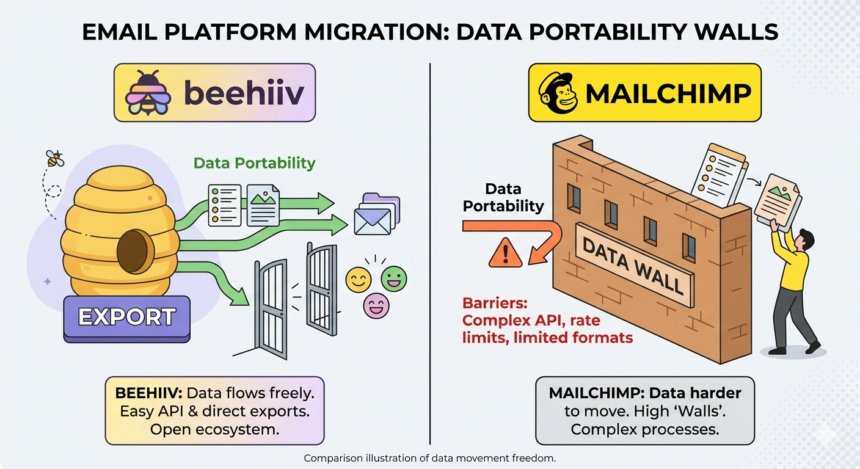
The marketing answer is everything. The real answer is your email list, mostly, and not much else.
This matters more than it sounds like it should. Newsletter writers have spent the last five years being told, over and over, that email is the one platform-proof asset they own. Social media algorithms can bury you. A subreddit can get banned overnight. But your email list, the story goes, is yours forever. Nobody can take it away.
That’s true, as far as it goes. What nobody tells you is how much of what makes that list valuable, the engagement history, the segmentation, the behavioral data, the automations you built over three years, doesn’t travel with it. You get the names. You get the addresses. The intelligence layer built on top of them mostly stays behind, locked inside the platform that collected it.
The Pitch
Beehiiv has built a real business on being the place creators go when they’re fed up with somewhere else. Its migration guide for Mailchimp users frames the whole process in the cheeriest terms imaginable, telling departing Mailchimp users to check “transfer audience” off their to-do list and get on with the “real fun” of growing their newsletter on a better platform.
It really is mostly three steps, on paper. Export your audience from Mailchimp as a CSV. Import it into Beehiiv. Map your fields. The official Beehiiv1 support article walks through the Mailchimp side too, down to which button to click on the Audience exports page.
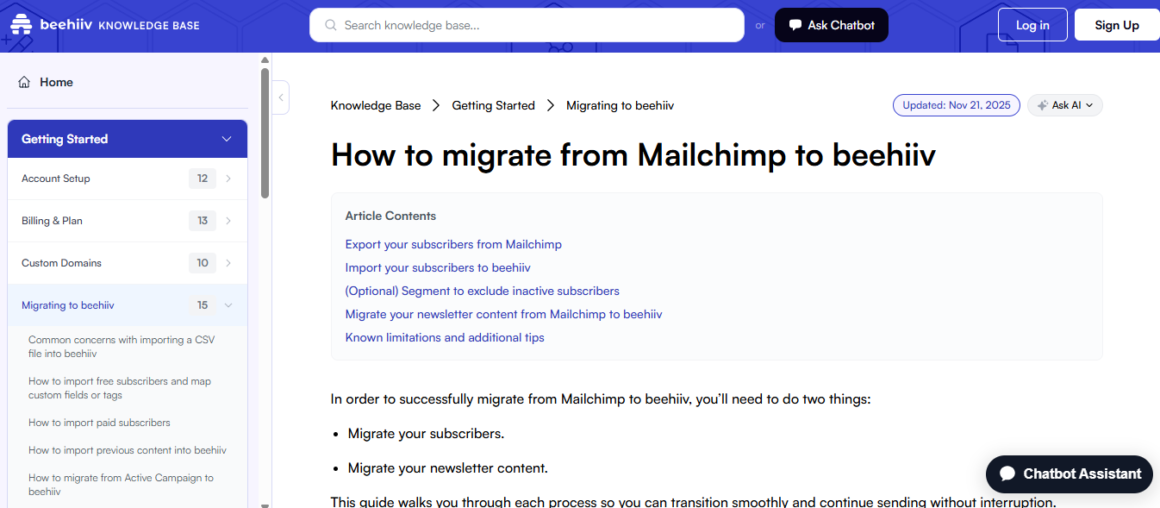
But read the small print and the cracks start to show almost immediately. The same support article warns that campaigns built in Mailchimp’s Legacy Email Builder won’t import at all. If you’ve got years of newsletters built that way, you’re looking at recreating them by hand. There’s a note buried further down about subscription dates. By default, Beehiiv assigns every imported subscriber the date they were imported, not the date they actually signed up on Mailchimp. If you want your original signup dates preserved, you have to finish the import first, then separately contact support and ask them to fix it retroactively.
Read that twice. The platform that’s supposedly making your migration effortless ships a default setting that quietly rewrites your subscriber history, and the fix is a support ticket, not a checkbox.
What Actually Moves
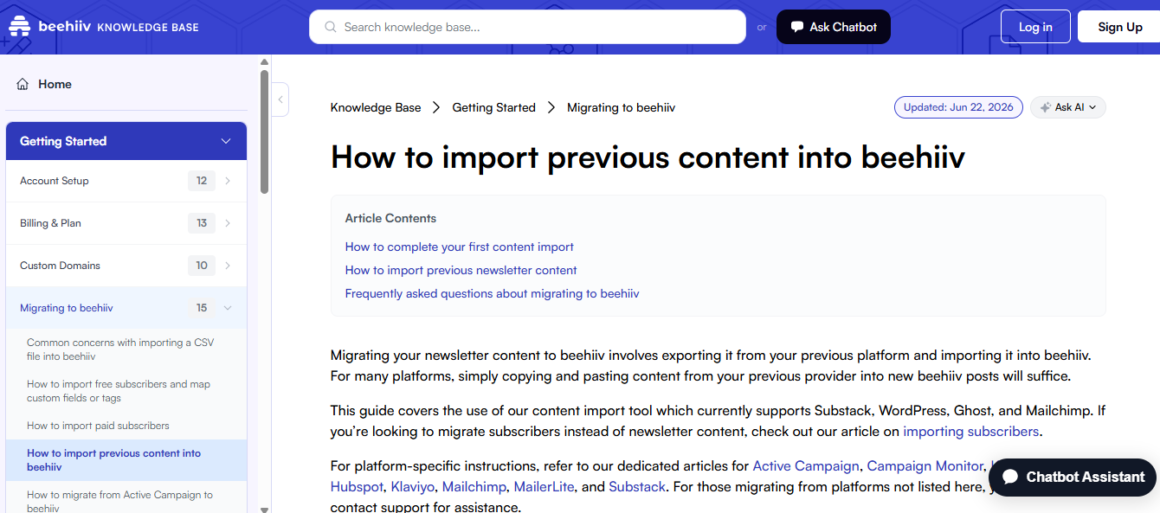
I want to be fair here, because the subscriber import itself genuinely works. Beehiiv’s2 content import tool supports Mailchimp alongside Substack, WordPress, and Ghost, and for many creators the basic transfer, the part that matters most on day one, goes through cleanly. Email addresses move. Subscription status moves, mostly. Custom fields can be mapped onto tags during import.
If you’re a small newsletter with a clean list and no fancy automations, the whole thing might genuinely take an afternoon. That’s not nothing, and it’s worth saying plainly: Beehiiv did not have to build any of this. A lot of platforms make leaving deliberately painful by building nothing at all.
But “the basic transfer works” is a low bar, and it’s the bar most comparison articles stop at. The interesting question isn’t whether your email addresses survive the trip. It’s what gets left on the platform when you go, and whether you even find out it’s missing until months later, when you go looking for it and it isn’t there.
The Stuff Nobody Mentions Until You Ask
Here’s a partial list of what does not travel from Mailchimp to Beehiiv, based on the platforms’ own documentation.
Engagement history. Your open rates, click rates, and the per-contact “member rating” Mailchimp builds up over years of sends, the score it uses to flag who’s actually reading and who’s a dead weight on your list, doesn’t transfer. Beehiiv’s own migration playbook from Sasanova3 actually recommends using that Mailchimp rating data before you leave, suggesting you segment out anyone rated a 1 or 2 and consider removing them entirely during migration, because once you’re on Beehiiv, that signal is gone. You have to act on Mailchimp’s data while you’re still standing on Mailchimp’s platform. Once you migrate, the slate is wiped.
Automations and workflows. Anything you built in Mailchimp’s automation builder, welcome sequences, re-engagement campaigns, tagged drip flows, has to be rebuilt from scratch in Beehiiv’s system. There’s no export format for “the logic of my email funnel.” It lives in Mailchimp’s infrastructure and it stays there.
Templates. Mailchimp’s drag-and-drop template library is larger and more mature than Beehiiv’s editor, and the Sasanova guide is candid about this, listing Mailchimp templates as one of the real costs of switching for anyone with heavily branded designs.
E-commerce integrations. If your Mailchimp setup is wired into Shopify or WooCommerce for abandoned cart emails and product recommendations, that entire layer doesn’t have a Beehiiv equivalent. The same guide is blunt about it: e-commerce businesses should probably just stay on Mailchimp, because Beehiiv is a newsletter platform, not a marketing automation suite for online stores.
And third-party data generally. Mailchimp’s4 own account export documentation states flatly that the platform can only export information about your contacts that is stored in Mailchimp itself. Anything that lives in a connected tool, a CRM, an analytics dashboard, a payment processor, stays where it is. Mailchimp isn’t hiding this. It’s just rarely the headline of any “how to switch” guide, because the guides are written by the platform you’re switching to, and they’d rather talk about how easy step one is.
Mailchimp’s Side of the Wall
It would be easy to write this as a story about Beehiiv’s import tool being incomplete. That’s only half of it. The other half is that Mailchimp’s export tools were never really built for creators to leave gracefully. They were built to satisfy a regulator.
Mailchimp’s5 contact export feature exists, in large part, because of GDPR. The company’s help documentation is upfront that the European Union’s privacy law gives EU citizens the right to know how their personal data is stored and used, and that if an individual contact requests their data, you have to export it from their specific profile rather than through a bulk export. The bulk export tool was built around a legal obligation to individual subscribers, not a product philosophy about helping you take your business elsewhere.
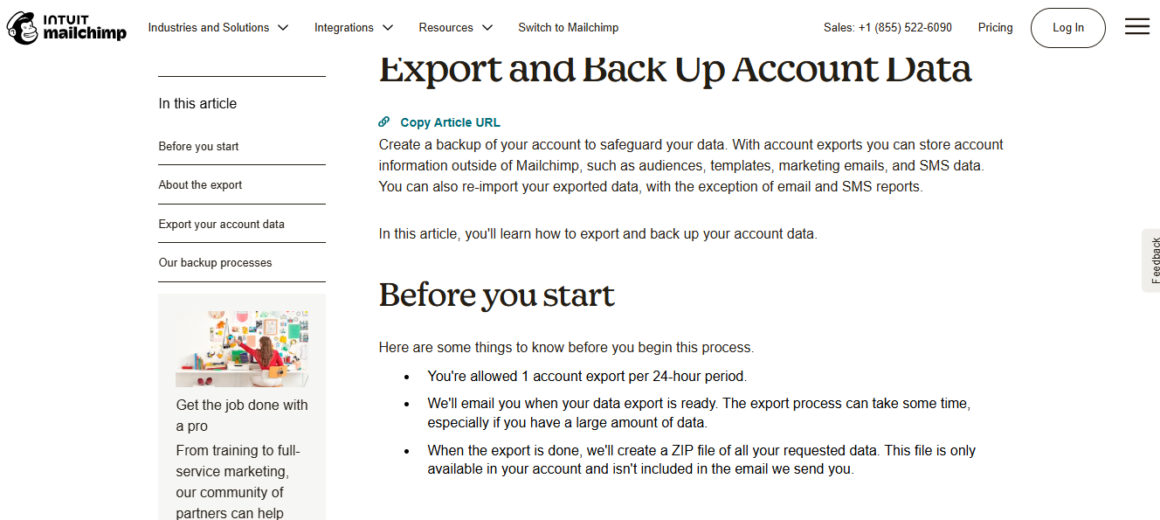
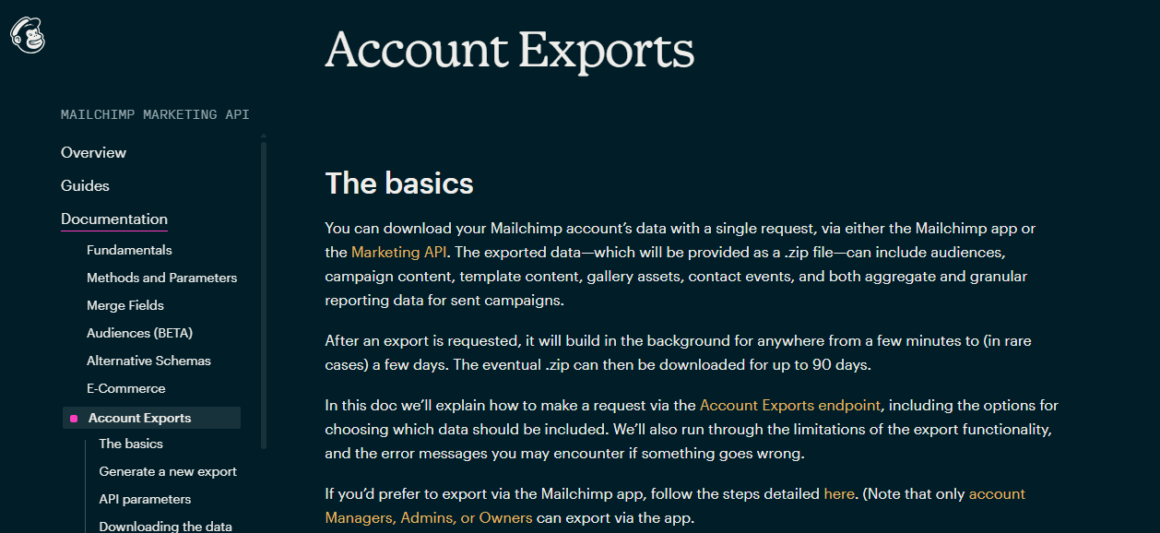
That shows in the details. The Mailchimp6 Marketing API’s export endpoint can take anywhere from a few minutes to, in the company’s own words, a few days to generate a full account export, and the resulting file is only available to download for ninety days. Try requesting a full export of a large, multi-year account and see how long it actually takes. Then imagine doing that while also trying to keep your newsletter running on schedule.
None of this is illegal. None of it is even unusual by SaaS standards. But it adds friction at exactly the moment a creator is most likely to give up and just start fresh, leaving years of audience history behind on a platform they’re trying to escape.
What the Forums Actually Say
The cleanest, least filtered accounts of what migration actually feels like don’t come from either company’s marketing pages. They come from creators writing about their own moves, in public, in real time, usually to their own subscribers.
The most detailed account I found was a migration report from the newsletter Today in Tabs7, documenting a move from Substack to Beehiiv. The author was refreshingly specific about what didn’t survive the trip. Reader comments didn’t transfer, because they’re tied to user accounts on the old platform and there’s no portable format for that kind of social data. Author information on collaborative posts didn’t come over either. On the content side, Beehiiv’s importer dropped links and alt text on images, lost some embeds, and didn’t bring over footnotes.
What struck me most was the writer pushing back on rumors that had spread among other creators, the idea that migrating to Beehiiv would mean automatically losing half your paid subscriber base. The author’s experience was that subscriptions moved from Stripe to Stripe without major losses, and that any glitches were fixable because the records and tools to fix them existed. It’s a useful corrective. A lot of what circulates about these migrations in creator circles is fear dressed up as fact, passed along by people who heard it from someone who heard it from someone.
But fear like that doesn’t come from nowhere. It comes from real, smaller failures that snowball in the retelling. One newsletter, Future Southeast Asia8, documented exactly this kind of small failure during its own move from Substack to Beehiiv. The writer had warned subscribers in advance that there might be problems, and sure enough, Substack sent an email to paid subscribers telling them their subscriptions had been cancelled, when in fact they’d simply been transferred. The writer had to send a follow-up apologizing for what he called a confusing email from Substack, reassuring readers their subscriptions were still active. Nothing was actually lost. But for a few hours, a chunk of that newsletter’s paying audience believed they’d been unsubscribed without warning, through no fault of the writer’s own.
That’s the part the comparison articles never capture. The technical migration might be ninety percent successful. But the ten percent that breaks tends to break in public, in front of your audience, and it’s your name attached to the confusion, not the platform’s.
Not every migration story ends in a stay, either. One creator, writing on the GameDev Diary newsletter9, described moving from Beehiiv back to Substack after concluding that most of the features that would have improved the experience were locked behind a paywall they weren’t willing to pay for. Still a fan of Beehiiv as a product, just not at the price for what they needed. Migration, in other words, isn’t a one-way ratchet toward whichever platform has the better onboarding video. People go back. They just rarely advertise it as loudly as the platform they’re arriving at advertises the arrival.
The Consent Problem Nobody Wants to Own
There’s one more wrinkle, and it’s the one that can quietly gut a list overnight if you get it wrong.
When you import subscribers into Beehiiv, the platform gives you the option to turn on double opt-in, where new subscribers have to click a confirmation link before they start receiving your emails, with an optional second reminder forty-eight hours later if they haven’t confirmed. That feature exists for good reasons. It keeps spam complaints down and protects your sender reputation.
But the Sasanova migration playbook10 flags something that should make any creator pause before clicking import. If you turn on double opt-in for subscribers you’re importing from Mailchimp, people who already agreed to receive your newsletter years ago, you’re effectively asking them to opt in again. And the guide’s estimate is brutal. Forcing re-confirmation on an imported list can cost you somewhere between thirty and sixty percent of it, almost overnight, as people who would have happily kept reading simply never see, or never bother to click, a confirmation email from a sender they don’t immediately recognize.
So the same setting that’s designed to protect new subscribers can, if left on by default during a migration, function as an accidental list-shredder for everyone you already had. The guide’s advice is to tag imported subscribers separately, something like “mailchimp-migration,” so you can track how they perform compared to people who signed up organically on Beehiiv, and to make absolutely sure double opt-in is switched off for that imported batch specifically.
This is the kind of detail that never shows up in a three-step migration headline, because it’s not really about the technology failing. The technology works exactly as designed. It’s about a default setting, built for one purpose, quietly working against you in a completely different context, and nobody at either company is going to call you up to warn you about it. You either read deep enough into a third-party guide to find this, or you find out the hard way when your open numbers crater the week after migration and you spend days trying to figure out why.
The Asymmetry Is the Point
Step back and a pattern emerges, and it’s not really about Beehiiv or Mailchimp specifically. It’s about who builds the on-ramp and who builds the off-ramp.
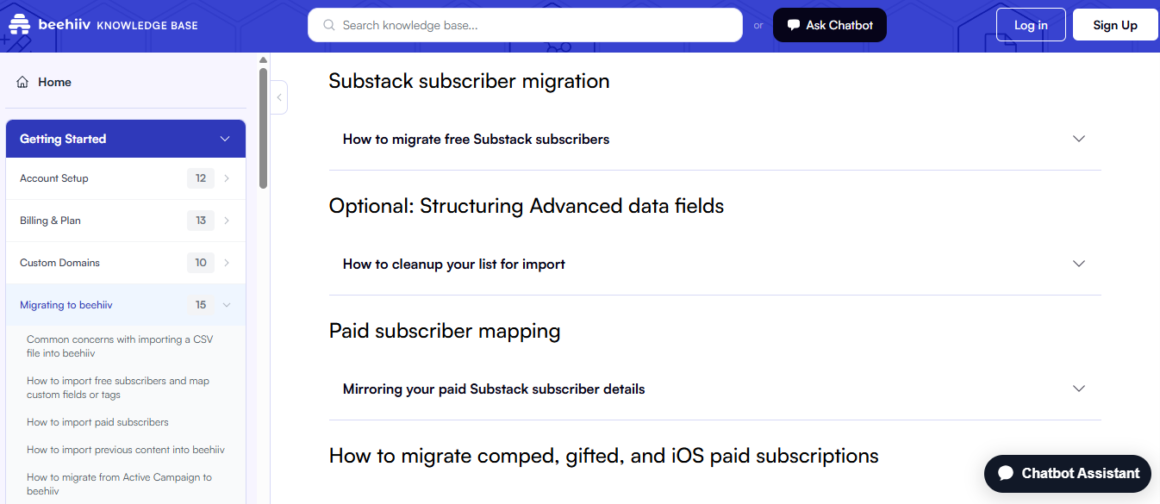
Every platform that wants your business builds a beautiful, detailed, hand-holding guide for getting your data in. Beehiiv11 has one for Mailchimp, one for Substack, one for Ghost, one for WordPress, one for MailerLite, even one for Klaviyo and HubSpot. These guides are detailed, well-maintained, and clearly a product priority, because every new import is a customer that used to belong to someone else.
Nobody builds the equally detailed guide for getting your data out, because no platform has a business incentive to make leaving easier. Mailchimp’s export tools exist because a regulation requires something to exist. Beehiiv’s own subscriber export feature, documented in its help center, is functional, a basic CSV with email, status, and tier, or a fuller version with custom fields and statistics. But it’s not advertised anywhere near as prominently as the import tools, and for good reason. Nobody writes a blog post titled “How Easy It Is to Leave Us.”
I don’t think this is a conspiracy, exactly. It’s closer to a structural default. Every product team’s incentives point toward acquisition. Retention happens passively, through switching costs nobody had to design on purpose, because the absence of a good off-ramp is itself a kind of moat. You don’t need to trap people if leaving is just annoying enough that most won’t bother.
The Regulation That Doesn’t Quite Reach You
There is, somewhere in the world, a legal framework that takes this problem seriously. It just doesn’t apply to you, probably.
According to GT Law12, the European Union’s Data Act, which began taking effect in September of 2025, creates a genuine right for business customers of cloud and SaaS providers to switch services, with the law requiring providers to remove contractual and technical barriers and support a transition period of up to thirty days, extendable in difficult cases. Switching fees are being phased out entirely by January 2027. Law firms tracking the rollout describe it as a fundamental shift in how SaaS providers have to think about customer lock-in, with one analysis going so far as to say long-term contracts, long the foundation of SaaS predictability, are now structurally weaker.
It’s a remarkable piece of regulation, and it is aimed almost entirely at enterprise infrastructure, the IaaS and PaaS layer, cloud computing contracts between businesses. A solo newsletter writer on Beehiiv’s free tier, or a small media operation paying Mailchimp’s standard plan, isn’t the customer this law was written to protect, even if the underlying problem, your operational history being functionally non-portable, is structurally identical.
In the United States, there’s no equivalent on the horizon. The closest thing creators have is goodwill, documentation, and whatever support staff happen to be willing to do for you on a given day, like manually correcting your subscriber signup dates after the fact because the default import setting didn’t preserve them.
What “Owning Your List” Actually Means Now
Here’s the thought I kept returning to, scrolling through all of this. The email list itself isn’t really where the value lives anymore. The value is in the years of behavioral signal layered on top of it, who opens what, who clicks what, who’s quietly gone cold, and that signal is exactly what doesn’t move.
And there’s a wrinkle that makes this even messier. Even the data that does survive is becoming less trustworthy on its own terms. Apple’s Mail Privacy Protection, rolled out in 2021, pre-fetches images before a recipient ever opens an email, which means the open rate data both Mailchimp and Beehiiv have been collecting for years is, as one industry analysis at Validity13 puts it, no longer a reliable signal of whether anyone actually read your newsletter. So even in the world where that historical engagement data was perfectly portable, a meaningful chunk of it would be measuring something closer to noise.
Which leaves creators in a strange position. The asset everyone tells you is the one thing you truly own, your email list, is real and does travel. But the context that made that list valuable, the part that told you which of those subscribers actually cared, was already degrading before you ever opened the export menu. Migration doesn’t just strip away your history. It exposes how much of that history was already unreliable.
None of this means don’t switch platforms. Beehiiv’s tools for monetization and growth are genuinely ahead of where Mailchimp’s newsletter features sit, and for creators thinking like publishers rather than marketers, the move makes sense for plenty of people. But go in with your eyes open. Export everything you can, while you can, including the engagement data you’ll never get back once you’ve left. Expect to rebuild your automations from scratch. Warn your paid subscribers before you migrate, not after something goes wrong. And don’t believe either platform’s framing of how “easy” this is, because easy, in this industry, almost always means easy for the part of the process that benefits the company telling you so.
Sources
- Beehiiv, www.beehiiv.com/support/article/19592149829399-how-to-migrate-from-mailchimp-to-beehiiv. Accessed 8 Aug. 2026. ↩︎
- Beehiiv, support.beehiiv.com/hc/en-us/articles/14492963813143-How-to-migrate-or-import-previous-content-to-beehiiv. Accessed 8 Aug. 2026. ↩︎
- “Leaving Mailchimp for beehiiv: The Complete Migration Playbook” Sasanova, www.sasanova.com/guides/migrate-mailchimp-to-beehiiv. Accessed 8 Aug. 2026. ↩︎
- “Export and Back Up Account Data” Mailchimp, mailchimp.com/help/export-back-up-data/. Accessed 8 Aug. 2026. ↩︎
- “View or Export Your Contacts” Mailchimp, mailchimp.com/help/view-export-contacts/. Accessed 8 Aug. 2026. ↩︎
- “Account Exports Documentation” Mailchimp Developer, mailchimp.com/developer/marketing/docs/account-exports/. Accessed 8 Aug. 2026. ↩︎
- Today in Tabs, www.todayintabs.com/p/migration-report. Accessed 8 Aug. 2026. ↩︎
- Clark, James. “Future Southeast Asia is moving” Future Southeast Asia, 2 Mar. 2024, futuresoutheastasia.substack.com/p/future-southeast-asia-is-moving. Accessed 8 Aug. 2026. ↩︎
- Klimek, Maurice. “This is the last migration of Gamedev Dairy. Promise!” The Solo Gamedev, 16 May 2023, gamedevdairy.substack.com/p/this-is-the-last-migration-of-gamedev. Accessed 8 Aug. 2026. ↩︎
- “Leaving Mailchimp for beehiiv: The Complete Migration Playbook” Sasanova, www.sasanova.com/guides/migrate-mailchimp-to-beehiiv. Accessed 8 Aug. 2026. ↩︎
- Beehiiv, www.beehiiv.com/support/article/14966988360215-How-to-migrate-from-Substack-to-beehiiv. Accessed 8 Aug. 2026. ↩︎
- GT Law, www.gtlaw.com/en/insights/2025/9/cloud-switching-under-the-eu-data-act. Accessed 8 Aug. 2026. ↩︎
- Delahunt, Jessica. “Case Closed: The Mystery of Declining Email Open Rates” Validity, 26 Sept. 2024, www.validity.com/blog/case-closed-the-mystery-of-declining-email-open-rates/. Accessed 8 Aug. 2026. ↩︎