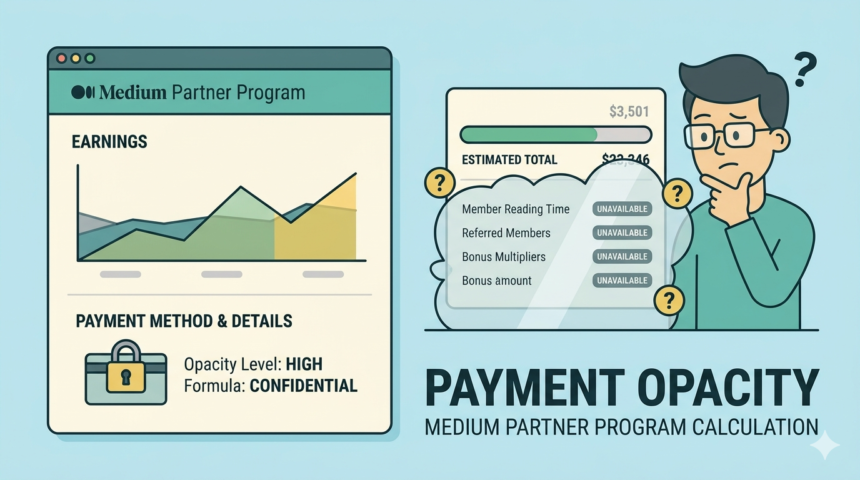

I started checking my Medium dashboard the way some people check the weather. A glance in the morning, a glance before bed, a small private ritual of hope and dread. The numbers moved, sometimes up, mostly down, and I could never tell you why. Not really. I had read the help pages. I had read the blog posts written by writers who claimed to have cracked the code. None of it added up to something I could trust. And the longer I sat with that feeling, the more I realized it wasn’t just me. It is the defining experience of writing for money on Medium, a platform that has spent nine years promising writers a cut of the revenue and nine years declining to show them the receipts.
This is not a story about whether Medium pays writers. It does. Writers have collectively earned tens of millions of dollars through the Partner Program since it launched in 2017, and some of them have built real careers on it. This is a story about what happens when a company builds an entire creator economy on a formula it refuses to fully explain, then changes that formula every few months, then tells the people whose income depends on it to simply trust the process. I went looking for the receipts. I found a community of writers doing the company’s transparency work for it, one screenshot and one grieving blog post at a time.
The Promise, and the Asterisk
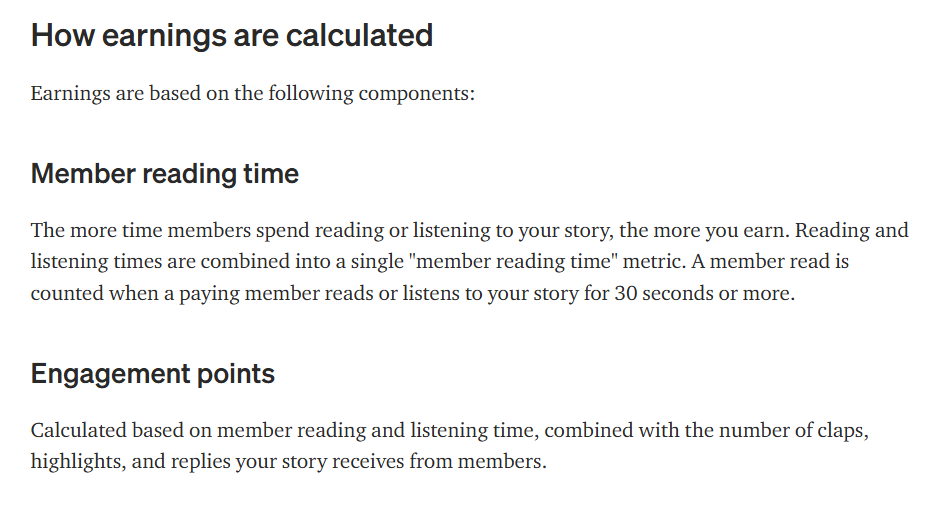
The pitch is simple enough. You write something good. Medium members read it. A slice of their five dollar monthly subscription fee flows back to you, based on how much of their reading time you captured. Medium calls this rewarding quality over clickbait, and frames it as a stand against the ad driven incentives that wrecked the rest of the internet. Medium’s1 official Partner Program page describes “member read time” as the central currency, with “long, thoughtful reads” encouraged.
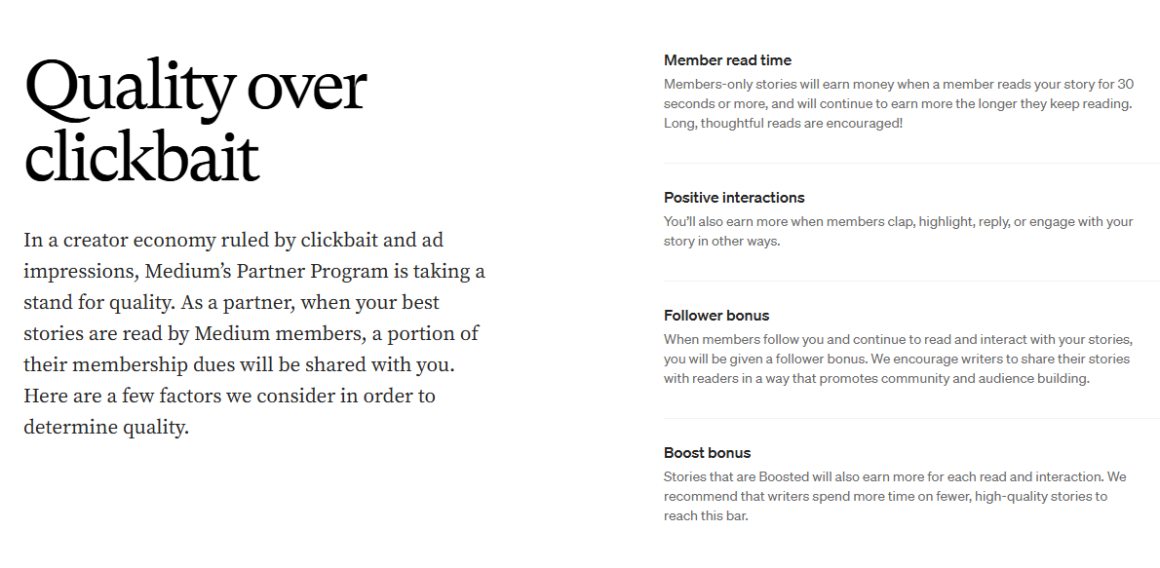
Here is the asterisk. The exact mechanics of how reading time becomes dollars have never been published in full, and Medium’s2 help center’s own explanation reads less like a ledger and more like a weather forecast. Earnings come from “member reading time,” combined with “engagement points,” adjusted by a “member read ratio,” multiplied by a “boost bonus” if you’re lucky, and topped up with an “external traffic bonus” depending on where your reader came from. Each of those terms sounds precise. None of them comes with an actual number you can plug into a spreadsheet. The page itself admits the model “is updated periodically,” which is Medium’s way of saying don’t get too comfortable with whatever you think you understand today.
I don’t think this ambiguity is necessarily malicious. Algorithms that reward “engagement” are hard to fully document without inviting people to game them, and Medium has a real spam problem. But there is a difference between protecting a formula from bad actors and protecting it from the very writers whose livelihoods depend on it. Medium has consistently chosen the second kind of protection, and writers have been left to reverse engineer their own paychecks.
The Bonus that Came From Somewhere
In late 2023, a writer who goes by The Engage on Substack3 noticed something odd. After a dip in earnings during September, a mystery payment appeared in October under the label “October’s Partner Program Bonus.” It read, on its face, like good news. A little extra cash, unprompted, with a cheerful name. But the explanation behind it was less cheerful than the label suggested.
Medium’s then product lead, Buster Benson, explained that the company had suspended a batch of accounts for fraudulent behavior, and the money those accounts would have earned got redistributed to writers who’d been shortchanged. In other words, the “bonus” was Medium quietly admitting that its own system had been leaking money to spammers, and that legitimate writers had been earning less than they should have because of it. Nobody got a breakdown of how much had been stolen, how many accounts were involved, or how the redistribution was calculated. They got a green bar on a dashboard and a blog post explaining, after the fact, why the bar was there.
I find this revealing in a way that goes beyond one company’s accounting quirks. It tells you that Medium’s earnings pool is a shared pot, and that fraud inside that pot directly reduces what honest writers take home, often for months before anyone notices or says anything. The system runs on trust that the pot is being managed fairly, and the only evidence writers get is the occasional after the fact apology, dressed up as a gift.
“Half the earnings per reads”
If 2023’s bonus was Medium admitting a mistake, August of that same year brought a change writers are still arguing about. Medium overhauled the Partner Program’s formula, and the result, by most independent accounts, was a steep drop in payouts for a huge swath of writers, even as traffic held steady or grew.
A writer on the blog Side Hustle Road4 put it plainly. Earnings across the board had fallen since the August 2023 changes, and writing on Medium, once a real source of side income, had become “rare to make much” unless your story got picked for what Medium calls a Boost. The Boost itself is a kind of editorial lottery ticket. Medium has a team of human curators who select certain stories to receive a multiplier on their engagement points. Get boosted, and your earnings can jump dramatically. Don’t, and you’re competing for scraps from a shrinking non boosted pool.
The criteria for a Boost are vague by design. Medium’s help documentation says boosted stories “earn engagement points at a higher rate,” and that the multiplier is “proportional to the total engagement points earned,” but the actual selection process, what makes a curator pick one essay over another, is left to “general guidelines” that Medium has never made public in detail. The writer behind Side Hustle Road, who says they’ve personally had several pieces boosted, still calls the whole system a gamble. Every time you hit publish, you’re rolling dice you can’t see.
The blogger and Medium publication editor Bin Jiang5 has tracked this decline with the kind of obsessive detail usually reserved for fantasy sports. In one post, speculating about a possible Medium IPO, Jiang lays out a pattern: traffic up, earnings down, repeatedly, across multiple months. By his estimate, writers were earning “half the earnings per reads” compared to where they’d been just months earlier, even as Medium expanded the Partner Program into dozens of new countries. He frames the expansion itself with suspicion, wondering aloud whether adding more countries to the program was about genuinely supporting global writers or about showing growth numbers to potential investors.
If Medium went IPO with these numbers, I’m sure the market would give it a good multiple and it does not include how much profit Medium already made till now.
I want to be careful here. I can’t verify Jiang’s IPO theory, and Medium has never confirmed any such plans that I could find. But the underlying observation, that the metrics Medium chooses to publicize (total writers paid, countries added, dollars distributed since 2017) are exactly the metrics that look good in a pitch deck, while the metrics individual writers actually need (per read rates, formula weights, boost criteria) stay locked away, struck me as the kind of thing you notice when you’ve been burned by a platform enough times. It’s not paranoia. It’s pattern recognition.
When the Bottom Falls Out
Some writers didn’t experience the 2023 changes as a slow decline. They experienced it as a cliff.
The newsletter writer behind drmehmetyildiz’s Substack6 described receiving more than 4,000 private complaints from writers in his network, all reporting the same thing: earnings that had been measured in dollars suddenly measured in cents, or nothing at all.
A tweaked and faulty algorithm caused thousands of writers to lose their income in an order of magnitude reducing daily rates to cents or ZERO amounts persistently.
He assumed, reasonably, that something had broken. He wrote it up, flagged it to Medium’s support team, and got a response from Medium VP Scott Lamb, who said the drop was due to an algorithm adjustment targeting low quality and AI generated content.
On its face, that’s a defensible position. Medium has a real AI slop problem, like every platform does now. But the writer pushed back on the framing, because the adjustment didn’t distinguish between actual AI generated spam and human writers whose engagement metrics happened to dip for unrelated reasons. Anyone earning cents instead of dollars got implicitly filed under “spammer,” whether they deserved it or not. He called the response disheartening, and from what I can tell, that reaction was widespread. When your income drops to zero and the platform’s explanation amounts to “well, some of the people in your situation were cheating,” you’re left to wonder which category you fall into, with no way to find out.
No Appeal, By Design
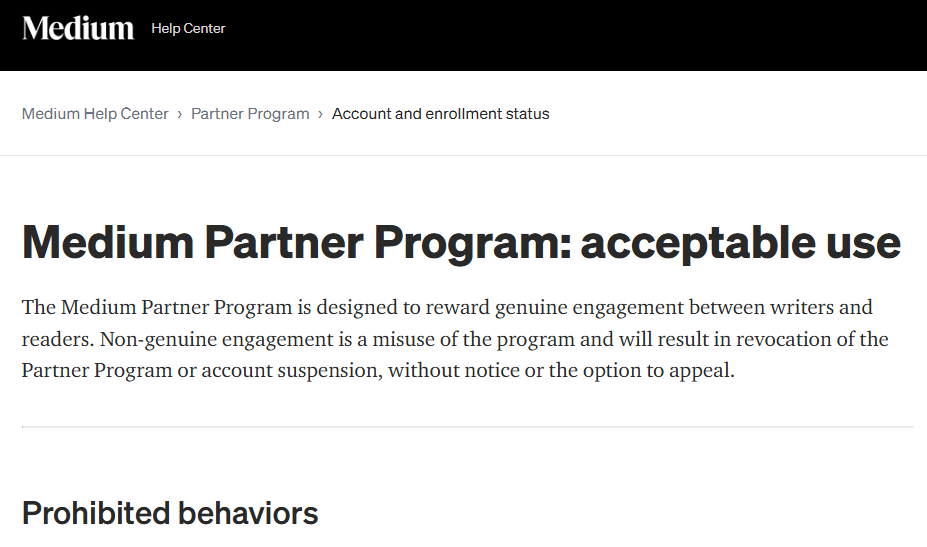
This is where Medium’s opacity stops being merely frustrating and starts looking structural. The company’s own policy on removal from the Partner Program states it directly: removal is permanent, and there is no appeals process. Medium’s7 acceptable use policy goes further, warning that violations result in suspension “without notice or the option to appeal.”
I’ve read through a handful of first person accounts from writers who got caught in these sweeps, and the pattern is remarkably consistent. A writer called LightSome Lena8 described setting up her Stripe payout account, only to receive an email days later saying her account had been suspended for “non-genuine engagement activity.”
Due to these rules, I set up Stripe for payouts shortly after New Year’s, even though I only earned $2.05 in December. Within a couple days after I was ready to receive earnings, I received an email telling me that my Medium account was suspended for “non-genuine engagement activity”.
In her account of the experience, she says she’d never used AI for her writing and never took shortcuts. The suspension email listed general examples of violations, and none of them, in her telling, matched anything she’d actually done.
Another writer, Francis Tan, described the dread of seeing his stats refuse to load one evening, the slow realization that his account might be gone, and the scramble to back up a year of work, hundreds of articles and thousands of followers, just in case. He emailed Medium’s trust team to ask for clarification and admitted he had no idea whether he’d hear back. His plea, in the Medium9 post he wrote about it, was simple: don’t revoke the whole account over one mistake, that’s throwing out the baby with the bathwater.
Bin Jiang, who edits a publication and sees this from the inside, has written about the same dynamic from the other direction. He’s had to start preemptively warning contributors about duplicate content, AI generated drafts, and undisclosed affiliate links, because the suspensions tend to land right before payout periods, in waves, with little warning to publication editors either. In a separate post discussing what happens to writers after revocation, Jiang relayed a comment from a reader who’d noticed something specific: accounts with certain naming patterns kept getting flagged, suggesting the detection system leans on surface level signals that catch real people in the same net as bots.
What strikes me about all of this isn’t that Medium polices fraud. Of course it should. What strikes me is the asymmetry. The company that built a payment system nobody can fully audit also built an enforcement system nobody can appeal. If you’re a writer relying on Medium for income, you are, by the platform’s own published terms, one algorithmic judgment call away from losing both your earnings and your recourse, with no human promised on the other end of the process. The help center does say appeals are reviewed by a human, somewhere, but the Partner Program specific language is unambiguous: for revocation, that door simply isn’t there.
The Moving Target of 2025 and 2026
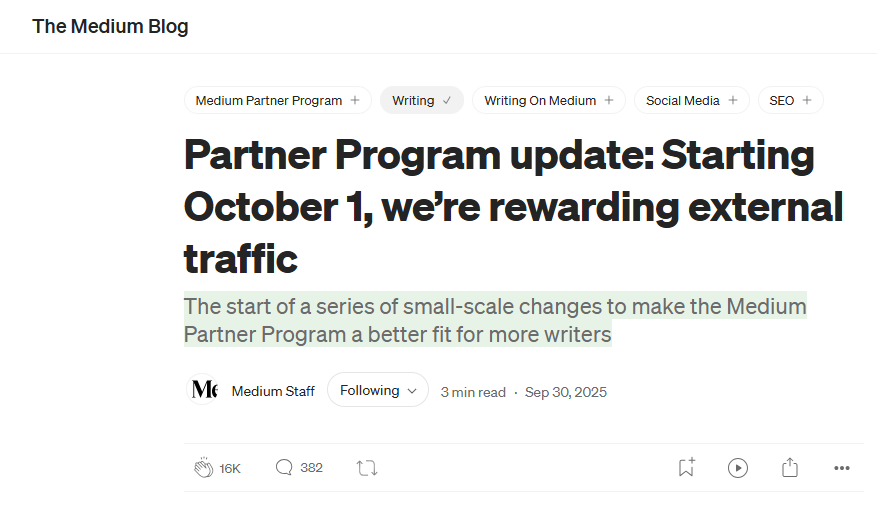
Just when writers had adjusted to the post 2023 reality, Medium10 changed the rules again. Starting October 1, 2025, the company began rewarding reads that originate from outside Medium, whether a reader clicks through from social media, a newsletter, or another website. Under the old system, only readers who discovered you within Medium’s own walls counted toward your pay. Now, sharing your work elsewhere can directly affect your income.
On paper, this is a meaningful shift, and one that several writers I read described as overdue. It addresses a long standing complaint: that writers with large audiences outside Medium got nothing for bringing those readers in, because the paywall blocked non members entirely. One blogger, writing in Write A Catalyst11, framed it as Medium finally rewarding people for bringing readers in, rather than just writing for the internal algorithm.
But Medium described this as the first of “a series of incremental changes through March 2026,” each one, in the words of one writer tracking the rollout, quietly reshuffling who earns what. And in May 2026, another shift arrived: an “Editor Partner Program,” under which assigned editors at participating publications would receive a 25 percent bonus based on a writer’s story earnings, on top of the writer still getting their full cut. Bin Jiang, who runs a publication and would presumably benefit from this as an editor, still flagged the obvious gaps: no word on caps, no word on duration, and a vague promise that publications would need to be “discerning” about what they accept, based on criteria Medium hadn’t clarified.
Read that timeline back to back. External traffic bonus in October 2025. Continued “incremental changes” through March 2026. A new editor revenue share in June 2026. Each change arrived as a blog post, sometimes an email, rarely with the underlying math. Writers were expected to adjust their strategy each time, often discovering the practical effects only by watching their own dashboards shift and comparing notes with each other afterward.
What’s struck me most is where the actual explanations live. Not on Medium’s own blog, which tends toward upbeat announcements and round number milestones. Not in the help center, which describes categories without weights. The explanations live in independent Substacks, personal blogs, and Medium posts written by writers for other writers, comparing screenshots, swapping theories, and occasionally getting a reply from a Medium employee in the comments section, which then becomes the closest thing to an official record.
This is, in its own way, a remarkable thing for a publishing company to have built. Medium’s writers have effectively formed an informal audit committee for the platform’s payment system, doing the documentation work that Medium itself won’t do, and distributing it for free, on Medium, sometimes behind the very paywall the Partner Program controls. Anangsha12, a writer with over 160,000 followers and tens of thousands of dollars in Partner Program income, has spent years publishing adaptation guides every time the rules shift, essentially translating Medium’s opaque announcements into actionable advice for everyone else. A reader replying to one of her posts called her a role model, which says something about how much writers have come to rely on each other rather than the platform for basic operating knowledge.
What Opacity Costs
I think it’s worth being honest about scale here. Medium isn’t Uber. Most writers in the Partner Program are not relying on it to pay rent, and the company has never claimed otherwise. Its own historical data, cited in a Blogging Guide newsletter13, put the share of active writers earning over 100 dollars in a given month in the single digits, around 7 to 9 percent.
But that’s exactly why the opacity matters. For the small percentage of writers who do earn meaningful money, Medium functions as a genuine income source, and for them, a sudden 50 or 75 percent drop, the kind one writer described in a Goodreads14 cross post after the August 2023 changes, isn’t an abstraction. It’s a budget line that disappears overnight, with no explanation beyond a vague reference to an “updated” formula. For the much larger group of writers earning a few dollars a month, the stakes are lower individually, but multiplied across hundreds of thousands of accounts, the aggregate effect of an opaque, frequently changing formula is a community that can never quite plan, never quite trust its own numbers, and never quite knows whether a bad month is its fault, the algorithm’s fault, or simply Medium’s fault for changing the rules again.
There’s also a quieter cost, one I felt myself while researching this. Writers internalize the blame. Read enough of these posts and you’ll notice how often writers conclude that they just need to write more, engage more, post more consistently, as the fix for declining earnings, even when the broader context, documented by dozens of other writers in the same months, suggests the platform itself had changed the terms underneath them. Opacity doesn’t just hide information. It redirects responsibility. When you can’t see the machine, you assume the problem is you.
It isn’t hard to imagine. Medium could publish the actual weightings behind member reading time, engagement points, and the read ratio adjustment, the way ad networks publish RPM benchmarks. It could publish aggregate Boost selection criteria and acceptance rates by category, the way Patreon and YouTube, however imperfectly, publish creator economy reports. It could offer a real appeals process for Partner Program revocations, even a slow one, rather than a blanket “no appeal” clause sitting in its terms of service. None of this would stop bad actors. Fraud detection can stay confidential while still telling honest writers, in good standing, roughly what determines their pay.
What Medium has built instead is a system where the company controls every variable, changes them periodically, announces the changes in its own voice on its own platform, and leaves writers to build, maintain, and constantly update their own shadow documentation just to understand their paychecks. That’s not a glitch. Nine years in, with the same pattern repeating through 2023, 2025, and into 2026, it’s the system working as designed. The only question left is whether “designed” is too generous a word for a formula that, by Medium’s own admission, nobody outside the company has ever fully seen.
Sources
- Medium, medium.com/partner-program. Accessed 12 Aug. 2026. ↩︎
- Medium, help.medium.com/hc/en-us/articles/360036691193-Calculating-earnings-in-the-Partner-Program. Accessed 12 Aug. 2026. ↩︎
- Alves, Rui. “Wri” Engage, 8 Nov. 2023, theengage.substack.com/p/the-medium-partner-program-bonus. Accessed 12 Aug. 2026. ↩︎
- Swengel, Michael. “Side Hustle Road” Substack, 19 Jan. 2024, sidehustleroad.substack.com/p/the-boost-program-is-everything-wrong. Accessed 12 Aug. 2026. ↩︎
- Jiang, Bin. “If Medium is Going Public (IPO) Then Everything Makes Sense” Bin Jiang | Write From None, 27 Dec. 2024, thebinjiang.substack.com/p/if-medium-is-going-public-ipo-then. Accessed 12 Aug. 2026. ↩︎
- Yildiz, Dr Mehmet. “What’s Really Happening on Medium? An Unexpected Turn of Events!” Content Strategy Mastery, 12 Jan. 2025, drmehmetyildiz.substack.com/p/whats-really-happening-on-medium. Accessed 12 Aug. 2026. ↩︎
- Medium, help.medium.com/hc/en-us/articles/39121414314135-Medium-Partner-Program-acceptable-use. Accessed 13 Aug. 2026. ↩︎
- Medium, medium.com/write-a-catalyst/my-new-writer-account-was-suspended-by-medium-in-mass-suspensions-38d07474fd32. Accessed 15 Aug. 2026. ↩︎
- Medium, medium.com/@sittingpony/my-account-has-been-revoked-from-the-partner-program-76eb3a73c70a. Accessed 15 Aug. 2026. ↩︎
- Medium, medium.com/boundless-bytes/mediums-partner-program-update-writers-can-finally-get-paid-for-bringing-new-readers-039912287c45. Accessed 15 Aug. 2026. ↩︎
- Medium, medium.com/write-a-catalyst/the-biggest-medium-payout-update-starting-october-1st-your-earnings-may-increase-3b65eea62c7b. Accessed 15 Aug. 2026. ↩︎
- Angheluta, Cosmin. “Adapting to the 2023 Medium Partner Program Changes” Explore AI with Anangsha, 1 Sept. 2023, anangsha.substack.com/p/adapting-to-the-2023-medium-partner. Accessed 15 Aug. 2026. ↩︎
- Botticello, Casey. “March Medium Partner Program Earnings Newsletter” Blogging Guide, 9 Apr. 2020, bloggingguide.substack.com/p/march-medium-partner-program-earnings. Accessed 15 Aug. 2026. ↩︎
- Goodreads, www.goodreads.com/author_blog_posts/24522500-medium-claims-their-new-model-increases-earnings-that-s-not-what-i-m-se?tab=book. Accessed 15 Aug. 2026. ↩︎