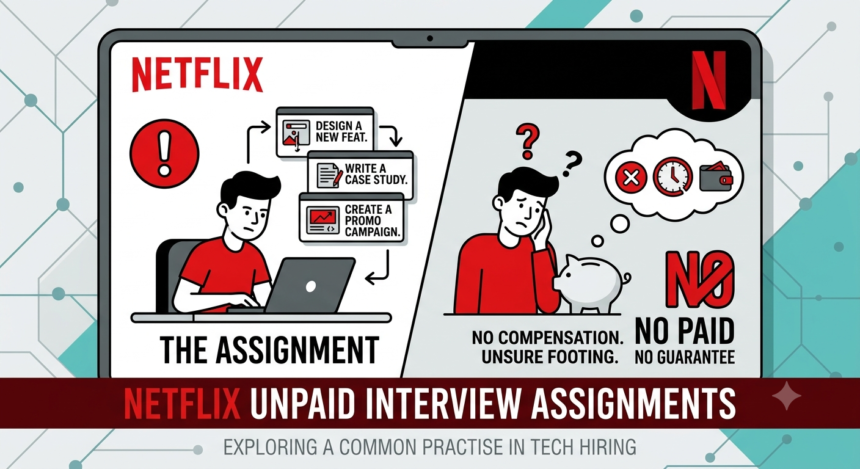

I keep coming back to one sentence buried in a Blind thread from someone in the middle of a Netflix interview loop. They had just received the company’s take-home assignment, the one that arrives, almost ceremonially, after a recruiter call and a hiring manager screen.
“The assignment says we do not expect it will take more than 8 hours,” they wrote, “but it will easily take more than 8 hours.” Then, a few lines later, almost an afterthought: “There goes my Netflix job application.”
That sentence is the whole story, really. A company estimates eight hours. A candidate knows it will be more. And somewhere in that gap between the stated time and the real time sits a quiet transfer of value, from the person who needs a job to the company that already has 300 million subscribers and a market cap north of $400 billion.
I have spent the last few weeks reading through hundreds of posts on Blind, Glassdoor, Reddit, Ask a Manager, and a handful of trade publications, trying to understand what Netflix’s take-home interview assignments actually look like from the inside. Not the recruiter’s pitch. Not the glossy “what to expect” guides written by interview-prep companies hoping to sell you a $200 mock session. The real thing, as described by the people who sat down on a Tuesday night, opened a laptop, and started building software for a company that had not promised them anything except a possible follow-up call.
What I found was not a scandal in the legal sense. Nobody is going to jail. But it is a story about how a company that built its entire public identity on a culture of radical honesty and high performance has quietly normalized asking job applicants, most of whom are unemployed or underemployed and desperate, to do real work for free, on a deadline, with no compensation, no guarantee, and often no real feedback when it’s over.
The 8-Hour Lie
Let’s start with the assignment itself, because the details matter.
According to interview-prep sites like Exponent1 and 4 Day Week2, Netflix’s engineering take-home assignments are typically pitched as a two-to-four hour exercise, sometimes stretched to six or eight depending on the team. Candidates are told to build something realistic. A microservice. A small full-stack application with a React front end wired up to a provided API. Something, in other words, that looks a lot like actual Netflix engineering work, because that is the point. The company wants to see how you operate when you’re not performing for an interviewer, when nobody’s watching the whiteboard.
But ask the people who have actually done it, and the math falls apart almost immediately.
On Blind, one candidate going through the loop for a senior backend role described it this way: a “distributed systems and concurrency problem” that he called simple, despite having extensive performance optimization experience at a major tech company and still getting rejected after submission. Another commenter on the same thread couldn’t quite believe it either, noting that they had never heard of a senior-level take-home being described as simple, and that they were staring at the post in disbelief. Someone else chimed in with the actual bar for passing: the code has to work straight out of the box, with a README and a containerized solution that any developer could spin up with a single command, or it’s a no-go. One person even pointed out he’d left off a trailing newline.
Read that again. This is the bar for an interview exercise. Production-quality code, containerized, documented well enough that a stranger could run it cold, built in a window of time the company itself describes as a handful of hours. And the reward for clearing that bar isn’t a job. It’s an invitation to the next round, where, as more than one candidate has found out, you might still get cut.
A different Blind poster preparing for the same kind of assignment for a distributed-systems role eventually just gave up before starting. It wasn’t worth spending several hours on what they called a stupid take-home assignment, they wrote, and pulled out of the process entirely. The replies underneath are where the real temperature of the discussion lives. One person wrote flatly that they would never do any take-home assignments and would simply ghost any company that asked, calling it a complete waste of time.
Someone tried to defend the practice by comparing it to LeetCode-style technical interviews, asking why people hated take-homes so much when they didn’t seem worse than getting grilled by an aggressive interviewer. The counter came back fast: it’s about asymmetric time investment. A LeetCode round costs an hour of your life and the interviewer’s. A take-home costs you an evening, sometimes a weekend, and costs the company nothing but a template they can reuse for the next hundred applicants.
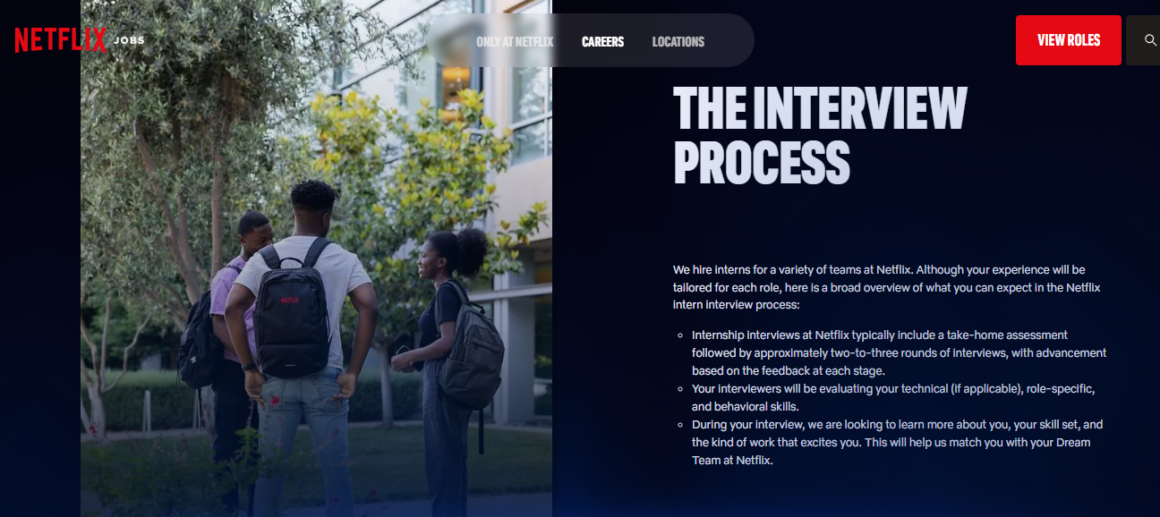
The Netflix story doesn’t exist in a vacuum, and that’s part of what makes it worth writing about. It’s one data point in a pattern that has gotten loud enough that even Netflix’s own PR department has had to respond to it.
In February 2024, Wired3 published a piece by Lauren Goode called “Tech Job Interviews Are Out of Control,” and buried in the middle of it is a detail that stopped me cold. Wired reviewed emails from a Netflix engineering candidate showing that a technical recruiter had asked the person to submit a three-page project evaluation within 48 hours, before the first round of interviews had even happened. Before the first round. Not as a final-stage gut check between two finalists, but as a door you had to walk through just to get a human conversation. Wired says a Netflix spokesperson confirmed the process varies by role and otherwise declined to comment.
That “declined to comment” is doing a lot of work. It’s the corporate equivalent of looking at the floor.
The same Wired piece quotes Laszlo Bock, who ran people operations at Google for a decade, on why this is happening now and not five years ago. The balance of power has shifted back to employers, which has made hiring tougher, partly because of mass layoffs and partly because of a broader cultural overcorrection after years of companies pampering tech workers with perks like remote-from-anywhere policies. In other words, the pendulum swung hard toward worker comfort during the pandemic hiring boom, and now it’s swinging back, and take-home assignments are one of the places where you can feel the swing land.
Wired also talked to Buzz Andersen, an engineer who has worked at Apple, Square, and Tumblr, who put it in terms that I think about a lot. He compared it to hiring a brain surgeon by quizzing them on freshman chemistry instead of trusting their track record as a proven specialist. The assignments aren’t really testing whether you can do the job. They’re testing whether you’re desperate enough, or naive enough, to do the job for free first.
Over on Bloomberg4, a piece from December 2023 opens with a 45-year-old laid-off software developer named Bryan Ashby, who spent a full week completing a complex coding project written in C++ as part of a required take-home assessment, all while he was juggling a mortgage and his daughter’s private-school tuition. The piece frames these assignments as part of a broader trend in a sluggish job market, and the framing is right. When unemployment in tech rises, the leverage shifts, and assignments that would have gotten an eye-roll in 2021 become something people grind through in 2024 because they don’t feel like they have a choice.
And then there’s Hacker News5, which is where engineers go to say the things they’d never say to a recruiter’s face. A thread from 2017 titled, more or less, “giving a candidate a take-home assignment is the most disrespectful thing a company can do,” has a top comment that’s aged into prophecy: unless the company is genuinely exceptional, with a jaw-dropping offer, the commenter isn’t doing free work for them, and even an exceptional company would need to prove that through actual employment rather than asking for unpaid labor up front. Seven years later, the assignments didn’t go away. They got longer.
One user simply and rightly says:
Giving a candidate a “take-home assignment” is actually the most disrespectful of the options listed.
The Forum Where NETFLIX Keeps Coming Up
I want to spend some time in one specific Blind thread6, because I think it’s the clearest window into how this actually feels from the inside, in real time, as it’s happening to someone.
The thread is titled “companies making candidates do free consulting,” and it opens with someone venting about Uber, describing seven to ten days of unpaid consulting work for Uber that ended with the company hiring someone else entirely. The poster says they only went through with it because the job market was bad and Uber was one of the few companies offering serious total compensation. They describe the broader pattern bluntly: interview processes that amount to unpaid consulting work and idea farming, where you don’t realize how much labor is involved until you’re already doing it. They say Uber even required them to email over the finished slide deck, which is, if you think about it for more than a second, a company asking a job applicant to hand over a deliverable, in writing, with their name on it, for free.
Then the thread takes a turn. Someone asks, almost as an aside, whether Netflix does the same thing. And the answer arrives within the hour, from someone apparently mid-process: they were in the middle of interviewing with Netflix and had just received the take-home assignment that day, with the assignment claiming it wouldn’t take more than eight hours despite the poster being certain it would take far longer. The next reply is short and says everything: sad to see Netflix here too, with the poster having hoped Uber was the exception, and a resigned goodbye to their Netflix application.
I find that exchange more revealing than any press release. This isn’t a candidate complaining about Netflix specifically because they have a grudge against Netflix specifically. This is someone watching a pattern repeat across the industry’s most admired companies, in real time, and feeling the small, specific defeat of realizing their dream employer does it too.
It’s worth noting that not everyone on these forums experiences the assignment as exploitative. Some candidates report relatively reasonable processes. One person who landed a full-stack offer at L4 described their take-home as a React application built against a provided API, given three days to complete but explicitly capped at no more than four hours of work, and described as not particularly difficult. That candidate passed, got an onsite, and eventually accepted an offer.
So the experience clearly isn’t uniform. Netflix itself told Wired the process varies by role, and based on what I read, that’s true. The problem isn’t that every Netflix take-home is a monster. The problem is that the company has built a system where the outcome is essentially a coin flip between “reasonable four-hour exercise” and “unpaid week of contract work,” and the candidate has no way to know which one they’ve been handed until they’re already inside it.
The Culture Memo Problem
Here’s where I think the Netflix angle gets genuinely interesting, and where I’ll admit my own bias as someone who has spent a fair amount of time writing about this company’s self-mythology.
Netflix’s culture memo is, by most accounts, required reading before you even get to the recruiter screen. Multiple Glassdoor reviewers7 mention it specifically, with one candidate noting the recruiter sent the culture memo and emphasized that candidates should go through it carefully. The memo, for anyone who hasn’t read it, is famous in HR circles. It talks about radical candor, about treating employees like adults, about the idea that Netflix doesn’t want “brilliant jerks,” and about the company’s commitment to paying top-of-market rates so people don’t have to negotiate or play games.
It is, in other words, a document about respect. About not wasting people’s time with corporate theater. About trust.
And then the same company, by its own candidates’ accounts, sends out take-home assignments that ask for production-quality, containerized, documented code, with an honest-time estimate that multiple candidates say is off by a factor of two or three, attached to a process where, as one Blind poster put it after getting rejected at the take-home stage for an L4 role, interviews at Netflix are entirely team-dependent, and getting rejected at the take-home, which was only the third step in the process, just sucks.
I don’t think this is hypocrisy in the cartoonish sense, where executives are twirling mustaches. I think it’s something more mundane and, honestly, more common: a company whose stated values were written for the people already inside the building, and whose hiring funnel was designed by a completely different set of incentives, mostly around recruiter efficiency and team-by-team autonomy, with nobody in the room asking whether the two things contradict each other.
The culture memo says, “we trust you with real responsibility.”
The take-home assignment says, “prove it, unpaid, on a deadline, and if a hiring manager doesn’t like your README formatting, you’ll never hear a real reason why.”
What the Law Actually Says, and Why It Doesn’t Help
I went down a rabbit hole on the legal side of this, too, because my first instinct was: surely there’s a wage-and-hour issue here. Surely a multi-day coding project crosses some line.
The honest answer is: probably, in some cases, but almost nobody is going to do anything about it.
California law is actually pretty unambiguous on the underlying principle. As one employment attorney explained on Eskridge8, California’s wage and hour laws require compensation for all hours an employee is suffered or permitted to work, whether or not the employer required it, though all that’s strictly mandated is minimum wage even if the role would pay far more. Another attorney, answering a similar question about unpaid “working interviews,” was even more direct: it is not appropriate to have unpaid working interviews, because the law treats any time an employer suffers or permits someone to work as time that must be paid, and if the interview is actually performing the kind of work the job requires, that work must be compensated.
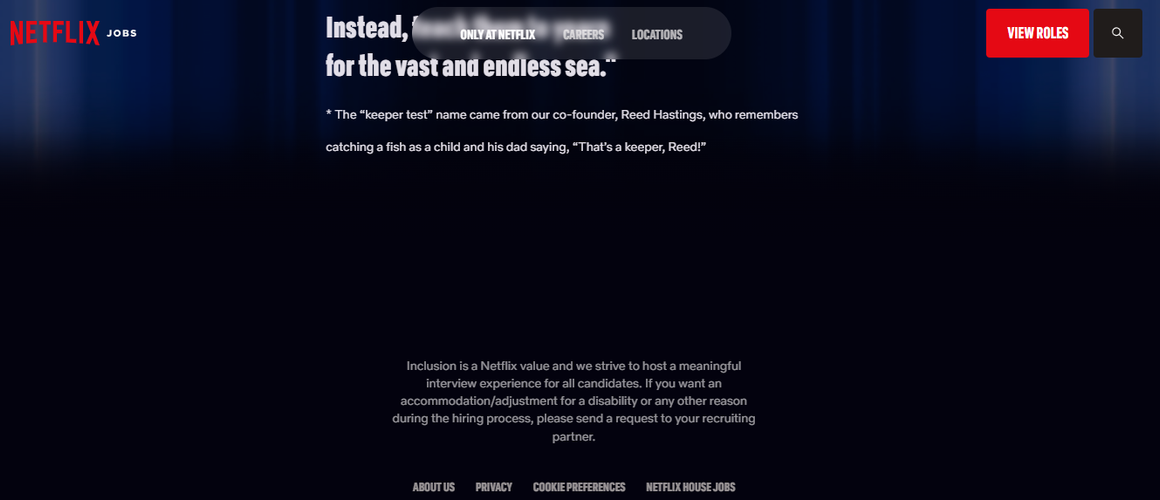
The catch, and it’s a big one, is the word “interview.” Netflix9 promises a meaningful interview experience for all candidates, yet the reality is not that simple.
A take-home coding exercise is, definitionally, framed as an assessment, not employment. Nobody is clocking in. There’s no offer letter, no W-2, no employment relationship for the law to attach itself to. A law firm that specializes in this exact gray area put it this way when discussing unpaid work product: the vast majority of interviews are unpaid, candidates show up on their own time and are asked to demonstrate skills through an independent project or brainstorming session, and employers generally cannot legally use or sell the work product from those unpaid interviews.
That last part is the closest thing to a real legal guardrail here, and it’s a weak one. In theory, Netflix can’t take your take-home React app and quietly ship the code. In practice, nobody is auditing that, and the value extracted isn’t really the code anyway. It’s the labor market signal. It’s the fact that thousands of engineers, every year, spend their evenings building free prototypes that teach Netflix something about how good engineers think, what patterns they reach for, how they structure a README, all of which feeds back into how the company writes its next assignment, completely detached from any individual candidate’s outcome.
Not everyone has thrown up their hands. I found one corner of the internet, a Substack thread10 about recruiting practices, where someone described working with a company that does the obvious, simple thing: paying candidates $500 to complete a take-home task, with a clear deadline, and reporting that nobody has ever declined the assignment under that arrangement. The reply underneath calls it exactly what it is: a policy that candidates received so well that it set the entire relationship off on the right foot, because nobody felt like they were wasting their time for free.
Five hundred dollars. That’s it. That’s the whole fix. It’s not a legal mandate, it’s not a union contract, it’s just a company deciding that if it’s going to ask for real work, it should pay for real work, the same way it would pay a contractor.
Career advice columnist Alison Green, who runs Ask a Manager11, has been fielding versions of this question for almost a decade now, and her framing has held up well. Responding to a reader describing an unpaid, multi-week training requirement before even being considered for a teaching position, she wrote that she couldn’t think of a legitimate reason an employer would need someone to complete that kind of unpaid work before hiring them, beyond simply using it to weed out people who wouldn’t push back, which doesn’t justify the time investment being demanded.
I’m finding that as part of the hiring process, a lot of employers are asking me to complete an assignment for them. I’m not against the idea, but the assignments I’m being asked to do are getting more and more laborious. They often have multiple parts to them, sometimes requiring me to research, strategize, ideate, format and write entire pieces, then explain my reasoning.
A commenter on that same post connected it to something bigger, calling it an extension of the broader cultural expectation that workers pay their dues through unpaid labor before being allowed into a paid position.
That’s the line that stuck with me while writing this. “Pay your dues.” We usually use that phrase to describe years, not hours. But the logic is identical. Somewhere along the way, the entry fee for a conversation with one of the most profitable entertainment companies on Earth became a working prototype, built on spec, on your own time, with your own electricity, judged by a standard the company itself can’t accurately estimate.
I don’t think Netflix set out to build an exploitative hiring funnel. I think it built a hiring funnel optimized for one thing, which is reducing the risk of a bad hire at a company that famously fires people who aren’t “keepers,” and nobody upstream ever modeled what that funnel costs the people going through it.
But costs are real even when nobody’s tracking them. Every hour a laid-off engineer spends containerizing a take-home app is an hour they’re not spending on an application to a company that won’t ask for one. Every “we estimate this will take four hours” that actually takes ten is a small, repeatable lie that candidates learn to expect, and that erodes trust in the exact kind of company that built its brand on trust.
The Blind poster I started with never got the job, as far as I can tell. The thread just ends. No update, no resolution, just the assignment sitting there, due in a few days, already known to be bigger than advertised. Multiply that by however many candidates Netflix puts through this process every year, across every team that’s chosen to run it this way, and you get a quiet, distributed transfer of labor from people who need work to a company that doesn’t need to ask for it.
Netflix doesn’t have to change the law to fix this. It just has to decide that the culture memo applies to people before they get the badge, not just after.
Sources
- “Get a Job at Netflix: Interview Process and Top Questions” Exponent, 22 June 2026, www.tryexponent.com/blog/an-inside-look-into-the-netflix-interview-process. Accessed 24 June 2026. ↩︎
- “Netflix Interview Process & Key Questions” 4Dayweek.Io, 21 Apr. 2022, 4dayweek.io/interview-process/netflix. Accessed 24 June 2026. ↩︎
- “[LINK] Tech Job Interviews Are Out of Control” 4 Feb. 2024, mailman.anu.edu.au/pipermail/link/2024-February/041516.html. Accessed 24 June 2026. ↩︎
- “Bloomberg” Are you a robot?, www.bloomberg.com/news/articles/2023-12-05/how-to-find-a-job-application-homework-frustrates-jobseekers. Accessed 24 June 2026. ↩︎
- Hacker News, news.ycombinator.com/item?id=15553961. Accessed 24 June 2026. ↩︎
- “Your Anonymous Workplace Community” Blind, www.teamblind.com/post/companies-making-candidates-do-free-consulting-sbz1trti. Accessed 24 June 2026. ↩︎
- Glassdoor, www.glassdoor.com/Interview/Netflix-Los-Gatos-Interview-Questions-EI_IE11891.0,7_IL.8,17_IC1147427.htm. Accessed 24 June 2026. ↩︎
- “Working Interviews” Eskridge Law, 16 Sept. 2019, www.eskridgelaw.net/working-interviews/. Accessed 25 June 2026. ↩︎
- “Netflix Jobs” jobs.netflix.com/culture. Accessed 2 Sept. 2026. ↩︎
- Scott, Tom. “Best recruiting practices for hiring product designers” Best recruiting practices for hiring product desig, 23 Jan. 2025, verifiedinsider.substack.com/p/best-recruiting-practices-for-hiring/comments. Accessed 25 June 2026. ↩︎
- Askamanager, www.askamanager.org/2017/04/should-you-do-free-work-as-part-of-a-job-interview.html. Accessed 25 June 2026. ↩︎