
How eBay’s managed payments system turned millions of sellers into involuntary lenders, and what the company does not want you to ask about the float.
- From PayPal to Adyen: A Power Transfer Disguised as a Simplification
- The Architecture of the Hold
- The Float Question Nobody at eBay Will Answer Directly
- The Policy Expansion Nobody Announced
- Germany and the Retroactive Rewrite
- The UK Experiment: Privatizing the Hold
- The Veteran Seller Problem
- The Fee Opacity Problem
- The Accountability Gap and the Practical Toll
There is a peculiar kind of financial hostage-taking happening every day on one of the world’s largest marketplaces. A seller ships a vintage camera. The buyer receives it, leaves five stars, and confirms the delivery. The money, already collected, already sitting somewhere, does not arrive. Not for a day. Not for two. Sometimes not for 30 days. In some cases, longer.
eBay’s managed payments system, which the company completed rolling out to all sellers by mid-2022 after a years-long migration away from PayPal, promised sellers “one place to sell and get paid.” What it delivered instead was something more complicated: a labyrinth of holds, reserves, and vague risk triggers that has left experienced sellers, people with feedback scores in the thousands and years of clean transaction histories, watching their earnings sit in an account they cannot access, earning interest they will never see.
This is not a glitch. It is a policy. And the people it affects most are not new sellers or bad actors. They are the backbone of a marketplace that processed roughly $73 billion in gross merchandise volume in 2024.
From PayPal to Adyen: A Power Transfer Disguised as a Simplification
To understand how we got here, it helps to go back to the beginning. eBay and PayPal were famously joined at the hip for years, operating as a single entity before being split into two publicly traded companies in 2015. For more than a decade, the relationship was symbiotic: eBay sent volume to PayPal, and PayPal gave sellers something close to real-time access to their money.
That arrangement ended when eBay struck a deal with Dutch payments processor Adyen in 2018. The idea, eBay executives said at the time, was to control the payments stack entirely. To stop sharing transaction economics with a third party and keep more of the fee revenue inside the house. As reported by A2X1, eBay’s then-CEO Devin Wenig put it, “the devil will be in the execution.”
He was more right than he probably intended.
The Adyen2 partnership entitled eBay to acquire up to 5% of Adyen’s fully diluted shares, tying the two companies together in a way that went far beyond a typical vendor relationship. When eBay later sold some of those Adyen shares, it booked hundreds of millions of dollars in proceeds. The financial logic of the managed payments migration was never purely about seller convenience. It was about owning the money flow.
Under the old system, a seller’s PayPal balance was effectively theirs the moment a buyer paid. PayPal3 had a program called Funds Now that allowed established sellers in good standing to avoid holds and delays in getting their money, even during disputes. That protection evaporated when managed payments took over.

The Architecture of the Hold
eBay’s Payments Terms of Use4 are worth reading carefully because they reveal just how much discretion the company reserves for itself. The document states plainly that eBay “reserve[s] the right to restrict your access to funds when necessary to manage risks.” The definition of “risk” is left almost entirely to eBay’s judgment.
There are two main mechanisms sellers can find themselves caught in.
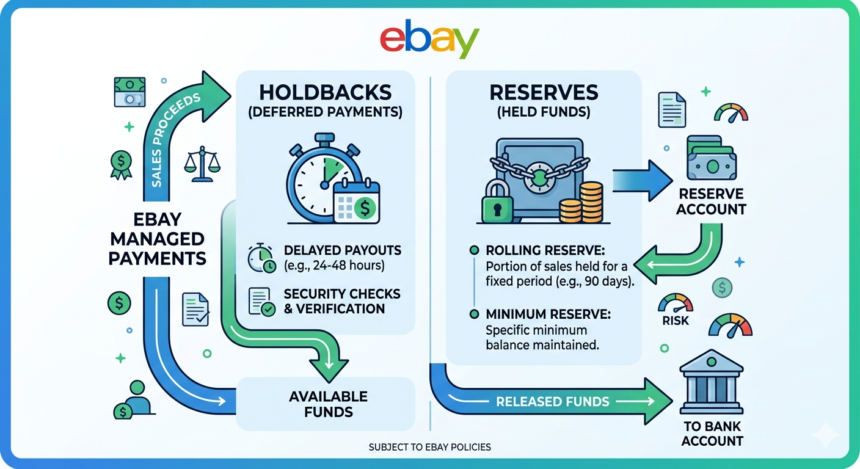
The first is a transaction-level hold. This is when eBay5 freezes the funds from a specific sale, most commonly affecting new or infrequent sellers, until delivery is confirmed and a waiting period expires. These holds typically last up to 30 days, though the company is careful to frame this as a guideline rather than a promise.
The second, and more financially damaging, is a reserve. eBay’s6 terms describe two reserve types: a rolling reserve, which withholds a set percentage, say, 10%, of daily proceeds for a fixed period before releasing them on a rolling basis, and a minimum reserve, which holds a fixed dollar amount from a seller’s payouts until it accumulates and can be held as a buffer. A 10% rolling reserve held for 60 days means that every day, a slice of a seller’s income disappears into a holding account. The money comes back eventually, but in the meantime, it is working for someone else.
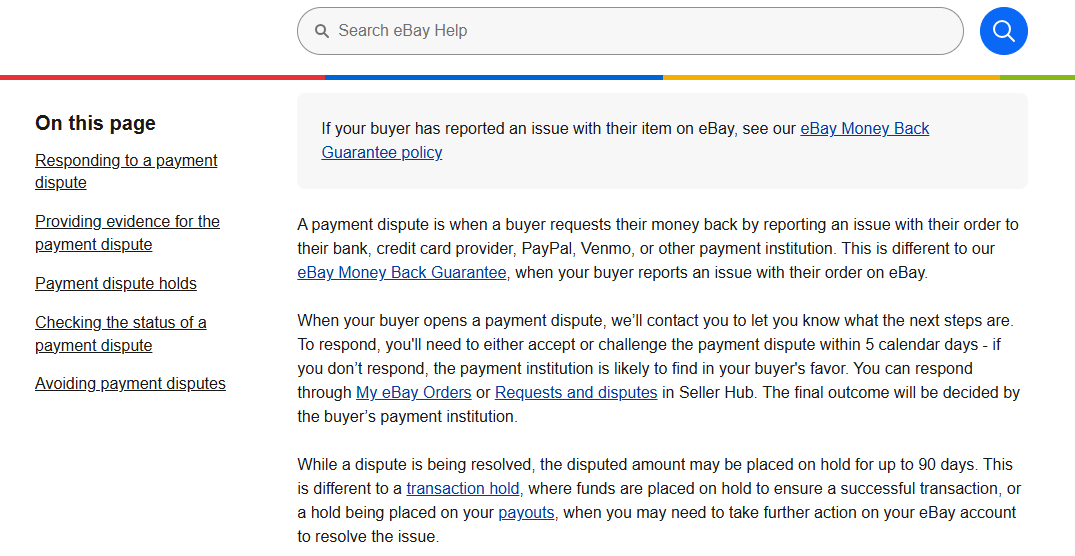
According to eBay7, disputed funds can be held for up to 90 days, or longer, depending on the payment network. Sellers who encounter chargebacks, which are buyer-initiated disputes processed through the buyer’s bank rather than through eBay’s own resolution system, can find their funds frozen for months while payment processors work through the dispute.
The factors eBay says it considers when imposing a reserve read like a checklist designed to ensure almost any seller could qualify: account history, category risk, chargeback rates, credit history for business accounts, whether you are pre-selling items not yet in your possession, and whether you have extended delivery windows. Notably, eBay also reserves the right to run credit checks on business sellers where permitted by law. A provision that most sellers discover only after reading the fine print.
The Float Question Nobody at eBay Will Answer Directly
There is a question that surfaces again and again in seller forums, Reddit threads, and comment sections, and eBay has never answered it cleanly.
When eBay holds your money, does it earn interest on it?
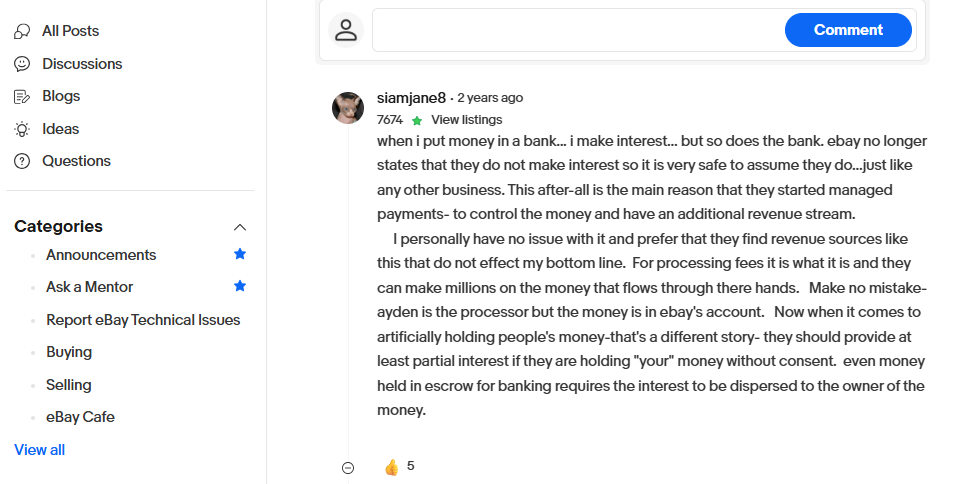
For years, eBay’s terms included explicit language stating that the company did not earn interest on held funds. Then, quietly, that language disappeared. Sellers noticed the change and began pointing it out in eBay8 community forums as early as 2024. One seller wrote:
“eBay no longer states that they do not make interest so it is very safe to assume they do… just like any other business. This after all is the main reason that they started managed payments — to control the money and have an additional revenue stream.”
eBay’s own SEC filings9 describe “funds receivable” as “customer cash in transit and held by payment processors… associated with marketplace activity and awaiting payment to sellers.” These balances sit in accounts. Those accounts sit in banks. Banks pay interest. The math is not complicated.
As one seller put it in the eBay community forum10:
“Think about ALL the sellers on eBay. All those funds in one bank account. The APR is the reason they hold funds. They draw interest off of your money. They’ll never admit it, but this is what’s happening.”
Another community member framed it in terms even a financial regulator should recognize:
“Even money held in escrow for banking requires the interest to be dispersed to the owner of the money.”
eBay processes tens of billions of dollars in gross merchandise volume each year. If even a fraction of that sum sits in interest-bearing accounts for a few days at a time, the passive income generated is substantial. At current interest rate levels, holding a billion dollars for 30 days at even a modest 4% annualized rate generates over $3 million in a single month. Multiply that across a platform the size of eBay, and the float becomes a revenue line. One that does not appear anywhere in the company’s public disclosures to sellers.
The Policy Expansion Nobody Announced
Late 2024 and into 2025 brought something new: holds started spreading to sellers who had never experienced them before.
According to Value Added Resource11, the changes began surfacing in the US and UK in late 2024 and early 2025, with sellers reporting that payouts for all their sales were suddenly delayed until two to three days after delivery confirmation, with no clear explanation. eBay’s terms had been quietly updated in December 2024 to include language noting that “in some cases (for example, if you are a new seller on eBay), funds may become available for disbursement after the items have been deemed delivered.” The parenthetical was doing a lot of work.
When affected sellers contacted support, the explanations they received were contradictory. Some were told this was a risk-based measure applying only to certain accounts. Others were told, pointedly, that this change would eventually be applied to all sellers on the platform. Then eBay’s own community managers contradicted that statement publicly.
One eBay12 customer service response, shared in a June 2025 community thread, was striking for its candor:
“Please know that you wouldn’t be singled out here. We are making changes to the ways sellers are paid which is different from a payment hold. It is affecting many accounts and will likely continue to roll out.”
A second response, apparently from eBay’s social media team, told a top-rated seller with stellar performance:
“These changes are not being made for risk and compliance reasons, but to enhance buyer value. The good news is funds are automatically made available 2 days after delivery.”
Read that again. Not risk. Not fraud prevention. “Buyer value.” eBay was telling an established seller with no account issues that their money would be withheld after delivery, in the name of enhancing a buyer experience that eBay’s Money Back Guarantee already fully covered. The logic does not hold. eBay Money Back Guarantee has protected buyers for years without requiring sellers to forfeit their liquidity.
Germany and the Retroactive Rewrite
The story gets murkier in Germany, where eBay’s handling of the policy expansion showed something that looked less like a communications failure and more like an attempt to rewrite history.
German sellers began reporting the same delivery-hold situation at least as early as July 2025. Value Added13 resource reported that an eBay Germany staff member named Miriam@eBay acknowledged on July 18, 2025, that delayed payouts could be applied due to unusual selling patterns, but stated it was not a blanket policy for all sellers.
Then, in December 2025, eBay posted a “reminder” in the German community claiming the policy had gone into effect in September 2025 and that sellers had been notified at that time. The linked policy page confirmed September 9, 2025 as the effective date. But the forum evidence showed sellers experiencing the holds months earlier. The company was, in effect, claiming a September start date for a policy that was already being enforced in July.
This is what policy laundering looks like at the platform scale: quietly implement a change, let it run for months, then publish a retroactive announcement that frames it as something orderly and disclosed.
The UK Experiment: Privatizing the Hold
The UK marketplace became eBay’s most ambitious test case for how far it could push payment delay as a structural feature rather than an exceptional measure.
Starting February 4, 2025, eBay UK14 made private sellers wait for their funds until after delivery confirmation. This was framed as part of a package that also eliminated selling fees for private sellers and introduced a new “Buyer Protection Fee” paid by buyers instead. eBay presented this as a benefit all around. Sellers would no longer pay final value fees. Buyers would get enhanced protection. Everyone wins.

The sellers did not see it that way.
As eBay’s own announcement noted, the Buyer Protection fee is embedded in the item price, meaning the buyer effectively pays it whether they know it or not. On a £4.99 item, one eBay community15 seller calculated, the effective fee burden actually increased compared to the old system, from £0.95 deducted from the seller to £1.09 collected from the buyer. eBay was taking more money from the transaction, distributing the extraction across a different party, and calling it a benefit.
On the payment timing specifically, UK sellers were pointed: “Everyone knows that the longer a company holds onto customers money, the more they earn in interest,” wrote one seller in the eBay UK community. “eBay doing this is morally corrupt and potentially illegal.” Another added:
“Sellers must receive their funds from sales as soon as possible in order to enable them to post the item. Currently it takes a day for eBay to clear funds and I cannot post the item until these funds have been cleared to protect myself from fraud but also because I need to use that money to pay for postage and packaging costs.”
That is a real cash flow problem. To ship an item, you need money for postage. If your sale proceeds are locked until after the item delivers, you are expected to front shipping costs from funds you do not yet have. The solution eBay nudged sellers toward was its own Simple Delivery managed shipping service, which, conveniently, allows sellers to use pending funds for postage labels. In other words, eBay’s payment hold created a problem that eBay’s own product then offered to solve.
By July 2025, eBay16 quietly softened the UK policy, announcing that private sellers with at least 10 completed sales totaling £150 or more within the last five years would receive their funds within 24 hours of the buyer’s payment. The retreat suggested eBay had seen enough disruption to selling activity, the metric Wall Street actually cares about, to dial back what had been one of its most aggressive payment holds.
The Veteran Seller Problem
Here is the part that is hardest to explain away with fraud prevention logic: the payment holds are not limited to new sellers or suspicious accounts. They routinely hit people who have been selling on eBay for a decade or more.
One seller posted in the eBay community forums17:
“I do not have a new account. I have been selling consistently for 8 years. My current feedback score is 99.5%. I have no open cases. My account is above standard. After over 1 hour with chat reps in Pakistan I demanded a manager.”
Another long-term seller wrote:
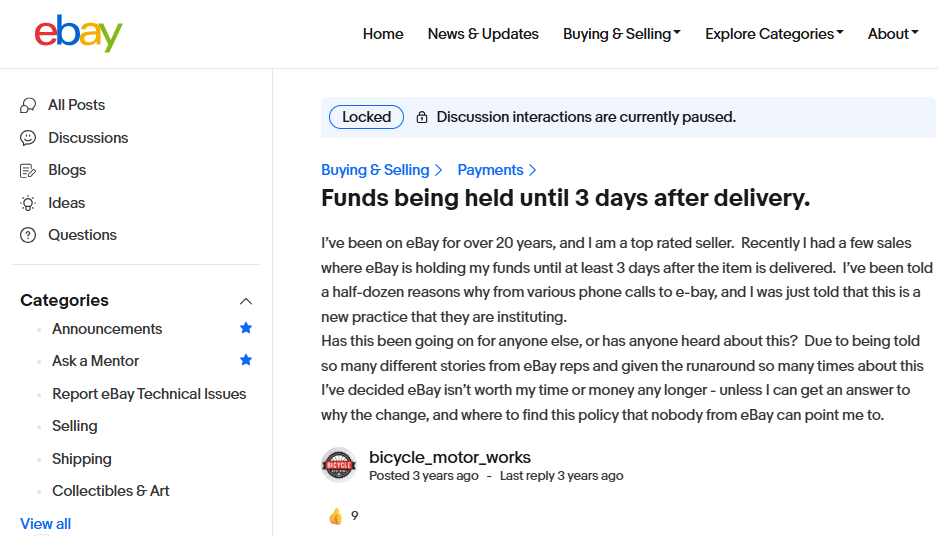
“I’ve been on eBay for over 20 years, and I am a top rated seller. Recently I had a few sales where eBay is holding my funds until at least 3 days after the item is delivered. I’ve been told a half-dozen reasons why from various phone calls to eBay, and I was just told that this is a new practice that they are instituting.”
The explanation sellers often receive for why a veteran account suddenly faces holds is this: eBay treats accounts that have not sold anything in 90 days as new sellers. A part-time reseller who takes a three-month break, or a small business owner who pauses while dealing with a personal crisis, returns to find their established history reset by an algorithm. As one community volunteer explained, bluntly:
“eBay considers you a new seller since you hadn’t listed or sold anything in over 90 days.”
The response from the community to this explanation was telling. “Your reply defies logic,” wrote one seller.
“If I sell something I should receive my money as close as possible to the time of sale. Why should my money be going to work for an enormous, cash-rich organization to which I pay exorbitant fees when it could be working for me in my own bank account?”
The Fee Opacity Problem
The payment hold issue sits inside a broader transparency problem. NerdWallet’s18 review of managed payments flagged that combined fees make it impossible to know what you are paying for each service. The fee you pay covers both eBay’s commission and payment processing costs, but you cannot separate them. In the old PayPal era, eBay’s cut and PayPal’s cut were distinct and visible. Now they are bundled, which is “convenient” in the way that black-box pricing is always convenient for the entity collecting the money.
According to SaleHoo19, under managed payments, sellers pay roughly 12.9% of the sale price plus a $0.30 transaction fee. The old structure, a 10% eBay fee plus 2.9% PayPal fee plus $0.30, came to a similar number. But the old structure let sellers see exactly where the money went. Now they cannot. And they certainly cannot see how much of it is being earned back by eBay through the spread on held funds.
There is a useful frame for understanding what eBay has built. Managed payments is not simply a payment processor. It is a financial intermediary that holds seller funds in transit, earns returns on that float, and periodically extends the hold period, sometimes through policy, sometimes through algorithm, while offering sellers a product loan service (eBay Seller Capital, powered by LendingPoint) as an alternative to simply getting paid on time.
The logic is not subtle. When managed payments moved sellers off PayPal, it also cut them off from PayPal Working Capital, the financing product some sellers relied on to manage cash flow. eBay then offered its own lending product as a replacement. Sellers who cannot access their held funds can, in theory, borrow money, at interest, from a company that is already holding their money. The circularity of this arrangement is remarkable.
As one commenter on EcommerceBytes20 captured it:
“More held money equals more profits for eBay from interest floats equals higher stock prices.”
That framing may sound conspiratorial. But it describes a mechanism that is factually straightforward. eBay holds cash. Cash in accounts earns interest. The longer cash is held, the more interest it generates. The seller earns nothing. eBay discloses nothing about what it earns on that float. And the policy governing when holds apply is written broadly enough that virtually any account, under the right circumstances, can be caught.
The Accountability Gap and the Practical Toll
There is no federal regulator in the United States whose mandate clearly covers this specific situation: a marketplace holding earned proceeds from sellers for extended periods without disclosing what it earns on those funds. The FTC has broad consumer protection authority, but its focus is typically on buyer-side deception. State money transmission laws could theoretically apply if eBay is functioning as an unlicensed money transmitter, but eBay’s payment entity structure, operating through licensed subsidiaries, is designed to keep it on the right side of those frameworks.
The EU has been more aggressive. Payment Services Directive rules impose stricter requirements on how long funds can be held and how they must be treated. eBay’s German policy retreat may have been shaped in part by regulatory awareness as much as seller complaints.
In the absence of clear legal obligation, the accountability falls to public pressure, seller organizing, and journalism. All three have had limited success so far. eBay’s community forums are full of threads from sellers who say they fought holds and lost, or gave up and left the platform.
The people bearing the cost of this system are not abstractions. They are the hobbyist who sold a guitar to cover a car payment and waited five weeks to access the funds. They are the small reseller who buys inventory with the expectation of a two-day payout and suddenly finds themselves fronting shipping costs on a frozen balance. They are the estate liquidator handling a deceased relative’s belongings who cannot understand why an eight-year-old account with perfect feedback is being treated like a suspected fraudster.
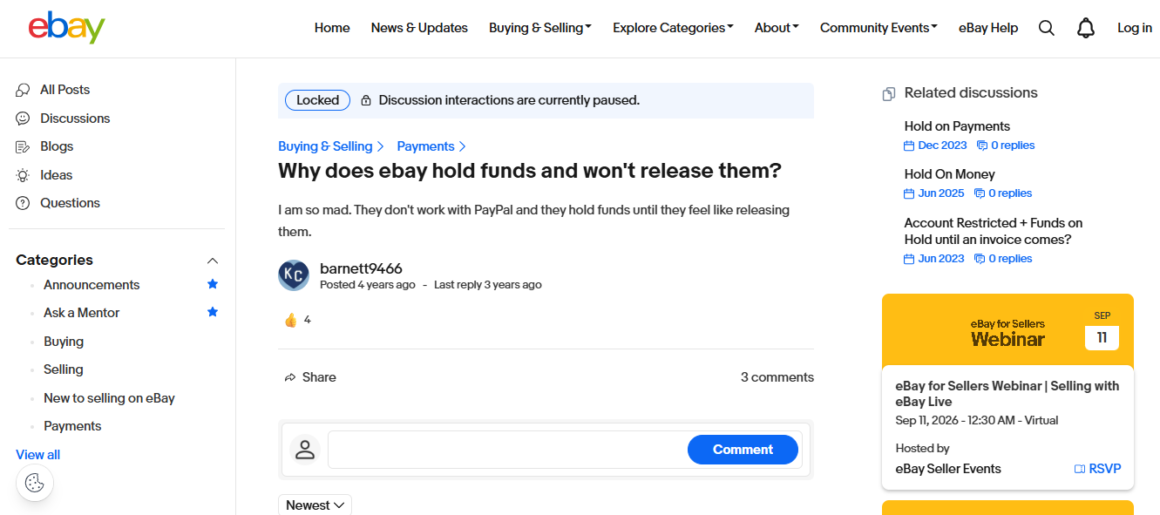
One seller put it plainly in the eBay forums21:
“eBay is on self-destruct, with managed payments, the out-of-date seller fees, and now withholding funds for no reason. All this is going to do is put off anyone from using this site.”
The irony is that the seller is paying eBay to use the platform, paying fees on each transaction, and then involuntarily lending eBay the proceeds of that transaction for days or weeks at no compensation. If any bank in any country operated this way with customer deposits, holding your money, earning interest on it, and telling you it was for your protection, the outcry would be immediate and the regulatory response swift.
On eBay, it has been going on for years. And the only thing that has changed recently is that the holds appear to be getting wider.
eBay does not have to be this opaque. There is a version of managed payments that would be genuinely fair to sellers: clear criteria for holds published in plain language, a defined maximum hold period with no exceptions for “ongoing assessment,” and, most importantly, disclosure of whether eBay earns any return on held funds, and if so, how much.
Platforms that process payments for merchants are not exempt from basic standards of transparency. A seller who ships a physical product, receives confirmed delivery, and positive feedback should be able to expect their money within 24 hours. Not as a privilege granted to those who qualify under opaque scoring criteria. As a baseline right.
Until eBay answers the float question directly, publicly, in its terms, in its SEC filings, the most reasonable inference is that the answer is one it does not want sellers doing the math on.
The money is sitting somewhere. It is earning something. And the people who earned it are not the ones getting paid.
Sources
- “eBay Managed Payments: Everything You Need to Know” A2X Accounting, 1 Dec. 2020, www.a2xaccounting.com/blog/ebay-managed-payments. Accessed 3 July 2026. ↩︎
- “First warrant tranche of long-term contract between Adyen and eBay Inc. exercised” Adyen, www.adyen.com/press-and-media/first-warrant-tranche-of-long-term-contract-between-adyen-and-ebay-inc-exercised. Accessed 3 July 2026. ↩︎
- Ready, Bill. “Funds Now: Giving Instant Access to Money From Online Sales” Funds Now: Giving Instant Access to Money From Onl, newsroom.paypal-corp.com/funds-now-giving-instant-access-to-money-from-online-sales. Accessed 3 July 2026. ↩︎
- “Payments Terms of Use” EBay.com, pages.ebay.com/payment/2.0/terms.html. Accessed 3 July 2026. ↩︎
- “Transaction holds” EBay, www.ebay.com/help/selling/getting-paid/getting-paid-items-youve-sold/payments-hold?id=4816. Accessed 3 July 2026. ↩︎
- “Payments Terms of Use” EBay.com, pages.ebay.com/payment/2.0/terms.html. Accessed 3 July 2026. ↩︎
- “Handling payment disputes” EBay, www.ebay.com/help/selling/getting-paid/handling-payment-disputes?id=4799. Accessed 3 July 2026. ↩︎
- Green, A C. “Disclaimer about Not Earning Interest on Held Funds Has Been Removed?” EBay Community Selling, 3 July 2023, community.ebay.com/t5/Selling/Disclaimer-about-Not-Earning-Interest-on-Held-Funds-Has-Been/td-p/33848128. Accessed 4 July 2026. ↩︎
- “SEC.gov”, www.sec.gov/Archives/edgar/data/0001065088/000106508824000076/Financial_Report.xlsx. Accessed 4 July 2026. ↩︎
- “eBay is holding my funds for 32 days after delivery and positive feedback was received.” EBay Community, 9 Mar. 2024, community.ebay.com/t5/Payments/eBay-is-holding-my-funds-for-32-days-after-delivery-and-positive/td-p/34337258. Accessed 4 July 2026. ↩︎
- Morton, Liz. “eBay US Payments Update: Funds Held Until After Delivery For “Some” Sellers” 29 Jan. 2025, www.valueaddedresource.net/ebay-us-funds-held-until-after-delivery-for-some-sellers/. Accessed 6 July 2026. ↩︎
- “Ebay Holding Seller Payments Until AFTER Delivery!” EBay Community, 14 June 2025, community.ebay.com/t5/Payments/Ebay-Holding-Seller-Payments-Until-AFTER-Delivery/td-p/35128457. Accessed 6 July 2026. ↩︎
- Morton, Liz. “eBay Quietly Updates Policies, Retroactively Covering Controversial Payment Hold Changes” 8 Dec. 2025, www.valueaddedresource.net/ebay-updates-policies-retroactively-payout-delay/. Accessed 6 July 2026. ↩︎
- “February 2025 news from eBay leaders” UK Seller Centre, www.ebay.co.uk/sellercentre/news/february-uk-leaders. Accessed 6 July 2026. ↩︎
- “The new when we get paid rules from February.” EBay UK Seller Central, 3 Jan. 2025, community.ebay.co.uk/t5/Seller-Central/The-new-when-we-get-paid-rules-from-February/td-p/7737925. Accessed 7 July 2026. ↩︎
- “July 2025 news from eBay leaders” UK Seller Centre, www.ebay.co.uk/sellercentre/news/july-uk-leaders. Accessed 7 July 2026. ↩︎
- “Funds on hold” EBay Community, 20 Apr. 2024, community.ebay.com/t5/Payments/Funds-on-hold/td-p/34420058. Accessed 7 July 2026. ↩︎
- Woock, Kurt. “EBay Managed Payments Review: Pros, Cons, How It Works” NerdWallet, 16 Feb. 2022, www.nerdwallet.com/article/small-business/ebay-managed-payments. Accessed 7 July 2026. ↩︎
- Slade, Simon. “eBay and PayPal Breakup: What eBay’s Move to Adyen Means for Sellers in 2026 and Beyond” SaleHoo, 17 June 2026, www.salehoo.com/learn/ebay-breaks-it-off-with-paypal. Accessed 8 July 2026. ↩︎
- Steiner, Ina. “Did You Know eBay May Hold Funds of ‘Low Volume’ Sellers?” EcommerceBytes, 29 Aug. 2021, www.ecommercebytes.com/2021/08/29/did-you-know-ebay-may-hold-funds-of-low-volume-sellers/. Accessed 8 July 2026. ↩︎
- “Why does ebay hold funds and won’t release them?” EBay Community, 2 July 2022, community.ebay.com/t5/Payments/Why-does-ebay-hold-funds-and-won-t-release-them/td-p/33044675. Accessed 8 July 2026. ↩︎