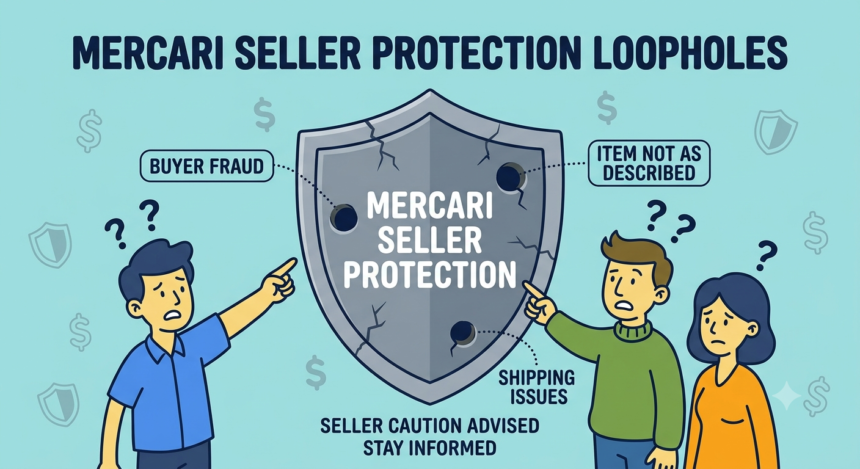

There is a particular kind of dread that arrives not with a knock at the door but with a notification on your phone. It lands after you have already shipped the item, already watched the tracking update to “delivered,” already started doing the math in your head on what you cleared. Then comes the message: the buyer has opened a dispute. And just like that, the money you thought was yours is not.
- The Three-Day Clock Nobody Tells You About
- The “Authenticity Concerns” Button: A One-Click Refund Machine
- The $200 Ceiling on Everything You Care About
- The “Any Reason Return” Experiment and the Seller Revolt
- The Switcheroo Scam Mercari Cannot Stop
- The Insurance Loophole Nobody Talks About
- Packaging Standards That Appear After the Fact
- The Weight Dispute Trap
- Account Suspension Without Warning
- What the Platform Gets Right, and What It Is Missing
This is the lived reality for thousands of sellers on Mercari, the Japanese-founded resale platform that now claims over 50 million U.S. downloads and positions itself as the scrappy, seller-friendly alternative to eBay and Poshmark. Mercari talks a lot about protection. It puts the word right in the name: Seller Protection, Buyer Protection, Shipping Protection. These are branded promises printed in the platform’s help pages like a contract. But spend enough time in the forums, in the complaint boards, in the threads on r/Mercari, and a different picture comes together. The protection language is real. The coverage, for many sellers, is not.
What follows is a careful look at the specific gaps, technical quirks, and exploitable mechanics that leave sellers exposed on Mercari, often without recourse, often without warning, and sometimes without even knowing the system has been gamed against them.
The Three-Day Clock Nobody Tells You About
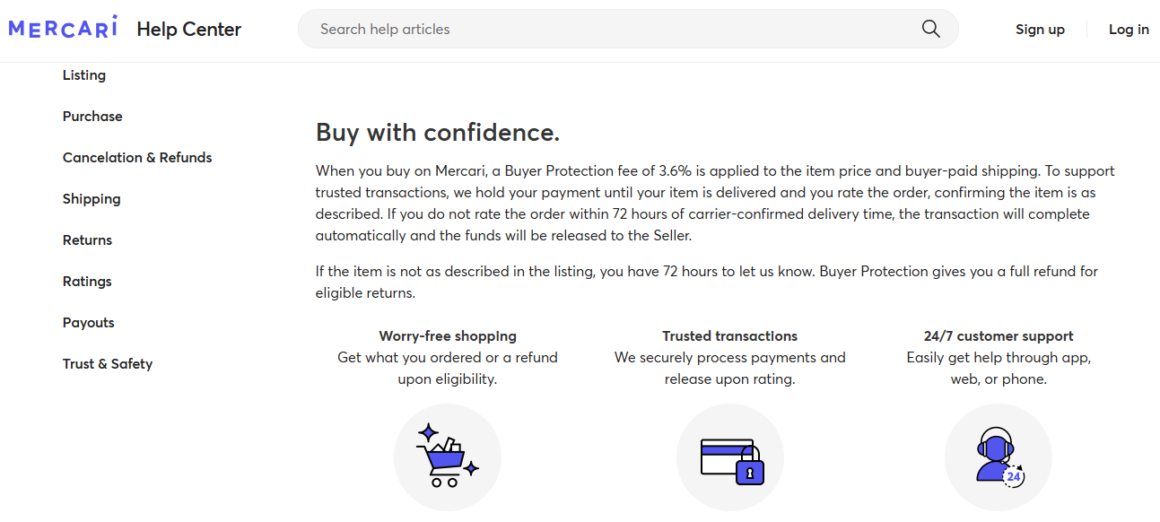
The first thing to understand about Mercari’s seller protection system is that it runs on a 72-hour window. According to Mercari’s own Buyer Protection policy1, a buyer has three days from the carrier-confirmed delivery time to inspect their item, rate the transaction, or file a claim. If no claim is made within 72 hours, payment is automatically released to the seller.
That sounds like a seller’s friend. In practice, it cuts both ways in ways Mercari does not advertise prominently.
On the buyer side, those 72 hours are long enough to open a dispute on nearly anything. On the seller side, if a buyer contacts them directly first, trying to resolve a problem amicably, and those conversations run past the three-day mark without a formal dispute being filed through Mercari’s system, the transaction auto-completes. Money releases. Now the buyer has no recourse. On Trustpilot2, a user described exactly this trap:
“I contacted Mercari who stated that because it was greater than 72 hours, the funds have been released to the seller and there’s nothing more that could be done. I explained that I contacted the seller directly and it took more than 72 hours to complete the communication. However, Mercari continued to state there was nothing that could be done.”
The platform, as that reviewer put it, was effectively “supporting fraudulent advertising.”
But the window also works in reverse for sellers. A buyer who knows the rules can open a dispute at hour 71, forcing a hold on a seller’s funds for days or weeks while Mercari processes a complaint that may be entirely fabricated. The seller sits and waits. The money does not move. And if the seller is running their resale operation on thin margins, buying inventory at estate sales, flipping finds from Goodwill, that held cash is not just annoying. It is a business constraint.
The “Authenticity Concerns” Button: A One-Click Refund Machine
There is a loophole on Mercari that experienced buyers know about and that sellers largely do not until they become victims of it. It involves the dispute-filing interface and a checkbox that says “authenticity concerns.”
When a buyer files a return request on Mercari, they choose from a short list of reasons. Most of those reasons require some level of documentation: photos, descriptions, evidence that the item differs from the listing. But checking the “authenticity concerns” box triggers a different automated pathway. Because Mercari takes brand authenticity seriously and has reputational incentives to err on the side of refunding anything that might be counterfeit, that checkbox routes disputes toward fast approval.
The problem is that Mercari does not have the capacity to actually verify authenticity remotely for most items. The result, as a Trustpilot3 reviewer who described themselves as an 11-year Mercari seller put it:
“Checking the authenticity concerns button is like spraying a bug with poison, they tend to flail around confused and of course they do not have any option for sellers to submit rebuttals. Therefore sellers are screwed but as a buyer you can force an approval.”
The same reviewer added a blunt warning:
“Sellers, I’m warning you to be VERY cautious cause of this loophole.”
This is not a theoretical exploit. It is a documented pattern that sellers report across complaint platforms. On the seller’s side, there is no equivalent fast-track option. No “I have video evidence of what I shipped” button. No immediate hold on the refund pending a rebuttal. The system, in its current design, treats the buyer’s claim as presumptively valid and forces the seller into a reactive posture.
The $200 Ceiling on Everything You Care About
Mercari’s Shipping Protection4 covers losses up to $200 for standard shipments made with a Mercari prepaid label. That is the cap. It has been $200 for years. And for a platform that sellers use to move electronics, luxury goods, vintage equipment, and collectibles, that cap represents a structural gap that Mercari has never seriously addressed.
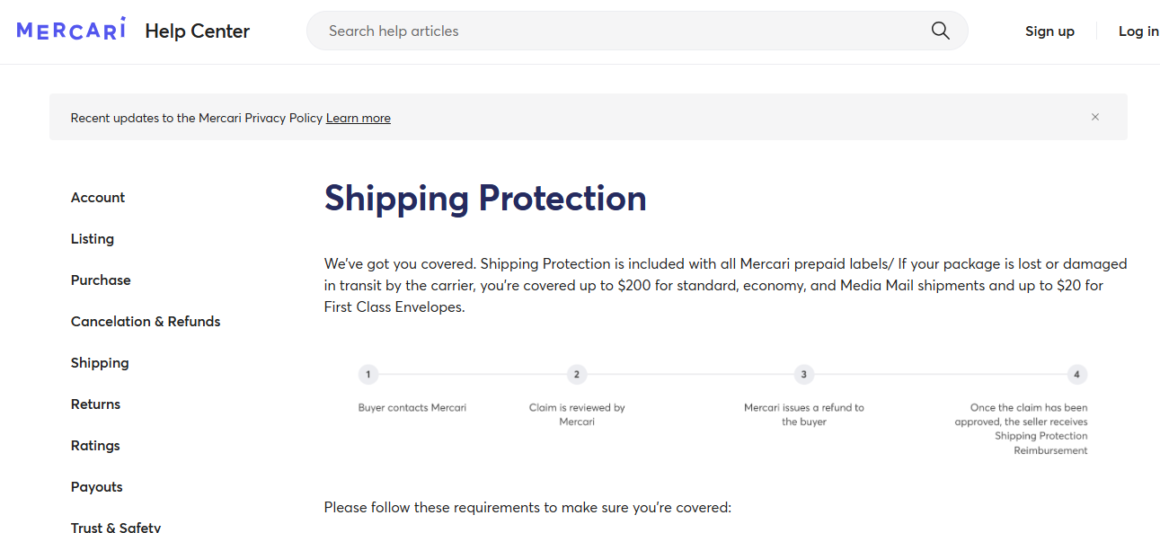
The math is brutal. Sell a $600 phone on Mercari, ship it with a Mercari label, and if it goes missing in transit, you get $200 back. Minus fees already deducted. You are absorbing a loss of $400 or more on a single transaction, and there is nothing in the platform’s protection framework that covers the difference. As PoshSideKick’s5 analysis of Mercari’s seller protection noted:
“The biggest weakness of Mercari seller protection is the $200 cap, which is a major gap for anyone selling expensive items.”
Sellers who ship with their own labels get even less. Mercari’s shipping policy6 is explicit: if you choose to ship with your own label rather than a Mercari prepaid label, you are entirely outside the Shipping Protection framework. The package has to arrive and be accepted at the carrier. If the carrier loses it, if it gets diverted, if it disappears, Mercari will not intervene and will not compensate you. You have taken on the full risk of the mail system with no backstop.
What Mercari does not make clear in its marketing is that even within the prepaid label system, the protections come with conditions that trip sellers up. According to Mercari’s own Shipping Protection terms, a package must have a carrier possession scan, an acceptance scan followed by a second movement scan, for the seller to be eligible for coverage in a lost-in-transit claim. If the carrier accepts the package but never scans it again, you may be out of luck even though you did everything right. And for an item to be considered “lost in transit” at all, 30 or more days must have passed since the last tracking scan. Sellers are expected to wait a month before even starting the claim process.
One seller captured this absurdity directly:
“I sold an item through Mercari and delivered it to the carrier the next day to be shipped. About a week later the tracking updated to ‘delivered to wrong post office correcting.’ I contacted Mercari over 2 weeks ago and now after my third email with no response from any support they tell me it’s not covered for shipping protection because it was delivered to the wrong post office. I had nothing to do with that, and I delivered it to the carrier with the label Mercari provided.”
The “Any Reason Return” Experiment and the Seller Revolt
In March 2024, Mercari made a decision that it almost immediately had to walk back. As part of a broader restructuring that also included eliminating seller fees entirely, the company introduced what it called an “any reason” return policy. Buyers could return items simply because they changed their minds, within a three-day window, with no need to claim the item was misrepresented or damaged.
The intention was competitive positioning. Mercari’s U.S. CEO John Lagerling was explicit about wanting to attract buyers with a confidence-boosting return experience. But the policy landed on sellers like a bomb. As Modern Retail7 reported, one Redditor claimed four returns in a single week compared to three across 700 prior orders. Another seller reported that Mercari approved a return “disputing a listing’s description accuracy, despite the photo and title being correct.”
Mercari reversed the policy less than two months after introducing it. But the episode revealed something important about how the platform thinks about the seller-buyer relationship. When it chose a side during that experiment, it chose buyers. The rollback was not a principled correction. It was a response to seller outrage and the threat of mass departures from the platform. As one seller wrote after the reversal was announced:
“Unfortunately now I don’t trust Mercari at all and therefore just can’t risk coming back. There have been too many horror stories.”
The return to a narrower return policy brought back the prior framework in which buyers can only initiate returns for items that are damaged, wrong, or significantly not as described. But it kept one element that sellers still flag as a problem: authenticity claims remain on the list of valid reasons for returns, with the same fast-track dynamics described above.
The Switcheroo Scam Mercari Cannot Stop
There is a scam so common on Mercari that it has acquired a colloquial name in seller communities. They call it the switcheroo. The mechanics are simple and almost elegant in their cruelty. A buyer purchases an item; say, a pair of Nike sneakers in good condition. The buyer receives the shoes. The buyer then opens a return request claiming the item is “not as described.” Mercari approves the return. The buyer ships back a different pair of shoes, worn and beaten. The seller receives what amounts to someone else’s trash. The buyer keeps the seller’s product and gets a refund.
As CLOSO’s8 analysis of r/Mercari community threads described it: “You sell a pair of new Nike sneakers. Buyer receives them and opens a return for ‘Not as Described.’ Mercari approves the return automatically (bots often do this). Buyer ships back a box containing their old, beat-up Nikes. Mercari refunds the buyer. You are left with old shoes and no money.”
One seller on the same forum described receiving a box that contained a literal garden rock. They had sold a Nintendo Switch Lite. They went to Mercari support. Support quoted policy and closed the ticket. The seller eventually got resolution only after invoking the terms “mail fraud” and “IC3 complaint,” which are keywords that escalate a ticket to human review.
This is a critical piece of the Mercari support puzzle. The platform runs heavily on automated systems, and those systems respond to certain trigger words and not others. There is no documented escalation path in Mercari’s help center that tells sellers to use these keywords. Sellers have to learn it from community forums. The platform has, in effect, outsourced the documentation of its own workarounds to Reddit.
Avast’s9 guide to Mercari safety noted that return fraud is one of the most damaging threats sellers face, with “buyers swapping out the original item, submitting misleading photos, and filing a claim for a refund” leading to losses that are “significant” and leave “sellers with limited recourse.”
The Insurance Loophole Nobody Talks About
There is one aspect of Mercari’s shipping protection structure that is genuinely shocking when you dig into it, and it receives almost no attention in the platform’s public-facing documentation. When a package is lost in transit and Mercari files a shipping claim with the carrier, Mercari files that claim. Not the seller. Mercari is the named party on the prepaid labels it sells. The insurance payout, when it comes, goes to Mercari.
The seller receives whatever Mercari decides to pay out from its $200 cap. The carrier pays Mercari. Mercari pays the seller. There is a financial intermediary between the seller and the insurance payout on their own shipment, and that intermediary is also the party making the coverage determination.
One seller on Trustpilot described discovering this the hard way:
“Mercari filed the claim for themselves. They KEPT ALL THE MONEY. I lost my merchandise and never received a dime from the insurance.”
Mercari’s10 own Shipping Protection policy confirms this structure without fanfare:
“The with the shipping carrier (only Mercari may do this).”
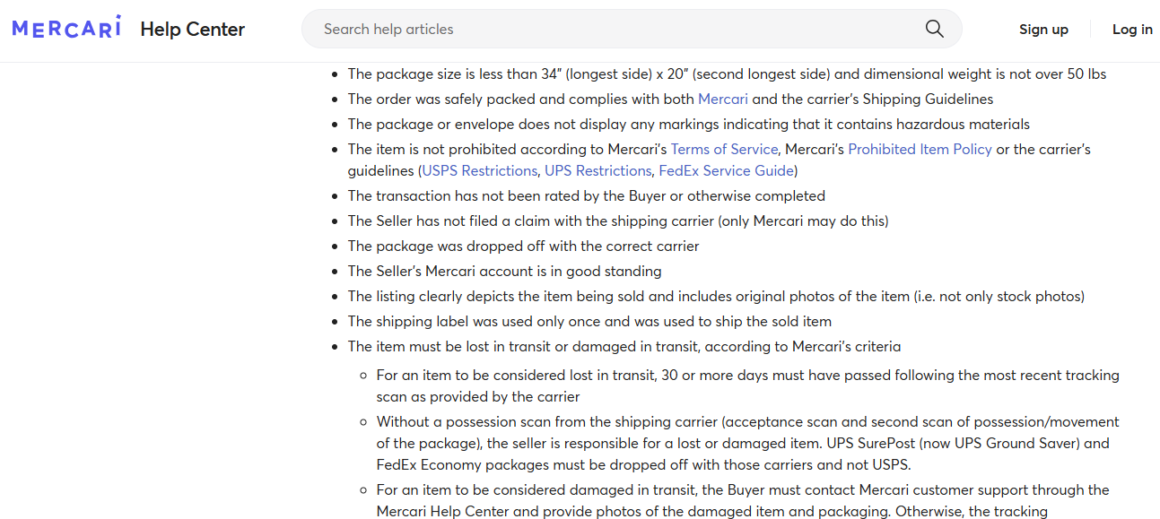
This means sellers are contractually prohibited from filing their own claim with UPS, USPS, or FedEx for a lost item shipped under a Mercari label. They must go through Mercari. And if Mercari denies the claim or deems the packaging insufficient, the seller has no independent avenue to recover the carrier’s liability.
Packaging Standards That Appear After the Fact
One of the most consistent complaint themes across Trustpilot, BBB filings, and PissedConsumer reviews involves sellers who followed Mercari’s packaging recommendations, had items damaged in transit, and were then told their packaging was “insufficient” in order to deny a shipping protection claim.
A BBB11 complaint filed in May 2026 described a seller who had photos proving their packaging met guidelines, yet Mercari refused to honor the shipping protection claim for a damaged item and stopped responding to messages entirely.
Another seller on SmartCustomer reviews12 wrote:
“I sold a fragile cosmetic product on Mercari, following their recommended packaging guidelines carefully. Despite this, the item was damaged during shipping. When I contacted Mercari for assistance, they refused reimbursement, stating that my packaging did not meet their standards, even though I followed the guidance. To make matters worse, the buyer was allowed to keep the damaged product.”
The pattern here is specific and worth naming. Mercari’s packaging guidelines are written in general terms. They advise appropriate cushioning, proper box sizing, and secure sealing. They do not specify, for instance, that fragile items require three inches of bubble wrap, but when a claim is denied, that can become the stated reason after the fact. The seller packaged the item in good faith according to the guidance they had. The platform then introduces a specific standard that was never communicated before the dispute. The claim is denied. The seller has no appeal path with the carrier because only Mercari can file those claims.
The Weight Dispute Trap
Several complaints across multiple platforms describe a variation of this experience that is worth examining separately: shipping weight fraud, or at least the appearance of it. Sellers report listing an item with the correct dimensions and weight, shipping it, having the item delivered successfully, and then receiving a notification that the carrier reported a different weight than what was listed, triggering an overage fee that is deducted from their payout, sometimes wiping it out entirely.
On ComplaintsBoard13, one seller described shipping a soft backpack cooler that weighed under four pounds, receiving a notification that the shipping cost $88 on a $35 cooler, and ending up with nothing from the sale. Another described being charged $95, $95, and $140 for luggage that was “light and properly shipped,” with Mercari refusing to release earnings even after successful delivery.
The challenge for sellers in these disputes is that once the carrier scans a package, Mercari treats the carrier’s reported weight as authoritative. The seller’s pre-shipment measurement is irrelevant. If there is a discrepancy, whether because of a scale error, a carrier scanning error, or dimensional weight calculations that sellers do not fully understand, the seller absorbs the cost. There is no independent weight verification mechanism available to sellers. They are trusting the carrier’s equipment and Mercari’s willingness to investigate discrepancies, and based on the complaint record, that trust is frequently misplaced.
Account Suspension Without Warning
There is a final layer to Mercari’s seller risk profile that affects not just individual transactions but entire seller accounts. Mercari can limit or close an account at any time for reasons that include “unusual behavior,” “suspicious activity,” or a high rate of cancellations and returns. Mercari’s own help documentation14 states that accounts may be limited when “an unusually high number of order cancellations” occur or when “Mercari receives high volumes of returns and/or chargebacks.”
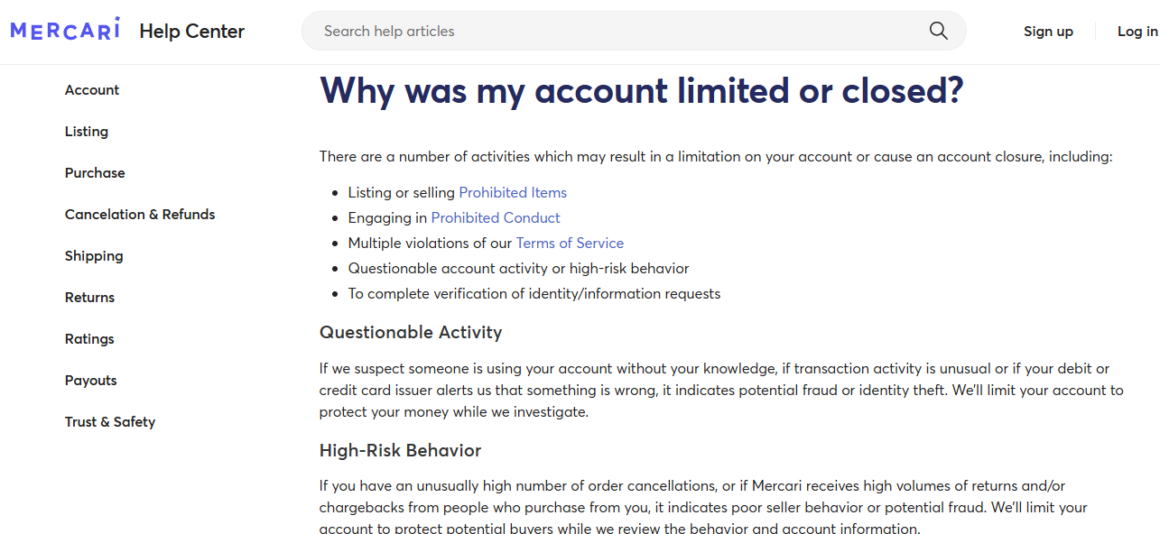
Here is the problem: a seller who is being targeted by return fraud, a seller who is being victimized, not perpetrating fraud, can accumulate exactly this kind of profile. Buyers file spurious returns. Mercari approves them. The return rate on the seller’s account rises. Mercari flags the account. The account is limited or suspended. The seller who was scammed now looks, from the outside of Mercari’s algorithmic perspective, like the bad actor.
When accounts are suspended, Mercari can hold funds for up to 180 days for permanently banned accounts. For sellers operating on thin margins or depending on platform income for essential expenses, that is not an abstract policy. One Trustpilot reviewer put it plainly:
“I depend on the money I earn from selling for groceries and bills. Mercari took that away with no accountability.”
Mercari’s BBB profile15 tells a damaging story. Over 5,500 complaints have been filed. The platform’s average customer review score on BBB sits at 1.16 out of 5. On Trustpilot16, the rating is 1.2 out of 5 from more than 20,000 reviews. App store ratings, which skew toward happy-path users who never encountered a dispute, run considerably higher. The gap between those two data sets is meaningful. When everything works, Mercari works well. When it does not, the experience is among the worst on any major resale platform.
What the Platform Gets Right, and What It Is Missing
None of this means Mercari is a fraudulent platform or that sellers should avoid it entirely. For low-value items, casual sellers, and transactions that go smoothly, which represents the majority of interactions, Mercari offers a genuinely simple experience, competitive fees after the January 2025 restructuring to a flat 10% seller fee, and meaningful shipping discounts. The platform’s prepaid labels offer roughly 40-54% savings compared to retail carrier rates, which is real money across dozens of monthly shipments.
The issue is not that Mercari fails routinely. The issue is that when it fails, it fails in ways that are structurally difficult for sellers to challenge, and the platform has built its dispute resolution framework with an asymmetry that consistently advantages buyers over sellers. That asymmetry is partly a deliberate business choice, Mercari competes for buyer attention in a market where Amazon has set the standard for frictionless returns, and partly a function of automated systems that are not sophisticated enough to detect fraud patterns before approving them.
What Mercari is missing is genuine parity. A dispute process where sellers can submit evidence that receives the same weight as a buyer’s claim. A shipping protection framework that does not cap at $200 for a platform where electronics listings routinely run three to ten times that amount. Packaging standards that are specific enough to give sellers genuine guidance before they ship, not vague enough to be weaponized against them in a denial. An authenticity review process that actually reviews authenticity before approving a return, not one that rubber-stamps claims because the platform lacks the staffing or infrastructure to investigate them.
The platform’s seller base is not asking for perfection. They are asking for a system that does not actively penalize them for being targeted by fraud, that pays out on protection that was sold to them, and that employs human reviewers capable of recognizing when a seller has done everything right and is still losing money.
Until that changes, the practical advice that sellers have assembled through hard experience on Reddit and forum threads is the most honest guidance available: video every packing session, use Mercari’s own labels for every shipment, never leave a balance sitting in the app, screenshot everything before and after a sale closes, and know the trigger words, “mail fraud,” “IC3 complaint,” that convert an automated ticket into a human review. None of that is in Mercari’s help center. It lives in the places sellers talk to each other when the platform has let them down.
That gap, between what the platform promises and what the community has had to build for itself, is the most honest measure of where Mercari’s seller protection actually stands.
Sources
- Mercari, www.mercari.com/us/help_center/article/235/. Accessed 30 June 2026. ↩︎
- Trustpilot, www.trustpilot.com/review/mercari.com. Accessed 30 June 2026. ↩︎
- Trustpilot, www.trustpilot.com/review/mercari.com. Accessed 30 June 2026. ↩︎
- Mercari, www.mercari.com/us/help_center/article/52/. Accessed 30 June 2026. ↩︎
- Mike. “Mercari Seller Protection: Does Mercari Protect Sellers?” Sidekick Tools, 8 Jan. 2026, poshsidekick.com/mercari-seller-protection/. Accessed 30 June 2026. ↩︎
- Mercari, www.mercari.com/us/help_center/topics/shipping/guides/shipping-for-sellers/. Accessed 30 June 2026. ↩︎
- Barkho, Gabriela. “Mercari reverses controversial return policy changes” 14 May 2024, www.modernretail.co/operations/mercari-reverses-controversial-return-policy-changes/. Accessed 30 June 2026. ↩︎
- “Mercari Reddit Guide: What the Community Really Says in 2026” CLOSO, 19 Jan. 2026, closo.co/blogs/blog/mercari-reddit-guide-what-the-community-really-says-in-2026. Accessed 30 June 2026. ↩︎
- Mouser, Anastasia. “Is Mercari legit? A guide to safe shopping and avoiding scams” 27 Mar. 2026, www.avast.com/c-is-mercari-legit. Accessed 30 June 2026. ↩︎
- Mercari, www.mercari.com/us/help_center/article/52/. Accessed 30 June 2026. ↩︎
- BBB, Better Business Bureau, www.bbb.org/us/ca/palo-alto/profile/online-retailer/mercari-inc-1216-895491/complaints. Accessed 30 June 2026. ↩︎
- “Mercari Reviews – 1.4 Stars” SmartCustomer, www.smartcustomer.com/reviews/mercari.com. Accessed 30 June 2026. ↩︎
- US, of. “Mercari Buyers And Sellers Reviews and Complaints” ComplaintsBoard, 17 July 2023, www.complaintsboard.com/mercari-b124550. Accessed 30 June 2026. ↩︎
- Mercari, www.mercari.com/us/help_center/article/162/. Accessed 30 June 2026. ↩︎
- BBB Better Business Bureau, www.bbb.org/us/ca/palo-alto/profile/online-retailer/mercari-inc-1216-895491/complaints. Accessed 30 June 2026. ↩︎
- Trustpilot, www.trustpilot.com/review/mercari.com. Accessed 30 June 2026. ↩︎