
An investigation into the platform’s notice-and-takedown machinery, wrongful removals, and the chilling effect on independent artists
There is a particular cruelty in the way the email arrives. No warning. No context. No named accuser. Just a notification that your work, something you drew, painted, or photographed from scratch, has been removed from Redbubble following an intellectual property complaint. The listing is gone. The sales are gone. And in some cases, so is your account.
This is not a hypothetical. It is the lived experience of thousands of independent artists who sell on Redbubble, the Australian-founded print-on-demand marketplace that powers over 800,000 independent creators selling designs on everything from stickers and phone cases to wall art and hoodies. The platform positions itself as a champion of the creative class. Redbubble’s1 own IP policy opens with a near-plea:
“Redbubble is a community built on respect and recognition of artists. We ask, rather we beg, that you remember this when you are posting work on Redbubble.”
The language is warm. The reality, for many creators, is not.
What follows is a close look at the mechanics of Redbubble’s IP strike system. How it works, where it breaks down, who benefits from the breakdowns, and why the artists who rely on the platform have so little recourse when the system gets it wrong.
How the Machine Works
Redbubble’s enforcement architecture rests on the foundations laid by the Digital Millennium Copyright Act (DMCA)2, a 1998 US law that established the “notice-and-takedown” framework used across the internet. The basic deal is simple. Copyright holders or their authorized representatives can file takedown notices with platforms. Platforms that comply in good faith earn safe harbor protections from liability for their users’ potential infringement. If a targeted creator disagrees, they can file a counter-notice. The system was designed to balance two legitimate interests. Protecting rights holders and protecting creators from over-reach.
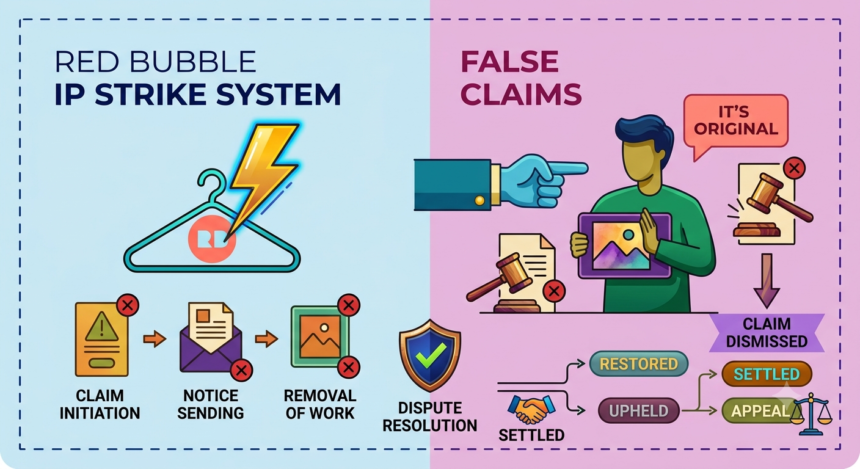
On Redbubble, the process mirrors this structure closely. A rights holder or authorized agent identifies a listing they believe infringes their copyright, trademark, or publicity rights, then submits a Notice and Takedown Report to Redbubble. The platform’s Content Team evaluates whether the notice is legally valid. If it is, the work comes down. The seller receives an email notification. They can then submit a counter-notice disputing the claim, at which point the original complainant has 14 days to initiate legal action before Redbubble may reinstate the work.
In theory, this is fair. In practice, it has significant structural problems that consistently harm legitimate artists.
The first is speed asymmetry. Redbubble typically processes takedown notices within one to three business days. Reinstatement through the counter-notice path takes a minimum of 14 days, the statutory waiting period for the claimant to file a lawsuit, assuming everything goes smoothly. For an artist who earns income from a listing, this asymmetry matters. The work is gone in days. Getting it back takes weeks, at best.
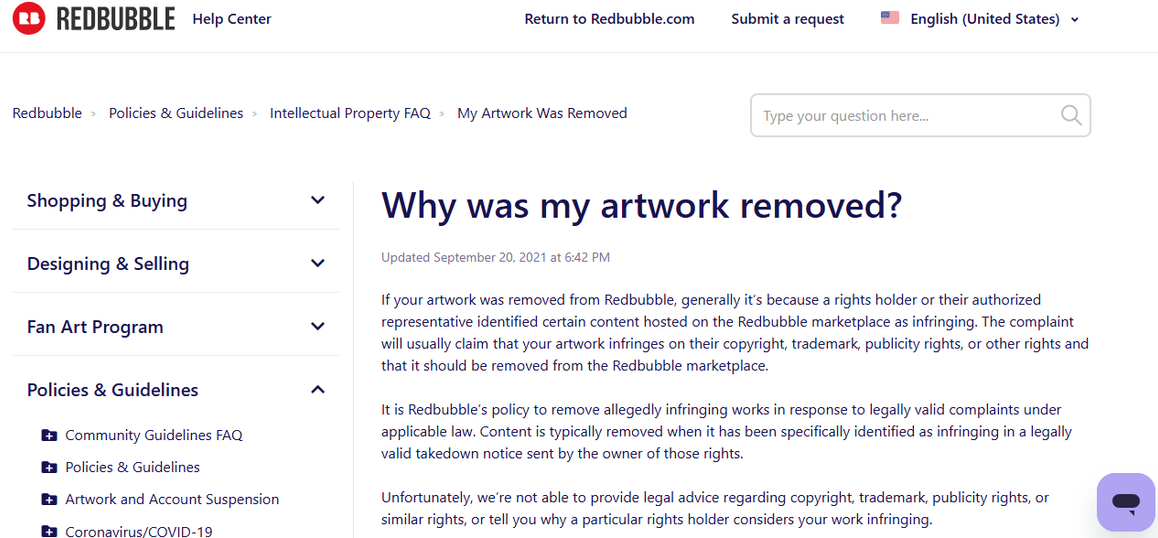
The second problem is opacity. When a work is removed, Redbubble sends an email stating that the listed item has been taken down in response to a complaint. What it does not do, as a matter of policy, is explain precisely what the claimed infringement is. Redbubble’s own help documentation3 acknowledges this plainly: “Unfortunately, we’re not able to provide legal advice regarding copyright, trademark, publicity rights, or similar rights, or tell you why a particular rights holder considers your work infringing.” An artist is told their work is gone. They are not told why. They are pointed toward the counter-notice process and advised to consult an IP attorney.
The third structural problem is cost. Filing a counter-notice requires the artist to consent to the jurisdiction of the Federal District Court in San Francisco and agree to accept service of process from the original complainant. This is not a trivial step. It exposes the artist to potential litigation from whoever filed the complaint. For a freelance illustrator making a few hundred dollars a month from sticker sales, the prospect of being served papers by a corporate IP firm is a meaningful deterrent. Many artists swallow the loss and move on rather than risk it.
The Numbers Behind the Platform
To understand why this matters, it helps to understand Redbubble’s scale and its relationship with its artist community. The platform, now operating under the parent company Articore Group and listed on the Australian Securities Exchange, reported marketplace revenue of $241.3 million for its 2024 financial year, even after a 17 percent revenue decline driven by changes in its paid marketing strategy. The company has been actively restructuring, cutting operating expenses by 35 percent and introducing artist account tiers, in a drive toward profitability.
According to ECBD4, Redbubble.com generated approximately $140 million in revenue in 2025, with over 15 million sessions recorded in March 2026 alone. In that same month, the platform processed roughly 246,000 transactions. These are not small numbers. This is an infrastructure that hundreds of thousands of artists depend on, many of them earning income that competes with, or exceeds, what they make elsewhere.
The IP strike system sits at the intersection of all of this. Redbubble’s safe harbor protections under the DMCA depend on its willingness to act swiftly on takedown notices. The faster the platform removes flagged content, the more legally protected it is. That creates a structural incentive that does not favor independent artists. Speed-of-removal protects Redbubble. Accuracy-of-removal protects artists. These are not the same thing.
The Anatomy of a False Claim
The most instructive window into the dysfunction of this system comes from looking at it at scale. When Atari filed IP complaints against Redbubble in 2018 over merchandise it alleged stole imagery from classic games like Pong and Asteroids, Redbubble acted fast. According to Lowe Law5, the platform removed 2,915 listings within 24 hours. That is a significant response by any measure. It also turned out that the vast majority of those removals were wrong. More than 90 percent of the flagged listings were later restored after artists demonstrated that their artwork bore no relation to Atari’s trademarks or copyrights.
Let that sink in. A single corporate complaint, filed under the DMCA’s good-faith standard, produced nearly 2,700 incorrect removals of artists’ legitimate work. The artists whose listings were erroneously taken down had two options: wait out a weeks-long counter-notice process or simply lose the sale while the platform sorted out its liability calculus. Atari’s lawsuit against Redbubble ultimately went to trial and a jury found, in November 2021, that Redbubble had not infringed any of Atari’s intellectual property. Not trademark, not copyright, not in any form. The legal system vindicated Redbubble and, by extension, its artists. But it did so years after the damage had been done.
This is what corporate IP enforcement looks like on print-on-demand platforms. Rights holders submit broad notices targeting keywords, image characteristics, or thematic resemblances to their intellectual property. Platforms like Redbubble, motivated by their own legal exposure, remove everything named in the notice. Legitimate artists, people who drew a mermaid that is not Ariel, painted a robot that is not an Atari character, or designed text art that happens to use a contested phrase, find their work gone without a specific explanation of what they supposedly violated.
Consider a case documented on DeviantArt6 forums where an artist received a takedown notice citing The Walt Disney Company as the complainant over a design titled
“Digital Pin Up Literature — The Little Mermaid.” Disney does not have a copyright on mermaids. Hans Christian Andersen’s story long predates any Disney trademark. The artist wrote:
“Disney certainly do not have a monopoly on mermaids, and she isn’t Ariel.”
After emailing Redbubble and receiving no initial response, they ultimately got the design reinstated following persistent follow-up. Redbubble apologized for “the confusion.” The design was back up. But the artist’s time was lost, the sales were lost, and the experience was a net discouragement from continuing to create.
The Counter-Notice Trap
Redbubble’s7 counter-notice process is the system’s official remedy for wrongful removals. The platform’s documentation frames it as a “right of reply” — a formal opportunity to dispute a takedown. Under US law, a counter-notice must include the artist’s personal contact information, a statement made under penalty of perjury that the material was removed by mistake, and consent to the jurisdiction of the federal courts. Redbubble then forwards this counter-notice, including all personal details, to the original complainant.
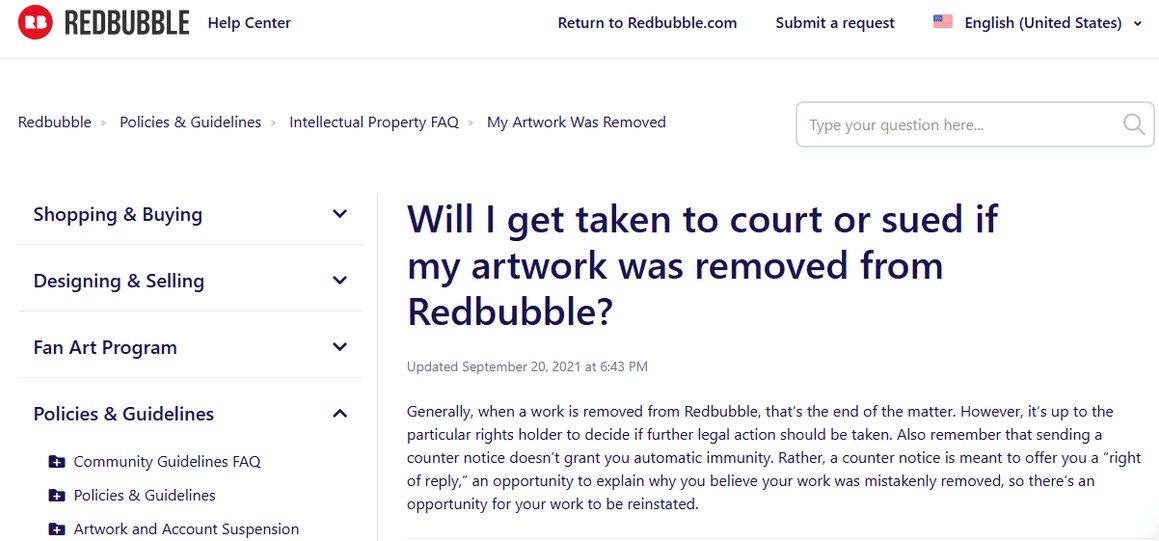
At that point, the complainant has 14 days to file a lawsuit. If they do not, Redbubble may reinstate the work. If they do, the artist is now a defendant in federal court.
Most independent artists on Redbubble are sole traders. Many are not based in the United States. The idea of being dragged into US federal litigation over a mermaid sticker or an original watercolor of a wolf is not theoretical. It is a genuine legal exposure. The counter-notice process was designed as a consumer protection. In practice, for many artists, it functions as a chilling mechanism. The legal risk of asserting your rights exceeds the financial value of the listing you lost. Corporations understand this. The economics of IP intimidation depend on it.
Under Section 512(f) of the DMCA, any person who knowingly makes material misrepresentations in a takedown notice can be held liable for damages, including costs and attorneys’ fees incurred by the artist or the platform. This provision exists precisely to deter bad-faith or negligent takedowns. But its application is constrained. Courts have generally required evidence of actual knowledge or willful blindness of falsity. A company that sends a bulk takedown notice covering thousands of listings and gets 90 percent of them wrong may still avoid 512(f) liability if it can credibly claim it acted in good faith, even negligently. The bar for accountability is high enough that many false claimants face no meaningful consequence.
The Rise of Automated Brand Protection
One of the least-discussed forces shaping this environment is the brand protection software industry. Companies like Red Points and MarqVision sell automated tools that scan platforms like Redbubble for potential infringement and submit takedown notices on behalf of rights holders at scale. Their selling proposition is efficiency. Their pitch to corporate clients is that the volume of infringement on print-on-demand marketplaces demands an automated response.
This is not inherently wrong. Genuine infringement on Redbubble is real. Bad actors do upload copyrighted characters, stolen logo designs, and lifted artwork. The problem is that automated systems do not draw distinctions well. A keyword match is not the same as copyright analysis. A visual similarity score is not the same as legal infringement determination. When an algorithm flags 3,000 listings in a sweep targeting a single brand’s assets, the resulting takedown notice may include legitimate original art that merely shares a visual style, a color palette, a genre, or a thematic territory with the protected property.
The DMCA requires claimants to include a statement that they have a good faith belief the use is not authorized. As the Ninth Circuit ruled in the landmark Lenz case, this good faith standard requires rights holders to consider fair use before sending a takedown notice, not merely to assert ownership. But when the entity submitting the notice is an algorithm authorized by a corporate rights holder, who performs the fair use analysis? The answer, in many cases, is nobody. The software sends the notice. The platform removes the work. The artist wakes up to an email.
Perkins Coie’s8 legal analysis of recent DMCA decisions makes clear that failing to conduct this evaluation before submitting a takedown notice creates liability exposure for the claimant — but the legal risk sits in the background while the practical damage to artists happens in real time.
The Repeat Infringer Problem
Redbubble’s response to accumulated IP strikes is layered. A single takedown notice removes a listing. Multiple notices against the same account can trigger a “restriction” — a temporary hold that prevents all works from being sold while the artist reviews their account. Further strikes, or a pattern deemed sufficiently egregious, can lead to permanent account termination under what Redbubble9 calls its Repeat Infringer Policy.
The platform states explicitly that accounts “will be subject to account-level action under our repeat infringer policy… up to and including immediate and permanent disablement of the account.” This is Redbubble’s obligation under US copyright law, which requires platforms seeking safe harbor protection to terminate “repeat infringers” in appropriate circumstances. The problem is that “repeat infringement” and “repeat false claims” can look identical from the outside. If an automated brand protection tool files three separate notices against an artist’s account, all three erroneous, the account may still face escalating penalties under the repeat infringer framework.
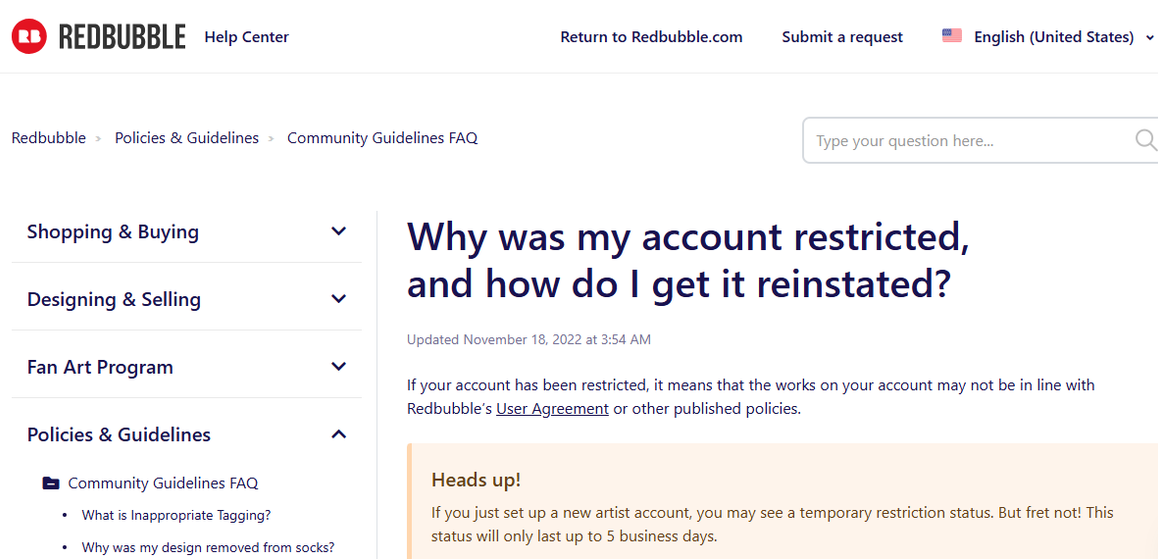
When an account is restricted, Redbubble’s10 guidance tells the artist to review their content and remove anything that might be in violation of guidelines. The platform acknowledges it cannot tell the artist which specific works are problematic. It recommends erring on the side of caution and removing anything uncertain. The effect of this advice, applied to an artist who has done nothing wrong, is self-censorship driven by legal anxiety. The platform’s own process asks innocent creators to police themselves in the absence of any clear indication of what they are supposed to have done.
Artist Brian11 in April 2024 wrote:
“I actually have no idea with this one, the list of possibilities above is too broad and they haven’t reached out with anything else… This is more a concern for anyone else that might be more reliant on the space for sales and their income — Redbubble can suspend your account for whatever reason.”
The account had been inactive for years. The artist had never received any specific complaint or explanation. They were simply suspended, asked to submit an appeal that included a photograph of their face, and left to guess at what rule they had broken.
The Platform’s Position and Its Limits
To be fair about this requires acknowledging what Redbubble actually does right. The platform does maintain a formal counter-notice process. It does communicate that removed listings are not confirmed infringements. It does state clearly that it “may” reinstate work after a successful counter-notice, that it does not investigate similarities in works beyond those specifically named in a notice, and that it has a legal obligation to act on valid reports regardless of whether the work is actually infringing. Redbubble’s12 policy acknowledges directly: “by removing the work, we are not stating that your work does or does not infringe copyright, trademark or publicity rights law.”
That is more honest than many platforms. But honesty about a structural problem is not the same as fixing it.
The deeper issue is incentive alignment. Redbubble’s path to DMCA safe harbor protection runs through speed of compliance with takedown notices. Its legal risk from wrongful removals is comparatively lower, because 512(f) claims against platforms are rare and damages in wrongful removal cases are modest. The artists whose legitimate work is taken down have limited recourse and limited resources to pursue it. Brand protection companies operate at scale with automated tools. The economics favor broad, fast removal over careful, accurate enforcement.
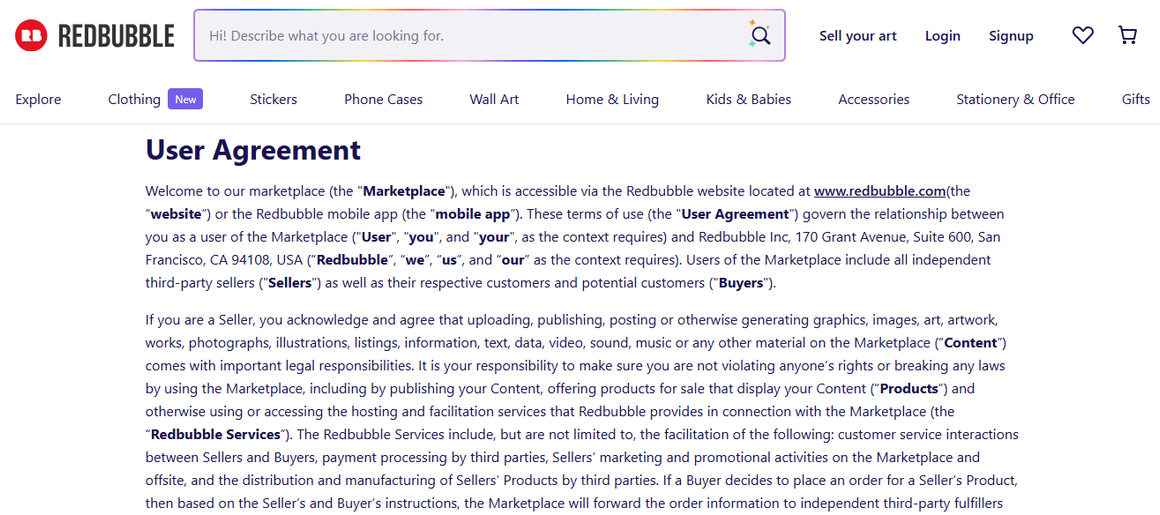
Redbubble’s user agreement13 contains a particularly blunt line:
“Access to the Marketplace and any Content including, but not limited to, account usernames and Product listing pages, may be limited or terminated at any time by us without notice for any reason in our sole discretion.”
This is standard boilerplate across most platforms. It is also a declaration that the platform reserves the right to remove an artist’s income-generating asset without explanation. The contract that governs every seller’s relationship with Redbubble places ultimate discretion with the platform. Artists who build revenue on Redbubble build on sand.
What Needs to Change
The DMCA’s notice-and-takedown system is nearly 30 years old. It was designed for a world with dial-up internet and a handful of major rights holders. The US Copyright Office has repeatedly flagged concerns about the abuse of the system, particularly about the adequacy of Section 512(f) as a deterrent against bad-faith or negligent takedowns. The Office has called for Congress to monitor the current standards and consider clarifying the knowledge requirements for misrepresentation liability. That conversation has been ongoing for years without producing meaningful reform.
In the absence of legislative change, platforms like Redbubble bear a responsibility that their legal team will always define as narrowly as possible. There are concrete improvements that would help artists.
Requiring complainants to identify the specific element of a design that is allegedly infringing, not just flag a listing, would force more careful review before submission. Requiring automated brand protection tools to certify human review of individual listings before submitting notices would reduce the volume of algorithmic over-removal. Establishing a maximum reinstatement timeline, not a 14-day minimum, would reduce the income loss artists absorb while waiting. Providing artists with the name and contact information of the complainant at the time of removal, not only upon filing a counter-notice, would give them more information to assess whether a dispute is worth pursuing.
None of these changes would eliminate IP infringement on the platform. Genuine infringement is real, and Redbubble hosts millions of listings that do steal from rights holders. What these changes would do is restore some balance to a system that currently treats the artist as a disposable variable in a legal compliance equation.
There is a number floating in the background of every conversation about Redbubble’s IP system, and it is worth naming. When Atari filed its mass takedown, the one that swept in 2,915 listings, over 90 percent of which were later confirmed non-infringing, those listings represented approximately $215,000 in potential product sales, according to Redbubble’s own testimony. That is $215,000 in potential revenue flowing to thousands of individual artists, artists who had created original work and were doing nothing wrong.
Atari lost at trial. The jury found no infringement. But the artists who lost weeks of sales during the takedown period did not get compensation. Nobody asked them to testify. Nobody assessed their damages. The platform that removed their work faced no penalty. The company that filed the notices over-broadly faced no 512(f) claim. The legal system vindicated the outcome in the abstract. The artists absorbed the cost in practice.
I keep returning to a line from Redbubble’s IP policy. The company states that it acts on reports that “may or may not have also included other works by other artists.” That quiet phrase, “may or may not,” contains a small universe of harm. It means that a single takedown notice can name dozens of unrelated artists in a single batch filing, and every one of them can lose their work the same day, for the same unstated reason, with the same non-explanation. The platform knows this happens. It acknowledges it in policy language. It proceeds anyway.
That is not a design flaw. It is a design choice. And the people who pay for it are the artists that Redbubble, in the same breath, asks us to remember it was built to serve.
Sources
- Redbubble, help.redbubble.com/hc/en-us/articles/201579195-Redbubble-IP-Publicity-Rights-Policy. Accessed 28 June 2026. ↩︎
- “The Digital Millennium Copyright Act” U.S. Copyright Office, www.copyright.gov/dmca/. Accessed 28 June 2026. ↩︎
- Redbubble, help.redbubble.com/hc/en-us/articles/360052267711-Why-was-my-artwork-removed. Accessed 25 Aug. 2026. ↩︎
- “E-Commerce Data & Analytics Based on Billions of Transactions” ecdb.com/resources/sample-data/retailer/redbubble. Accessed 25 Aug. 2026. ↩︎
- Lowe Law, lowelaw.com/redbubble-defeats-ataris-trademark-and-copyright-infringement-claims/. Accessed 25 Aug. 2026. ↩︎
- “DeviantArt” The Largest Online Art Gallery and Community, www.deviantart.com/forum/community/complaints/2127069. Accessed 25 Aug. 2026. ↩︎
- Redbubble, help.redbubble.com/hc/en-us/articles/360039131592-Will-I-get-taken-to-court-or-sued-if-my-artwork-was-removed-from-Redbubble. Accessed 25 Aug. 2026. ↩︎
- Perkin Scoie, perkinscoie.com/insights/article/district-court-decision-indicates-liability-erroneous-dmca-takedowns. Accessed 25 Aug. 2026. ↩︎
- Redbubble, help.redbubble.com/hc/en-us/articles/201579195-Redbubble-IP-Publicity-Rights-Policy. Accessed 26 Aug. 2026. ↩︎
- Redbubble, help.redbubble.com/hc/en-us/articles/360051811312-Why-was-my-account-restricted-and-how-do-I-get-it-reinstated. Accessed 26 Aug. 2026. ↩︎
- Brian. ““Your Redbubble account has been suspended”” Brian’s Blog, 10 Apr. 2024, bmhonline.wordpress.com/2024/04/10/your-redbubble-account-has-been-suspended/. Accessed 26 Aug. 2026. ↩︎
- Redbubble, help.redbubble.com/hc/en-us/articles/201579195-Redbubble-IP-Publicity-Rights-Policy. Accessed 26 Aug. 2026. ↩︎
- Redbubble, www.redbubble.com/agreement. Accessed 26 Aug. 2026. ↩︎