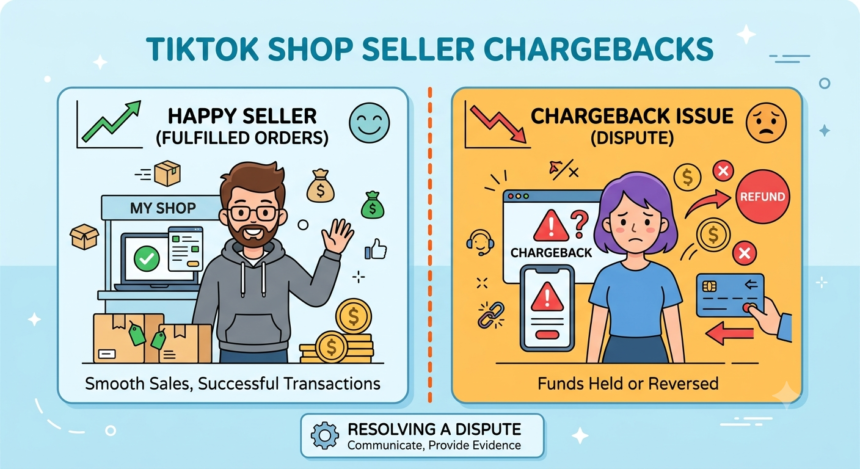

I started looking into TikTok Shop chargebacks because of a sentence I kept finding, in slightly different forms, across forums, comment sections, and TikTok’s own discover page. A seller would write something like it. The platform took the money back, gave me five days to prove I didn’t deserve it, and charged me ten dollars for the privilege of asking. I read that sentence so many times it stopped sounding like a complaint and started sounding like a policy.
- What a Chargeback Actually Is, and Why TikTok’s Version Bites Harder
- Five Days, Ten Dollars, and a Process You Don’t Control
- The Clock Nobody Can Beat
- “Aftersales Disputes”: A Second System, Designed to Lose
- What Sellers Are Actually Saying
- The Business That’s Grown Up Around the Problem
- A Margin Already Too Thin to Absorb This
TikTok Shop is no longer a side hustle for teenagers selling phone cases. According to SQ Magazine1, it generated $66 billion in global gross merchandise value in 2025 and is projected to reach $112.2 billion in 2026. In the United States alone, sales grew 108% year over year to $15.82 billion, and the seller base exploded from 4,450 shops in mid-2023 to 475,000 by 2026, a roughly 5,000% increase. That is not organic growth. That is a gold rush, the kind that pulls in people who have never run a business before and convinces them that a phone and a credit card processor is all they need.
What nobody tells those people, until it happens to them, is that the gold rush has a tollbooth on the way out. It is called a chargeback, and on TikTok Shop it behaves less like a normal cost of doing business and more like a tax collected at gunpoint, with the seller required to fund their own defense.
What a Chargeback Actually Is, and Why TikTok’s Version Bites Harder
A chargeback happens when a customer goes around the merchant entirely and asks their bank to claw the money back. A chargeback occurs when a customer disputes a transaction and requests a refund directly from their financial institution or card issuer. It is a tool built for fraud protection. It has become, across e-commerce broadly, a tool for something else entirely.
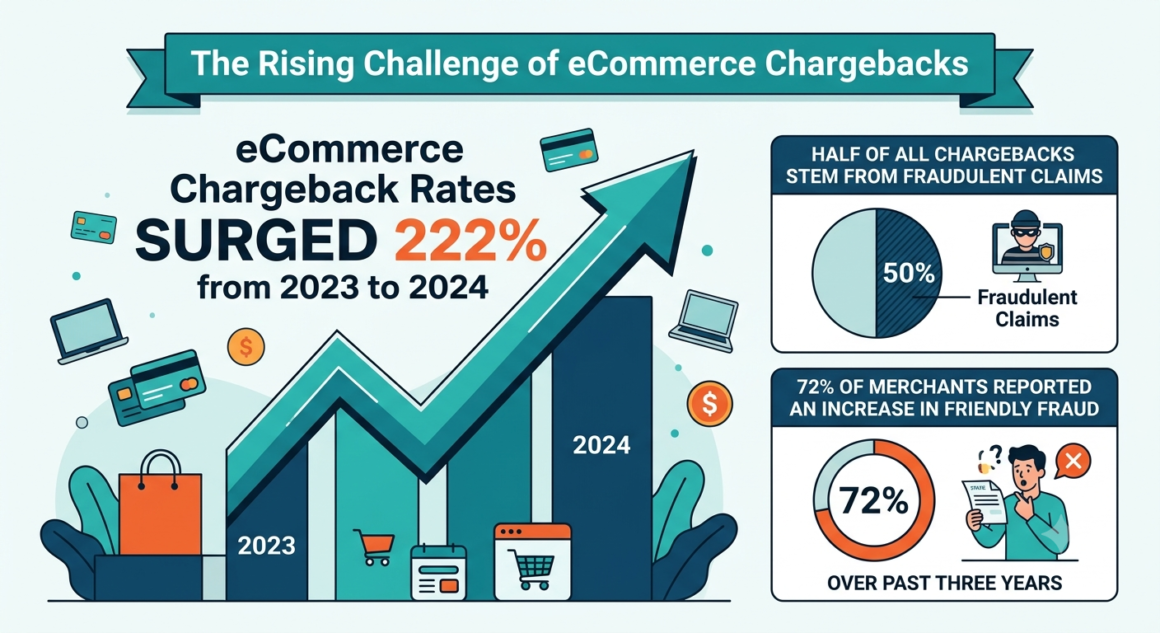
The numbers on that something else are stark. Friendly fraud, meaning legitimate purchases disputed anyway by the customer, makes up nearly 80% of chargebacks. According to Swell2, eCommerce chargeback rates surged 222% from 2023 to 2024. Over half of all chargebacks stem from fraudulent claims, and 72% of merchants have reported an increase in friendly fraud over the past three years. Friendly fraud is a strange phrase. There is nothing friendly about it. A customer buys something, uses it, decides she does not want to pay, and calls her bank instead of the seller. The bank sides with her almost by default, because banks keep customers and lose nothing when a merchant eats the cost.
For every $1 lost to chargebacks, merchants lose an average of $3.75 in revenue, once you count the fees, the lost merchandise, and the labor of fighting back.
That math was already brutal before TikTok Shop entered the picture. What TikTok Shop adds is a fee structure that makes losing cheaper for the platform and more expensive for the seller, and a dispute system that runs on TikTok’s clock, not the seller’s.
Five Days, Ten Dollars, and a Process You Don’t Control
Here is how it works, according to TikTok’s own seller documentation. When a customer disputes a charge, TikTok3 Shop’s third-party payment processor contacts TikTok Shop and asks for details about the transaction. The seller then has a narrow window to respond. To appeal a chargeback, sellers must respond in Seller Center within seven calendar days of the chargeback notification. Miss it, and TikTok Shop may appeal the chargeback on the seller’s behalf using whatever evidence is available to it, which is a polite way of saying the company will mount a halfhearted defense using whatever scraps it has lying around, on your behalf, without you.
Then there is the fee. Appealing a chargeback requires representation that costs $10 per chargeback, plus any additional state or local taxes. That fee is not contingent on winning. Because TikTok Shop does not have any control over the chargeback appeal, the appealed chargeback fee will be collected regardless of the outcome of TikTok Shop’s appeal representation. Read that twice. The seller pays ten dollars to fight, and pays it whether they win or lose. If they lose, TikTok Shop charges the seller account the full amount of the chargeback on top of that fee. The only way to avoid the fee entirely is if the bank itself labels the dispute “unauthorized payment,” in which case the seller is not charged an appeal fee and TikTok Shop does not collect the chargeback amount. Everything else, every dispute over a late package, a damaged item, a customer who simply changed her mind, lands on the seller’s desk with a ten-dollar cover charge and a coin flip attached.
I want to be fair here. Chargeback appeals taking time, and platforms charging some fee for processing, is not unusual in payments. What is unusual is stacking that fee on top of a system where, as I’ll get to, the seller is already on the hook for return shipping, restocking, and inventory loss in disputes that have nothing to do with chargebacks at all. TikTok Shop has built two separate machines for taking money away from sellers after a sale closes. The chargeback system is one. The “aftersales dispute” system, which I’ll come to, is the other, and it is arguably worse.
The Clock Nobody Can Beat
The appeal itself can drag for months. According to SPS Commerce4, chargeback appeals can take up to 90 days to process from the date of the initial chargeback notification. Ninety days is a long time to have money sitting in limbo if you’re a small operation buying inventory on thin margins. It’s an even longer time if, as is common for new TikTok Shop sellers, your account is already under a reserve.
PPC Land5 states that TikTok keeps a rolling reserve, holding a portion of seller payouts for around 30 days, to cover refunds, chargebacks, or disputes if sellers do not fulfill orders. That reserve sits on top of standard settlement delays. The standard settlement timeframe is 7 days after an order is delivered, though better performance can mean faster settlements while poor performance translates to longer settlement times, a structure TikTok calls Dynamic Settlement. In other words, the very sellers most likely to be drowning in disputes, the ones with thin margins, slow shipping, or quality control problems, are also the sellers TikTok slows payments to the most. It’s a flywheel, and it spins in one direction.
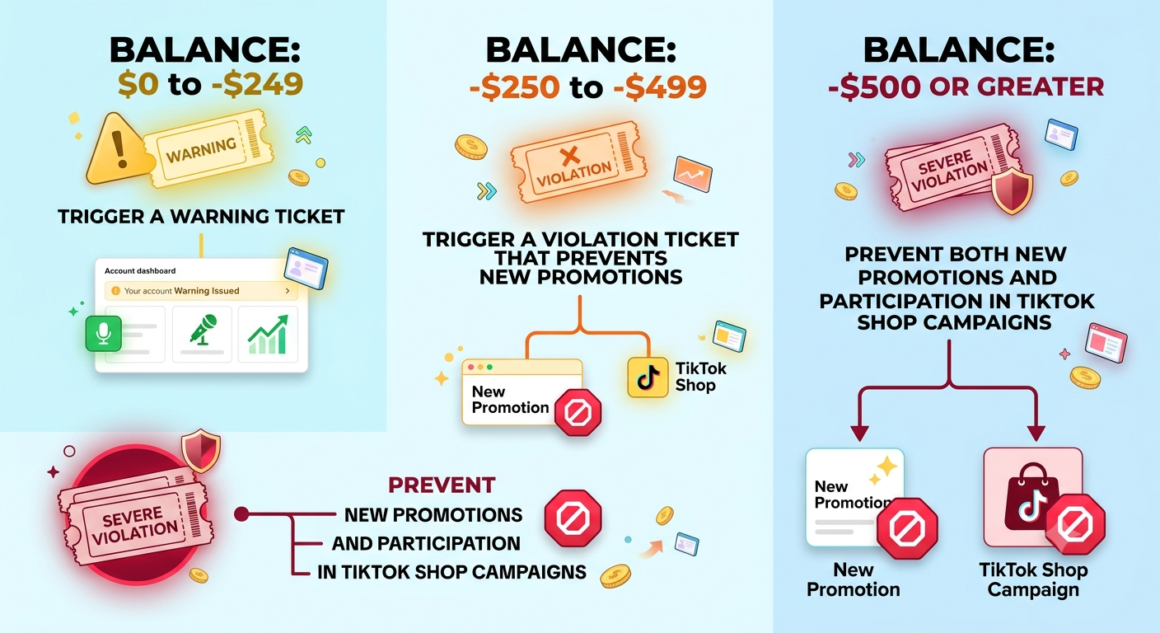
If the math runs against a seller and their account balance dips below zero, the consequences escalate by tier. Balances from below $0 to -$249 trigger a warning ticket. Balances from -$250 to -$499 trigger a violation ticket that prevents new promotions. Balances of -$500 or greater prevent both new promotions and participation in TikTok Shop campaigns.
Beyond that, enforcement actions can include deferred settlements, fund deductions, withholding balances, and even account deactivation. And if TikTok decides, at its sole discretion, that an account engaged in anything it considers deceptive or abusive, the consequences stop being temporary. The seller’s funds may be temporarily withheld for 45, 90, or 365 days, and TikTok reserves the right to permanently withhold some or all funds, including platform-funded incentives previously provided to the seller within the past 365 days. Read that last clause again. TikTok can claw back marketing subsidies it gave you a year ago, after the fact, if it later decides your account crossed a line it alone defines.
“Aftersales Disputes”: A Second System, Designed to Lose
Chargebacks at least involve a bank, an outside party with its own incentives and its own (admittedly imperfect) rules. TikTok Shop’s “aftersales dispute” process has no outside party at all. It is TikTok investigating a complaint against TikTok’s own seller, on TikTok’s own platform, with TikTok as judge.
The rules read fair on paper. Tiktok6 states that their rellers must respond within 4 business days to a return or refund request. If approved, the seller must process the refund or replacement. If the seller does not respond within 4 business days, the request is automatically approved. That last sentence is the trap. No response means automatic loss. Compare that to the seller’s appeal deadline elsewhere: If a seller fails to submit evidence within 24 hours of a dispute being escalated, TikTok Shop will make a decision based only on the customer’s materials. This almost always results in a ruling for the customer. Twenty-four hours. Not seven days. Not thirty. One day, and the system tells you in its own documentation that missing it almost always means you lose.
Lose, and the bill is comprehensive. Sellers must refund the full cost of the product, and in most cases, both the original and return shipping fees. If the customer never sends the item back, that’s still the seller’s problem in most circumstances. You must provide a correct, accessible return warehouse address. If the address is wrong and the item is lost, you bear the loss. You are responsible for any damage or loss during return shipping in most seller-fault cases. This means you must issue a refund even if the returned item never arrives. A seller can do everything right, the customer can be the one who botches the return, and the seller still pays for a product they will never see again.
Even winning a dispute doesn’t end it cleanly. If the decision goes against the seller, they must follow the judgment within those hours or face deductions from their payments, which may involve refunds, replacements, or sending additional products, and they might need to cover shipping costs. Compare that to the buyer’s obligations: customers may be required to return the product, but if the product is unsuitable for return, such as counterfeit, lost, customized, or fully damaged, a refund may be processed without return at all. The framework is built so that nearly every category of ambiguity resolves toward the customer keeping both the product and the money.
What Sellers Are Actually Saying
I went looking for sellers talking about this in their own words, not in TikTok’s policy language but in the comment sections and short videos where they vent because nobody at the company answers their tickets. The tone across them is consistent: exhaustion mixed with something close to disbelief that the math works the way it does.
One small apparel seller at Tiktok7, fed up with the per-return fee structure, wrote that going forward she would handle disputes privately rather than through TikTok’s system at all.
“From now with TikTok orders if anything is wrong I’m going to put my email & number in the orders and people can message me privately for a return & refund. I cannot be paying £8.50 per return for these £1 items!”
That is a seller calculating that TikTok’s own dispute infrastructure costs more than the products it’s supposed to protect.
Another, replying to a customer who’d asked about a complicated chargeback case, admitted the system caught her off guard in a way that should worry anyone trusting TikTok’s refund flow.
“This was the most challenging for sure! I had no idea you could place a chargeback even though I issued a refund!”
A refund and a chargeback are supposed to be mutually exclusive resolutions to the same problem. On TikTok Shop, apparently, a customer can collect both.
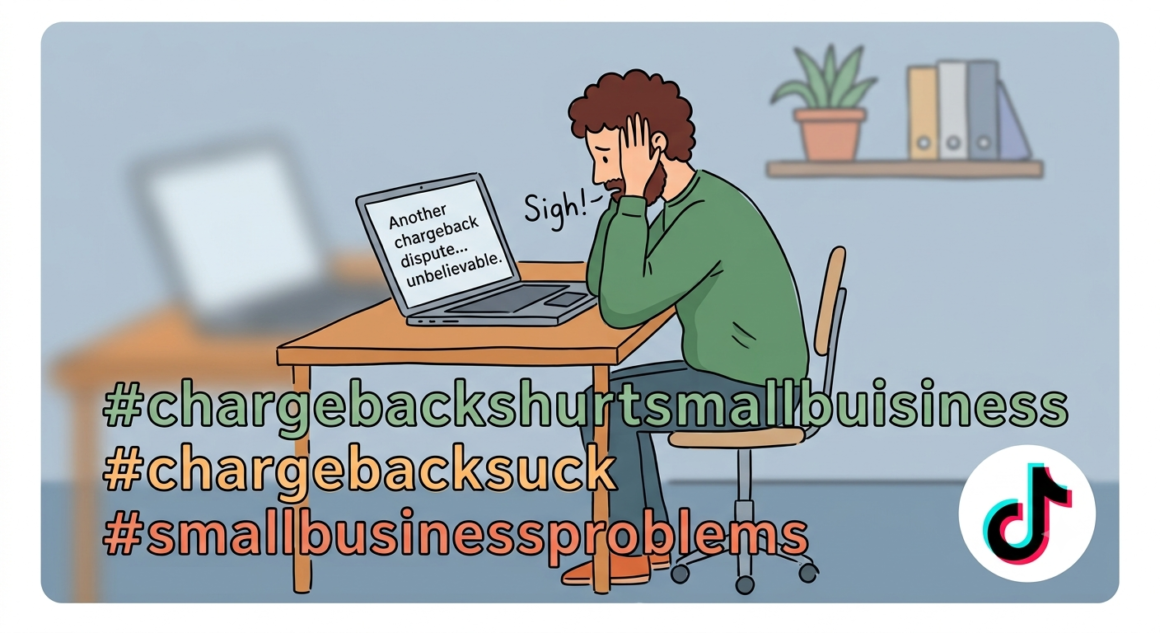
The frustration shows up in the hashtags as much as the words. Sellers have built an entire shorthand around it: #chargebackshurtsmallbuisiness (the misspelling has stuck around long enough to become its own tag), #chargebacksuck, #smallbusinessproblems. One small business owner, while tagging her video #chargebacks #chargebackshurtsmallbuisiness #smallbusiness #scams, posted,
“if youre a small business owner you’ll relate to everything im saying,”
Another simply wrote,
“Stop playing with our businesses.”
A third, gearing up for an appeal, posted, “I’m more then prepared to fight this battle,” under the same #chargebackshurtsmallbuisiness tag, which by now reads less like a hashtag and more like a support group.
Even on the buyer side, the frustration runs the other direction and reveals how chaotic the dispute experience is for everyone involved. One buyer complained about a charge they never authorized, writing in frustration about TikTok’s support, “like take my money out for sum i didn’t even order real quick but tryin to get a human to handle the situation /cancel and get a refund virtually impossible fix this now do better tiktok.” If buyers can’t reach a human either, it tells you something about who actually adjudicates these disputes. Mostly, it seems, nobody does. An algorithm reads timestamps and missing responses and rules accordingly.
The Business That’s Grown Up Around the Problem
Where there’s a recurring financial wound, someone builds a bandage and sells it. An entire cottage industry has formed around TikTok Shop chargebacks, which is itself a kind of evidence. Chargeback recovery firms now market specifically to TikTok sellers, promising to automate appeals and recapture revenue the platform’s own process makes hard to recapture. One such company advertises that it can “stop friendly fraud, block digital shoplifters & prevent the next chargeback before it happens,” with a guaranteed return multiple on recovered funds. Financing companies have pivoted too, offering revenue-based loans specifically pitched as a cushion against TikTok Shop chargeback delays, because disputes often take weeks or months to resolve, all while sellers still need to pay for inventory, marketing, and other operating expenses.
None of this is illegal or even unusual by the standards of e-commerce generally. Amazon sellers have dealt with similar predatory return economics for years. What’s notable about TikTok Shop is the speed at which the problem scaled alongside the platform itself. The seller base went from under five thousand shops to nearly half a million in roughly two years. The infrastructure to protect those sellers, by contrast, reads like it was written for a much smaller, slower platform and never substantially rebuilt.
A Margin Already Too Thin to Absorb This
The deeper problem is that TikTok Shop sellers were never operating with much cushion to begin with. Customcy8 found that the average active US TikTok Shop seller nets approximately $690 per month on $3,750 in sales, an 18.4% net margin after platform fees, creator commissions, fulfillment, returns, and ad spend. That is not a typo. Six hundred ninety dollars. A single contested fifty-dollar order, multiplied by a ten-dollar appeal fee and a lost product that never makes it back to the warehouse, can wipe out a meaningful slice of a month’s profit for a seller running at that scale.
And the fee structure keeps tightening around them. According to Dashboardly9, since independent shipping ended on March 31, 2026, TikTok’s Fulfilled by TikTok program is effectively mandatory for most sellers, charging $2.86 to $3.58 per unit. Return shipping costs cut further into margin based on a seller’s performance score: return shipping costs the seller 20% of the return shipping fee if their Shop Performance Score is 4 or above, and 50% if below 4, making the Shop Rating directly tied to margin. A bad month of chargebacks doesn’t just cost money directly. It drags down the performance score that determines how much every future return will cost too. The system punishes you twice for the same mistake, once in the moment and again in every transaction afterward.
Meanwhile, Branvas10 reports that more than half of the 475,000 registered US shops recorded zero sales, and only about 2,000 stores in the US exceeded $1 million in GMV in 2025. The headline growth numbers conceal a brutally concentrated reality. A small number of sellers are thriving. A much larger number are scraping by on margins so thin that the platform’s own dispute mechanics function as an existential threat rather than a rounding error.
I don’t think TikTok Shop set out to build a system this punishing toward the people stocking its shelves. Companies rarely design cruelty on purpose. They design for growth, and growth at this pace, four hundred thousand new shops opened in two years, tends to outrun any policy team’s ability to build fair adjudication into the plumbing. What you get instead is a set of rules optimized for processing volume fast and limiting TikTok’s own liability, with sellers absorbing whatever friction is left over.
But intent only goes so far in explaining outcomes. A seven-day appeal window paired with a twenty-four-hour evidence deadline elsewhere in the same dispute architecture is not an accident, it’s an inconsistency that happens to always cut one way. A ten-dollar fee charged regardless of outcome is not neutral, it’s a tax on disputing anything at all. A reserve system that holds money longest from the sellers most likely to need it fastest is not bad luck, it’s a design choice with a predictable victim.
The sellers posting under #chargebackshurtsmallbuisiness aren’t wrong about the math. They’re just the only ones doing it in public.
Sources
- SQ Magazine, sqmagazine.co.uk/tiktok-statistics/. Accessed 2 July 2026. ↩︎
- “40 High-Risk Ecommerce Statistics Defining Payment Processing Success in 2025” Swell, www.swell.is/content/highrisk-industry-ecommerce-statistics. Accessed 3 July 2026. ↩︎
- “Chargeback Policy” 15 June 2026, seller-us.tiktok.com/university/essay?knowledge_id=7989055607670570&lang=en. Accessed 3 July 2026. ↩︎
- Tatem, Bekah. “4 TikTok Shop Payment Policies Every Seller Should Know” The Supply Chain Source, www.spscommerce.com/community/articles/tiktok-shop-payment-policies-every-seller-should-know. Accessed 3 July 2026. ↩︎
- Rijo, Luis. “TikTok Shop forces sellers to answer disputes in 24 hours or lose refund” 29 June 2026, ppc.land/tiktok-shop-forces-sellers-to-answer-disputes-in-24-hours-or-lose-refund/. Accessed 3 July 2026. ↩︎
- “Requirements for Managing Returns, Refunds, and Replacements” 25 June 2026, seller-us.tiktok.com/university/essay?knowledge_id=984433248438058&lang=en. Accessed 3 July 2026. ↩︎
- “TikTok” Make Your Day, www.tiktok.com/@bts_with_ibz/video/7621958111498128662. Accessed 3 July 2026. ↩︎
- Asim, Muhammad. “How Much Do TikTok Shop Sellers Make in 2026” Customcy, 26 Mar. 2026, customcy.com/blog/how-much-money-tiktok-shop-sellers-make/. Accessed 3 July 2026. ↩︎
- “TikTok Shop Fees 2026: 6% Referral Fee + Full US Breakdown” 23 Feb. 2026, www.dashboardly.io/post/tiktok-shop-fees-2026-the-complete-seller-fee-guide. Accessed 3 July 2026. ↩︎
- Cui, Yi. “TikTok Shop Statistics 2026: GMV, Sellers & Category Benchmarks” 30 June 2026, branvas.com/blogs/news/tiktok-shop-statistics. Accessed 3 July 2026. ↩︎