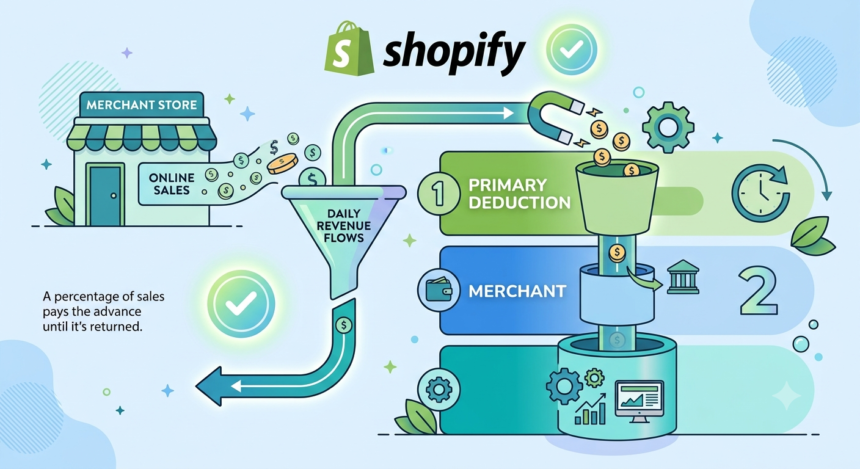

I keep thinking about a sentence buried in a help document, the kind of sentence written to be skimmed, not read. It says that if a merchant accepts a Shopify Capital loan on or after March 9, 2026, the repayment no longer comes out of a bank account. It comes out of the Shopify Payments balance before that money ever becomes the merchant’s money at all.
Read it twice. That is not a technical footnote. That is a company deciding, quietly and without a press conference, that it gets paid before you do.
For years the story of Shopify Capital was a story about speed. No credit check. No loan officer squinting at your five-year projections. A merchant sells candles or protein powder or hand-poured resin jewelry, Shopify’s algorithm looks at the sales history, and an offer appears in the admin like a gift. Take it or leave it. Most people take it. According to, Onramp1, since launch, Shopify Capital has funded more than five billion dollars to merchants. And SAL Accounting2 reported that in 2025 alone it handed out 4.2 billion dollars, a billion more than the year before. Shopify3 says merchants who accept Capital see sales rise 36 percent in the following six months. That is a real number and it is worth sitting with, because it means the product works, at least for a while, for a lot of people.
But the question I want to ask is not whether Shopify Capital works. It is what happens when it does not. And more specifically, whose claim on a struggling merchant’s money comes first when the money runs thin. That question used to have a legal answer, buried in Article 9 of the Uniform Commercial Code and a document called a UCC-1. As of this year, Shopify has started answering it a different way. Not through a filing office. Through the plumbing.
The Old Way, and Why It Mattered
Before March, Shopify Capital repayments worked like most merchant cash advances. A daily percentage of sales, collected by an automatic debit from the merchant’s bank account. It sounds like a small distinction, balance versus bank account, but it is the difference between a lender standing in line with everyone else who has a claim on your checking account, and a lender who simply never lets the money leave the building.
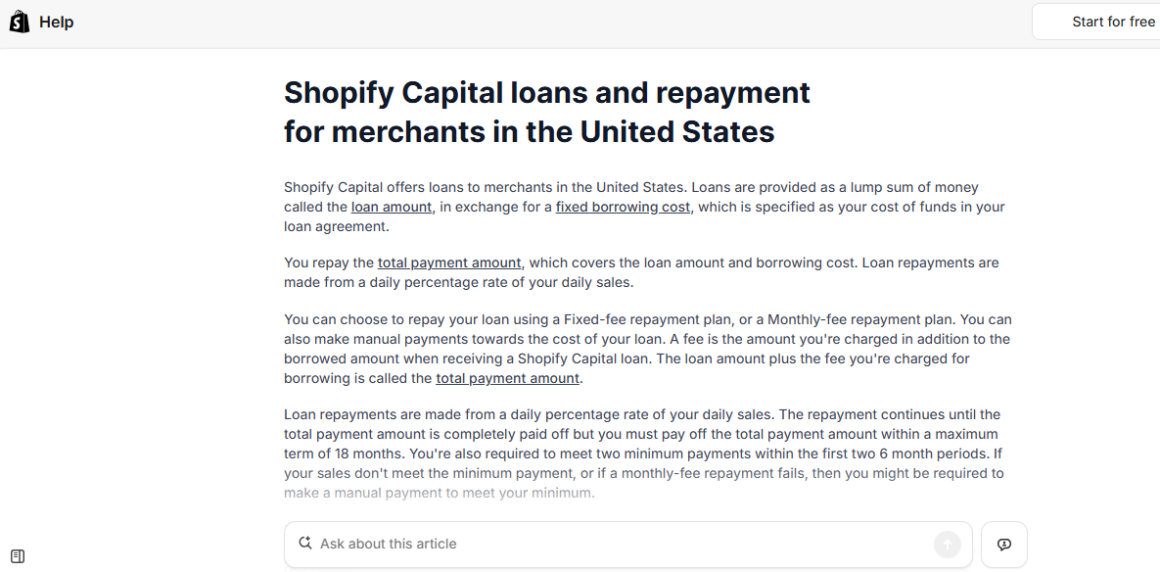
Shopify4 Capital loans in the United States are already secured loans. The loan agreement includes a security interest in business assets, and depending on the size of the loan, Shopify may file a UCC-1 financing statement, the same instrument banks and equipment lenders use to establish who eats first if a company goes under. UCC filings work on a first in time, first in right basis. According to Wolters Kluwer5, attorneys who specialize in this area of law describe it almost exactly that way, that priority is generally awarded in the order a perfected UCC-1 statement was filed. Whoever files first gets to stand at the front of the line when there is not enough money to go around.
That system, for all its flaws, is at least public. Other lenders can search the filing, see that Shopify already has a claim, and price their risk accordingly, or walk away. Legal guides written for e-commerce founders warn plainly that a UCC filing can make it harder to secure additional funding from future funding partners, because nobody wants to lend behind Shopify. One law firm that defends small businesses against merchant cash advance lenders put it more bluntly, writing that when a funder files a blanket UCC-1 it can effectively lock every other lender out of priority until the lien is paid off, subordinated, or fought in court. SBA underwriters, equipment financiers, even other merchant processors will often refuse to move until that first lien clears.
So Shopify was already first in line, legally, on paper, in the filing office. What changed in March is that Shopify stopped needing the filing office at all.
Here is the mechanism, as plainly as I can put it. Under the old bank debit model, a merchant’s daily sales landed in the Shopify Payments account, Shopify released a payout to the merchant’s bank, and then, separately, an ACH debit pulled the loan payment back out of that same bank account. Two steps. Two moments where the money technically belonged to the merchant, however briefly, and where a bank overdraft protection, a competing automatic payment, or a merchant’s own bill-pay software could interrupt the sequence.
Under the new model, the repayment is attempted directly from the Shopify6 Payments balance, attempted several times, and only falls back to a bank debit if that fails. The money is deducted before the payout even happens. It shows up as a line item, tucked into the Adjustments section of the payout details, a phrase almost designed to sound uneventful.
This is priority without paperwork. Shopify does not need to win a race to the filing office anymore because it built the finish line inside its own system. No other creditor, no landlord, no supplier, no factoring company, no tax authority trying to levy a bank account, gets a chance to touch that dollar before Shopify does. The dollar is claimed at the source.
I called this an architectural form of priority when I was drafting notes for this piece, and I keep returning to that word, architecture. A UCC filing is a legal claim that has to be enforced, sometimes in court, sometimes over months. A payment rail is a claim that enforces itself, silently, every single day, without a judge or a lawyer or a filing fee. One is a contract. The other is a structure you cannot see until you are inside it.
What Merchants Are Actually Saying
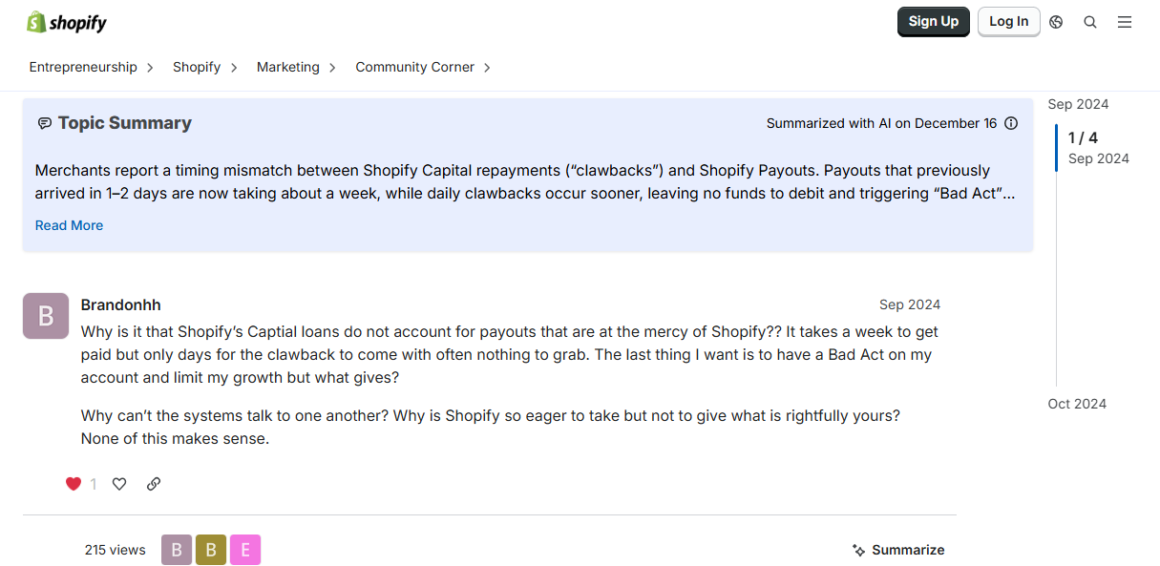
Merchant forums have carried some version of this frustration for years, long before March 2026 formalized it. On the official Shopify community boards7, one merchant wrote a post titled Concerns Regarding Shopify Capital Loan and Payout Delays, asking why the platform can take a clawback in days while payouts themselves can take a full week to land, and wondering aloud why the systems that hold a merchant’s money and the systems that collect a merchant’s debt never seem to talk to each other on the merchant’s behalf.
Reddit’s r/shopify8 has its own record of this tension, less polished, more raw. One user described the arithmetic of a deal gone sideways in stark terms, borrowing 78,000 dollars and owing 85,000 back at five percent of daily sales, u/nwlrvlx wrote in a thread later cited by the financial planning tool Luca9. User u/nanlycc wrote:
“You’re likely blacklisted indefinitely if you weren’t able to fully complete the loan.”
Another merchant who had taken close to a million dollars across several rounds summed up the relationship with the kind of weary clarity you only get from someone who has lived inside a system long enough to see its edges, saying it can work well in some industries but that they had since moved on to an SBA loan, according to u/n7yyk6y in the same thread. A third merchant, describing what happens to sellers who cannot complete a repayment cycle, wrote that you are likely blacklisted indefinitely, a claim attributed to u/nanlycc on the same forum.
Our recent Shopify Capital $180,000 loan has been declined after we applied. This is strange to me, as since 2025 we’ve successfully been accepted for and repaid over $500k in capital loans.”
None of these are lawsuits. None of them are regulatory filings. They are just people typing into a text box at midnight, trying to explain a feeling that the tool built to help them grow is also the tool with the fastest hand in the room when things go wrong. That feeling is data too. It just does not show up in a factor rate.
The Industry Shopify Is Quietly Outrunning
It helps to remember that Shopify did not invent this game, it entered one that was already ugly. Merchant cash advances, as a category, have a documented history of aggressive collection tactics that regulators have started to punish. In 2025, New York Attorney General Letitia James10 secured a billion dollar settlement against Yellowstone Capital, an MCA provider accused of predatory lending practices against more than 18,000 small businesses. Attorneys who represent small business owners against MCA lenders describe a familiar playbook, a rapid escalation from default to lawsuit to bank restraint, with the UCC-1 lien serving less as a technical formality and more as leverage, a threat dressed up as paperwork.
Against that backdrop, Shopify’s pitch has always been the polite version of merchant financing. No credit check, no confession of judgment, no debt collector calling a supplier. Just an algorithm and a slider in the admin panel that lets you choose how much of the offer to take. It is, by the standards of the industry it belongs to, one of the gentler products on the market. Onramp Funds11, a competitor that finances multi-channel sellers, frames Shopify Capital’s 10 to 17 percent factor rate as roughly in line with the category. Compared to a confession of judgment and a courtroom, an automatic deduction sounds almost humane.
But gentleness and priority are not the same thing, and I think that is the distinction that gets lost in most of the coverage of merchant financing. A product can be transparent about its cost and still be first in line for your money, ahead of your landlord, ahead of your supplier, ahead of your own payroll if a bad month arrives at the wrong time. Shopify discloses its factor rate up front. It does not need to disclose that it collects before you see a dime, because as of March, that is simply how the system works, not a term you negotiated.
Compare that to a traditional MCA lender operating outside a platform. That lender has to chase the money. It has to hope a bank debit clears, or file a lien, or eventually send a demand letter and threaten a lawsuit if the merchant stops answering the phone. Every one of those steps costs the lender time and money, and every one of those steps gives the merchant a chance to negotiate, stall, or fight back. Shopify skipped the chase entirely by owning the pipe the money travels through. It does not need to threaten anyone. It simply reaches into the balance before the balance becomes yours. That is a genuinely different kind of power than the power an independent MCA company has, even a predatory one, because it requires no enforcement at all. It is enforcement built into the checkout flow.
The Merchant Who Never Sees the Choice
Picture a small skincare brand, the kind that does most of its volume in the six weeks around the holidays and spends the rest of the year rebuilding cash reserves. The owner takes a 40,000 dollar advance in February to restock before a slow season, expecting to repay comfortably once spring sales pick back up. Spring is soft. A competitor undercuts pricing on a bestselling product. Ad costs climb. The daily remittance keeps pulling its slice from a balance that was already thin, and because the deduction happens before payout rather than after, there is no moment where the owner can look at a healthy bank balance and decide to delay a supplier payment by a week to keep the lights on. The decision has already been made, upstream, by the platform, before the money ever reaches a place where a human being gets to choose.
This is not a hypothetical dreamed up to make a point. It is the mechanical result of moving the deduction point from the bank account to the balance, and it is why the March 2026 change matters more than its dry help-center language suggests. A daily percentage of sales sounds proportional and fair when you say it out loud. It stops sounding proportional the moment you realize the merchant no longer has a say in the order operations happen in.
To be fair to Shopify, and I want to be fair here, the company has never hidden the fact that Capital is a secured product. It says so plainly in its own documentation. The shift to balance-based collection also comes with a genuine upside for merchants in good standing, since a failed debit under the old system could trigger overdraft fees at the merchant’s own bank, a cost entirely outside Shopify’s control and entirely borne by the seller. Collecting from the balance first, then falling back to the bank account only if that fails, arguably protects merchants from a version of the same problem, just one layer removed.
There is also the honest observation that Shopify is, in some structural sense, more patient than most alternatives. On a day with zero sales, a merchant owes nothing. There is no fixed monthly payment clawing at a business during a genuinely dead month, the way a term loan would. Merchants comparing their options frequently note this, and financing guides across the industry describe it as one of the product’s real strengths, that the repayment scales down automatically during slow periods rather than demanding a payment the business cannot make.
I do not think either of these things cancels out the priority question. I think they coexist with it. A lender can be patient about timing and still be first in line about order. Those are two different axes, and Shopify has quietly optimized the second one this year while continuing to market the first.
Capital Flex and the Disappearing Off-ramp
There is a second product worth mentioning here, because it extends the same logic further. In early 2026 Shopify12 rolled out Capital Flex, a revolving credit line that replaced the company’s earlier line of credit product. Instead of one lump sum repaid down to zero, a merchant draws what they need, repayments immediately restore the available capacity, and the merchant can draw again without waiting for a new offer cycle. It is marketed as flexibility, and for a merchant with predictable seasonal gaps it probably is.
But a revolving product also means the balance rarely reaches zero. Guides written for merchants evaluating the product note that repayments on Capital Flex replenish available capacity rather than closing the account out, which is a polite way of saying the relationship does not naturally end the way a fixed advance does. With a standard merchant cash advance, there is a finish line, a purchased amount, a day when the balance letter arrives and the obligation is gone. With a revolving line collected straight from the balance, the toll booth just stays open, and every payout, indefinitely, passes through it first. I am not arguing this is a trap by design. I am arguing that a merchant who takes Capital Flex should understand they are opting into a permanent first-in-line arrangement, not a temporary one, and that the marketing language rarely puts it that way.
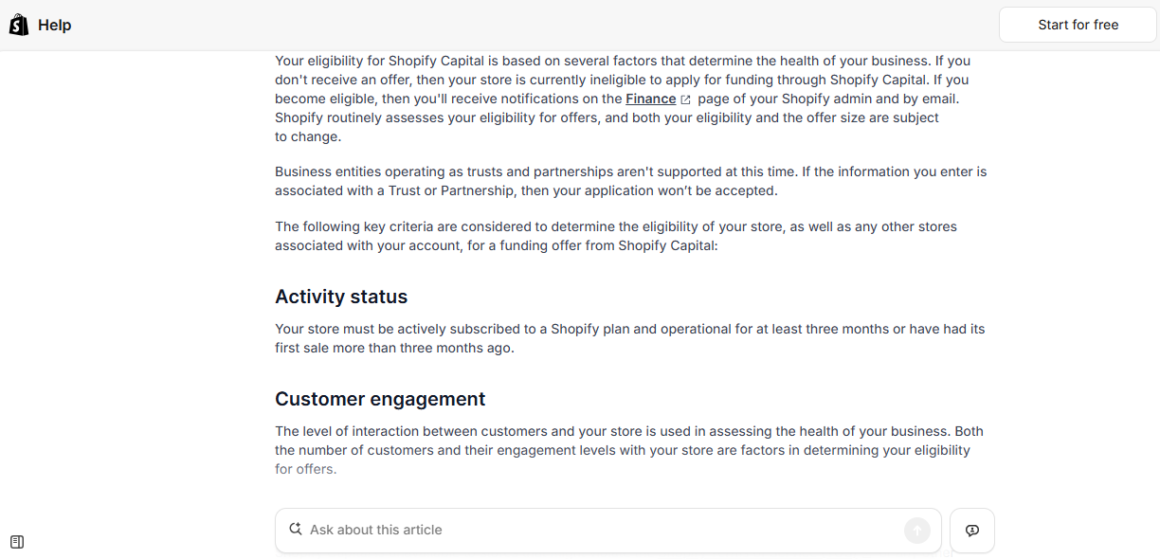
Eligibility for Shopify Capital is not something a merchant applies for. It is something Shopify decides, silently, using store performance data, sales velocity, and dispute rates that the merchant never sees in full. The offer simply appears one day in the admin, a number and a slider, take it or leave it, no negotiation on the terms themselves. That already puts the merchant in a weaker bargaining position than a business owner walking into a bank. Add the balance-based collection on top of that asymmetry and the picture sharpens. A merchant does not just accept a rate they cannot negotiate. They accept a place in a queue they cannot see, ahead of every other bill that queue was supposed to help them pay.
This is where I think the platform accountability conversation needs to widen a little. We talk a great deal about algorithmic transparency, about whether a gig platform explains why a driver got deactivated or why a seller’s listing got buried. Repayment priority is the same category of problem wearing a finance costume. It is a rule that governs who gets paid, written by the platform, applied automatically, invisible until the day a merchant needs to understand it and cannot.
The Part Nobody Puts in the FAQ
What strikes me most, writing this, is how little friction the change generated. There was no rebrand, no announcement email with a subject line designed to get opened, no press cycle. Just an update to a help document, effective a specific Monday in March, applying only to new loans, worded so carefully that a merchant would need to be actively hunting for it to notice the shift in leverage it represents.
That is, I think, the real story here, more than the mechanics of factor rates or the specifics of UCC perfection. Platforms that hold both your sales data and your payment rail do not need courts to establish priority. They do not need to win a race to a filing office, or hire a collections firm, or send a demand letter. They just need to decide where in the sequence the deduction happens, and because they own the sequence, the decision is invisible until you are the one living inside it, watching a payout arrive a little lighter than you expected, with the explanation sitting quietly in a section of your admin most people never open.
I do not have a tidy conclusion for where this goes next. Maybe regulators eventually treat balance-based collection the way they have started treating confession of judgment clauses, as a form of leverage that deserves more daylight. Maybe merchants adapt, the way they always do, keeping tighter reserves and reading the fine print before they hit accept on the next glowing offer. Maybe nothing changes at all, because the offer is fast, and the money is needed now, and next season’s inventory will not buy itself.
I think that is probably the most honest place to leave it. Not a warning, not a verdict, just an observation about where the line moved and who moved it. Most merchants borrowing from Shopify Capital today will never read the help document I opened this piece with. They will only notice the difference on a Tuesday morning months from now, staring at a payout that arrived a little lighter than the math in their head predicted, wondering where exactly the missing part went before it ever became theirs to spend.
Sources
- “Shopify Capital Merchant Cash Advances 2026: Latest Features Explained” Onramp Guides, 22 Apr. 2026, www.onrampfunds.com/guides/shopify-capital-merchant-cash-advances-2026-latest-features-explained. Accessed 2 July 2026. ↩︎
- Jacobs, Adam. “Shopify Capital Loans And Alternative Funding Options For Your E-commerce Business In 2026 – CPA Tax Accounting And Bookkeeping Firm Toronto” SAL Accounting, 19 Apr. 2026, salaccounting.ca/blog/shopify-capital-loans-alternative-funding-options/. Accessed 2 July 2026. ↩︎
- Smith, Jack. “Shopify Capital Guide 2026: Funding for Merchants Explained” EasyApps Ecommerce, 12 Mar. 2026, easyappsecom.com/guides/shopify-shopify-capital-guide.html. Accessed 2 July 2026. ↩︎
- Shopify, help.shopify.com/en/manual/finance/shopify-capital/united-states. Accessed 2 July 2026. ↩︎
- Wolter Skluwer, www.wolterskluwer.com/en/expert-insights/protecting-your-clients-ucc-position-when-insolvency-looms. Accessed 2 July 2026. ↩︎
- Shopify, help.shopify.com/en/manual/finance/shopify-capital/united-states. Accessed 2 July 2026. ↩︎
- “Concerns Regarding Shopify Capital Loan and Payout Delays” 26 Sept. 2024, community.shopify.com/t/concerns-regarding-shopify-capital-loan-and-payout-delays/361787. Accessed 2 July 2026. ↩︎
- Reddit, www.reddit.com/r/shopify/. Accessed 2 July 2026. ↩︎
- Bidinger, Eric. “Shopify Capital 2026: How It Works, Real Costs, Eligibility, and Smarter Funding Alternatives” Luca, 13 Apr. 2026, ask-luca.com/blogs/shopify-capital. Accessed 2 July 2026. ↩︎
- “Attorney General James Announces $1 Billion Settlement with Predatory Lender Yellowstone Capital for Harming Small Businesses” 22 Jan. 2025, ag.ny.gov/press-release/2025/attorney-general-james-announces-1-billion-settlement-predatory-lender. Accessed 2 July 2026. ↩︎
- “How does Shopify Capital compare to the top eCommerce financing options in the market?” Onramp Guides, 21 Aug. 2025, www.onrampfunds.com/guides/how-does-shopify-capital-compare-to-the-top-ecommerce-financing-options-in-the-market. Accessed 2 July 2026. ↩︎
- Shopify, help.shopify.com/en/manual/finance/shopify-capital/shopify-capital-flex. Accessed 2 July 2026. ↩︎