

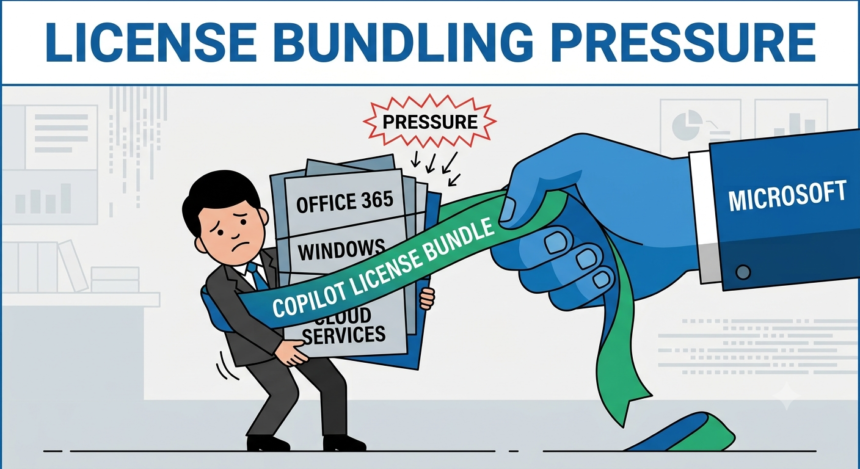

An Australian YouTuber named Alistair Fleming opened his Microsoft 365 bill last year and found a stranger living in his subscription. His monthly charge had climbed from AUD 11 to AUD 16. Nothing he used had changed. What had changed was that Microsoft added Copilot to his plan, whether he wanted it or not, and priced accordingly. Fleming told the Wall Street Journal1 that the assistant “was very keen to be used, and this was irritating to me as a user.”
I keep coming back to that word. Irritating. Not dangerous. Not even expensive, really, on its own. Just irritating, the way a houseguest is irritating when he rearranges your kitchen and calls it a gift. That is the emotional register of the Copilot bundling story. Nobody is being robbed at scale. Everybody is being nudged, repeatedly, toward a product they didn’t request, at a price they didn’t set, with an opt-out button that Microsoft seems to redesign every few months.
This is a story about how a trillion-dollar company sells artificial intelligence to people who never asked for it. It is also a story about capital expenditure, because Microsoft’s AI infrastructure spending has become so large that the company needs Copilot revenue to grow no matter what customers think of the product. Those two facts, the irritation and the arithmetic, explain almost everything that has happened since 2024.
The Mechanism, Explained Plainly
Start with what actually happened, because Microsoft’s own language tends to obscure it. On December 4, 2025, Microsoft announced a global Microsoft 365 pricing update taking effect July 1, 2026.
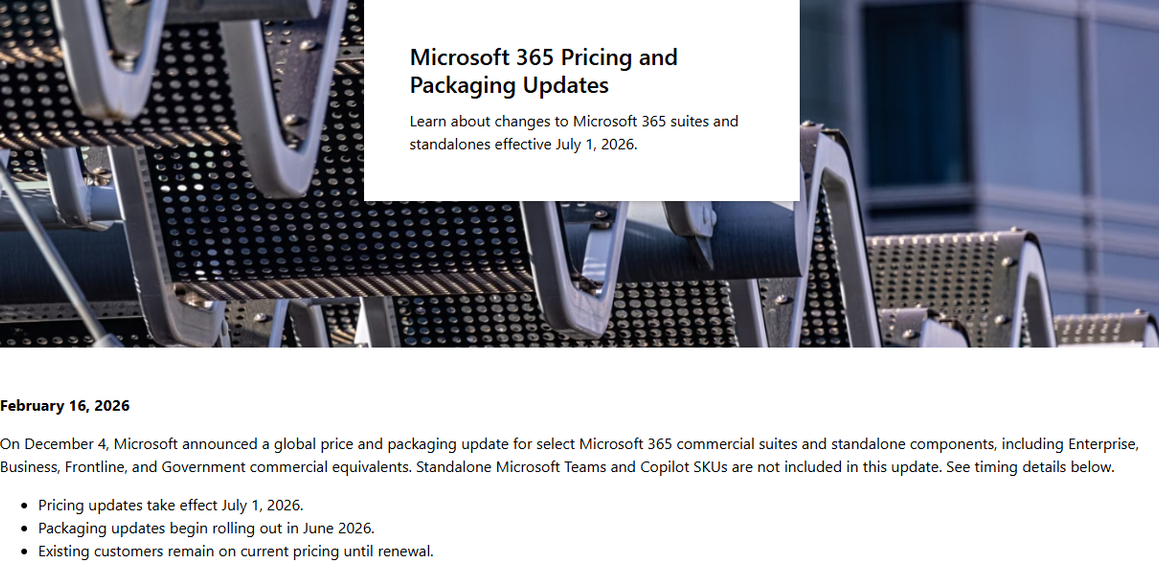
The company called it “continuous innovation and value we deliver.” OneHuman2 stated that it meant a price increase of 5 percent to 43 percent across Business, Enterprise, and Frontline plans, timed to land just after Microsoft quietly removed the volume discounts that large enterprises had negotiated under Enterprise Agreements the previous month.
E3 rose from $36 to $39 a user, per month. E5 went from $57 to $60. Business Standard climbed from $12.50 to $14. Frontline F1, the cheapest tier, used by retail and hospital staff who barely touch a spreadsheet, jumped 33 to 43 percent depending on configuration. Folded into nearly every one of those tiers, for the first time, was baseline Copilot Chat: inbox awareness, calendar awareness, and agent access inside Word, Excel, and PowerPoint. You didn’t choose this feature. You are paying for it anyway. So, every Microsoft 365 subscriber now pays incrementally more for AI embedded in the base plan, whether or not they use it.
I want to be fair to Microsoft here, because the company did add real things. Defender for Office 365 Plan 1 came bundled into E3 for customers who’d been paying for it separately. E5 customers got a metered allocation of Security Copilot compute. These are not nothing. But security add-ons and an unrequested chatbot are not the same category of value, and Microsoft priced them as though they were.
Who Actually Absorbs the Increase
Look closer at who pays the steepest part of this bill, and the story stops being about knowledge workers arguing over Excel formulas. Frontline plans, the cheapest tier in the Microsoft 365 lineup, built for retail clerks, warehouse staff, and hospital aides who mostly need email and a shift schedule, took the largest percentage hikes of the entire July 2026 update. Microsoft 365 F1, stripped of Teams, rose from roughly $2.25 to $3 a month, a jump north of 33 percent. Some F-tier configurations climbed as high as 43 percent, according to reporting compiled by MarketScale3.
Sit with that for a second. The workers least likely to ever open a Copilot prompt, because their jobs don’t involve drafting memos or summarizing spreadsheets, are the ones whose employer absorbs the biggest jump in percentage terms. Enterprise E5 customers, the accounts stuffed with lawyers, bankers, and consultants who might genuinely benefit from an AI drafting assistant, saw the smallest increase, just over 5 percent. The pricing curve runs backward from what the product actually does. That is not how you would design a fee structure if your goal were matching price to value. It is exactly how you would design one if your goal were harvesting revenue from the accounts with the least negotiating leverage and the least appetite to switch platforms over a few dollars a seat.
Small and midsize businesses feel this differently than the Fortune 500 does. A large enterprise has a licensing team, a Microsoft account manager, and leverage to negotiate. A twelve-person law firm or a regional nonprofit has an IT contractor who checks in once a quarter and an invoice that arrives whether anyone reads it or not. One detailed writeup on Windows Forum4 advised smaller shops to treat license hygiene as the fastest, lowest-risk way to blunt the increase, meaning quarterly seat audits and automated deprovisioning, because most organizations are quietly paying for licenses nobody uses anymore. That is sound advice. It is also an admission that the built-in defense against a Microsoft price increase is administrative vigilance, not product choice, because there usually isn’t a real product choice on the table.
This Is Not New. It Is a Sequel.
The commercial bundling wave of 2026 had a dress rehearsal, and it went badly enough that a national government sued over it.
In October 2024, Microsoft folded Copilot into Microsoft 365 Personal and Family plans. The personal plan’s annual price jumped 45 percent, to roughly A$159. The family plan rose 29 percent, to A$179. Millions of people got an email announcing the new price with no clear indication that a cheaper option still existed.
It did exist. Microsoft kept selling a Copilot-free “Classic” plan at the old price. But as Australia’s competition regulator alleges in a lawsuit filed in 2025 as reported by Yahoo!News5, the company only revealed that option to customers who had already started the process of canceling their subscription. About 2.7 million people were affected. The Australian Competition and Consumer Commission is seeking penalties, consumer redress, and costs, and Microsoft has said it is reviewing the claim.
The company later apologized, after the fact, in six Asia-Pacific markets, and reportedly began offering refunds for the price difference to affected customers. An apology is a strange artifact to find sitting next to a corporate earnings call. It suggests a company that knew, at some level, that its rollout crossed a line, and did it anyway because the upside was worth the risk.
I went looking for the people who use this software every day, not analysts, not press releases. I found them on a Microsoft support forum6, in a thread with a title that does not sound like it was written by a communications department. It is called, plainly, “The copilot fiasco – unwanted, forced to pay, and terrible execution.” The anonymous poster asked:
I know MS don’t read these messages. I’ll submit it, but with the tight monopoly they have, there is no need to listen to customers. Is there any way round this?
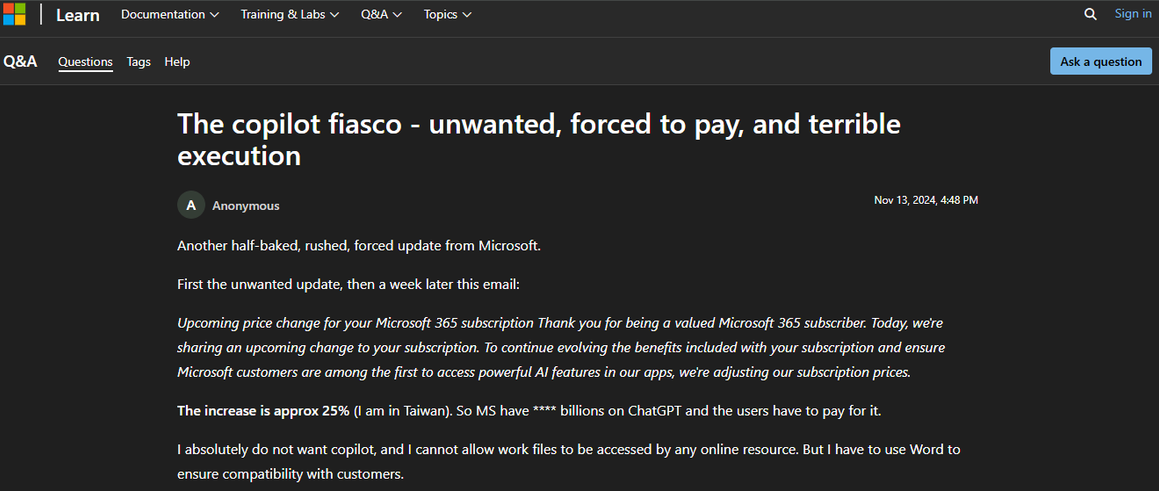
The thread is a small museum of frustration. Users trade command-line instructions for uninstalling Copilot manually because there is no clean toggle. One person wrote:
So get on with fixing Office 365 so we can disable copilot. If you can add it in – you can take it out. And let us know when you have listened to the tsunami of complaints.
Another describes canceling a subscription only to discover, buried in the renewal flow, a cheaper classic tier that dropped the assistant entirely and kept the original price. Nobody had told them that option existed. They found it by trying to leave.
In my case I cancelled the original subscription but that just meant the renewal was cancelled. I then had the option to renew for the next year using Microsoft 365 Family Classic at the original price and without copilot. It was not easy to find though, and I wonder now if they have rolled that back. Totally agree that forcing copilot is ridiculous. I didn’t want or use any of the cloud services either.
That pattern, a hidden off-ramp discoverable only through the exit door, shows up again and again across this story. It showed up in the ACCC complaint. It shows up in enterprise licensing threads about the July 2026 price change. Sysadmins are told, correctly, that they can opt out of Copilot’s automatic desktop installation through the Microsoft 365 Apps admin center. But as one detailed writeup on Windows Forum7 points out, the setting has to be found and changed before the deployment reaches a device, admin consoles are scattered across a dozen different portals, and turning off Copilot inside an Office app is not the same as preventing the standalone Copilot app from installing itself onto a Start menu.
Microsoft has actually reversed this specific policy once already. It paused automatic installation of the Copilot desktop app in March 2026 after complaints, then quietly resumed it in June, this time exempting the European Economic Area, where GDPR makes force-installing software without consent a legal liability. Everywhere else, the default flipped back to on. A piece on TechPowerUp8 described the mechanics bluntly: users may end up installing the app without their consent, and removing it involves extra steps, especially for IT admins managing a whole organization.
I don’t think this is incompetence. I think it is a company that has calculated the complaint tolerance of its customer base and found it higher than the cost of shipping the feature anyway. One forum writer summed up the pattern better than I could, noting that Microsoft rarely reverses strategic direction because of a burst of complaints. It waits, sands off the sharpest edges, and tries again. Anyone who lived through Teams bundling, OneDrive integration, or Edge’s relentless pop-ups on Windows will recognize the rhythm. This is a company playing a long game against user fatigue, and it usually wins, because switching an entire organization off Microsoft 365 is a project measured in years, not a button click measured in seconds.
The Regulator Already Has a Playbook
None of this is happening in a vacuum. Microsoft has been down this bundling road before, and it lost.
In June 2024, the European Commission found that Microsoft violated EU competition law by tying Teams to Office 365 and Microsoft 365, a case that traced back to a 2020 complaint from Slack. Facing a fine of up to 10 percent of its global annual revenue, Microsoft agreed in September 2025 to sell Office versions without Teams, at a lower price, with improved interoperability for rival apps, a commitment binding for seven years.
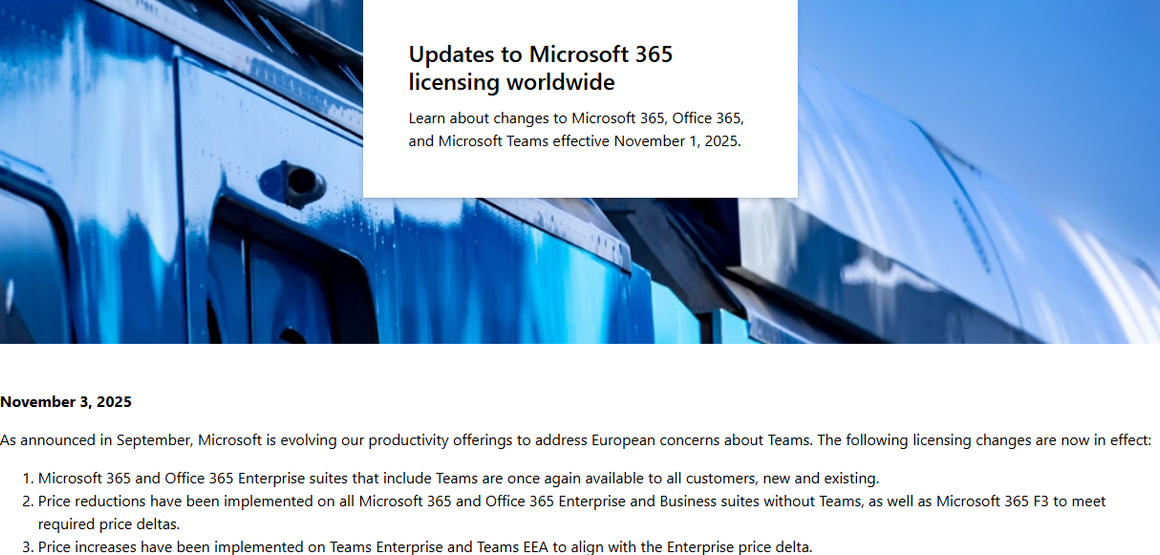
Salesforce’s chief legal officer, Sabastian Niles, told CNBC9 that the tying “denied customers fair choice” and cost the market years of lost competition. It was, by one count, the third time in a decade that Microsoft settled a European tying complaint, after roughly $2.4 billion in prior fines over Windows Media Player and Internet Explorer.
Set the Teams case next to the Copilot rollout and the resemblance is hard to miss. Both involve a dominant productivity suite. Both involve a second product folded into the first with pricing and defaults engineered to make the bundle the path of least resistance. Both drew regulatory attention only after years of customer complaints failed to move the needle internally. If history repeats, the Copilot bundle is a European Commission filing waiting to happen, and Australia’s ACCC lawsuit may just be the first jurisdiction to get there first.
What the Money Says
Here is where the story gets genuinely strange, because the harder Microsoft pushes Copilot into people’s workflows, the less evidence there is that people actually want it.
Microsoft reports more than 100 million monthly Copilot users across all its surfaces and says about 70 percent of the Fortune 500 have purchased Microsoft 365 Copilot licenses. Sounds like triumph. But independent estimates tell a colder story. According to SourceTrail10, as of Q3 fiscal 2026, Microsoft 365 Copilot had roughly 20 million paid seats, a little under 4.5 percent of the commercial Office base. Weekly usage among those licensed seats runs an estimated 20 to 30 percent, which means somewhere around one percent of Microsoft’s entire commercial customer base is actually opening Copilot in a given week. The rest are seats sitting on a shelf, purchased, billed, and untouched.
Independent survey data makes the comparison worse. A Q1 2026 enterprise poll asking users to name their primary AI tool and reported by Redress Compliance11, given a choice, found that 76 percent picked ChatGPT, 18 percent picked Copilot, and 6 percent picked Gemini. When Copilot is the default, people use it a little. When Copilot competes on merit against something else, most people walk right past it. Another figure worth sitting with: 44.2 percent of people who tried Copilot and then stopped cited distrust of its answers as their primary reason for quitting, according to adoption research compiled by Stackmatix12.
Even Microsoft’s own flagship research contains the tell. The company’s 2026 Work Trend Index, produced by Microsoft’s13 own WorkLab and cited constantly in earnings calls, found that 88 percent of workers use AI regularly in at least one business function, but only 39 percent of organizations attribute any measurable profit impact to it. A researcher at VaaSBlock14 put the observation sharply: this is not outside criticism. This is the company whose stock trades on closing that gap, publishing the gap itself.
I don’t think Microsoft is lying about adoption. I think Microsoft is measuring the wrong thing on purpose, because “seats sold” is the number that supports the pricing story, and “seats used” is the number that would force a much harder conversation with investors about whether the eighty-plus billion dollars a quarter going into AI infrastructure is actually earning its keep.
Why Now, and Why This Shape
None of this bundling makes sense as a product decision. It makes complete sense as a balance sheet decision.
Put some real numbers next to each other. Microsoft’s capital expenditure guidance for AI infrastructure sits around $190 billion, and the company’s AI revenue run rate was reported at roughly $37 billion annualized as of its most recent quarterly report, according to figures cited in OneHuman’s15 analysis of the July pricing reset. Twenty million paid Copilot seats, at roughly $30 a month list price, works out to about $7.2 billion a year in direct Copilot subscription revenue. Set against $190 billion in capex, that is something like a one-to-twenty-six ratio. Paid seats are not the only AI revenue line Microsoft books, and not every dollar of that capex is Copilot-specific data center buildout. But the gap is wide enough that no honest read of the numbers calls Copilot revenue proportionate to Copilot spending, not yet.
That gap is the entire reason this bundling wave exists. Copilot, priced separately at $21 to $30 a seat as a genuine opt-in purchase, was growing too slowly to carry the weight investors expect from an AI story of this size. So the company changed the unit of sale. Instead of asking a CFO to approve a new $30-per-user line item that competes for budget against every other tool in a technology stack, Microsoft folded the cost into the renewal everyone already pays. A price increase disguised as a packaging update is a far easier thing to push through procurement than a new AI subscription that has to justify itself on its own merits, in its own line item, in front of a budget committee that might say no.
This is, in a sense, the inverse of the Teams story. Microsoft bundled Teams into Office to kill a competitor’s market before it could grow. Microsoft is bundling Copilot into Office to manufacture a market that adoption data says barely exists. The tactic is identical. The intent is different. One was offense. This one looks more like life support for a product line that needed the base subscription to carry it, because it could not yet stand on its own numbers.
I don’t think Copilot is a scam, and I don’t think Microsoft is acting in bad faith in the legal sense, mostly. I think Microsoft built a genuinely capable tool, priced it honestly at first as an add-on, watched adoption disappoint, and then reached for the oldest lever in enterprise software: make the thing hard to avoid rather than easy to love. It is a rational move for a company under earnings pressure. It is also, I’d argue, a quiet admission that the product hasn’t earned its price on its own merits yet.
The apology in Australia matters here, small as it seems. Companies don’t apologize for pricing decisions that are working. They apologize when the backlash risks becoming a regulatory or reputational cost bigger than the revenue gained. Watch what happens next in that ACCC case, and watch whether Brussels opens a Copilot file the way it opened a Teams file five years ago. The rhythm Microsoft has used since Windows Media Player, bundle first, apologize selectively, settle quietly, has worked for two decades. Adoption numbers this weak, stacked against price increases this steep, are the first real sign that the rhythm might be catching up with the company faster than it expects.
For now, if you administer a Microsoft 365 tenant, the honest advice from every forum thread I read is the same. Audit your licenses. Find the opt-out settings before the rollout finds your users first. And remember that the cheaper, Copilot-free option Microsoft rarely advertises usually exists somewhere. You just have to start canceling to find it.
There is a broader lesson here too, one that goes beyond any single vendor. The AI industry has spent three years selling the idea that generative tools are so obviously valuable that adoption would take care of itself, that the only real question was how fast the technology would spread once it existed. Copilot is the biggest test of that theory running inside real businesses right now, at a scale no startup could match, backed by a distribution advantage no competitor can replicate. And the honest result, buried in Microsoft’s own research, is that most of the people who have it don’t reach for it, and most of the people asked to choose freely reach for something else. That doesn’t mean the technology is worthless. Excel and Word features tied to Copilot post real, measurable time savings in the pilots where companies actually invest in training and change management, and some large deployments genuinely have moved usage numbers into the high eighties and nineties. It means the value is not automatic, is not evenly distributed across job types, and is not something a company can manufacture by making the software harder to avoid.
Microsoft knows this. That is precisely why the bundling exists. If Copilot sold itself, nobody would need to fold it into a renewal notice, bury the opt-out three menus deep, or auto-install a desktop app onto machines whose owners never asked for it. You bundle a product when you believe in its long-term destiny more than you trust its short-term appeal. Microsoft may turn out to be right about the destiny. History says the company usually outlasts its critics on questions like this one. But it is worth naming plainly what is happening while we wait to find out. A company under enormous pressure to prove its AI bet was worth the money is quietly shifting that pressure onto every customer who never asked to carry it.
Sources
- WSJ, www.wsj.com/tech/ai/microsoft-ai-assistant-copilot-365-suite-dfb293b3?st=ZdJhdE. Accessed 3 Oct. 2026. ↩︎
- “Microsoft Raised M365 Prices July 1. The Mechanism Is Disclosed. The Driver Isn’t.” OneHuman – AI Consumer Protection, 6 July 2026, onehuman.io/news/microsoft-365-copilot-bundling-monetization-july-2026. Accessed 4 Oct. 2026. ↩︎
- “Microsoft 365 prices rise up to 43% as Copilot Chat folds into base plans” 15 July 2026, www.marketscale.com/industries/software-and-technology/microsoft-365-prices-rise-up-to-43-as-copilot-chat-folds-into-base-plans. Accessed 4 Oct. 2026. ↩︎
- “Your Request Was Blocked” Windows Forum, windowsforum.com/threads/microsoft-365-2026-pricing-update-ai-copilot-and-security-bundling.401375/. Accessed 3 Oct. 2026. ↩︎
- Yahoo!, www.yahoo.com/news/articles/australia-takes-microsoft-court-says-225139457.html. Accessed 4 Oct. 2026. ↩︎
- “The copilot fiasco – unwanted, forced to pay, and terrible execution” Microsoft Q&A, learn.microsoft.com/en-us/answers/questions/5349310/the-copilot-fiasco-unwanted-forced-to-pay-and-terr. Accessed 4 Oct. 2026. ↩︎
- Windows Forum, windowsforum.com/threads/microsoft-365-copilot-app-auto-install-june-july-2026-it-opt-out-guide.428844/. Accessed 4 Oct. 2026. ↩︎
- 22nd, Jun. “Microsoft Will Again Force-Install Microsoft 365 Copilot App on Windows 11” TechPowerUp, 22 June 2026, www.techpowerup.com/350160/microsoft-will-again-force-install-microsoft-365-copilot-app-on-windows-11. Accessed 4 Oct. 2026. ↩︎
- Browne, Ryan. “Microsoft sidesteps hefty EU fine with Teams unbundling deal” 12 Sept. 2025, www.cnbc.com/2025/09/12/microsoft-avoids-big-fine-as-eu-accepts-deal-to-unbundle-teams.html. Accessed 4 Oct. 2026. ↩︎
- “Microsoft Copilot Adoption Low Despite New Features, Price Hikes” SourceTrail, 17 July 2026, www.sourcetrail.com/software/microsoft-copilot-adoption-low-despite-new-features-price-hikes/. Accessed 4 Oct. 2026. ↩︎
- Andersen, Morten. “Microsoft Copilot adoption in 2026. Buy seats for the users who stay active.” Redress, 24 May 2026, redresscompliance.com/microsoft-copilot-adoption-2026. Accessed 4 Oct. 2026. ↩︎
- Pru, Matt. “Microsoft Copilot Adoption Statistics & Trends (2026)” 6 Apr. 2026, www.stackmatix.com/blog/copilot-market-adoption-trends. Accessed 4 Oct. 2026. ↩︎
- “Microsoft” The Work Trend Index India 2026 report is all…, www.facebook.com/MicrosoftIndia/posts/the-work-trend-index-india-2026-report-is-all-about-people-and-ai-working-togeth/1375272031387286/. Accessed 4 Oct. 2026. ↩︎
- Rogers, Ben. “MS Work Trend Index Exposes Its Copilot ROI Gap” VaaSBlock, 19 June 2026, www.vaasblock.com/research/microsoft-work-trend-index-2026-copilot-roi-paradox/. Accessed 4 Oct. 2026. ↩︎
- “Microsoft Raised M365 Prices July 1. The Mechanism Is Disclosed. The Driver Isn’t.” OneHuman – AI Consumer Protection, 6 July 2026, onehuman.io/news/microsoft-365-copilot-bundling-monetization-july-2026. Accessed 4 Oct. 2026. ↩︎


