

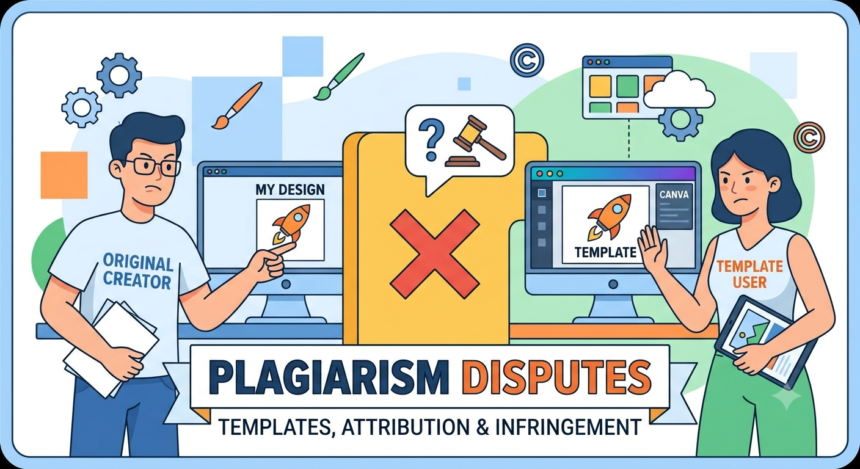

She saw it while scrolling through her own competitor’s listings, the way sellers do when business is slow. Her layout. Her spacing. Her exact choices, right down to the placement of a border. Someone had lifted it wholesale and put it up for sale under a different shop name. Then, for reasons that still baffle her, they watermarked it. Not her watermark. Theirs. On eBay’s seller forum, she wrote it plainly: “He even watermarked it, what the f***.” A few replies down, another seller pushed back. Looked similar, sure, but far from a copy. Maybe he just loved the design and it helped him land on something close. Or maybe, the third reply offered, it was just a lazy man who thought her work looked cool.
- A Business Built on a Promise
- The License Nobody Reads
- When It Is Not a Grey Area at All
- The Neighborhood Watch
- The Platform That Punished the Wrong Person
- What Canva Will and Will Not Do
- The Cost of Doing This Properly
- The AI Layer Nobody Has Fully Reckoned With
- Watermarks, Link Locks, and Other Small Defenses
Three strangers on a forum thread, staring at the same two images, and unable to agree on what had actually happened. That disagreement, more than any single theft, is the real story of the Canva template economy in 2026.
The plagiarism problem in the Canva economy is not just a policing failure. It is a demand-side problem, manufactured in part by the very gurus who sell people on the dream of passive template income in the first place.
A Business Built on a Promise
Start with the promise, because the promise is why so many people are in this fight at all. Katya Varbanova, a former bank employee, has become something of a patron saint of the Canva template hustle. Her story, retold by Insider Life1, goes like this: she built a Canva template business that pulled in $1.4 million in revenue in under three years, working roughly ten hours a week. A presale alone moved 255 packs in a matter of days. Thirteen thousand customers followed.
“I worked for about an hour the other day, and we still made 23 template sales totaling $2,444.89.”
That story is not a lie. It is also not typical, and it has been repackaged into an entire cottage industry of courses, guides, and YouTube tutorials promising anyone with a laptop and a free Canva account a similar shot at passive income. Search “how to sell Canva templates” and you will find dozens of near-identical guides pointing to the same handful of tactics: pick a niche, build a bundle, price it at five to fifteen dollars a template, and let it sell itself while you sleep.
Here is the part that nobody selling those courses says out loud. If ten thousand people follow the exact same guide, built from the exact same platform, using the exact same font library and the exact same trending color palettes, you do not get ten thousand original businesses. You get ten thousand versions of a handful of ideas, all fighting for the same buyers, all searchable under the same keywords. Some of what gets labeled theft in these forums is theft. Some of it is just what happens when a business model gets mass-produced by influencers who profit whether or not their students succeed.
The License Nobody Reads
To understand why so many of these disputes end in a shrug rather than a resolution, you need to understand what a Canva user actually owns.
Canva’s2 Content License Agreement grants users a non-exclusive license to the platform’s stock photos, illustrations, fonts, and pre-built layout elements. Non-exclusive is the operative word. It means the botanical line drawing you used in your wedding invitation template is available, right now, to every other Canva user on the planet, all 220-plus million of them across 190 countries. Your copyright, according to Canva’s3 own help documentation, covers the original decisions you layered on top: your composition, your typography pairing, your color story. It does not cover the underlying assets. It never did.
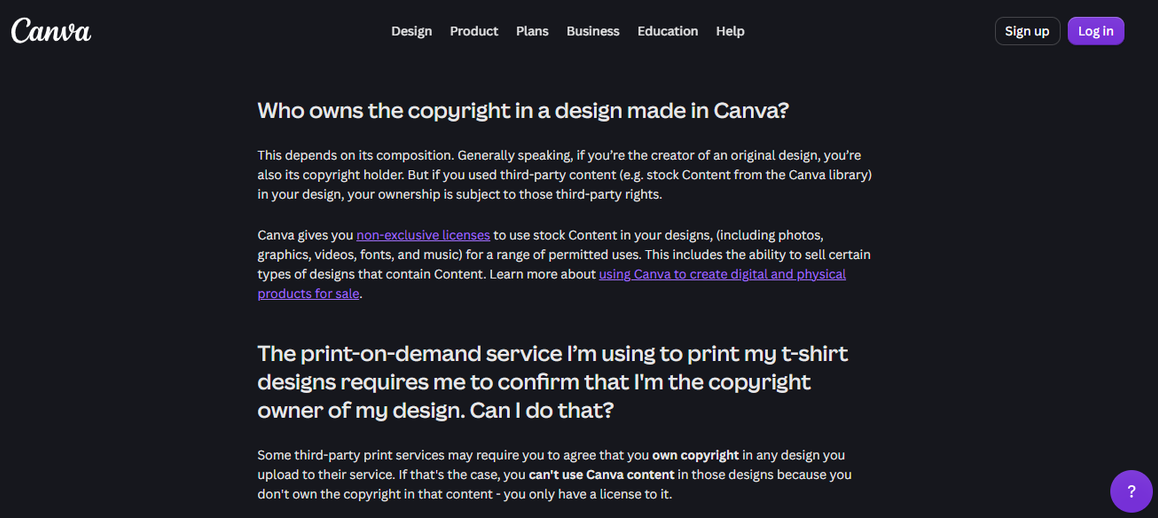
This creates a strange kind of legal fog. A designer can genuinely believe her work was stolen and be technically wrong, because two people pulling from the same limited palette of trending fonts and stock illustrations will, sooner or later, land in the same neighborhood by accident. And a designer can genuinely have been robbed and struggle to prove it in a cease and desist letter, because a lawyer looking at both templates will ask the same question the eBay forum asked: how much of this is really yours, and how much of it belongs to the shared toolbox everyone is drawing from?
I put this dynamic to a small template seller I found through a Facebook group for Canva shop owners, who asked not to be named because she still sells in some of the same spaces as the sellers she has accused. She told me she gets an accusation of copying roughly once a month.
“Half the time I look at what they’re upset about and it’s a font and a color, nothing more,” she said. “The other half, I feel sick, because I know exactly what they mean.”
When It Is Not a Grey Area at All
Then there are the cases that leave no room for that kind of ambiguity.
In 2023, Manoela Muraro of Your Social Team4 discovered that a wedding photographer named Carissa Kruse-Fox, who had been a paying member of her template subscription, had taken several of the templates, kept the product name, kept the price, and redistributed them to her own paying audience through a membership called Wedding-Preneurs Content Club. Muraro even found the email copy from her private member newsletter, lifted word for word.
This is the variant of the story that community forums rarely capture, because it does not involve a stranger scraping a listing. It involves someone who paid for legitimate access and then turned around and resold it. Template memberships, subscription libraries, and “swipe file” bundles all run on the same trust assumption: customers get editable files, and customers agree not to redistribute them. Enforcing that agreement against a customer scattered somewhere on the internet, with no registration requirement and no real identity verification, is close to impossible for a solo creator with no legal budget.
The Neighborhood Watch
Ask template sellers what they actually do when this happens, and almost none of them mention a lawyer. They mention each other.
On the Bambu Lab community forum5, which serves a design community adjacent to the Canva template world, one designer described filing a formal copyright claim against a seller reselling their work, only to conclude flatly:
“As a small creator I feel nothing will be done.”
Other posters in that same thread described a workaround that has become standard practice across template-selling communities: when one member spots a stolen listing, several members report it simultaneously, on the theory that a coordinated wave of complaints gets a platform’s attention faster than one voice ever will.
That workaround exists because the official channels are so slow and so opaque that creators built their own. It is DMCA takedown requests as a group sport, unpaid, unglamorous, and entirely necessary because nobody else is going to do it for them.
The Platform That Punished the Wrong Person
Here is a story that, as far as I can tell, has not gotten much attention outside the sellers it affected directly, and it complicates the tidy narrative of villainous copiers and innocent originators.
On Etsy’s own seller forum6, a seller described being the first person in her niche to spot a gap in the market. Last Black Friday, she built Canva templates to help AI art users organize their prompts, a genuinely original idea at the time, and built her shop’s income around it. Then Etsy rolled out a policy update clarifying what counts as “designed by a seller,” and her listings, along with a wave of other AI-adjacent templates, got deactivated. Meanwhile, she noted, competitors who had copied her concept months after she launched it were still showing up in search.
“That’s not fair to me,” she wrote. “I made these templates from scratch and it took me a while to get them right.”
This is the platform-accountability angle that gets lost when the story is framed purely as creator versus thief. Sometimes the platform itself, in its effort to police one kind of abuse, becomes the instrument of unfairness against the very people it claims to protect. Etsy’s trust and safety apparatus is built to detect patterns at scale, not to adjudicate who genuinely originated an idea within a crowded niche. A blunt policy hits the honest early mover and the shameless copycat with the same blunt force, and often it is the honest mover, with fewer listings and less search history to fall back on, who takes the harder hit.
What Canva Will and Will Not Do
Canva’s own position on all of this is written in language that sounds sympathetic right up until the sentence that matters most.
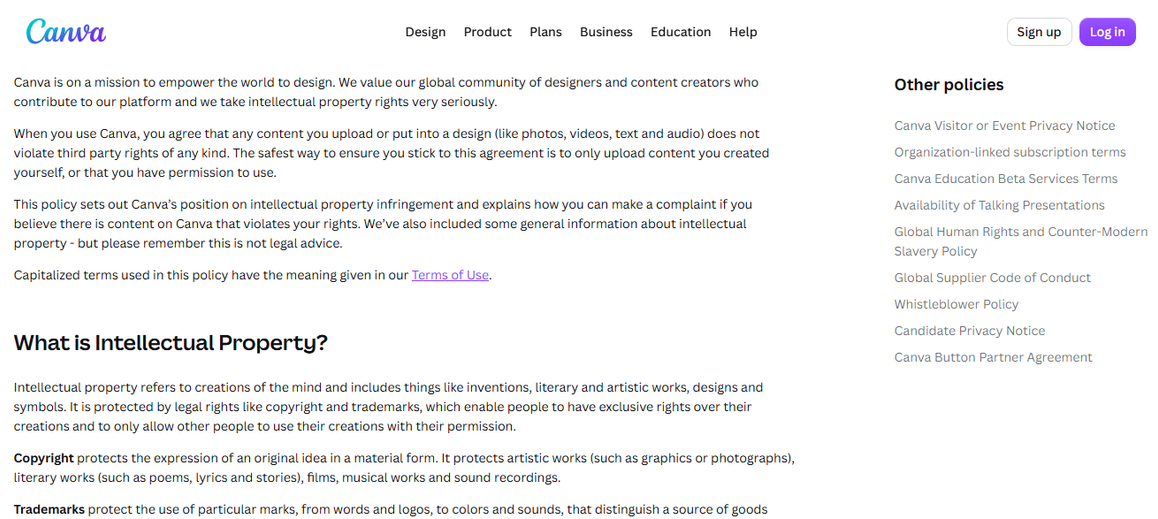
Canva’s7 intellectual property policy states that it takes IP rights seriously and will act on properly filed DMCA notices, and that Canva Creators with originality concerns about marketplace templates should route their complaints through a dedicated Creators support form rather than the standard DMCA process, since template similarity often requires human judgment an automated system cannot provide. Fair enough, on paper.
Then comes the sentence every creator I spoke to eventually brought up unprompted:
“Unfortunately, Canva is unable to assist our community with any infringement of their work that has occurred outside of Canva.”
Etsy, Creative Market, Gumroad, a competitor’s own website, all of it is out of Canva’s jurisdiction, by Canva’s own admission. And that is where the overwhelming majority of template commerce actually happens. Canva built the tool and the marketplace where creators design and, for some, sell their work directly through the Canva Creators royalty program. But the moment a template leaves that walled garden for the open marketplace of Etsy shops and personal storefronts, which is where most template sellers actually make their money, Canva’s protection ends at the door.
Inside Canva’s8 own Creators marketplace, where creators earn royalties based on template usage rather than direct sales, the asymmetry cuts even deeper. If a copycat’s template earns royalties for months before a complaint is investigated and resolved, that royalty income does not get clawed back and redistributed to the original creator once the copy is found. The remedy, when it comes at all, is prospective. It stops future harm. It does nothing about the harm already done.
The Cost of Doing This Properly
Real legal protection exists, and it is worth being honest about both its power and its price.
Registering a design with the U.S. Copyright Office establishes a public record of ownership and, critically, opens the door to statutory damages, which matter enormously for a $12 template where actual provable damages might be laughably small. The Copyright Claims Board9, a small-claims-style tribunal created by the CASE Act and running since 2022, was built specifically to give creators like this a venue that does not require a federal lawsuit. Under its smaller claims track, statutory damages can run up to $7,500 per work for unregistered material timely claimed, and higher for work registered before the infringement began.
But the CCB requires you to have already filed for registration, or to file concurrently, and registering hundreds of templates a year, one by one, is not something most solo sellers can afford to do. A handful of designers I found in forum threads register only their flagship products, the ones generating the bulk of their income, and accept that everything else in their catalog is essentially unprotected. That is not negligence. It is triage, forced on people running businesses with margins too thin to insure every piece of inventory.
The AI Layer Nobody Has Fully Reckoned With
Layer generative AI onto all of this and the ground shifts again. In 2023, Canva rolled out Magic Studio, its suite of AI design tools, and made a deliberate choice, according to reporting from Plagiarism Today10, to train those systems on its own in-house licensed library rather than scraping external creator work without consent. Canva has also committed $200 million over three years toward creators who opt in to having their content used for training.
That is a more responsible posture than a lot of the industry has taken. It does not solve the deeper problem, which is subtler than direct copying. If a tool trained on a huge pool of templates can generate near-infinite variations that echo a particular creator’s distinctive aesthetic, without lifting a single specific file, no copyright claim applies. Style itself has never been protectable under copyright law. But a market flooded with AI-generated approximations of your look, produced at zero marginal cost and with none of your years of trial and error behind them, devalues what made your work sellable in the first place, whether or not any single act of copying can be pinned down and proven.
Watermarks, Link Locks, and Other Small Defenses
Talk to enough template sellers and you start hearing the same handful of defensive tactics repeated like a folk remedy passed between neighbors, because in the absence of real institutional protection, folk remedies are what people build.
Watermarking preview images is the most common one. A seller uploads a clean, professional-looking mockup to advertise the product, but stamps it with a semi-transparent logo across the design itself, so a screenshot cannot simply be lifted and resold. It is a small, humble defense against theft, and it works about as well as you would expect against someone determined to crop it out or edit it away in Canva’s own background tools. Raket.PH.11 recommends delivering templates as locked PDFs first, with the fully editable Canva link handed over only after purchase, precisely because an open template link is an open invitation.
Some sellers go further and limit which elements of a template are actually editable before a customer buys, a tactic that protects the seller at the direct expense of the customer experience, since browsers want to see exactly how flexible a template will be before they commit five or fifteen dollars to it. It is a genuine bind. Make the preview too generous and you have handed away the product. Make it too restrictive and you lose the sale to a competitor’s more transparent listing.
None of these tactics stop a determined copier. They mostly stop casual, opportunistic lifting, the kind that happens when someone browsing Pinterest or Etsy decides a design is good enough to screenshot and rebuild from scratch in twenty minutes. Against that kind of theft, small friction genuinely helps. Against someone willing to invest real effort in reproducing a look, watermarks are a speed bump, not a wall.
I keep coming back to that eBay thread, because it captures something the plagiarism narrative usually flattens out. Three people looked at the same two images and produced three different verdicts. Theft. Coincidence. Laziness. All three explanations are plausible in a marketplace built on a shared toolbox, chasing the same trending aesthetics, marketed by the same handful of income gurus telling everyone to enter the same niches.
None of that excuses the Kruse-Fox case, or the seller who reused someone else’s product name and price down to the dollar, or the customer who takes a membership’s private files and resells them to a second audience. Those are not disputes over font choices. They are straightforward acts of taking something that was not yours and selling it as though it were. But the volume of noise around the genuinely ambiguous cases, the font-and-palette arguments that consume entire Facebook groups, drowns out the clear ones and burns creators’ limited energy on fights that were never winnable to begin with.
If there is a single piece of original ground I want to stake here, distinct from how this story usually gets told, it is this: the plagiarism crisis in the Canva template economy is not purely a story about theft. It is also a story about oversupply, engineered by an entire secondary industry of courses and gurus who profit from convincing as many people as possible to enter the same narrow lanes, using the same limited set of tools, chasing the same trending look. Some of what gets called plagiarism is exactly that. Some of it is simply what a crowded, homogenized market looks like from the inside, where everyone was handed the same paints and told to go make something no one else has ever made.
The people most likely to weather this are not the ones who file the most DMCA notices. They are the ones who stop chasing whatever niche this month’s guru is pushing and build something recognizably, stubbornly their own. That is not a legal strategy. It might be the only strategy that actually works.
I do not think that is a satisfying answer, and I do not think it is supposed to be. It puts the burden of solving a structural, platform-level problem onto individual creators who are already working nights and weekends to build something out of nothing. A designer with a distinctive style still gets copied. She just has a slightly better shot at proving it when she does, and a slightly better shot at rebuilding her audience’s trust in her name specifically, rather than in a look that anyone with a Canva login can approximate by Thursday.
None of the parties with real leverage here, not Canva, not Etsy, not the course sellers teaching thousands of new entrants the same five tactics every month, have much financial incentive to shrink the flood. Canva earns subscription revenue regardless of how many nearly identical templates get built on its platform. Etsy collects a transaction fee whether the listing is original or a copy. The gurus get paid the moment someone buys the course, long before that student discovers whether the market has any room left for them. The people absorbing the actual cost of all this churn are the ones at their kitchen tables at eleven at night, watching a stranger’s five-star reviews pile up under a layout that used to be theirs alone.
Sources
- “Insider Life” Katya Varbanova on her Canva template…, www.facebook.com/InsiderLife/posts/katya-varbanova-on-her-canva-template-business-i-worked-for-about-an-hour-the-ot/5936260016404360/. Accessed 15 Oct. 2026. ↩︎
- “Canva” www.canva.com/policies/content-license-agreement/. Accessed 15 Oct. 2026. ↩︎
- “Canva” www.canva.com/help/copyright-design-ownership/. Accessed 15 Oct. 2026. ↩︎
- Muraro, Manoela. “Public Statement re: our digital products being distributed without our authorization — Your Social Team” Your Social Team, 9 May 2023, yoursocial.team/blog/public-statement-digital-products-plagiarism. Accessed 15 Oct. 2026. ↩︎
- “Etsy copyright claims, anyone have experience?” Bambu Lab Community Forum, 2 Nov. 2024, forum.bambulab.com/t/etsy-copyright-claims-anyone-have-experience/109225. Accessed 15 Oct. 2026. ↩︎
- “Etsy deactivated a bunch of Canva templates I made myself | Etsy Community Technical Issues” Etsy Community, 9 July 2024, community.etsy.com/t5/Technical-Issues/Etsy-deactivated-a-bunch-of-Canva-templates-I-made-myself/m-p/146045612/highlight/true. Accessed 15 Oct. 2026. ↩︎
- “Canva” www.canva.com/policies/intellectual-property-policy/. Accessed 15 Oct. 2026. ↩︎
- “Canva” www.canva.com/help/canva-creators-program/. Accessed 15 Oct. 2026. ↩︎
- 30 Apr. 2025, ccb.gov/handbook/ccb.gov/handbook/Infringement-Claim.pdf. Accessed 15 Oct. 2026. ↩︎
- Bailey, Jonathan. “Canva Launches New Suite of AI-Powered Design Tools” Plagiarism Today, 4 Oct. 2023, www.plagiarismtoday.com/2023/10/04/canva-launches-new-suite-of-ai-powered-design-tools/. Accessed 15 Oct. 2026. ↩︎
- Raket.PH., blog.raket.ph/stop-people-from-stealing-your-canva-template-designs/. Accessed 15 Oct. 2026. ↩︎


