

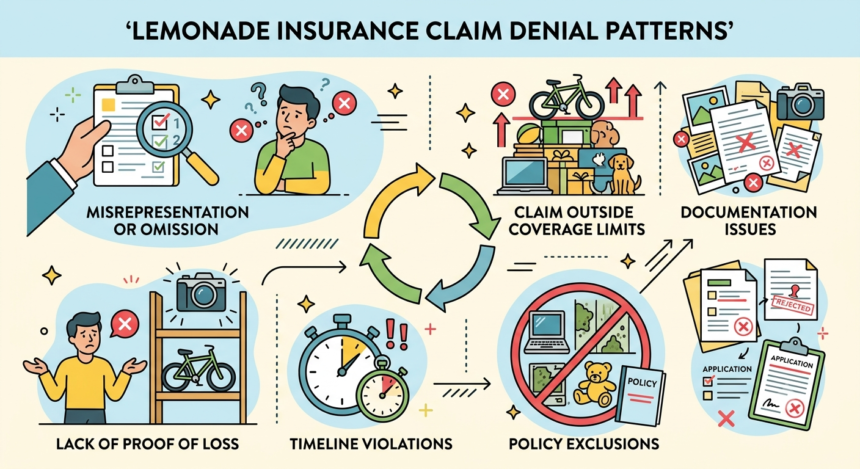

A woman in Florida files a claim for her cat. The cat has diarrhea, lethargy, no appetite. The vet runs X-rays, gives steroids and antibiotics. The bill comes to $1,400. Lemonade denies it. Pre-existing condition, the company says. She had paid premiums for three years. She never filed a claim before. BBB1 captured the denial, and the confusion that followed it, is one of dozens now sitting in the public record, a small paper trail of a much bigger story.
I have spent the last several weeks reading that paper trail. Complaint boards. Court dockets. State insurance filings. Trustpilot pages in six languages. What I found was not a company running a scam. It was something stranger and, in its way, more instructive: a company that built its entire identity on being fast, transparent, and different, and then discovered that fast, transparent, and different does not automatically mean fair when a claim gets complicated.
The Three-Second Claim
Lemonade’s origin story is a good one, and the company has told it well. In December 2016, a renter filed a claim for a stolen parka. Three seconds later, the app told him it was approved, the money was already wired, and the claim was closed. Lemonade2 called it a world record. The star of the story was a chatbot named AI Jim, who supposedly cross-referenced the claim against the policy and ran eighteen fraud algorithms in the time it takes to read this sentence.
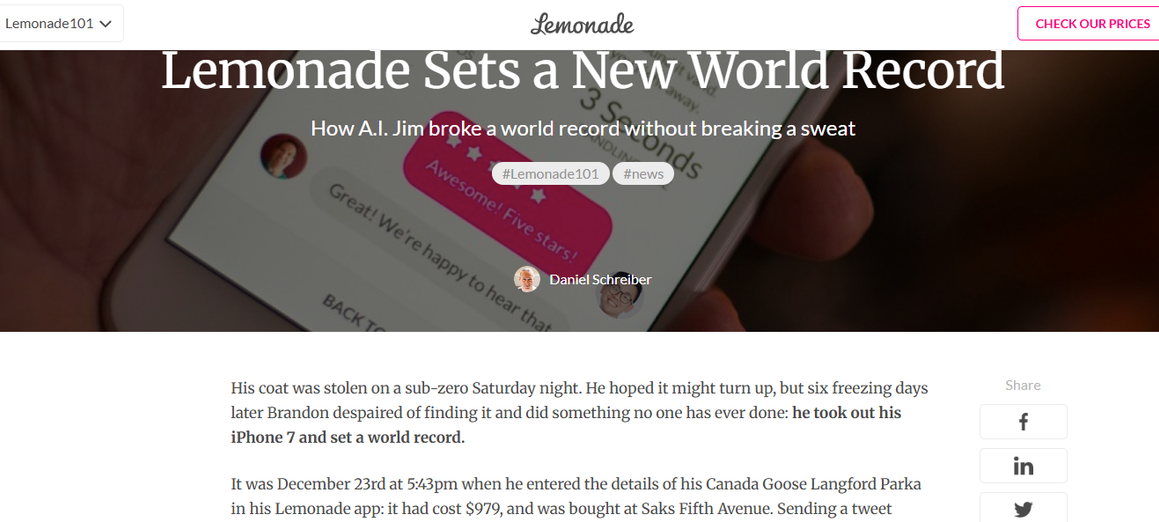
That story sold a lot of renters insurance. It also set a trap Lemonade would spend the next several years half-escaping. If the pitch is “our AI decides in seconds,” the follow-up question writes itself. What happens when the AI decides no?
Lemonade is a real insurance carrier, licensed and regulated, not a lead-generation website. It went public in 2020, it cedes a large share of its risk to reinsurers, and it files audited financials like any other carrier. None of that is in dispute. What’s in dispute, based on the trail I followed, is what happens to a policyholder once a claim leaves the part of the pipeline the AI can handle cleanly and enters the part that needs judgment.
“We Do Not Use AI to Deny Claims”
In May 2021, Lemonade posted a thread on Twitter explaining how its technology lowers what insurers call the loss ratio, the share of premium dollars paid out in claims. One tweet in the thread said the company’s AI “carefully analyzes” the selfie videos customers submit with claims, and that it “can pick up non-verbal cues that traditional insurers can’t.” The Register3 reported that the internet did not like that.
Researchers and AI ethicists piled on fast. The technology to reliably detect lying from a face and a voice does not exist, several told reporters, and building a system that tries anyway risks something closer to digital phrenology than fraud detection. According to Marketplace4, Ryan Calo, a law professor at the University of Washington who studies AI policy, put it plainly to a public radio reporter: if you try to read honesty off a face using patterns learned from a training set of “honest” people, anyone who doesn’t behave like that training set gets flagged, whether or not they did anything wrong.
Lemonade deleted the tweets and published a blog post walking the claim back. The company said “non-verbal cues” was a clumsy phrase for something narrower: facial recognition used to catch the same person filing claims under different names. It swore off emotion recognition. It said, in writing, that it does not use AI “to automatically decline claims.” Never, the company said, in bold enough terms that The Register5, and half a dozen trade outlets all ran the quote.
I believe Lemonade meant that statement sincerely in 2021. I also think it mattered less than the company hoped, because the more useful question was never whether a single algorithm rejects a claim by itself. It’s whether a system built for speed leaves room for the slow, careful parts of claims handling once a case turns out to be genuinely disputed.
What the Complaints Actually Say
The National Association of Insurance Commissioners tracks a complaint index for every carrier, a ratio of how many regulatory complaints a company draws relative to its market size. According to MoneyGeek6, a score of 1.0 is average. Lemonade’s renters insurance complaint index runs around 3.5, more than three times the industry baseline. Rateschaser7 says that its homeowners index sits near 3.85, nearly four times the expected volume. Its auto book, still small and concentrated in a handful of states, posted an index around 10 in one recent analysis. NerdWallet8, running its own weighted version of the same math using 2022 through 2024 data, reached the same basic conclusion independently: Lemonade draws a much higher complaint rate than traditional carriers like State Farm.
What are people actually complaining about? I read through a stack of them, and a shape emerges fast. Almost nobody complains about buying a policy or getting a simple claim paid. The friction sits entirely on the far side of “simple.” A review of the complaint landscape by Money Atlas9 put it about as well as I’ve seen it put: three themes recur, claim denials that read as automated and are hard to escalate to a human, non-renewals concentrated in catastrophe-exposed markets, and slow resolution once a claim leaves what that review calls the happy path.
The individual stories fill in the texture the statistics can’t. One renter’s ceiling collapsed from water damage. According to BBB10, Forty days later, past the 40-day deadline California law sets for a decision, Lemonade still hadn’t approved or denied the claim. Instead the company kept demanding new documents. A plumbing report. Personal bank statements. Water utility bills. A laptop diagnostic report, at the policyholder’s own expense. When the renter objected in writing with eleven supporting exhibits, Lemonade threatened to close the claim entirely if the demands weren’t met by a set date. The policyholder filed a complaint with the California Department of Insurance. That case was still open when I checked.
US Reviews11 showcased the case of another policyholder’s apartment that had a slab leak. No water for days. The user explained:
My experience with this insurance company has been terrible. When my apartment had a slab leak that needed a lot of work and left me without water for days, Lemonade denied my claim because the leak didn’t come above ground. Even though I’ve been paying premiums for almost 7 years, they wouldn’t help with the repairs, so I had to pay thousands of dollars myself. It’s really unfair and feels like a scam. I recommend looking for a different insurance company that you can trust.
Lemonade denied the claim because the leak, in the company’s reading, hadn’t occurred “above ground.” Seven years of premiums, paid on time, and the line got drawn on a technicality most renters would never think to ask about before signing up. A third filed a fire claim and says the adjuster misclassified restoration expenses, running them through personal property coverage instead of loss-of-use benefits, which meant a smaller payout, and separately undervalued furniture despite submitted receipts.
None of these are the algorithm literally typing “denied” in under a second. They’re something arguably worse for a company that marketed itself as the anti-bureaucracy insurer: ordinary claims bureaucracy, wearing an app’s friendly interface, moving at a pace that outlasts what state law allows.
The Pre-Existing Condition Problem
Pet insurance deserves its own paragraph, because it generates its own cottage industry of complaints. Pre-existing condition exclusions are standard across the pet insurance business, not a Lemonade invention, and Lemonade’s12 own explainer page is upfront about that. The trouble, according to the complaints I read, is how the line between “pre-existing” and “new” gets drawn after the fact, once a claim is already on the table and money is on the line.
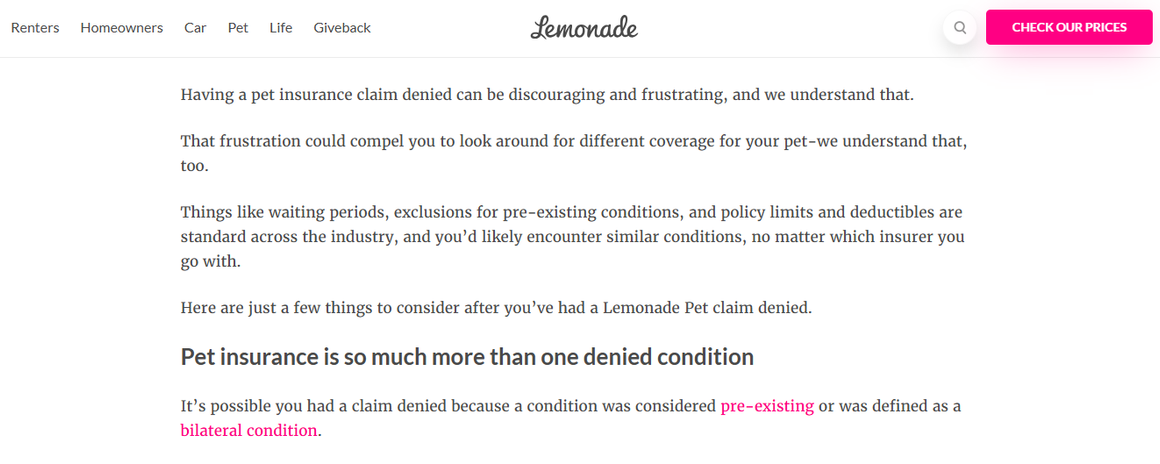
Bottari and Doyle13 stated that pre-existing conditions are, in its experience, the single most common reason for a Lemonade pet claim denial, and that many of the people calling have what the firm calls legitimate claims. A separate appeal-generator site, PetInsuranceDenied.com14, has built an entire product around it: a database of Lemonade’s appeal windows, its pre-existing condition definitions, and a fill-in-the-blank appeal letter generator, cited back to Lemonade’s own policy language. That an outside business exists purely to help people fight one insurer’s denials tells you something about the volume flowing through that pipeline. Nobody builds an appeal-letter factory for a company that rarely says no.
The Lawsuit Nobody Predicted
Not every legal fight against Lemonade is about a denied roof or a denied ear infection. In 2021, two policyholders sued the company in the Southern District of New York, arguing that Lemonade’s own privacy pledge, the one promising it wouldn’t collect biometric data, was itself deceptive, given what its claims-video analysis actually captured. As shown by Justia Law15, the case, Pruden v. Lemonade, survived a motion to dismiss in 2022, with a federal judge ruling that most of the claims could proceed. The parties later went to private mediation.
Then, separately, a data exposure. Lemonade disclosed that an online quote platform had been compromised between April 2023 and September 2024, exposing personal information including driver’s license numbers. According to ClassAction.org16, three related lawsuits got consolidated into one, In re Lemonade, Inc. Data Disclosure Litigation, and this year the company agreed to pay $10.5 million to settle it, with individual payments up to $10,000 for documented losses.
Two different lawsuits, two different failures, but I’d argue they rhyme. Both grew out of the same instinct: build the fastest, most automated pipeline possible, and treat the guardrails, privacy protections, security audits, human review, as things to bolt on once regulators or plaintiffs’ lawyers force the issue, rather than as part of the product from day one.
The Business Model Argument, and Its Limits
Lemonade’s defenders make a real argument, and it deserves a fair hearing. The company built its whole pitch around something called the Giveback. Lemonade takes a flat fee from premiums, uses the rest to pay claims, and donates whatever’s left at year’s end to charities its customers pick. As one financial analyst, Fool.com17, explained it on a podcast a few years back, the logic runs like this: a denied claim never becomes Lemonade’s own profit, so in theory the company has no financial incentive to deny one. That’s a genuinely clever piece of incentive design, and it’s not spin. It’s baked into the policy structure.
But an incentive against denial isn’t the same thing as a process built for accuracy on hard cases, and the complaint data suggests the gap between those two things is where policyholders are getting stuck. A system can have zero incentive to cheat you and still fail you through understaffing, rigid automated rules, or adjusters juggling too many files with too little training on how to handle a dispute that doesn’t fit the standard template. I don’t think Lemonade wants to deny legitimate claims. I think it built a claims operation optimized for the ninety percent of cases that are simple, and it’s still catching up on the ten percent that aren’t.
When the State Steps In
Regulators have already found real problems, not just customer service ones. In August 2024, Lemonade signed a consent order with the Texas Department of Insurance18 after the company self-reported a rating error on certain residential property policies. Lemonade agreed to pay restitution with interest to the policyholders it had overcharged. Credit where it’s due: the company caught the error itself and reported it. But a rating error affecting an unspecified number of homeowners policies, discovered internally rather than by a regulator or a customer, is its own small data point in the larger pattern: a company running fast enough that mistakes slip through before anyone outside the building notices.
California adds another layer entirely. State law bars insurers from non-renewing or cancelling residential policies for a year after a wildfire emergency is declared in or near a policyholder’s zip code, a moratorium law the state’s insurance commissioner has invoked repeatedly as fires have grown more frequent. Lemonade’s own underwriting guidelines for the state build in a wildfire risk score, called a FireLine score, and the company’s approved filing states that a policy won’t be cancelled solely because that score climbs to a moderate level after the policy is already in force. It’s a reasonable rule on paper. Whether it holds up as California’s fire seasons get longer and Lemonade’s homeowners book grows in exposed markets is a question the next few years will answer, not this one.
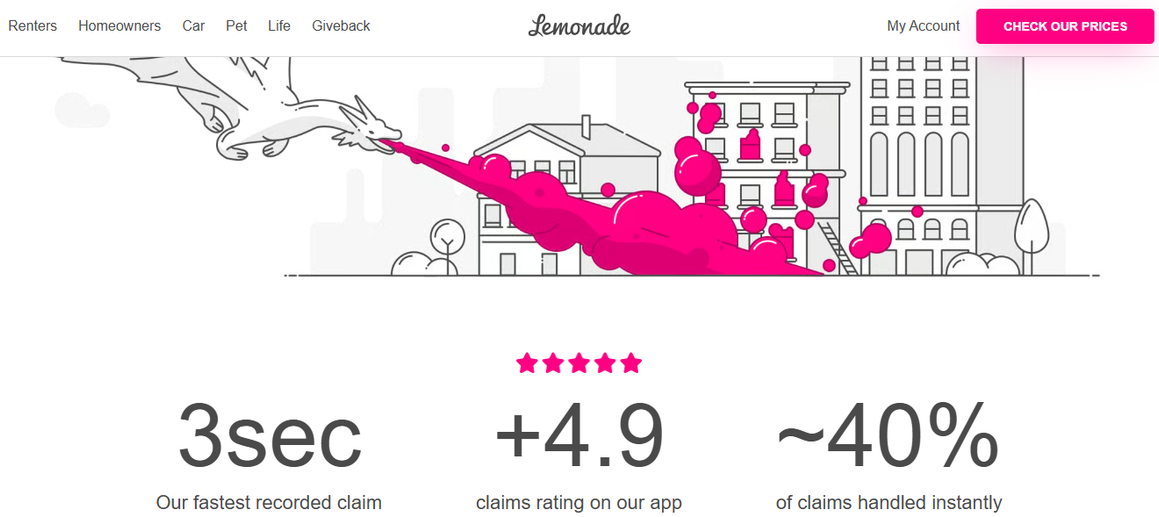
I want to be careful here, because it would be easy to write this piece as a takedown, and that’s not quite what the record supports. Most Lemonade claims, the company says, and outside reviewers largely confirm, do get paid fast and without drama. The problem isn’t the ninety percent. It’s what happens to the other ten, the pre-existing condition disputes, the underground-versus-aboveground leak, the fire claim where the coverage category itself is contested, the water damage claim that blows past a legal deadline while the company keeps asking for one more document.
What ties these stories together isn’t malice. It’s a mismatch between marketing and machinery. Lemonade sold itself as the insurer that replaced bureaucracy with software. What the complaint record actually shows is a company that replaced some bureaucracy with software and kept the rest, minus the humans who used to be reachable by phone when the software ran out of answers. A three-second claim payout is a real achievement. It is also, I’d argue, the easy part. The hard part of insurance was never approving the obvious claims quickly. It was handling the ambiguous ones fairly, and that’s exactly where an app with a friendly chatbot and no local agents runs out of road.
If there’s an original thought I’d leave a reader with, it’s this. Every disruption story eventually meets the part of its own business that resists disruption. For ride-hailing, it was insurance and labor law. For food delivery, it was restaurant margins. For Lemonade, it’s turning out to be claims adjustment on hard cases, the one function in insurance that has always required a person who can sit with an ambiguous set of facts and make a judgment call. You can build a chatbot that files a claim in three seconds. You cannot yet build one that can look at a family’s fire-damaged living room and know, with the fairness a human adjuster owes them, exactly where Coverage D ends and Coverage C begins. Lemonade is still finding that out in public, one denied claim at a time.
Sources
- Better Business Bureau, www.bbb.org/us/ny/new-york/profile/insurance-agency/lemonade-insurance-company-0121-170773/customer-reviews. Accessed 8 Sept. 2026. ↩︎
- Schreiber, Daniel. “Lemonade Sets a New World Record” Lemonade Blog, www.lemonade.com/blog/lemonade-sets-new-world-record/. Accessed 8 Sept. 2026. ↩︎
- Quach, Katyanna. “Insurance startup backtracks on running videos of claimants through AI lie detector” 26 May 2021, www.theregister.com/2021/05/26/ai_insurance_lemonade/. Accessed 8 Sept. 2026. ↩︎
- Marketplace, 8 Mar. 2021, www.marketplace.org/episode/2021/05/28/companies-keep-overpromising-about-ai. Accessed 8 Sept. 2026. ↩︎
- Quach, Katyanna. “Insurance startup backtracks on running videos of claimants through AI lie detector” 26 May 2021, www.theregister.com/2021/05/26/ai_insurance_lemonade/. Accessed 8 Sept. 2026. ↩︎
- Fitzpatrick, Mark. “Lemonade Renters Insurance Review 2026: Rates, Pros and Cons” 7 July 2026, www.moneygeek.com/insurance/renters/lemonade-renters-insurance-reviews/. Accessed 8 Sept. 2026. ↩︎
- Wagner, Michael. “Lemonade Homeowners Insurance Review: 2026 Pros, Cons, and Alternatives” Rates Chaser, 11 Feb. 2026, rateschaser.com/home-insurance/reviews/lemonade-homeowners-insurance-review/. Accessed 8 Sept. 2026. ↩︎
- Schlichter, Sarah. “Lemonade Renters Insurance Review 2026” NerdWallet, 5 Mar. 2025, www.nerdwallet.com/insurance/renters/lemonade-renters-insurance-review. Accessed 8 Sept. 2026. ↩︎
- Atlas, Money. “Lemonade Insurance Review 2026: Renters, Home, Pet & Car Compared” Money Atlas, www.moneyatlas.com/review/lemonade-insurance. Accessed 8 Sept. 2026. ↩︎
- Better Business Bureau, www.bbb.org/us/ny/new-york/profile/insurance-agency/lemonade-insurance-company-0121-170773/complaints?page=2. Accessed 8 Sept. 2026. ↩︎
- “Shocking Honesty: Lemonade Reviews 2026” US-Reviews, 21 Dec. 2018, us-reviews.com/insurance/lemonade-reviews. Accessed 8 Sept. 2026. ↩︎
- “Pet Claim Denials: Things to Keep in Mind • Lemonade Insurance” 21 May 2026, www.lemonade.com/pet/explained/pet-claim-denials/. Accessed 8 Sept. 2026. ↩︎
- Bottari and Doyle, www.bottarianddoyle.com/lemonade-denied-claim. Accessed 8 Sept. 2026. ↩︎
- “Lemonade Pet — Appeal a Denied Pet Insurance Claim” PetInsuranceDenied.com, 6 May 2026, petinsurancedenied.com/carrier/lemonade. Accessed 8 Sept. 2026. ↩︎
- Justia Law, law.justia.com/cases/federal/district-courts/new-york/nysdce/1:2021cv07070/565408/48/. Accessed 9 Sept. 2026. ↩︎
- ClassAction.org, www.classaction.org/news/10.5m-lemonade-settlement-resolves-class-action-lawsuit-over-17-month-data-breach. Accessed 9 Sept. 2026. ↩︎
- Frankel, Matt. “Here’s Why 1 Million People Have Chosen Lemonade Insurance” The Motley Fool, 17 Feb. 2021, www.fool.com/investing/2021/02/17/heres-why-1-million-people-have-chosen-lemonade-in. Accessed 9 Sept. 2026. ↩︎
- Villarreal, Linda. “Lemonade_order_for_processing.pdf” 13 Aug. 2024, www.tdi.texas.gov/commissioner/disciplinary-orders/documents/www.tdi.texas.gov/commissioner/disciplinary-orders/documents/20248780.pdf. Accessed 9 Sept. 2026. ↩︎


