
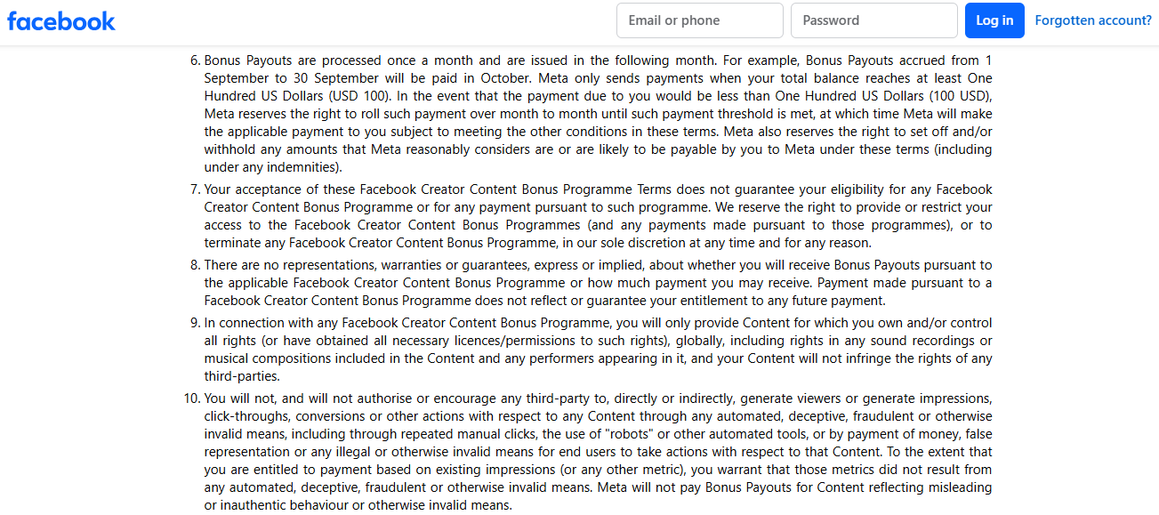
I have spent a lot of time lately reading Instagram’s fine print, and one line keeps snagging on me. Meta can end a bonus program “in our sole discretion at any time and for any reason.” No warning required. No refund owed. Just a door that closes while you are still standing in the doorway.
That sentence sits inside the Facebook Creator Content Bonus Program Terms1, and it governs money that has, at various points over the last four years, paid creators anywhere from a few dollars to tens of thousands in a single month. It is the legal skeleton underneath a much messier human story. Creators get a notification. Their professional dashboard lights up with a new tab called Bonuses. They post more, film more, edit more, chase a number they cannot see the formula for. Then one day the tab is gone, or the payout is ten cents on a million views, and nobody at Meta owes them an explanation.
I want to walk through how this actually works, because it is stranger and more deliberate than most creators realize, and because the pattern keeps repeating with almost comic regularity.
A Short, Chaotic History of Getting Paid to Make Reels
Instagram’s2 bonus programs started in 2021 as something called the Reels Play Bonus, part of a billion dollar creator fund Meta announced across Facebook and Instagram to compete with TikTok. The pitch was simple. Post Reels, hit view thresholds, get paid. Early reporting from TechCrunch3 captured how confusing it was even in its first weeks. A creator named Maddy Corbin, with about 52,000 followers, was offered up to $1,000 for a month of Reels. She noticed other creators with bigger followings getting smaller offers. She told the outle:
“I wish I knew more on how that was generated.”
Nobody could tell her. That has basically remained true ever since.
The program grew fast and paid real money to the people who got in. Some creators pulled in more than $10,000 a month, and a few claimed payouts as high as $35,000, according to TechCrunch’s later reporting. Then in March 2023, Meta pulled the plug. It told Business Insider4 that monetization on the platform was “evolving” and that other products were “proving more sustainable.” Creators who had built posting schedules and sometimes their entire income around the bonus got about 30 days notice that existing commitments would still be honored, and nothing beyond that.
That should have been the end of the story. It wasn’t. It was the first verse of a song Meta would sing again and again.
Instagram brought back a “holiday bonus” for Q4 2023, then a “New Year’s bonus” in early 2024, both invite only, both temporary, both gone once the season passed. Meta launched a bonus program on Threads in the spring of 2024, and Engadget5 later confirmed that it was quietly killed roughly a year later, with creators noticing the payments had simply stopped arriving around the end of April. Meta never explained why. Some of those creators had been earning between $500 and $5,000 a month.
In January 2025, with TikTok’s future in the U.S. hanging by a legal thread, Meta rolled out the “Breakthrough Bonus,” dangling up to $5,000 over 90 days to lure TikTok creators onto Reels, plus, according to reporting from The Verge6, exclusivity deals worth $10,000 to $50,000 a month for the biggest names. By the time TikTok’s ban crisis cooled off, so did Meta’s urgency. Creators started posting on TikTok7 itself that the money had dried up. One video, captioned bluntly, told followers “unfortunately, bonuses for creators have been discontinued,” a message creators were left to discover through each other rather than through Meta.
By May 2025, Instagram was running an entirely different invite only test called Referrals, paying creators up to $20,000 over six weeks for driving new signups, confirmed by Meta to Business Insider8. Somewhere in the middle of all this, Instagram had also shut down its profile ad revenue sharing program, ended its native affiliate program, and killed IGTV’s ad split years earlier. Then, in October 2025, Instagram introduced something called the Ring Award, a symbolic honor for top creators that pays absolutely nothing, which TechCrunch9 pointed out arrived the same year creators saw a 52 percent drop in brand deals.
I keep a running list of these programs when I research these pieces, and Instagram’s bonus history might be the longest, most tangled one I have built yet.
Invite Only Means Nobody Can See the Rules
Here is the part that makes this different from a normal business decision to cut a budget line. Every one of these programs was invite only from the start. You do not apply. You do not know the criteria. Instagram simply decides, using signals it will not disclose, that you qualify, and a tab appears in your professional dashboard. Miss the window to activate it, typically about seven days, and the invite evaporates.
Meta has more or less admitted the selection process involves an element of chance. As the Manychat blog10 explains after digging through Instagram’s own disclosures, an element of random selection happens during testing phases, which is Meta’s own explanation for why two creators with similar audiences can end up with completely different access, or none at all. Instagram does not publish its payout formula. It never has. Creators are told to post more, post consistently, keep engagement up, and then wait to see what the algorithm decides they are worth that month.
That opacity produces a very specific kind of anxiety, one I have seen described the same way across dozens of posts and interviews. A creator on r/Instagram, quoted on that same Manychat page, put it about as plainly as anyone I found:
“My bonus has been horrible the last few months with no explanation.”
Ten dollars for a million views, they said, with nothing to indicate why the rate had collapsed. Somebody else in the same thread was pulling $1,200 to $1,500 every two weeks by posting three Reels and three carousels daily, an enormous time commitment with a payout that could vanish or fluctuate without cause.
What the Paperwork Actually Says, and How It Compares
I went looking for how Meta’s language stacks up against a competitor, because I wanted to know if “no warning” was really the industry standard or something specific to Meta.
TikTok’s Creator Rewards Program Terms are strikingly different. Under its own contract, TikTok commits that “we will provide you with reasonable advance notice” before ending or materially changing the rewards program, and the company promises to notify creators of significant changes through the Creator Portal. That is not a perfect system. TikTok11 has its own history of gutting payout rates. But the contract at least gestures toward an obligation.
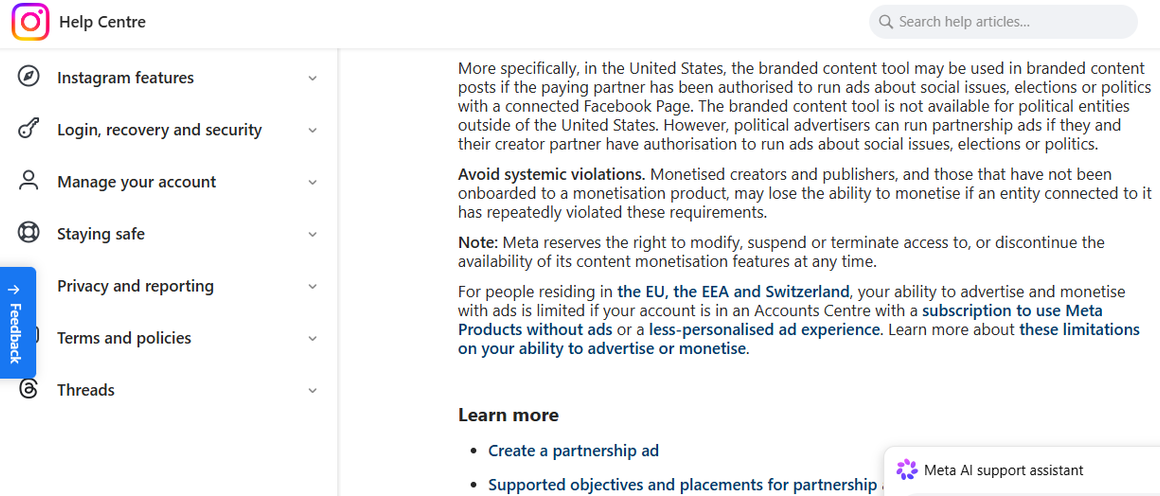
Meta’s language does not. The Facebook Creator Content Bonus Program Terms state plainly that the company can restrict access or terminate any bonus program “in our sole discretion at any time and for any reason,” and go further, saying payment under one bonus period “does not reflect or guarantee your entitlement to any future payment.” Instagram’s12 help center language on monetization eligibility echoes the same posture, reserving the right to “modify, suspend or terminate access to, or discontinue the availability of” its monetization features at any time. There is no notice period written into any of it. Nothing requires Meta to tell you a program is ending before it ends.
I am not a lawyer, and creators who sign up for these programs are agreeing to those terms, so this is not a story about broken contracts. It is a story about a contract written entirely in one direction.
Voices from the Feed and the Forum
What struck me most while reporting this was how similar the complaints sound no matter where I found them, whether it was a Reddit thread, a Substack post, or a quote buried in a trade publication.
A writer who posts under the name meredithaleighawells described her relationship with the Reels Bonus Program on her Substack13 in language that captured the specific exhaustion of it. She wrote about Meta’s near total lack of customer service, noting that if your account gets hacked, or if you qualify for monetization but never receive the payout, you are largely on your own. Her phrase for the app itself stuck with me. She called it
“An app that could disappear for no reason without warning.”
She was talking about her own account access, but she may as well have been describing the bonus program itself.
Elsewhere, creators complaining about Meta’s newer Content Monetization Program, which folded several older bonus schemes into one dashboard in 2025, sound just as unmoored. Forbes14 gathered a batch of these reactions in early 2026, and one line stood out to me for how much frustration it packs into a single sentence:
“Facebook monetisation is so inconsistent! 275,000 views and only earned $0.10.”
Another creator quoted in that same piece said switching over to the new unified system tanked their monthly earnings entirely. These are not isolated cranks. They are people whose income, in part, depends on a system they cannot audit.
I want to be fair here. Not every bonus story ends badly, and Meta’s programs have paid out real money to real people, sometimes life changing amounts for a single month of posting. But the good months do not cancel out the structural problem, which is that a creator has no way to know, going in, whether they are looking at a program that will run for years or one that will vanish before their first payout clears.
The 2025 Consolidation, and Why It Didn’t Fix Anything
Meta’s official answer to years of this criticism was to simplify. On August 31, 2025, the company folded its scattered programs, in-stream ads, ads on Reels, the Performance Bonus, into a single system called the Content Monetization Program, described by outlets tracking the shift as an effort to stop creators from artificially fragmenting their strategy just to qualify for separate localized bonuses. One breakdown of the change, published on Clip-Short15, notes that the older programs simply stopped paying out on that date, full stop, with a new invite only system taking their place.
Consolidation sounds like stability. In practice it just moved the same uncertainty one layer deeper. The new unified program is still invite only. It still runs country by country, with different eligibility timelines depending on where a creator lives. It is still, per its own governing terms, cancelable at Meta’s discretion. What changed is the label on the door, not the fact that Meta can lock it whenever it wants.
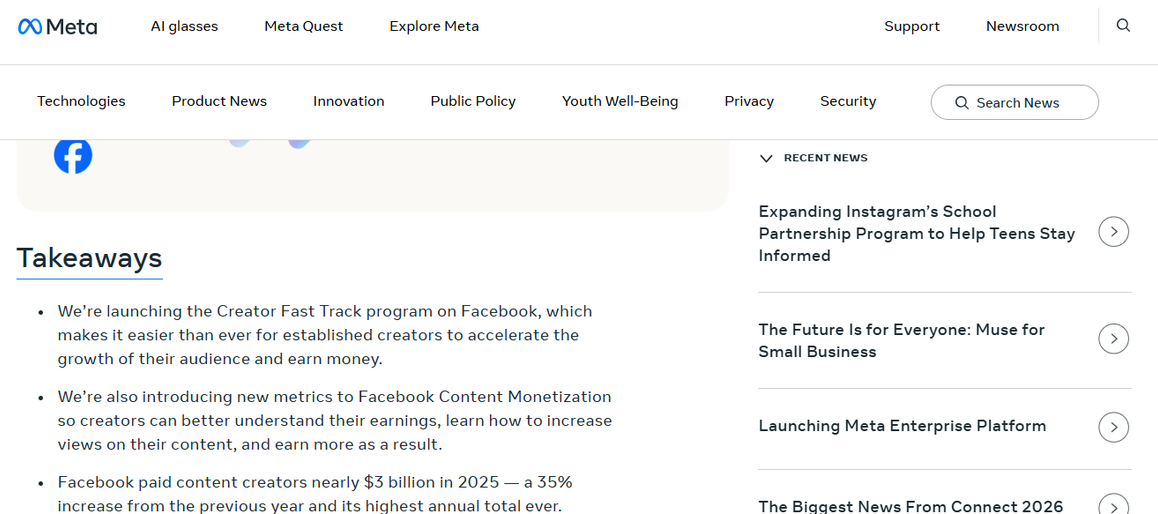
Meta16 reported that Facebook alone paid out nearly $3 billion to creators in 2025 through its various monetization tools, a 35 percent jump year over year, and that the number of creators earning more than $10,000 annually grew by over 30 percent. Those are genuinely large numbers. They also sit right alongside a wave of Reddit and forum comments describing payouts that dropped without warning the moment the new system replaced the old one.
Why This Keeps Happening
Here is my own read on it, after going through four years of these programs one by one. Instagram treats creator payments the way a startup treats a growth experiment, not the way an employer treats payroll. Every bonus program I found was described internally, at launch, using the word “testing.” That word does real legal and cultural work. A test can end. A test was never a promise. By framing every payout structure as provisional from day one, Meta builds itself permanent cover to walk away whenever the underlying incentive, usually poaching creators from a rival platform during a moment of crisis, stops being useful.
Look at the timing. The Reels Play Bonus scaled up while Instagram was racing to compete with TikTok’s early dominance in short video, then died once Reels had enough momentum to survive on its own. The Breakthrough Bonus appeared exactly when TikTok’s U.S. future looked shakiest, then quietly disappeared once that threat passed. These were never creator support programs in the way a union pension is a support program. They were customer acquisition budgets wearing a friendlier name, and acquisition budgets get cut the moment the acquisition target stops being scared.
Creators are, for the most part, not employees. They are not owed severance, notice periods, or continuity of income, and the platforms know this better than anyone. A 2025 Visa and Morning Consult survey17 of more than 1,000 creators found that a huge share consider themselves small business owners rather than platform employees, which is true and also convenient for Meta, since it means nobody expects Instagram to behave like an employer when it shuts a program down. Other industry data collected around the same period shows just how top heavy the resulting economy is, with the highest earning ten percent of creators capturing well over half of all creator payments, while roughly half of all creators earn under $5,000 a year from their content. When a bonus disappears, it rarely bankrupts someone at the top of that pyramid. It is far more likely to gut someone in the middle, the person who had finally built a posting rhythm around a few hundred extra dollars a month and had started planning around it.
I don’t think there is a clean villain in this story, and I don’t think Meta is doing anything its own terms of service don’t allow. That is sort of the point. The terms allow almost anything, and creators sign them anyway because the alternative is not being invited to the tab at all.
What I keep coming back to is the asymmetry of information. Instagram knows exactly why a bonus rate dropped, exactly when a program is scheduled to end, exactly which creators are about to lose access. Creators know none of that until it has already happened to them, and by then the only real recourse is a forum post describing the loss to a room full of strangers who have felt the same thing. Somewhere in Menlo Park, a product manager is probably already testing the next bonus, and somewhere in a professional dashboard, a new invite tab is probably lighting up for someone right now. Whether it lasts a season or a single billing cycle is not something Instagram is required to say, and it likely won’t, until the day it simply doesn’t.
Sources
- “Facebook” www.facebook.com/legal/creator_content_bonus_program_terms. Accessed 26 Sept. 2026. ↩︎
- “Earn with Bonuses” Instagram for Creators, creators.instagram.com/bonuses. Accessed 26 Sept. 2026. ↩︎
- Silberling, Amanda. “Instagram is offering huge bonuses for posting on Reels, its TikTok clone” TechCrunch, 11 Nov. 2021, techcrunch.com/?p=2232426. Accessed 26 Sept. 2026. ↩︎
- Mehta, Ivan. “Meta will stop offering Reels bonuses to creators on Facebook and Instagram” TechCrunch, 10 Mar. 2023, techcrunch.com/2023/03/10/meta-will-stop-offering-reels-bonuses-to-creators-on-facebook-and-instagram/. Accessed 26 Sept. 2026. ↩︎
- Bell, Karissa. “Meta has ended its bonus program on Threads” 22 July 2025, www.engadget.com/social-media/meta-has-ended-its-bonus-program-on-threads-201627935.html. Accessed 26 Sept. 2026. ↩︎
- 21 Jan. 2025, www.theverge.com/2025/1/21/24348510/instagram-tiktok-creators-bonuses. Accessed 26 Sept. 2026. ↩︎
- “TikTok” Make Your Day, www.tiktok.com/discover/facebook-took-away-breakthrough-bonus. Accessed 26 Sept. 2026. ↩︎
- Bradley, Sydney. “Instagram is offering creators up to $20,000 to bring people to the app” Business Insider, 19 May 2025, www.businessinsider.com/instagram-paying-creators-hundreds-dollars-drive-traffic-new-sign-ups-2025-5. Accessed 26 Sept. 2026. ↩︎
- Malik, Aisha. “Instagram introduces new ‘Ring’ award for top creators” TechCrunch, 6 Oct. 2025, techcrunch.com/2025/10/06/instagram-introduces-new-ring-award-for-top-creators. Accessed 26 Sept. 2026. ↩︎
- Rogers, Sierra. “Instagram Play Bonus is Gone — Here’s What Replaced It” Manychat Blog, 30 Jan. 2026, manychat.com/blog/instagram-play-bonus-update/. Accessed 26 Sept. 2026. ↩︎
- “TikTok Creator Rewards Program Terms” TikTok, www.tiktok.com/legal/page/global/creator-rewards-program-us/en. Accessed 26 Sept. 2026. ↩︎
- “Help Center” help.instagram.com/1372533836927082. Accessed 26 Sept. 2026. ↩︎
- Wells, Meredith Aleigha. “Meredith Aleigha Wells” Substack, meredithaleighawells.substack.com/p/artistvsthealgorithmpt1. Accessed 26 Sept. 2026. ↩︎
- “Forbes.Com” 20 Mar. 2026, www.forbes.com/sites/ianshepherd/2026/03/20/meta-offered-creators-cash-heres-how-they-responded/. Accessed 26 Sept. 2026. ↩︎
- “Facebook Content Monetization in 2026: How It Works” Clip-Short, 23 Sept. 2026, www.clip-short.com/guides/facebook-content-monetization. Accessed 26 Sept. 2026. ↩︎
- “Creator Fast Track: A New Way to Quickly Grow Your Audience and Earn Money on Facebook” 18 Mar. 2026, about.fb.com/news/2026/03/creator-fast-track-grow-your-audience-earn-money-on-facebook/. Accessed 29 Sept. 2026. ↩︎
- “Monetized VISA 2025 Creator Report” 28 Oct. 2025, images.globalclient.visa.com/Web/InovantElqVisaCheckout/images.globalclient.visa.com/Web/InovantElqVisaCheckout/%7Bc2509c5c-74a9-4e07-92d8-1863f9e71644%7D_Monetized_Visa_2025_Creator_Report.pdf. Accessed 26 Sept. 2026. ↩︎