

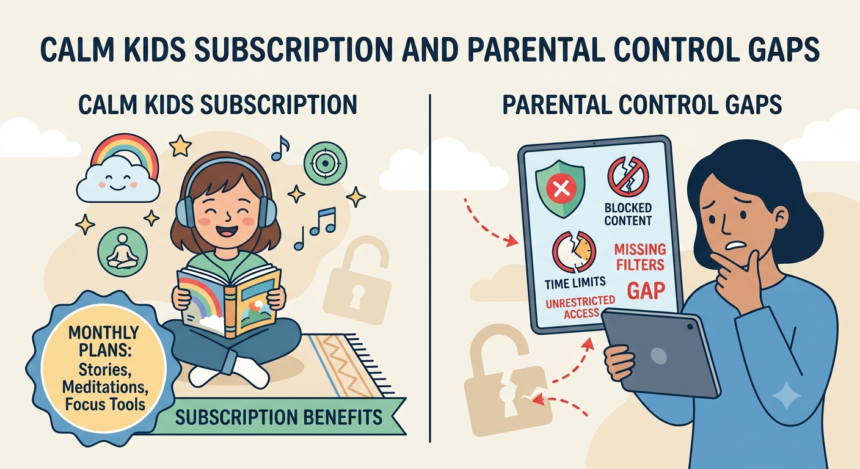

Inside the parental control gaps, data privacy failures, and subscription dark patterns lurking beneath one of the world’s most trusted wellness apps for kids.
The name is the promise. Calm. It is right there on the icon, soft blue, a lake at dusk, the word rendered in a typeface so gentle it almost whispers. The app launched in 2012 with a straightforward pitch: help anxious adults breathe more slowly and sleep better. It worked. By the mid-2020s, Calm had tens of millions of subscribers, a valuation that once touched $2 billion, and a brand synonymous with mental wellness. Peppa Pig lulled children to sleep through it. Matthew McConaughey narrated bedtime stories on it. Your pediatrician probably mentioned it.
Then the app built a section specifically for children, called Calm Kids, and the promise got complicated.
This is a story about what happens when a company markets a product to parents, calls it safe for kids as young as three, and then builds almost no infrastructure to make that true. There are no parental controls inside the Calm app. There is no separate child profile. There is no age gate stopping a seven-year-old from navigating from a Peppa Pig lullaby to an adult meditation on grief, sexual wellness, or the psychology of romantic love. There is a family subscription plan that bundles up to six accounts for $99.99 a year, but the plan admin cannot see what any other member is actually listening to. And in 2024, it emerged that Calm had been quietly sharing sensitive user data, including information about users reporting anxiety and depression, with third-party analytics firms that were not even named in its privacy policy.
None of this is secret, exactly. But none of it is advertised either. The gap between what Calm sells and what Calm delivers is the subject of this investigation.
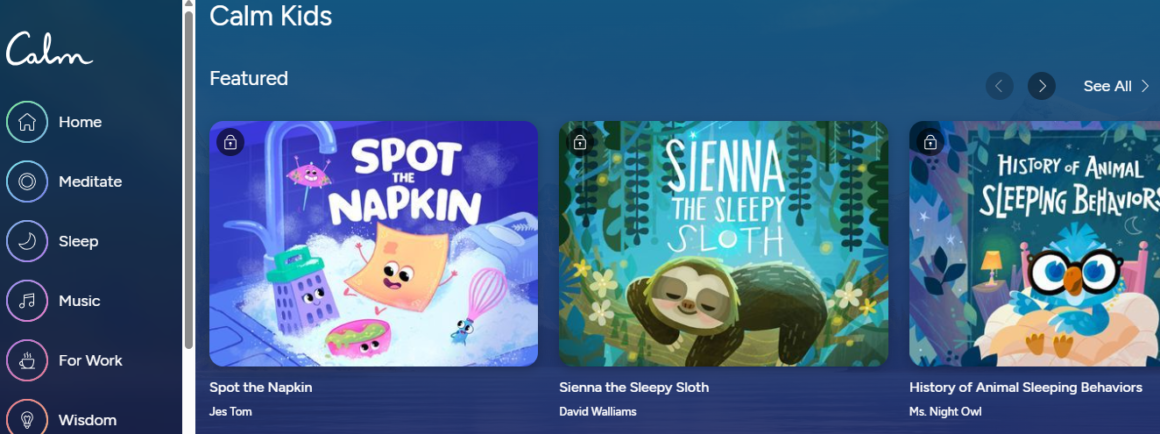
The Calm Kids content library lives inside the main Calm app. You find it through the Discover menu. It is not a separate app. It is not a walled garden. It is a tab.
According to Common Sense Media’s review, the section includes meditations teaching children belly breathing and loving kindness, plus sleep stories for kids starting at age three. The library has become a genuine marketing operation. Variety reported that Calm recruited Pink, Maya Rudolph, Wanda Sykes, and Diane Keaton as narrators, and licensed Peppa Pig, Kung Fu Panda, and the Minions franchise to produce character-branded sleep stories. The celebrity roster grew. The press releases multiplied. The Calm Kids section started looking, from the outside, like a product built for children.
“We now feel a unique urgency,” Calm VP of content Greg Justice said at the time of the expansion. “It’s been very stressful for young people in the past year, so we are doubling down on all things Calm Kids.”
No Controls, No Profiles, No Gate
I spent time looking for a parental control feature inside the Calm app. There is not one. Internet Matters1, a UK child safety organization, documents it clearly: “Calm does not offer any parental controls, meaning parents will be unable to use settings to manage what content their children access or how long they spend on the app.” That statement is still accurate as of 2026.
This is not a minor omission. Calm’s adult library includes meditations on grief and loss, sexuality and relationships, clinical depression, alcohol dependency, and trauma processing. These are valuable for adults. They are not age-appropriate for a six-year-old who wandered past the Peppa Pig section.
“I put the Calm Kids section on my son’s iPad thinking that’s what he’d stick to. Found him the next week listening to something about grief after divorce. He’s eight. He has no idea what divorce is.”
– Parent review, App Store comments, 2024
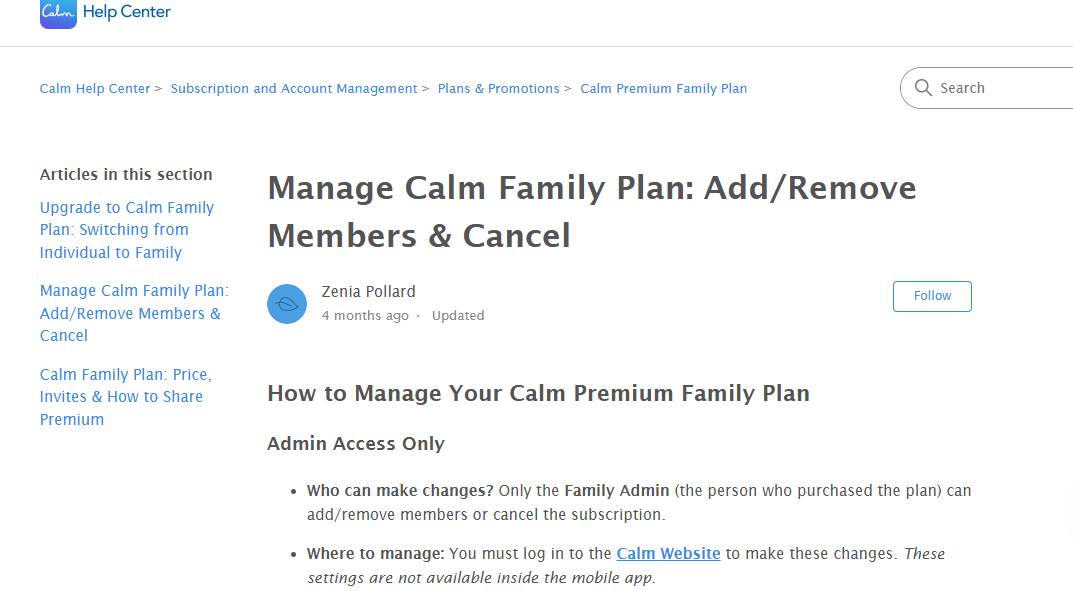
When Calm launched its Premium Family Plan, TechCrunch2 reported that each member gets their own account and login. Calm also noted that session history, stats, and personal information are not shared between family plan members, and that the plan admin can only see the name and email address of each member. No listening history. No usage data. No oversight of what a child account is accessing.
That last part reads as a privacy feature. And in some contexts it is: you might not want your teenager’s meditation history visible to a parent. But when the “family member” is a five-year-old, the same design becomes a parental blindspot. The admin pays for the account and gets zero visibility into what the child is doing on it. Calm’s own help documentation3 confirms this explicitly: “No. The Admin can only see your name and email address to manage the subscription. They cannot see your meditation history, favorites, or check-ins.”
“The app locks most tools behind a paywall. Calm does not offer any parental controls, meaning parents will be unable to use settings to manage what content their children access.”Internet Matters, UK Child Safety Organization
Compare this to what the wider industry is moving toward. The leading parental control tools now offer per-child customization, four-tier content filtering systems, and real-time alerts. Google Family Link provides per-app time limits, app approval workflows, and SafeSearch enforcement. Platforms serving children are under increasing pressure to build real oversight infrastructure. Calm has built none of it.
There is a legal dimension to this gap. The FTC’s COPPA Rule4 applies to operators of online services directed to children under 13, and also applies to general-audience services that have actual knowledge they are collecting data from children under 13. Calm’s terms of service prohibit individuals under 13 from using the service, but the company also markets a Kids section, sells family plans explicitly for use with children, and has published research acknowledging that children as young as three use its content. The 2025 COPPA rule update tightened requirements: the FTC now evaluates “directedness” comprehensively, including subject matter, visual content, animated characters, and the actual age of users. Calm’s Calm Kids content, by any honest reading, is directed at children.
What COPPA Requires:
The Children’s Online Privacy Protection Act requires verifiable parental consent before collecting personal data from children under 13. It applies whenever a service is “directed to children” based on subject matter, visual content, animated characters, or its actual users, regardless of whether the operator asks for age.
Calm explicitly markets content to children as young as three. Its privacy policy, however, prohibits under-13 users rather than addressing how it handles their data when they inevitably appear on the platform anyway.
What Calm Does With the Data It Collects
In August 2024, a series of federal class-action lawsuits were filed in the Northern District of California. The target was Twilio, the cloud communications company whose analytics software development kit is embedded in the Calm app. According to ClassAction.org5, the suits alleged that Twilio’s Segment SDK was collecting user data from Calm without consent: in-app search terms, keystrokes, button presses, page views, names, and email addresses. The data collected from Calm was described as “incredibly sensitive” because it related directly to stress, anxiety, and depression.
The mechanism was specific. Consumer Watchdog6 reported that the Calm app prompts users to answer questions about how they are feeling. If a user reports feeling anxious, that emotional disclosure is captured by the SDK and transmitted to Twilio. The users had no idea. Twilio was not mentioned anywhere in Calm’s privacy policy. There was no opt-in, no opt-out, and no disclosure.
The Register7 confirmed the technical reality: when testing Calm on iOS before account creation, the app was already making network calls to segment.com, appsflyersdk.com, perimeterx.net, iterable.com, and segment.io. The data pipeline was operating before a user even set up an account.
“The problem with Twilio is that consumers do not know that by interacting with an app which has embedded the Segment SDK that their sensitive data is being surreptitiously siphoned off by an unknown third party,” the lawsuit stated. “Consumers are never informed about the Segment SDK being embedded into the app, they never consent to Twilio’s data collection practices, nor are they allowed to opt-in or opt-out of Twilio’s data collection practices.”
In August 2025, Justia8 reported that a federal court ruled that Twilio could force the case into arbitration as a third-party beneficiary of Calm’s terms of service, because the plaintiff’s claims were intertwined with Calm’s own user agreement. The case did not go away. It went sideways, into a process designed to keep outcomes private.
This matters for children specifically because the same SDK operating on an adult account operates on a child’s account. A seven-year-old opening the Calm app to listen to a Peppa Pig sleep story is generating keystroke data, behavioral data, and potentially emotional check-in data that gets routed to third parties through a pipeline the child’s parents were never told about. Calm has not addressed this publicly.
Separately, according to LawsuitLegit9, Calm faced accusations of sharing users’ video watch history with Facebook without consent, in alleged violation of the Video Privacy Protection Act. The eligible class included Calm subscribers with Facebook accounts who watched videos on the platform in the prior two years.
Common Sense Media’s10 privacy evaluation of Calm gave the app a Warning rating. The evaluation found that personal information is sold or rented to third parties, personal information is shared for third-party marketing, personalized advertising is displayed, and data profiles are created for ad targeting. The parental consent section of the evaluation received a score of just 20 percent, with the evaluators noting that Calm does not provide a separate section or policy for children, and that it is unclear whether the company deletes children’s personal information if collected without parental consent.
“Calm may sell personal information to third parties for profit, and Calm may track a user’s activity on its service and across the internet over time for commercial purposes.”
– Common Sense Media Privacy Evaluation of Calm
The Subscription Architecture Is Built for Adults
The Calm family plan costs $99.99 per year and covers up to six accounts.
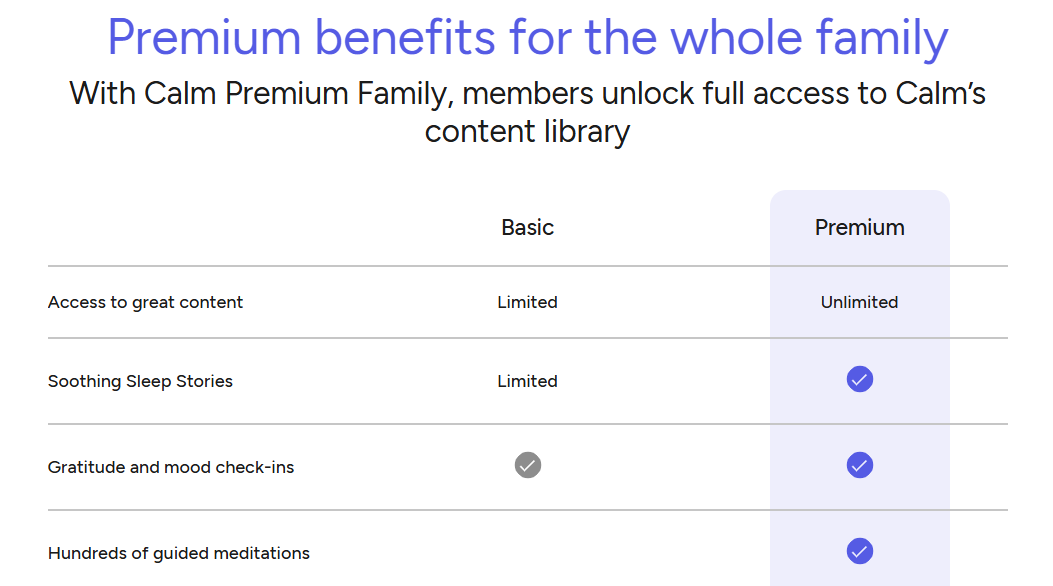
Scary Mommy11 noted when the plan launched that members of the family plan don’t need to live in the same household, which is sometimes a useful feature for adults splitting the cost. For parents managing their children’s digital lives, it creates a strange situation: the account admin is paying for six seats but has almost no visibility into any of them.
Cancellation is its own ordeal. Trustpilot12 reviews of Calm show a pattern of users who believed they had cancelled but continued to be charged, with one reviewer describing a 4 AM text confirming an annual renewal after a cancellation they thought was completed. Another called the company “expert scammers” after being charged for an upgraded annual plan without clear consent.
A third-party cancellation service, Pine AI13, documented more than 300 recent complaints on Pissed Consumer, specifically flagging “incorrect billing amounts” and poor customer service around trial endings. Calm’s family plan, per its own help documentation, can only be cancelled by the admin through the website, not through the app, adding a layer of friction that parents already juggling multiple digital subscriptions may not navigate smoothly.
The pricing has also climbed. What was once a $59.99 annual plan now runs to $79.99 per year for individuals, with the family plan at $99.99. Reviews on Trustpilot indicate that some users have seen price increases communicated poorly or not at all ahead of renewals.
“I cancelled my ‘free trial’ within hours, which was confirmed via email. Days later, CALM sent a text at 4 AM confirming my annual subscription: cancellation does not prevent payment.”
-Trustpilot review, 2025
The children using these accounts have no billing relationship with Calm at all. They are passengers on plans managed by adults. But the data those children generate, the meditations they play, the emotional check-ins they complete, the search terms they enter, flow into the same data infrastructure as every other account.
The Broader Legislative Moment
Calm’s gaps exist inside a regulatory environment that is finally, if slowly, catching up to how children actually experience apps.
A Fortune14 analysis from March 2026 described two bills moving through Congress that take fundamentally different approaches to protecting children online. KOSA, the Kids Online Safety Act, requires companies to conduct risk assessments, restrict default settings on minors’ accounts, disclose how recommendation algorithms work, and give parents meaningful oversight tools. The App Store Accountability Act aims to stop the problem earlier: requiring age verification at the account level and parental consent for each minor’s download.
At the state level, Inside Privacy15 reported that Utah enacted the country’s first law requiring app store providers to verify all users’ ages and obtain verifiable parental consent before minors can download or purchase apps. The law went into effect in May 2026. Nebraska’s Parental Rights in Social Media Act requires platforms to provide methods for parents to supervise minor accounts, including the ability to view posts and control settings.
A bipartisan Parents Decide Act16 proposes requiring age verification at the device level, creating a system where parental decisions made at activation flow through to apps. The legislation’s proponents cited a 13-year-old who died by suicide after engaging with an AI chatbot, and a 14-year-old in Florida who was encouraged toward self-harm by an AI model. The harms driving this legislation are not from bad actors in dark corners of the internet. They are from apps and platforms that positioned themselves as safe, beneficial, or even therapeutic.
Calm positioned itself as all three.
A 2024 study cited by MMGuardian17 found that 67 percent of apps marketed to children still use trackers or request permissions that violate COPPA guidelines. Calm is not unusual in its practices. It is notable because of the contrast between its brand identity, built on the explicit promise of safety, peace, and mental health, and what its data infrastructure actually does.
What the Science Actually Says About Kids and Meditation Apps
Before any of the privacy questions, there is a more basic one worth asking: Does Calm Kids even do what it promises?
A review of mindfulness apps for children published in Springer’s Mindfulness journal18 found that despite acceptable quality scores, most apps in the category failed to reach a “good” rating across all evaluated dimensions, and the authors concluded that “empirical evidence on their effectiveness is clearly warranted.” In other words: the science has not caught up to the market.
A 2025 systematic review and meta-analysis published in NIH’s19 scientific reports found that results for mindfulness-based interventions on anxiety, depression, and stress in children and adolescents remain uncertain, with variable results across studies. The most credible research on mindfulness apps, a 2024 systematic review in NPJ Mental Health Research20 covering 28 randomized controlled trials and nearly 6,000 adults, found moderate to large effects for attention regulation and reducing repetitive negative thinking, but mixed findings across most other domains, with sustained engagement being a consistent problem.
That last finding matters for children specifically. Calm’s business model depends on daily habits, streaks, and retention. The app shows users their meditation minutes and streak counts. These engagement mechanics work for adults. Applied to children, they risk turning a therapeutic tool into an obligation, and a potentially anxiety-producing one at that.
Calm has not published peer-reviewed research on outcomes for child users specifically. Studies found widespread child use of the platform was a survey of parental perception, not a clinical trial. Parents believed Calm was helping. That belief may or may not reflect what is actually happening in a seven-year-old’s nervous system.
What a Responsible Design Would Look Like
The gap between what Calm offers and what responsible child-focused design would look like is not narrow. It is a chasm you could drive a Peppa Pig float through.
A genuinely parent-safe children’s wellness app would have separate child profiles with age-appropriate content locked in at the profile level. It would require a parent to authenticate before any account settings are changed. It would give the managing adult visibility into which content their child accessed, while still respecting the child’s emotional privacy in meaningful ways. It would prohibit third-party SDKs from collecting behavioral and emotional data from child accounts. It would have a clear, prominent privacy policy for children that meets COPPA standards. And it would not bury family plan cancellation behind a web-only interface while auto-renewing at escalating prices.
None of this is technically difficult. Apps in adjacent categories manage it. The reason Calm has not done it is probably simple: building real parental infrastructure costs money and adds friction. The current design is frictionless for everyone except the parent trying to understand what their child is actually doing inside it. One user simply stated:
“I have been trying for 2 years to cancel my Calm app. Please advise on how to achieve this. I’m very frustrated!”
Bark21, a parental monitoring service, reviewed Calm and concluded that because the app has no social features, no objectionable content, and no community interactions, “no parental controls are needed.” That conclusion made sense when Bark evaluated it. What Bark did not account for: the adult meditation content sitting two taps from a children’s story, the behavioral data flowing to third-party analytics platforms, or the subscription architecture that makes oversight nearly impossible for the adults nominally in charge.
The brand promise of Calm is that it makes difficult things easier. Anxiety. Insomnia. Grief. The irony is that for parents trying to understand whether the app is safe for their children, Calm makes everything harder. There is no parental dashboard. There is no content filter. There is no privacy policy that directly addresses what happens to a six-year-old’s emotional check-in data. There is just the app, doing what apps do, and a Calm Kids section that exists primarily as a marketing layer over an adult product.
That is not calm. That is a problem dressed in blue.
What Needs to Happen
Calm should build a genuinely separate child mode, with age-gated content, parental visibility controls that do not compromise children’s appropriate privacy, and an explicit COPPA-compliant policy governing data collection from child accounts. It should audit which SDKs are collecting data from accounts linked to children and remove or restrict any that are not disclosed in its privacy policy. It should redesign family plan cancellation so that it is as easy as signing up, and disclose pricing changes clearly before they hit a credit card.
The broader problem is that wellness apps occupy a strange regulatory space. They are not medical devices, so the FDA does not regulate them. They are not social networks, so social media-focused legislation does not quite fit. But they collect sensitive mental health data, market to children, and operate subscription models that have generated hundreds of consumer complaints. The legislative push happening at both the state and federal levels is long overdue. Whether Calm changes before it is required to is a question of corporate character.
The app markets itself on the promise of peace of mind. Parents deserve to actually have some.
Sources
- Internet Matters, www.internetmatters.org/advice/apps-and-platforms/wellbeing/calm-app/. Accessed 20 June 2026. ↩︎
- Malik, Aisha. “Meditation app Calm introduces new family plan with six accounts” TechCrunch, 8 Nov. 2021, techcrunch.com/2021/11/08/meditation-app-calm-introduces-new-family-plan-with-six-accounts/. Accessed 20 June 2026. ↩︎
- Calm, support.calm.com/hc/en-us/articles/4410432145435-How-to-Manage-Your-Calm-Premium-Family-Plan-Subscription. Accessed 20 June 2026. ↩︎
- “Complying with COPPA: Frequently Asked Questions” 20 July 2020, www.ftc.gov/business-guidance/resources/complying-coppa-frequently-asked-questions. Accessed 20 June 2026. ↩︎
- ClassAction.org, www.classaction.org/news/privacy-lawsuits-allege-twilio-verve-amplitude-software-dev-kits-steal-consumers-data. Accessed 20 June 2026. ↩︎
- “Software Used By a Meditation App and DoorDash is Being Sued For Sending Personal Data to Unknown Third Parties Without Consent – Consumer Watchdog” 15 Aug. 2024, consumerwatchdog.org/privacy/software-used-by-a-meditation-app-and-doordash-is-being-sued-for-sending-personal-data-to-unknown-third-parties-without-consent/. Accessed 20 June 2026. ↩︎
- Claburn, Thomas. “Twilio’s Segment SDK challenged with wiretapping claim” 9 Aug. 2024, www.theregister.com/2024/08/09/twilio_privacy_lawsuit/. Accessed 20 June 2026. ↩︎
- Justia, docs.justia.com/cases/federal/district-courts/california/candce/3:2024cv04914/434000/47. Accessed 20 June 2026. ↩︎
- Crane, Shirley. “Calm Faces Privacy Breach Accusations” Personal Injury Lawyers And Class Action Lawsuit S, 17 Mar. 2024, lawsuitlegit.com/calm-faces-privacy-breach-accusations/. Accessed 20 June 2026. ↩︎
- “Calm” Privacy Evaluation, privacy.commonsense.org/evaluation/Calm. Accessed 20 June 2026. ↩︎
- “The Calm App’s New Family Plan Is Exactly What We Need Right Now” 9 Nov. 2021, www.scarymommy.com/calm-app-family-plan. Accessed 20 June 2026. ↩︎
- Trustpilot, uk.trustpilot.com/review/calm.com. Accessed 20 June 2026. ↩︎
- “How to Cancel Your Calm Subscription (2026)” Pine AI, www.19pine.ai/cancel-subscription/gym-memberships-and-wellness/how-to-cancel-calm. Accessed 20 June 2026. ↩︎
- Gioino, Catherina. “Social media companies are scrambling to verify minors online. Congress just made it a lot more complicated” Fortune, 18 Mar. 2026, fortune.com/2026/03/18/kosa-kids-act-app-store-accountability-act-minors-age-verification/. Accessed 20 June 2026. ↩︎
- Inside Privacy, www.insideprivacy.com/childrens-privacy/state-and-federal-developments-in-minors-privacy-in-2025/. Accessed 20 June 2026. ↩︎
- “RELEASE: Gottheimer Announces Bipartisan “Parents Decide Act” to Protect Kids Online” gottheimer.house.gov/posts/release-gottheimer-announces-bipartisan-parents-decide-act-to-protect-kids-online. Accessed 20 June 2026. ↩︎
- Pritchett, Coley. “Safe Apps for Kids in 2026: The Ultimate Parent’s Guide to Privacy, Control & Screen Time” MMGuardian, 18 Aug. 2025, www.mmguardian.com/blog/safe-apps-for-kids. Accessed 20 June 2026. ↩︎
- Nunes, Andreia. “A Review of Mindfulness-Based Apps for Children” Springer Nature Link, 20 Nov. 2020, link.springer.com/article/10.1007/s12671-020-01410-w. Accessed 20 June 2026. ↩︎
- “Mindfulness in Mental Health and Psychiatric Disorders of Children and Adolescents: A Systematic Review and Meta-Analysis of Randomized Controlled Trials” PMC , pmc.ncbi.nlm.nih.gov/articles/PMC12101429/. Accessed 20 June 2026. ↩︎
- NPJ, doaj.org/article/962c371355c04943a49da7ec59b760bf. Accessed 20 June 2026. ↩︎
- “Is Calm Safe? A Calm App Review for Parents and Families” Bark, www.bark.us/app-reviews/apps/calm/. Accessed 20 June 2026. ↩︎


