

There is a woman in Miami who used to make wedding favors for a living. She’d been doing it since 2015, designing custom pieces full-time, balancing a one-person business with being a single mother. By early 2023, her two Etsy shops were bringing in more than $30,000 a month in orders. She had built something real. Then, on May 18, 2023, Etsy placed a reserve on her accounts. She didn’t get a clear explanation. She couldn’t unlock the funds. In June, with $20,000 frozen inside her Etsy Payment account, her income dropped to $444 for the entire month.
- What a Reserve Actually Is
- How It Started, How It Spread
- The 75 Percent Problem
- The Float Nobody Talks About
- The Rules Changed, the Structure Didn’t
- Star Seller: The Escape Hatch That Isn’t
- The October 2025 Expansion
- The Compliance Argument and Its Limits
- What the Balance Sheet Tells You
- Where Things Stand Now
“They’re holding $20,000 of mine,” she told Sky News1, withholding her surname out of fear Etsy would shut her account entirely. “I basically can’t buy food. I’ve just reached two months of my rent being late and I’ve maxed out two credit cards.”
This wasn’t an anomaly. It was a pattern. And three years later, the system that destroyed her summer is still running.
What a Reserve Actually Is
Before getting into the damage, it’s worth understanding the mechanics. Etsy’s Payments Policy2 defines a reserve as “an amount of money pending settlement” placed on an account when Etsy believes “there may be a high level of financial risk associated with you, your account, your business model, or your transactions.” When a reserve is active, a percentage of incoming funds is held and cannot be deposited. The money shows up in a seller’s dashboard. They can see it. They just can’t touch it.
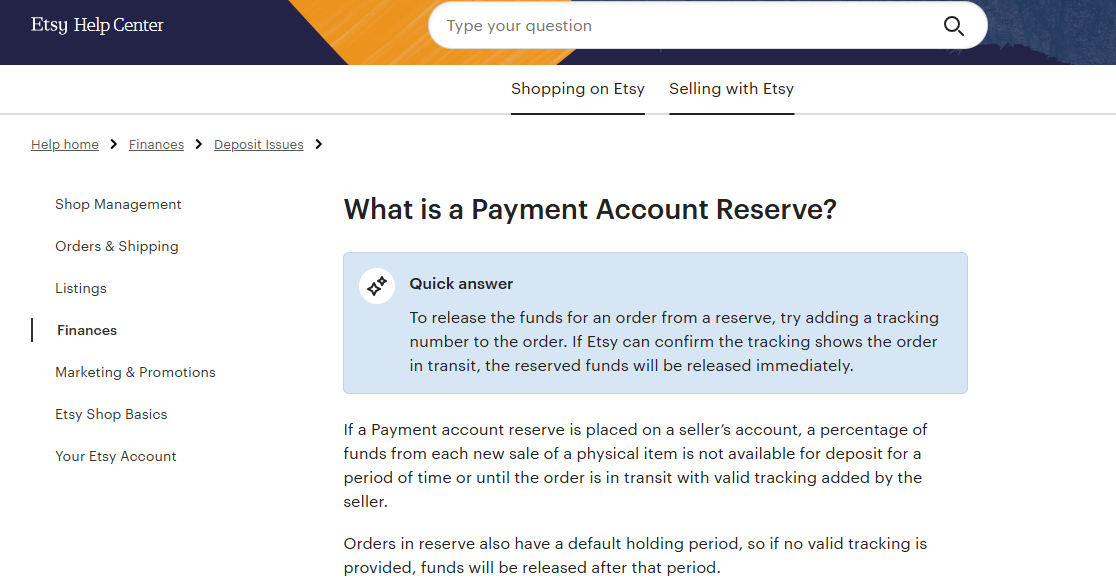
Etsy’s official Help Center page3 on reserves explains that funds held for individual orders are typically released once tracking confirms shipment, or after 45 days. For most sellers, the reserve itself is removed within 90 days, provided the shop remains in good standing. But that 90-day clock can be extended if Etsy has “concerns with order fulfillment or policy violations.” The policy adds, almost in passing, that support agents cannot remove a reserve from an account. Whatever algorithm put it there is the only thing that takes it off.
This is the structure sellers are working inside: a black box that charges a financial toll, with no human override and no formal appeals process.
How It Started, How It Spread
Etsy introduced payment reserves in February 2021, initially targeting new shops. The reasoning was straightforward: new sellers are unproven, and Etsy is liable if a buyer files a chargeback against a shop that has already withdrawn its funds and disappeared. Holding a portion of early earnings was a precaution. It was also, in the fine print, always a right Etsy reserved for anyone.
The trouble started when “anyone” began to mean longtime sellers with years of five-star reviews.
By early 2023, Etsy had quietly expanded reserve eligibility to established shops. The triggering criteria, as listed in Etsy’s Seller Handbook4, included a sudden spike in orders, consistently missing tracking information, late shipments, a recent increase in refunds, and being new to the marketplace. But Etsy was explicit about what it would not share: the specific logic and thresholds behind the system. The platform’s stated reason for this opacity was to protect against fraudulent actors gaming the criteria. The practical effect was that sellers had no way to understand, predict, or challenge a reserve placed on their account.
“A payment account reserve is placed on a seller’s account due to a combination of factors, so it’s unlikely that a reserve would be placed due to only one change or risk criteria. We do not share the specific logic or thresholds we use to determine if a reserve is placed on a seller’s account.”
That post generated over 200 replies. It was far from the only thread on the subject.
The 75 Percent Problem
The number that made sellers furious wasn’t 45 days. It was 75 percent.
According to research compiled by the Indie Sellers Guild5, a nonprofit organization advocating for marketplace sellers, most established shops that were placed on reserve in 2023 had 75 percent of their incoming funds held. That left 25 cents of every dollar. Out of that 25 cents, Etsy then deducted its own transaction fees, listing fees, and payment processing costs, which typically run between 11 and 17 percent of a sale. Taxes came out on top of that. For many sellers, the math left almost nothing to operate on.
Shirlee Grund6, a fine jewelry artisan who had sold on Etsy for over a decade with thousands of five-star reviews, described her experience in a blog post that circulated widely in seller communities:
“Etsy placed my shop on hold for months with a 75% reserve. Despite consistent customer service and thousands of 5-star reviews, Etsy held my funds without notice or explanation.”
She said the Help Center was largely unresponsive, offering contradictory information including one agent who told her the shop was scheduled for deletion. She eventually received her funds only after filing a complaint with the Better Business Bureau and threatening legal arbitration. The experience led her to restructure her entire business model to limit her Etsy presence.
This was a recurring script. Sellers who had never had a chargeback, never violated a policy, and had operated cleanly for years were suddenly locked out of their own income. Researcher Cindy Baldassi at CindyLouWho27, who tracked the situation closely, noted that she encountered “numerous examples that make no sense based on Etsy’s own statements, and others that seem to be overkill, as well as a few that are confirmed errors by Etsy’s automated systems.”
Dan, a furniture seller from Aylesbury in Buckinghamshire, also declined to provide his surname to press. He told Sky News8 his Etsy business had been growing steadily until a reserve was imposed on June 14, 2023, without warning. Steen Ross, from Norwich, had £1,800 frozen in her account. These were not rogue actors. They were small business owners who had trusted a platform with their livelihoods.
The Float Nobody Talks About
There is a financial dimension to this story that rarely gets named directly.
When Etsy holds seller funds in reserve, that money doesn’t disappear. It sits somewhere. And while it sits, it can earn interest. Etsy’s own balance sheets show the scale of what’s in play. In its 2023 annual report filed with the SEC9, Etsy listed “Funds payable and amounts due to sellers” as a current liability of $265 million as of December 31, 2023. At the peak earlier that year, it was higher. Quarter after quarter, hundreds of millions of dollars owed to sellers sat on Etsy’s books.
This is not unique to Etsy. PayPal, Stripe, Amazon, and other payment platforms all carry similar liabilities. What makes Etsy distinctive is the combination of opacity around why individual holds are triggered, the severity of the percentage withheld, and the fact that sellers operating on tight margins can be materially harmed by a 45-day delay on 75 percent of their income. The mechanics of float are a standard part of payments infrastructure. The question is who bears the cost of that float and who captures the benefit.
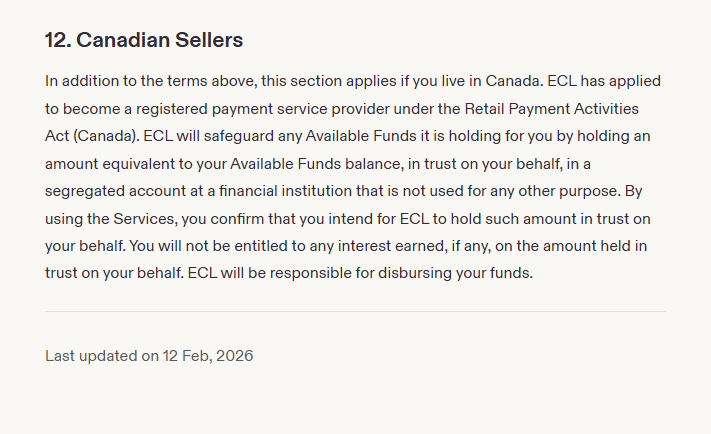
Etsy’s policy10, introduced in October 2025, actually made this explicit in a telling way. The updated terms stated that Canadian sellers would “not be entitled to any interest earned, if any, on the amount held in trust on your behalf.” The language answered a question most sellers had never thought to ask: yes, there is interest. No, you don’t get it.
In July 2023, the British press finally got hold of the story. Sky News published a report featuring multiple sellers whose businesses had been crippled by the reserve policy, including the Miami wedding favor designer and the Aylesbury furniture seller. UK Small Business Commissioner Liz Barclay was quoted directly:
“Up until now, we have been hearing of online platforms withholding smaller amounts of money. This is the first time I’ve heard 75% being withheld in reserves and that is quite shocking.”
She added:
“These small suppliers are the lifeblood and the talent that drives your business success. They need to be paid as quickly as possible or they may go to the wall.”
Barclay also acknowledged the limits of her own power. The UK government, she said, had no jurisdiction over online selling platforms like Etsy, which are not UK companies. The complaint could be made, the coverage could run, but the mechanism for forcing change didn’t exist.
What did exist was embarrassment ahead of an earnings call.
Within days of the Sky News report, Etsy began quietly releasing some reserves early, without explanation. Several UK sellers reported their holds lifted shortly after the story aired. Then, on August 1, 2023, Etsy announced it would “substantially” reduce the percentage held for most sellers, adjust tracking requirements to better account for sellers in countries without cheap tracked shipping options, and provide more communication to sellers placed on reserve.
Value Added Resource11, which covers e-commerce platform policy closely, framed the question bluntly: was this a sincere effort to improve seller relations, or a last-ditch move to head off payment reserve scrutiny ahead of the Q2 2023 earnings call?
The answer was probably both. The reserve percentage dropped. The opacity did not.
The Rules Changed, the Structure Didn’t
After the August 2023 announcements, the standard reserve percentage came down from 75 percent to roughly 30 percent for most established sellers. The Indie Sellers Guild12 updated their documentation to reflect this shift, while noting that the underlying system remained unchanged. The criteria were still opaque. The algorithm still couldn’t be appealed. The customer support agents still couldn’t override it.
For new sellers, the picture stayed harsh. In March 2024, Etsy13 introduced payment holds specifically for new shops, ranging from 14 to 20 business days before any funds could be accessed at all. By 2025, the rolling reserve for new sellers was holding 30 percent of funds until day 49 from the date of sale.
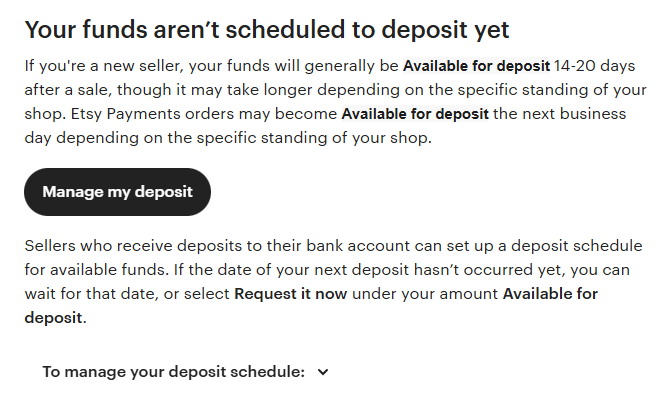
The math on a $200 custom order under this system: $60 held for 45 days. For a new seller buying supplies to fill orders they’ve already received, that’s a forced float they never agreed to, secured against their own labor.
One account from the ecomdelivery.net14 payment tracker described a seller named Danielle who ran a pressed-flower resin jewelry shop with around 180 active listings. When a TikTok creator featured her botanical earrings in October 2024, she pulled in $9,800 in 11 days. Etsy flagged her account for “unusual sales velocity” and placed a reserve on 35 percent of incoming funds. “I had 140 orders to fulfill,” she said.
“Resin, molds, dried botanicals — I needed to buy supplies immediately. Instead I was scrambling to front $800 out of my personal account while Etsy sat on my money.”
This is the structural trap. A sales spike, which is the thing every small seller is working toward, can be the very thing that triggers a reserve. Growth becomes a liability flag.
Star Seller: The Escape Hatch That Isn’t
Etsy built one official path to reserve exemption: the Star Seller badge. Per Etsy’s policy15, sellers who qualify for Star Seller are not subject to payment account reserves. The badge requires a consistent track record of fast response times, on-time shipping with tracking, and positive reviews. Shops are reviewed on the first of each month.
The exemption sounds generous until you look at who needs it most.
Star Seller rewards sellers who have already built stable, consistent operations with strong track records. The sellers most at risk of reserves are, by definition, the ones who don’t have that yet: new shops, sellers who just had an unusual spike in orders, sellers who ship items that are difficult to track affordably across international borders, sellers who make high-value custom pieces that take longer to produce.
Etsy’s own policy16 acknowledges that a reserve can be triggered by a sudden sharp increase in orders. A seller who gets Star Seller in September, has an unusually busy October, and loses Star Seller status in November can find themselves placed on reserve in December for the same growth that looked like success two months earlier.
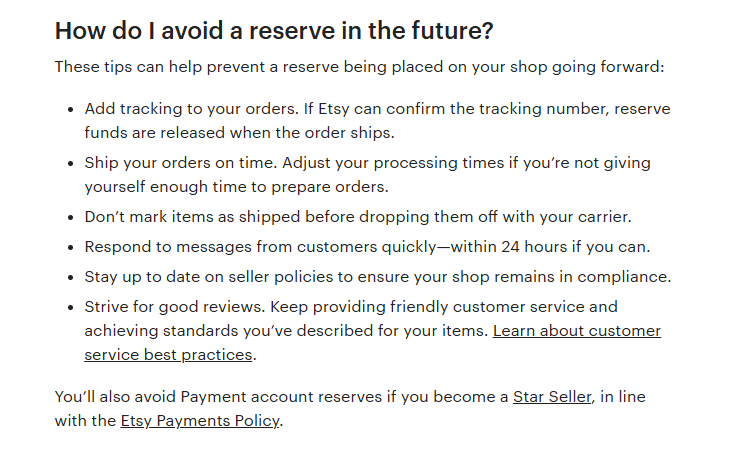
The badge is designed to reward stability. Reserves are triggered by instability. Sellers live in the space between the two.
The October 2025 Expansion
If 2023 was the year sellers learned about reserves, 2025 was the year the system got broader.
In August 2025, Etsy17 quietly posted an update to its Payments Policy that took effect October 9, 2025. The most significant change: Etsy extended its power to place holds and delays on deposits to any accounts it “determines are related” to an account under review. Previously, a hold was placed on the account of concern. Under the new language, if Etsy decides two shops are connected, it can place a hold on both.
The practical implications are significant for anyone who has run multiple shops, shares a home address with a family member who also sells on Etsy, or has ever been linked to another account for any reason. The definition of “related” is not spelled out. It’s another opaque determination made by a system sellers cannot see or challenge.
Value Added Resource18 flagged the concern immediately:
“Do we really want Etsy determining what accounts are ‘related’ to others and then placing a reserve on other shops, or deducting a debt owed from shops that are in fact not related? Given Etsy’s history with this sort of thing, and the complete lack of support available to sellers right now, this is a huge potential problem.”
The October 2025 update also formally established Etsy as an “agent” for US sellers for the purposes of receiving, holding, and settling payments. This is a technical designation with legal implications around who controls the funds during the holding period and what remedies sellers have if something goes wrong.
The Compliance Argument and Its Limits
Etsy is not wrong that payment reserves serve a purpose. The company is on the hook for chargebacks and buyer protection claims. If a seller takes payment for 100 orders, ships nothing, and withdraws all their funds, Etsy is the one that has to cover the refunds. Reserves are a legitimate risk management tool used across the payments industry.
The practice is legal and common. The firm was called in to consult on whether sellers had grounds for legal action. Their conclusion was that reserves can be a blanket policy, and that platforms can hold funds as a precaution. Amazon, for comparison, holds 3 percent of daily payments for sellers who have been on the platform for over a year and have processed at least 100 orders.
The difference is 3 percent versus 75 percent. The difference is being told about it before you open your shop versus having it imposed on a business you’ve been running for eight years. The difference is a policy that applies universally versus an algorithmic determination that strikes some sellers and not others for reasons the platform refuses to explain.
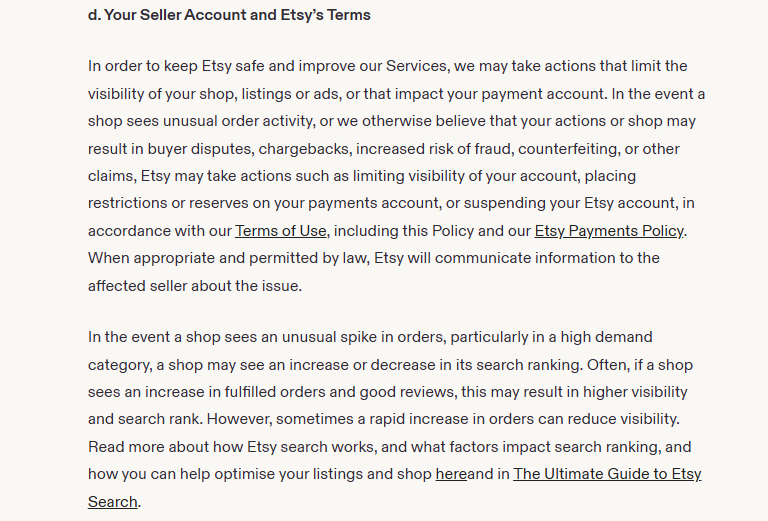
Etsy’s seller policy19 states that “when appropriate and permitted by law, Etsy will communicate information to the affected seller about the issue.” The phrase “when appropriate” is doing a lot of work in that sentence.
What the Balance Sheet Tells You
It is worth spending a moment on Etsy’s own numbers, not to suggest bad faith, but to understand incentives.
According to Yahoo Finance20, Etsy’s full-year 2024 revenue was $2.81 billion, with a profit margin of roughly 11 percent. The company was simultaneously watching its active seller count fall: by Q3 2025, active sellers had dropped 10.9 percent year-over-year to 5.5 million. A new CEO, Kruti Patel Goyal, took over on January 1, 2026, promising “human-centric technology” and a return to growth.
The seller decline happened alongside increased fee extraction. One analyst at Simply Wall St21 noted in a 2024 review that Etsy’s profit margins increased as the company earned more fee revenue on sellers, “yet it saw a sharp decline in sellers, buyers, and sales per customer.” The analysis concluded:
“In my view, Etsy has become too focused on extracting income from sellers instead of creating a rich ecosystem of buyers and sellers.”
This is the broader context for understanding the reserve system. It is not simply a risk tool. It exists inside a fee architecture that is already expensive and inside a power dynamic where sellers have few real alternatives. The reserve holds funds, those funds may earn interest that sellers don’t see, and the communication around why it happened and when it will end is systematically vague.
When a seller can’t access their own money to buy supplies to fill the orders that generated that money in the first place, the cost of the reserve is borne by the seller. The benefit, in the form of float and reduced chargeback exposure, accrues to the platform.
Read through the Etsy Community forums22 and the pattern is clear. A thread from April 2024 captures a seller trying to formally complain after Etsy placed a deposit hold following a bank verification process. The seller had verified their account, saw it listed as verified, and still couldn’t access funds. They had contacted support five times. They were told there was no formal complaints procedure. Another community member responded: “Etsy and sellers is a business to business contract between businesses. There is no complaints procedure.”
That response is not wrong. It’s just clarifying how little recourse actually exists.
The community thread on whether to file a complaint also noted that Etsy’s terms of use allow reserves and deposit holds for up to six months. Six months. For a small business that operates on a monthly cash cycle, six months of 30 to 75 percent withheld is not a precaution. It can be a closure.
Where Things Stand Now
According to BBC23, as of 2025 and into 2026, Etsy’s reserve system for new sellers can hold up to 75 percent of income for 45 days. The standard for most new shops sits at 30 percent withheld until day 49. The Star Seller exemption remains in place. The appeal process for reserves remains nonexistent. Etsy’s support team still cannot override the system. And the October 2025 policy expansion means that holds can now cascade across accounts that Etsy decides are connected, for reasons Etsy does not have to explain.
The advice given to sellers on forums is by now well-rehearsed: build a cash buffer before you launch, buy shipping labels through Etsy to get tracking that Etsy’s system can read, keep your processing times conservative, don’t ship without tracking, respond to messages within 24 hours, and pray you don’t have a viral moment before you’ve earned Star Seller status.
That last one is not a joke. The system penalizes growth before it can be verified. It treats success as a risk signal. And it does so through a mechanism that is algorithmic, opaque, and functionally unchallengeable.
Here is the question that runs underneath all of this: what is the right relationship between a platform and the small businesses that generate its revenue?
Etsy’s marketplace model depends on sellers. Without the candle makers and the jewelry designers and the furniture builders and the wedding favor artists, there is no Etsy. The platform’s entire value proposition to buyers is predicated on those sellers showing up, making things, fulfilling orders, and building reputations. When the platform’s risk management systems impose financial costs on those same sellers, costs that can be severe enough to push small businesses into debt or closure, the question of who bears the real risk of operating on the platform becomes sharp.
Payment reserves are, in theory, a shield for the platform. In practice, for the sellers who absorb the cash flow damage, they function as an extraction. The seller does the work, ships the order, provides the customer experience. The platform holds the money, earns whatever the money earns while it sits, and releases it on a schedule the seller cannot negotiate.
That’s not a bug in the system. It’s what the system is designed to do.
Sources
- Sky News, news.sky.com/story/they-are-holding-15-000-i-basically-cant-afford-food-etsy-sellers-claim-platform-is-imposing-75-reserves-on-their-sales-12921271. Accessed 26 June 2026. ↩︎
- “Etsy.Com” www.etsy.com/legal/etsy-payments/. Accessed 26 June 2026. ↩︎
- Etsy, help.etsy.com/hc/en-us/articles/360058722214-What-is-a-Payment-Account-Reserve. Accessed 26 June 2026. ↩︎
- “Etsy.Com” www.etsy.com/seller-handbook/article/1177649220109. Accessed 26 June 2026. ↩︎
- Indiesellersguild, indiesellersguild.org/etsy-payment-account-reserves-what-weve-learned/. Accessed 26 June 2026. ↩︎
- Grund, Shirlee. “The Etsy Seller Reserve Program: Unraveling the Unseen Struggles for Sellers” Shirlee Grund Jewelry, 17 Aug. 2023, shirleegrund.com/blogs/news/how-etsys-seller-payment-reserve-policy-hurts-small-businesses. Accessed 26 June 2026. ↩︎
- “Etsy Payment Account Reserves: What Every Seller Needs To Know — CindyLouWho2” 22 Oct. 2021, www.cindylouwho2.com/blog/2021/10/22/etsy-payment-account-reserves-what-every-seller-needs-to-know. Accessed 26 June 2026. ↩︎
- Sky News, news.sky.com/story/they-are-holding-15-000-i-basically-cant-afford-food-etsy-sellers-claim-platform-is-imposing-75-reserves-on-their-sales-12921271. Accessed 26 June 2026. ↩︎
- “SEC.gov”, www.sec.gov/Archives/edgar/data/0001370637/000137063724000013/Financial_Report.xlsx. Accessed 26 June 2026. ↩︎
- “Etsy.Com” www.etsy.com/legal/etsy-payments/. Accessed 26 June 2026. ↩︎
- Morton, Liz. “Etsy Responds To Seller Concerns About Payment Reserves” Value Added Resource, 31 May 2023, www.valueaddedresource.net/etsy-responds-to-seller-concerns-about-payment-reserves/. Accessed 26 June 2026. ↩︎
- Indiesellersguild, indiesellersguild.org/etsy-payment-account-reserves-what-weve-learned/. Accessed 26 June 2026. ↩︎
- Etsy, help.etsy.com/hc/en-us/articles/360002080688-Why-Hasn-t-My-Money-Been-Deposited-Yet. Accessed 26 June 2026. ↩︎
- ecomdelivery, ecomdelivery.net/when-does-etsy-pay-sellers-2025-deposit-schedule/. Accessed 26 June 2026. ↩︎
- “Etsy.Com” www.etsy.com/seller-handbook/article/1177649220109. Accessed 26 June 2026. ↩︎
- Etsy, help.etsy.com/hc/en-us/articles/360058722214-What-is-a-Payment-Account-Reserve. Accessed 26 June 2026. ↩︎
- “Etsy.Com” www.etsy.com/legal/policy/etsy-payments-policy-effective-until/1396469674685. Accessed 26 June 2026. ↩︎
- Morton, Liz. “Etsy Payments Policy Update October 2025: What Sellers Need To Know” 30 Aug. 2025, www.valueaddedresource.net/etsy-payment-policy-update-october-2025/. Accessed 26 June 2026. ↩︎
- “Etsy.Com” www.etsy.com/legal/policy/seller-policy-effective-through/1283095227943. Accessed 26 June 2026. ↩︎
- Yahoo, finance.yahoo.com/news/etsy-full-2024-earnings-eps-102946715.html. Accessed 26 June 2026. ↩︎
- Simply Wall St, simplywall.st/stocks/us/retail/nyse-etsy/etsy/health. Accessed 26 June 2026. ↩︎
- “Etsy withholding funds against their own policy | Etsy Community Technical Issues” Etsy Community, 11 Apr. 2024, community.etsy.com/t5/Technical-Issues/Etsy-withholding-funds-against-their-own-policy/td-p/145308567. Accessed 26 June 2026. ↩︎
- Masud, Faarea. “Etsy U-turn in row over withholding sellers’ money” 2 Aug. 2023, www.bbc.com/news/business-66387147. Accessed 26 June 2026. ↩︎