



In India’s IT services industry, employment can feel secure and uncertain at the same time. You clear the interviews. You complete the training. You receive the offer letter from a global giant like Infosys or Wipro. Your family celebrates. You have made it.
- The Bench Model: Efficient for Firms, Ambiguous for Workers
- Skills in Suspension: The Risk of Technical Stagnation at Infosys and Wipro
- Income Growth and the Utilization Trap at Infosys and Wipro
- Mental Health, Visa Status, and the Hidden Weight of Bench Time at Infosys and Wipro
- A Brief Path Forward: Measuring What Matters
Then you wait.
You log in each morning. You check internal portals for project openings. You complete mandatory learning modules. You message managers. You update your skills dashboard. You are technically employed. You are on payroll. But you are not on a project.
This is the bench.
In corporate language, the bench is a buffer. It allows firms to respond quickly to client demand. In earnings calls and business reporting, bench strength is discussed alongside utilization rates and margins. Business Today1 has reported that large bench sizes at Indian IT firms can weigh on margins when demand slows.
But what happens to the people sitting on that bench rarely makes headlines.
As I researched Infosys and Wipro’s bench policies, I found a pattern. Short bench periods can be manageable. Prolonged bench time can quietly reshape early careers. It can stall skill growth, cap income progression, strain mental health, and complicate visa security for employees working abroad.
The bench is not just an operational metric. It is a lived experience.
The Bench Model: Efficient for Firms, Ambiguous for Workers
Indian IT services companies operate on a staffing model built for volatility. Firms like Infosys and Wipro hire in anticipation of future deals. They train in large batches. They deploy talent across global client projects. When demand dips or projects close, employees are placed on the bench and wait until a new assignment opens.
From a corporate standpoint, this makes strategic sense. The services model depends on readiness. Clients want rapid deployment. A company that cannot staff quickly risks losing contracts. So firms maintain a buffer of trained employees who are technically on payroll but not yet billable. Bench strength becomes a signal of delivery capacity.
Industry coverage often frames this as operational discipline. Moneycontrol2 reported that average bench duration at major IT firms, including Infosys and Wipro, has in some periods been reduced to around 35 to 45 days. Trak.in3 similarly noted that companies have actively tried to shrink average bench time to protect utilization metrics.
On paper, this suggests efficiency. Shorter average bench time implies strong demand forecasting and tighter resource planning. Utilization rates rise. Margins improve. Investors are reassured.
But averages hide outliers.
When I examined employee discussions across forums such as Reddit’s r developersIndia and Team Blind, a different story emerged. Workers describe bench periods that stretch well beyond the reported averages, especially during market slowdowns or hiring freezes. Some posts describe two or three months without allocation. Others mention longer gaps, particularly for niche skill profiles or freshers who lack project experience.
This is the structural tension at the heart of the model. For the firm, the bench is a buffer. For the individual, it can become a pause with consequences.
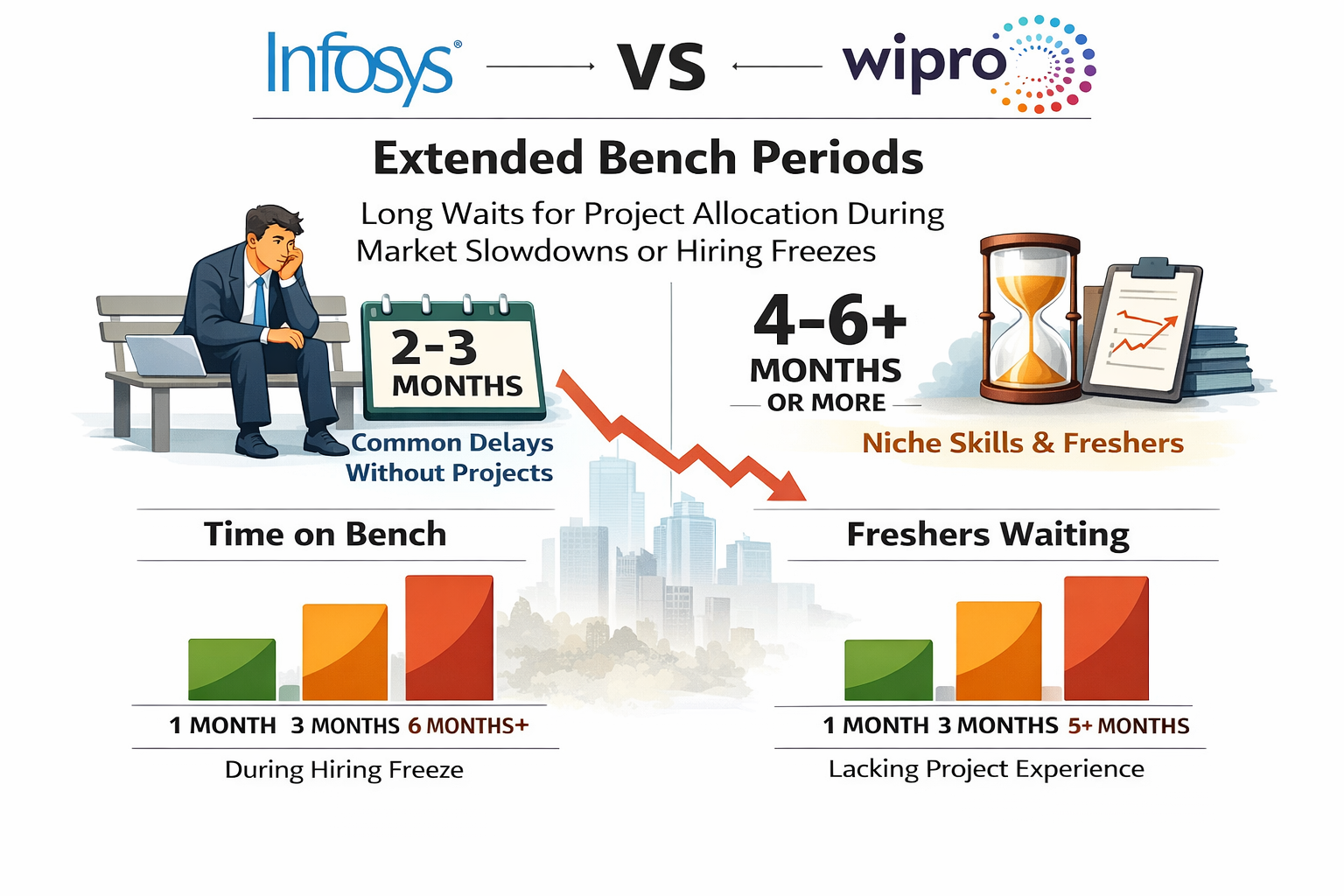
Early career workers are uniquely exposed. They join with expectations of hands on learning, rapid skill development, and clear growth pathways. Their first two years shape technical confidence and earning trajectory. A three month delay early in a career is not the same as a three month delay mid career. The compounding effect matters.
There is also a psychological asymmetry. Companies measure bench time through dashboards and averages. Employees experience it day by day. A worker on the bench may still attend training modules or internal certifications. Yet without real client exposure, the sense of professional progress can stall. Performance appraisals often prioritize billable contribution. Informal reputation building happens on projects, not in waiting queues.
The bench model also shifts risk downward. Market uncertainty is absorbed by workers in the form of non allocation rather than by the firm in the form of reduced hiring. In theory, the employee remains salaried. In practice, concerns about future deployment, performance ratings, or potential separation during cost cutting cycles create anxiety.
Public financial reporting reinforces the importance of utilization. Infosys and Wipro regularly discuss utilization rates in earnings calls as indicators of efficiency and demand stability. A drop in utilization signals pressure. A rise signals recovery. That metric rarely captures how bench experiences differ across roles, levels, and geographies.
It would be simplistic to frame the bench model as inherently exploitative. It is embedded in the global services architecture. Without it, rapid scaling would be difficult. But it would also be naïve to assume that reducing average bench days automatically protects workers.
For early career employees, those months matter. They affect skill velocity. They shape income progression. They influence confidence. And in some cases, especially for those on visas abroad, they can determine whether they remain employed at all.
The bench model may be efficient for firms. For workers at the beginning of their careers, its impact is far more ambiguous.
Skills in Suspension: The Risk of Technical Stagnation at Infosys and Wipro
Technology careers are built on application, not theory. You learn by building systems that break. You grow by shipping code that users depend on. You sharpen judgment by handling real client pressure and real production risk.
Bench time interrupts that cycle.
Infosys publicly positions itself as a learning driven organization. Its training infrastructure, including the Infosys Global Education Center in Mysuru, is one of the largest corporate training facilities in the world. Infosys4 emphasizes continuous learning through structured programs and digital platforms, highlighting its education and training initiatives as a competitive advantage. Wipro5 makes similar claims, promoting its talent transformation framework and digital upskilling strategy across emerging technologies such as cloud, cybersecurity, and artificial intelligence.

On paper, both companies invest heavily in capability building. Annual reports frequently mention reskilling numbers that run into the hundreds of thousands of training hours. During earnings calls, leadership often refers to large scale certification drives in cloud platforms like AWS, Azure, and Google Cloud.
The infrastructure exists. The content exists.
The question is whether structured modules can substitute for real client exposure.
When reviewing employee accounts across public forums, a consistent theme emerges around extended bench periods and the gap between certification and deployment.
On Glassdoor6, one Infosys reviewer wrote,
“Long time on bench with continuous internal certifications but no real project allocation,” adding that despite clearing assessments, “billable opportunity took months.”
Another employee noted that “training is structured, but deployment depends heavily on market demand,” suggesting that skill building and client exposure do not always move in parallel.
Wipro reviews on Glassdoor7 reflect similar experiences. One reviewer described being “on bench for months completing mandatory learning paths,” while another stated,
“Finished all required courses but still waiting for project mapping.”
These comments frequently frame the bench as active but not necessarily career accelerating, especially for early career professionals.
On Reddit’s r developersIndia8, users discuss the emotional and professional tension more candidly. One contributor wrote,
“I completed multiple certifications during bench but I am worried I am not getting real hands on exposure,”
Another observed, “Recruiters ask about project impact, not just training modules.”
The underlying concern is not inactivity, but relevance.
Posts on Team Blind echo this perspective. One user commented that “bench learning feels theoretical without client pressure or production systems,” highlighting the distinction between structured training and applied delivery experience.
These employee narratives mirror broader workforce research. The World Economic Forum9 has emphasized that “skills gaps continue to be one of the most significant barriers to business transformation,” and that effective reskilling must prioritize practical application in fast evolving fields such as AI, cloud, and data engineering. In rapidly changing domains, learning without deployment risks lagging behind industry reality.
This concern aligns with broader labor market research. The World Economic Forum has repeatedly emphasized that in rapidly evolving domains such as cloud computing, data engineering, and artificial intelligence, practical reskilling and applied exposure are essential. The Future of Jobs research highlights that theoretical learning alone is insufficient in fast changing markets. Without deployment, certification risks becoming a credential without context.
This matters acutely at Infosys and Wipro because their business model depends on billable utilization. According to financial disclosures and industry reporting, utilization rates are closely tracked metrics that influence margins and investor sentiment. When utilization dips, bench strength rises. When utilization rises, margins stabilize. Workers experience this fluctuation not as a metric but as delayed project allocation.
For early career engineers, the first two or three years are formative. Technical identity is shaped by what you build and fix. If a graduate joins Infosys or Wipro and spends several months on bench during their first year, they accumulate tenure without depth. On a resume, it may show one year at a global IT major. In an interview, hiring managers ask for specific architecture decisions, production incidents handled, performance tuning challenges solved. Bench time often leaves those answers thin.
There is also the issue of specialization. Many early career hires enter with broad training in Java, Python, or generic full stack stacks. Real projects force specialization. You become the Kubernetes person. The SAP integration analyst. The Salesforce customization expert. Bench time delays that narrowing. Without a defined project context, engineers remain generalists longer than the market rewards.
At Infosys and Wipro, internal training ecosystems are robust. Yet several employees report that access to high impact client projects is uneven. Allocation often depends on internal networking, prior project ratings, or alignment with in demand skills. Freshers without prior client exposure may struggle to compete internally for desirable roles. Extended bench time can become a feedback loop. Without project experience, it becomes harder to secure a strong project. Without a strong project, experience remains limited.
The result is subtle but serious.
Skill confidence erodes. Engineers begin to question whether they are falling behind peers in product companies or startups. Technical identity weakens because identity is built on shipped work. Career momentum slows because promotions and salary increments are often tied to measurable contribution on billable engagements.
From the outside, Infosys and Wipro appear as prestigious brand names that anchor early resumes. Inside, prolonged nonallocation can quietly suspend the most critical ingredient of a technology career, applied learning under real constraints.
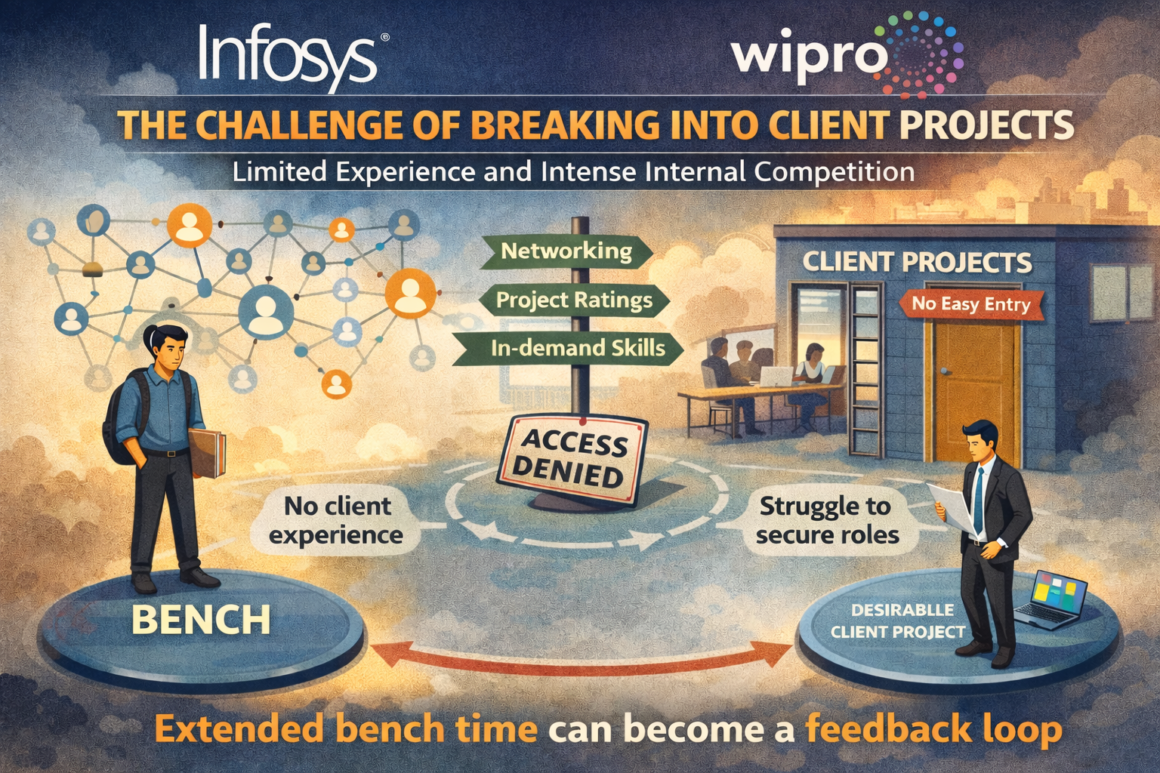
Training keeps knowledge current. Projects build judgment.
When the latter is delayed, even temporarily, the cost is not immediately visible in financial statements. It accumulates in the lived experience of early career professionals whose growth depends not just on being employed, but on being deployed.
Income Growth and the Utilization Trap at Infosys and Wipro
Bench time does not always mean unpaid time. At Infosys and Wipro, most early career employees on the bench continue to receive their base salary. That fact is often used to defend the model. The employee remains on payroll. There is no immediate income shock.
But income growth in large IT services firms rarely depends on base salary alone. It is shaped by utilization, performance ratings, client feedback, and structured promotion cycles.
Utilization is not a minor operational metric. It is central to the financial model. IT services companies earn revenue when employees are billable on client projects. When utilization dips, margins compress. Business Standard10 has reported that lower utilization rates can pressure profitability across major IT firms, especially during demand slowdowns. Earnings calls from Infosys and Wipro routinely reference utilization as a key performance indicator discussed alongside operating margins and deal pipelines.
That corporate pressure does not stay confined to quarterly investor presentations. It filters downward.
Users have described internal expectations to secure project allocation within defined time frames to avoid negative appraisal signals. Some contributors have written about feeling personally responsible for their own allocation status, even when market conditions limited available roles . The tone in many of these discussions is not one of entitlement. It is anxiety. Employees worry that extended bench time will reflect poorly on their commitment or competence.
For early career employees at Infosys and Wipro, performance ratings are closely tied to project contribution. Annual and semi annual appraisal cycles often incorporate client feedback, measurable deliverables, and team evaluations. An engineer who spends several months unallocated may have fewer tangible achievements to present during review discussions. Even if the bench period was driven by macro demand conditions, the appraisal system may not fully account for that context.
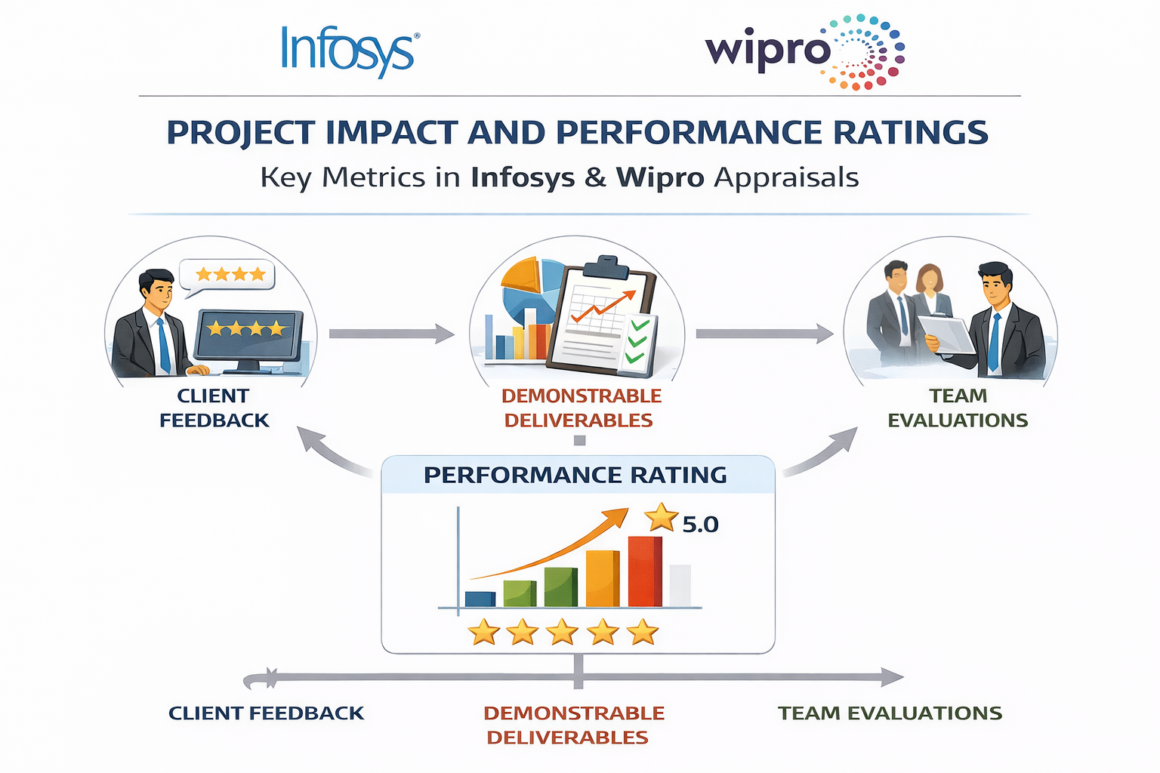
The effect compounds.
Promotions in these firms often follow structured timelines. For example, progression from entry level engineer to senior engineer or module lead may depend on both tenure and performance band placement. If an employee receives a lower rating due to limited billable exposure, they may miss a promotion cycle. A missed cycle can mean a lower salary base that carries forward for years. In a system where percentage based increments build on prior salary, even a modest delay can create long term earnings gaps.
Publicly available salary aggregation platforms such as Glassdoor and AmbitionBox show that early career salary growth in large Indian IT firms is incremental rather than exponential. That makes timing crucial. A one year delay in role progression can significantly alter cumulative earnings over five to seven years. While exact numbers vary by role and geography, the structural pattern is consistent. Advancement is staged. Missing a stage has consequences.
There is also a distortion effect that is harder to quantify but frequently described.
Employees on extended bench periods sometimes accept roles outside their preferred technical trajectory simply to regain billability. A backend developer may shift into application support. A cloud trainee may move into manual testing. A data engineering aspirant may accept a low complexity maintenance role. The immediate goal is survival within the utilization system. The long term cost is specialization drift.
At Infosys and Wipro, internal job portals and allocation systems are meant to match skills with demand. Yet during slowdowns, high demand roles may be scarce. Early career workers with limited project experience may feel compelled to take whatever opportunity appears first. Once slotted into a track, lateral movement can become harder. Project experience builds profile alignment. A few years in support or testing can narrow future options.
In this environment, income growth becomes less about skill mastery and more about allocation velocity. Securing a project quickly protects utilization metrics. Strong utilization supports better ratings. Better ratings support faster promotion. The logic is internally coherent. It is also unforgiving.
From a corporate perspective, this system rewards responsiveness and flexibility. From the standpoint of a 22 year old engineer trying to build a coherent technical identity, it can feel precarious.
The utilization trap lies in this tension. Bench time may not immediately cut pay. But it can quietly influence performance ratings, promotion timing, and long term earning potential. The cost is not visible in a single payslip. It appears over years, in slower salary growth and career paths shaped by the urgency to be billable rather than the strategy to be specialized.
For Infosys and Wipro, utilization is a lever of financial discipline. For early career employees, it can become the axis around which income security revolves.
Mental Health, Visa Status, and the Hidden Weight of Bench Time at Infosys and Wipro
At Infosys and Wipro, the bench is framed as a structural feature of a global delivery model. It allows firms to manage volatility, ramp up for large deals, and maintain flexibility. But for employees, especially early career professionals and visa holders, the psychological cost of sitting between projects is harder to quantify and deeply felt.
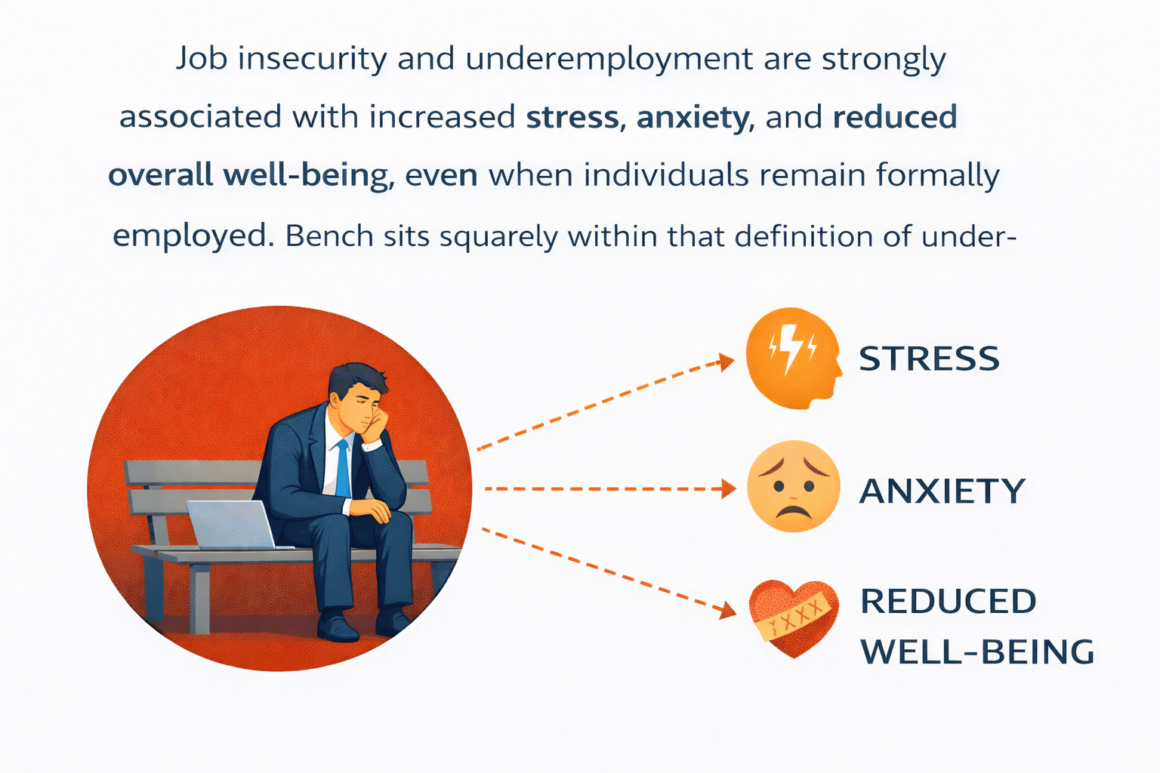
The American Psychological Association11 has found that job insecurity and underemployment are strongly associated with increased stress, anxiety, and reduced overall well being, even when individuals remain formally employed. Bench sits squarely within that definition of underemployment. A salary continues. A title remains. Yet the daily experience of meaningful work is suspended.
In employee discussions on Reddit’s r/developersIndia and on Team Blind, contributors from Infosys and Wipro describe refreshing internal allocation portals multiple times a day, messaging resource managers repeatedly, and worrying about how long they can remain unassigned before it affects their reputation. Some speak of feeling invisible as peers move into high visibility transformation projects while they complete internal training modules or wait for deployment.
Project teams provide more than billable hours. They provide structure, deadlines, feedback loops, and social belonging. Bench removes much of that. Many employees join Infosys and Wipro in campus cohorts. When some members of that cohort are staffed quickly and others remain unallocated, comparison becomes inevitable. Career narratives begin to diverge early.
From a research perspective, prolonged uncertainty is often more stressful than a clear negative outcome. Not knowing whether bench will last two weeks or four months creates ambient anxiety. Employees may not receive explicit negative feedback, yet they sense that utilization metrics are closely tracked. The mind fills in worst case scenarios about ratings, promotions, and future mobility.
For those working overseas on visas, this stress compounds.
According to The Indian Express12 Infosys and Wipro have historically ranked among the largest H1B visa sponsors in the United States, reflecting their deep integration into the American technology services market. Under United States labor regulations, employers must pay required wages to H1B workers even during nonproductive periods if the worker is available for work. The Department of Labor explicitly states that placing an H1B employee in unpaid status due to lack of assigned work is generally not permitted. Immigration law experts have reinforced that wage obligations continue during nonproductive status except in narrow circumstances.
Legally, this offers protection. An H1B employee on the bench should still receive the mandated wage.
Psychologically and structurally, however, uncertainty persists.
Visa holders depend not only on salary, but on sustained corporate sponsorship. Extensions, amendments, and green card processing require active employer participation and business justification. In online discussions among Indian tech workers in the United States, concerns frequently surface about whether extended nonassignment might weaken internal support for long term immigration pathways.
Bench abroad can also mean relocation pressure. Employees may be encouraged to move states or accept projects outside their preferred specialization to maintain billable status. A consultant settled in one city may be asked to relocate quickly for a short term engagement. Families are affected. Children’s schooling, spousal employment plans, and housing leases are reconsidered. Financial planning becomes fragile in the face of sudden geographic mobility.
In this context, bench time is not merely a pause in project allocation. It becomes a question about legal stability and life continuity.
For early career professionals at Infosys and Wipro, the combination of underemployment stress and visa dependency can create a persistent background tension. They are formally employed, yet unsure of trajectory. They are legally protected in terms of wages, yet uncertain about long term sponsorship. They are part of a global enterprise, yet temporarily disconnected from the work that defines their professional identity.
The result is a quiet strain that does not always appear in utilization reports or quarterly earnings calls. It shows up instead in late night forum posts, in constant portal refreshes, and in the subtle erosion of confidence that can occur when work, stability, and identity are placed on hold.
The bench, in these moments, is no longer just an operational buffer. It is a psychological and legal.
From the corporate perspective, bench is strategic. IT services firms cannot wait to hire until contracts are signed. They must anticipate growth. They must maintain readiness.
But readiness for firms can translate into stagnation for individuals.
A bench percentage of 15 percent at a company employing hundreds of thousands of workers represents thousands of people in waiting. Each of them has a career clock ticking.
As I examined earnings reports and industry commentary, I noticed how often bench is framed in financial terms. Utilization. Margins. Efficiency. Rarely is it framed in human development terms.
Early career workers are particularly vulnerable because they lack leverage. They cannot easily negotiate allocation. They are evaluated within structured systems that they did not design.
The services model is unlikely to change fundamentally. But the human cost deserves equal attention.
A Brief Path Forward: Measuring What Matters
Bench will remain part of the IT services ecosystem. For companies like Infosys and Wipro, which operate at global scale and hire in anticipation of large enterprise deals, some degree of buffer capacity is inevitable. The real question is not whether bench should exist. It is whether prolonged bench can be redesigned so it does not slow early career growth or destabilize visa holders.
The first step is transparent timelines. Both Infosys and Wipro already track utilization closely because it affects margins and investor confidence. That same data discipline could be extended to employee protection. If bench exceeds a defined duration, for example 30 or 45 days, there should be structured escalation. This could include mandatory intervention by resource management teams, formal matching rounds, and visibility into available roles across business units. Early career employees should not have to rely on informal networking or repeated messages to managers to secure deployment.
Second, project based internal labs could replace passive waiting. Infosys has large scale training infrastructure. Wipro has positioned itself as a talent transformation leader. Instead of limiting bench time to certification modules and internal assessments, both firms could assign unallocated employees to internal innovation sprints with real deliverables. These projects could simulate client environments, include measurable milestones, and require cross team collaboration. Code would ship. Systems would be tested. Outcomes would be documented. This would preserve skill sharpness and give early career engineers concrete experience to discuss in appraisals and interviews.
Third, appraisal safeguards are critical. If bench time is driven by market slowdown or client budget cuts, it should not penalize performance ratings. Infosys and Wipro operate on structured appraisal cycles where utilization and client feedback influence outcomes. Clear policy language could state that employees unallocated beyond a certain threshold due to demand conditions will not face negative rating impact. Without this protection, early career workers bear risk they do not control. A missed promotion cycle can depress income growth for years because salary increments build on previous bases.
Fourth, proactive visa communication must be standard practice. Infosys and Wipro have long been among the largest sponsors of H1B visas in the United States. That scale brings responsibility. During nonassignment periods, HR and legal teams should provide written clarification about wage compliance, sponsorship continuity, and transfer timelines. Visa holders should not have to depend on informal forum advice to understand their status. Clear internal communication reduces anxiety and builds trust.
Bench does not have to be a holding pattern. It can become structured incubation. But that requires intent, policy clarity, and investment in meaningful internal work.
In quarterly earnings calls, utilization rates at Infosys and Wipro are dissected carefully. Bench percentages are scrutinized. Margins are projected with precision.
What is harder to measure is stalled confidence. Slowed skill growth. Quiet anxiety. Deferred promotions.
As I examined public reports, employee discussions, and corporate disclosures, one distinction became clear. The bench itself is not inherently harmful. Prolonged bench without safeguards is.
For early career professionals at Infosys and Wipro, months of nonassignment can shape trajectories for years. Technical depth depends on applied work. Income growth depends on performance cycles. Visa stability depends on sustained corporate engagement. When all three are placed in suspension at once, the cost compounds.
These firms have the systems, data, and training infrastructure to address the issue. The question is whether human development will be measured with the same rigor as financial efficiency.
If utilization is tracked to protect margins, then allocation equity and skill continuity should be tracked to protect careers. In an industry defined by speed, innovation, and global mobility, the space between projects should not become the space where early momentum quietly fades.
Sources
- Chaturvedi, Aakanksha. “TCS, Infosys, Wipro: Are huge bench sizes dragging down Indian IT majors?” BusinessToday, 18 Apr. 2023, www.businesstoday.in/latest/corporate/story/tcs-infosys-wipro-are-huge-bench-sizes-dragging-down-indian-it-majors-377876-2023-04-18. Accessed 11 Feb. 2026. ↩︎
- Ghosh, Debangana. “Top Indian IT firms reduce bench time amid uncertain times; average duration drops to 35-45 days” www.moneycontrol.com/technology/top-indian-it-firms-reduce-bench-time-amid-uncertain-times-average-duration-drops-to-35-45-days-article-12956768.html. Accessed 11 Feb. 2026. ↩︎
- Kajarekar, Radhika. “Average Bench Time Slashed By 50% To 30-35 Days By TCS & Other IT Firms” Indian Business of Tech, Mobile & Startups, 28 June 2025, trak.in/stories/average-bench-time-slashed-by-50-to-30-35-days-by-tcs-infosys-wipro-hcl/. Accessed 11 Feb. 2026. ↩︎
- Infosys, www.infosys.com/industries/education.html. Accessed 12 Feb. 2026. ↩︎
- “Wipro’s Talent & Change Consulting Practice Enhances Employee Experience” www.wipro.com/consulting/services/talent-and-change/. Accessed 12 Feb. 2026. ↩︎
- “Reviews” Glassdoor, www.glassdoor.co.in/Reviews/Infosys-Reviews-E7927.htm. Accessed 12 Feb. 2026. ↩︎
- “Reviews” Glassdoor, www.glassdoor.co.in/Reviews/Wipro-Reviews-E9936.htm. Accessed 12 Feb. 2026. ↩︎
- Reddit, www.reddit.com/r/developersIndia/. Accessed 12 Feb. 2026. ↩︎
- “The Future of Jobs Report 2025” World Economic Forum, 7 Jan. 2025, www.weforum.org/publications/the-future-of-jobs-report-2025/. Accessed 12 Feb. 2026. ↩︎
- Standard, Business. “Indian firms’ to slow down IT spending due to cost, global factors: Study” Business Standard, 25 Apr. 2023, www.business-standard.com/industry/news/indian-firms-to-slow-down-it-spending-due-to-cost-global-factors-study-123042500460_1.html. Accessed 12 Feb. 2026. ↩︎
- APA, www.apa.org/pubs/reports/work-in-america/2025. Accessed 12 Feb. 2026. ↩︎
- Gupta, Cherry. “Top 10 American companies sponsoring most H-1B visas: 4 Indian-origin tech companies featured” 1 Apr. 2025, indianexpress.com/article/trending/top-10-listing/top-10-american-companies-sponsoring-the-most-h-1b-visas-9768780/. Accessed 12 Feb. 2026. ↩︎


