

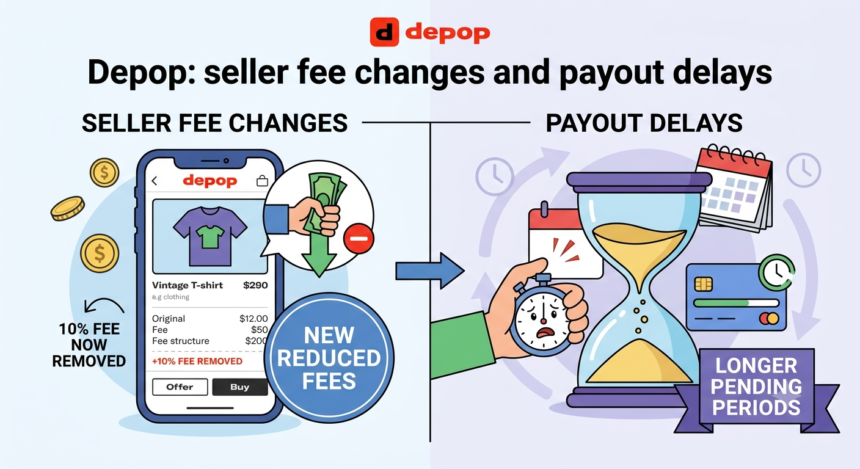

In 2024 Depop told sellers its fee was gone. Two years later, I went looking for what that cost.
The number was zero.
In July 2024, Depop1 told its American sellers that the 10 percent fee it took from every sale was gone. The company announced it as a gift. Sellers would keep more of each sale. The average US seller, Depop said, made over $450 in their first year on the platform. That is not a fortune. It is a closet’s worth of money. It is a start.
Zero is a clean number. You can put it on a banner. I wanted to know what it was standing in front of.
So I read for a few weeks. I read Depop’s own announcements and its help pages. I read the trade press that covers marketplaces for the people who live on them. I read forum threads and review boards, the places sellers go when the support queue goes quiet. I did the arithmetic myself, because arithmetic does not care about banners.
Here is where I ended up. The zero is real. It is also a number that did not vanish. It moved. It went to places a seller has to look harder to find. And next to the fees sits a second problem that gets less attention than fees ever do. The wait. The days between a sale and the money.
I will take them in order. Fees first. Then the wait. Then the new owner, because there is one now, and it has not said much.
Where the Ten Percent Went
The old deal was easy to say out loud. You sell a thing. Depop keeps a tenth.
The new deal has layers. Money2 reported that the cut was gone for US sellers as of that week, following a trial in the UK. What replaced it came in three parts.
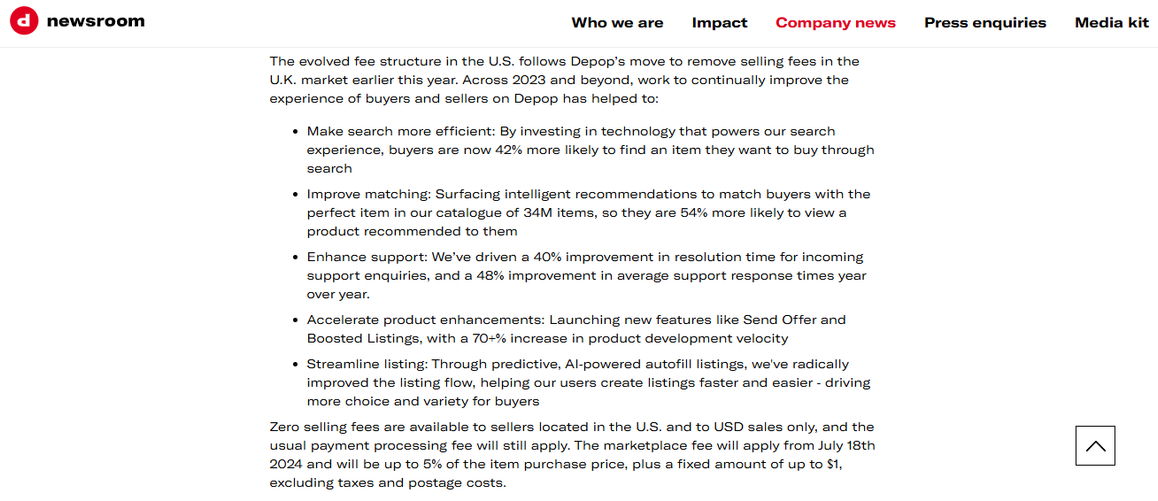
The first part landed on the buyer. In its announcement, Depop3 set a marketplace fee of up to 5 percent of the item price, plus a fixed amount of up to a dollar, starting July 18, 2024. The buyer sees it at checkout. If someone buys several items from one seller in a bundle, Money noted, the fixed part is charged only once. Depop said the money would go toward protection, customer support and work on the platform.
The second part stayed with the seller. Payment processing. In the US that is 3.3 percent plus 45 cents. The base is wider than most sellers assume. According to a FeeFigure4, the percentage applies to the item price, plus shipping, plus any applicable taxes. Sales tax is not the seller’s money. The seller still pays a percentage on it.
The third part is optional. It is called a boost. I will come back to it.
Let me run one sale. A jacket for $40. The buyer pays $8 for shipping. The buyer’s marketplace fee comes to as much as $3, which is 5 percent of $40 plus a dollar. The seller’s processing fee, before tax, is about $2.03. That is 3.3 percent of $48 plus 45 cents. No commission. Under the old rule, the commission alone would have been $4.
So the seller does better. I want to say that plainly, because it is true. The seller keeps the $4 that used to go to Depop. For a casual seller clearing out a closet, that is a good change, and Depop’s own numbers suggest people noticed. In a later announcement about Australia, Depop5 said that removing selling fees in the UK and US lifted listings by 30 to 45 percent in the 28 days after the changes. That is the company’s own figure, and it carries an asterisk in the original. I take it as a sign that something moved.
But listings have consequences. More listings means more sellers competing for the same set of eyes. I cannot prove what comes next. I can only show the timing. The selling fee went to zero in 2024. The fee that sells attention, the boost, went up in the UK in late 2025 and in the US in March 2026.
The reporter at Money saw another effect coming. Sellers already live with lowball offers, and the piece guessed that buyers might ask for discounts to offset the new fee. If so, the fee Depop moved to the buyer does not stay there. It comes back across the offer button. I find that plausible. I cannot prove it either.
There is a quieter cost too. It is the cost of working out what the rules are.
I found CLOSO6 with a correction banner at the top, dated August 2026. The banner says Depop no longer charges the 10 percent fee. Below the banner, the article goes on explaining how Depop takes 10 percent. Nobody tore it down. The old fee has not died in the minds of the people who write guides about it. I think that is partly Depop’s doing. The rules live in a newsroom post, in help pages split by country, in emails to sellers, and in the footnotes of third party calculators. The same fee reference lists a zero selling fee for the US, the UK and Australia, and 10 percent on all sales for sellers elsewhere. Australia only joined the zero list on July 22, 2026, according to Value Added Resource7. A seller who ships to three countries needs three tables and a good memory.
That Australia story holds one more detail that matters for what follows. Depop’s help pages, Value Added Resource reported, say sellers in the US, UK and Australia can’t connect PayPal. Depop Payments is the road. There is only one road now. Keep that in mind when we get to the wait.
The Fee You Can Say No to
On March 23, 2026, the boost fee went from 8 percent to 12 percent for new boosts. Sellers got an email. Value Added Resource8 published the notice in early March. It said the higher rate would apply only to boosts made from that date forward. It said sellers pay only if a buyer purchases the boosted item within 28 days of seeing the boosted listing. It said sellers could unboost any time. And it carried what the site called a not so subtle nudge to use the lower rate while it lasted.
That nudge is worth sitting with. Sell more now, before the price goes up. It is the language of a store clearance. It is also an admission that the seller is being asked to buy something before the terms get worse.
The reaction was loud and a little confused. In one Reddit thread9, a commenter wrote:
“Saw this coming from a MILE AWAY when eBay acquired them. Greedy.”
Another noted that the message promising things would stay the same had gone out, and that a week later something had already changed. A third said eBay’s long habit is to pit sellers against each other with promotional fees and programs, with no transparency about how ad clicks get credited. That last comment was about eBay’s own ad system. But the complaint travels well. When your fee depends on someone else’s record of what a buyer saw, you take their word for it.
There was a problem with the blame. As Value Added Resource pointed out, eBay did not own Depop yet. The deal had been announced less than two weeks before and had not closed. So the fee increase was still an Etsy decision. The same site noted that Depop had already announced the same increase for UK sellers in November 2025, and that Etsy had said plainly that seller services, meaning ads and add ons, were a priority for revenue. The site’s reading was that Etsy may have been squeezing extra money out of Depop before the sale closed.
So the sellers got the owner wrong and the pattern right. I find the mistake interesting on its own. A seller who blames the wrong company for a fee is a seller who has stopped trusting any company to explain its fees. That trust is an asset. It is hard to get back.
Now the arithmetic. A boost on the $40 jacket costs 12 percent of $40, which is $4.80. Add the $2.03 in processing and the seller’s total is $6.83. That is about 17 percent of the item price. And here is the part I keep turning over. The boost fee alone is now higher than the old selling fee. Twelve percent against ten. On the sales it touches, a boost costs more than the commission Depop took out of the front door in 2024.
SECND’s10 guide, written when the boost fee was 8 percent, warned that switching on boosts across a whole shop would quietly turn Depop back into a marketplace charging roughly 11 percent on those sales. That was the 8 percent plus processing. Do the same sum at 12 and you get about 15 percent, plus the fixed fee. A zero that comes back as fifteen is not zero. It is a toll booth with a different color of paint.
Depop would say the boost is optional. That is true. The question is whether an unboosted listing is seen. Sellraze11 says the boost is optional, then adds that in a crowded market “it is often the only way to get noticed.” That line is opinion. It is one writer’s view. I looked for public documentation of how much visibility a listing loses when it is not boosted, and I did not find any. If it exists, I would like to read it. Until then, the seller decides in the dark. If you do not know how much attention you lose, you cannot know what the fee is worth.
The Wait
Money has a speed. For a seller on Depop, the speed is set by a schedule most people never read until something goes wrong.
Here is the schedule. For UK sellers, Depop’s help page12 says payouts arrive two to three working days after tracking shows an item as delivered, or ten working days after the sale date, whichever comes first. Ten working days is fourteen calendar days. US guides that cite Depop’s own pages give the same shape. SellerToolNest13 says the funds are released two business days after delivery or ten business days after the sale. So the clock has a floor and a ceiling. The floor is quick. The ceiling is two weeks.
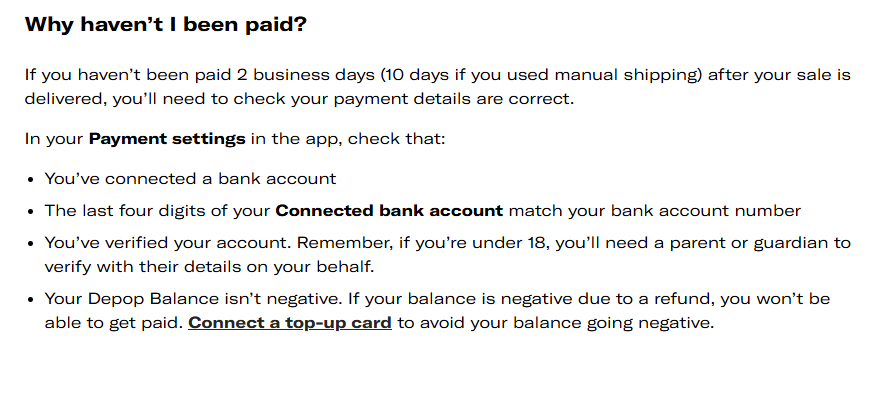
Two words on that help page carry a lot. Pending means the buyer has paid and the funds are waiting to clear. On hold means the buyer has raised an issue with the purchase. One is routine. The other is a dispute. Both show up as a number a seller cannot spend.
Think about what two weeks means to the person at the bottom of this marketplace. A teenager who bought a vintage jacket for $15 and paid $8 for the label has $23 out the door on day one. A reseller who buys by the bag and ships forty parcels a week is carrying inventory, postage and a balance that is not theirs yet. The ceiling is the worst case, and most sales clear faster. But the worst case is the number that tells you who is lending money to whom.
We know what a bad stretch looks like because one was documented. In March 2024, TechCrunch14 reported that Etsy-owned Depop sellers had watched their payout dates slide for months. The pattern was strange in its small steps. The app would promise a payday on a Wednesday. On Wednesday it would say Thursday. Then Friday. Sellers wrote to support and heard little. Others took to the r/Depop subreddit, X, Facebook and Instagram, the story said.
When TechCrunch asked, a Depop spokesperson first said the support queue was longer than usual and that the company did not know why sellers were having trouble getting paid. After more questions, Depop said it had found a problem in its automated payouts system. It said the fix was in and that all pending payments had gone out. It promised to answer support tickets and to notify its high volume sellers directly in the future.
One seller, on the app for over a year, had just dropped a parcel at the post office. The seller worried about contacting Depop again once it arrived.
“After this I’m not sure I’ll sell anymore on Depop.”
A Reddit seller quoted in Value Added Resource’s15 coverage at the time said Depop kept pushing back the payout date and that they could not post new listings either. I mark that second part. A payout problem that also freezes the storefront is a problem that touches the whole account, not just the cash.
That same coverage carried a second thread. TechCrunch had found that Depop seemed to be testing a 5 percent buyer service fee. A support page explaining it had been made private. A spokesperson suggested it might be a test applied unevenly across the app. Four months later, the buyer marketplace fee went live in the US at up to 5 percent plus a dollar. I am not claiming a plot. I am pointing at a sequence. The fee was tested quietly, the payouts slid loudly, and the fee arrived officially in the summer.
Not every complaint comes from that spring. On Trustpilot16, I found a review describing a sale paid for on February 24, with the funds held by Depop until March 14 and then held by PayPal until April 4. The reviewer’s verdict was plain.
“Sellers should not have to wait this long to access their own funds.”
Another reviewer wrote that once the fees, the postage and PayPal were done, a dress sale was hardly worth it, with money still on hold at PayPal twenty days later.
The reviews I saw were undated, and both mention PayPal. That matters. Sellers in the US, UK and Australia can no longer connect it. So those reviews describe an older, split system, with two companies holding the same money one after the other. They show how long a delay can run when two hands are on the cash. They do not describe today.
Something else in that older pile caught my eye. An old Quora17 answer said Depop had “changed their payments again,” holding money for 72 hours after shipping, with a few more days before it reached a bank. I cannot date that change. I can say what the answer shows. The rules moved under sellers often enough that a stranger felt the need to say again.
Now to the part I cannot answer. Depop Payments runs on Stripe. Stripe’s18 own support page says that when a payout date keeps getting pushed out, the most likely cause is an outstanding account verification requirement. It also says a first payout can take 7 to 14 days. I do not know how much of Stripe’s standard behavior shows through in a Depop account, or how clearly the Depop app tells a seller that a verification step is waiting. I could not test it.
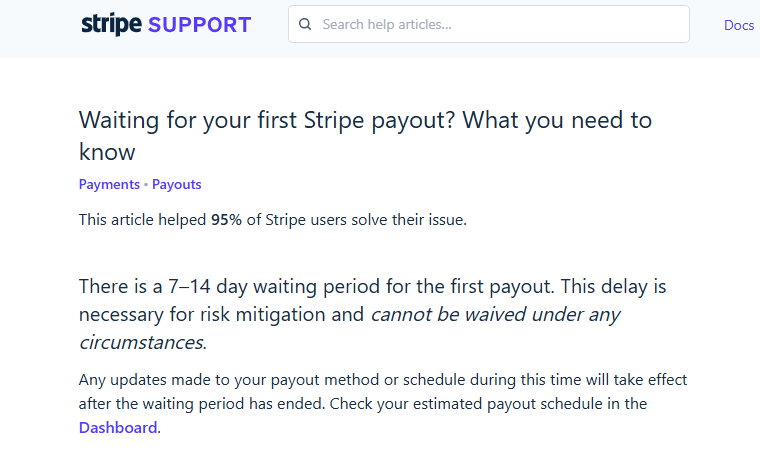
But I can see the shape of the trap. From inside the app, a Depop glitch and a verification hold look the same. A date that slides. The first is Depop’s to fix. The second is the seller’s to solve. A seller staring at a moving date cannot tell which one they have, and may spend days writing to the wrong party. That is not a scandal. It is a design problem. It is the kind that costs the least powerful person in the transaction the most time.
Here is another number, and I want to be careful with it. GlobalData’s summary of the eBay deal says Depop generated about $1 billion in gross merchandise sales in 2025, per the Retail Insight Network19. Spread evenly, that is around $2.7 million a day. Every day of average delay parks something like that much of sellers’ money in a balance they cannot touch. A week of delay is close to $19 million. This is my arithmetic, not a reported figure. It assumes even sales and uses a rough total that includes more than item prices might. I do not know the real average wait, and Depop does not publish one. I do not claim that Depop earns interest on it. The money sits with a processor or in a balance somewhere. I only claim this. The seller earns nothing on it, and the seller has no say.
I should say what I did not find. I found no public record of a mass payout failure in 2026. The loudest documented episode is March 2024. CLOSO20 claims a glitch in December 2025 left sellers waiting over two weeks, and says so on a page about support delays. I found no second source. It is a search optimized site, so I am not counting it. If you sold on Depop that month and waited, I would like to hear from you.
The honest picture is this. Depop publishes a schedule. Many payouts, I assume, arrive inside it. The record of failure is thinner than the record of confusion. But confusion is its own cost. When the app says pending, and the date slides, and support is a ticket queue, a seller has no way to know whether the system is working.
A New Landlord
In all this time, Depop changed hands.
Etsy bought Depop in 2021 for about $1.6 billion. In February 2026, eBay21 announced it would buy it back out of Etsy’s hands for $1.2 billion in cash. The sale closed on July 30, 2026. Depop had about 7 million active buyers at the end of 2025, nearly 90 percent of them under 34, and more than 3 million active sellers. It had grown nearly 60 percent in the US over the year. Etsy paid top price for a young company and sold it at a discount and its stock jumped on the news.
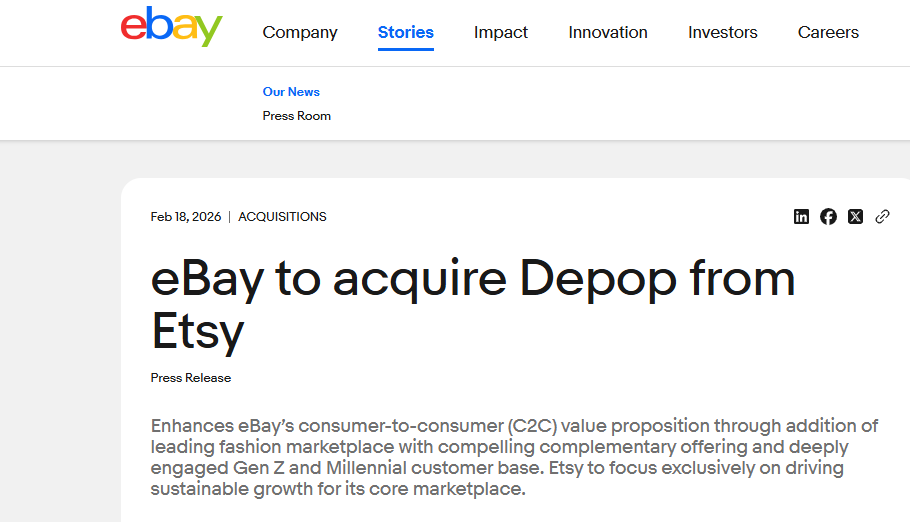
What will eBay do with it? The public answer so far is nothing much. The same seller tool says Depop’s help center has said there are no planned changes to how sellers run their shops. Depop keeps its name, its brand and its platform, according to eBay’s own announcement.
But one line in the coverage deserves a second look. The Retail Insight Network reported that Depop would gain access to eBay’s financial services, shipping capabilities and buyer protection programs. Those are three words I read twice. Financial services. Shipping. Protection.
We have seen what eBay does with those words elsewhere. eBay went fee free for private sellers in Germany in 2023 and the UK in 2024. It then added a buyer protection fee and mandatory managed shipping in the UK. That model has now reached Australia. Free to sell. The buyer pays a fee. The platform controls the label.
I am not saying that is Depop’s future. I do not know. Nobody outside the building does. But the pattern raises questions I think sellers deserve to hear asked out loud, and answered.
Will Depop Payments stay on its current processor, or move to eBay’s payment systems? If it moves, what happens to a payout in flight? Will managed shipping come to Depop, and if so, who decides what the label costs? Will the 12 percent boost fee hold, or follow the pattern of eBay’s own promoted listing rates? And will anyone publish an average payout time, so that sellers can tell a slow week from a broken one?
Those are the questions I would put to Depop and to its new owner. They are not hostile. They are the questions a person asks before leaving money with someone.
What the Zero Costs
I started with a number and I will end with a few.
Zero is the fee on the line that has a name. Selling fee, zero. That is true in the US, the UK and Australia. It is a real change, and it helped people.
Three point three percent plus 45 cents is the fee on the line that has a different name. Processing. It sits on your shipping and on your sales tax as well.
Twelve percent is the fee on the line that is optional, if you are willing to be unseen. Up to five percent plus a dollar is the fee on the line the buyer pays, until the buyer asks you for a discount to cover it.
And between the sale and the money sits a gap that runs from a couple of days to two weeks, with a status screen that says pending and a date that sometimes slides.
The pattern is not unusual. It is how platforms get paid now. A fee is announced as dead. It is reborn as a service. The cost does not go away. It changes its shape and its address. What does not change is who has to do the math. The seller does the math. The seller does it on their phone, between shipping labels, in a hurry.
If I were selling on Depop today, I would do four things. I would price each item against all the layers, not the headline. I would screenshot every payout date when it first appears, so I could prove a slide. I would turn boosts on one listing at a time, never across a shop. And I would keep some of my own money in the game, enough to wait two weeks without panic.
None of that is hard. It is only work. It is work the platform could have done for me, with a clearer screen and an honest average.
The number was zero. It still is, on the line with the name. I am still reading the others.
Sources
- “Depop removes selling fees in the United States, evolves fee structure” Depop newsroom, news.depop.com/company-news/depop-removes-selling-fees-in-the-united-states-evolves-fee-structure/. Accessed 12 Oct. 2026. ↩︎
- Glum, Julia. “It’s Getting Way Cheaper to Sell Clothes on Depop” Money, 16 July 2024, money.com/depop-seller-fee-eliminated/. Accessed 12 Oct. 2026. ↩︎
- “Depop removes selling fees in the United States, evolves fee structure” Depop newsroom, news.depop.com/company-news/depop-removes-selling-fees-in-the-united-states-evolves-fee-structure/. Accessed 12 Oct. 2026. ↩︎
- “Depop Fees in 2026: What “0% Selling Fee” Actually Costs You” FeeFigure, 4 Aug. 2026, feefigure.com/depop-fees/. Accessed 12 Oct. 2026. ↩︎
- “Depop makes selling free in Australia, helping people earn more from fashion resale” Depop newsroom, news.depop.com/company-news/depop-makes-selling-free-in-australia-helping-people-earn-more-from-fashion-resale/. Accessed 12 Oct. 2026. ↩︎
- “Does Depop Take a Cut? Analyzing Fees in 2026” 22 Apr. 2026, closo.co/blogs/platform-specific-guides/does-depop-take-a-cut. Accessed 12 Oct. 2026. ↩︎
- Morton, Liz. “Depop Cuts Seller Fees In Australia As Buyers Pick Up New Marketplace Fee” 3 July 2026, www.valueaddedresource.net/depop-drops-seller-fees-australia/. Accessed 12 Oct. 2026. ↩︎
- Morton, Liz. “Depop Raises Boosted Listing Ad Fees, eBay Gets The Blame” 3 Mar. 2026, www.valueaddedresource.net/depop-raises-boosted-listing-ad-fees/. Accessed 12 Oct. 2026. ↩︎
- Reddit, www.reddit.com/r/Depop/comments/1riyl2t/really_depop_why_are_the_fees_raising_up_by_4/. Accessed 12 Oct. 2026. ↩︎
- Team, SECND. “Depop Seller Fees in 2026: What Depop Charges Sellers Now” SECND, 16 Aug. 2026, www.secnd.ca/blog/depop-seller-fees. Accessed 12 Oct. 2026. ↩︎
- “Depop Fees Explained for Resellers in 2026” SellRaze, 6 Apr. 2026, www.sellraze.com/blog/is-depop-legit-honest-depop-review-for-sellers-in-2026-2. Accessed 12 Oct. 2026. ↩︎
- Depop, depophelp.zendesk.com/hc/en-gb/articles/25245286495377-How-payouts-work-UK. Accessed 12 Oct. 2026. ↩︎
- team, SellerToolNest editorial. “How Does Depop Pay You? US Payout Timeline (2026)” SellerToolNest, sellertoolnest.com/guides/how-does-depop-pay-you/. Accessed 12 Oct. 2026. ↩︎
- Silberling, Amanda. “Depop sellers faced ongoing payment delays due to tech issue, company admits” TechCrunch, 13 Mar. 2024, techcrunch.com/2024/03/13/depop-sellers-faced-ongoing-payment-delays-due-to-tech-issue-company-admits. Accessed 12 Oct. 2026. ↩︎
- Morton, Liz. “Etsy-Owned Depop Testing Buyer Fees, Payouts Delayed As Revenue Pressure Builds” Value Added Resource, 14 Mar. 2024, valueaddedresource.net/depop-payout-delays-testing-buyer-fees. Accessed 12 Oct. 2026. ↩︎
- Trustpilot, no.trustpilot.com/review/depop.com. Accessed 12 Oct. 2026. ↩︎
- Quora, www.quora.com/Why-does-my-payout-on-depop-keep-getting-delayed-I-ve-shipped-out-all-items-and-added-tracking-to-every-sold-item. Accessed 12 Oct. 2026. ↩︎
- “Payout schedules FAQ” support.stripe.com/questions/postponed-and-future-payouts. Accessed 12 Oct. 2026. ↩︎
- “eBay to acquire Depop from Etsy for $1.2bn in cash” 19 Feb. 2026, www.retail-insight-network.com/news/ebay-acquire-depop-from-etsy/. Accessed 12 Oct. 2026. ↩︎
- “Depop Support Not Responding? Here’s What You Can Do in 2026” 23 Apr. 2026, closo.co/blogs/platform-specific-guides/depop-support-not-responding. Accessed 12 Oct. 2026. ↩︎
- “eBay to acquire Depop from Etsy” 18 Feb. 2026, www.ebayinc.com/stories/news/ebay-to-acquire-depop-from-etsy/. Accessed 12 Oct. 2026. ↩︎


