

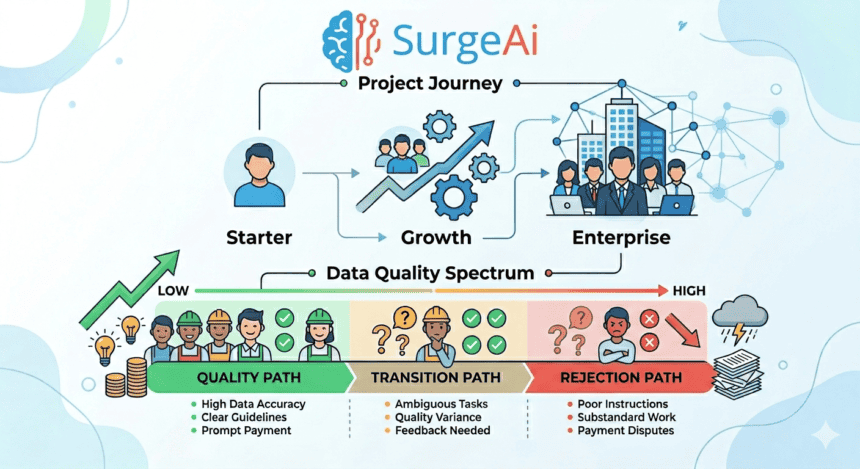

There is a job posting that reads like an offer too good to be true. “Train AI on the richness of human data,” it says. Flexible hours. Premium pay. Work from home. You set your own schedule.
- The Company Behind the Curtain
- The Pay Structure: Premium at the Top, Murky at the Bottom
- The Rejection Problem
- “Zero Transparency”: Workers Speak Out
- The Lawsuit: What the Court Filings Reveal
- The Subsidiary Shell: DataAnnotation.tech and the Opacity Problem
- The Broader Context: An Industry in a Legal Moment
- The Profitability Equation
- What Changes, If Anything
What it does not tell you is that the platform can lock you out without warning, that you may be required to complete hours of training that nobody pays you for, and that a single algorithmic scoring decision can send your earnings crashing. That the company behind it all is worth, by some estimates, over $24 billion. And that it has never had to explain itself to a single outside investor.
This is the world of Surge AI.
The Company Behind the Curtain
Surge AI, founded in San Francisco in 2020 by Edwin Chen, a former data scientist at Twitter and Google, has spent five years operating in near-total obscurity for a company of its scale. While Silicon Valley’s funding announcements dominated tech headlines, Chen was building something different: a bootstrapped, relentlessly profitable machine that fed human intelligence into the maw of artificial intelligence.
According to reporting by Forbes1, Surge AI hit $1.2 billion in annualized revenue in 2024, with growth driven primarily by a group of roughly twelve frontier AI labs including OpenAI, Google, Anthropic, Microsoft, and Meta.
The company operates with approximately 50,000 expert contractors and 130 full-time employees. By revenue-per-employee metrics, it is one of the most capital-efficient AI infrastructure companies ever built.
Compilation from public records and press reports notes that the company coordinates a global workforce of over one million annotators, manages subsidiaries including GetHybrid, TaskUp, and DataAnnotation.tech, and has a valuation that analysts have placed anywhere between $15 billion and $25 billion. Today In AI2 reported in late 2025 that Meta alone spends over $150 million per year with Surge.
This is the company that, until a 2025 class action lawsuit, most of the people doing its foundational work had never heard of.
The Pay Structure: Premium at the Top, Murky at the Bottom
The official story on Surge AI compensation sounds reasonable. Sacra3 reports that approved “Surgers” earn between 30 and 40 cents per working minute, which works out to roughly $18 to $24 per hour. The company says this exceeds typical crowdsourcing platform rates. For expert-tier workers doing specialized RLHF evaluation, rates can go higher. Surge’s own DataAnnotation.tech blog4 describes a compensation ladder where workers doing coding-adjacent evaluations can earn $50 to $60 per hour, and those bringing professional expertise in law, medicine, or finance can earn $50 to $100 or more.
These numbers are real for people who reach the upper tiers of the platform. But the experience of getting there, staying there, and not having your earnings retroactively clawed back is a different story entirely.
DataAnnotation.tech is the primary public-facing portal through which Surge AI recruits its contract workforce. Pay starts at $20 per hour for general tasks and scales upward for specialized work. Payments are made weekly via PayPal or ACH transfer. The platform markets itself as a high-quality alternative to the low-rent microtask farms that dominated early crowdwork. And yet, the Jobright Blog’s5 2026 review of the platform is careful to describe it as suitable only for side income, not primary earnings. The reason is structural: task availability is unpredictable, account stability is not guaranteed, and the approval pipeline is opaque to the point of cruelty.
The Rejection Problem
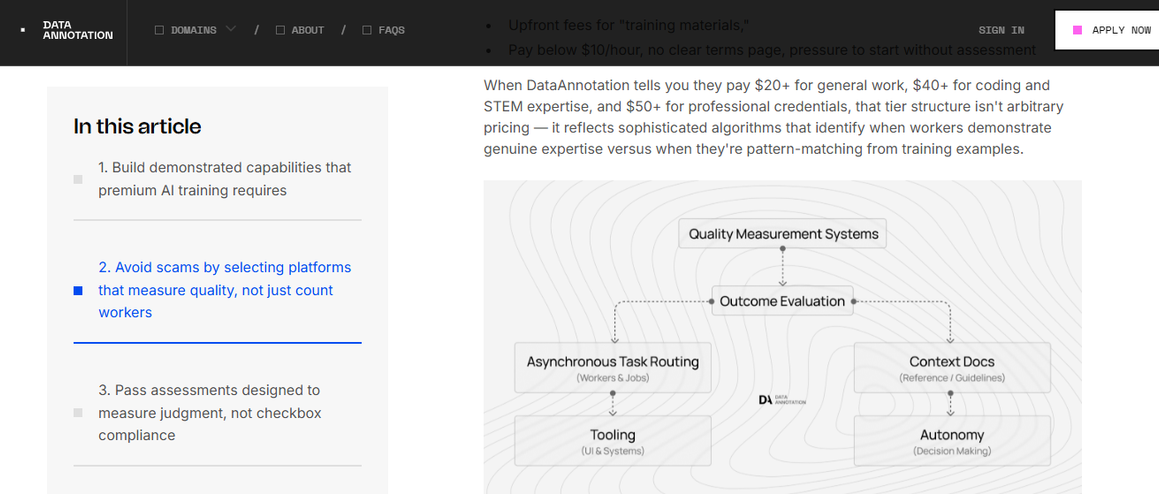
Getting into DataAnnotation.tech is the first gauntlet. The platform requires applicants to pass a series of assessments before any paid work becomes available. These assessments are unpaid. Pass them and you are in. Fail them, or simply fall through the cracks of an algorithmic screener with too many applicants, and you hear nothing.
A guide published by Ops Army6 is blunt about what happens when you do not make the cut:
“The platform rarely sends rejection notifications. If you wait longer than a few weeks without receiving an acceptance email, the general consensus is to assume the application has failed the quality check.”
No email. No explanation. No appeal. You do the work of applying, sometimes including hours of unpaid screening tasks, and then nothing arrives. You are just quietly erased from the queue.
Even workers who make it through the initial filter report being left in a kind of suspended limbo, having passed the assessment but receiving no tasks. They are credentialed workers waiting in an empty room. TIME’s7 2024 investigation into data annotation work documented this pattern, noting that some workers reported their accounts being deactivated while carrying substantial unpaid earnings, with one person owed $2,869 who received no response after contacting support.
The mechanism behind much of this is algorithmic management. Milagros Miceli, who leads the Data, Algorithmic Systems, and Ethics research group at the Weizenbaum-Institut in Berlin, told TIME that data annotation sites “often use algorithmic management to keep their costs low, which can result in the poor treatment that many workers experience.” She added that because the data annotation industry is poorly regulated, companies rarely face consequences for substandard treatment of workers.
Within the platform, once you are working, your continued access to tasks is governed by a scoring system that measures quality. Sacra’s analysis describes Surge’s real-time dashboard as tracking “gold-standard accuracy, inter-annotator agreement scores, and per-worker trust ratings,” with labels identified as low quality automatically reassigned to other annotators. If your trust rating drops, your task allocation drops with it. If it drops far enough, your account can effectively become dormant without any human ever deciding to deactivate you. The algorithm does it quietly.
I tried to find a single official Surge AI or DataAnnotation.tech document explaining what the minimum trust rating threshold is, what the specific rubric for scoring submitted work looks like, or what the appeal process involves when a task is rejected. I could not find one. The company does not appear to publish these details.
“Zero Transparency”: Workers Speak Out
The loudest and most consistent source of testimony about Surge AI’s labor practices comes from Reddit, particularly communities like r/WFHJobs, r/dataannotation, and r/slavelabour. These are not anonymous screeds. They are people sharing specific, detailed accounts of what it is like to work for a company that generates over a billion dollars in annual revenue while providing no effective feedback loop to its workforce.
A worker in a widely circulated Reddit thread discussing the May 2025 class action lawsuit wrote:
“There’s zero transparency. You can be doing fine one day, and then suddenly you’re locked out with no explanation. No warning, no appeal.”
Another commenter, describing the structural model itself, said:
“They call you a contractor, but they control everything, the tasks, the rules, the scoring, and then drop you the moment you don’t fit what they want.”
Elsewhere, a worker who described a more positive experience added an important qualifier:
“I’ve worked for them for almost a year. Payments came through PayPal, no issues, but task availability can be unpredictable.”
What strikes me reading through these threads is not so much the volume of complaints, but the specific quality of what workers are describing. These are not disgruntled people venting about a bad day. They are laying out a structural critique: a company that controls every variable of the working relationship while legally refusing to bear any of the responsibilities of being an employer.
The Lawsuit: What the Court Filings Reveal
In May 2025, the Clarkson Law Firm filed a class action lawsuit in California’s Superior Court in San Francisco on behalf of plaintiff Dominique DonJuan Cavalier II against Surge Labs Inc. and its subsidiaries, including DataAnnotation.tech.
The complaint, as reported by Inc. Magazine8, alleges that Surge AI “misclassifies its contract workers and fails to pay them for training, citing millions in unpaid wages.” The core legal argument is that data annotators are functioning as employees in every practical sense while being classified as independent contractors, denying them the protections of California labor law including minimum wage guarantees, overtime pay, and meal and rest break requirements.
Bloomberg Law’s9 coverage of the case noted that the proposed class action alleges Surge AI deliberately misclassified its workers, “denying them key benefits afforded to employees while the company receives a major windfall in labor costs.”
A legal analysis from the Independent contractor compliance publication10 highlights the specific mechanisms cited in the complaint: the platform provides annotators with “a queue of tasks, which are assigned to them via an automated algorithm,” requires unpaid training, “determines which projects are offered to them as well as fees the annotators receive for a project, sets time limits for tasks, and provides the instrumentalities that it requires the annotators to use for their work.” These are, the plaintiff argues, hallmarks of an employment relationship dressed in contractor language.
The time limits are worth dwelling on specifically. As reported by Yahoo11, workers were subject to “near-impossible time limits for tasks that caused their pay to be docked.” This is the hidden edge of the rejection rate story. A task is not only rejected if the quality score is too low. It can be effectively underpaid or nullified if you do not complete it within a timeframe that a company-set algorithm has decided is appropriate. The human worker is blamed, algorithmically, for being human.
Glenn Danas, a partner at Clarkson Law Firm, did not mince words in the complaint:
“The AI industry is booming, and it is being built on the backs of countless human workers who train these AI models, yet multi-billion-dollar tech companies are putting the tech over their workers’ livelihoods.”
Surge AI did not respond to requests for comment from multiple outlets, including the Los Angeles Times and TIME magazine.
The Subsidiary Shell: DataAnnotation.tech and the Opacity Problem
One of the more troubling aspects of Surge AI’s operation is structural opacity. The company does not present itself directly to most of its contractors. Instead, it operates through subsidiaries, the most prominent of which is DataAnnotation.tech.
New York Magazine12 reported in 2023 that Surge AI appeared to own multiple separate platforms for work, including GetHybrid, TaskUp, and DataAnnotation. It notes that the Data Annotation platform has been criticized for its lack of transparency regarding its ownership and unexplained annotator account cancellations.
The connection is not clearly disclosed on the DataAnnotation website. A worker signing up to annotate AI responses for what they think is a standalone tech platform may not realize they are entering a contractual relationship with a company now valued at north of $15 billion and embroiled in active litigation.
A 2026 investigation by Spechulative.blog13 confirmed:
“DataAnnotation.tech is operated by Surge Labs, Inc., formerly known as Surge AI. The New York Times confirmed this connection.”
But the platform’s own onboarding does not volunteer this information.
This opacity is not accidental. TIME14 quoted Milagros Miceli explaining that companies prefer secrecy because it “reduces the chances that they will be linked to potentially exploitative conditions, such as low wages and exposure to traumatic content.” Surge AI, TaskUp.ai, DataAnnotation.tech, and GetHybrid.io did not respond to TIME’s request for comment ahead of publication.
According to Business Insider15, in July 2025, two documents from Surge AI were leaked, one covering model training and safety guidelines for workers, and another detailing which websites contractors training Anthropic models were and were not allowed to use.
Yahoo16 reported on the safety document, noting that it was last updated in July 2024 and covered worker decision-making across topics including medical advice, sexually explicit content, hate speech, and violence. The document, as reported by Inc., put workers in the position of making nuanced editorial judgments about AI outputs with major commercial consequences, without full clarity about how those decisions would be evaluated or whether a wrong call would cost them their position on the platform.
Surge AI’s own description of annotator work confirms this complexity: workers are “asked to compare different AI responses to the same question and explain why one is better than the other.” They are asked to coax chatbots into producing harmful outputs, and then provide better alternatives. This is not low-skill work. It requires judgment, domain knowledge, and emotional resilience. What it does not reliably provide, according to court documents and worker accounts, is stable pay or basic job security.
The Broader Context: An Industry in a Legal Moment
Surge AI is not alone in facing this scrutiny. Scale AI, its main competitor, faces multiple class action lawsuits of its own, including one in which contractors allege they were made to process graphically violent and sexually explicit content, resulting in documented cases of post-traumatic stress disorder. The Department of Labor opened and then dropped an investigation into Scale AI’s practices under the Fair Labor Standards Act.
A 2024 analysis of AI training gig wages published by emp0.com17 documented a recurring industry pattern: project names change, pay rates drop, workers are effectively re-hired on worse terms with no negotiating leverage. In one example, Mercor ended a project called “Musen” in November 2025 and immediately launched an identical project called “Nova” paying $16 per hour instead of the former $21. Workers could either accept the cut or leave.
Academic research at NIH18 on crowdwork wages, published in the journal Business and Information Systems Engineering, has found that “remuneration in crowdworking has become a source of discontent, due to perceived underpayment on the worker side, regardless of the workers’ location,” with workers in developed countries frustrated by wages far below national averages once idle time is factored in.
That idle time point matters enormously. Jobright’s19 data annotation jobs guide for 2026 is stark about the effective hourly reality:
“In my breakdown of public reviews and pay reports from five major gig-style platforms, over 70% of workers reported effective earnings below US minimum wage when you factor in idle time and unpaid qualification tasks.”
Think about that. The platform advertises $20 to $75 per hour. The real-world earnings, once you account for time spent waiting for tasks, completing unpaid assessments, navigating quality-related pauses, and dealing with account anomalies, often fall below the federal minimum wage of $7.25 per hour.
The Profitability Equation
What makes this story unusual is that Surge AI is not a struggling startup cutting corners to survive. It is, by any measure, one of the most profitable AI infrastructure companies in history.
The company reported $1.2 billion in revenue in 2024, while managing operations with 130 full-time employees and roughly 250 total staff, including part-time consultants. That works out to approximately $9 million in revenue per person. Edwin Chen, the sole founder, reportedly owns roughly 75% of the company. At its most recently discussed valuation of approximately $24 billion, that puts his personal net worth around $18 billion.
The Executive Magazine20 posted how by generating $1.2 billion in revenue without any outside funding, Edwin Chen has established Surge AI as a dominant player in the AI space.
The profitability equation is not complicated. A company that generates $1.2 billion in revenue while classifying its entire labor force as independent contractors, paying no benefits, covering no training time, and using algorithmic management to deny pay for tasks that fall outside automated time windows, has found a way to extract enormous value from human labor without bearing any of the traditional costs of employing people. The workers bear those costs instead.
The lawsuit’s complaint puts it plainly: Surge Labs and its subsidiaries “have reaped enormous profits by deliberately avoiding paying wages and benefits to those performing work that forms the backbone of Defendants’ business.”
What Changes, If Anything
The trajectory for workers in this sector is difficult to read optimistically right now. The demand for human annotation of AI model outputs is vast and growing. The frontier model labs that pay Surge AI’s bills need human judgment at scale to make their systems work. There is no purely algorithmic replacement for the human who can decide whether one AI response is better than another in a nuanced context.
But the legal and regulatory pressure is beginning to build. California’s labor laws are among the most worker-protective in the country, and the Clarkson Law Firm21 has indicated it intends to pursue the case aggressively. The complaint seeks unpaid wages, overtime compensation, statutory penalties, injunctive relief, and damages.
A 2026 analysis of algorithmic pay practices from Equitable Growth22 found that AI-powered piecework systems have effectively resurrected a form of wage determination that was largely abolished by the Fair Labor Standards Act, using algorithmic decision-making to create legal ambiguity that workers cannot easily challenge.
The broader picture is one of an industry that has grown fast enough that the regulatory infrastructure has not caught up. The data annotation sector involves millions of workers globally and generates tens of billions of dollars in enterprise value for AI companies. The workers who make it possible are, in most cases, classified in ways that give them almost no recourse when things go wrong.
There is something genuinely strange about this arrangement. The argument for paying human annotators less is implicitly that their work is low-skill. But the leaked Surge AI documents, the company’s own marketing materials, and the experience of every serious annotator I have read about suggest otherwise. These workers are making editorial and ethical judgments that directly shape the behavior of AI systems used by hundreds of millions of people. They are, in a meaningful sense, the final arbiters of what it means for an AI to respond well.
They are just not being paid like it.
- “Forbes” Surge AI, which helps tech companies get the…, www.facebook.com/forbes/posts/surge-ai-which-helps-tech-companies-get-the-high-quality-data-they-need-to-impro/1168107411845914/. Accessed 1 Sept. 2026. ↩︎
- Todayinai, www.todayin-ai.com/p/surgeai. Accessed 29 June 2026. ↩︎
- “Surge AI revenue, funding & news,” Sacra, sacra.com/c/surge-ai/. Accessed 29 June 2026. ↩︎
- “How to Get Premium Data Annotation Jobs That Pay Premium Rates (Not Commodity Microtasks)” 15 Apr. 2026, www.dataannotation.tech/blog/how-to-get-data-annotation-jobs. Accessed 29 June 2026. ↩︎
- “Surge AI Review 2026: Features, Setup, and Final Verdict” Jobright Blog, 5 Jan. 2026, jobright.ai/blog/surge-ai-review-2026-features-setup-and-final-verdict/. Accessed 29 June 2026. ↩︎
- Monticello, DM. “Waiting to Hear Back? Your Complete Guide to the Data Annotation Hiring Process and Response Times” OpsArmy, 8 Nov. 2025, www.operationsarmy.com/post/waiting-to-hear-back-your-complete-guide-to-the-data-annotation-hiring-process-and-response-times. Accessed 29 June 2026. ↩︎
- Henshall, Will. “Side Hustle or Scam? What to Know About Data Annotation Work” 2 Apr. 2024, time.com/6962608/data-annotation-legit-tech-jobs-ai/. Accessed 29 June 2026. ↩︎
- “Inc.Com” www.inc.com/sam-blum/surge-ai-sued-over-unpaid-wages-the-latest-legal-blow-to-ai-data-labeling-startups/91191340. Accessed 29 June 2026. ↩︎
- Poritz, Isaiah. “AI Training Firm Surge AI Hit With Worker Misclassification Suit” 20 May 2025, news.bloomberglaw.com/litigation/ai-training-firm-surge-ai-hit-with-worker-misclassification-suit. Accessed 29 June 2026. ↩︎
- 16 May 2025, www.independentcontractorcompliance.com/2025/06/16/artificial-intelligence-industry-targeted-for-independent-contractor-misclassification-lawsuits-may-2025-ic-legal-news-update/. Accessed 29 June 2026. ↩︎
- Yahoo, www.yahoo.com/news/surge-ai-latest-san-francisco-205539095.html. Accessed 29 June 2026. ↩︎
- NY MAG, nymag.com/intelligencer/article/ai-artificial-intelligence-humans-technology-business-factory.html. Accessed 29 June 2026. ↩︎
- Virk, Ibtisam. “Is Data Annotation Tech Legit? BBB, Lawsuit & Pay Facts 2026” Spechulative.Blog, 26 Feb. 2026, spechulative.blog/is-data-annotation-tech-legit/. Accessed 29 June 2026. ↩︎
- Henshall, Will. “Side Hustle or Scam? What to Know About Data Annotation Work” 2 Apr. 2024, time.com/6962608/data-annotation-legit-tech-jobs-ai/. Accessed 29 June 2026. ↩︎
- Rollet, Charles. “Here’s the list of websites gig workers used to fine-tune Anthropic’s AI models. Its contractor left it wide open.” Business Insider, 23 July 2025, www.businessinsider.com/anthropic-surge-ai-leaked-list-sites-2025-7. Accessed 29 June 2026. ↩︎
- Yahoo, www.yahoo.com/news/leaked-document-reveals-troubling-details-134540850.html. Accessed 29 June 2026. ↩︎
- Lim, Anya. “Why are wages crashing in AI Training Gig Economy?” Articles, 12 May 2026, articles.emp0.com/ai-training-gig-economy-wages/. Accessed 29 June 2026. ↩︎
- author, ✉ Corresponding. “Hourly Wages in Crowdworking: A Meta-Analysis” PMC , pmc.ncbi.nlm.nih.gov/articles/PMC9425816/. Accessed 29 June 2026. ↩︎
- Dora. “Data Annotation Jobs: Pay, Requirements & Legit Platforms (2026)” Jobright Blog, 23 Jan. 2026, jobright.ai/blog/data-annotation-jobs-guide/. Accessed 29 June 2026. ↩︎
- “The Executive Magazine” The Executive Magazine, www.facebook.com/TheExecutiveMag/posts/edwin-chen-has-turned-surge-ai-into-one-of-the-most-valuable-names-in-artificial/1639622028169958/. Accessed 2 Sept. 2026. ↩︎
- Clarkson. “Clarkson Represents Surge AI Workers in Labor Law Class Action — Clarkson” 20 May 2025, clarksonlawfirm.com/clarkson-represents-surge-ai-workers-in-labor-law-class-action/. Accessed 29 June 2026. ↩︎
- Monroe, Maria. “How artificial intelligence uncouples hard work from fair wages through ‘surveillance pay’ practices—and how to fix it” Equitable Growth, 21 Aug. 2025, equitablegrowth.org/how-artificial-intelligence-uncouples-hard-work-from-fair-wages-through-surveillance-pay-practices-and-how-to-fix-it/. Accessed 29 June 2026. ↩︎


