

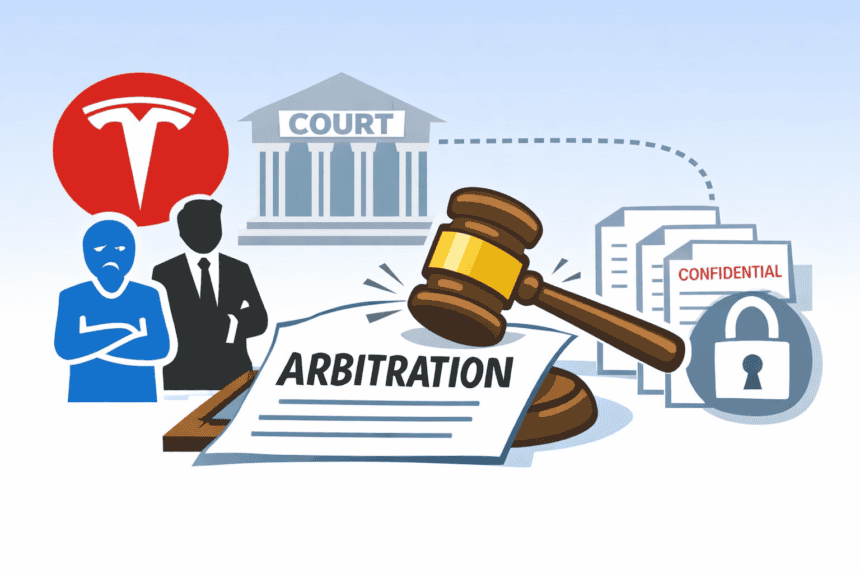

It started with a simple question. How many employment lawsuits has Tesla faced over the past decade? It seemed like a measurable thing. Tesla operates massive factories. It employs tens of thousands of people. It builds cars at a pace that has reshaped the auto industry. Companies of that size tend to generate litigation. Disputes are part of scale.
There were high-profile cases. There were discrimination claims. There were wage disputes. There were jury verdicts that made national headlines. And then, between those moments, there were long stretches of quiet.
Cases would appear. Then a motion to compel arbitration would be filed. Then an order would issue. Then the public record would stop.
The silence was not natural. It was procedural. It led me to arbitration.
The Legal Framework That Enables It
Mandatory arbitration rests on a century-old statute, the Federal Arbitration Act. Enacted in 1925, the law requires courts to enforce arbitration agreements in most commercial contexts. According to Cornell Law School’s Legal Information Institute1, the statute reflects a strong federal policy favoring arbitration agreements and instructs courts to place them on equal footing with other contracts.
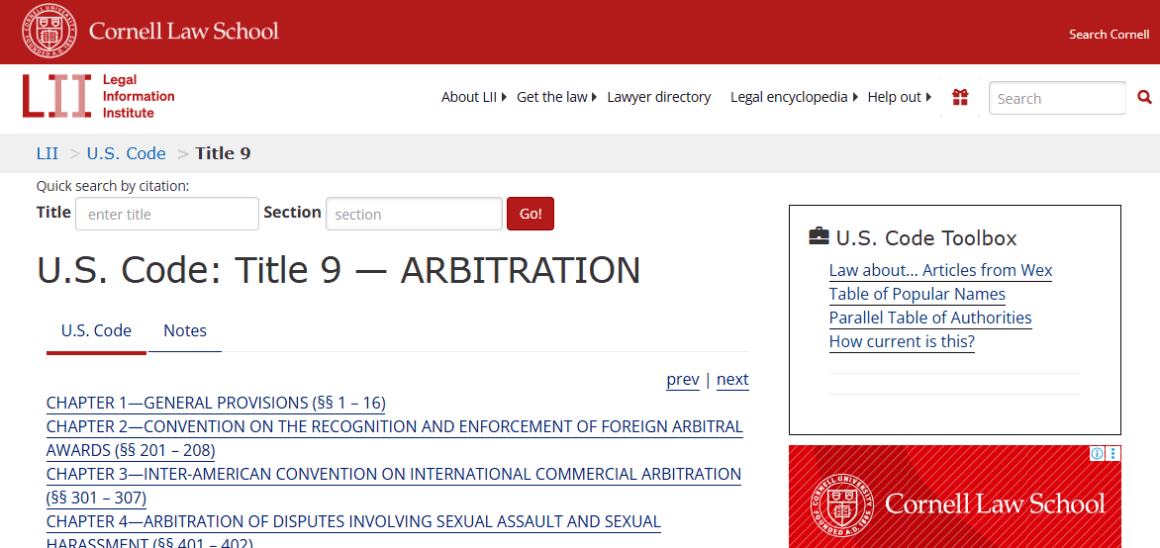
The statute itself is brief. Its impact is not.
Over the last several decades, the Supreme Court of the United States2 has repeatedly strengthened the enforceability of arbitration clauses. In Epic Systems Corp. v. Lewis, the Court held that employers may require employees to resolve disputes through individual arbitration rather than collective or class actions. The Court wrote that arbitration agreements must be enforced according to their terms, even when they bar class proceedings.
The decision did not focus on Tesla. But it reshaped the terrain in which companies like Tesla, Inc. operate.
Under current precedent, if an employee signs an arbitration agreement, courts will generally enforce it. The agreement can cover discrimination claims under Title VII of the Civil Rights Act. It can cover wage disputes under the Fair Labor Standards Act. It can reach state law claims for wrongful termination or retaliation.
The courtroom door does not shut entirely. But it narrows.
The Tesla Employment Agreement
Tesla’s arbitration language has appeared in public filings. According to documents filed with the U.S. Securities and Exchange Commission, Tesla includes a binding arbitration provision in its employment agreements. The company has filed versions of its employment and proprietary information agreements as exhibits in SEC filings3.
The agreement provides that employment-related disputes will be resolved through arbitration rather than litigation. It includes a waiver of jury trial. It limits the ability to pursue class or collective claims in court. Disputes over discrimination, harassment, wages, and termination are routed into arbitration.
The clause is not buried in microscopic print. It appears in the onboarding paperwork. Yet its long-term consequences are rarely clear at the moment of signing. For a new hire, arbitration is one provision among many. Stock grants, confidentiality, intellectual property, non solicitation. The arbitration clause is one paragraph in a stack of forms.
When an employee files suit in court despite the agreement, Tesla can move to compel arbitration. Federal courts routinely evaluate such motions under the Federal Arbitration Act framework. If the court grants the motion, the case leaves the public docket and proceeds before a private arbitrator.
According to KVUE4, numerous employment cases filed against Tesla have followed this trajectory. A complaint appears. A motion to compel arbitration is filed. The court grants the motion. The docket reflects a stay or dismissal pending arbitration.
From that point forward, the public record often goes quiet.
I began to see this pattern repeatedly.
When Courts Enforce the Clause
In Lambert v. Tesla, Inc., the United States Court of Appeals for the Ninth Circuit addressed whether Tesla’s arbitration agreement was enforceable in a race discrimination case. According to FindLaw5, which published the opinion, the appellate court upheld enforcement of the arbitration clause and rejected arguments that it was procedurally and substantively unconscionable under California law.
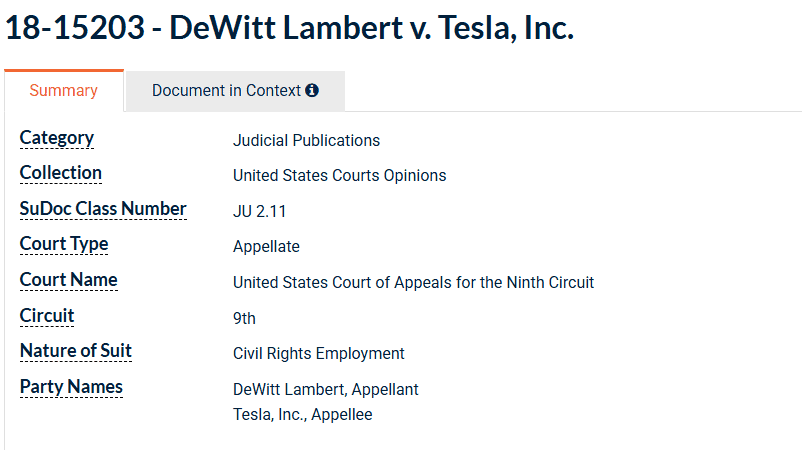
The plaintiff had argued that aspects of the agreement were unfair and should not be enforced. The Ninth Circuit disagreed. The panel concluded that the agreement met governing standards and that the Federal Arbitration Act required enforcement.
The ruling did not examine whether discrimination had occurred. It did not weigh evidence of workplace conduct. It did not assess damages.
It assessed the contract. That distinction matters.
Under the framework established by the Federal Arbitration Act and reinforced by Supreme Court precedent, courts focus first on whether a valid arbitration agreement exists and whether the dispute falls within its scope. If both conditions are met, the court compels arbitration. According to the US Law6, arbitration agreements must be enforced as written.
In practical terms, once a court grants a motion to compel arbitration, the litigation either is dismissed or stayed pending arbitration. The docket will reflect the complaint. It will reflect the motion. It will reflect the order.
After that, the detailed factual allegations and evidentiary record typically move into a private forum.
This is not an anomaly unique to Tesla. It is how the statutory design functions. The Federal Arbitration Act channels disputes away from public adjudication when parties have agreed to arbitrate. According to Congress.gov7, courts are directed to rigorously enforce arbitration agreements according to their terms.
For the individual litigant, the dispute continues before an arbitrator. Witnesses may testify. Evidence may be presented. A written award may be issued.
For the public, the paper trail narrows sharply.
Unless a party later seeks to confirm or vacate the award in court, the arbitration proceedings themselves usually do not generate publicly accessible transcripts or judicial opinions. As a result, allegations that once appeared in a filed complaint often fade from the searchable record.
This is not secrecy imposed after wrongdoing is proven. It is privacy embedded at the procedural stage.
When courts enforce the clause, they are not ruling on discrimination. They are ruling on the forum.
The difference shapes what the public is able to see.
The Rare Case That Reaches a Jury
Owen Diaz’s case against Tesla, Inc. is one of the exceptions that broke through the arbitration wall. Diaz, a former contract elevator operator at Tesla’s Fremont facility, alleged that he was subjected to severe racial harassment while working at the factory.
- The Legal Framework That Enables It
- The Tesla Employment Agreement
- When Courts Enforce the Clause
- The Rare Case That Reaches a Jury
- Arbitration Behind Closed Doors
- Investors, Disclosure, and the View From Online Forums
- Legal Development, Efficiency, Data Gaps, and the Meaning of Silence
- Endnote: A Thinner Archive
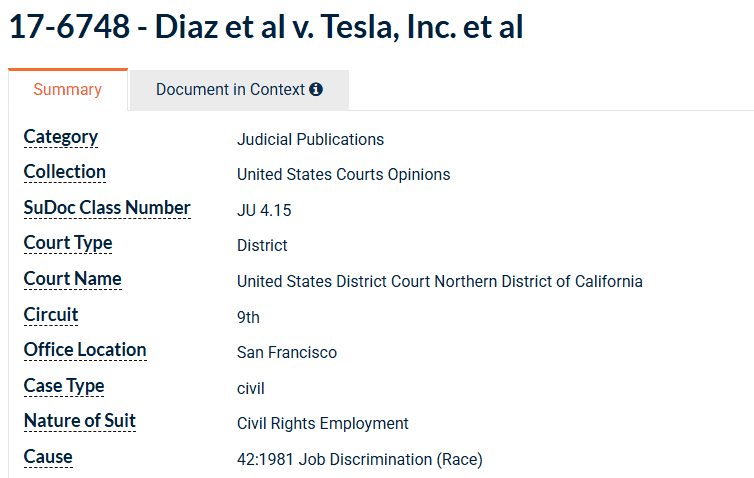
The case proceeded in federal court rather than being diverted into private arbitration. In 2021, a jury in the Northern District of California found in Diaz’s favor. According to Al Jazeera8, the jury initially awarded him 137 million dollars in damages, including compensatory and punitive damages.
The verdict drew national attention. Major outlets reported on testimony describing racial slurs and graffiti in the workplace. Because the proceedings occurred in open court, journalists were able to quote witness accounts and describe the evidence presented to the jury.
The award did not remain static. According to Reuters9, the trial judge later reduced the damages to 15 million dollars, concluding that the original award was excessive under governing legal standards.
Diaz rejected the reduced award and opted for a new trial on damages. In 2023, a second jury awarded 3.2 million dollars in total damages. Reuters10 reported that the new verdict reflected a substantially lower figure than the original award, continuing the legal back and forth that followed the first headline number.
The litigation evolved through post trial motions and appeals. Each stage generated written orders and reporting. The record became layered and detailed.
Because the dispute unfolded in public court, the allegations entered the historical archive. Court filings are accessible through federal docket systems. Orders are published. Media coverage preserves summaries of testimony and judicial reasoning. Legal analysts can examine how the judge applied standards for punitive damages. Civil rights advocates can cite the jury findings in policy debates.
That is what public litigation does. It creates a shared record that extends beyond the immediate parties. The contrast with arbitration is stark.
Had the case been compelled into arbitration at the outset, there would have been no public jury verdict. There would have been no published order reducing damages. There would likely have been no national reporting on the evidence presented. The dispute would have been resolved between the parties and the arbitrator, with limited public visibility unless one side sought judicial intervention.
Diaz’s case demonstrates what becomes visible when a workplace dispute remains in court. It also underscores how rare that visibility can be in an era when arbitration clauses are routinely enforced.
Arbitration Behind Closed Doors
Arbitration proceedings are generally private. Hearings are not open to the public. Arbitrators are selected by the parties or through provider procedures. Awards are delivered to the parties.
Unless one side seeks judicial confirmation or vacatur, the award may never be filed in court.
In another Tesla case, a former employee was awarded approximately 1 million dollars in arbitration over racial slur allegations. According to Al Jazeera11, details emerged only because related proceedings brought the matter into public view.
That glimpse revealed that arbitration can produce significant awards. But it also revealed how little of the underlying record is accessible.
There are no trial transcripts available online. No searchable exhibits. No jury instructions.
The public sees fragments.
When a dispute is litigated in federal court, it generates data. Complaints are filed. Motions are briefed. Orders are written. Judges explain their reasoning. The docket becomes searchable.
Researchers can identify patterns. Journalists can connect cases. Investors can track risk.
When a dispute is compelled to arbitration, that process shifts.
The initial complaint may remain in the docket. The motion to compel arbitration is often public. The order granting it is public. After that, the trail goes cold.
The dispute has not ended. It has moved to a forum where transparency is limited.
Over time, this shift changes the shape of the public record.
The debate over arbitration has intensified in recent years. In 2023, several United States senators urged Tesla to end mandatory arbitration for employees and consumers. According to CNBC12, the lawmakers argued that arbitration can conceal patterns of discrimination and harassment.
The senators framed arbitration as an accountability issue. If claims are resolved privately, they argued, systemic misconduct may remain hidden.
Tesla did not announce an end to its arbitration policies in response.
Congress has passed legislation limiting arbitration in certain contexts, such as sexual assault and sexual harassment claims. But most employment disputes remain arbitrable under federal law.
The legal architecture still favors enforcement.
State courts have also weighed in.
According to Justia13, in Wise v. Tesla Motors, Inc., a California appellate court upheld Tesla’s arbitration agreement despite challenges to related contractual provisions.
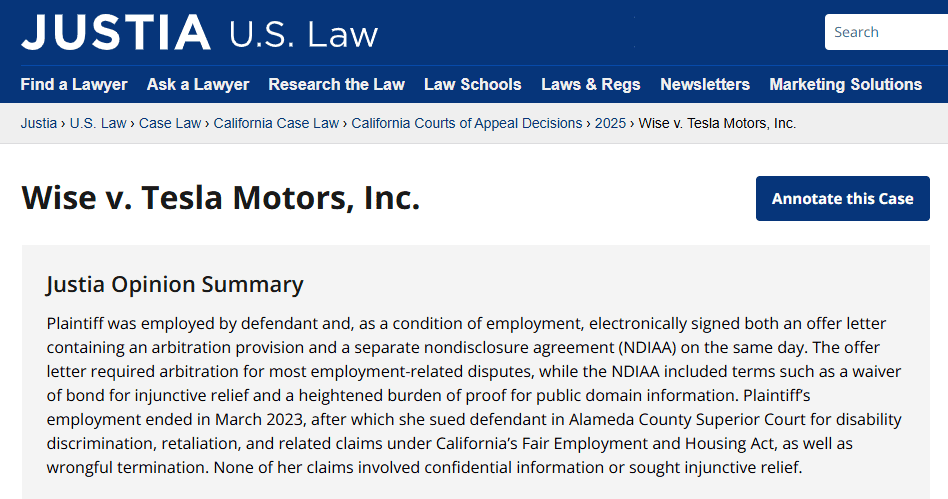
The decision followed established principles. Courts examine whether arbitration clauses are procedurally or substantively unconscionable. If they are not, they are enforced.
The outcome reinforces a consistent message. Arbitration clauses, when properly drafted, will be honored.
The practical effect is that disputes continue to migrate from public courtrooms to private conference rooms.
Investors, Disclosure, and the View From Online Forums
The transparency question does not affect only employees. It also shapes how investors evaluate corporate risk and long-term exposure.
As You Sow has pressed Tesla, Inc. for stronger disclosure around workplace diversity, equity, and inclusion metrics. In its shareholder proposal addressing human capital management, As You Sow stated that
“Investors require sufficient information to assess the company’s management of human capital risks.”
The organization argued that without clearer reporting, shareholders cannot fully evaluate potential reputational and legal liabilities tied to workplace practices.
In the same proposal, As You Sow wrote that enhanced transparency would “allow investors to better understand how the company manages diversity, equity, and inclusion risks and opportunities.” The framing is financial. The language is about risk management, not public image.
When disputes unfold in open court, they often produce detailed filings, sworn testimony, judicial rulings, and media coverage. Those materials become part of the information environment that analysts and institutional investors study. Arbitration alters that flow.
Investors rely heavily on filings with the U.S. Securities and Exchange Commission, quarterly earnings calls, and reputable news reporting. They do not have routine access to arbitration transcripts or confidential awards unless a dispute later returns to court. If allegations are resolved privately, fewer details enter the searchable public record.
The market responds to what it can see. A jury verdict can trigger headlines, analyst questions, and stock movement. A confidential arbitration award may never be widely known.
Outside formal filings and shareholder proposals, arbitration appears in a different register. It shows up in everyday conversation.
On online forums, Tesla customers and employees have discussed arbitration provisions embedded in purchase and employment agreements. In Tesla-focused communities, users have debated opt-out windows and deadlines.
Oneuser wrote,
“I didn’t even realize there was an arbitration clause until someone mentioned the opt out period.”
Another commenter asked,
“If I opt out, does it actually change anything in a real dispute?”
In a separate discussion thread, a user expressed confusion about the process, stating,
“The language is dense and I’m not a lawyer. I just want to know what I’m giving up.”
These posts are anecdotal. They are not judicial findings. Yet they reveal how contractual provisions feel at the individual level. Arbitration is not debated in abstract constitutional terms. It appears as a paragraph in a contract presented during onboarding or purchase.
Some users described learning about the clause only after completing paperwork. Others questioned whether opting out would meaningfully alter their leverage in a dispute with a large corporation.
Rarely do these threads include detailed narratives of arbitration hearings. There are a few descriptions of witness testimony or written accounts. The process remains largely invisible to the broader public.
That invisibility has consequences. Investors see limited dispute data. Consumers see contract language. Employees see onboarding forms. The disputes that follow may shape real lives and real finances, yet their resolution often leaves only faint traces in the public record.
Legal Development, Efficiency, Data Gaps, and the Meaning of Silence
Employment law develops in public. Judges interpret statutes. Appellate courts clarify standards. Written opinions accumulate and form precedent. Lawyers cite those decisions. Employers adjust policies in response. Workers and advocates learn where the boundaries lie.
That is how the system is designed to function.
When disputes are resolved in arbitration, fewer judicial opinions are produced. Arbitrators may issue written awards, sometimes with detailed reasoning. But those awards are not binding precedent. They are not published in official reports. They do not shape the law beyond the parties involved.
The Federal Arbitration Act requires courts to enforce arbitration agreements in most circumstances. The statute establishes a “liberal federal policy favoring arbitration agreements.”
That policy has been reinforced by the Supreme Court of the United States. In Epic Systems Corp. v. Lewis, the Court wrote that arbitration agreements must be enforced “as written,” even when they require individual proceedings and bar class actions.
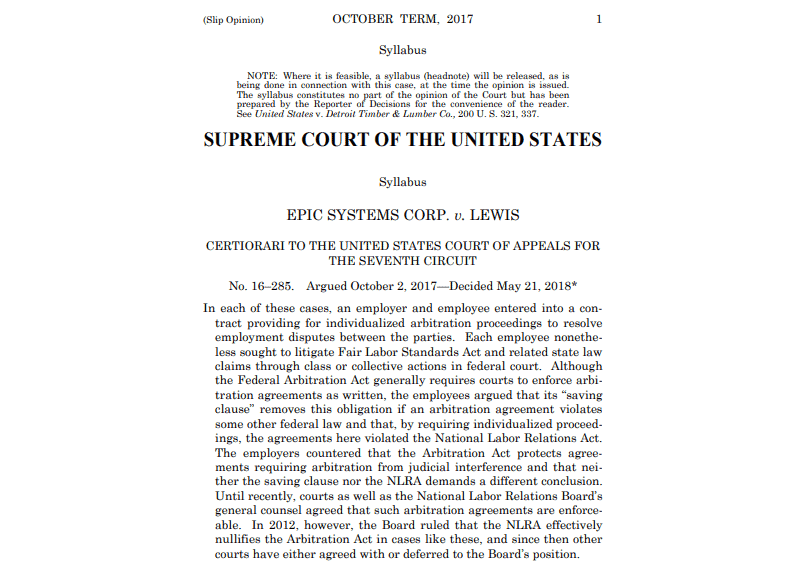
The cumulative effect is subtle but significant. As more employment disputes are channeled into arbitration, fewer opinions are issued interpreting federal and state workplace statutes. The development of law shifts from public articulation to private resolution.
For employees and employers alike, that shift can affect predictability. Published opinions provide guidance. They signal how courts interpret hostile work environment standards, retaliation frameworks, or damages calculations. Without a steady stream of publicly reasoned decisions, legal standards may feel less visible, even if the underlying statutes remain unchanged.
Supporters of arbitration emphasize efficiency. Cases can often be scheduled more quickly than in crowded federal courts. Discovery may be narrower. Hearings are typically less formal. Costs can be lower.
For some claimants, arbitration may feel less intimidating than federal court. A hearing room is smaller than a courtroom. There is no jury. The process may conclude sooner.
Privacy can also be a benefit. Public trials can expose painful details about workplace conflict, personal history, and medical information. Arbitration may allow resolution without wide publicity.
These are real considerations. But efficiency carries tradeoffs.
Transparency allows patterns to emerge. It allows journalists to connect allegations across time and departments. It allows policymakers to detect systemic problems. It allows appellate courts to refine doctrine.
When disputes are resolved privately, systemic visibility can diminish.
One of the most difficult aspects of examining this issue is quantification. How many employment disputes involving Tesla, Inc. have been resolved in arbitration over the past decade? There is no centralized public database that provides a comprehensive answer.
Some arbitration providers publish aggregate statistics. Yet detailed breakdowns by employer, claim type, and outcome are difficult to obtain. Confidential settlements further reduce visibility.
The result is opacity. Not necessarily secrecy in a conspiratorial sense, but structural opacity. Outsiders cannot easily measure the volume or character of disputes that never generate published opinions.
Tesla is not unique in using mandatory arbitration. Many large corporations include similar clauses in employment contracts. The practice is embedded across industries, from technology to retail to finance.
What makes Tesla particularly visible is its cultural prominence. The company’s products, leadership, and public controversies attract sustained attention. When disputes involving such a company move into private channels, the transparency question feels amplified.
But the same dynamic operates far beyond one employer.
Behind every docket entry is a human story. A worker who alleges discrimination or retaliation. A supervisor who disputes those allegations. A company that defends its policies and practices.
Arbitration does not erase those experiences. It relocates them.
For an individual claimant, the primary question may be practical. Was the process fair? Was evidence heard? Was compensation awarded? Did the resolution bring closure?
For the broader public, the questions differ. Are there recurring allegations across facilities? Do certain patterns repeat? Is reform warranted?
Arbitration can answer the first set of questions privately. It often leaves the second set unresolved in public.
As I reviewed federal dockets, I saw the same sequence again and again. Complaint filed. Motion to compel arbitration. Order granted. The case stayed or was dismissed.
That silence is not accidental. It is structural.
Mandatory arbitration alters the architecture of accountability. It does not prevent claims from being filed. It redirects them to a different forum. It does not guarantee confidentiality in every instance. Some cases return to court. Some generate media attention. But the default path narrows the channel through which disputes become part of the shared record.
The legal system enforces this structure. Courts apply the Federal Arbitration Act. They apply Supreme Court precedent. Agreements are honored as contracts.
The consequence accumulates over time. The public record becomes more selective. High-profile cases that reach jury verdict, like the discrimination case brought by Owen Diaz that The New York Times14 reported initially resulted in a 137 million dollar award, stand out sharply.
Routine disputes that proceed quietly through arbitration do not generate similar visibility.
Transparency is not merely symbolic. It shapes incentives. Public trials can deter misconduct. They can expose systemic flaws. They can prompt legislative reform. Private arbitration can resolve disputes efficiently and discreetly. It can also limit the ripple effects of public exposure.
The balance between efficiency and transparency reflects policy choices embedded in statutes and reinforced by judicial decisions. For Tesla, as for many corporations, mandatory arbitration is a lawful strategic choice supported by existing precedent.
For the public, it means that understanding workplace realities often requires assembling fragments. Some information appears in court opinions. Some appear in media investigations. Some surfaces in shareholder proposals and regulatory filings. Some appear in online forums.
The rest remains in private case files, accessible only to the parties involved.
That is what the silence means.
Endnote: A Thinner Archive
When I began this inquiry, I expected to find a dense record of public employment litigation involving Tesla, Inc. A company of its scale, workforce size, and visibility would normally generate a substantial trail of published court decisions.
Instead, I found something thinner. The archive was punctuated by headline cases, but between them were stretches of procedural quiet. Complaints appeared. Motions to compel arbitration followed. Orders were entered. Then the docket often fell silent.
The gap between expectation and record led me back to arbitration.
Under current federal law, Tesla’s arbitration agreements are enforceable. Courts have upheld them. The legal foundation rests on the Federal Arbitration Act15, which the Legal Information Institute describes as reflecting a “liberal federal policy favoring arbitration agreements.”
The Supreme Court of the United States has reinforced that policy. In Epic Systems Corp. v. Lewis, the Court held that arbitration agreements must be enforced according to their terms, even when they require individual proceedings and prohibit class actions.
At the same time, lawmakers and advocates have questioned the transparency effects of mandatory arbitration. Reuters16 reported that several United States senators urged Tesla to end mandatory arbitration for employees and consumers, arguing that the practice can obscure patterns of discrimination and harassment.
Al Jazeera17 reported that some Tesla workplace disputes became visible only because they unfolded in public court or reentered the judicial system after arbitration outcomes were challenged.
Each of those sources captures a different dimension of the issue. Statutory text explains why courts enforce arbitration clauses. Supreme Court precedent clarifies how broadly those clauses apply. Legislative criticism highlights concerns about systemic visibility. Media reporting reveals the rare moments when private disputes surface in public view.
Taken together, they describe a system in which disputes continue, but the public record becomes selective.
The legal architecture does not eliminate claims. Employees still file them. Companies still defend against them. Arbitrators still hear evidence and issue awards.
What changes is visibility.
The docket goes quiet. The proceedings continue elsewhere.
That is the structure of mandatory arbitration under current law. It does not erase disputes. It reduces their public trace.
Sources
- “U.S. Code: Title 9” US Law, 15 Aug. 1990, www.law.cornell.edu/uscode/text/9. Accessed 28 Feb. 2026. ↩︎
- “16-285 Epic Systems Corp. v. Lewis (05/21/2018)” 18 May 2018, www.supremecourt.gov/opinions/17pdf/www.supremecourt.gov/opinions/17pdf/16-285_q8l1.pdf. Accessed 2 Mar. 2026. ↩︎
- “SEC.gov”, www.sec.gov/Archives/edgar/data/1318605/000156459017009968/tsla-ex107_954.htm. Accessed 2 Mar. 2026. ↩︎
- Searles, Sam. “Cases filed against Tesla’s Texas Gigafactory for labor, employment violations” Kvue.Com, 15 Nov. 2022, www.kvue.com/article/news/local/teslas-texas-gigafactory-labor-employment-violations/269-97f1c319-e907-485f-8629-26f5ac3c84a7. Accessed 2 Mar. 2026. ↩︎
- “Find Law”, caselaw.findlaw.com/court/us-9th-circuit/1905302.html. Accessed 2 Mar. 2026. ↩︎
- Lii. “Epic Systems Corp. v. Lewis” US Law, www.law.cornell.edu/supct/cert/16-285. Accessed 2 Mar. 2026. ↩︎
- “Congress.gov” www.congress.gov/crs-product/LSB11217. Accessed 2 Mar. 2026. ↩︎
- Jazeera, Al. “Tesla to pay $137m to former employee over racism at work” Al Jazeera, 5 Oct. 2021, www.aljazeera.com/economy/2021/10/5/tesla-to-pay-137m-to-former-employee-on-racism-at-work. Accessed 2 Mar. 2026. ↩︎
- “Reuters.Com” www.reuters.com/legal/litigation/tesla-gets-137-mln-race-bias-verdict-cut-15-mln-2022-04-13. Accessed 2 Mar. 2026. ↩︎
- “Reuters.Com” www.reuters.com/legal/jury-awards-32-mln-ex-tesla-worker-race-bias-case-2023-04-03. Accessed 2 Mar. 2026. ↩︎
- Jazeera, Al. “Former Tesla employee awarded $1m over racial slur” Al Jazeera, 5 Aug. 2021, www.aljazeera.com/economy/2021/8/5/former-tesla-employed-awarded-1m-over-racial-slur. Accessed 2 Mar. 2026. ↩︎
- Feiner, Lauren. “Tesla urged by seven senators to end forced arbitration for workers and customers” 8 May 2023, www.cnbc.com/2023/05/08/tesla-urged-by-senators-to-end-arbitration-for-employees-consumers.html. Accessed 2 Mar. 2026. ↩︎
- Law Justia, law.justia.com/cases/california/court-of-appeal/2025/a170983.html. Accessed 2 Mar. 2026. ↩︎
- “Nytimes.Com” 4 Oct. 2021, www.nytimes.com/2021/10/04/business/tesla-racism-lawsuit.html. Accessed 2 Mar. 2026. ↩︎
- 19 July 2017, www.federalregister.gov/documents/2017/07/19/2017-14225/arbitration-agreements. Accessed 2 Mar. 2026. ↩︎
- “Reuters.Com” www.reuters.com/business/autos-transportation/seven-us-senators-raise-concerns-about-tesla-use-forced-arbitration-clauses-2023-05-08/. Accessed 2 Mar. 2026. ↩︎
- Jazeera, Al. “Carmaker Tesla ordered to pay $3.2m in US racial bias lawsuit” Al Jazeera, 4 Apr. 2023, www.aljazeera.com/news/2023/4/4/carmaker-tesla-ordered-to-pay-3-2m-in-us-racial-bias-lawsuit. Accessed 2 Mar. 2026. ↩︎


