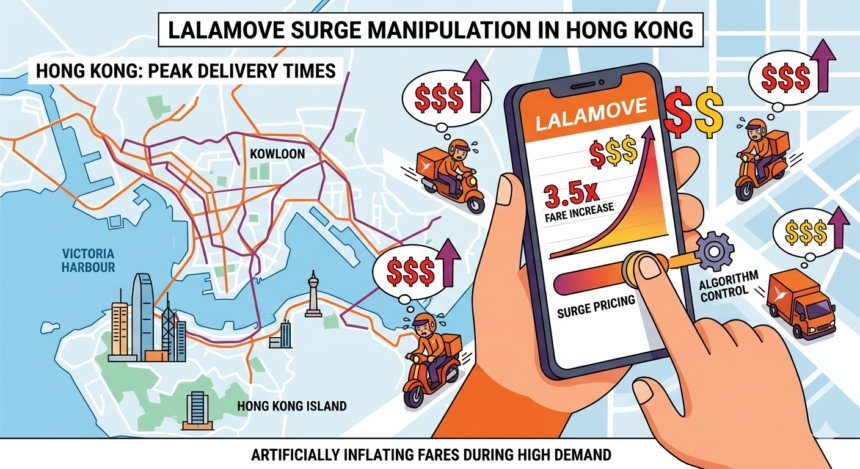

How the city’s dominant on-demand logistics platform built an empire on opaque pricing, and what drivers and customers are paying for it
There is a moment every Lalamove driver in Hong Kong knows well. You open the app, you accept a job that the screen tells you will pay a reasonable rate, and then somewhere between pickup and dropoff, the numbers shift. The fare displayed to the customer is not quite what you were promised. The surge that was there when you accepted the order seems thinner by the time it settles. You push through it because the platform owns the morning, the midday rush, and the dinner window too. There is nowhere else to go. Lalamove does not just compete in Hong Kong’s on-demand logistics market. For all practical purposes, it is that market.
Founded in December 2013 by Chow Shing-Yuk under the name EasyVan, Lalamove rebranded and expanded from its home city to become what its parent company, Lalatech Holdings, now calls the world’s largest logistics transaction platform by closed-loop freight gross transaction value. As of 2025, Lalamove operates across more than 400 cities in 17 markets, from Bangkok to Brazil, from Manila to the UAE. The numbers it presents to potential IPO investors are genuinely impressive. According to BigGo Finance1, the platform surpassed 1.027 billion global orders in 2025, with a gross transaction volume reaching $13.32 billion and three straight years of profitability. On April 30, 2026, Lalatech submitted its prospectus to the Hong Kong Stock Exchange for the eighth time in five years, backed by Goldman Sachs, Merrill Lynch, and JPMorgan. The listing machinery is polished, patient, and expensive.
But behind the investor-grade language about “transparent pricing” and “algorithm-driven efficiency,” something else is going on. Drivers across Hong Kong and the broader region have been telling a different story for years. Forums, union reports, academic research, and regulatory documents paint a picture of a platform that uses its algorithmic pricing architecture to extract maximum value from both ends of the transaction. Customers who pay more during surge windows, and drivers who often receive less than they expected when the final tally appears. Understanding how this works, and why Hong Kong’s regulatory environment has made it so hard to challenge, is the actual story of Lalamove’s rise.
The “Transparent Pricing” Problem
Lalamove’s2 homepage carries a promise: “Transparent pricing with no hidden costs.” Scroll one paragraph further, and the company adds a qualification that most users miss.
The fare, it explains, is “based on multiple factors such as traffic situation, order volume, availability of delivery partners, applicable tolls, surcharges and so on.” It follows with a direct admission: “
The total fare of the service may vary. The fare displayed at the time of request may not be the same if there is a change to order details.”
This is not a loophole. It is the whole architecture. Lalamove’s pricing is dynamic in the truest sense: not fixed, not predictable, and subject to algorithmic adjustments that neither the customer nor the driver fully controls or understands. When demand spikes, a typhoon warning, Chinese New Year, the lunch hour in Causeway Bay, the platform’s algorithm responds by raising prices. That much is common knowledge. What is less discussed is how the surge pricing interacts with driver earnings, customer expectations, and the platform’s own margin calculations in ways that consistently favor Lalatech’s bottom line.
The company describes its revenue architecture as a “hybrid monetization model.” In practice, this means Lalamove earns money from multiple levers simultaneously: a commission on each order, subscription fees from drivers who pay for priority access or better order matching, and surge multipliers applied on top of the base fare during high-demand periods. Mainland regulators summoned Lalamove more than a dozen times in recent years over complaints related to payment delays for carriers, arbitrarily adjusted pricing rules, and high commission rates and membership fees. That pattern is notable precisely because it documents, in the language of regulatory intervention, what drivers and users have been saying informally for years.
The Driver’s Math
To understand surge manipulation, you have to understand how drivers in Hong Kong actually earn. When a peak-hour surge activates, the customer sees a higher fare displayed in the app before booking. The driver, meanwhile, receives an order assignment that reflects a portion of that elevated fare. A portion determined not by any published formula but by the platform’s internal algorithm. The driver has no visibility into the customer’s displayed price. The customer, similarly, has limited visibility into how much of the surge premium flows to the driver versus how much is retained by Lalamove as additional commission on top of the standard rate.
This information asymmetry is not accidental. It is structural. Research from the University of Minnesota’s Carlson School of Management3, examining millions of rides on a major Chinese ride-hailing platform, found that surge pricing significantly increases the probability of a driver receiving a complaint, and that about 23 percent of a driver’s immediate income boost from surge pricing is offset by future income loss from rider complaints that follow. The study concluded that platforms often treat pricing and review systems as separate mechanisms, when in reality they interact in ways that partially negate surge-related income gains for drivers.
For Lalamove drivers specifically, the commission dynamics compound this. According to Biggo4, in mainland China, Lalamove’s comprehensive commission rate for intra-city freight declined from 12.2 percent in 2023 to 10.9 percent in 2025. A drop the company attributes to regulatory pressure and driver complaints. In Hong Kong, no equivalent public disclosure exists. The company does not publish commission rate breakdowns for its home market, which means drivers here operate with even less information than their mainland counterparts.
Drivers who requested anonymity given the power the platform holds over their access to orders, described the experience in straightforward terms.
One said:
“You see the surge icon and you think: good, this is going to be worth it. But the commission structure, the membership fee, the way the app assigns orders — it is designed so the platform always gets its cut first. What is left for you depends on decisions you cannot see and cannot contest.”
The most documented confrontation between Lalamove and its drivers came in November 2022. As reported by Wage Indicator5, Lalamove drivers organized a nationwide work stoppage in mainland China to protest the platform’s introduction of “multi-factor pricing” — a new algorithmic model that drivers said calculated delivery distance in ways that understated the actual routes they were required to travel. Alongside that, the company had introduced “discounted hitch orders” that let customers receive lower fares by sharing route segments, with the discount deducted from driver compensation rather than from platform revenue.
This was the breaking point. The protests spread from Southern China to multiple provinces. In Shenzhen, at least 50 vans drove slowly in convoy formation through a main avenue, carrying banners protesting what drivers called “unilateral pay cuts.” In Chengdu, drivers delivered collective grievances to local Lalamove offices. In Xi’an, banners read: “Lalamove destroys market rules, get out of Xi’an.” One driver interviewed on Yunnan television described the experience with particular clarity:
“We did not get any heads up. We got up in the morning and went to work, then we realised our fees had been cut overnight.”
The company had reduced the minimum initial fee per delivery from 38 yuan to 30 yuan and then to 28 yuan. Drivers doing the math at the end of a month found themselves earning less despite completing the same or more orders. A driver in Hangzhou said that from May to December 2022, his monthly net income was only about 5,000 yuan after deducting costs and fees. Another, in Yiwu, completed 172 orders in April 2022 for a gross income of 9,916 yuan. Numbers that look reasonable until you subtract fuel, vehicle maintenance, and the mandatory platform membership fee.
What is relevant to Hong Kong is the template these events revealed. Lalamove had constructed a pricing architecture in which the platform could unilaterally adjust the fee structure that determined driver income, without notice, without negotiation, and without recourse. Subsequent regulatory pressure from China’s Ministry of Transport and the State Administration for Market Regulation focused specifically on algorithmic transparency. A signal that the opaque pricing engine was recognized as a systemic problem, not an isolated complaint.
The protests kept happening all around the world.
As posted by Anakbayan6, on July 24, the Lalamove Driver Association held a nationwide strike booking and joined the State of the Nation Address (SONA) protest to demand fair working conditions. Around 7,000 riders across Metro Manila, Cebu, Davao, Batangas, Quezon, and Laguna participated in the movement.
Hong Kong and the Absence of Oversight
In Hong Kong, the story becomes more complicated. The city occupies a distinctive position in the Lalamove empire: it is the company’s founding home, the address of its North Point headquarters, and the venue for its repeated IPO attempts. It is also a market in which regulatory oversight of algorithmic pricing in the gig economy barely exists.
Research published by Cambridge University Press7 on food delivery workers in Hong Kong found that platform-worker relations are “depicted as unequal, as platforms’ decisions via algorithms lack transparency and information for workers.” The researchers found that many workers understood how platforms made profits by exploiting legal loopholes “facilitated by the government’s non-intervention approach to the platform economy.”
That non-intervention has consequences. According to YPC8, Hong Kong government estimates from 2023 counted approximately 114,000 app-based riders and drivers in the city. These workers have no specific legislative protection. They are classified as self-employed contractors, meaning they are not entitled to the paid annual leave, sick leave, or minimum wage protections available to employees under the Employment Ordinance. A 2023 Labour Tribunal ruling that classified delivery couriers for the platform Zeek as employees was a landmark, but it addressed a different company, and Lalamove has argued consistently that the control it exercises over its drivers falls short of the legal threshold for employment.
Effective from January 2026, Hong Kong expanded its “continuous contract” eligibility rules to cover more gig workers, and the 2025 Chief Executive’s Policy Address proposed legislative reforms to improve compensation for digital platform delivery workers. These are meaningful steps. But they leave the core question of algorithmic pricing transparency entirely unaddressed. A driver can potentially gain access to sick leave without ever learning why the surge multiplier that appeared in their app this morning resulted in a settlement figure that seemed lower than expected.
The IPO and the Transparency Paradox
Lalamove’s repeated attempts to list on the Hong Kong Stock Exchange place the company in an unusual position. To attract institutional investors, it must disclose financial data with considerable granularity: commission rates, gross margins, revenue structure, risk factors. But to maintain operational advantage over its drivers and preserve pricing flexibility, it needs those same details to remain opaque at the transactional level.
The prospectus language is instructive here. According to The Standard9, the company acknowledges in its own risk disclosures that “dissatisfied carriers with the pricing models may file complaints with regulators, which, regardless of their veracity, may lead to heightened scrutiny from regulators, as well as increased attention and negative publicity from the public.” This is the company telling potential shareholders, explicitly, that driver complaints about pricing are a known risk factor for the business. It is a striking admission, not that the pricing is unfair, but that complaints about pricing create regulatory and reputational exposure.
In September 2025, Caixin Global10 reported that China’s State Administration for Market Regulation summoned Lalamove specifically over antitrust concerns, ordering it to “adjust its business conduct in a timely manner and compete fairly in the market.” The regulator called on the company to “make platform rules and algorithms fair, impartial and transparent.” By that point, complaints about Lalamove on China’s Black Cat consumer platform had approached 100,000. The company published its dispatch algorithm rules in response, a concession that was meaningful but also limited, disclosing how orders are matched without fully explaining how fares are calculated or how surge multipliers are applied.
The overseas monetization rate tells another part of the story. Lalamove’s overseas markets, which include Hong Kong, carry monetization rates nearly seven percentage points higher than mainland China. This gap reflects the fact that regulatory pressure in China forced the company to reduce commissions and concede ground, while in markets like Hong Kong and Southeast Asia, no equivalent pressure exists. The result is that Hong Kong’s drivers and customers are, in structural terms, subsidizing a monetization model that the company can no longer sustain in China without regulatory intervention.
What Solidarity Looks Like
In October 2022, as mainland Chinese Lalamove drivers were preparing for their November strike, another protest was unfolding in Bangkok. Delivery workers for Lalamove Thailand staged demonstrations against a discount campaign that offered customers reduced fares by deducting the discount directly from worker compensation. The country’s Freedom Rider Union demanded the return to a base starting fee, called out the platform for charging drivers on every bank withdrawal, a fee Lalamove had falsely attributed to the banks themselves, and demanded one free withdrawal per day.
The Hong Kong Labour Rights Monitor documented these events and the common thread running through them: “Cuts to workers’ pay, unfair pricing systems that disadvantage workers and lack of transparency in the algorithms are the main reasons for the workers’ mobilization.” The document noted that “these mechanisms were developed and implemented by the platform companies to workers’ disadvantage and without any consultation or negotiation in good faith with workers.”
The Hong Kong chapter of this story is quieter, partly because Hong Kong’s political environment after 2020 made collective worker organizing significantly more constrained. But the structural grievances are identical. Drivers in Hong Kong face the same information asymmetry, the same unilateral fee adjustments, and the same absence of appeal mechanisms as their counterparts in Shenzhen, Bangkok, or Jakarta. The app is the same. The algorithm is the same. Only the regulatory environment is different, and in Hong Kong, it is more permissive.
In Indonesia, Lalamove reduced its per-kilometer commission gradually over the period before 2021, and changed payment withdrawal rules so drivers could only access earnings during office hours. The Lalamove Partners Gathering Forum spokesperson Ade described drivers who completed orders on weekends and holidays unable to access their money until the following Monday. “However, we are still working on Saturday and Sunday, as well as on national holidays, since the app is still taking orders during holidays,” he said. The pattern is consistent enough to suggest that it is not a series of regional accidents. It is a business model.
The Competition That Isn’t
Part of what makes Lalamove’s pricing power so durable in Hong Kong is the absence of meaningful competition. The company’s closest local rival, GoGoVan, exited through a merger with China’s 58 Suyun in 2017 as reported by Tech in Asia11.
Since then, Lalamove has operated in a category it largely defines. The company controls 63.1 percent of China’s intra-city freight market and a 53.1 percent global market share by closed-loop freight GTV. Numbers that gave China’s antitrust regulators reason for concern and that explain why drivers in Hong Kong have limited practical alternatives.
When a platform achieves this kind of market concentration, surge pricing stops functioning as a market mechanism and starts functioning as a toll. The theory of dynamic pricing is that high prices during peak periods attract additional supply . More drivers come online, balancing the market and eventually moderating prices. But when there is only one dominant platform, drivers cannot move to a competitor during low-surge periods and return during surges. They stay because the platform is the market. And when they stay regardless of surge levels, the pricing signal loses its supply-balancing function entirely. What remains is a revenue-extraction mechanism dressed in the language of supply-and-demand economics.
Lalamove’s own prospectus acknowledges the risks inherent in this structure. The company notes that “retaining drivers is difficult as they are freelancers; if they find higher pay, they will switch immediately.” The document is honest about driver mobility as a competitive risk. What it does not address is the flip side: that drivers cannot easily switch precisely because Lalamove has captured enough of the market to make alternatives impractical.
A Hong Kong Problem
I want to be precise about what this investigation is and is not claiming. Surge pricing in itself is not manipulation. Every city’s logistics economy experiences genuine demand spikes: typhoon signals, public holidays, the weeks before Lunar New Year. A pricing mechanism that responds to those spikes by raising fares to attract more driver supply is defensible in principle. The problem in Hong Kong is not surge pricing as such. It is the combination of factors that make Lalamove’s specific implementation of it structurally exploitative.
The factors are these: dominant market position that eliminates the competitive check on pricing behavior; algorithmic opacity that makes it impossible for drivers to verify whether the fare they receive accurately reflects the surge their customers paid; absence of Hong Kong-specific regulation governing dynamic pricing transparency in gig logistics; and a prospectus that, while disclosing financial data to investors, acknowledges driver complaint risk without committing to the transparent pricing its homepage promises.
Hong Kong’s Competition Ordinance exists and has teeth, but its enforcement record against tech platform pricing practices is thin. The Competition Commission has pursued resale price maintenance cases and cartel enforcement, but algorithmic pricing by a dominant platform sits in different regulatory territory. One that the city’s framework has not yet mapped with much clarity.
The Legislative Council has been moving. The 2025 Policy Address signaled a willingness to legislate protection for digital platform workers. The expanded continuous contract rules that took effect in January 2026 were a genuine step. A Legislative Council12 research brief from August 2025 examined the regulation of digital platform algorithms in the European Union and elsewhere, signaling that algorithm transparency was at least on the research agenda. But policy ambition and enacted protection are not the same thing, and Lalamove’s IPO timeline suggests the company is hoping to capitalize on Hong Kong’s capital markets before any meaningful algorithmic regulation arrives.
Here is the most revealing thing in Lalamove’s repeated IPO filings. The company publishes gross transaction value, the total amount customers paid. It publishes revenue, the amount it retained after paying drivers their share. The gap between these two numbers, as a percentage of GTV, is the monetization rate. And the monetization rate tells you, at a macro level, how much of every dollar customers pay ends up with Lalamove rather than with drivers.
In mainland China, where regulatory pressure has been intense, the net monetization rate slid from 9.7 percent to 8.9 percent between 2023 and 2025 as reported by Biggo13. In overseas markets including Hong Kong, that rate is nearly seven percentage points higher. The company does not publish a Hong Kong-specific monetization rate in its prospectus. Given that the overseas aggregate is consistently higher than the regulated Chinese market, the reasonable inference is that Hong Kong drivers receive a smaller share of customer fares, relative to what those customers actually pay, than their mainland counterparts now do following years of regulatory intervention.
This matters because surge pricing on top of a high base monetization rate produces a compounding extraction. When fares double during peak demand, both the driver’s share and the platform’s commission double in absolute terms. But if the platform retains a higher percentage in the first place, and if the surge multiplier is applied after the platform commission is calculated, the driver’s gain is proportionally smaller than the customer’s cost increase. The driver sees a good surge. The customer pays a premium. Lalamove collects a larger absolute amount regardless.
None of this is disclosed in the app. The “transparent pricing” promise on Lalamove’s Hong Kong homepage remains what it has always been: a marketing statement, not an operational commitment.
What Accountability Would Look Like
The path to accountability here is not complicated, even if it is politically difficult. Hong Kong’s Competition Commission could examine whether Lalamove’s market position enables pricing behavior that would not survive in a competitive market. The government’s proposed legislative reforms for platform workers could include a transparency requirement mandating that drivers have access to the full fare paid by each customer on each order. The Hong Kong Monetary Authority’s payment oversight could extend to the settlement mechanics of gig platform earnings.
In the UK, the Supreme Court’s ruling in Uber’s labor classification case forced a genuine rethinking of how platform companies categorize their workers. In France, algorithmic transparency requirements for platform workers entered law in 2022. The European Union’s Platform Work Directive, passed in 2024, establishes rights around algorithmic management that go far beyond anything currently available in Hong Kong. None of these precedents require Hong Kong to import foreign law wholesale. They simply demonstrate that the regulatory problems Lalamove presents are solvable, that other governments have chosen to solve them, and that the choice not to solve them is a policy decision with real costs to real people.
Those people are the van drivers who wake up before dawn and check the app for surges, trying to predict which neighborhoods and which hours will offer enough premium to make a day’s work worthwhile. They are the small business owners who paid a peak-hour rate to move inventory and received no explanation of what triggered it or how it was calculated. They are the workers on Trustpilot who wrote that Lalamove “refused to take accountability” for problems that arose during delivery. They are, in aggregate, the constituency that makes Lalamove’s business possible. And the constituency that its IPO documents discuss primarily as a risk factor rather than as a group of people with legitimate interests in knowing how the algorithm treats them.
Hong Kong is proud of being a world-class financial center. It is preparing to host the Lalamove IPO, backed by three of the largest investment banks on earth. It would be worth asking, before that listing happens, whether a company that cannot explain its pricing to its own drivers deserves the city’s most prominent financial platform, or whether the price of that listing should include, at minimum, an honest answer to the question its app refuses to answer: exactly how much of the surge do you keep?
Sources
- BigGo Finance, finance.biggo.com/news/fpPAMJ4BoicNoOgCQeZQ. Accessed 17 July 2026. ↩︎
- “Lalamove Hong Kong | On-demand delivery platform” Lalamove, www.lalamove.com/en-hk/. Accessed 14 July 2026. ↩︎
- “How Rideshare Surge Pricing Impacts Complaints” Carlson School of Management, 10 May 2023, carlsonschool.umn.edu/news/how-rideshare-surge-pricing-impacts-complaints. Accessed 22 Sept. 2026. ↩︎
- Biggo, finance.biggo.com/news/fDsf6J0BNl__-4_GPtmw. Accessed 22 Sept. 2026. ↩︎
- Wage Indicator, wageindicator.org/labour-laws/platformeconomy/platform-workers-news/november-2022-china-lalamove-riders-on-a-3-day-strike. Accessed 22 Sept. 2026. ↩︎
- “Facebook” www.facebook.com/photo/?fbid=664227899080317&set=a.625478112955296. Accessed 24 Sept. 2026. ↩︎
- “The gig economy, platform work, and social policy: food delivery workers’ occupational welfare dilemma in Hong Kong | Journal of Social Policy” Cambridge Core, 4 Jan. 2024, www.cambridge.org/core/journals/journal-of-social-policy/article/gig-economy-platform-work-and-social-policy-food-delivery-workers-occupational-welfare-dilemma-in-hong-kong/9C9C585D54F6D9B4BA45EF49BF78528D. Accessed 24 Sept. 2026. ↩︎
- YPC, www.youngpostclub.com/yp/spark/stories/article/3315044/spark-deep-dive-hong-kongs-gig-workers-want-industry-regulated. Accessed 24 Sept. 2026. ↩︎
- “Share sale on the move again” 27 Nov. 2023, www.thestandard.com.hk/finance/article/58162/Share-sale-on-the-move-again. Accessed 24 Sept. 2026. ↩︎
- “China’s Market Regulator Summons Lalamove Over Antitrust Concerns” Caixin Global, 24 Sept. 2025, www.caixinglobal.com/2025-09-24/chinas-antitrust-regulator-summons-lalamove-over-competition-concerns-102365557.html. Accessed 24 Sept. 2026. ↩︎
- “Tech in Asia” With the new funds, GoGoX plans to invest…, www.facebook.com/techinasia/posts/with-the-new-funds-gogox-plans-to-invest-resources-across-various-markets-and-im/4264565003581880/. Accessed 24 Sept. 2026. ↩︎
- “Regulation of digital platform algorithms in the European Union and the Mainland” 11 Aug. 2025, app7.legco.gov.hk/rpdb/en/uploads/2025/IN/app7.legco.gov.hk/rpdb/en/uploads/2025/IN/IN14_2025_20250811_en.pdf. Accessed 24 Sept. 2026. ↩︎
- Biggo, finance.biggo.com/news/fDsf6J0BNl__-4_GPtmw. Accessed 24 Sept. 2026. ↩︎