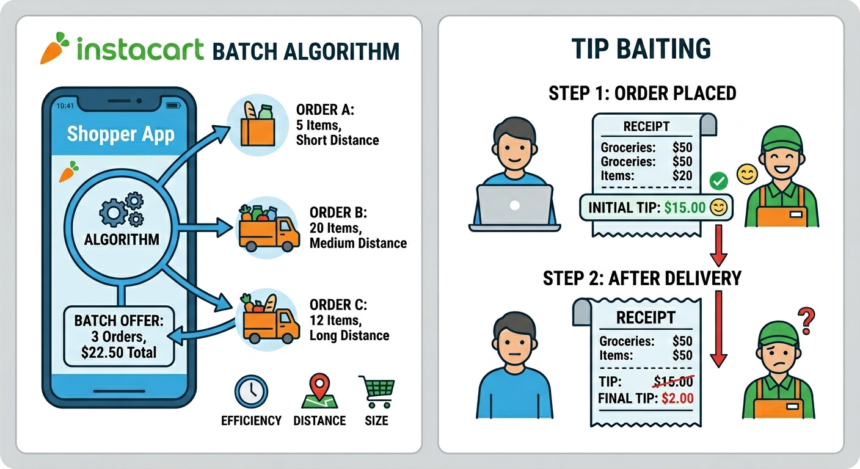

The order looked like a gift. A $97 tip on a single batch. For an Instacart shopper working under the handle @instacartier1 on TikTok, it was the kind of number that makes your hands move faster. He accepted it, filmed himself saying “I need y’all to pray for me and make sure that this guy is not tip-fishing me,” and got to work on what would have been a $113 payout. The prayer went unanswered. What happened next, the tip evaporating, a support call that ended with the batch stripped from his account, and a 24-hour account freeze just for asking for a pay bump, is not exceptional. It is Tuesday.
This is the world that roughly 600,000 Instacart shoppers navigate every shift: a black-box algorithm that decides who gets work, paired with a tipping structure that has, for years, allowed customers to weaponize generosity as bait. Understanding how both systems function, and, more pointedly, how they interact to shape the daily economics of gig grocery work, requires pulling apart two pieces of machinery that Instacart has every incentive to keep opaque.
The Machine That Hands Out Work
Before you can understand tip baiting, you need to understand what a “batch” actually is and why shoppers fight over them the way they do.
A batch is an Instacart delivery job. It can contain one order or several, sourced from one store or multiple. When a shopper opens the app and a batch appears on their screen, they have seconds to decide whether to accept it. What they see is a summary: the store, the estimated pay, the number of items, the tip amount, the distance to the delivery address. What they don’t see is the full logic that decided they were the one getting shown this particular batch at this particular moment.
That logic is the algorithm, and it runs on several visible and invisible inputs.
Instacart’s1 own documentation acknowledges that batches from a store are made available to shoppers based on proximity to that store. The closer you are, the more likely you are to see an available batch. Once you’re inside a “highlighted area” around a store, you have maximized your physical proximity advantage. But proximity alone doesn’t win you the best work. That’s where the Cart Star tiering system enters the picture.
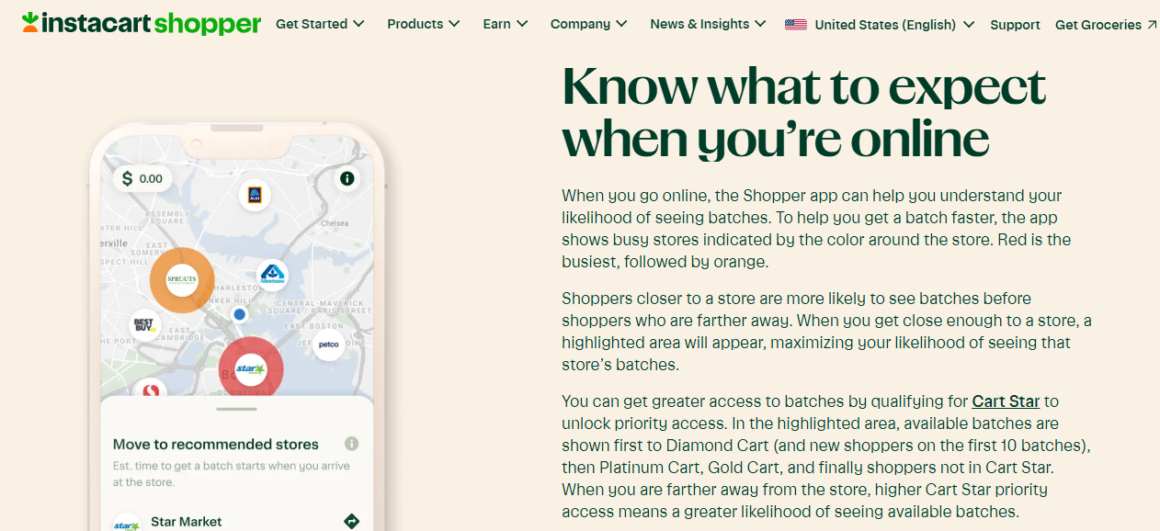
Cart Star is Instacart’s rewards program, structured around three tiers: Gold, Platinum, and Diamond. To qualify, shoppers must complete a minimum number of orders and maintain a minimum shopping quality score and a customer rating of at least 4.7 stars over a three-month qualifying period. Points reset each period. Fail to hit your numbers, and your tier drops. The rewards, particularly at the Diamond level, are significant: Diamond shoppers see batches before stores open, before any other shoppers, and have first pick of the available work. Platinum shoppers see batches before Gold and non-Cart Star shoppers. Everyone else gets what’s left.
The practical effect of this system is a multi-class structure among shoppers competing for the same pool of work. A Diamond shopper positioned near a busy grocery store at 9 a.m. will see a batch of desirable orders before anyone else in the vicinity. A brand new shopper, or one whose rating has slipped below 4.7, might be staring at the dregs, long-distance orders, low-tip batches, orders with heavy items, or nothing at all.
According to Ridesharing Driver2, some Diamond Cart shoppers have complained that grinding through lower-quality batches just to accumulate enough points to maintain tier status is its own trap: “I’m expected to take the worst batches just to reach diamond cart, which only puts me back where I was before this update.” Another wrote: “My earnings plummeted when this release came out, platinum cart here.”
The algorithm also considers what Instacart calls “order demand.” Batches that have been waiting or declined by other shoppers get their pay boosted to attract someone willing to take them. This means the rejected orders eventually do find takers, but it also means there’s a secondary market of boosted-pay batches that only become available after better shoppers have already passed. If you’re a new shopper, or one whose rating has been dinged, you might find yourself working the leftover pile with artificially inflated numbers that still don’t justify the drive.
According to Gridwise3, base batch pay typically ranges from $7 to $12 for standard orders, with complex multi-item or long-distance deliveries pushing higher. Instacart guarantees a minimum batch pay, generally $7 to $10 depending on market, so there’s a floor, but it’s a low one. Orders with heavy items like cases of water or large bags of pet food trigger a heavy pay bonus, typically $2 to $5 extra. That sounds fair on paper. In practice, shoppers carrying 40-pound water cases through apartment building lobbies, up staircases, and through long parking lots often report that $3 in extra pay doesn’t quite cover the physical cost.
TechZeel4 reported that in early 2025, Instacart updated its batch pay algorithm to more heavily weight item count and driving distance, which produced higher pay for larger, more complex orders. The adjustment was a concession to a persistent complaint: the old formula undervalued the real labor of big-grocery batches. Whether it fully addressed that complaint depends on who you ask.
The Tip Is the Job
Here is the thing about Instacart batch pay: it is only part of the equation, and often the smaller part. Tips are how the math actually works.
Instacart5 passes 100% of customer tips directly to shoppers, which is more than can be said of its earlier history. The tip is visible to shoppers before they accept a batch, which means it is directly woven into the decision to take or skip an order. A batch offering $9 base pay plus a $25 tip looks very different from an identical batch offering $9 base pay and a $3 tip. The first goes fast. The second sits.
This is not an accident of design. It is the design. Tips are the mechanism by which customers, without realizing it, queue-jump. A customer who puts a generous tip on an order is buying faster, more competitive service. Their batch will be seen and accepted by higher-tier shoppers with more experience. A customer who tips nothing, or the Instacart-suggested default of 5%, is gambling that someone will still pick up their order. And someone will. Eventually. After the algorithm has boosted the pay to compensate for the lack of tip.
The structural problem is that tips can be changed after delivery.
Tip Baiting: The Long History of a Short Con
Tip baiting is the practice of placing a large tip on an order to attract a shopper, then reducing or zeroing out that tip after the delivery is complete. It emerged prominently in the early months of the COVID-19 pandemic, when demand for grocery delivery exploded and time slots became competitive. Customers who struggled to get their orders picked up quickly discovered that a large upfront tip was essentially a bidding mechanism. Some of them, once the groceries were in hand, quietly took their money back.
The shoppers noticed. Kristi Fitzpatrick, a former rideshare driver who moved to Instacart shopping during the pandemic, told ABC76 what it felt like:
“Everything goes perfect…and suddenly there’s no tip and there’s a dollar or there’s just basically change.” Orders that started at $50, $60, sometimes $100 tips would vanish after delivery. Not always, not often. But enough.
Newsweek7 reported on TikTok user @thatgiglife, who had stumbled across an order with a $385 tip. The kind of number that makes the heart move before the brain does. The shopper said the problem was more widespread than most people realized:
“Tip baiting happens more often than people realize. I think it’s really sad to lure someone into doing a task or a job for you and then take away the earnings you promise, especially when they do a good job.”
Instacart’s official position has always been that tip baiting is rare. During the pandemic period, TechCrunch8 stated that the company maintained that less than 0.5% of orders had tips removed after delivery, and that tip totals had roughly doubled since lockdowns began. In March 2020, the company claimed that more than 99% of customers either didn’t change the tip or increased it after delivery.
The shopper community, predictably, did not find these percentages reassuring. When you’re doing 15 to 20 batches a day, 0.5% of orders does not feel statistically insignificant. It feels like roughly one order a week disappearing from your wallet. And the financial stakes of any single removed tip are much higher than they would be in most tipped service contexts, because shoppers actively selected those high-tip orders at the expense of other available work.
The legal argument against tip baiting is actually interesting. U.S. Senators including Elizabeth Warren, Sherrod Brown, and Brian Schatz wrote to the FTC9 in May 2020 to request an investigation, arguing that the practice potentially violated Section 5(a) of the FTC Act, which prohibits “unfair or deceptive acts or practices in or affecting commerce.” Their argument was direct: “By permitting customers to ‘bait’ shoppers with high tips that are then revoked, online delivery services facilitate the deception.” An advance offer of a tip in exchange for labor, they implied, might reasonably be construed as a contractual promise. Instacart’s architecture allowed that promise to be broken.
The Incremental Response
Instacart has tried to fix tip baiting, or at least to appear to try, in a series of measures rolled out over several years.
The first significant response came in June 2020. Fox Business10 reported that Instacart reduced the tip-changing window from three days to 24 hours and required customers who removed a tip to leave feedback explaining why. The company also committed to deactivating the accounts of customers who repeatedly engaged in tip baiting. Shoppers could now cash out their tips 24 hours after delivery, rather than waiting days for funds that might vanish.
The 24-hour window was a meaningful improvement. It reduced the exposure period and took away some of the most brazen long-game tip-baiting strategies. But it did not close the window. A motivated tip-baiter still had a full day.
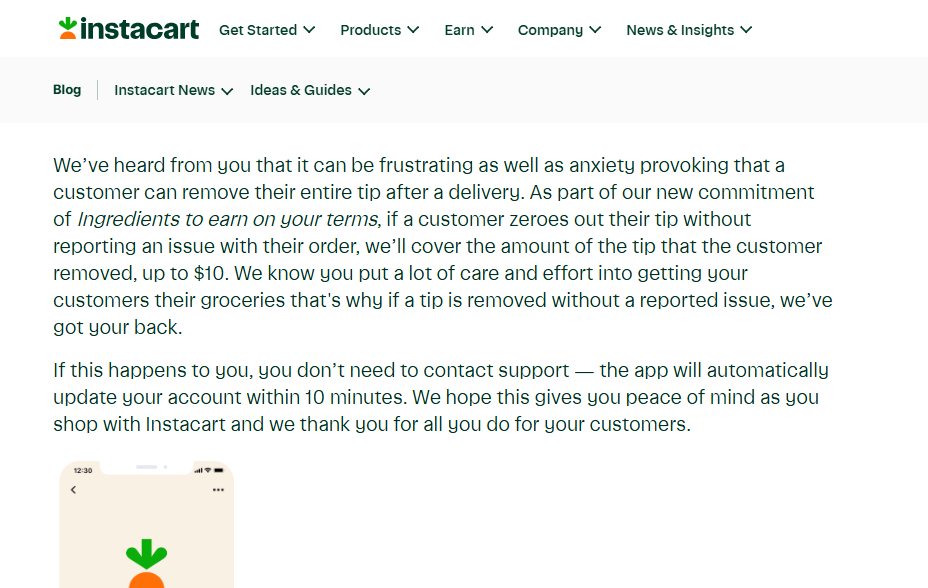
Two years later, in April 2022, Instacart added tip protection: if a customer zeroed out their tip after delivery without reporting an order issue, Instacart would cover the removed tip amount, up to $10. TechCrunch11 noted the obvious limitation: a flat $10 cap makes no sense as a protection mechanism for an order that arrived with a $50 or $100 tip. A percentage-based protection would have been more meaningful. Instacart did not offer one.
In late 2024, Instacart12 updated its tipping policy again. The new protections included the tip protection guarantee, covering zeroed-out tips up to $10, alongside features designed to prompt customers toward higher tipping at checkout and after delivery. Shopper earnings from tips on eligible orders rose 6% on average, and the number of customers electing not to tip declined by 12%, according to Instacart’s own figures. These are real improvements. They are also improvements that took Instacart the better part of five years to fully implement, and they still leave the fundamental architecture of post-delivery tip adjustment in place.
Supermarket News13 quoted John Adams, vice president of shopper and fulfillment product at Instacart:
“We strive to equip shoppers with information on the best way to earn, so they can earn what they need, when they need it.”
The framing is telling. The company positions tip protection as a tool to help shoppers understand earnings, rather than as a correction of an architectural flaw that it built into the platform and maintained for years.
The Longer History of Instacart and Tips
To fully understand the tip baiting era, you need to go further back.
According to TechCrunch14, in 2016, Instacart removed tipping entirely, replacing it with higher delivery commissions. Shoppers protested, loudly, and the feature was restored within a month. Then, in 2019, the company was hit with a class-action lawsuit after it emerged that Instacart had been using customer tips to subsidize base pay: when a shopper’s Instacart pay plus their tip fell below the guaranteed $10 minimum, Instacart was counting the tip as part of that minimum instead of paying on top of it. Customers were tipping under the impression they were giving shoppers a bonus. In reality, some of that money was going straight back into Instacart’s effective costs.
CEO Apoorva Mehta apologized publicly:
“While our intention was to increase the guaranteed payment for small orders, we understand that the inclusion of tips as a part of this guarantee was misguided.”
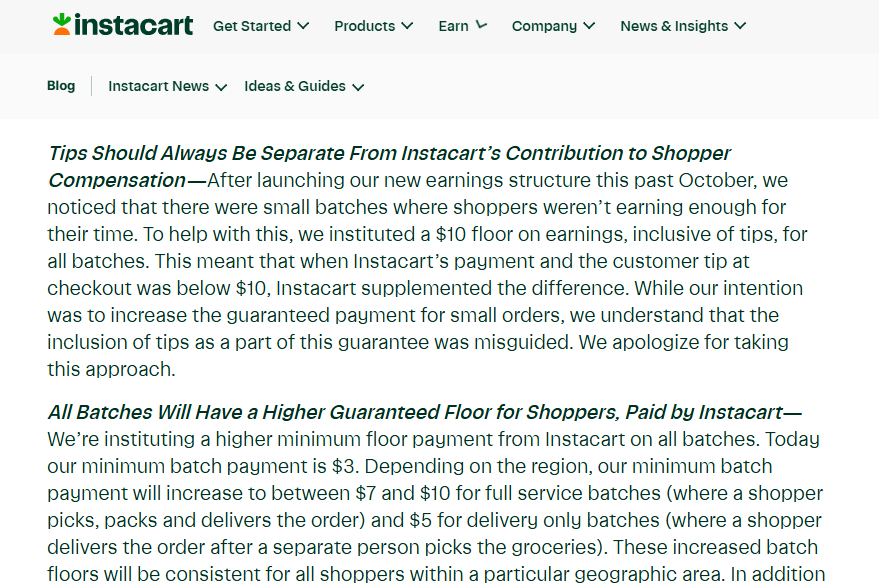
The company raised minimum batch floors and committed to keeping tips separate. It retroactively compensated shoppers. But as CBC News15 reported in 2021, shoppers were still seeing their earnings slide without explanation, unable to get satisfactory answers from support, and afraid to complain publicly for fear of deactivation. One shopper, identified only as “Mark,” described going from earning over $1,000 a week at $25 to $30 an hour to barely clearing $400 in some weeks, working the same hours, for the same platform, doing the same work.
CBC’s follow-up reporting uncovered a mileage pay discrepancy: at least one shopper had tracked his orders and found he was being shorted roughly 38% on mileage reimbursement consistently. When shoppers tried to ask support agents for detailed pay breakdowns, they found that support had been instructed around December 2021 to stop providing mileage breakdowns to shoppers at all.
Human Rights Watch’s16 2025 report on gig economy labor practices framed the broader problem clearly: six of the seven major delivery platforms it examined “use algorithms with opaque rules to assign jobs and determine wages, meaning that workers do not know how much they will be paid until after completing the job.” Instacart sits squarely in this category. The batch offer you see before you accept is an estimate. The final pay figure depends on variables you don’t control and formulas you can’t audit.
The Structural Problem That Remains
There is a real tension at the center of all this that Instacart has never directly resolved.
The batch algorithm is built to be a competitive selection mechanism. Better shoppers, as defined by rating, order volume, and tier status, get first access to better batches. This is presented as a reward for quality. But “better batches” means, in large part, “higher-tip batches.” Tip visibility before acceptance means that the algorithm and the tip structure are deeply intertwined: tips are not just gratuities, they are the primary price signal that determines which human being does which job.
When customers can retroactively adjust that price signal after the labor is complete, the entire system of batch selection is being gamed. The shopper selected the order at $X expected earnings. They would not have selected it at $Y. The customer knows this. That is precisely why some of them enter a high tip: not because they intend to pay it, but because they know it will cause a faster, better shopper to prioritize their order.
Academic research at Wiley Online Library17 on algorithmic management has documented that “asymmetries are inherent part of AM and are deliberately created by online platforms to exert direct and indirect algorithmic control over gig workers.” The information asymmetry in the Instacart system is acute: the company knows far more about a shopper’s behavior, ratings, and historical earnings than the shopper knows about how the batch algorithm weights their profile. The shopper operates largely on intuition, forum gossip, and trial and error.
Forums like r/InstacartShoppers on Reddit are dense with this kind of collective intelligence, people sharing which stores are ghost towns at which hours, which batch sizes are worth it, which time slots flood the market with other shoppers and drive down your chances of seeing anything good. Gridwise18 data published in 2025 found that the median Instacart shopper makes $12.21 per hou, not the “$15 to $25 per hour” figures that circulate in promotional material. At the median, a full-time Instacart shopper would gross roughly $25,400 per year before expenses. Car costs, gas, and self-employment taxes take a significant bite.
Instacart’s19 Cart Star priority removal in Seattle in early 2026 offers a different angle on how the tier system functions in the real world. The city’s Office of Labor Standards determined that Cart Star’s priority access feature violated Seattle’s App-Based Worker ordinance. Instacart said it strongly disagreed, noted that over 75% of Seattle shoppers viewed the benefit favorably in a 2025 survey, and complied. But the city’s reasoning, that a system where workers must compete for priority access to jobs creates a coercive structure, is not a fringe view. It is a coherent critique of what the algorithm actually does when you spell it out plainly.
What the Fix Would Actually Look Like
Instacart’s incremental approach to tip baiting, window reduction, feedback requirements, account deactivation, tip protection up to $10, new prompting features, has produced real improvements at the margin. The percentage of tips removed after delivery has declined. The average tip has grown. The company’s own data suggests the direction is positive.
But incremental fixes to a structural problem leave the structure intact.
The $10 tip protection cap is the clearest example. It addresses the most visible form of tip baiting, the customer who removes the entire tip, but offers no protection against the customer who drops a $60 tip to $4, or the customer who reduces a $40 tip to $12. These are not zero-out scenarios. They are reductions. Instacart does not cover them. And because the shopper accepted the batch based on $60 or $40, not $4 or $12, they were still bait-and-switched. Just not completely.
A more robust fix would look like tip locking after acceptance: once a shopper accepts a batch based on a posted tip, that tip is guaranteed. Customers could still increase tips after delivery but not reduce them. This would require Instacart to eat the cost of any post-delivery tip removals or to pass that cost on to customers directly, neither of which the company has been willing to do.
Another approach: decouple the tip entirely from the batch selection screen. Remove tip visibility before acceptance, and base shopper selection purely on pay, distance, and item count. This would eliminate tip baiting as a batch-gaming mechanism overnight, because there would be nothing to bait with. The downside is that it would likely reduce overall tip amounts, since one of the reasons customers post high tips in the first place is to attract better service — a dynamic that benefits both sides when the customer actually follows through. The Instacart default tip is 5%. Without competitive visibility, it might drift lower.
The cleanest solution is probably also the one Instacart is least likely to implement: raise base batch pay to the point where tips are genuinely supplementary rather than foundational to shopper economics. At that point, a removed tip stings but does not define the income calculation. Shoppers would have less reason to chase high-tip batches, and customers would have less power to manipulate the queue with false generosity.
What strikes me, reading through the shopper forums and the TikTok documentation and the CBC investigations and the HRW reports, is how much labor these workers put into understanding a system that was deliberately designed to resist understanding.
The batch algorithm is not publicly documented. The Cart Star requirements were updated in phases through 2025 and 2026, with different shoppers receiving the new rules at different times. The mileage reimbursement calculation was, at least for a period, something that support agents were instructed not to explain. The tip adjustment window, the tip protection cap, the deactivation triggers for repeat tip-baiters — all of this information is parceled out in company blog posts, official FAQs, and press releases, each responding to a crisis already in progress.
Shoppers have responded by building their own knowledge infrastructure. Third-party apps track earnings across platforms. Batch grabber bots, software that monitors the batch feed and accepts orders automatically, have proliferated, despite violating Instacart’s terms of service and risking deactivation. Reddit threads run thousands of comments deep on the question of which stores, which hours, which markets, are worth working. This is not the behavior of a workforce that feels well-informed.
The gig economy’s essential promise is flexibility in exchange for security. You choose your hours. You accept no batch you don’t want. You are never, officially, penalized for declining. What you get in return is a set of systems, algorithmic, financial, social. That you do not control and cannot fully see, operated by a company whose primary obligation runs to its shareholders, not to you.
Instacart went public in 2023. The IPO pushed the company into a new phase of accountability, one measured quarterly in gross transaction value and take rates. In that context, every dollar of batch pay increase comes at a direct cost to margin. Every tip dollar that stays in a shopper’s pocket rather than being recycled through a tip-subsidization scheme is a dollar that Instacart isn’t leveraging. The company’s repeated policy reversals on tips. Removing them, restoring them, counting them in minimums, being shamed out of counting them in minimums, introducing tip protection, expanding it. Trace the shape of a business that has never quite decided what shoppers are worth.
What’s clear is that the batch algorithm and the tip structure are not separate problems. They are the same problem viewed from two angles. The algorithm decides who sees what work. Tips decide how much that work pays. Until both systems are redesigned in ways that don’t pit shoppers against customers and don’t leave workers’ earnings contingent on good-faith behavior from strangers, the answer to “why am I not getting batches on Instacart?” and “why did my tip disappear?” will remain the same: because the machine was built that way.
Sources
- “Instacart Company” Access Batches, www.instacart.com/company/shoppers/access-batches. Accessed 9 June 2026. ↩︎
- H, Doug. “Cart Star on Instacart: How to get Diamond Cart and priority batch access” Ridesharing Driver, 3 Jan. 2023, www.ridesharingdriver.com/cart-star-priority-access/. Accessed 9 June 2026. ↩︎
- “How Much Do Instacart Shoppers Make? (2025 Data from 500k+ Drivers)” Gridwise, gridwise.io/blog/how-much-do-instacart-shoppers-make. Accessed 16 July 2026. ↩︎
- Purna, Anna. “Instacart Pay and Gig Worker Earnings: A Complete 2026 Guide” TechZeel, 25 Mar. 2026, techzeel.net/instacart-pay-gig-worker-earnings-2026/. Accessed 16 July 2026. ↩︎
- “State of Pay — Doing Right By Our Shoppers” Instacart, 18 Aug. 2021, www.instacart.com/company/shopper-community/state-of-pay%E2%80%8A-%E2%80%8Adoing-right-by-our-shoppers. Accessed 16 July 2026. ↩︎
- Chatman, Samantha. “Instacart drivers say some customers leave large tips, then change it to $0 after delivery” ABC7 New York, 18 May 2020, abc7ny.com/post/instacart-drivers-say-some-customers-leave-tip-then-change-it-to-$0/6185367/. Accessed 16 July 2026. ↩︎
- Fowler, Kate. “Delivery Drivers Call Out Customers ‘Tip Baiting’: ‘So Evil’” Newsweek, 13 May 2022, www.newsweek.com/tiktok-delivery-driver-instacart-call-out-tip-baiting-trick-1706378. Accessed 16 July 2026. ↩︎
- Mascarenhas, Natasha. “Instacart makes changes to tip policy following shopper complaints” TechCrunch, 5 June 2020, techcrunch.com/2020/06/05/instacart-makes-changes-to-tip-policy-following-shopper-complaints/. Accessed 16 July 2026. ↩︎
- FTC, www.ftc.gov/system/files/documents/public_events/1591478/www.ftc.gov/system/files/documents/public_events/1591478/open_commission_meeting_comments_july_1_2021redacted.pdf. Accessed 16 July 2026. ↩︎
- Manfredi, Lucas. “Instacart tightens rules to crack down on ‘tip baiting’” Fox Business, 7 June 2020, www.foxbusiness.com/lifestyle/instacart-tip-baiting-policy-change. Accessed 16 July 2026. ↩︎
- Mascarenhas, Natasha. “Instacart is coming after users who tricked shoppers out of tips” TechCrunch, 5 Apr. 2022, techcrunch.com/2022/04/05/instacart-tip-protection/. Accessed 16 July 2026. ↩︎
- “Tip Protection for Zeroed Out Tips” Instacart, 25 Apr. 2022, company.instacart.com/shopper-community/tip-protection-for-zeroed-out-tips. Accessed 17 July 2026. ↩︎
- Redman, Russell. “Instacart takes aim at ‘tip baiting’” 5 Apr. 2022, www.supermarketnews.com/grocery-trends-data/instacart-takes-aim-at-tip-baiting-. Accessed 16 July 2026. ↩︎
- Dickey, Megan Rose. “Instacart now suggests 5% tip default” TechCrunch, 24 Apr. 2018, techcrunch.com/2018/04/24/instacart-now-suggests-5-tip-default. Accessed 17 July 2026. ↩︎
- CBC News, www.cbc.ca/1.6208197. Accessed 17 July 2026. ↩︎
- “The Gig Trap” Human Rights Watch, 12 May 2025, www.hrw.org/report/2025/05/12/the-gig-trap/algorithmic-wage-and-labor-exploitation-in-platform-work-in-the-us. Accessed 17 July 2026. ↩︎
- Wiley Online Library, onlinelibrary.wiley.com/doi/full/10.1002/job.2831. Accessed 17 July 2026. ↩︎
- “How Much Do Instacart Shoppers Make? (2025 Data from 500k+ Drivers)” Gridwise, gridwise.io/blog/how-much-do-instacart-shoppers-make. Accessed 17 July 2026. ↩︎
- “Seattle’s Office of Labor Standards Forces Instacart to Remove Priority Access in the City” Instacart, 3 Feb. 2026, company.instacart.com/shopper-community/seattle-ols-forces-instacart-to-remove-priority-access. Accessed 17 July 2026. ↩︎