

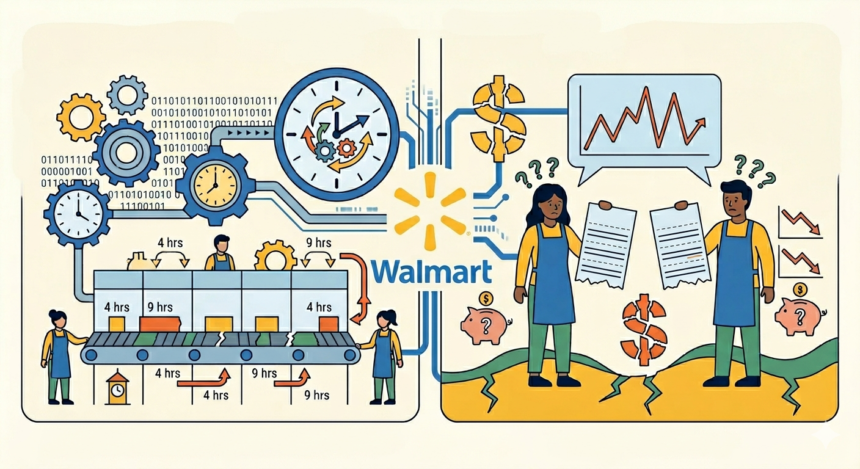

The week before Christmas, a Walmart associate in a Georgia Supercenter opened her Me@Walmart app to find 22 hours on her schedule. The previous week she had worked 36. The week before that, 28. It had been like this for months — a shifting number that arrived a few days ahead and governed almost everything: whether she could fill her gas tank, whether she’d call her landlord before the due date or after it, whether she’d be eating peanut butter sandwiches or something that cost a little more. She’d been with the company three years. She earned around $16.40 an hour, and according to Axios1, Walmart’s stated average for U.S. store associates. But averages don’t pay rent. Volatility does the damage.
This is how it works for roughly 1.6 million Walmart employees in the United States. The company is the nation’s largest private employer, and the system that governs when and how much they work is not a human one. It is an algorithm, fed by foot traffic data, sales trends, regional variables, and seasonal forecasts, producing a weekly schedule that can swell or contract with the rhythm of the business, indifferent to the human consequences at the other end of the screen.
I’ve spent weeks going through research, worker forums, court documents, academic studies, and legislative records trying to understand one central question: is Walmart’s scheduling algorithm a neutral tool for operational efficiency, or is it a cost-reduction machine that transfers financial risk from the corporation onto its lowest-paid workers? The answer, based on everything I found, is mostly the latter.
The Machine’s Architecture
The story of Walmart’s algorithmic scheduling goes back further than most people realize. According to NBC News2, as early as 2006, the company was piloting a computerized scheduling system designed to match staffing levels to shopper foot traffic in real time. A briefing document from that year, obtained by the union-backed advocacy group WakeUpWalMart, instructed managers to inform staff that workers unwilling to be available during peak evening and weekend hours could wind up with fewer hours or lose their full-time status. The company at the time called the document outdated and denied that hours were being cut. Workers said otherwise.
The technology evolved. According to Fortune3, by 2016, Walmart introduced what it called Customer First Scheduling, a system designed to prioritize staffing during peak shopping times by integrating sales data and foot traffic signals from every department in every store. The company said workers had the option to choose preferred hours. Labor advocates were skeptical. The United Food and Commercial Workers union said it was not clear whether the changes would make any material difference for workers. OUR Walmart, the labor group focused on Walmart employees, said it welcomed some improvements but warned the system still failed to address the core problem of inadequate hours.
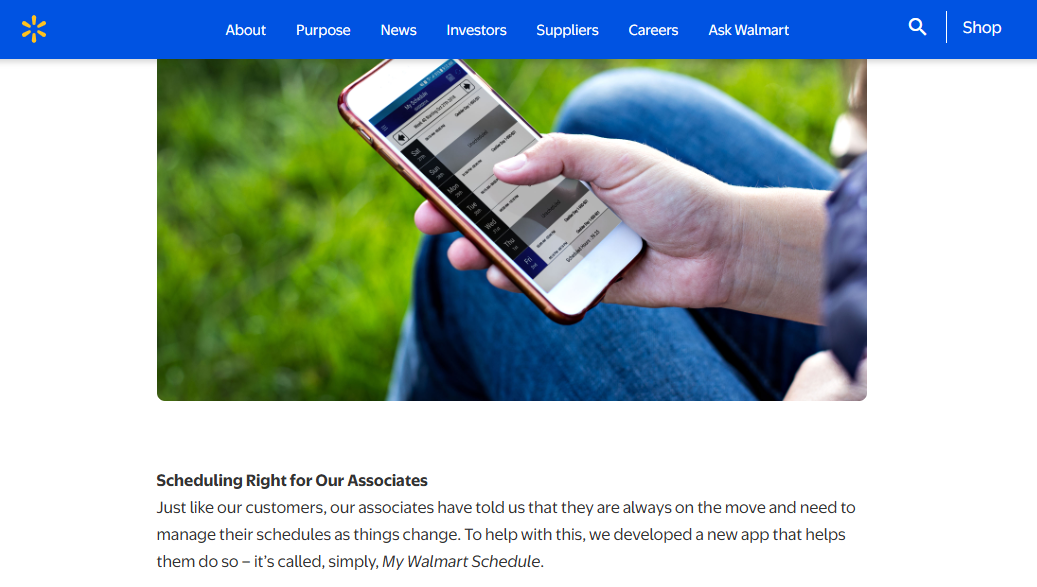
In 2018, the company rolled out the current iteration: a smartphone app called My Walmart Schedule4, later consolidated into the broader Me@Walmart platform. The app gives workers visibility into their schedules, allows shift swaps without manager intervention, and, in theory, allows employees to pick up extra shifts. Rory Graham, Walmart’s then-senior director of workforce management, described the goal as ensuring associates are “in the right place at the right time.” Management loved it, store managers reportedly saved up to eight hours a week on administrative scheduling tasks. What those hours looked like for associates on the receiving end was another matter.
At the core of the system is a concept called “core hours,” which Walmart describes as a feature that gives certain workers the same shifts for at least 13 weeks, providing some measure of predictability. On paper it sounds reasonable. In practice, workers have reported something different. On TheLayoff.com, a forum where current and former employees discuss their work conditions, one post from an associate reads: “My wife was supposed to have core hours of 30 hours a week. Been okay through December, but the first week of January she is down to 22 hours. What about the guarantee of at least 30 hours?” Another commenter on the same thread summed up the dynamic plainly: “It’s not that they are cutting hours. You just have to be available for ‘the needs of customers and business.’ I had to open my availability.”
That phrase, “open your availability,” comes up again and again in worker accounts. It is the algorithmic pressure point. Workers who restrict their availability to certain days or hours may find themselves receiving fewer shifts. Those who declare themselves available across the board become more schedulable, which the system rewards with more hours, but also more unpredictability. The choice is not really a choice. It is a coercive trade-off engineered into the system’s logic.
What the Research Shows
The most rigorous independent examination of Walmart’s scheduling practices comes from the Shift Project5, a research initiative housed at Harvard Kennedy School run by sociologists Daniel Schneider and Kristen Harknett. Beginning in 2017, the project began surveying tens of thousands of workers at America’s largest retail and food-service employers, including Walmart, to measure schedule volatility and its effects.
Their findings are stark. In a 2018 survey of roughly 2,000 hourly Walmart workers, Schneider and Harknett6 found that despite Walmart’s 2016 pledge to offer employees the option of consistent hours on consistent days, “there has been no change at all in Walmart workers’ schedules.” Hours fluctuation, the gap between the week with the most hours worked and the week with the fewest, ranged between 23 and 26 percent, essentially unchanged from before the company’s announced reforms. The data showed the promises hadn’t moved the needle.
Income volatility is the downstream consequence. The Shift Project found that among workers with the most schedule instability, two-thirds report their household income varies from week to week. Among workers with the most stable schedules, that number drops to one-third. For an hourly worker earning $16.40, a swing of ten hours in a given week means a difference of $164 in take-home pay before taxes. Over a month, that variability makes budgeting functionally impossible. You cannot negotiate a payment plan with your electricity company based on what the algorithm might decide to give you next Tuesday.
The Shift Project’s7 broader findings go further. They document that six in ten hourly workers at large retail and food-service firms experienced at least one material hardship over the prior year. A third reported hunger hardship; at least one instance where they went without enough to eat or relied on free food because they couldn’t afford to buy enough. Workers at the 75th percentile for scheduling instability, meaning a weekly hours swing of about 50 percent, faced a 13 percent higher risk of hunger hardship and an 11 percent higher risk of residential instability compared to workers with steady hours.
The Shift Project concluded:
“Unstable and unpredictable schedules are a much more significant determinant [of poor health outcomes] than low wages.”
This finding deserves to sit with you for a moment. It isn’t just that Walmart pays people less than they need. It’s that the scheduling system makes whatever they earn unreliable, compounding the damage in ways that basic hourly wage figures obscure.
The Economic Policy Institute has documented the same mechanism at a broader level. According to EPI research8, 42 percent of workers who report significant income variability attribute it directly to an irregular work schedule. More than all other work-related reasons combined.
The Algorithm’s Incentive Structure
To understand why the system functions this way, you have to understand what it is actually optimizing for. The scheduling algorithm is not trying to maximize worker income stability. It is trying to minimize labor costs relative to projected revenue.
Quora9 responses from retail industry insiders and former workforce management professionals describe the chain of incentives clearly: corporate HR and analytics teams set labor budget targets and tune the forecasting algorithms. Regional and district leadership translates those targets into store-level directives. Store managers then operate within those labor cost constraints, using the algorithmic output to build actual schedules.
One commenter explained:
“Store-level incentives — labor percentage targets, sales per labor hour, shrink control — push managers to tighten schedules when metrics demand it, even if that produces inconvenient patterns for staff.”
The system Walmart has been moving toward uses AI and machine learning to forecast demand at 15-minute intervals, integrating sales data, foot traffic patterns, weather forecasts, and promotional calendars to predict exactly how many workers it needs in each department during each slice of the day. PredictHQ10, a demand forecasting company, describes the approach as using “reinforcement loops” that compare actual performance against forecasted demand, feeding prediction errors back into the model to improve accuracy over time.
“Dynamic schedule re-optimization handles unexpected situations like employee call-outs or sudden demand spikes. The system automatically identifies coverage gaps and suggests optimal solutions from available staff.”
What this means in plain language: the system can trigger last-minute shift extensions or emergency call-ins when demand spikes. Workers who don’t answer may receive fewer hours the following week. The algorithm doesn’t punish anyone overtly. It just routes more shifts toward the more available, more compliant workers.
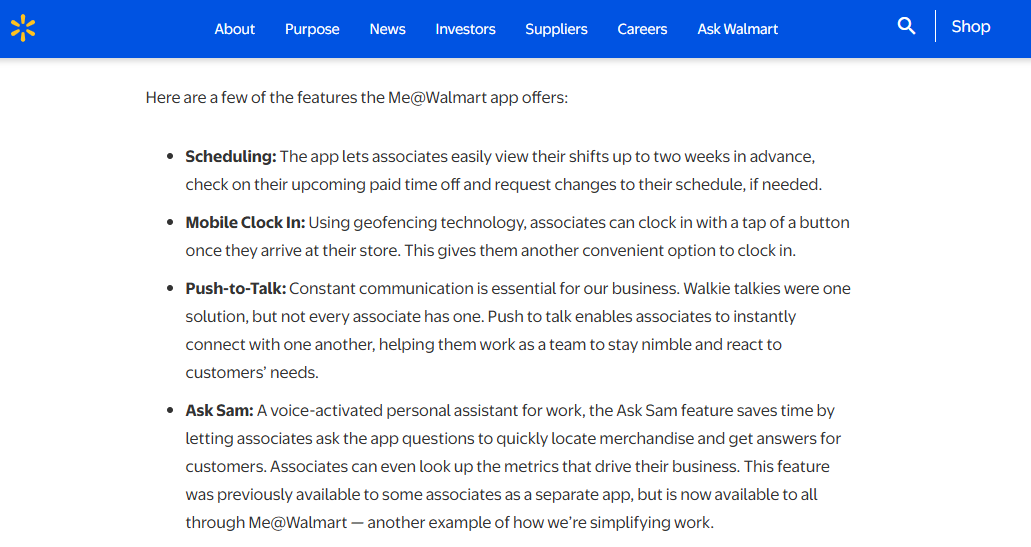
Walmart replaced its older Red Prairie system with newer cloud-based HR infrastructure through Workday Human Capital Management. The Me@Walmart app, built on top of this, generates schedules that store managers receive and can adjust, but within the constraints the system sets. According to a Tipsoi11, managers have reported saving an average of four hours a week on administrative changes, time freed up, as the company tells it, to spend on the sales floor. What no one at corporate publicly discusses is the time workers spend staring at their phones waiting for a schedule that determines their entire week.
The Broader Industry Pattern
Walmart is not an outlier. It is a pace-setter. When the company moves, other retailers watch.
The 2025 Labor Planning and Optimization Report from Logile12 surveyed 500 U.S. store associates and found that 77 percent say their store regularly loses sales due to poor scheduling or staffing decisions. Eighty percent say unpredictable schedules add stress to their jobs, with 82 percent feeling regularly overwhelmed at work. Thirty-one percent are actively considering quitting because of poor scheduling or lack of hours, with another 22 percent saying they’re close to that point.
Those numbers suggest that the problem isn’t isolated to one company or one system. Algorithmic scheduling has spread across the retail sector because it works for the bottom line. In 2025, labor unions organized coordinated protests against Walmart’s workforce management system specifically, with workers and advocacy groups arguing that the AI-driven approach lacks transparency and disproportionately harms lower-income workers who depend on stable hours. Reports from those actions indicated hours had been cut by up to 20 percent for affected workers. Walmart had not issued a formal response to those claims at the time of publication.
The pattern is not new. A broader study of how algorithmic scheduling tools reduce wages was described by Harvard’s Daniel Schneider as capturing something unusually powerful when a natural experiment presented itself. According to WAMC13, Schneider said, commenting on documented cases where workers saw their incomes fall sharply after employers adopted new scheduling software:
“The fact that you have this before and after is super powerful.”
In those cases, at firms using platforms like NICE, which advertises itself as providing “smarter scheduling, accurate forecasting, and real-time intraday optimization,” workers saw income drops ranging from 18 to over 70 percent after the software was introduced.
This is what the technology actually does when deployed without guardrails. It optimizes. And what it optimizes out of the equation is the worker’s ability to plan a life.
Who Gets Hurt Most
Schedule instability is not distributed evenly. The Shift Project’s14 research on racial inequality and scheduling found that Black and Latino workers are disproportionately concentrated in jobs with higher levels of schedule volatility, compounding existing wage gaps with an additional layer of income unpredictability. Women, who are more likely than men to carry primary caregiving responsibilities, face particular damage. A study co-authored by Schneider found that parental exposure to schedule instability was associated with measurable increases in children’s stress-related behaviors.
For parents working at Walmart, the scheduling uncertainty has downstream consequences that go well beyond individual paychecks. Child care arrangements depend on knowing when you work. When the schedule shifts with four days’ notice, your child care arrangement may not. The Center for Law and Social Policy15 has documented how volatile schedules also interfere with public benefits eligibility, workers whose income fluctuates week to week may find themselves on the wrong side of SNAP income thresholds in a high-income week, then struggling without benefit support in a low one. The system produces cliff effects that punish the volatility it created.
It is worth noting that Walmart workers collectively spent an estimated $173 million on tax preparation in 2021, according to Shift Project reporting16. Tax complexity is partly a consequence of variable income; irregular earnings make withholding estimates unreliable, driving more workers toward paid tax preparation services. The algorithm extracts a tax.
The Legislative and the Stable Scheduling Evidence
Lawmakers have been trying to address this for a decade. Senator Elizabeth Warren17 and Congresswoman Rosa DeLauro have reintroduced the Schedules That Work Act multiple times, most recently in December 2025. The legislation would require many employers to provide schedules two weeks in advance and compensate workers when their schedules change at the last minute.
“Unpredictable scheduling makes it impossible for workers to arrange child care, juggle an education, or even pay the bills,” Warren said at the reintroduction.
The bill has not passed.
In the absence of federal action, cities have been moving on their own. Fair workweek laws now exist in Berkeley, Chicago, Emeryville, Los Angeles, New York City, Philadelphia, San Francisco, and Seattle. Oregon remains the only state with a statewide predictive scheduling law. Most of these ordinances require employers to provide schedules at least 14 days in advance and to pay workers “predictability pay,” typically one hour’s wages, when schedules change within the notice window. Los Angeles County’s Fair Workweek Ordinance, which took effect on July 1, 2025, extended these protections to retail employers with 300 or more employees worldwide, a threshold Walmart clears by a factor of thousands.
The patchwork is exactly that: a patchwork. A Walmart worker in Chicago has legal protection that a Walmart worker in Arkansas, Georgia, Iowa, or Tennessee does not. Those four states have passed laws actively prohibiting their local governments from enacting predictive scheduling ordinances at all. The geography of worker protection in America maps almost precisely onto the geography of labor vulnerability. The places where Walmart has the most political influence are often the places where workers have the fewest legal options.
There is a version of this story where Walmart doesn’t have to choose between efficiency and stability. The evidence suggests stable scheduling can actually improve the company’s bottom line.
A landmark study at Gap, Inc., the Stable Scheduling Study conducted by researchers from UC Hastings, the University of Chicago18, and the University of North Carolina, found that giving employees more stable, predictable schedules increased sales and labor productivity while offering a measurable return on investment. The study’s conclusion challenged the foundational assumption behind algorithmic just-in-time scheduling: that schedule flexibility for the employer is a necessary trade-off for operational efficiency. It is not. It is a choice.
IKEA, which has run its own self-scheduling intervention in partnership with the Shift Project19, found that more worker-controlled scheduling reduced turnover significantly. The widely cited headline from 2024 put it directly:
“IKEA Lost $5,000 When Each Worker Quit. So It Began Paying More.”
The same arithmetic applies to scheduling. High turnover generated by schedule instability is expensive. Walmart’s own hiring and training costs make this true at scale.
The argument that algorithmic scheduling saves money only holds if you don’t count the cost of constantly replacing the workers it burns through.
What Workers Are Doing About It
They are talking to each other. The forums tell the story. On TheLayoff.com20, threads about Walmart scheduling have run for years, workers across hundreds of stores comparing notes; when their hours got cut, whether opening availability helped, what happened when they complained to management.
One post reads:
“I’ve been working at Walmart for 3 years and 2 months and I can’t get any hours. What the heck is 8 hours a week to give someone… I gotta find me another job.”
Another:
“I just turned 50 and I’m searching for another job. They treat all associates as second class citizens.”
These aren’t isolated complaints. They are a distributed data set. Thousands of workers across thousands of stores, all reporting variations of the same structural problem. The algorithm doesn’t know any of them. It knows their availability windows and their labor cost per hour and what the foot traffic looked like on a Tuesday in February.
The labor organizing efforts that have grown across the retail sector in recent years are, in part, a response to this dynamic. Workers who cannot count on a stable income have a harder time planning collective action. That is partly the point. Volatile scheduling is a union-avoidance mechanism by another name. When you don’t know if you’ll be working 22 hours or 38 hours next week, organizing a meeting with your coworkers falls somewhere below keeping the lights on.
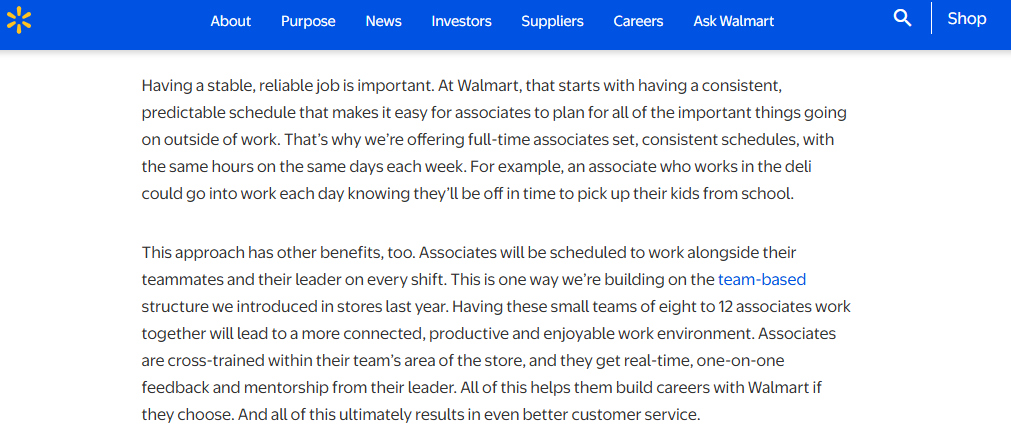
Walmart has made real commitments over the years to address scheduling instability, and has often failed to follow through. The 2016 pledge to offer all employees the option of consistent hours went unverified because Walmart does not publish the data that would allow independent researchers or regulators to check. The Shift Project’s survey of 2,000 workers was specifically designed to fill that void, and what it found was that the pledge had produced no measurable change.
This is the accountability gap at the center of the story. A corporation with 1.6 million American workers can announce scheduling reforms, get credit for them in the press, and then be held to them only by the voluntary participation of researchers who have to survey workers on Facebook because no other mechanism exists. The algorithm runs in a proprietary black box. Workers see the output. Nobody outside the company sees the logic.
The language of algorithmic management makes this opacity feel technical and inevitable. Terms like “real-time demand forecasting,” “dynamic re-optimization,” and “intraday labor efficiency” make the scheduling machine sound like a force of nature rather than a deliberate design. But every parameter in that system was set by a human being with a budget target. Every threshold that decides whether a worker gets 22 hours or 38 hours was a choice made by someone in Bentonville. The algorithm doesn’t make those choices inevitable. It makes them invisible.
The week before Christmas, back in Georgia, the associate with the 22-hour week would have had $360.80 coming to her before taxes. The previous week, at 36 hours, it was $590.40. The week before that, 28 hours, $459.20. That is a range of nearly $230 in a single paycheck cycle, with essentially no notice and no recourse. She has worked there three years. She knows the stockroom. She knows the customers. The algorithm doesn’t know any of that. It knows she was available, and it knows what things cost.
That’s the whole story, really. The machine knows what you cost. It doesn’t know what you need.
Sources
- Axios, 7 Mar. 2023, www.axios.com/2023/01/24/walmart-raises-hourly-wages. Accessed 7 Oct. 2026. ↩︎
- News, NBC. “Wal-Mart denies new scheduling cuts hours” 30 Jan. 2007, www.nbcnews.com/news/amp/wbna16894240. Accessed 16 Sept. 2026. ↩︎
- Fortune. “Walmart Is Giving Its Workers More Power Over Their Schedules” Fortune, 5 Aug. 2016, fortune.com/2016/08/05/walmart-workers-schedules. Accessed 7 Oct. 2026. ↩︎
- “New Scheduling System Gives Associates More Consistency and Flexibility” 30 Mar. 2018, corporate.walmart.com/news/2018/11/13/new-scheduling-system-gives-associates-more-consistency-and-flexibility. Accessed 7 Oct. 2026. ↩︎
- Harknett, Kristen. “Secure Scheduling” The Shift Project, 28 July 2026, shift.hks.harvard.edu/secure-scheduling/. Accessed 7 Oct. 2026. ↩︎
- Scholars.org, scholars.org/contribution/how-unpredictable-work-scheduling-hurts-retail. Accessed 7 Oct. 2026. ↩︎
- Schneider, Daniel. “It’s About Time: How Work Schedule Instability Matters for Workers, Families, and Racial Inequality” The Shift Project, 16 Oct. 2019, shift.hks.harvard.edu/its-about-time-how-work-schedule-instability-matters-for-workers-families-and-racial-inequality/. Accessed 7 Oct. 2026. ↩︎
- “Irregular Work Scheduling and Its Consequences”, www.epi.org/publication/irregular-work-scheduling-and-its-consequences/. Accessed 7 Oct. 2026. ↩︎
- Quora, www.quora.com/Why-does-Walmart-give-their-employees-bizarre-inconsistent-work-schedules-Who-is-responsible-for-scheduling. Accessed 7 Oct. 2026. ↩︎
- Nguyen, Kris. “How AI Workforce Scheduling Transforms Retail Labor Management” PredictHQ, 4 Sept. 2025, www.predicthq.com/blog/how-ai-workforce-scheduling-transforms-retail-labor-management. Accessed 7 Oct. 2026. ↩︎
- Momtaz, Sadia. “Workday Walmart: The $35M HR Transformation Explained” Tipsoi, 5 Feb. 2025, tipsoi.pro/what-every-business-can-learn-from-walmarts-hr-cloud-transformation-journey/. Accessed 7 Oct. 2026. ↩︎
- “77% of Retail Workers Say Labor Planning Gaps Are Hurting Store Performance, Logile Survey Finds” Logile, 20 May 2025, www.logile.com/resources/news/77-of-retail-workers-say-labor-planning-gaps-are-hurting-store-performance-logile-survey-finds. Accessed 7 Oct. 2026. ↩︎
- “How algorithms wreaked havoc with these workers’ schedules and cut their pay” WAMC, 3 May 2026, www.wamc.org/2026-05-03/how-algorithms-wreaked-havoc-with-these-workers-schedules-and-cut-their-pay. Accessed 7 Oct. 2026. ↩︎
- Schneider, Daniel. “It’s About Time: How Work Schedule Instability Matters for Workers, Families, and Racial Inequality” The Shift Project, 16 Oct. 2019, shift.hks.harvard.edu/its-about-time-how-work-schedule-instability-matters-for-workers-families-and-racial-inequality/. Accessed 7 Oct. 2026. ↩︎
- “Volatile Job Schedules and Access to Public Benefits” CLASP, 24 Sept. 2026, www.clasp.org/publications/report/brief/volatile-job-schedules-and-access-public-benefits/. Accessed 7 Oct. 2026. ↩︎
- 10 Jan. 2023, shift.hks.harvard.edu/wp-content/uploads/2025/05/shift.hks.harvard.edu/wp-content/uploads/2025/05/Shift-Newsletter-3-FINAL-May22.pdf. Accessed 7 Oct. 2026. ↩︎
- “Warren, DeLauro Renew Bill to Ban Unpredictable Scheduling Practices” www.warren.senate.gov/newsroom/press-releases/warren-delauro-renew-bill-to-ban-unpredictable-scheduling-practices. Accessed 7 Oct. 2026. ↩︎
- 27 Mar. 2018, crownschool.uchicago.edu/sites/default/files/2022-12/crownschool.uchicago.edu/sites/default/files/2022-12/2018_Stable_Schedules_Study_Report.pdf. Accessed 7 Oct. 2026. ↩︎
- Harknett, Kristen. “Secure Scheduling” The Shift Project, 28 July 2026, shift.hks.harvard.edu/secure-scheduling/. Accessed 7 Oct. 2026. ↩︎
- TheLayoff.com, www.thelayoff.com/t/1k99z8wfa. Accessed 7 Oct. 2026. ↩︎


